Tag: Increasingly

  • Young men are increasingly lonely and isolated. Could reading more to boys be the answer?

    Young men are increasingly lonely and isolated. Could reading more to boys be the answer?

    by JT Torres, The Hechinger Report
    October 28, 2025

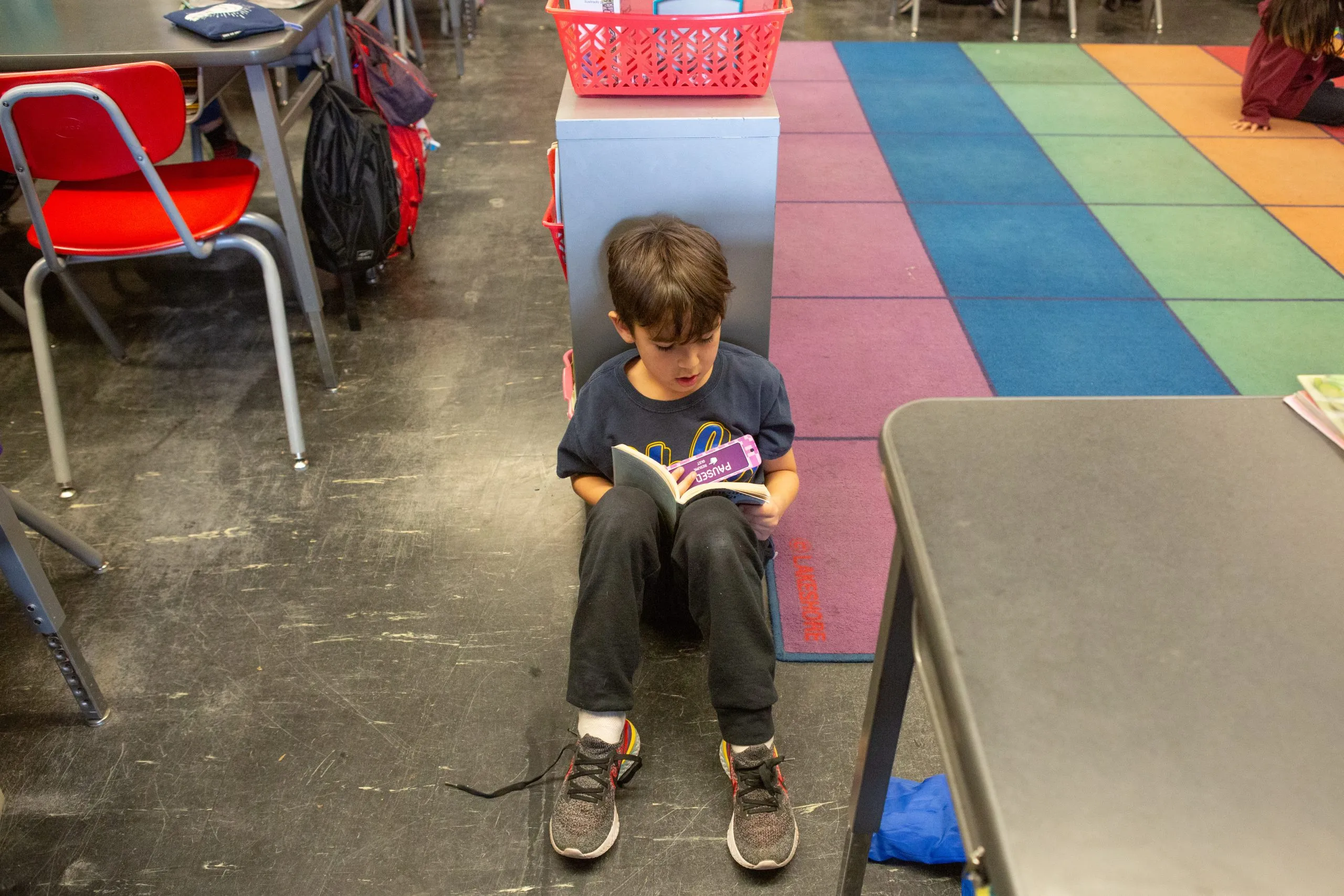
    Young men in America today are feeling lonely and socially isolated. They are not going to college, entering the workplace or going on dates as often as young men did in prior generations.

    In my years teaching literacy, I’ve watched the lines on two graphs move in opposite directions: male loneliness climbs as male reading and writing scores drop. Are these trends correlated, and if so, can reading help address loneliness?

    Diminished friendships, reduced economic opportunities and the substitution of online interactions for face-to-face connections seem to particularly impact young men.

    Some 25 percent of U.S. men aged 15-34 felt lonely “a lot of the previous day,” compared to 18 percent of women in the same age group, a recent Gallup survey found. The same survey found that U.S. men are lonelier than their international counterparts.

    Overlaying this epidemic of loneliness is a literacy crisis that continues to deepen, evidenced by sharp declines in the 2024 NAEP results. Only 35 percent of high school seniors now read at or above proficiency, with reading scores 10 points lower than they were in 1992. The numbers reflect not just skill deficits but broader cultural shifts.

    Related: A lot goes on in classrooms from kindergarten to high school. Keep up with our free weekly newsletter on K-12 education.

    In the UK, a country with similar male loneliness rates, just 41 percent of parents with children under five read frequently to them, down from 64 percent in 2012, a 2024 Harper Collins UK survey found. The survey revealed even sharper reading drops for boys: Less than one-third from birth through the age of 2 were read to daily, compared to 44 percent of girls. Meanwhile, the number of American adolescent boys who read for fun has dropped to a historic low.

    Literacy instruction has not kept up with changes in the literacy landscape, and is failing to help students connect, think carefully and resist manipulation. Traditional reading and argument, for instance, have been dramatically replaced by memes and misinformation that spreads faster than anyone can correct it. Public discourse has become inflammatory rather than inquisitive, with half-quotes from podcasters and political pundits lobbed like verbal grenades.

    These two trends have serious social costs, and may reinforce each other. Data show, for example, that as young men fall behind in education, they become increasingly attracted to conspiratorial thinking and political radicalization.

    Combining a lack of critical reading skills and habits with an unsatisfied need to bond, to connect and to belong results in an emotional feedback loop, driving young men into spaces designed to persuade or recruit rather than inform.

    Related: Behind the latest dismal NAEP scores

    Thus, while it is tempting to treat literacy and male loneliness as separate issues, research demonstrating the social benefits of reading to children offers interesting connective tissue. Neuroscience research confirms, for example, that reading aloud activates brain regions associated with both language processing and social bonding. Respondents to an international survey described reading as a method for maintaining social connection.

    Young boys need these benefits at this very moment.

    That is why I strongly believe that one simple way we can and should address these trends is to inspire interest in reading among boys.

    Parents, teachers, guardians, siblings and anyone who takes care of children should read to and with them. Longstanding cultural norms reward girls for reading but not boys. Literacy needs to be framed not as a gendered expectation or duty but as a relational ritual.

    Schools need to do more than prepare students for literacy tests; they should create formal spaces to enjoy reading, including book clubs, intergenerational reading groups and classes which show that reading is not a solitary grind but a communal act. The solution I propose is fairly cheap, carries no risk and is backed by evidence: Treat reading as the most important social experience children can have.

    JT Torres is director of the Harte Center for Teaching and Learning at Washington and Lee University.

    Contact the opinion editor at [email protected].

    This story about male reading and loneliness was produced by The Hechinger Report, a nonprofit, independent news organization focused on inequality and innovation in education. Sign up for Hechinger’s weekly newsletter.

    This <a target=”_blank” href=”https://hechingerreport.org/opinion-young-men-are-increasingly-lonely-isolated-and-reading-less/”>article</a> first appeared on <a target=”_blank” href=”https://hechingerreport.org”>The Hechinger Report</a> and is republished here under a <a target=”_blank” href=”https://creativecommons.org/licenses/by-nc-nd/4.0/”>Creative Commons Attribution-NonCommercial-NoDerivatives 4.0 International License</a>.<img src=”https://i0.wp.com/hechingerreport.org/wp-content/uploads/2018/06/cropped-favicon.jpg?fit=150%2C150&amp;ssl=1″ style=”width:1em;height:1em;margin-left:10px;”>

    <img id=”republication-tracker-tool-source” src=”https://hechingerreport.org/?republication-pixel=true&post=113065&amp;ga4=G-03KPHXDF3H” style=”width:1px;height:1px;”><script> PARSELY = { autotrack: false, onload: function() { PARSELY.beacon.trackPageView({ url: “https://hechingerreport.org/opinion-young-men-are-increasingly-lonely-isolated-and-reading-less/”, urlref: window.location.href }); } } </script> <script id=”parsely-cfg” src=”//cdn.parsely.com/keys/hechingerreport.org/p.js”></script>
    Source link

  • Hawaiʻi Is Increasingly Relying On Unlicensed Teachers To Fill Vacancies – The 74

    Hawaiʻi Is Increasingly Relying On Unlicensed Teachers To Fill Vacancies – The 74


    Get stories like this delivered straight to your inbox. Sign up for The 74 Newsletter

    As students returned to class earlier this month, Hawaiʻi schools reported the lowest number of teacher vacancies the state has seen in more than five years. As of last week, only 73 teacher positions were unfilled, compared to more than 1,000 in the aftermath of the Covid-19 pandemic.

    But schools are employing a growing number of unlicensed teachers, also known as emergency hires, to fill those vacancies. Last August, Hawaiʻi schools started the year with 670 emergency hires, an 80% increase from four years ago. 

    Emergency hires can work in schools for up to three years but must make progress toward earning their licenses. 

    The recent increase in emergency hires partly stems from state efforts to put more teachers in classrooms, including increasing pay for unlicensed educators in 2023. But while research shows that emergency hires tend to have higher retention rates, they may also be less effective than licensed teachers, who typically have more training and classroom experience.

    While the Hawaiʻi teacher licensing board tracks emergency hires in schools, it doesn’t publish regular data on how many of these teachers go on to earn their teacher licenses and continue working in public schools here.    

    Even so, principals and researchers say hiring unlicensed teachers is better than leaving positions vacant, which can leave schools scrambling for substitutes. The state has also explored other options to recruit and retain educators, like raising teacher pay and bringing in workers from the Philippines, but some solutions may only be temporary. 

    “There’s a united front to attract qualified educators that are already certified,” said Chris Sanita, principal at Hāna High and Elementary. “I think it’s a larger state issue on housing and affordability.” 

    A Growing Population

    In 2018, Brandon Galarita began teaching at Ke’elikōlani Middle School as an emergency hire, hoping to build on his experience as a substitute teacher and use his college degree in English. While the pay was low, Galarita said, working full-time as an emergency hire allowed him to earn a living while also completing the requirements for a teacher license. 

    “At least it starts building a teacher if they want to go into education,” said Galarita, who earned his license from the University of Hawaiʻi Mānoa in 2020. “I would hope that the influx of emergency hires will result in more teachers that are staying in the profession.” 

    University of Hawaiʻi Mānoa’s College of Education offers a program that helps cover the costs of tuition and fees for residents pursuing their teacher’s license. (Kevin Fujii/Civil Beat/2024)

    Osa Tui Jr., president of the state teachers’ union, said he attributes the big jump in emergency hires to the pay raise they received two years ago. Currently, emergency hires earn about $50,300 a year, compared to $38,500 previously. 

    “These numbers reflect exactly what we were hoping to accomplish,” Tui said. 

    The state has encouraged prospective educators, including emergency hires, to earn their licenses through the Grow Our Own initiative at UH Mānoa, which helps cover the costs of tuition for teacher preparation programs. Teachers who complete the program and earn their licenses must work in public schools for at least three years. 

    Emergency hire numbers don’t always reflect teachers’ progress toward earning their licenses, said Waiʻanae Intermediate School Principal John Wataoka. While he has around 11 emergency hires on staff this year, only one of the teachers has yet to complete a teacher preparation program.

    The rest have finished their training but are waiting to take a licensing exam or haven’t received the results of their final tests yet, Wataoka said. 

    “Right now, it’s just a waiting game,” he said. 

    But a recent study of emergency hires entering Massachusetts schools during the pandemic suggests that unlicensed teachers may be less effective than other educators. Students taught by emergency hires tended to have lower math and science test scores compared to their peers, according to research from the National Center for Analysis of Longitudinal Data in Education Research. 

    Jonathon Medeiros, a teacher at Kauaʻi High School and vice president of the Hawaiʻi Education Association, said he understands parents’ possible concerns about emergency hires and the quality of education students are receiving. But it’s still preferable to have an emergency hire in a classroom than a substitute — or nobody at all.

    In the past, Medeiros said, students were occasionally sent to the library or cafeteria for study hall when there weren’t enough educators to teach every class and the state faced a shortage of substitute teachers. 

    Unlike emergency hires, DOE doesn’t require substitute teachers to have a college degree.   

    “We all want skilled, caring, talented teachers who are from the community and committed to their schools,” Medeiros said. “How do we make sure we get those people in every single classroom is the key question.”

    Expanding The Pool

    While the boost in emergency hire pay has attracted more teachers to public schools, the state is still searching for other solutions to increase the hiring pool. 

    At Waiʻanae Intermediate, Wataoka said he’s hired seven international teachers to fill staff positions over the past two years. The J-1 visa program, which DOE has participated in since 2019, allows teachers from other countries, primarily the Philippines, to teach in the state for up to five years. 

    This year, the department hired around 100 new teachers through the visa program, Superintendent Keith Hayashi said in a Board of Education meeting earlier this month. International teachers’ interest in working in Hawaiʻi is comparable to past years, he said, despite concerns that participation could drop after Immigration Customs and Enforcement agents raided the shared Maui home of teachers from the Philippines last spring. 

    On Maui, Sanita said he’s also seeing the impact of the bonuses introduced for teachers in hard-to-fill positions five years ago. While it’s difficult to attract people to Hāna — a town with limited housing and no stop signs – the $8,000 bonus for remote schools helps retain teachers who would otherwise struggle with the high cost of living, Sanita said.   

    “The differentials have really helped people, our teachers in Hana, not to have five different side hustles,” Sanita said. “They can actually teach and make ends meet.” 

    The bonuses have also incentivized teachers to remain at Waiʻanae Intermediate even when they face long commutes from other parts of the island, Wataoka said. While the Leeward Coast has the greatest concentration of new teachers in the state, the $8,000 bonus has helped experienced teachers cover the cost of gas to West Oʻahu and remain at Waiʻanae Intermediate.

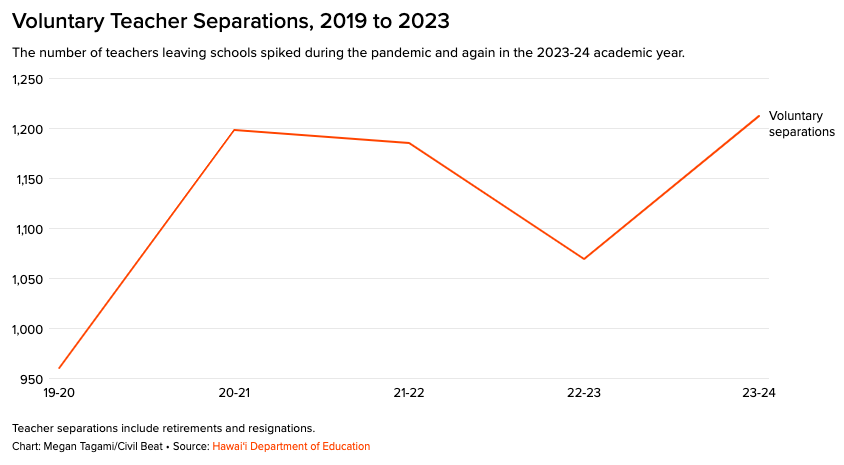
    But despite more retention measures in place, the department saw a jump in the number of teachers leaving schools last year. Over 1,200 teachers voluntarily resigned or retired from DOE in the 2023-24 school year, compared to roughly 1,000 the year before.

    Tui said there’s no single answer as to why the number of teachers leaving schools jumped. In some cases, teachers may have felt more comfortable changing jobs after the pandemic as they faced less uncertainty in the job market, he said. 

    This year, educators continuing to work in public schools will receive a 3% pay raise, with some veteran teachers receiving a larger raise of around 7%. While the pay increase will encourage teachers to stay in schools longer, Tui said, it’s possible the state will see a wave of educators retiring after three years as they qualify for higher state pensions. 

    For teachers hired before 2012, the state uses their three highest years of pay to determine their pensions. 

    “We have to make sure that we can get people into the profession that we can recruit to handle a drop off like that,” Tui said. 

    Civil Beat’s education reporting is supported by a grant from Chamberlin Family Philanthropy.


    Get stories like these delivered straight to your inbox. Sign up for The 74 Newsletter

    Source link

  • Students Increasingly Rely on Chatbots, but at What Cost? – The 74

    Students Increasingly Rely on Chatbots, but at What Cost? – The 74


    Get stories like this delivered straight to your inbox. Sign up for The 74 Newsletter

    Students don’t have the same incentives to talk to their professors — or even their classmates — anymore. Chatbots like ChatGPT, Gemini and Claude have given them a new path to self-sufficiency. Instead of asking a professor for help on a paper topic, students can go to a chatbot. Instead of forming a study group, students can ask AI for help. These chatbots give them quick responses, on their own timeline.

    For students juggling school, work and family responsibilities, that ease can seem like a lifesaver. And maybe turning to a chatbot for homework help here and there isn’t such a big deal in isolation. But every time a student decides to ask a question of a chatbot instead of a professor or peer or tutor, that’s one fewer opportunity to build or strengthen a relationship, and the human connections students make on campus are among the most important benefits of college.

    Julia Freeland-Fisher studies how technology can help or hinder student success at the Clayton Christensen Institute. She said the consequences of turning to chatbots for help can compound.

    “Over time, that means students have fewer and fewer people in their corner who can help them in other moments of struggle, who can help them in ways a bot might not be capable of,” she said.

    As colleges further embed ChatGPT and other chatbots into campus life, Freeland-Fisher warns lost relationships may become a devastating unintended consequence.

    Asking for help

    Christian Alba said he has never turned in an AI-written assignment. Alba, 20, attends College of the Canyons, a large community college north of Los Angeles, where he is studying business and history. And while he hasn’t asked ChatGPT to write any papers for him, he has turned to the technology when a blank page and a blinking cursor seemed overwhelming. He has asked for an outline. He has asked for ideas to get him started on an introduction. He has asked for advice about what to prioritize first.

    “It’s kind of hard to just start something fresh off your mind,” Alba said. “I won’t lie. It’s a helpful tool.” Alba has wondered, though, whether turning to ChatGPT with these sorts of questions represents an overreliance on AI. But Alba, like many others in higher education, worries primarily about AI use as it relates to academic integrity, not social capital. And that’s a problem.

    Jean Rhodes, a psychology professor at the University of Massachusetts Boston, has spent decades studying the way college students seek help on campus and how the relationships formed during those interactions end up benefitting the students long-term. Rhodes doesn’t begrudge students integrating chatbots into their workflows, as many of their professors have, but she worries that students will get inferior answers to even simple-sounding questions, like, “how do I change my major?”

    A chatbot might point a student to the registrar’s office, Rhodes said, but had a student asked the question of an advisor, that person may have asked important follow-up questions — why the student wants the change, for example, which could lead to a deeper conversation about a student’s goals and roadblocks.

    “We understand the broader context of students’ lives,” Rhodes said. “They’re smart but they’re not wise, these tools.”

    Rhodes and one of her former doctoral students, Sarah Schwartz, created a program called Connected Scholars to help students understand why it’s valuable to talk to professors and have mentors. The program helped them hone their networking skills and understand what people get out of their networks over the course of their lives — namely, social capital.

    Connected Scholars is offered as a semester-long course at U Mass Boston, and a forthcoming paper examines outcomes over the last decade, finding students who take the course are three times more likely to graduate. Over time, Rhodes and her colleagues discovered that the key to the program’s success is getting students past an aversion to asking others for help.

    Students will make a plethora of excuses to avoid asking for help, Rhodes said, ticking off a list of them: “‘I don’t want to stand out,’ ‘I don’t want people to realize I don’t fit in here,’ ‘My culture values independence,’ ‘I shouldn’t reach out,’ ‘I’ll get anxious,’ ‘This person won’t respond.’ If you can get past that and get them to recognize the value of reaching out, it’s pretty amazing what happens.”

    Connections are key

    Seeking human help doesn’t only leave students with the resolution to a single problem, it gives them a connection to another person. And that person, down the line could become a friend, a mentor or a business partner — a “strong tie,” as social scientists describe their centrality to a person’s network. They could also become a “weak tie” who a student may not see often, but could, importantly, still offer a job lead or crucial social support one day.

    Daniel Chambliss, a retired sociologist from Hamilton College, emphasized the value of relationships in his 2014 book, “How College Works,” co-authored with Christopher Takacs. Over the course of their research, the pair found that the key to a successful college experience boiled down to relationships, specifically two or three close friends and one or two trusted adults. Hamilton College goes out of its way to make sure students can form those relationships, structuring work-study to get students into campus offices and around faculty and staff, making room for students of varying athletic abilities on sports teams, and more.

    Chambliss worries that AI-driven chatbots make it too easy to avoid interactions that can lead to important relationships. “We’re suffering epidemic levels of loneliness in America,” he said. “It’s a really major problem, historically speaking. It’s very unusual, and it’s profoundly bad for people.”

    As students increasingly turn to artificial intelligence for help and even casual conversation, Chambliss predicted it will make people even more isolated: “It’s one more place where they won’t have a personal relationship.”

    In fact, a recent study by researchers at the MIT Media Lab and OpenAI found that the most frequent users of ChatGPT — power users — were more likely to be lonely and isolated from human interaction.

    “What scares me about that is that Big Tech would like all of us to be power users,” said Freeland-Fisher. “That’s in the fabric of the business model of a technology company.”

    Yesenia Pacheco is preparing to re-enroll in Long Beach City College for her final semester after more than a year off. Last time she was on campus, ChatGPT existed, but it wasn’t widely used. Now she knows she’s returning to a college where ChatGPT is deeply embedded in students’ as well as faculty and staff’s lives, but Pacheco expects she’ll go back to her old habits — going to her professors’ office hours and sticking around after class to ask them questions. She sees the value.

    She understands why others might not. Today’s high schoolers, she has noticed, are not used to talking to adults or building mentor-style relationships. At 24, she knows why they matter.

    “A chatbot,” she said, “isn’t going to give you a letter of recommendation.”

    This article was originally published on CalMatters and was republished under the Creative Commons Attribution-NonCommercial-NoDerivatives license.


    Get stories like these delivered straight to your inbox. Sign up for The 74 Newsletter

    Source link

  • Employers will increasingly focus on graduates’ skills over technical knowledge

    Employers will increasingly focus on graduates’ skills over technical knowledge

    There are few safe bets about the future, so the impact of technology on labour markets, how transitions through education and into work will change, and the need to reskills and upskill, can only be predicted.

    But we do know that technology – AI in particular – is a disruptive force. We know that declining birth rates and higher employer skills needs have the potential to create a difficult labour market that hinders growth. We also know it’s likely that people who don’t adapt to changes in work could see their careers suffer.

    In response to these shifts, graduate and apprentice employers are considering fresh approaches to their talent strategies. Strategies that will focus less on a person’s age, education and technical experience, and more on their skills, capabilities and aptitudes.

    The Institute of Student Employers (ISE) recent report, From early career to emerging talent, shows that 68 per cent of early career employers have already adopted or partially adopted a skills-based strategy to hiring – and another 29 per cent are considering it.

    A constricted labour market

    Quite rightly, we are all concerned about the tough jobs market facing students, the high volumes of applications they make, and the time it takes many to get a graduate job. Because of the UK’s anaemic growth, the current labour market is tight (ISE predicts graduate vacancies will only grow by one per cent this year). But once growth returns to the economy, it’s likely employers will see significant talent shortages.

    We can see latent labour market problems in the current Labour Market Information (LMI) data. The UK’s unemployment rate at 4.4 per cent is historically low. Only 16.4m people in England and Wales are educated to level 4 or over – yet there are 18.6m jobs currently at that level, rising to 22.7m over the next 10 years. Over the next decade the working age population will increase only by 1.14m people (the over-70s, on the other hand, will increase by 2.1m).

    Mention 2022 and while most remember the heatwave, recruiters remember the post-pandemic growth spurt which left many vacancies unfilled. A CIPD labour market survey from summer of that year reported that 47 per cent of employers had hard-to-fill vacancies and the top response to difficulties reported by employers was to upskill existing staff.

    A problematic word

    What is a skill, an attribute or a capability? What can be taught, learned and developed, and what individual traits are innate? Some skills are technical, some more behavioural. And we’ll all have our own views on the abilities of ourselves and others. So, the word skills is problematic, which makes agreement on what approach we take to skills problematic.

    In their recent Wonkhe articles, Chris Millward and Konstantinos Kollydas and James Coe are right to highlight the challenge of differentiating between knowledge, technical behavioural and cognitive skills. To varying degrees, employers need both. I’d add another challenge, particularly in the UK: the link between what you study and what you do is less pronounced. Over 80 per cent of graduate recruiters do not stipulate a degree discipline. This makes connecting skills development to the labour market problematic.

    Another problem with the use of the word skills is the danger that we take a reductive, overly simplistic view of skills. A student who does a group activity successfully may think they’ve nailed teamworking skills. In reality, working with people involves a multitude of skills that many of us spend our working lives trying to master.

    Employers are already increasing their focus on skills

    In their report The skill-based organisation: a new operating model for work and the workforce, Deloitte describe how organisations are developing “a whole new operating model for work and the workforce that places skills, more than jobs, at the centre.”

    As recruitment for specific expertise becomes more challenging, people are matched to roles based on skills and potential, less on experience in a role. Skills-based hiring strategies encompass career changers, older workers, people who have near-to work experience. Technology maps an organisation’s skills base to create an internal marketplace for roles and employees are encouraged to re-skill and upskill in order to move about the organisation as jobs change.

    Graduates will need the skills and associated mindset to navigate this future world of work. World Economic Forum 2025 Future of Jobs analysis shows that 69 per cent of UK organisations placed resilience, flexibility and agility in the top five skills that will increase in importance by 2030.

    Graduate recruitment strategies could evolve to make less use of education exit points to define the talent pool hired from: career-changers, older-workers, and internal switchers are incorporated into development programmes. More learning content becomes focused on developing behavioural and cognitive skills to promote a more agile cohort.

    Students do develop skills

    Within HE, practitioners have already established a considerable body of knowledge, research and practice on employability skills. Where change is occurring, is in the campus-wide approach to skills that many institutions have developed (or are in the process of developing). Approaches that aim to ensure all students have the opportunity to develop a core set of skills that will enable them to transition through education and into work. Bristol and Kingston, among others, have shown how skills can be embedded right across the curriculum.

    I’m a big fan of Bobby Duffy’s work on delayed adulthood which suggests to me that the average student or graduate in their late teens and early twenties is at quite a different stage of development to previous generations. Which means that it’s wrong-headed to think of deficits in students’ work readiness as the fault of students (or their coddling parents).

    Employers and educators together have a role to play in helping students understand their own skills and how to develop them. Skills require scaffolding. Surfacing skills in the curriculum ensures students understand how their academic work develops core skills.

    And the provision and promotion of extra-curricular activities, including work experience, can be built into the student journey. Programmes where students develop their ability to deal with change and challenging situations, to analyse and solve complex problems, to adopt a positive approach to life-long learning.

    The skills agenda opportunity

    At the ISE we leave the language of skills gaps and employers’ apparent low opinion of graduates to the tabloids. Only 17 per cent of employers in our annual survey say they disagree that graduates are not work-ready. We do ask a more subtle question on the attitudes and behaviours that employers expect early career hires to possess when they start work. The top skills employers thought students weren’t as proficient in as they expected were self-awareness, resilience and personal career management.

    I am not, never have been, and never will be, a policy wonk. Maybe someone who is can design the architecture of incentives and systems that better connect education pathways to labour market needs. This architecture will also have to be able to predict labour market needs four to five years in advance, because that’s the lag between a typical students’ course choice and their job application. But if that can’t be done, surely a good investment is ensuring that students have plenty of opportunities to develop their skills and attributes to deal with an ever more changing workplace.

    Fully embracing a skills approach is a great opportunity to demonstrate how HE adds value to the UK economy through the triangulation of student interests, employer needs and a great education experience.

    Read the ISE’s report, From early talent to emerging talent, for a detailed analysis of the forces impacting how employers will hire and develop students in the future.

    Source link

  • International Student Aspirations Increasingly Align With The Skills Needed To Propel UK Growth, ApplyBoard’s Internal Data Shows

    International Student Aspirations Increasingly Align With The Skills Needed To Propel UK Growth, ApplyBoard’s Internal Data Shows

    • Justin Wood is Director, UK at ApplyBoard.

    Millions of international students have used the ApplyBoard platform to search for international study opportunities.[1] For many of these students, searching for courses in Australia, Canada, Ireland, the United Kingdom, and the United States is one of the first steps in their study abroad journey. This proprietary search data reveals a leading indicator of changing student preferences.

    What UK Fields of Study did International Students Search for in 2024?

    After the Sunak Government announced the tightening rules on international student dependants and a review into the graduate route, the UK saw a significant contraction in interest from international students in 2024—applications declined by 14% year-over-year, while dependant applications dropped by 84%. The good news for a struggling sector is that early signs point to positive momentum in 2025, with higher enrolments for many of the institutions that offer a January intake. Enroly data suggests a 23% increase in January 2025 compared to January 2024, and ApplyBoard has experienced growth at three times this rate.

    ApplyBoard’s search trends reinforce these early signs: interest in UK courses jumped 25% in 2024 vs. 2023. With search behaviour often signaling future application trends, this surge suggests the UK’s positive momentum in early 2025 could continue throughout the year. Beyond this overall growth, shifting field-of-study preferences highlight how international applicants are adapting to the UK’s changing landscape:

    Health fields saw the largest proportional increase among UK searches, climbing nearly four percentage points to 12.8% of all searches. This growing interest aligns with the UK’s expanding healthcare sector, which is projected to add 349,000 jobs by 2035, growing 7% from 2025. Likewise, the information technology sector is expected to grow 8% over the next decade, which aligns with shifting student preferences—ApplyBoard platform data shows Engineering and Technology accounted for 17% of searches in 2024, up two percentage points year-over-year.

    Interest in the Sciences also expanded, rising from 13% in 2023 to 16% in 2024. Alongside the gains in Health and Engineering and Technology, this shift underscores how international student priorities are increasingly aligning with long-term global workforce demands.

    How International Students are Navigating UK Study Fields

    This alignment comes at a time when interest in UK courses is rising. Interest in UK courses grew significantly among several key student populations in 2024, with searches from students in Bangladesh, Sri Lanka, Ghana, and Saudi Arabia doubling year-over-year. Meanwhile, student searches from Nigeria and Pakistan saw substantial gains, rising 66% and 40%, respectively. However, searches from Nepalese students experienced the most dramatic increase, with searches tripling compared to 2023.

    Further supporting the possibility that the UK’s positive momentum in January 2025 will continue throughout the year, searches from most key student demographics reached an all-time monthly high in either December 2024 or January 2025.

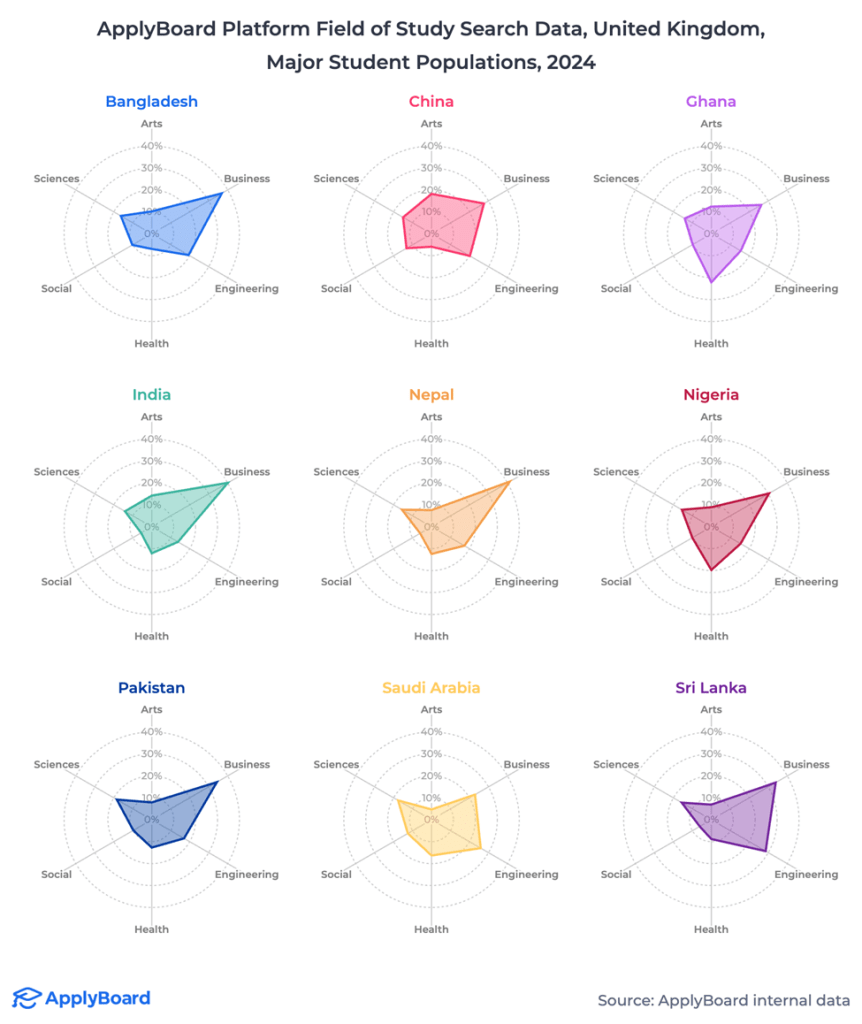
    The graphic below illustrates how major student populations explored different fields of study in the UK on the ApplyBoard platform last year:

    Student interest in Health fields was strongest among Ghanaian (22%), Nigerian (20%), and Saudi Arabian students (16%). Compared to the previous year, the share of searches for this field rose by six percentage points among Ghanaian students and five percentage points among Nigerian students. Additionally, the proportion of Health searches among Sri Lankan students doubled over this period.

    By comparison, the Sciences were a priority across all nine student populations, making up at least 14% of UK course searches. Students from Pakistan (18%), Saudi Arabia (18%), and Bangladesh (16%) had the highest proportion of Science-related searches. Notably, seven of the nine key student populations devoted a greater share of their searches to the Sciences in 2024 than in the previous year.

    Engineering and Technology also accounted for at least 14% of searches among these major student populations, although Sri Lankan (29%), Saudi Arabian (26%), and Chinese (23%) students showed the highest engagement in this field. Additionally, eight of the nine key student populations allocated a larger share of their searches to Engineering and Technology in 2024. As student interest in UK courses continues to grow, institutions can strengthen their appeal by aligning their portfolio with evolving student priorities and workforce needs.

    The UK’s Edge: Where Student Interest Outpaces Canada and the US

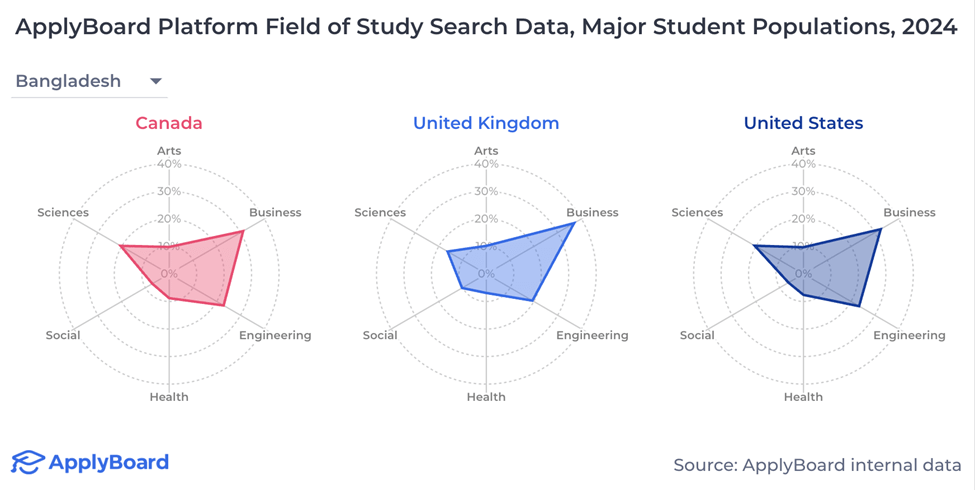
    Understanding where the UK sees higher proportional interest in key fields of study compared to Canada and the US can reveal important competitive advantages for institutions and better inform strategic recruitment strategies. This interactive visualization allows you to explore student interest by field and destination, filterable by top student populations:

    Health-related fields accounted for 25% of searches for UK institutions among Filipino students—three percentage points higher than their searches for Canada and the US. Likewise, 22% of Ghanaian students were interested in UK-based Health courses, outpacing the interest shown for both Canadian (21%) and American (20%) options.

    In Engineering and Technology, 29% of Sri Lankan students’ searches for UK courses were in this field—matching their interest in US study but well surpassing their searches for Canada (24%).

    Social-related fields like Law, Social Sciences, and Teaching captured 10% of Pakistani searches for the UK, outpacing that for Canada (6%) and the US (7%). A similar trend occurred among Bangladeshi students, with 10% of their UK-based searches occurring for social-related fields compared to 7% of Canada and 6% for the US.

    Leveraging Search Trends to Shape Future Recruitment

    Search trends serve as a leading indicator of shifting student interest, often signaling future application patterns. The surge in searches for UK courses—particularly in high-demand fields like health, engineering, and sciences—suggests a growing alignment between student priorities and workforce needs. By analysing these trends, institutions can proactively refine course offerings and recruitment strategies to attract top international talent. As demand continues to evolve, leveraging real-time search insights enables institutions to stay ahead of market shifts, ensuring they meet student expectations while strengthening their global competitiveness. Understanding where the UK holds a competitive edge will be key to optimizing outreach and course development in 2025 and beyond.


    [1] In the past, ApplyBoard platform search data was generated based on button clicks on a page, while the new search data is generated by any changes made to the page’s filters (destination, field of study, etc.) As a result, the new search count, if tallied using the previous search data approach, would be significantly inflated compared to the original search count. To make the search counts more comparable, we changed our methodology as of August 2024 to use unique entries per user within each hour.

    Source link

  • Higher Education Inquirer : Higher Education Inquirer: Increasingly Relevant

    Higher Education Inquirer : Higher Education Inquirer: Increasingly Relevant

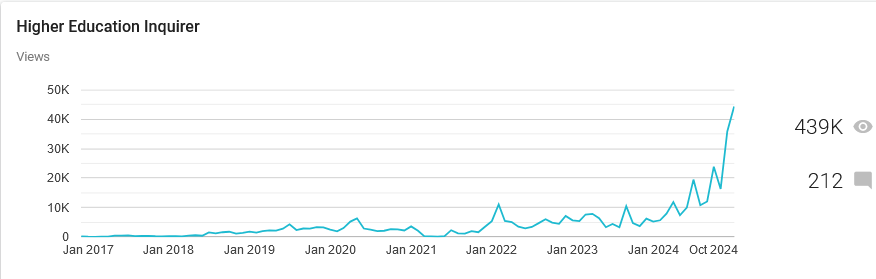
    The Higher Education continues to grow. We believe our growth stems largely from our increasing relevance and in our truth telling, which other higher education news outlets are unwilling to do in these times.

    Our devotion to transparency, accountability, and value for our readers guides us. 

    We invite a diverse group of guest authors who are willing to share their truths. The list includes academics from various disciplines, advocates, activists, journalists, consultants, and whistleblowers. We back up all of this work with data and critical analysis, irrespective of politics and social conventions. We are willing to challenge the higher education establishment, including trustees, donors, and university presidents.

    Our articles covering student loan debt, academic labor, nonviolent methods of protest, and freedom of speech are unparalleled. And we are not shy about including other issues that matter to our readers, including stories and videos about mental health, student safety, technology (such as artificial intelligence), academic cheating, and the nature of work.  And matters of of war, peace, democracy, and climate change

    Our focus, though mainly on US higher education, also has an international appeal

    Some of our work takes years to produce, through careful documentation of primary and secondary sources, database analysis, and Freedom of Information Act (FOIA) requests. We share all of this information for everyone to see, at no cost.  

    Of course, we could not operate without all your voices. We welcome all your voices. Something few other sources are willing to do.    

    Source link