Tag: Indiana

  • Indiana Budget Bill Contains Sweeping Higher Ed Changes

    Indiana Budget Bill Contains Sweeping Higher Ed Changes

    Indiana state lawmakers have sent their governor a state budget bill that goes beyond setting funding levels. If Republican governor Mike Braun signs it into law, House Enrolled Act 1001 will require faculty at public colleges and universities to post their syllabi online and undergo “productivity” reviews.

    The bill would also—among other things—prohibit faculty emeriti from voting in faculty governance organizations, place low-enrolled degree programs at risk of elimination by the Indiana Commission for Higher Education and end alumni elections for three Indiana University Board of Trustees seats by filling them with gubernatorial appointees. In addition, it has a provision that would let Braun remove the currently elected board members before their terms expire.

    “I think overreach doesn’t begin to describe the actions of the Legislature,” said Russ Skiba, a professor emeritus of education at IU Bloomington. “This is really a sweeping takeover of higher education in Indiana.”

    The Republican-controlled Indiana General Assembly passed the legislation—which runs more than 200 pages—less than two days after revealing it Wednesday, April 23. The state House approved it around 12:45 a.m. Friday, followed by the Senate’s agreement at about 1:20 a.m.

    “I know a lot of legislators … simply didn’t have enough time to fully read it,” Skiba said. “There was no opportunity whatsoever for any sort of public input.”

    Matt Pierce, a Democratic Indiana House member who’s a senior lecturer at IU Bloomington, said the conference committee report revealing the budget bill wasn’t even released until Wednesday evening.

    “As people began to kind of go through it, they discovered all these higher education provisions that had never been discussed anywhere,” Pierce said. To have “provisions of this magnitude” pass in the budget bill “with no hearing or public input, that was pretty shocking,” he said.

    The budget bill’s higher education provisions echo those passed, or at least proposed, in other red states. But Indiana’s General Assembly continues to be in the vanguard among even GOP-controlled legislatures in its fervor for regulating public higher education. Last year, state lawmakers passed, and the former governor signed, a law threatening the jobs of nontenured and tenured faculty who don’t sufficiently foster “intellectual diversity,” as defined by campus boards of trustees.

    These bills follow pro-Palestine protests at IU Bloomington and tensions between faculty and university president Pamela Whitten. And with a further reduction of tenure protections looming in the new bill, a tenured professor at IU Bloomington says he’s under investigation for allegedly violating a policy the university wrote to uphold last year’s intellectual diversity law.

    Ben Robinson, an associate professor of Germanic studies and a prominent pro-Palestine campus protester, told Inside Higher Ed that an anonymous student filed a complaint against him in October. The unnamed student, according to a copy of the complaint Robinson provided, wrote that Robinson “talks negatively about the state of Israel and describes the war in untrue and unfair ways” and has discussed being arrested at a pro-Palestine rally “on numerous occasions.” The student also complained that Robinson had spoken “against Indiana University on several occasions” and used class time to say the university was restricting free speech.

    This complaint was filed in IU’s bias incident reporting system, which wouldn’t have involved potential discipline, Robinson said, but university administrators appeared to refile it as an intellectual diversity–related complaint under the policy passed after the General Assembly’s intellectual diversity law. He said he thinks administrators “want to overcomply on particularly this ideological issue, because that’s what they’re being told they have to enforce” by the federal government.

    “How can a professor know what’s going to be called bias?” Robinson said. He also said IU Bloomington is “a campus in which the witch hunts are alive and well, and I, along with many others, have been an open target of them.”

    IU spokesperson Mark Bode, in response to Inside Higher Ed’s requests for an interview and written questions about Robinson’s situation, wrote in an email simply that “IU does not comment on personnel matters.”

    Accusations of IU Involvement

    Multiple critics have accused IU leaders of backing one or more of the 11th-hour budget bill’s higher education changes. When asked about this, Bode provided a written statement that didn’t say whether IU was specifically involved.

    “Throughout the session, Indiana University engaged with state lawmakers to shape meaningful conversations about the university’s commitments to making higher education accessible to Hoosiers and driving the state’s economy through life-changing research and innovation,” the statement said. IU “will be working over the coming weeks to understand the full impact of state legislation and ensure compliance.”

    Before the bill passed, Pierce said, he texted an IU lobbyist asking the university’s position on it. The lobbyist replied that the institution didn’t have a position because it was still carefully reviewing the legislation, Pierce said.

    “And right then and there I knew that IU was behind it,” Pierce said. He also questioned how lawmakers would have the “pretty esoteric” knowledge that emeritus faculty serve in some faculty governance organizations.

    “You now have a convergence of the Republican attacks on higher education and the actual administration of Indiana University, and that’s a pretty shocking development,” he said.

    The IU Board of Trustees currently has six gubernatorial appointees—including a student with a two-year term—plus three members elected by alumni. If Braun signs the budget bill, he and future governors will be able to appoint all nine members, the student member’s term will drop to one year and there will be no more alumni-elected members.

    Braun has expressed support for this change, according to the Indiana Capital Chronicle.

    “I think it’s being done because the current process [has] not maybe yielded the proper results on the entirety of how you want that important part of our state to be run—from curriculum to cost to the whole way one of our flagship universities has been operating,” Braun said, according to the Capital Chronicle. “I want to get a board there that is going to be a little more rounded, that’s going to produce better results.”

    Vivian Winston, one of the elected board members, who previously announced she’s not seeking re-election, said she voted against IU president Whitten’s contract extension and the university’s post-encampment protest restrictions. But she said she doesn’t know whether her votes were related to the board change part of the legislation—which, like the other higher ed provisions in the bill, caught her “unaware.”

    “I found out through the media,” Winston said of the changes in the bill.

    Rodric Bray, a Republican and Indiana’s Senate president pro tem, provided Inside Higher Ed a rationale for the part of the bill ending alumni elections.

    “A very small fraction of the IU alumni have been participating in the election for the alumni seats on the IU Board of Trustees,” Bray said in an emailed statement. “Of the approximately 790,000 alumni around the world, only about 2.5% of alumni voted in the most recent election for trustee. Because the number is so small, it is not a fair representation.”

    But some opponents of the provision don’t see it that way. Skiba, the IU Bloomington emeritus faculty member, said, “This is clearly payback for opposition of policies favored by the president of the university and the Legislature.” He said the change would “take those voices of opposition off the Board of Trustees and essentially give complete control of the Board of Trustees over to the governor.”

    Over all, Skiba said, “this Legislature is following the Trump lead—wishing to put an airtight lid on free expression. And if you’re wishing to do that, universities are an obvious place to start.”

    Source link

  • FBI Raids Indiana U Cybersecurity Professor’s Homes

    FBI Raids Indiana U Cybersecurity Professor’s Homes

    Federal investigators spent hours last Friday raiding two homes belonging to a cybersecurity professor at Indiana University at Bloomington, multiple local news outlets reported.

    It’s unclear what investigators were looking for, but Chris Bavender, an FBI spokesperson, confirmed to The Herald-Times that the raid was “court authorized law enforcement activity,” and that the agency had “no further comment.”

    Xiaofeng Wang, a tenured computer science professor and director of IU’s Center for Security and Privacy in Informatics, Computing, and Engineering, has worked at the university for more than 20 years. But after numerous government agents began removing boxes from the Bloomington home Wang shares with his wife, Nianli Ma—who also worked for IU’s library as a systems analyst and programmer—neighbors told The Herald-Times they knew little about the couple, including their names. 

    Law enforcement also arrived Friday morning at a home belonging to the couple in Carmel, about an hour and 15 minutes north of Bloomington. A video taken by a neighbor and published by local NBC affiliate, WTHR, shows FBI agents shouting, “FBI, come out!” through a megaphone pointed toward the residence. 

    An unidentified woman then exits the home holding a phone, which agents confiscated before questioning her and later removing evidence from the home. The woman left the scene and returned hours later with her lawyer, who later told WTHR “they’re not sure yet what the investigation is about.”

    According to The Bloomingtonian, Wang was fired from IU in early March. Both his and Ma’s employee profiles have been scrubbed from the university’s websites.

    Source link

  • Indiana First Lady to Raise Money for Dolly Parton’s Library Program – The 74

    Indiana First Lady to Raise Money for Dolly Parton’s Library Program – The 74


    Get stories like this delivered straight to your inbox. Sign up for The 74 Newsletter

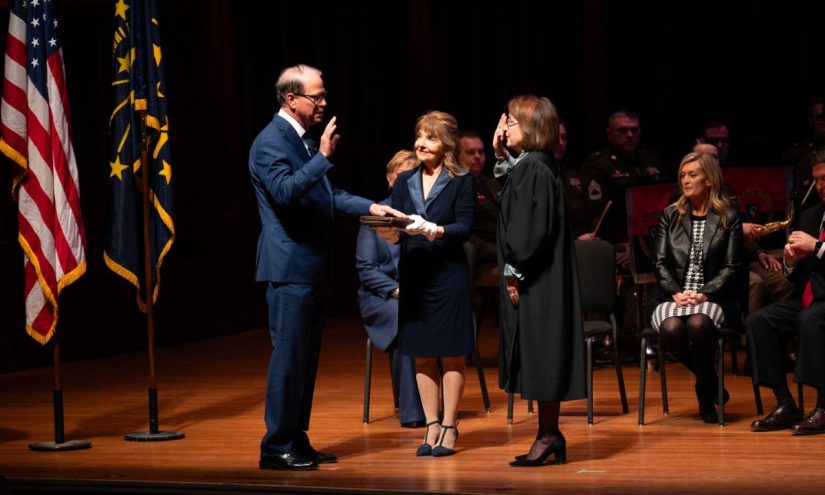
    After slashing a popular reading program from the budget, Gov. Mike Braun said Friday he asked First Lady Maureen Braun to spearhead an initiative to keep Dolly Parton’s Imagination Library in Indiana.

    “She has agreed and she will work with philanthropic partners and in consultation with state leadership to identify funding opportunities for the book distribution program,” the governor said in a news release.

    The program gifts free, high quality, age-appropriate books to children from birth to age five on a monthly basis, regardless of family income.

    Former Gov. Eric Holcomb included a statewide expansion of the program in his 2023 legislative agenda. The General Assembly earmarked $6 million for the program in the state’s last biennial budget — $2 million in the first year and $4 million in the second — to ensure that all Hoosier kids qualify to receive free books.

    But when Gov. Braun prepared his budget proposal in January he discontinued the funding as part of an overall effort to rein in state spending.

    “I am honored to lead this work to help ensure our youngest Hoosiers have as much exposure as possible to books and learning,” said First Lady Maureen Braun. “Indiana has many strong community partners and I am confident we will collaborate on a solution that grows children’s love of reading.”

    Jeff Conyers, president of The Dollywood Foundation, said he appreciates Braun’s commitment to early childhood literacy.

    “The Imagination Library brings the joy of reading to over 125,000 Hoosier children each month in all 92 counties across the state, and we are encouraged by Governor and First Lady Braun’s support to ensure its future in Indiana. We look forward to working with the Governor and First Lady, state leaders, and Local Program Partners to keep books in the hands of Indiana’s youngest learners and strengthen this foundation for a lifetime of success,” he said.

    Indiana Capital Chronicle is part of States Newsroom, a nonprofit news network supported by grants and a coalition of donors as a 501c(3) public charity. Indiana Capital Chronicle maintains editorial independence. Contact Editor Niki Kelly for questions: [email protected].


    Get stories like these delivered straight to your inbox. Sign up for The 74 Newsletter

    Source link

  • Indiana governor issues executive order eliminating DEI

    Indiana governor issues executive order eliminating DEI

    Indiana governor Mike Braun signed an executive order Wednesday eliminating diversity, equity and inclusion in all state agencies and replacing it with what he’s calling “MEI”—merit, excellence and innovation.

    The order requires all executive branch state agencies to uphold the Supreme Court’s 2023 decision in Students for Fair Admissions vs. Harvard, which prohibited the consideration of race in college admissions, noting that “eliminating racial discrimination means eliminating all of it” and that equal protection applies “without regard to any differences of race, of color, or of nationality.”

    Under the order, government offices cannot use state funds, property or resources to support DEI initiatives, require job candidates to issue DEI statements or “mandate any person to disclose their pronouns.” State agencies must review their individual programs and policies for compliance by April 30 and provide a written report to the governor by July 1.

    The order also closes the government’s Office of the Chief Equity, Opportunity and Inclusion Officer, which was created in 2020 under Braun’s predecessor, Governor Eric Holcomb.

    This makes Indiana the second state this year to eliminate DEI by executive order, following West Virginia.

    Among the other executive orders Braun signed during his first week as governor was one requiring the state personnel office to review all job postings and eliminate degree requirements for positions where they’re not necessary.

    Source link

  • Indiana University Faculty Who Focus on Student Engagement Using Top Hat See 11.5% Decrease in Student Withdrawal Rate

    Indiana University Faculty Who Focus on Student Engagement Using Top Hat See 11.5% Decrease in Student Withdrawal Rate

    Course withdrawals carry significant academic and financial consequences for students and universities. Studies consistently demonstrate that withdrawing from first-year courses can greatly increase a student’s risk of discontinuing their studies, reducing their likelihood of completing a degree (Akos & James, 2020).

    TORONTO – October 22, 2024 – Top Hat, a leading provider of student engagement solutions for higher education, has released the first significant finding in an ongoing research initiative with Indiana University exploring the impact of student engagement leveraging Top Hat on retention and academic outcomes. The study, involving an analysis of hundreds of courses from the Spring, Summer, and Fall semesters of 2023, observed that the use of Top Hat by instructors resulted in an 11.5 percent decrease in the mean student withdrawal rate compared to similar course types without using the platform. In absolute numbers, this would equate to approximately 289 of the sampled Indiana University students continuing their course work during the 2023 academic year. The findings highlight the positive impact of integrating Top Hat into course delivery on student retention, particularly in introductory courses that often have higher drop-out rates.

    The Top Hat platform empowers educators to use frequent low stakes assessments to increase student engagement during lectures through interactive polls, quizzes, and discussions. The use of frequent low stakes assessments have been shown to improve student confidence, academic outcomes and retention (Meer & Chapman, 2014). The principles of active learning can also be extended outside of class through Top Hat Pages, a content editing and personalization tool that enables instructors to create or customize their own interactive learning materials. Every interaction is captured by the platform, providing students with real-time feedback, while empowering faculty with data-driven insights they can use to identify struggling students and improve the impact of their instruction.

    “Indiana University is deeply committed to the success of our students, and the findings from this research demonstrate how the thoughtful integration of instructional technologies has contributed to strengthening our undergraduate retention,” said Gina Londino-Smolar, Ed.D., Teaching Professor at IU Indianapolis. “Implementing active learning and frequent assessment, which have been shown to improve student outcomes, has been an important focus for us and our partnership with Top Hat has been instrumental in enabling us to scale these practices across our institution, ensuring a consistent, high quality learning experience for our students.”

    The study’s primary objective is to evaluate the influence of Top Hat on various student outcomes, with an initial focus on withdrawal rates—a key indicator of student success. The collaborative research project, approved by the Institutional Review Board (IRB), involved analyzing data from thousands of individual courses. From the original large dataset, similar courses based on discipline and level were identified in order to equalize the sample size and undertake a more accurate analysis. After filtering the dataset, 235 unique Top Hat courses were compared against a similar set of 235 unique courses that did not use Top Hat.

    Indiana University began working with Top Hat in 2017 and, based on high rates of faculty adoption, made the decision to offer the platform free of charge to all students by entering into an enterprise license agreement the following year. By addressing concerns around equity, student affordability and ensuring compliance with respect to data privacy and standards for web accessibility, adoption has increased substantially. For the 2023/2024 academic year 1,022 faculty and 51,679 students across more than 1,900 individual courses from all nine IU campuses used Top Hat to enhance learning.

    “This study reinforces the importance of providing faculty with tools that make evidence-based practices, like active learning, easier to adopt,” said Maggie Leen, CEO of Top Hat. “The data speaks for itself—when instructors have access to the tools to support effective teaching methods, it can lead to stronger student engagement and higher persistence. We’re proud to be part of Indiana University’s efforts to increase on-time graduation rates for their students.”

    The 2030 IU Strategic Plan has one pillar dedicated to Student Success and Opportunity with a commitment to student affordability and experience throughout their educational journey to have success in the workplace and beyond. The incorporation of Top Hat to engage students with the course content, reducing withdrawal rates, can be seen as a direct contribution to the pillar for student success.

    Since its founding in 2009, Top Hat has continued to introduce new features to make proven teaching methods more accessible to instructors. Most recently, Top Hat announced the release of Ace, an AI-powered teaching and learning assistant that enables instructors to generate assessment questions and discussion prompts based on their lecture slides and course materials. As a personalized study assistant, Ace allows students to break down challenging concepts, find guidance tackling difficult homework assignments, and create on-demand practice questions they can use to prepare for high stakes assessments. 

    The initial findings will inform both Indiana University and Top Hat’s future strategies for enhancing student outcomes. The research initiative is currently focused on identifying patterns of usage by instructors across disciplines and their impact on student engagement and academic performance. Ongoing analysis is exploring the impact of Top Hat on the academic experience of various student populations, including historically underrepresented groups with a focus on how the platform supports equitable access to learning, improves engagement, and contributes to closing achievement gaps.

    About Indiana University

    Indiana University (IU) is one of the nation’s leading public research universities, with 90,000 students across 930+ academic programs, seven campuses, two regional academic centers and nine School of Medicine campuses. Since 1820, Indiana University has helped students create brighter futures while also driving innovation, from breakthroughs in DNA technology to cancer research to trailblazing cultural programs and resources. IU is home to world-class academics with the country’s largest medical school, the world’s first school of philanthropy, the top-ranked Kelley School of Business and O’Neill School of Public and Environmental Affairs, and the Luddy School of Informatics, Computing and Engineering, the nation’s first school of informatics. The university’s campuses are united by IU 2030, an aspirational vision for a bold and ambitious future focused on student success and opportunity, transformative research and creativity, and service to the state of Indiana and beyond. Learn more at iu.edu.

    About Top Hat

    As the leader in student engagement solutions for higher education, Top Hat enables educators to employ proven student-centered teaching practices through interactive content and tools enhanced by AI, and activities in in-person, online and hybrid classroom environments. To accelerate student impact and return on investment, the company provides a range of change management services, including faculty training and instructional design support, integration and data management services, and digital content customization. Thousands of faculty at 750 leading North American colleges and universities use Top Hat to create meaningful, engaging and accessible learning experiences for students before, during, and after class.

    Contact [email protected] for media inquiries.

    Source link