Recent protests in Iran have drawn renewed attention
to dissent under the country’s authoritarian government. The
demonstrations have been met with mass arrests, internet
restrictions, and even accusations of murder.
While large-scale demonstrations appear to have
subsided for now,
reporting from Iran describes a tense calm, a heightened
security presence, and widespread “disappointment and
disillusionment” among Iranians.
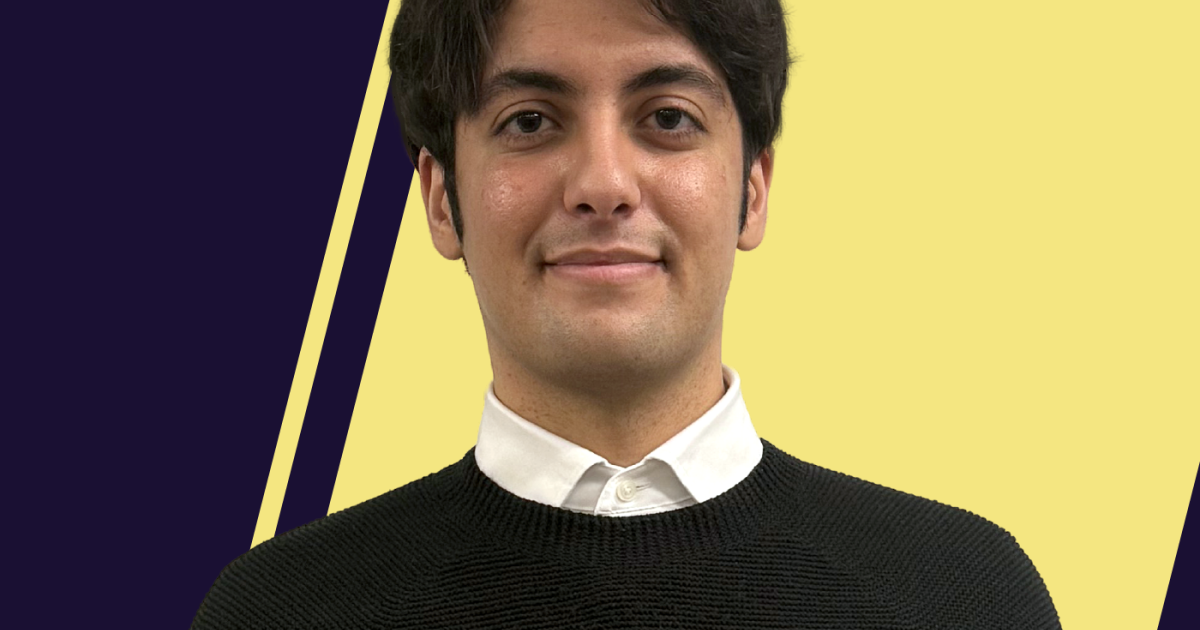
Today we are joined by Pouya Nikmand, an Iranian-born
writer who escaped Iran at 18. He writes about how his experiences
have shaped his understanding of expression, freedom, and belonging
on his Substack, Outliving Iran.
Timestamps:
00:00 Intro
02:17 What’s happening in Iran now?
10:47 What does life look like under an authoritarian
regime?
20:33 Growing up in Iran
24:48 The influence of Western media in Iran
32:55 Escaping Iran
37:05 Life after escape
40:55 Being trafficked to Poland
54:45 Escaping captivity and coming to America
01:01:53 An immigrant’s perspective on US
immigration
1:07:24 Outro
Enjoy listening to the podcast? Donate to FIRE today
and get exclusive content like member webinars, special episodes,
and more.
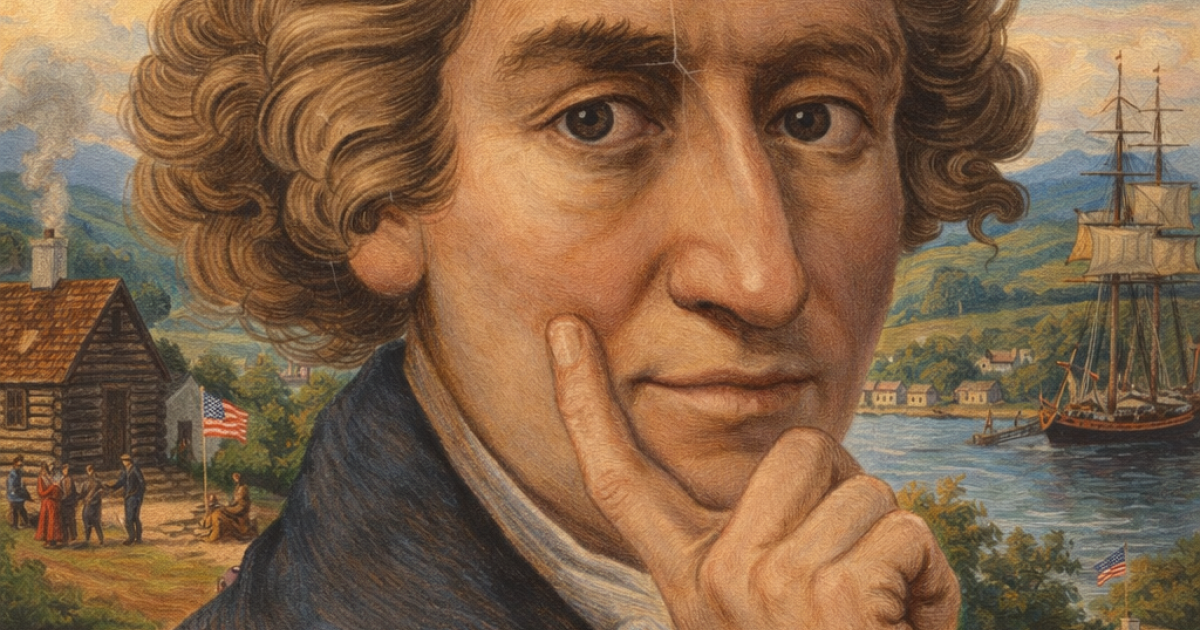
Accounts differ, but sometime between late November and the middle of December 1774, a terribly sick man was carried off a ship in colonial Philadelphia. Riddled with typhus, the middle-aged Brit was too weak to walk after his long voyage from London. But in his pocket were life preservers, notes of introduction from none other than Philadelphia’s favorite son, Benjamin Franklin, in London lobbying on behalf of the colonies.
The bearer Mr Thomas Pain is very well recommended to me as an ingenious worthy young man. He goes to Pennsylvania with a view of settling there . . . If you can put him in a way of obtaining employment as a clerk, or assistant tutor in a school, or assistant surveyor, (of all which I think him very capable,) so that he may procure a subsistence at least, till he can make acquaintance and obtain a knowledge of the country, you will do well.
If the British had any idea of who this Thomas Pain would become — he wouldn’t add the “e” until later — they may never have let him set sail to the New World to begin with. In little more than a year, this impoverished 37-year-old, who had known only heartache and failure in Britain, would find his voice as a successful editor and journalist in America’s largest city. And with his newfound purpose and confidence, he would write one of the great world-changing pieces of political propaganda ever published and help birth a free and independent United States of America.
On Jan. 10, 1776, Thomas Paine unleashed Common Sense on the colonial public. In an economical 47 pages, which he wrote in the fall of 1775, Paine’s anonymous pamphlet articulated in plain English the rising sentiment that there could be no reconciliation with the mother country. Brimming with rage after the outbreak of hostilities at Lexington and Concord — “No man was a warmer wisher for reconciliation than myself, before the fatal nineteenth of April 1775” — Paine argued for complete independence from Great Britain and attacked hereditary monarchy with a populist and democratic fire.
King George III, according to Paine, was “an inveterate enemy of liberty” with a “thirst for arbitrary power.” But Paine didn’t just attack this king — he attacked hereditary monarchy in all its perniciousness and absurdity. He told his fellow colonists of how absolute power corrupted absolutely, tracing the rise of monarchy not to “an honorable origin,” but to one “principal ruffian of some restless gang” who made himself “chief among plunderers.” He wrote of how an accident of birth could mean a child ascending to the crown or a king “worn out with age and infirmity” remaining on the throne, exposing the public “to every miscreant, who can tamper successfully with the follies either of age or infancy.” With his acid pen, Paine appealed to the intelligence of anyone who could believe a mortal was “born to reign” and delivered one of the pithiest lines against monarchy ever: “One of the strongest natural proofs of the folly of hereditary right in kings, is, that nature disapproves it, otherwise she would not so frequently turn it into ridicule by giving mankind an ass for a lion.”
Sometimes Paine’s arguments for independence were practical. “There is something very absurd, in supposing a continent to be perpetually governed by an island,” he wrote, noting how ridiculous it was to petition a government 3,000 miles away that didn’t know, much less care, about the colonists. Paine declared now was the time to strike. Otherwise, like cowards, colonial men would be “leaving the sword to our children.” And for those who thought reconciliation still possible, he had nothing but scorn: “But if you have, and still can shake hands with the murderers, then are you unworthy the name of husband, father, friend, or lover.”
But Paine went farther than just arguing for independence — he wrote of a social revolution, too. “We have it in our power to begin the world over again” didn’t just mean breaking from England. It meant representative democracy. It meant the rule of law. It meant respect for common people. “Of more worth is one honest man to society and in the sight of God,” Paine wrote, “than all the crowned ruffians that ever lived.”
Maybe Paine had the temerity to write such stirring and nakedly seditious words because he had nothing to lose — aside from his life, of course. Before coming to America, Paine was a failed corset maker and excise officer with minimal formal education whose first wife died in childbirth, along with their child. He had to sell his belongings to avoid debtor’s prison before skipping London for Philadelphia. As eminent historian of the American Revolution Bernard Bailyn wrote, “One had to be a fool or a fanatic in early January 1776 to advocate American independence.”
Paine’s brazenness was rewarded. Common Sense immediately became a blockbuster. The first run of 1,000 pamphlets sold out in days — the author known only as an “Englishman” on its cover. After a dispute with the original publisher, Paine paid for another run of 6,000 himself, priced it to undercut the first publisher, included his responses to loyalist criticism in the new edition, and forswore all royalties, donating the proceeds to Gen. George Washington’s Continental Army. Known as the Bradford edition, the author’s name was displayed clearly: “Thomas Paine.” The now-39-year-old failure from Thetford, England, had stepped out of obscurity and into history.
The impact of Common Sense cannot be overstated. Within three months, printers sold 120,000 copies — a runaway bestseller in a population of 2.5 million colonists. Those who could not read had it read aloud to them. It wasn’t just popular, it was persuasive — to both commoners and the colonial rebel elite. A fan from Connecticut gushed that Paine had “declared the sentiments of millions.” He continued, “The doctrine of Independence hath been in times past, greatly disgustful; we abhorred the principle. It is now become our delightful theme and commands our purest affections.” Another reader from Massachusetts declared, “Nothing else is now talked of, and I know not what can be done by Great Britain to prevent it.”
But Paine went farther than just arguing for independence — he wrote of a social revolution, too. “We have it in our power to begin the world over again” didn’t just mean breaking from England. It meant representative democracy. It meant the rule of law. It meant respect for common people.
Writing to Washington, Gen. Charles Lee believed it would “give the coup-de-grace to Great Britain.” Washington, in turn, would write in an April 1776 letter that the pamphlet was “working a powerful change there in the Minds of many Men” in Virginia. Maybe the best evidence of Thomas Paine’s outsized impact on the founding comes from none other than John Adams. It wouldn’t be an exaggeration to say that Paine lived rent-free in the irascible and petty Founding Father’s head. The more hierarchical-minded Adams detested Paine and his democratic principles. By the end of his life, Adams described the pamphlet as “a poor, ignorant, malicious, short-sighted, Crapulous Mass.” Yet Adams would also write, “Without the pen of Paine, the sword of Washington would have been wielded in vain.” Always worried about his legacy, an exasperated John Adams admitted to Thomas Jefferson in an 1819 letter: “History is to ascribe the American Revolution to Thomas Pain.”
Historian Jill Lepore puts it bluntly: “Common Sense made it possible to declare independence.” Less than six months later, the Second Continental Congress officially separated from Great Britain — the road to independence paved by Paine’s pen.
If we were to stop at Common Sense, that work alone should have cemented Paine’s place beside Washington, Jefferson, Adams, and Franklin in the nation’s true pantheon of Founding Fathers. But when American patriots needed another jolt in defense of the Cause, he wielded his pen again to save the infant nation from being strangled in its crib.
The months after independence were a military disaster. Washington and his army were on the run, abandoning New York City and retreating across New Jersey. Morale withered. Desertions spiked. Enlistment contracts were on the verge of expiring. Congress evacuated Philadelphia for Baltimore. The stench of defeat was everywhere.
After Congress declared independence, Paine enlisted, eventually becoming an aide to Gen. Nathanael Greene. But Paine was no military man; he was a writer and journalist. With the war almost over before it ever began, Paine started to write the first of his 13 Crisis essays — one for each colony — which were rousing defenses of the Cause to keep morale up and public opinion behind the war.
The first American Crisishit Philadelphia streets a week before Christmas 1776, signed “Common Sense.” Paine once again gave the work away for free to keep the costs down, with printers rushing out 18,000 copies. Washington, now camping just north of British-occupied Trenton on the Pennsylvania side of the Delaware, obtained a copy. The commander-in-chief ordered Paine’s words read to the remaining troops, freezing and ill-provisioned, as they prepared for their Christmas crossing of the river — a Hail Mary if there ever was one to save the Cause. It began:
These are the times that try men’s souls. The summer soldier and the sunshine patriot will, in this crisis, shrink from the service of their country; but he that stands by it now, deserves the love and thanks of man and woman. Tyranny, like hell, is not easily conquered; yet we have this consolation with us, that the harder the conflict, the more glorious the triumph. What we obtain too cheap, we esteem too lightly: it is dearness only that gives every thing its value.
On the morning of Dec. 26, the inspired Continental Army routed the Hessian mercenaries hired by the British to augment the redcoats. According to historian Harvey Kaye, author of Thomas Paine and the Promise of America, the first Crisis “served both to recruit militiamen back to their units and to persuade locals to volunteer aid and assistance.”
Disaster averted. The war continued.
If you walk through the visitor’s center in Washington’s Crossing, Pennsylvania, you’ll naturally be surrounded by art and exhibits celebrating the genius and heroism of Gen. Washington and his mythical nighttime crossing of the Delaware. But off in a corner next to the bathrooms, almost as an afterthought, sits a small sculpture of Thomas Paine, emblazoned with arguably his most famous line: “These are the times that try men’s souls.”
Time hasn’t proven kind to the radical British expat. “Thomas Paine is, at best, a lesser Founder,” Lepore notes in her wry fashion. “In the comic-book version of history that serves as our national heritage, where the Founding Fathers are like the Hanna-Barbera Super Friends, Paine is Aquaman to Washington’s Superman and Jefferson’s Batman.”
The reasons are many.
Temperamental and argumentative in person, Paine could be difficult to like. Historians of Paine have speculated that he suffered serious bouts of depression and may have been bipolar. As Franklin’s daughter Sarah Bache would write to him in France from Philadelphia in 1781:
There never was a man less beloved in a place than Payne is in this, having at different times disputed with everybody, the most rational thing he could have done would have been to have died the instant he had finished his Common Sense, for he ever again will have it in his power to leave the World with so much credit.
It also didn’t help that he was a nobody before emigrating to America — flotsam and jetsam from the Old World washing on the New World’s shores. Paine was common rabble to the well-born members of America’s founding generation.
His later writings from Europe, particularly The Rights of Man and The Age of Reason, however, would make him despised. In The Rights of Man, Paine took up the cause of the French Revolution. It was a full-throated defense of humanity’s natural rights and democratic republicanism against Edmund Burke’s conservative denunciation of the revolution in his Reflections on the Revolution in France. Then to hit the trifecta, Paine published The Age of Reason, a rationalist attack on all organized religions, punctuated by his declaration: “My own mind is my own church.” Benjamin Franklin told him not to publish it, writing, “He that spits against the wind, spits in his own face.” Paine did it anyway. Franklin was proven correct — its publication destroyed whatever reputation he had left.
The Age of Reason would end Paine’s friendship with Samuel Adams, who asked him contemptuously: “Do you think that your pen … can unchristianize the mass of our citizens?” Even Teddy Roosevelt would get in on the hate generations later, calling Paine “a filthy little atheist.” (Paine, similar to other Founding Fathers like Jefferson, was a deist.)
John Adams, ever ready to pounce on his enemy, summarized the elite’s disdain for Paine and all his free-thinking mischief in an 1805 letter. “For such a mongrel between pigs and puppy, begotten by a wild boar on a bitch wolf, never before in any age of the world was suffered by the poltroonery of mankind to run through such a career of mischief. Call it then the Age of Paine.”
He didn’t mean it as a compliment.
Paine remains in the popular wilderness 250 years after the publication of Common Sense. No monument graces his name in Washington, D.C., or Philadelphia. No movie or limited series tells his story. The writers of HBO’s John Adamsleave him out entirely — the Rodney Dangerfield of the American Revolution. But if that 37-year-old immigrant never had set sail for Philadelphia in the fall of 1774, we might not be here at all.
Changes at the Pentagon, Charlie Kirk and cancel
culture, free speech and misinformation, globalized censorship,
Indiana University, how to support FIRE, and more!
Timestamps:
00:00 Introductions
02:11 What is the Press Clause, and who does it apply
to?
05:53 FIRE’s position on Oklahoma student grading
incident
08:50 What does FIRE need from Members besides
financial support?
Become a paid subscriber today to receive invitations
to future live webinars.
If you became a FIRE Member through a donation to FIRE
at thefire.org and would
like access to Substack’s paid subscriber podcast feed, please
email [email protected].
A federal court has once again vindicated FIRE’s longstanding concerns with the Trump administration’s unlawful and unconstitutional approach to enforcing Title VI — including combatting antisemitism — in higher education. This time, the smackdown came in a ruling for plaintiffs at the University of California.
In a blistering opinion, the court found that the Trump administration has weaponized federal funding and “flouted the requirements of Title VI and Title IX,” all with the goal of “bringing universities to their knees and forcing them to change their ideological tune.”
In light of this and a similar victory for Harvard in federal court, universities should take note: if they stand up for themselves, their students, and their faculty in court, there’s a strong pathway to victory.
To avoid future losses in court, the Trump administration must cease its pressure campaign and follow the congressionally mandated procedure for enforcing federal civil rights laws. Failure to do so will only hurt students who have actually experienced discriminatory hostile environments and need serious, lawful federal oversight. The federal government should seek to get things right the first time and not let procedural infirmities and unlawful demands delay civil rights enforcement.
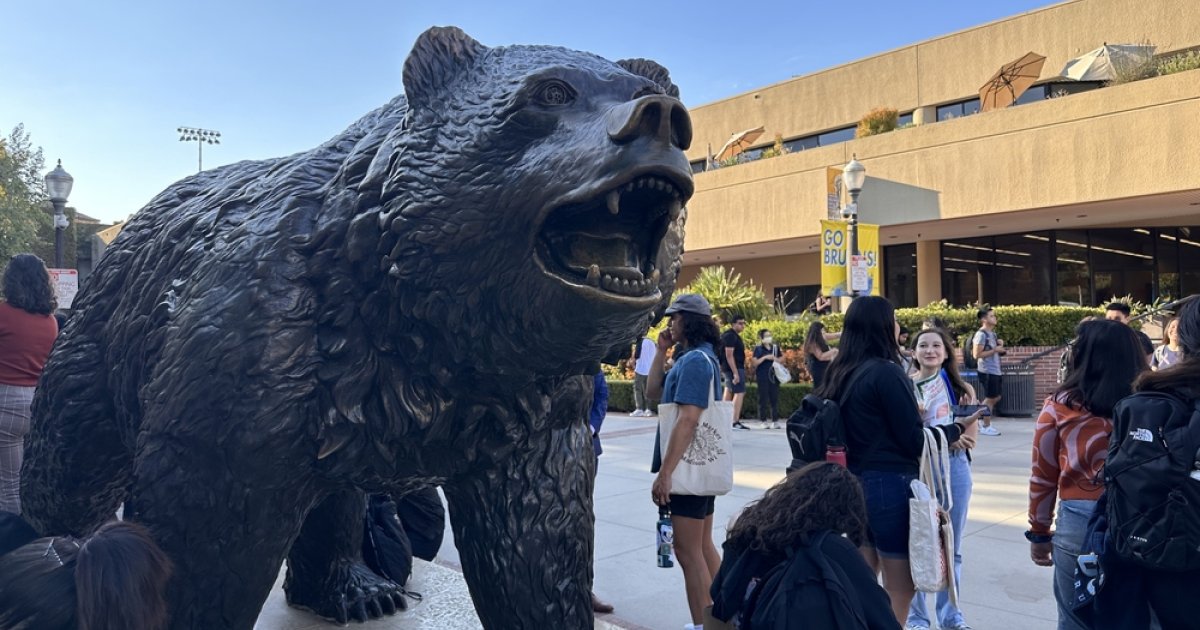
Unlike the Harvard case, which was brought by university leaders alongside other stakeholders, this suit was filed by associations and labor unions that represent over 100,000 UC employees, faculty, and students. They brought their case after the administration fined the University of California, Los Angeles $1.2 billion and froze further research funding, asserting that UCLA violated the Equal Protection Clause and Title VI.
UCLA may well have failed to protect some of its Jewish students from unlawful discrimination, and the federal government should ensure that the university is now complying with Title VI. But the court found that the administration’s goals go far beyond the issue of antisemitism, explaining:
The record shows that Defendants engaged in a concerted policy to use allegations of antisemitism to justify funding cancellations, when their intent is to coerce universities into purging disfavored “left” and “woke” viewpoints from their campuses and replace them with views that the Administration favors.
This, of course, violates the First Amendment. And the court notes that even if the administration were solely focused on combatting antisemitism, it could not “accomplish that goal by coercing the UC into adopting practices with widespread chilling effects on constitutionally protected speech.”
Accordingly, the court’s preliminary injunction prohibits federal agencies from withholding funds, “or threatening to do so, to coerce the UC in violation of the First Amendment.” And just to ensure its message is clear, the court provided examples of funding conditions that would violate the plaintiff’s First Amendment rights, including:
Requiring the UC to make hiring, firing, or funding decisions on the basis of Plaintiffs’ members’ protected speech or freedom of assembly.
Requiring the UC to restrict its curriculum, scholarship, or research based on the Defendants’ preferred viewpoints.
Requiring the UC to screen international students based on “anti-Western” or “anti-American” views and/or “socialize” international students to favored “norms.”
Beyond the First Amendment, the court also found that the administration failed to “follow longstanding, legally-required process that is intended to safeguard against coercive or retaliatory government actions under Title VI and IX.” These procedural failures include denying UCLA a hearing and the opportunity to voluntarily remedy alleged violations, failing to provide a written report to Congress, and failing to limit the scope of funding suspensions to noncompliant entities.
The federal government has a legal and moral obligation to ensure that schools are protecting students from discrimination, including antisemitism. But it must meet that obligation in ways that uphold the law and the Constitution. Unfortunately, the administration’s strategy has so far failed on both fronts. And ultimately, those hurt most by this failure will be students in need of lawful civil rights enforcement.
When she was 10, Ella Spurlock spent her free time making little booklets for her grandparents — drawing and coloring short, stapled stories about flowers, her dog, or whatever caught her eye that week. “I would staple them and give them to my Nana and Pop,” she remembers. “I liked making something that lasted.”
A decade later, in her freshman year at the University of Central Oklahoma, she found an adult version of that ritual: a byline. Her first story for The Vista, a feature on an art gallery show, ran on a Wednesday. She knew the issue was out before class ended. She sprinted from the Liberal Arts Building to the nearest news rack, slid a copy free, and saw her name there in the ink. The Vista, founded in 1903, is Oklahoma’s oldest student newspaper, an abiding symbol of a free press on campus — and now Spurlock was part of that history.
“I sent a picture to my dad and grandparents,” she says. “Then I showed it to my roommate. I was so excited — just over the moon.”
She folded the paper and carried it all day, the same way she had with those prized booklets years ago.
That memory has since taken on a strange weight. The very spring after her first story in The Vista, UCO administrators began discussing a “digital transition,” foreshadowing the end of the paper’s print edition. They said it was about the budget. But Spurlock suspected more. Administrators at UCO had voiced their displeasure with the paper’s investigative work before.
Under Pressure: The Warning Signs of Student Newspaper Censorship
Colleges are more obsessed with ‘protecting the brand’ than they’ve ever been before. The result? An epidemic of student media censorship.
Print funding supposedly hinged on votes that administrators didn’t control. In May 2025, the Student Media Advisory Board met and voted unanimously to fund The Vista and its sister broadcast program, UCentral, with a $56,000 budget — enough to maintain the paper’s biweekly print schedule through the end of the year. Despite the vote, administrators overruled the board and announced that the historic paper would cease to print and would go digital-only in fall 2025.
On July 21, faculty adviser Erika Williams emailed Dean Elizabeth Maier regarding the push to end print. Later that day, Maier replied that going digital “was a statement, not a request,” adding, “That decision is final and not up for debate or negotiation.”
Andrew Frazier remembers that summer as a blur of forwarded messages and quiet anger. He had just started reporting for The Vista. “I came in around July or August,” he says. “I was pretty vocal about how frustrated I was — not even about it going digital, but about the lack of transparency. They were lying to us, pretending not to know things, and gaslighting us.”
Frazier grew up in Oklahoma City, watching his father read the newspaper over breakfast every morning. He remembers well the ritual of the paper being folded and refolded, the sound of the pages, his father’s occasional comments, the smell of coffee. “I’d see him sitting out there every morning,” Frazier says, “and when he finished, I’d pick it up and read the comics — Peanuts or Calvin and Hobbes.”
That’s part of why the summer’s news stung. The Vista is older than the state of Oklahoma. Yet its steward had decided the printed page was no longer worth keeping. “It was everything I hate,” Frazier says. “Spin, control, top-down messaging — happening right here, in my own community.”
The university didn’t budge. Their plea for a free press had fallen on deaf ears.
UCO administrators said print was too expensive and outdated. But their actions belied their true motives. After the advisory board’s unanimous vote to keep printing, Dean Maier floated a “Vista Going Digital Launch Party” and even offered to pay for refreshments. Board chair Joe Hight objected that the administration’s decision ignored both data and process. When Hight shared a letter from Vista donors Jim Epperson and Bob Ray, in which they warned that ending print would betray The Vista’s tradition as “a watchdog . . . protected by the First Amendment” — the university didn’t budge. Their plea for a free press had fallen on deaf ears.
Not only that, but the university kept pushing to ensure their voice wouldn’t find a print audience. Students asked if they could print using money from the Dennie Hall Endowment, an alumni fund for The Vista. Administrators said no. At a budget meeting before the semester, students say they were warned that if they printed with donor funds, the university would cut funding for the entire student-media program. “They read our emails out loud,” Spurlock remembers, referring to messages students had written to professors, asking for help. “And then they said they’d cut everything if we printed. That’s when I cried.”
A week later, at administrators’ direction, facilities workers removed The Vista’s newspaper racks from campus.
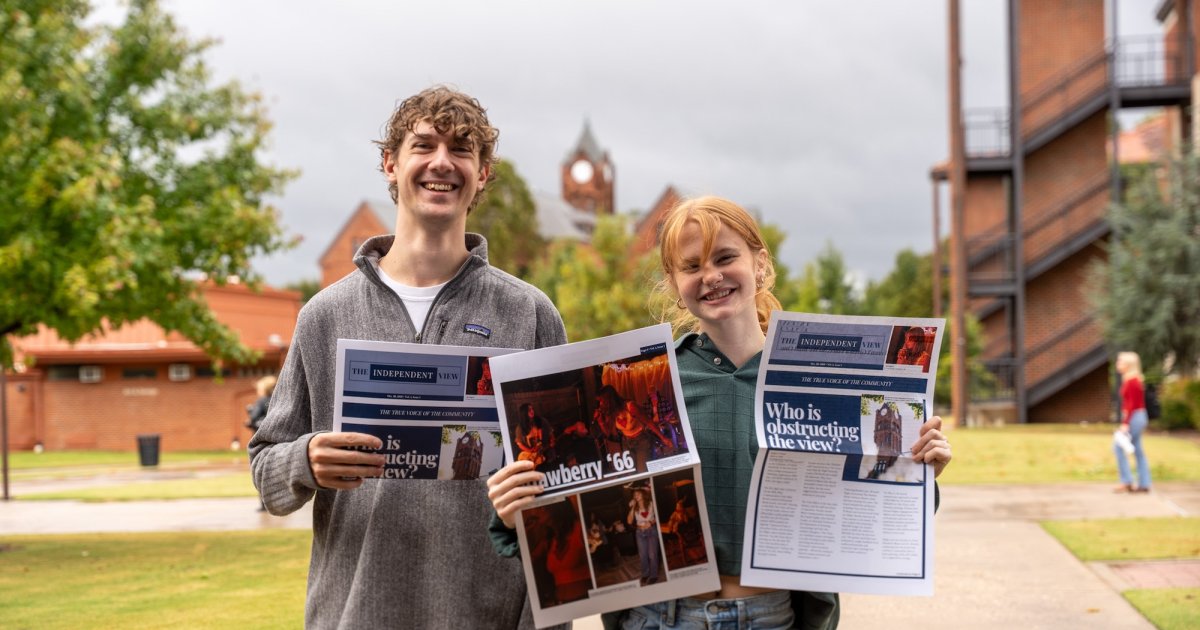
Ella Spurlock, managing editor at the University of Central Oklahoma’s independent student newspaper, The Independent View.
By fall, Frazier and several other students decided that if The Vista couldn’t publish freely, they’d build something that could. They called it The Independent View. It was scrappy, student-run, and fueled by small donations and borrowed space. “It feels like a startup with your friends,” Frazier says. “We’re all in it together, building something honest.”
Their first major story, published in their inaugural edition on Oct. 28, showed exactly why that sense of independence mattered.
The play they tried to cancel
In late September, two UCO juniors, Maggie Lawson and Liberty Welch, were preparing to direct the play Boy My Greatness, about the boys who played women’s roles in Shakespeare’s England. “It’s so heartbreaking but also so heartwarming,” Welch told The Independent View. “You see these people who are exactly like you, but it’s 1606.”
The students had spent months rehearsing. Their actors were cast, their set built, and the script licensed from the playwright. Then, hours before their first dress rehearsal on Sept. 3, the play lost university support. The reason? Senate Bill 796, Oklahoma’s new law restricting DEI programming at public colleges.
At first, no one could say who made the call. The Independent View’s coverage detailed what the university had tried to obscure: that the decision had come not from the theater department, but from upper administration, which cited legal concerns over the play’s “contract requirements.”
Lawson and Welch were offered a choice: pick a different play under university oversight, or continue without university support. They chose independence.
That night, they posted a TikTok explaining what happened and launched a GoFundMe, hoping for a few hundred dollars. Instead, they raised nearly $10,000 overnight, and their story spread across campus and into national outlets like Playbill.
“We thought we’d get a couple hundred bucks and a pat on the back,” Welch said. “We were shocked when it blew up.”
To the students behind The Independent View, the story wasn’t just about a canceled show. It was about how easily art and journalism could be choked by the same bureaucratic caution. “If they can pull a play hours before rehearsal,” Frazier said, “what can’t they pull?”
The story they erased
For Spurlock, the stakes were clear long before that first edition of The Independent View. Her breaking point had come months earlier at The Vista, when she covered the University of Central Oklahoma Student Association and its student activity fee allocations. The fee is approximately $5 per student. Spurlock found that the UCOSA president controlled roughly 84% of the funds — but couldn’t fully account for them.
When Spurlock pressed him, UCOSA President Cooper Autry stalled and evaded. “He did not want to talk to me,” she recalls. “I had to follow up three times.” She spoke to an anonymous source within UCOSA who confirmed the numbers. Spurlock filed her report and saw it pass through every level of review. With no red flags raised in the editorial process, The Vista took the article to press. Then, UCOSA leadership and university staff demanded a meeting. “They printed out my story and highlighted everything they didn’t like,” she says. “They called it defamation.”
She remembers the meeting feeling like a trial. Around the table sat UCOSA’s president, vice president, two advisors, and a university budget administrator. On her side were a fellow student, Jake Ramsey, and her faculty adviser, Erika Williams. “It felt like divorce court,” she says. “They tore it apart, line by line.”
‘Once you’ve had your story deleted, you know how easily the truth can just… vanish.’
When the meeting ended, administrators told Spurlock not to worry, that it was “not a big deal.” But she left shaken. “I didn’t know if I’d done something wrong,” she says. “I just knew I was supposed to be learning to be a watchdog, and instead I was being told to sit down.”
Williams, who had told Spurlock beforehand that the piece was solid, took the story down from The Vista’s website soon after. “They didn’t fix an error,” Spurlock says. “They erased a story.”
The numbers she’d reported never changed. The university never issued a correction. That experience shaped how Spurlock saw everything that came next: the summer votes, the override, the disappearance of the newspaper racks. “Once you’ve had your story deleted,” she says, “you know how easily the truth can just… vanish.”
That disappearing act gets even easier when the story is never printed on paper in the first place. So when the print ban came, she recognized the pattern. “I’m not here to cover up the ugly,” she says. “I’m here to make it known.”
Broken eggs
In late October, FIRE sent a letter to UCO President Todd Lamb, accusing the school of violating the Constitution by meddling in The Vista’s operations. The letter cited every detail the students had described — the print ban, the confiscated racks, the threats to defund the program, and the retaliation against those who resisted. It even noted an earlier remark Lamb made to a former editor suggesting the paper stop focusing on “broken eggs” and focus instead on “perfectly good omelette” stories.
FIRE called the university’s actions a “prior restraint on expression” and a form of viewpoint discrimination, urging UCO to lift the print ban and reaffirm its student journalists’ right to publish freely. So far, the university has stayed silent.
‘It was never about printing a paper. It was about how they took away our voice.’
Meanwhile, The Independent View grows. Its newsroom is a patchwork of laptops, coffee shops, and Zoom calls. Reporters write between classes and part-time jobs. Their funding comes not from the university but from alumni and locals — many of them graduates who remember reading The Vista in its heyday.
“We’re not funded by the university,” Frazier says. “Our funders just want good, honest news.”
Spurlock’s old copy of her first article sits in a drawer in her dorm room. The paper has yellowed a bit. Before the first edition of The Independent View went to press, she recalled missing the smell of ink, the weight of the page. “At the end of the day,” she says, “it was never about printing a paper. It was about how they took away our voice.”
She thinks back to the crooked staples of her childhood booklets, where she got her first taste of the power of storytelling — the pride of putting ink to an idea, shaping something lasting from scattered scraps. She knows now that making something real means breaking a few eggs.
And at The Independent View, they’ve only just started to cook.
If you’re a free-speech lawyer, you face a choice: Either expect to be disappointed by people of all political stripes — or go crazy. I choose low expectations.
Again and again, political actors preach the importance of free speech, only to reach for the censor’s muzzle when it helps their side. If, like me, you defend free speech as a principle rather than invoke it opportunistically, you get distressingly accustomed to seeing the same people take opposite positions on an issue, sometimes within the space of just a few months.
On the first day of his second presidential term, for example, Donald Trump signed an executive order titled “Restoring Freedom of Speech and Ending Federal Censorship,” castigating the Biden administration for pressuring online platforms to censor Americans’ speech. Last Thursday Mr. Trump mused that when broadcasters portray him negatively, “maybe their license should be taken away.”
Or consider hate speech. The concept was developed in the 1980s by leftist legal scholars like Richard Delgado and Mari Matsuda, and it shaped the campus speech codes and so-called political correctness of the 1990s. Intellectuals on the right were quick to contest the idea of hate speech — U.S. law does not recognize a general hate-speech exception to the First Amendment, and never has. Charlie Kirk rejected the idea of using hate speech rationales to crack down on free speech. Yet after Mr. Kirk’s assassination, Republicans rushed to promise crackdowns on hateful expression, deploying the same concept.
Critics of the idea of hate speech, including my organization, have long warned that the concept is so vague and broad that it provides a handy weapon to censor almost any opinion.
Last week, Attorney General Pam Bondi vowed that “we will absolutely target you, go after you, if you are targeting anyone with hate speech.” When Mr. Trump was asked about this statement by Jonathan Karl of ABC, he said that Ms. Bondi would “probably go after people like you,” and that Mr. Karl’s network — which last year settled a defamation lawsuit brought by Mr. Trump — paid “$16 million for a form of hate speech.”
Critics of the idea of hate speech, including my organization, have long warned that the concept is so vague and broad that it provides a handy weapon to censor almost any opinion. Unfortunately we have been vindicated on this point.
Consider, too, the fight against so-called misinformation and disinformation. The Biden administration created (and then quickly shuttered, following criticism) an advisory board at the Department of Homeland Security on the threat of disinformation. The Biden administration also pressured social media platforms to censor Americans who posted what the administration considered obvious falsehoods, including the suggestion — now considered plausible by a large assortment of mainstream institutions and experts — that the coronavirus originated from a laboratory in Wuhan, China.
Today, the right is making the same mistakes. The late-night talk show host Jimmy Kimmel included a line in a recent monologue suggesting that Mr. Kirk’s killer was a Trump sympathizer — which prosecutors’ documents seem to contradict. In the wake of conservative outrage, ABC suspended Mr. Kimmel’s show. That was an overreaction: If partisan wishful thinking were a regulatory infraction, few comedians or commentators on the left or the right would still have a job. (ABC said on Monday that it would resume Mr. Kimmel’s show on Tuesday.)
It’s possible that Disney, ABC’s parent company, would have punished Mr. Kimmel on its own. But the Trump administration took the initiative. Before ABC suspended Mr. Kimmel’s show, the chairman of the Federal Communications Commission, Brendan Carr, said during a podcast interview: “We can do this the easy way or the hard way. These companies can find ways to change conduct, to take action, frankly on Kimmel, or there’s going to be additional work for the F.C.C. ahead.”
Using your opponents’ nastiest tools doesn’t persuade them to disarm; it inspires retaliation.
And then there’s cancel culture. The right has long balked at the use of social pressure to punish conservative thinkers by, for instance, getting them fired from their jobs. The rise in cancellations that began around 2014 was initially celebrated by the left, which it defended as “consequence culture.” Now comes the inevitable role reversal. A few days ago, Vice President JD Vance urged those who saw people celebrating Mr. Kirk’s assassination to “call them out,” including by calling “their employer.”
I don’t like having to make a case for human rights such as freedom of speech by appealing to self-interest; these are supposed to be rights whose importance transcends one’s personal needs. But for political partisans, it’s often the only argument that cuts through. So here’s my practical warning: The weapon that you reach for today will be used against you tomorrow.
Using your opponents’ nastiest tools doesn’t persuade them to disarm; it inspires retaliation. Tit for tat, forever and ever.
“Free speech for me, but not for thee” is an all-too-familiar impulse in politics. But the point of the principle of free speech is that how we respond to ideas we don’t like is ultimately not about our opponents’ rights — it’s about ours.
Enjoy listening to the podcast? Donate to FIRE today
(https://www.thefire.org/) and
get exclusive content like member webinars, special episodes, and
more. If you became a FIRE Member
through a donation to FIRE at thefire.org and would like access to
Substack’s paid subscriber podcast feed, please email [email protected].
After the assassination of conservative activist Charlie Kirk, universities faced a dilemma that has become grimly familiar in the age of social media: what to do when a member of the campus community says something online that others find intolerable.
Within days, institutions moved with visible urgency. Some suspended employees. Others terminated them outright. A few launched “investigations” whose conclusions seemed preordained. FIRE has condemned these actions (when taken by public institutions) as violations of the First Amendment and intervened in over a dozen cases.
Yet the punishments themselves tell only half the story. Equally revealing were the justifications universities offered for them:
Clemson University declared that free speech “does not extend to speech that undermines the dignity of others.”
The University of Mississippi stated that a fired staff member’s comments about Kirk “run completely counter to our institutional values of civility, fairness, and respecting the dignity of each person.”
The president of Austin Peay State University said a faculty member’s social-media post “does not align with our commitment to mutual respect and human dignity” and was therefore grounds for termination.
The message these colleges sent was unmistakable: offensive speech is not merely offensive, it is an assault on human dignity itself. And that, in the eyes of administrators, makes it punishable.
The impulse to regulate speech in these circumstances is understandable. When tragedy strikes, ordinary condemnations can feel hollow beside the enormity of what has been lost. Requiring respect for “dignity” seems to offer something more; something higher: a recognition of our shared humanity, a pledge to the campus community that while ideas may be contested, no person will be debased.
But the moment “dignity” becomes a standard of compliance, it stops inspiring behavior and starts regulating it. The language of virtue invariably becomes the grammar of control.
The moment dignity must be imposed, it has already been lost.
The trouble with “dignity” begins with its vagueness.
“Dignity” can mean many things: (a) the inherent value of the human person; (b) the social honor one commands in the eyes of others; (c) the inner self-respect that resists humiliation; or all the above. These meanings both overlap and collide. Which, then, is a university to enforce: the idea of respect, the appearance of respect, or the feeling of respect?
There is no objective way to make this decision. And when a rule depends on subjective perception, it cannot be applied fairly. What one dean calls satire, another may label cruelty. What one student finds invigorating, another experiences as demeaning. And all of these people may be completely in earnest. Under such conditions, enforcement becomes a matter not of principle but of preference.
And because “dignity” sounds so unimpeachably virtuous, its invocation cloaks coercion in benevolence. Who, after all, would dare oppose dignity?
From this vagueness comes overbreadth. When “attacking dignity” can mean almost anything, it ends up encompassing nearly everything.
Universities that rightly prohibit harassment or discrimination — categories of unprotected acts that may involve expression — increasingly extend those prohibitions to merely “undignified” expression, which is protected. The University of Michigan’s harassment policy, for example, forbids conduct that diminishes “individual dignity.” Similarly, Penn State’s harassment policy defines discriminatory behavior as violating “the dignity of individuals.”
Penn State Revises ‘Principles’ in Victory for Free Speech
Once disagreement itself is framed as a denial of dignity, even empirical or policy debates about healthcare, sports, or law are reclassified as “harassment” rather than legitimate discussion. The zone of the impermissible grows, and the culture of caution grows with it.
Faculty and students, uncertain where the invisible boundary lies, retreat into self-censorship. They learn to treat disagreement as danger and discomfort as moral injury. The less precise the rule, the wider its reach. The wider its reach, the more timid the discourse. Administrative control breeds emotional fragility, and emotional fragility, in turn, justifies greater administrative control. It’s a feedback loop of moral protectionism.
What is at stake is no less than the mission of the university itself. Higher education exists not to shield its members from offense, but to teach them how to confront it; to refine judgment through exposure to conflict; to cultivate reason through disagreement. The “dignity rule” diminishes the (ahem) dignity of that mission. It transforms the university from a marketplace of ideas into a tribunal of sentiment.
To be clear, none of this is to diminish the importance of human dignity itself. Indeed, any university worthy of its title should strive toward cultivating an educational environment wherein all members of the campus community are treated with equal dignity. But when vague and overbroad noble values become instruments of coercion, liberty is often the first casualty.
This is precisely why the Supreme Court has consistently rejected attempts to limit speech on the grounds of indignity. In Snyder v. Phelps (2011), the Court held that even the Westboro Baptist Church’s vile protest at a fallen soldier’s funeral — which most Americans would see as a profound affront to dignity — was protected expression. In America, the right to speak, to offend, and to argue is not the enemy of dignity, but its precondition.
That is, to affirm the value of human dignity is not to be shielded from ridicule or offense but to be recognized as a rational, moral agent capable of hearing, weighing, and responding in kind.
In short: the moment dignity must be imposed, it has already been lost. And when universities attempt to enforce it, they risk betraying their commitment to free speech and the mission of education itself: to cultivate minds capable of reasoning in the face of offense, and of finding in that encounter — not in its suppression — the measure of their humanity.
FIRE staff also take your questions on Charlie Kirk’s
assassination, President Trump’s lawsuit against The New York
Times, cancel culture, and more. Timestamps: 00:00 Intro 01:42
Attorney General Pam Bondi’s comments that “hate speech” is
distinct…
Dinah Megibow-Taylor is a rising second-year at the University of Chicago while Eli Kronenberg is a rising junior at Northwestern University. Both are former FIRE summer interns.
How sure are you of your own consciousness? Of the accuracy of your memory? Of the solar system’s shape?
However well you think you know these things, there’s a chance you could be wrong, and learning to keep this in mind is crucial to maintaining a culture of civil discourse and free speech. How, you ask?
This year, the FIRE summer interns took a poll, rating our certainty of God’s existence on a scale of 0 to 100%, and found that our responses averaged out to 49%.
Early in our 10-week program, we had heard countless stories of previous intern classes embroiling themselves in heated political debates in the Tinker Room at the office of FIRE in Philadelphia, broadcasting their disagreements to the rest of the office. Yet from the get-go, our cohort took on a less confrontational dynamic, exemplified by one Friday when we decided to explore our religious beliefs.
As each intern expressed a level of certainty in the existence of God, something interesting happened: our conversation turned into an exercise of epistemic humility. The next Monday, one intern said she wanted to change her answer — from 100% certainty to 99%. This was a crucial reminder that even our most cherished beliefs should remain open to debate, for that simple 1% shift opened the door to a rich, good-faith ideological exchange. And it reminded us that even for basic factual matters, such as the earth being round or that one plus one makes two, there can be a dangerous element of outsourcing one’s knowledge to second-hand sources and centuries-old conclusions.
After all, no less than the math gods Alfred North Whitehead and Bertrand Russell once tried to prove that one plus one makes two — and the result, their magnum opus Principia Mathematica, ended up being 379 pages long. The point is, even seemingly self-evident truths can be painfully difficult to actually prove, and many if not most of the things we assume to be true have never gone through such a rigorous process. As Russell once put it, “In all affairs, it’s a healthy thing now and then to hang a question mark on the things you have long taken for granted.”
Similarly, in Plato’s Apology, Socrates famously declares himself wiser than a certain unnamed statesman because unlike the statesman, Socrates knew better than to be too sure of things. And, in J.S. Mill’s On Liberty, we find the line, “The beliefs which we have most warrant for, have no safeguard to rest on, but a standing invitation to the whole world to prove them unfounded.”
That’s how safeguarding a touch of uncertainty, even when it comes to your most tightly held beliefs, can help promote a culture of free speech. Because people only become censorial when they are sure of themselves. But if you keep open the possibility that you might be wrong, and that the other person might be right, you are more likely to want to hear what they have to say.
In his book Kindly Inquisitors, journalist Jonathan Rauch reminds us that nobody has perfect access to the truth. He refers to the refusal to seriously consider that you are wrong as intellectual fundamentalism. To avoid this trap, we look to FIRE President and CEO Greg Lukianoff’s summation of Mill’s argument for free speech. Mill says there are only three possibilities for any given belief, each of which lends itself to open and vigorous debate: you are totally right, you are totally wrong, you are partially right.
If you are not entirely correct, it benefits you to hear from others who may have the puzzle pieces you are missing, and if you are entirely correct, hearing from critics may sharpen your argument and help you better spread the truth.
Consider the case of Megan Phelps-Roper, who was raised in the Westboro Baptist Church, the granddaughter of the group’s founder. From the age of 5, Phelps-Roper held up crude signs declaring gay people worthy of death at the church’s notorious pickets, including at military funerals.
“I believed what I was taught with all my heart,” Phelps-Roper said in a 2017 TED talk, “and I pursued Westboro’s agenda with a special sort of zeal.”
Yet, over time, she began to interact with ideological opponents on the internet, and slowly came to question the church’s doctrine. She is now an outspoken critic, and speaks movingly about the importance of civil discourse and holding empathy for even those whose views we consider extreme. Her uplifting story demonstrates that it’s possible to be completely certain in one’s worldview, and then to have those beliefs flipped on their heads.
Ask yourself, the last time you realized you were wrong about something, did you feel that you were wrong beforehand? Probably not, or you wouldn’t have held that belief. Yet you felt sure, all the same. What this teaches us is that our feeling of certainty is an unreliable counselor at best.
One of our first tasks as interns was to familiarize ourselves with Judge Learned Hand’s “The Spirit of Liberty” speech. “The spirit of liberty is the spirit which is not too sure that it is right,” he professed. To be free is to be humble, to recognize our limitations, and to ceaselessly interrogate ourselves and each other.