Tag: info

  • Antisemitism action waiting on more info – Campus Review

    Antisemitism action waiting on more info – Campus Review

    Education Minister Jason Clare said the government will deliver its plan to tackle antisemitism after considering input from the Islamophobia envoy, Race Discrimination Commissioner and Expert Council on University Governance.

    Please login below to view content or subscribe now.

    Membership Login

    Source link

  • Higher Education Inquirer : IMPORTANT INFO for Sweet v Cardona (now Sweet v McMahon) CLASS

    Higher Education Inquirer : IMPORTANT INFO for Sweet v Cardona (now Sweet v McMahon) CLASS

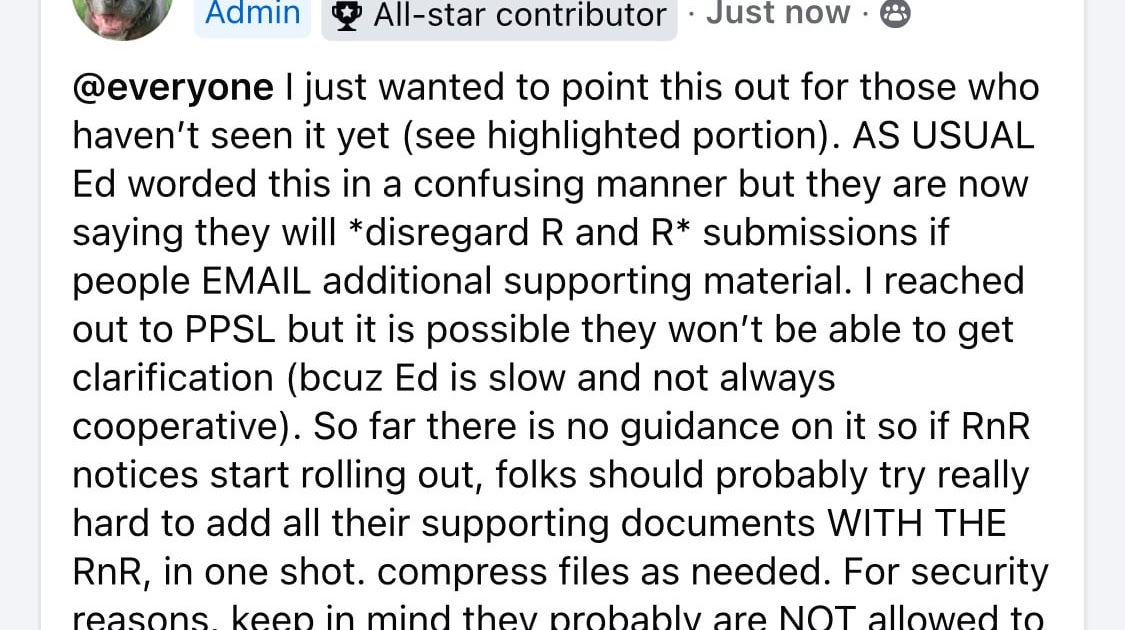
    Just dropping this IMPORTANT INFO from the DOE for Sweet v Cardona (now Sweet v McMahon) peeps who are CLASS – DECISION GROUPS and POST-CLASS.

    Edited To Add

    Decisions Class are streamlined R and R submissions.

    Post-class denials MUST ask the DOE for a reconsideration, which allows you to add additional evidence.

    Orginial Post:

    For REVISE and RESUBMITS (R and R) notices, the DOE is now saying that they WILL “disregard R and R*”* submissions if you EMAIL additional supporting documents or material. You CANNOT email the R and R back.

    You MUST submit a NEW BDTR APPLICATION and INCLUDE your previous BDTR application number which can be fund on the Denial letter.

    YOU HAVE 6 MONTHS TO RE-SUBMIT FROM THE RECEIPT OF THE R AND NOTICE (Here: https://studentaid.gov/borrower-defense**/

    **)

    The DOE states, “If you email supplemental information to the DOE or attempt to update your existing application, you will be treated as having failed to Revise and Resubmit”.

    ALSO, If you are still trying to add more evidence to your BDTR application this late in the game, you may want to wait for the decision letter to come out. We are reaching Group 5 Decision deadline, and Post-Class is 6 months after that. If you feel uneasy about your evidence, START collecting it now!

    Follow all DIRECTIONS on anything you get from the DOE relating to BDTR (except demanding payment, they can pound sand LOL).

    In Solidarity!!!

    Source link

  • College parents speak out in new survey: Weekly updates, mental health info and more access needed

    College parents speak out in new survey: Weekly updates, mental health info and more access needed

    As colleges nationwide double down on enrollment, retention, and student success strategies, one key voice is becoming harder to ignore: the family. According to the 2025 Current Families Report released by CampusESP, families want more updates, more access, and more say in the college journey, and they’re increasingly dissatisfied when they don’t get it. In addition, when parents do receive the information they need to support their student, research shows significant gains in student yield and retention.

    The survey, conducted across 81 colleges and universities and with more than 32,000 parents and supporters of current students, is the most comprehensive look at family engagement to date. And the findings are impossible to miss.

    Mental health, money, and mentorship

    Nearly half of all parents talk to their student daily, with the number jumping to over 60% for low-income and first-generation households. These families aren’t just chatting about weekend plans — they’re offering support on mental health (53%), academic advice (57%), and student life (69%).

    “Parents aren’t bystanders — they’re active advisors,” says the report. “And they need the right tools to guide their students.”

    Communication expectations are high

    A staggering 77% of families want to hear from their student’s college weekly or more, up 12% in just four years. While email is still the go-to channel, the demand for text messaging is surging, especially among Black, Hispanic, low-income, and first-gen families.

    However, a gap remains: 48% of families prefer text, but only 28% of colleges offer it.

    Trust wavers without transparency

    Families are becoming more skeptical about the return on their tuition investment. Only 59% say college is worth the cost — a sharp drop from 77% the year before. Their #1 request? More info on career services and job placement, which ironically ranked lowest in satisfaction.

    Families want in, but feel left out

    Even when they receive a high number of communications from their student’s college, families still feel sidelined. Just 46% are satisfied with their opportunities to get involved on campus, down from 63% last year. And only 30% feel they have good ways to connect with other families.

    Yet the desire is there: 38% want to be more involved, and 22% say they’re more likely to donate to their student’s college than their own alma mater.

    Financial aid frustration runs deep

    Navigating costs is a pain point. 59% say it’s hard to pay for college, and only 25% found financial aid information easy to understand.

    And with confusion comes attempts at self-education. Nearly half of families rely on their student’s login to access key financial records—posing serious data privacy concerns.

    The report confirms what many enrollment leaders have long suspected: families aren’t just part of the support system — they are the support system. The challenge for institutions? Reaching them with the right information, in the right format, at the right time.

    “Family engagement isn’t optional — it’s a strategic advantage,” the report concludes.

    Download the full 2025 Current Families Report from CampusESP to explore the findings and access actionable strategies for turning family influence into institutional success.

    Source link

  • That info you found. You sure of the source?

    That info you found. You sure of the source?

    Ever play telephone? You sit with a bunch of friends and whisper a phrase in the ear of the person next to you. That person whispers it to the next person. So, it goes until the phrase reaches the last person. 

    More times than not, the initial phrase became so convoluted as it is passed from person to person that it is funny. The phrase “80% of success is showing up” might end up as “an Asian person senses a growing pup.”

    That’s often the case with information on the internet. The more sources through which an article has been published through a syndicate or aggregated source, the more likely that article will change. Sometimes important context or nuance is lost. 

    In journalism, the goal is to be as close as possible to the publication making that initial “phone” call.

    “The closer you can get to the source, the better,” said Dan Evon, senior manager of education design at the News Literacy Project, a nonpartisan education nonprofit that provides students with media literacy tools. “It’s important for people to know how to find those sources.” 

    How to know if info has been rehashed

    Sometimes it is difficult to tell an original source from one that has been republished and rehashed. Media consumers often think they got their information from an original source, when they had found it on what is called an aggregator or syndicator.

    An aggregator compiles data from many sources into one. Many institutions host aggregated databases with publications from various sources, including the scientific and medical communities. 

    One such example of an aggregated source is the National Library of Medicine PubMed, the world’s largest biomedical library that hosts more than 37 million citations. Publications hosted by the database span institutions, journals and online books but always include the name of the original publication. 

    These are shown at the top of the webpage near the title; the page should display the original journal or book that the research appeared in. In addition, research studies include a unique code known as a Digital Object Identifier (DOI), and a search of this configuration of numbers and letters will also lead to the original publication. 

    Other aggregators include the Harvard Web of Science, a database that indexes the world’s leading scholarly literature, and Science.gov, an online U.S. government database of millions of scientific research across U.S. federal agencies.

    Syndicators and news wires

    Syndicators are networks of media organizations that share content. Snopes, a U.S.-based fact-checking website, publishes original content. This content can then be republished by its syndicated partners, which include MSN and Yahoo. 

    But just as in that game of telephone, important information can be lost or confused when a story is republished. For example, a syndicate publication may adjust a headline or alter the story’s content, leading to a story being factually incorrect or lacking crucial context. 

    Many news publications, for example, use content from newswire services like the Associated Press or Reuters, but each publication might alter the story or reword photo captions.

    “If you have a correction or an article is withdrawn, or there’s an editor’s note, that might not make it into the sites aggregating it,” said Evon. “When outlets republish articles, sometimes they change headlines, which can sometimes change their meaning — especially when people don’t read past the headlines.” 

    In other words, an update, editor or correction note issued to the original article may not be reflected in a syndicated article published before these additions. 

    Who wrote the story?

    Look to the writer’s byline to find an article’s original publication source. Information about the reporter, original publication outlet, date and location should be included here. Sometimes, that information is at the bottom of the article. 

    Perhaps the most well-known syndicated news source in journalism is The Associated Press, a wire service that covers global news. This independent news source publishes original reporting that websites, newspapers and broadcasts worldwide can republish. AP syndicated stories can appear in various news outlets, including local newspapers.

    To identify an AP style, look for the “AP” and original publication location in the byline. 

    If this information isn’t readily available or apparent, a Google search of the article headline and reporter name may sometimes reveal the original source. In a seemingly endless world of information, how does one determine whether a news source is reputable? Evon advises readers to take their time. 

    “Slow down. There is so much information that comes at you so fast, and you don’t have to look at everything,” Evon said. “The internet is awesome. It has all the information that you need. You just have to slow down and learn how to use it properly. Take a few seconds to look at an account name, who is publishing it, where it’s coming from — there are many basic questions that can be answered in 30 seconds that can really weed about the false information that goes around.”

    Credibility can’t be rushed.

    A credible media outlet or news publication will be transparent in its editorial strategies, correction policies, staff, funding and any conflicts of interest. This information should be easy to find and is often listed on a website’s “About” page. 

    “Once you know that’s a source that you can trust, you don’t have to do that work every time. It’s more about when you come across new and unfamiliar sources,” said Evon. “If you do not recognize the account or the outlet, that should give you pause to do a bit of research.”

    Understanding the different source types can also help determine whether information comes from an aggregated or syndicated source. Sources of information often fall into three categories — primary, secondary and tertiary — based on how close they are to the source. Primary sources are considered original materials or official sources of information, such as a research journal that published a study or a press release issued by a law official. 

    Tracking down the primary source is the best way to track down the first time this information was made available and hasn’t yet been distorted by varying degrees of reporting, interpretations or users who copy and paste text without context. 

    For scientific or social science studies, the primary source will be the study itself and the researchers who conducted it and the university where the research took place. Moreover, once you identify the researchers, you can contact them and interview them for original research of your own. 

    Secondary sources reprint, restate or analyze primary sources. These might include textbooks, articles, biographies, political analyses or commentaries that add value to the primary source but don’t necessarily represent its original context. 

    Tertiary sources compile, index and organize different pieces of information to create a broader understanding of a topic. These include dictionaries or encyclopedias, almanacs and manuals that usually do not credit a particular author.

    “Journalists play a role of an intermediary between sources, so there is this desire or inclination to go to the primary source,” Evon said. “What we hope journalists can do is look at that primary source, parse that data into easily understandable tidbits that they can then put out to the general readership.” 


    Questions to consider:

    1. What is meant by a news aggregator?
    2. How do you tell who conducted the research when you find a scientific or social science study on the Internet?
    3. Why is it important to tell if information has been republished and altered?


    Source link