Tag: Innovation in Teaching

  • 20+ Ultimate Ice Breakers for College Students

    20+ Ultimate Ice Breakers for College Students

    This guide is designed for college professors and educators seeking effective ways to help students connect and participate. It covers 20+ practical icebreakers for college students and provides a free downloadable list with additional activities, ensuring you have the tools to foster a welcoming classroom environment. Even better, these icebreaker activities can easily be assigned in the Top Hat app. Icebreakers for college students encourage new students to have conversations, get to know you and each other and build a sense of community and trust. Icebreaker activities help students relax and connect with one another during orientation, creating a sense of community and trust in a classroom setting. Used early on, icebreakers can help students feel comfortable in your classroom or team meeting. They’re ideal for the first day of school, but can be used throughout the semester and serve as a precursor for teamwork and collaborative learning. Virtual icebreakers—facilitated via social media, discussion boards or in virtual team meetings—have also gained new meaning in helping group members warm up to one another.

    A classroom icebreaker for college students can be as simple as asking learners to introduce themselves to the class or to the students sitting next to them, but games and activities offer a chance to interact with a greater number of classmates and build camaraderie. According to a guide1 from Nottingham Trent University, for classroom icebreaker games “there ought to be a fun aspect to the activities in order to provide participants with some shared history that they can discuss later and, where possible, a relevance to the taught course/university experience.”

    It’s no doubt that icebreaker activities like scavenger hunts or Pictionary are overdone. Campus-based icebreakers, such as orientation activities or exploring campus landmarks, can also help students get familiar with their new environment. Keep in mind that some classroom icebreakers for college students could be awkward or uncomfortable, such as publicly sharing personal information. The key is to get students talking to each other, having conversations and making connections—without social risk. This could mean facilitating small group activities versus requiring students to share personal information in front of the whole class. As an educator, help your students get to know one another in a safe and effective way. Recognizing the importance of icebreakers in fostering inclusion and community can set a positive tone for the semester. Icebreakers encourage people to participate, help students find commonalities with their peers, and build rapport within the group.

    Download The Ultimate List of Icebreakers for the College Classroom and begin assigning to your students using Top Hat (get the list here).

    Introduction to classroom icebreakers

    Classroom icebreakers are a powerful way for college professors to set a positive tone at the beginning of a course. These activities help college students introduce themselves, share fun facts, and discover what they have in common with fellow students. Whether you’re teaching a small group or a larger group, icebreakers can be tailored to fit your classroom’s unique needs and the goals of your course material. By encouraging students to interact and get to know one another, icebreakers help build a sense of community and belonging right from the start. When students feel comfortable and connected, they’re more likely to participate, collaborate, and engage with the material and each other throughout the semester. Incorporating icebreakers into your teaching toolkit is a simple yet effective way to foster a welcoming classroom environment where everyone feels included.

    Benefits of icebreakers

    Encouraging participation

    Fun icebreakers offer a range of benefits for both students and teachers, especially for first year students who may be new to the college experience. Icebreaker activities help students feel more at ease in the classroom, making it easier for them to participate in class discussions and share their ideas. Icebreakers can create a relaxed atmosphere that encourages participation among students.

    Supporting academic success

    Icebreakers can also introduce students to key course concepts in a fun and engaging way, setting a positive tone for the rest of the semester. When students feel supported and included, they’re more likely to take academic risks, ask questions, and explore new ideas. Ultimately, using icebreakers helps create a classroom environment where everyone feels welcome, valued, and ready to learn.

    With these benefits in mind, let’s explore how to plan and implement effective icebreakers in your classroom.

    Planning icebreakers

    Setting goals

    When planning icebreakers for your class, it’s important to start with your goals in mind. Think about what you want your students to gain from the activity—whether it’s helping students get to know each other, encouraging participation, or introducing a new topic.

    Considering group size

    Consider the size of your class: some icebreakers work best in small groups, while others are ideal for larger groups. Choose activities that are interactive and fun, such as “Two Truths and a Lie” (a fun way to help students get to know each other), “Human Bingo” (students find classmates who match traits on a bingo card), or “The Human Knot” (a physical activity where participants untangle themselves without letting go of each other’s hands, fostering non-verbal teamwork). These classic icebreakers can be easily adapted to fit your group size and learning objectives.

    Selecting activities

    The key is to encourage students to share, connect, and engage with one another in a way that feels natural and enjoyable. By selecting the right icebreakers, you’ll set the stage for a lively and inclusive classroom experience.

    Best practices for icebreaker design

    Inclusivity and comfort

    Designing effective icebreakers means keeping your students’ needs and comfort in mind. Start by choosing activities that are inclusive and respectful, ensuring that every student feels welcome to participate. Avoid icebreakers that might make some students uncomfortable or single anyone out.

    Clear instructions

    Make sure your instructions are clear and the activity is easy to follow, so students know exactly what to expect. As the teacher, be ready to guide the activity, answer questions, and offer support as needed.

    Building community

    The goal is to create a sense of community and belonging in your class, helping students feel connected to each other and to the course material. By following these best practices, you’ll design icebreakers that not only break the ice but also lay the foundation for a positive and collaborative classroom environment.

    Now that you know how to plan and design effective icebreakers, let’s dive into a variety of activities you can use in your classroom.

    7 group games for college students (with fun icebreaker questions)

    This list features a variety of effective icebreakers for college students, including fun, low-pressure activities like Two Truths and a Lie, Human Bingo, interactive games like the Marshmallow Challenge, and simple question prompts. These activities are designed to help students relax, connect, and build community, whether you’re teaching in-person or online.

    1. Concentric circles

    This is a great team-building icebreaker for an in-person learning environment. Arrange students in two circles, one inside the other, with students facing each other in pairs. Ask a fun icebreaker question, such as “what’s your favorite thing about college and why?” Pairs discuss the answer, then rotate the circle to form new pairs for the next question—exposing students to the different perspectives of their peers. The trick is to provide open-ended questions rather than those with a ‘yes’ or ‘no’ answer to get students to talk and engage in meaningful conversation.

    2. Find someone who…

    Alternative: Human Bingo: students find classmates who match traits on a bingo card.

    • Students are given bingo cards with a grid of squares. Each square contains an item, such as ‘traveled to another continent’ or ‘has a younger sister.’
    • During the activity, students can pass their bingo cards to others to verify matches or to keep the game moving.
    • Students are given a time limit to find classmates who fit the description.
    • Whoever gets ‘Bingo’ first wins. You can even award a prize of your choice, such as a bonus point or two on an upcoming assignment.

    Human Bingo is considered an effective, low-pressure icebreaker for college students and is a good classroom activity to help your students warm up to one another at the start of the school year—especially those who are meeting one another for the first time.

    3. Name game

    Enables participants to informally interact with their teammates.

    This classic party game can also be applied in the classroom—you can even tweak it to reflect the curriculum. Write down names of famous people (or names related to course material) on sticky notes. Students place a sticky note on their forehead and interact with their classmates, asking fun icebreaker questions to understand which person they are embodying. For example, a student might ask, “Am I a historical figure?” and another might respond, “Yes, you are,” helping the student narrow down their guess. This team icebreaker helps students loosen up and informally interact with their classmates. It also helps them learn about a figure who may have previously been unknown to them.

    4. Poker hand

    This classroom icebreaker for college students is ideal for large groups (a maximum of 50). Shuffle a deck of cards and hand out a card to each student.

    • Give students a set amount of time to find four classmates and form a hand of poker.
    • The best hand ‘wins’ when their time is up—consider offering a couple of bonus points on an assignment.
    • To encourage connections among students with similar academic interests, you can adapt the activity by having students form groups based on their major, or by assigning card suits to different majors.
    • Keep in mind that not everyone knows how to play poker, so display the rules of the game on a whiteboard or a slide at the front of the classroom.

    This activity may help students develop their analytical skills.

    5. Three of a kind

    Helps students find commonalities with each other.

    • Set a time limit and instruct students to find commonalities by seeking out three other students they share something in common with—though not anything obvious or visible, such as hair color.
    • The idea is to help them make connections that may not be immediately apparent.

    For more strategies to help your students get to know their classmates, download our free list of college icebreakers.

    6. Find your pair

    In advance of class, prepare word pairs—such as salt and pepper, or ketchup and mustard—on separate pieces of paper.

    • Have students select a piece of paper from the pile, ensuring they don’t share their word with anyone else.
    • Run the activity as a quick round, giving students a limited time to walk around the room and ask yes or no questions to their peers to try and figure out what word they have (and helping them get to know more people in your class).
    • Once students have figured out what word they have, they then must find their pair (if they haven’t already) by continuing to ask fun icebreaker questions.

    7. Act and react

    Ask students to write down an event or scenario on a piece of paper. These may range from “I just got fired from my job” to “I just got stung by a bee.” For a more meaningful experience, you can choose scenarios that encourage students to connect on a personal level, helping them share relatable or significant moments.

    • Fold the pieces of paper up and put them in a bag or hat.
    • Have students randomly draw a slip of paper and react to the experience using their facial features, gestures or words.
    • The remaining students can guess what just happened.

    This activity will help lighten the mood in your class and allow for student-student interaction.

    → Download Now: 20+ Free Icebreakers for College Courses

    7 first day icebreakers for college students

    8. Two truths and a lie

    A fun way to help students get to know each other.

    Divide the class into small groups. Each group sits in a circle, and each participant tells their group three statements; two are true and one is a lie. The other students in the group must guess which is the lie. This interactive icebreaker could be used during the first day of class to make introductions and reduce first-day jitters, with each student sharing a fun fact about themselves as part of the activity.

    9. This or that

    Prompts students to choose between two options, revealing preferences through movement or gestures.

    Present students with a choice between ‘this or that.’ Topics should be relatively light, such as whether they prefer dogs or cats (though you could also tie this back to course material). For example, ask students whether they would rather visit the mountains or the beach.

    • Students move to the side of the room that reflects their choice.
    • After a few minutes, encourage one or two members in each group to defend their position amongst a new group of students.
    • Ask students to repeat this process for several rounds to help familiarize themselves with a variety of standpoints.

    Similar to would you rather, this or that is ideal for small or large groups and spurs conversations and makes connections.

    10. Longest line

    Instruct students to form one continuous line based on certain criteria, such as alphabetically by first name or from shortest to tallest. For large classes, you could ask students to gather in groups based on some commonality (such as by birthday month). Another engaging option is to have students line up according to the part of the world they are from or a country in the world they would most like to visit. The goal is for students to line up as fast as possible—a result of clear and open communication in medium-sized groups. This classroom icebreaker for college students is a great team-building activity and can help create a sense of community should it be used as a first day icebreaker or at the beginning of the year.

    11. Three Ps

    Divide students into small groups, and have them share three facts about themselves to help them connect on a personal level: something personal, something professional, and something peculiar, such as an interesting hobby or habit. This icebreaker idea can easily be used in virtual meetings. It should be noted, the personal fact shouldn’t be anything too personal—it could be something as simple as a country they’ve always wanted to travel to. Use this great icebreaker when students go back to school from the summer, helping them warm up to their peers.

    Start assigning fun icebreakers for college students directly in Top Hat. Access the guide now!

    12. Beach ball

    Like the name suggests, this activity requires an inflatable plastic beach ball. Ahead of class, write different get-to-know you questions on each segment of a beach ball using a Sharpie. Arrange students in a circle. For larger classes, you may want to divide the class into smaller groups. The fun icebreaker questions could be “what was one of your highlights from the summer?” or “who is your celebrity idol and why?”

    • Toss the ball. Whoever catches it asks the question closest to their left thumb, answers it and then tosses the ball to another student.

    In a virtual or hybrid setting, students could post their answers to the beach ball questions on a discussion board or class social media page to encourage interaction and connection.

    13. Syllabus questionnaire

    Before sharing your syllabus with students, place them into groups of five and have them fill in a Google Doc or worksheet with questions they have about your course.

    • Structure the first five minutes as a brainstorming session.
    • After each group has prepared their list of questions, distribute the syllabus and have students find answers to their questions using this document.
    • Re-convene as a group and give students an opportunity to ask any further questions that couldn’t be answered from the syllabus.

    For remote teams, this activity can be easily adapted by using virtual breakout rooms and collaborative online documents to ensure all participants are engaged, regardless of location. You may also wish to facilitate this activity using individual lesson plans throughout the semester.

    14. String a story

    Arrive to class with a big roll of yarn or string and cut various pieces ranging from five to 20 inches in length. Bunch the pieces of string together and place them to the side.

    • Have each student draw a piece of string from the pile and slowly wind it around their index finger.
    • As they are winding the string around their finger, students must introduce themselves and give a first-person account of their life—in whatever capacity they wish—until the string is completely wound up.

    For example, a student might share a story about moving to a new city for college, describing how they felt nervous at first but made friends by joining a campus club.

    6 course- or assignment-specific icebreakers for college students

    15. Blind contour

    This activity is a fun way to get your visual arts students talking in a small group of people.

    • Split students into groups of five and have each student choose an object to sketch—without looking at their paper.
    • Give students five minutes to complete their sketch, then have them share it with their team members and ask the remaining students to guess what they drew.
    • Repeat the process with another item or object, until time runs out.

    This game helps hone students’ observational skills, while making sure students are mentally present.

    16. It was the best of classes, it was the worst of classes

    This classroom icebreaker not only helps students relate to each other, it can help inform your teaching practices throughout the term.

    • On one side, write “the best class I ever had” and on the other side, write “the worst class I ever had.”
    • Without referring to specific professors or courses, ask students to share what they liked and disliked about their previous courses.
    • For example, a student might say their best class experience involved interactive group projects and clear feedback, while their worst class experience was a lecture-heavy course with little student engagement.
    • Make a list of these items to potentially implement—or avoid—in your own course this semester.

    Additionally, consider using an anonymous discussion board or a group worksheet in your virtual classroom to encourage participation.

    17. The living Likert scale

    This icebreaker question for college students lets learners see where they—and their peers—stand on a variety of topics related to your discipline.

    • Before class, write numbers ‘1′ through ‘7′ on pieces of paper and place them across the room. The sheet with ‘1′ on it could refer to ‘strongly disagree’ while ‘7′ might refer to ‘strongly agree.’
    • Acting as a facilitator, pose a series of statements related to your discipline—such as “I think television can make children act aggressive” in a social psychology class—and have students move to the side of the wall according to their stance.
    • Students who are comfortable sharing their opinions pertaining to the topic may do so.

    18. Why am I here?

    Have students draw a picture that represents why they enrolled in your course.

    • Encourage them to include their major in the drawing or explanation, and to think beyond the fact that they may need your course credit to graduate, or that their high school guidance counselor recommended your course.
    • They could think about wanting to learn more about your field, how their major connects to the course, or simply that their friends were enrolled in your class, too.
    • After five minutes, have students share their picture with the larger group if they’re comfortable—helping students feel like part of one interconnected community.

    Want to assign these icebreakers and more using your Top Hat account? Get started by downloading our classroom icebreaker resource now!

    19. Class in one word

    Have students share their perceptions of your discipline in one word, such as ‘complicated,’ ‘analytical,’ or ‘enjoyable.’

    • Students can go around in a circle—or the order they appear in your Zoom tile view—and describe their past experiences in your field using a single word.
    • In an asynchronous course, set up an anonymous discussion question in Top Hat and have students respond on their own time.

    This activity offers a humanizing view of who else is in the same boat.

    20. Philosophical chairs

    A statement that has two possible responses—agree or disagree—is read out loud.

    • Depending on whether they agree or disagree with this statement, students move to one side of the room or the other.
    • After everyone has chosen a side, ask one or two students on each side to take turns defending their positions.

    This allows students to visualize where their peers’ opinions come from, relative to their own.

    Classroom icebreakers aren’t just a ‘feel good’ exercise. The best icebreakers can help students create connections and build a sense of camaraderie in your classroom. It can also help educators get to know their students and build better relationships. Whether you’re in a physical classroom or in a remote team setting, the above icebreakers will surely create a light-hearted environment for your students to thrive in.

    As Jennifer Gonzalez explains on her website, Cult of Pedagogy, “building solid relationships with your students is arguably the most important thing you can do to be an effective teacher. It helps you build trust so students take academic risks, allows you to better differentiate for individual needs, and prevents the kinds of power struggles often found in poorly managed classrooms.”2

    5 good icebreaker questions to engage college students in your classroom

    21. Dream dinner party

    Ask students: If you could invite any three people, living or dead, to a dinner party, who would they be and why? This question allows students to share their interests, values, and the historical or influential figures they admire. It can spark interesting conversations and provide insights into each student’s personality.

    22. Bucket list sharing

    Ask students to share one item from their bucket list. This can range from travel destinations to personal goals. It helps students discover shared interests and aspirations, fostering connections based on common goals.

    23. Memory lane

    Ask each student to share a significant or memorable experience from their past, such as a favorite childhood memory, a significant achievement, or an interesting travel story. This allows students to open up about their lives in a positive way.

    24. Favorites icebreaker

    Ask students to share their favorites, such as their favorite book, movie, food, or vacation spot. This simple icebreaker can reveal common interests among students and provides an easy topic for conversation.

    25. Superpower scenario

    Ask students, if they could have any superpower, what would it be and why? This question adds a creative and imaginative element to the discussion, and students can explain the reasoning behind their choice, providing insights into their personalities.

    Download The Ultimate List of Icebreakers for College Students, packed with 20+ easy-to-implement activities that you can assign directly in Top Hat. Get the full list of fun icebreakers.

    Related stories

    References

  • Creating a welcoming digital community: Teaching online with personality, compassion and with real interaction. (2021). Retrieved from https://www.ntu.ac.uk/media/documents/adq/flexible-learning-documentation/creating-a-welcoming-digital-community.pdf
  • Gonzalez, J. (2017, July 23). A 4-Part System for Getting to Know Your Students. Retrieved from https://www.cultofpedagogy.com/relationship-building/
  • Frequently asked questions

    1. What are the most effective icebreakers for college students on the first day of class?

    Effective first-day icebreakers for college students are activities that help students feel comfortable, reduce anxiety, and encourage early participation. Popular options include Two Truths and a Lie, Human Bingo, and This or That, all of which allow learners to connect quickly without feeling put on the spot. These activities work well for both small and large classes and set a positive tone for discussion and collaboration throughout the semester.

    2. How do icebreakers help build community in the college classroom?

    Icebreakers for college students support community-building by breaking down social barriers, encouraging conversation, and helping classmates discover shared interests or experiences. When students feel more connected to one another, they are more likely to participate, collaborate on group work, and engage with course material. This sense of belonging is especially important for first-year students who may be adjusting to a new environment.

    3. What types of icebreakers work best for large college classes or lecture halls?

    For large groups, the best icebreakers for college students are high-movement or fast-interaction activities. Examples include Longest Line, Poker Hand, and Concentric Circles, which encourage students to meet many peers in a short period of time. These scalable activities help foster connection in spaces where traditional discussion-based icebreakers may be less practical.

Source link

  • Top Hat Acquires OpenClass IP and Welcomes Founder to Team

    Top Hat Acquires OpenClass IP and Welcomes Founder to Team

    Top Hat’s engineering team is gaining a valuable new voice with the addition of Alec Kretch, whose work and experience sits at the intersection of technical innovation and learning science. As the founder of OpenClass—an AI-powered platform that helps educators design meaningful, mastery-based assignments—Kretch is a strong advocate for using assessment as a tool for learning rather than simple measurement. The acquisition of OpenClass’s intellectual property, along with Kretch’s appointment to Top Hat’s engineering team, will support Top Hat’s continued investment in discipline-specific solutions and in expanding the company’s capabilities around authentic assessment. These efforts align with a growing institutional focus on career readiness and helping students build practical skills they can carry into life after graduation

    “Alec has shown how technology can help educators create richer, more effective learning experiences through relevant, real-world application,” said Maggie Leen CEO of Top Hat. “His work with OpenClass aligns closely with our focus on supporting instructors with tools that encourage deeper thinking and meaningful student engagement.”

    OpenClass was originally developed to help computer science instructors create authentic assignments, where students solve in-browser coding problems and receive immediate, actionable feedback. While built with programming in mind, the underlying approach is broadly applicable across disciplines. Authentic assessment encourages students to apply what they’ve learned in practical contexts, fostering critical thinking, creativity, and lasting understanding in ways traditional assignments often fall short. This kind of learning experience is especially vital as students increasingly look to higher education to build the skills they’ll need to succeed in their future careers.

    Over the past few years Top Hat has expanded innovation across many disciplines. Aktiv Chemistry, for example, which the company acquired in 2022, offers interactive tools designed to meet the unique needs of chemistry educators and learners. Offering personalized, authentic assessments that reflect the real-world scenarios students will face in their careers supports Top Hat’s mission to spark better teaching and more meaningful learning.

    “Top Hat is the gold standard for evidence-based learning platforms,” said Kretch. “We share a vision for the future of higher education—one that’s equitable, personalized, and focused on helping students develop real skills. I’m excited to help bring the best of OpenClass to more instructors and learners.”

    Source link

  • What’s New With Top Hat?

    What’s New With Top Hat?

    As you gear up for a new term, we’re excited to share some of Top Hat’s latest features—along with practical resources to help you engage students, streamline your teaching and set your course up for success.

    Affordable Learning Just Got Active 

    Interactive OpenStax Textbooks

    We’ve brought a curated selection of OpenStax textbooks into the Top Hat platform—at no extra cost to you or your students. These peer-reviewed, open-license texts are enriched with embedded assessments, accessibility upgrades and seamless integration into your course. It’s a powerful way to meet affordability goals while offering interactive, customizable materials that improve learning. Browse the OpenStax catalog.

    Making Teaching Easier and More Engaging

    Guest Mode for Presentations

    Engage any audience! Guest Mode makes it easy to use Top Hat outside the classroom, such as during conference talks, public lectures, or internal training sessions. Participants can join via QR code or session link—no login or student account needed. The perfect solution for one-time or public-facing presentations where simplicity and speed matter most. Learn more.

    Ace: AI-Powered Example Generator

    Help students see the ‘why’ behind what they’re learning. With a single highlight, you can ask Ace to generate a career-relevant or real-life scenario to bring a course concept to life. Whether you’re teaching accounting, anatomy, or sociology, Ace can tailor examples to match your students’ goals—helping them better connect with and retain the material.

    Preview New Builder Questions (Expected July)

    A new “preview” button in questions created with the new question builder allows instructors to view and interact with question content as it appears to students. You can interact with and submit responses to questions in preview mode to test things out before going live. Just note that these responses will not be saved.

    Live reactions (Expected August)

    Enable students to send real-time emoji reactions to presentation content throughout the lecture, providing even more opportunities for interactivity in class. This feature will be released first for guest mode sessions and then for regular classroom use.

    New Join Screen for Classroom Sessions (Expected July)

    We’re reducing friction even further by allowing students to join classroom sessions simply by scanning a QR code on the join screen.

    Easier In-Course Content Search

    Quickly find the materials you need, when you need them. Need to locate a quiz question, a specific slide, or an assignment from earlier in the term? Our upgraded content search lets you filter by type and keyword within your course, saving time and reducing prep friction. Learn more.

    Helpful Resources to Start the Term

    Student Engagement Toolkit

    This toolkit offers ready-to-use activities, templates, and low-stakes assessment ideas grounded in learning science to energize the classroom experience. View the Toolkit!

    Teaching with Top Hat Toolkit

    Everything you need to become a Top Hat pro. Whether you’re new to the platform or looking to level up, this toolkit walks you through the essentials—from setup and grading to extending learning outside class. Includes step-by-step tutorials, sample activities and instructional design tips. Access the Toolkit!

    Interested in learning more about Top Hat? Click here to book a platform overview.

    Source link

  • Acing Your Year: How You Used Top Hat in 2024

    Acing Your Year: How You Used Top Hat in 2024

    As the year draws to a close, we are once again excited to celebrate your commitment to equitable, personalized and AI-rich learning. We’re thrilled to unveil this year’s Top Hat Graded: our annual report that looks at how you and your students used our engagement platform and Ace, our AI-powered teaching and learning assistant, to your advantage. Let’s dive in.

    Giving new meaning to student engagement

    Click on target. Multiple choice. Fill-in-the-blank. It’s clear you wanted to shake up the standardized quiz this year. We’re honored to be along for the ride! You created more than 9.6 million multiple choice questions and 1.7 million long answer questions this year. But that’s not all. You also designed more than 985,000 fill-in-the-blank questions using our interactive platform. Our engaging formative assessment questions helped students stay focused before, during and after class when tackling their homework. Simply put, more questions posed meant more reason for students to complete their readings and attend class.

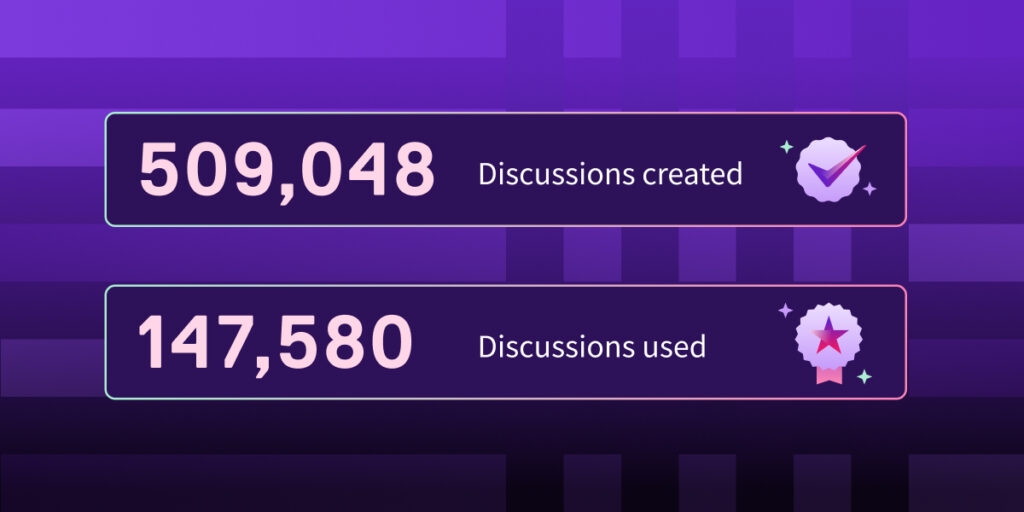
    We also recognize that a good debate or small group discussion can help students shape their understanding of a new topic. While Gen Z might call it a vibe check, we’re filing this under your commitment to giving every student an equal voice. You created more than 509,000 discussions this year—interspersed within your lectures, readings and assignments. In turn, more than 147,000 discussions were used by students to assess their comprehension along the way.

    Harnessing AI for good in the higher ed classroom

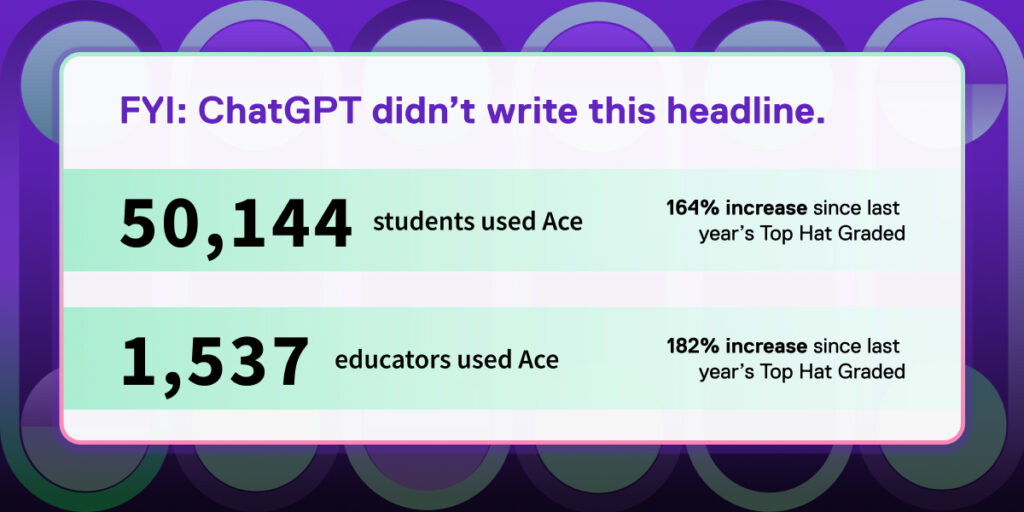
    Artificial intelligence has, once again, been a hot topic in higher education. This past year, you viewed Ace under a refreshing light. More than 50,100 students relied on Ace for course-specific study assistance and AI-powered practice quizzes. In turn, learners also received immediate feedback rooted in the context of their course to guide their future studying efforts.

    Now, let’s turn to you. More than 1,500 of your fellow faculty members used Ace this past year. Educators especially valued being able to add AI-generated questions into their slides using our Lecture Enhancer feature. Not only do our AI-powered features for educators save time during the question creation stage, Ace generates hints and explanations that allow students to identify their own misconceptions. Even better, we’ve charted a 182 percent increase in Ace usage among professors since our 2023 summary—speaking to the benefit of incorporating AI into the classroom.

    Using Ace to spark active learning and higher-order thinking

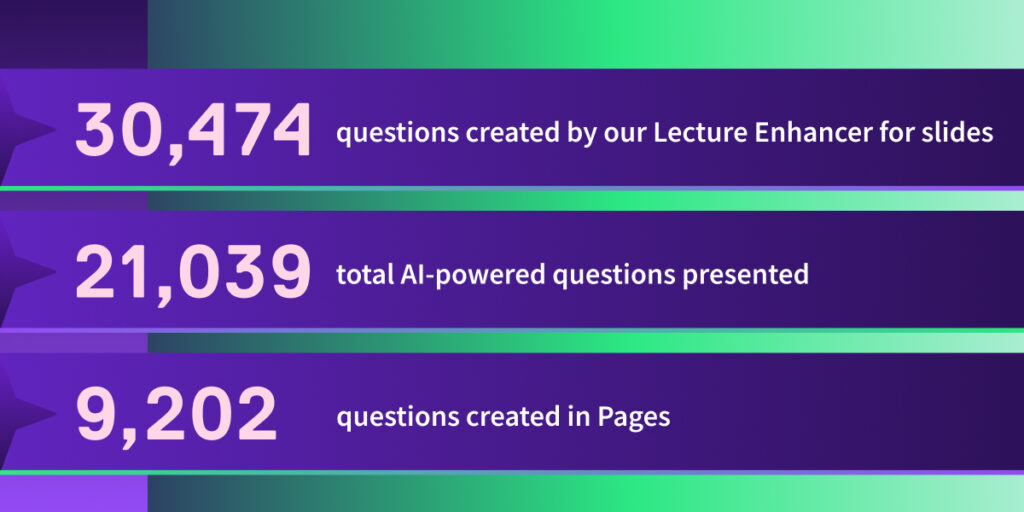
    Once again, you found a way to assess student comprehension without the extra time commitment. You created more than 30,400 questions using Ace’s Lecture Enhancer. Whether you wanted to drill into students’ understanding of mitosis in your biology course or Victorian architecture in your art history class, Ace offered tailored questions in response to the context of your material. Faculty also designed more than 9,200 questions using Top Hat Pages. That meant students were given yet another opportunity to assess their learning during textbook readings and homework.

    We thank you for your investment in AI-powered, active learning for every student. We wish you a successful start to the new semester!

    Source link

  • The Top 5 Higher Education Podcasts

    The Top 5 Higher Education Podcasts

    As an educator, where do you go for advice on teaching? Perhaps it’s a book. Maybe it’s a social media channel of your choosing. But more often than not, faculty have turned to higher education podcasts as a way of gleaning fresh insights in a captivating, bite-sized format. It’s no secret that educators are stretched between teaching, grading and research commitments. So listening to a reputable guest share their best practices for improving equity, engagement and interaction in the classroom is a valuable faculty development and training exercise in of itself.

    If you’re looking for the best higher education podcasts to explore, this post is for you. We’ve rounded up our favorite shows that speak to the good, the bad and the ugly within higher ed in our present moment. We also capture podcasts hosted by leaders who bring deep, discipline-specific expertise to their field. Most importantly, we’ve summarized shows that not only cover the latest trends but offer practical advice in an educational and entertaining way. So grab your earbuds and let’s dive into the top higher education podcasts of the year.

    → NEW HIGHER EDUCATION PODCAST: Stream S1 of Higher Listenings by Top Hat

    1. Higher Listenings by Top Hat

    Ok, call us biased, but we think Higher Listenings from Top Hat is well worth a listen. Higher Listenings aims to engage and entertain educators with a look at the latest trends shaping the future of teaching and learning. In our first season, we offer practical advice to leave you feeling equipped and confident to tackle your next teaching challenge—whether boosting reading completion rates or embracing AI-powered learning. The first season offers an all star line up featuring some of the leading change makers in higher ed including Jesse Stommel (author of Ungrading: Why We Grade and How to Stop), José Antonio Bowen (author of Teaching with AI) and Terrell Strayhorn (leading expert on student belonging). Stay tuned for season two releasing in January 2025! In the meantime, catch up on our inaugural season by listening on Apple Podcasts or Spotify.

    2. Teaching in Higher Ed by Bonni Stachowiak

    As the most effective educators know, good teaching is both an art and a science. Dr. Bonni Stachowiak is a professor and Dean of Teaching and Learning at Vanguard University. As the host of the Teaching in Higher Ed podcast, Stachowiak serves up best practices across four key categories including: digital pedagogy, student life, work-life balance and teaching. Notable guests include Joshua Eyler (Director of the Center for Excellence in Teaching and Learning at the University of Mississippi) and Jenae Cohen (Executive Director at the Center for Teaching and Learning at the University of California, Berkeley). Whether you’re looking for strategies to grade more productively or need guidance on ed tech integration in higher education, Stachowiak’s impressive lineup will leave you feeling inspired. Listen to the latest episodes on Apple Podcasts or Spotify.

    3. Intentional Teaching by Derek Bruff

    Do you want to take your knowledge of foundational teaching practices to the next level? Dr. Derek Bruff will help you do just that. Bruff, Associate Director of the Center for Teaching Excellence at the University of Virginia and author of Intentional Tech, hosts the Intentional Teaching podcast geared towards college and university faculty. His goal is to leave listeners with actionable techniques to make their classrooms more inclusive, responsive to an AI-saturated world and ultimately, more engaging for every learner. Esteemed guests on his podcast include Thomas J. Tobin (Senior Teaching and Learning Developer at the University of Wisconsin-Madison) and Viji Sathy (Associate Dean for Evaluation and Assessment at the University of North Carolina, Chapel Hill). Check out Bruff’s star-studded episodes on Apple Podcasts or Spotify.

    4. Tea for Teaching by John Kane and Rebecca Mushtare

    If you’re looking for faculty development and training paired with emerging research in pedagogy, this higher education podcast will surely be your cup of tea. The Tea for Teaching show is produced by John Kane and Rebecca Mushtare, who run the Center for Excellence in Learning and Teaching at the State University of New York (SUNY) at Oswego. The producers wrestle with hot-button topics from upskilling in the age of AI to reducing bias in course evaluations. High-impact guests, who include Michelle Miller (Professor in the Department of Psychological Sciences at Northern Arizona University) and Anthony Abraham Jack (Faculty Director of the Boston University Newbury Center), are featured in weekly episodes. Grab your favorite warm beverage and a notebook and tune into this podcast on Apple Podcasts or Spotify.

    5. Teach and Learn by D2L

    Unsure about the direction that education is heading in? Then you’ll want to take note of D2L’s Teach & Learn podcast. Geared towards K-12 and higher ed faculty, the show is hosted by Dr. Christi Ford (Vice President of Academic Affairs at D2L) and Dr. Emma Zone (Senior Director of Academic Affairs at D2L). In candid discussions with educational experts, the hosts dive into issues affecting higher education institutions today. This timely higher education podcast offers practical advice such as how to put diversity, equity and inclusion at the forefront of your course and how to harness AI to improve student learning. Recent guests include Thomas Cavanagh (Vice Provost for Digital Learning at the University of Central Florida) and Karen Costa (Faculty Development Facilitator for the Online Learning Consortium). Leave with practical tips for your own course by listening on Apple Podcasts or Spotify.

    Source link

  • Infographic: What 21,000+ Students Say About Top Hat

    Infographic: What 21,000+ Students Say About Top Hat

    It’s that time: the days are becoming shorter, temperatures are beginning to dip and more importantly, educators and students have returned to the classroom. At Top Hat, we recognize the value of ensuring every student comes to class prepared and excited to learn. We recently surveyed more than 21,000 students who used Top Hat in the Spring 2024 term about the impact our engagement platform and content solutions had on their academic journey. From interactive readings to in-the-moment study support, here’s how Top Hat made a tangible difference in their studies.

    Greater preparedness = better retention

    When students arrive to class feeling prepared, they’re more likely to persist. Data from the American Council on Education and the School of Education and Information Studies at the University of California at Los Angeles backs this up. The report finds that three out of five students surveyed state academic underperformance drove their decision to leave college for more than one term.

    Faculty have made tremendous strides in providing opportunities for frequent, low-stakes knowledge checks during the term. The emphasis on bite-sized assessments hasn’t gone unnoticed among students. “Real-time quizzes and polls not only helped reinforce key concepts but also encouraged active participation among students. Top Hat has truly enhanced our classroom interaction and made learning more enjoyable,” says Muhammad Ali Gajani at Indiana University Bloomington.

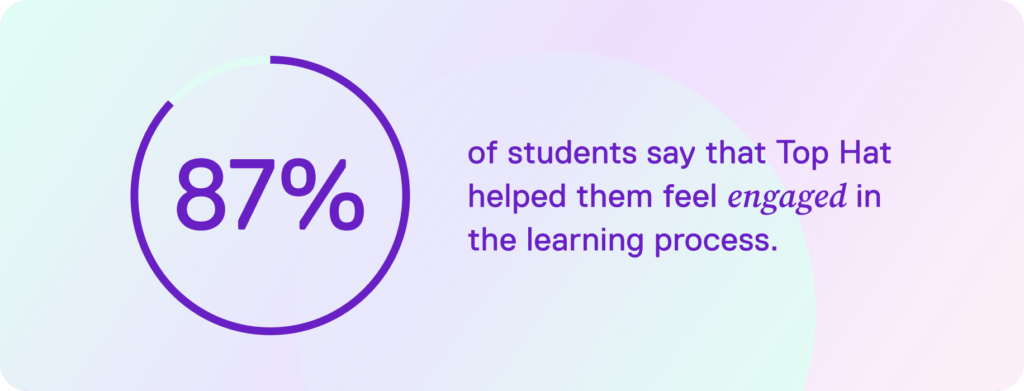
    An image that reads: 87% of students say that Top Hat helped them feel engaged in the learning process.

    Students bring an array of opinions and interests to your course. It’s why they value the opportunity to be active participants in the classroom. Research also shows that students who learn using active learning methods perform better on tests than those who sit in long-form lectures. Students echoed the impact Top Hat’s interactive polls, quizzes and discussions had when applying their knowledge. “Top Hat helped me perform better in my class as well as apply my understanding to my homework and exams,” shares Jacob Purcell at West Texas A&M University. An anonymous student from Texas State University at San Marcos chimes in. “It helped me to pay attention and stay engaged, getting me a better grade.”

    Turning static readings into an interactive experience

    We hear from educators that students don’t always complete their reading assignments before class. Over the years, students have tried to take shortcuts to their readings by searching for online summaries. How have educators responded? For starters, they’ve chosen to create ‘snackable’ content with media and real-world case studies that reflect an ever-changing world. Faculty have also relied on Top Hat’s personalized and interactive content solutions to ensure students have opportunities to read and then apply their understanding of concepts in the form of embedded polls and discussions.

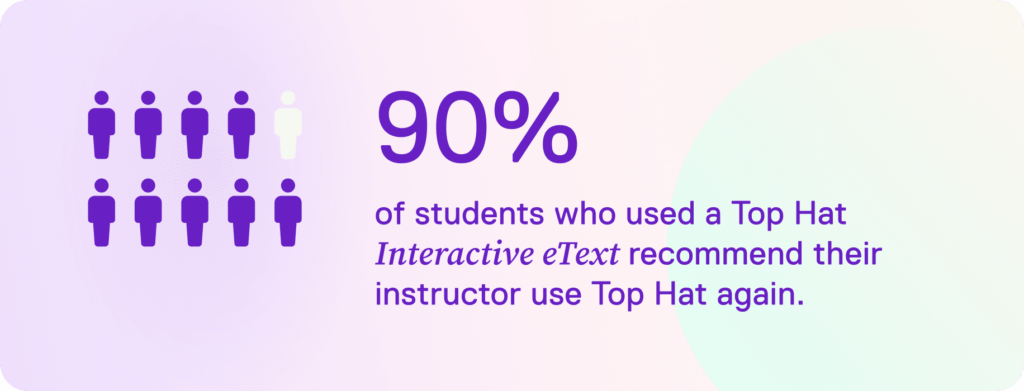
    An image that reads: 90% of students who used a Top Hat Interactive eText recommend their instructor use Top Hat again.

    No matter discipline, students have responded favorably to using Top Hat titles in their course. “I loved the interactive aspect of my Top Hat textbook. Engaging with models, watching videos, and answering questions in chapters was really interesting and valuable to my learning experience,” shares an anonymous student at the University of South Dakota. Learners also appreciate the digestible nature of Top Hat Interactive eTexts. “With Top Hat, I felt that I could easily understand the information and stayed focused throughout my reading for the first time,” shares an anonymous student at Northern Virginia Community College.

    Making participation less intimidating

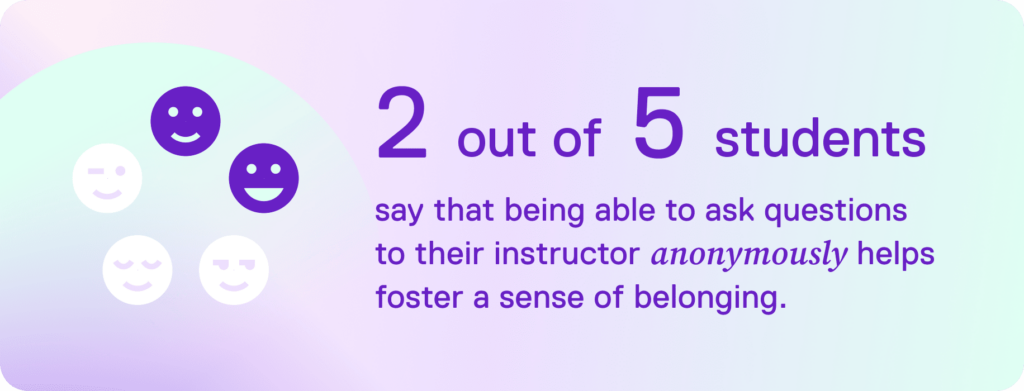
    An image that reads: 2 out of 5 students say that being able to ask questions to their instructor anonymously helps foster a sense of belonging.

    Raising your hand in a large class can come with a good deal of intimidation. Students place increased importance on asking questions anonymously and without fear of judgment. It’s why millions of students have flocked to Generative AI platforms such as ChatGPT for instant study guidance. Educators have tapped into the heightened interest in AI and have shared ethical use principles with students. Some faculty have even allowed students to build off content generated by a Large Language Model. For instance, English professors may let students use ChatGPT to form a thesis statement for an essay and ask them to critique the strengths and weaknesses of the generated response.

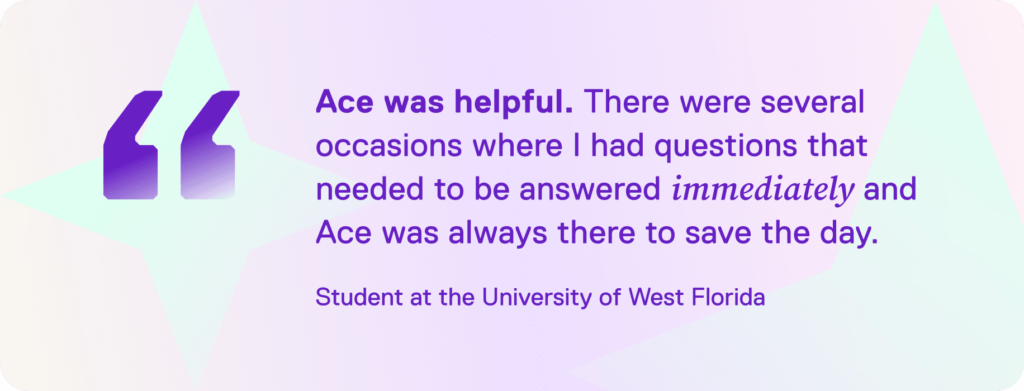
    An image that reads: “Ace was helpful. There were several occasions where I had questions that needed to be answered immediately and Ace was always there to save the day.” Student at the University of West Florida

    More than 630 of our survey respondents used Top Hat Ace, our AI-powered teaching and learning assistant, in the Spring term. Their comments revealed three primary ways that they relied on Ace through the course of their study. 

    1. Provide clarity: Students valued receiving clarification on challenging concepts covered in lecture or while reading their assigned text. “I liked that [Ace] asked a thought-provoking question after answering to promote continuous understanding of the topic, not just giving me the answer,” shares an anonymous student at Oakton Community College.
    2. Personalize study support: Students often relied on Ace for course-specific guidance when completing homework. The best part: since responses are built from the context of the course, students feel like they’re learning along the way versus being handed answers. “I love Ace! I would ask questions and Ace always believed in me that I could answer the question on my own so it would just recommend a section of the module to re-read,” says Nazli Kircicek at McGill University.
    3. Assess knowledge on the fly: Several students highlighted how Ace allows them to reduce their knowledge gaps in advance of tests. Many also used Ace as a tool to apply their understanding of concepts in a low-stakes, low-stress environment. “Ace was able to create sample exam questions relating to the content we were learning in class to prepare for exams during lectures,” shares an anonymous student at Grand Valley State University.

    → New Ebook: FREE strategies to use AI effectively in any course

    Source link

  • Dr. James Lang’s 4 Tips for a Great First Day of Class

    Dr. James Lang’s 4 Tips for a Great First Day of Class

    What goes into a great first lecture? Ask any educator and they’ll highlight three resounding themes: prioritize community, foster connection and build excitement. The good news is that designing a high-impact first lecture doesn’t involve a complete rewrite of your existing lesson plan. Rather, it’s about making simple adjustments to help students form a great first impression.

    Dr. James Lang, acclaimed author of Small Teaching and featured speaker at Top Hat Summer Camp 2024, shares actionable strategies to deepen engagement during week one of your course. We’ve rounded up his ideas below.

    → Student Engagement Toolkit: Enjoy FREE teaching tips, templates and more!

    1. Focus on community building

    Set the table for long-term success by getting to know students and in turn, help them get to know you. Consider sharing what made you want to teach your specific subject and the most rewarding part of teaching. Dr. Lang also suggests intentionally forging personal ties with students. Simple practices could involve showing up to class early and greeting students as they file in. You might also use your first lecture to stream a relevant TED talk, podcast snippet or music video that relates to your course material. Helping students see that there’s more to the first day than reviewing the syllabus will surely leave them feeling inspired and primed to learn. What better feeling could there be as an educator?

    2. Ensure activities model your course structure

    The early stages of your course represent an important opportunity to instill the right behaviors. Dr. Lang’s advice? Begin as you intend to continue by modeling the kind of learning environment you seek. For instance, if your course revolves around peer-to-peer discussions, consider including a collaborative exercise during your opening session. If active learning is important, give students a problem to solve or have them respond to a series of polling questions. Dr. Lang shares other discipline-specific examples of how to break the ice between students.

    History English Math
    Take a page out of Dr. Cate Denial’s book. The Bright Distinguished Professor of American History at Knox College, who teaches a problem-based course, randomly places students in small groups. She then provides each group with a document package about a specific event. Students then work together to develop stories about what occurred during the event. Finally, they share their stories with the wider group. The purpose of the exercise is to demonstrate that in the pursuit of truth there are often numerous ways historical events can be interpreted.  Any English instructor can vouch for the importance of discussion and critical analysis. Consider holding a prior knowledge brainstorm to spark conversation among students. For example, if your course covers 21st Century British literature and culture, you might ask students to respond to the following prompts: a) what do we mean by the word ‘British?,’ b) what are your impressions of British culture and c) are you familiar with any British writers? This is a great way to surface prior knowledge, clarify common misconceptions, and get students thinking about the journey ahead.  You might also use your opening class to get students reflecting on their past experiences in your subject. Dr. Robert Talbert, Professor in the Department of Mathematics at Grand Valley State University, uses open-ended questions to encourage students to reflect on their learning. He shares the following prompts: a) what is something that you are good at doing? And b) how did you get good at the thing you are good at doing? Math is a challenging subject. This exercise gets students thinking about their approach to learning while sending a subtle message that you are invested in their success. 

    3. Pose ‘big’ questions to students (and yourself)

    Framing your course as a BIG question to explore over the term is a powerful way to pique curiosity, build excitement, and communicate the value of what students will learn. Starting your course with a BIG question is also a great opportunity to engage students right away in a meaningful discussion. Here’s an example from a course on science fiction:

    “Can you be confident that the person sitting next to you on the bus is really a human rather than some remarkable replica conjured up by a mad scientist or, perhaps, an alien from another planet? What evidence is needed to conclude that the person casually looking at her mobile device is human? How have we constructed the conceptual boundary between what we qualify as human and what we categorize as robotic, animal, android, or alien? What, in the end, makes the human “human”?”

    If you’re struggling to craft a big question for your course, Dr. Lang suggests thinking through the following prompts:

    • What deep questions drove the development of my discipline?
    • What questions drove the creation of my course?
    • What intriguing questions have arisen over time?
    • What questions remain unanswered in my field?

    To drive a first day discussion around your big question, you might ask your students to pair up and answer the following: What do you know about this subject? How might this relate to other things you’ve studied? How would you answer this question? What other questions does this bring to mind?  Once students have had an opportunity to discuss, regroup as a class and ask a handful of pairs to share their insights.

    4. Try out the Annotated Syllabus method

    Your course syllabus serves as the roadmap for the term. While important to review, Dr. Lang advises it shouldn’t be your first priority and counsels against simply reciting each section. Instead, he suggests using the Annotated Syllabus methodology. Conceptualized by Dr. Remi Kalir, Assistant Professor of Learning Design and Technology at the University of Colorado Denver, the Annotated Syllabus is a tool to generate a broader conversation about your course.

    Prior to the next class, ask students to work through the following prompts: What do students feel needs further clarification? What are their sentiments around your course policies? What are their opinions about readings and assignments? What advice do you have in order to be successful in the course? The goal is to strive for commentary that is “inquisitive and constructive.” Above all, an Annotated Syllabus invites feedback that may otherwise go unheard. Students are made active participants from the get-go and are more accountable for reading the document before coming to class.

    Source link