Tag: Inquirer

  • Higher Education Inquirer : College Prospects, College Targets

    Higher Education Inquirer : College Prospects, College Targets

    In the old American dreambook, a “college prospect” was a young person with ambition and promise—a student looking for a campus where they could grow intellectually, socially, and economically. But in today’s reality, “prospect” is an industry term, a sales category. In enrollment management suites across the country, prospective students aren’t just applicants; they’re targets.

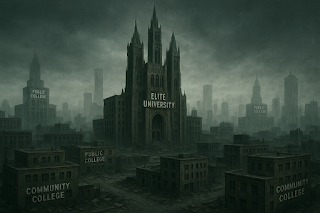
    [Image from Brown University, August 2025)

    Higher education—whether elite, public, or for-profit—now runs on sophisticated marketing pipelines. The same predictive analytics used by corporations, political campaigns, and even law enforcement are deployed to track, segment, and convert students into paying customers. Colleges buy and sell student data from standardized test companies, online lead generators, and high school surveys. They follow “prospects” through their clicks, their campus visits, their FAFSA submissions—nudging them toward a deposit with personalized emails, algorithmically timed text messages, and calculated financial aid offers.

    This is not about education first. It’s about yield rates, tuition revenue, and net tuition per student. For working-class families, first-generation students, and those from marginalized backgrounds, this targeting can be especially dangerous. The glossy brochures and “student success” slogans conceal the hard realities: inflated tuition, debt burdens that can last decades, and career outcomes far less rosy than advertised.

    The for-profit sector perfected this playbook. Schools like Corinthian Colleges, ITT Tech, and the Art Institutes honed high-pressure recruiting scripts, built massive lead databases, and saturated social media feeds with ads promising quick career training and big paydays. When many of these institutions collapsed under federal scrutiny, their tactics didn’t disappear—they spread. Today, public universities and elite private schools use their own version of the same system, dressed up in more respectable branding.

    At the top end of the prestige ladder, “targets” have a different profile. Elite schools scout “development prospects”—wealthy families whose applications are accompanied by the potential for multimillion-dollar gifts. The student is both a potential enrollee and a future donor pipeline. Recruitment here is less about financial aid and more about legacy admissions, networking dinners, and quiet tours with the president.

    What all this targeting has in common is an imbalance of information. Colleges know almost everything about their prospects—income bands, likely majors, ability to pay—while students and families often have only the marketing copy and a sticker price. In this environment, independent, transparent information is a rare form of defense.

    That’s where tools like TuitionFit and the CollegeViability app come in—not as recruitment aids, but as counterintelligence for families.

    • TuitionFit collects and shares real financial aid offers from students across the country. This allows families to see what schools are actually charging students with similar academic and financial profiles—not just the “average” cost schools advertise. By revealing the hidden discounting game, TuitionFit helps families avoid overpaying and resist the psychological pressure of “limited-time offers” from admissions officers.

    • The CollegeViability app compiles public financial data from the U.S. Department of Education and other sources to create an at-a-glance picture of an institution’s fiscal health. It tracks enrollment trends, tuition dependency, debt loads, and other risk factors—warning signs that a college might be on the verge of closing or slashing programs. Families who use it can see trouble coming long before the next headline about a sudden campus shutdown.

    These are not small benefits. Every year, thousands of students are lured into institutions that overpromise and underdeliver. Some are blindsided by mid-program closures. Others graduate into underemployment with six figures of debt. Without tools like TuitionFit and CollegeViability, many would walk into these situations blind.

    The troubling truth is that higher education’s recruitment machine treats students the same way a corporate sales funnel treats customers—and sometimes the way a military intelligence operation treats enemy assets. Prospects are acquired, qualified, engaged, and converted. They are ranked by “propensity to enroll,” courted by carefully timed contact, and celebrated in quarterly revenue reports.

    The people making the targeting decisions rarely bear the costs of a bad outcome. If a student drops out with debt and no degree, it’s a personal tragedy, not a liability on the college’s balance sheet. If a school shutters with no warning, students and their families are left scrambling while administrators move on to new posts elsewhere.

    College should be more than a precision-marketed capture. It should be a transparent, good-faith exchange where both sides have access to the same essential facts. Right now, that balance doesn’t exist—and the gap is being exploited.

    Families who want to survive the recruitment gauntlet must treat it for what it is: a sales process backed by data analytics, designed to maximize institutional revenue, not student outcomes. That means using every independent resource available, asking hard questions, and refusing to be rushed into decisions.

    In the end, the difference between being a college prospect and a college target might be whether you’re armed with real information—or just hope.

    Sources:

    • The Century Foundation, College Admissions and the Business of Enrollment Management

    • U.S. Senate HELP Committee, For Profit Higher Education: The Failure to Safeguard the Federal Investment and Ensure Student Success

    • The Hechinger Report, How Colleges Use Big Data to Target Students

    • TuitionFit, About

    • CollegeViability, Institutional Health Indicators

    Source link

  • Higher Education Inquirer : The Dirty World of Billionaire Leon Black and Jeffrey Epstein: Profits Over People

    Higher Education Inquirer : The Dirty World of Billionaire Leon Black and Jeffrey Epstein: Profits Over People

    Leon Black, the billionaire co-founder and former chief executive officer of Apollo Global Management, maintained a financial relationship with convicted sex offender Jeffrey Epstein that lasted for years and ultimately contributed to Black’s resignation from the firm. Why should HEI be covering this old story?  Because the theme, of profits over people, is a major theme in the dirty world of business that permeates US higher education. 

    Profits Over People

    Apollo Global Management, the firm Black co-founded, is one of the world’s largest alternative asset managers, with hundreds of billions of dollars in assets under management across private equity, credit, and real estate. In 2016, Apollo, along with the Vistria Group and Najafi Companies, acquired Apollo Education Group, the parent company of the University of Phoenix, for over $1.1 billion. The University of Phoenix remains under the control of these owners and continues to operate as a for-profit institution.

    Critics of private equity and venture capital in education argue that such firms are driven by short-term profitability rather than long-term institutional quality. This can lead to aggressive marketing, high tuition, cuts to faculty and staff, and diminished student outcomes. In the case of Apollo Global Management’s ownership of the University of Phoenix, concerns have persisted about the potential for cost-cutting and profit-maximizing strategies to undermine the educational mission. For-profit colleges owned by large investment firms have been accused in the past of prioritizing shareholder returns over student success, adding another layer to the public scrutiny of both Apollo and the institutions it controls.

    Ties Between Leon Black and Jeffrey Epstein

    Between 2012 and 2017, Black paid Jeffrey Epstein approximately $158 million for what he described as financial advice, including tax and estate planning services. A March 2025 report from the Senate Finance Committee revealed that the total amount transferred to Epstein was closer to $170 million, about $12 million more than previously disclosed. In 2023, Black agreed to pay $62.5 million to the U.S. Virgin Islands to settle claims that some of his payments to Epstein were used to support Epstein’s illicit operations. Black has said publicly that his association with Epstein was a “horrible mistake” and has emphasized that had he known more about Epstein’s criminal activities, he would have cut ties sooner.

    Although Black has described his relationship with Epstein as limited, records show that Epstein became one of the original trustees of the Leon Black Family Foundation in 1997. Black also contributed a handwritten poem to a 2003 “50th birthday book” for Epstein, an item that included greetings from other prominent figures. In January 2021, following an independent review by the law firm Dechert LLP that detailed the payments to Epstein, Black announced that he would step down as CEO of Apollo Global Management.

    Black has faced several legal challenges connected to allegations of sexual misconduct, many of which reference Epstein. In 2023, “Jane Doe” filed a lawsuit claiming she was assaulted by Black at Epstein’s Manhattan townhouse; in April 2025, her lawyers sought to withdraw from the case. In another case, accuser Cheri Pierson alleged rape but withdrew her lawsuit in early 2024. A separate suit filed by Guzel Ganieva, which accused Black of abuse and coercion involving Epstein, was dismissed in 2023. Black has consistently denied any wrongdoing.

    Sources

    Business Insider

    The Daily Beast

    ABC News

    Wikipedia – Leon Black

    Wikipedia – Apollo Global Management

    EdSurge

    Republic Report

    Source link

  • Higher Education Inquirer : Art Laffer at YAF: Still Relevant, Still Wrong

    Higher Education Inquirer : Art Laffer at YAF: Still Relevant, Still Wrong

    Arthur Laffer, the Reagan-era economist best known for the “Laffer Curve,” appeared recently at a Young America’s Foundation (YAF) event, still making the same tired claims that have shaped decades of economic inequality, deregulation, and magical thinking. The event, broadcast on C-SPAN, was marketed as a fresh take on conservative economics. What it delivered instead was a rerun of discredited supply-side talking points—punctuated by jokes that fell embarrassingly flat.

    Laffer claimed that Donald Trump’s tariffs were a strategy to bring about more free trade in the future—a baffling contradiction to anyone who understands trade policy or the basics of coercive economic diplomacy. The idea that protectionism is a roundabout route to free markets would be laughable if it weren’t so destructive. But Laffer, like many libertarians, thrives on contradiction. The audience—young, mostly white, mostly male—nodded along as if it all made sense.

    He also defended increased U.S. military spending, invoking Ronald Reagan’s 1980s arms buildup. What he didn’t mention: Reagan was in the early stages of dementia during his presidency, and his military strategy deepened the national debt, even as Laffer’s beloved tax cuts starved the government of revenue. That context never surfaced, of course.

    Laffer’s appearance was followed by Linda McMahon, former WWE executive and Small Business Administration head under Trump. The tag team pairing reinforced the spectacle of right-wing economic theater disguised as intellectual discourse.

    YAF, a competitor to Turning Point USA, presents itself as the more polished brand of conservative youth organizing. It’s backed by deep pockets and institutional support, but its message remains the same: glorify the market, demonize government, and elevate charisma over critical thinking. Its speakers are well-coached in rhetorical sparring, skilled in sophistry, and eager to exploit the inexperience of their college-aged audience.

    Laffer fits that mold perfectly. He’s less a thought leader than a relic of failed policy, propped up by a movement that rewards ideological loyalty over intellectual honesty. His ideas can’t really be called “theories” anymore—empirical evidence has repeatedly debunked them. But among libertarians and the far right, evidence is optional, and repetition is persuasive.

    Young America’s Foundation is adept at drawing youth into a worldview of individualism that rarely benefits individuals. It relies on the passion and ignorance of its followers, asking them to embrace contradictions: that tariffs bring freedom, that debt from war is freedom, that cutting taxes magically increases revenue. It’s a faith-based economics, and Laffer remains its high priest.

    In the end, the only thing more stale than the Laffer Curve is the attempt to keep it alive.

    Sources:

    • C-SPAN: Art Laffer speech at YAF

    • Reagan’s Alzheimer’s revelations: The New York Times

    • Critiques of supply-side economics: Brookings, Economic Policy Institute

    • YAF background: Media Matters, The Nation

    Source link

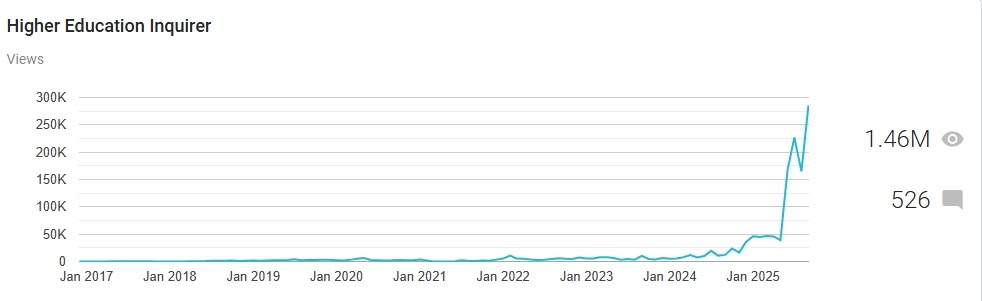
  • Higher Education Inquirer Surpasses 1 Million Views, Including More Than 200,000 in July 2025

    Higher Education Inquirer Surpasses 1 Million Views, Including More Than 200,000 in July 2025

    The Higher Education Inquirer has reached a major milestone: more than 1 million total views since its founding, with over 200,000 views in July 2025 alone—a record-breaking month for the independent investigative site. This surge in readership reflects growing public concern with the state of U.S. higher education, especially at a time of increasing economic precarity, political unrest, and institutional dysfunction.

    As corporate media outlets continue to downsize or ignore coverage of student debt, credential inflation, predatory schools, and the exploitation of academic labor, readers are seeking more critical, independent voices. HEI, which has long focused on underreported stories within the higher education-industrial complex, is becoming a go-to resource for policymakers, whistleblowers, journalists, and everyday people trying to make sense of the education economy.

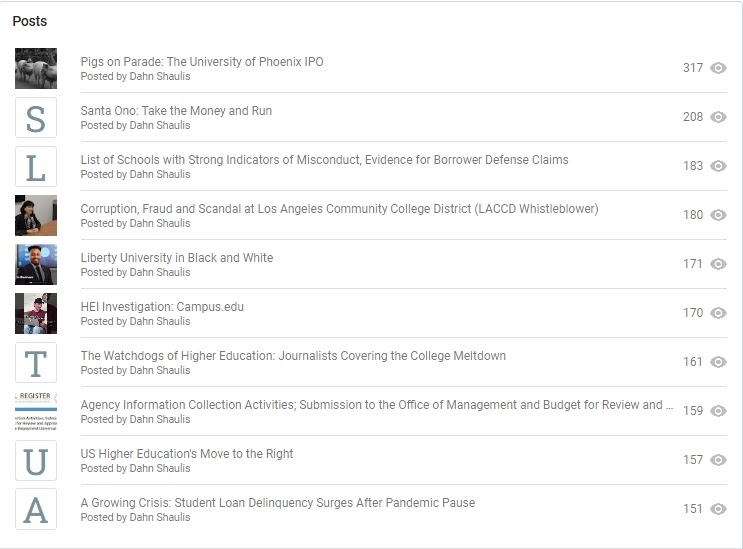
    Most Viewed Stories in July 2025

    A few standout articles reveal key themes that are resonating with readers:


    1. “Camp Mystic: A Century of Privilege, Exclusion, and Resilience Along the Guadalupe”

    Views: 8,730

    This deeply researched piece on the elite girls’ camp in Texas struck a nerve with readers interested in the intersection of inherited wealth, segregation, and performative philanthropy. Camp Mystic serves as a metaphor for the parallel institutions that shape American leadership in quiet, exclusive ways—far from public scrutiny.

    Trend: Growing interest in how generational wealth and private networks perpetuate elite power and influence, especially through educational institutions.


    2. “The Big Beautiful Bill”: A Catastrophic Blow to College Affordability

    Views: 1,290

    This analysis of new legislation affecting federal student aid programs explores how a bill dressed in populist language has real consequences for working-class and middle-income families. Readers responded to its dissection of policy doublespeak and the structural defunding of public education.

    Trend: Rising awareness of how both major political parties contribute to the erosion of affordable education—often under misleading rhetoric.


    3. “Santa Ono: Take the Money and Run”

    Views: 956

    A pointed critique of University of Michigan President Santa Ono’s high salary and revolving-door administrative career drew in readers frustrated by bloated leadership pay and lack of institutional accountability.

    Trend: Increased public scrutiny of university presidents and boards of trustees, especially at elite institutions.


    4. “List of Schools with Strong Indicators of Misconduct, Evidence for Borrower Defense Claims”

    Views: 943

    This database-style article provided a valuable resource for former students, journalists, and attorneys. By documenting schools with troubling records, it supported those filing Borrower Defense to Repayment claims and highlighted the ongoing fallout from the for-profit college boom.

    Trend: Continued demand for actionable consumer information amid the Biden Administration’s limited and politically fraught debt relief efforts.


    5. “Degrees of Discontent: Credentialism, Inflation, and the Global Education Crisis”

    Views: 900

    This global take on the failures of credential-driven economies resonated with a wide audience—from jobseekers with degrees they can’t use to educators struggling to make sense of shifting academic value.

    Trend: A philosophical and economic reckoning with credentialism, especially as degrees lose value while tuition and debt skyrocket.


    6. “Layoffs at Southern New Hampshire University”

    Views: 826

    Coverage of SNHU, a major player in online education, shed light on the darker side of “innovation”: layoffs, overwork, and instability for faculty and staff.

    Trend: Growing doubts about the long-term sustainability and labor ethics of the online education model.


    7. “Universities Brace for Endowment Tax Hike, Rethink Investment Strategies”

    Views: 687

    A timely piece on elite university endowments caught the eye of readers interested in how wealth hoarding and financial engineering are baked into modern academia.

    Trend: Rising critiques of nonprofit tax loopholes and the financialization of higher ed.


    8. “Liberty University in Black and White”

    Views: 684

    This critical examination of Liberty University’s public image, internal contradictions, and links to right-wing political power explored how Christian nationalist ideology operates through higher education.

    Trend: High interest in the political roles of conservative religious institutions and their ties to the culture wars.


    9. “Corruption, Fraud and Scandal at Los Angeles Community College District (LACCD Whistleblower)”

    Views: 615

    A whistleblower-centered article on LACCD corruption revealed widespread misuse of funds and institutional cover-ups, especially in facilities projects.

    Trend: Rising demand for investigative journalism focused on local corruption in publicly funded institutions.


    10. “Agency Information Collection Activities…Borrower Defense to Loan Repayment Universal Forms”

    Views: Not Yet Indexed

    While bureaucratic in title, this article was shared among policy experts and debt activists for its breakdown of how regulations—and public comment periods—impact real people trying to discharge fraudulent debt.

    Trend: Readers are becoming more engaged in regulatory policy and more skeptical of federal agencies’ ability or willingness to protect consumers.


    What Readers Want 

    What these stories show is a distinct pattern: readers want more accountability, more transparency, and less propaganda from the education system that has long promised prosperity and delivered precarity. They’re fed up with bloated administrative salaries, empty credentials, elite hypocrisy, and legislative betrayal.

    Thanks to grassroots support and collaborations with students, whistleblowers, and journalists, the Higher Education Inquirer continues to grow in both reach and relevance.

    As we pass 1 million views, we’re not just marking clicks—we’re tracking the pulse of a system in crisis. And we’re not done yet.

    Source link

  • Higher Education Inquirer : Forgetting Neil Postman

    Higher Education Inquirer : Forgetting Neil Postman

    [For my good friend, a higher education executive who has seen it all, and suggested that all of us pause, take a look back, and think.]

    Neil Postman first gained national attention in 1969 with Teaching as a Subversive Activity, co-authored with Charles Weingartner. In a period marked by war, civil unrest, and cultural transformation, Postman offered a bold challenge to the status quo of American education. Schools, he argued, were failing not because they lacked resources or rigor, but because they had lost sight of their deeper purpose. Instead of fostering critical thinking and civic engagement, they were manufacturing conformity through standardized tests, textbooks, and passive learning. Postman envisioned classrooms without fixed curricula, where teachers would become co-learners and facilitators, helping students develop the tools of inquiry and what he memorably called “crap detection.” It was a radical vision: education as an act of democratic resistance.

    By the early 1980s, Postman had turned his attention to how media was shaping society—and deforming education. In The Disappearance of Childhood (1982), he claimed that television was dissolving the cultural boundaries between children and adults. Television, unlike print, made no distinction in content delivery; it treated all viewers as equal consumers of images and sensation. The consequences, he warned, were profound: children were becoming prematurely cynical while adults increasingly behaved like children. The medium, he believed, flattened developmental distinctions and eroded the cultural function of school as a place for guided maturation and ethical formation.

    Then came Amusing Ourselves to Death in 1985, Postman’s most widely read and enduring work. Written during the ascendancy of television and Reagan-era consumer culture, the book argued that television had transformed public discourse into entertainment. It was not merely the content of television that disturbed him, but its form—its bias toward speed, simplification, and emotional stimulation. In such a media environment, serious discussion of politics, education, science, or religion could not survive. News became performance, candidates became celebrities, and education was increasingly judged by its entertainment value. Postman lamented the way Sesame Street, often hailed as educational television, conditioned children to love television itself—not learning, not schools, not the slow, difficult process of study.

    As the decade progressed, Postman began articulating a broader cultural critique that culminated in Technopoly: The Surrender of Culture to Technology (1992). In this work, he defined technopoly as a society that not only uses technology but is dominated by it—a culture that believes technology is the solution to all problems, and that all values should be reshaped in its image. Postman acknowledged that tools and machines had always altered human life, but in a technopoly, technology becomes self-justifying. It no longer asks what human purpose it serves. Postman noted that schools were being wired with computers, not because it improved learning—there was no solid evidence of that—but because it seemed modern, inevitable, and profitable. His question—“What is the problem to which this is the solution?”—was a challenge not just to education reformers, but to an entire ideology of progress.

    In The End of Education (1995), Postman returned to the question that haunted all his work: what is school for? He argued that American education had lost its narrative. Without compelling guiding stories—what he called “gods”—schools could not inspire loyalty, discipline, or moral development. In place of narratives about democracy, stewardship, public participation, and truth-seeking, schools now told the story of market utility. They trained students for jobs, not for life. They emphasized performance metrics over philosophical inquiry, and they treated students as customers in a credential economy. Education, he warned, was becoming just another mass medium, modeled increasingly after television and later the internet, with predictable results: shallowness, fragmentation, and disengagement.

    By the time Postman died in 2003, the world he had warned about was rapidly taking shape. Facebook had not yet launched. Smartphones had not yet arrived. Generative AI was decades from the mainstream. But already, education was being reshaped by branding, performance metrics, digital delivery, and venture capital. The university was becoming a platform. The classroom was being converted into content. Students were treated not as citizens in formation, but as users to be optimized. The language of education—once rooted in moral philosophy and civic purpose—had begun to sound more like business strategy. Postman would have heard the rise of terms like “learning outcomes,” “human capital development,” and “scalable solutions” as evidence of a culture that had surrendered judgment to systems, wisdom to code, and meaning to metrics.

    Postman’s refusal to embrace digital culture made him easy to ignore in the years that followed. He never gave a TED Talk. He didn’t blog. He didn’t build a brand. He never even used a typewriter. He wrote every word by hand. In a world of media influencers, LinkedIn thought leaders, and edtech evangelists, Postman’s ideas didn’t fit. But the deeper reason we forgot him is more unsettling. 

    Remembering Postman would require a painful reckoning with how far higher education has drifted from its public mission and democratic roots. It would mean admitting that education has been refashioned not as a sacred civic institution but as a delivery mechanism for marketable credentials. It would mean asking questions we’ve tried hard to bury.

    What is higher education for? What kind of people does it produce? Who decides its purpose? What stories do our schools still tell—and whose interests do those stories serve?

    Postman would not call for banning screens or abolishing online learning. He was not nostalgic for chalkboards or print for their own sake. But he would demand that we pause, reflect, and resist. He would ask us to think about what kind of citizens our institutions are shaping, and whether the systems we’ve built still serve a human purpose. He would remind us that information is not wisdom, and that no innovation can substitute for meaning.

    As the Higher Education Inquirer continues its investigations into the commercialization of academia, the credentialing economy, and the collapse of higher ed’s public trust, we find Postman’s voice echoing—uninvited but indispensable. His critiques were not popular in his time, and they are even less welcome now. But they are truer than ever.

    We may have forgotten him. But we are living in the world he tried to warn us about.


    Sources

    Neil Postman and Charles Weingartner, Teaching as a Subversive Activity (1969)

    Neil Postman, Amusing Ourselves to Death (1985)

    Neil Postman, Technopoly: The Surrender of Culture to Technology (1992)

    Neil Postman, The End of Education: Redefining the Value of School (1995)

    Postman’s archived writings: https://web.archive.org/web/20051102091154/http://www.bigbrother.net/~mugwump/Postman/

    Source link

  • Higher Education Inquirer : Forgetting Henry George

    Higher Education Inquirer : Forgetting Henry George

    As American colleges and universities spiral deeper into debt, corporatization, and social irrelevance, it is worth asking not just what ideas dominate the landscape—but what ideas have been buried, neglected, or deliberately forgotten. Among the most significant casualties in our intellectual amnesia is Georgist economics, a once-influential school of thought that offered a radical, yet practical, alternative to both capitalism’s excesses and socialism’s centralization. And in today’s extractive academic economy—what Devarian Baldwin calls the “UniverCity”—its insights are more relevant than ever.

    The Ghost of Henry George

    Henry George, a 19th-century American political economist, is best known for his seminal work Progress and Poverty (1879), in which he argued that while technological and economic progress increased wealth, it also deepened inequality—primarily because the gains were siphoned off by landowners and monopolists. His solution was deceptively simple: tax the unearned income from land and natural monopolies, and use that revenue to fund public goods and social services.

    At one time, George’s ideas inspired political movements, policy debates, and even academic curricula. He was considered a serious rival to Karl Marx and a practical philosopher for American reformers, including the early labor movement. Cities like San Francisco saw brief experiments with land value taxation. But today, outside niche think tanks and the occasional urban planning circle, Georgism is a faint echo, barely audible in the halls of economic departments or public policy schools.

    The University and the Land

    If we look at contemporary higher education through a Georgist lens, what emerges is a sobering picture. Colleges and universities are not merely neutral grounds for the exchange of ideas—they are massive holders of land, beneficiaries of public subsidies, and agents of displacement. Institutions from NYU to the University of Chicago to Arizona State have used their nonprofit status and real estate portfolios to expand into communities, often gentrifying and pricing out working-class and BIPOC residents.

    At the same time, these same institutions profit from a credentialing economy built on a foundation of student loan debt. Over 43 million Americans collectively owe more than $1.6 trillion in federal student loans, an economy of indebtedness that props up tuition-driven institutional budgets while shackling generations of graduates. The very students who attend these universities, often in the hope of upward mobility, find themselves trapped in debt servitude—subsidizing administrative bloat, sports franchises, and real estate empires they will never own.

    This is where Devarian Baldwin’s work becomes critical. In In the Shadow of the Ivory Tower, Baldwin exposes how universities have become “anchor institutions,” deeply embedded in the urban fabric—not just through education, but through policing, property development, hospital systems, and labor exploitation. These institutions accumulate wealth not by producing new knowledge, but by extracting rents—social, economic, and literal—from their surroundings.

    Baldwin and George, though a century apart, are speaking to the same fundamental economic injustice: wealth flowing upwards through property and privilege, at the expense of the many.

    Why Georgism Was Forgotten

    So why has Georgism disappeared from mainstream education? The answer lies partly in the success of those it sought to regulate. Landowners and financiers, who stood to lose the most from land value taxation, worked diligently to discredit George’s theories. Neoclassical economics, with its abstract models and marginal utility curves, became the dominant language—obscuring the real-world power dynamics of land and labor.

    Universities, especially elite ones, adopted this neoclassical framework, increasingly aligning their interests with those of capital. Philanthropic foundations and corporate donors funded economic departments and think tanks that promoted market fundamentalism. Over time, Georgism—radical yet rooted in common sense—was pushed out of the curriculum.

    This forgetting wasn’t accidental. It was ideological.

    A Forgotten Game with a Forgotten Message

    A striking example of Georgism’s cultural erasure lies in the very board game that has taught generations about capitalism: Monopoly. Originally created in the early 20th century by a woman named Elizabeth Magie, the game was first called The Landlord’s Game and was explicitly designed to illustrate Henry George’s ideas. Magie’s intent was pedagogical—she wanted players to see how land monopolies enriched a few while impoverishing others, and to promote George’s remedy of a single land tax.

    But over time, the game was appropriated and rebranded by Parker Brothers and later Hasbro, stripped of its Georgist message and recast as a celebration of ruthless accumulation. What began as a cautionary tale about inequality became a glorification of it—a metaphor for how George’s ideas were not just buried but inverted.

    In that sense, Monopoly is the perfect symbol for the American university: a system that once had the potential to democratize opportunity but now functions as a machine for privatizing wealth and socializing risk, leaving students and communities to pick up the tab.

    What Higher Education Could Learn—and Teach

    If the goal of higher education is to educate an informed, critical citizenry, then forgetting Georgist economics is not just an intellectual oversight—it’s a moral failure. Henry George offered a vision of society where value created by the community is returned to the community. In the age of student debt, university land grabs, and deepening inequality, this vision is urgently needed.

    Imagine a higher education system where public revenue from land values funds debt-free college. Imagine a world where students no longer mortgage their futures for degrees whose value is increasingly uncertain. Imagine colleges not as engines of gentrification but as stewards of local wealth, investing in community-owned housing and cooperatives. Imagine students learning about economics not just as math problems, but as moral questions about justice, equity, and the public good.

    Devarian Baldwin’s scholarship, much like George’s, invites us to interrogate power structures and imagine alternatives. It’s time for a revival of that imagination.

    Relearning the Unlearned

    Reclaiming Georgist economics in the academy would not be a return to some golden past, but a reckoning with the present. It would mean confronting the rentier logic at the heart of higher education—and the debt-based financing that sustains it—and reorienting our institutions toward justice and common prosperity.

    In a moment when so much of American higher ed is collapsing under its own contradictions, perhaps what’s needed is not another billion-dollar endowment or ed-tech unicorn, but an idea long buried: that land—and learning—should belong to the people.

    For the Higher Education Inquirer, this is part of an ongoing inquiry into the pasts we forget, the futures we imagine, and the power structures that shape both. 

    Source link

  • Higher Education Inquirer : Trump’s March Backward

    Higher Education Inquirer : Trump’s March Backward

    The United States is witnessing an alarming shift in the balance of power. Recent actions by the Supreme Court and Congress have effectively cleared the way for President Donald Trump to exercise authority in ways critics say resemble authoritarian rule.

    Central to this shift is the Supreme Court’s decision on July 8, 2025, to allow Trump’s mass federal layoffs to proceed. This ruling overturned a lower court’s injunction that had temporarily blocked the president’s executive order to slash tens of thousands of federal jobs. The layoffs target agencies including the Environmental Protection Agency, the Department of Education, and the Department of Health and Human Services, critical players in addressing climate change, public health, and education.

    The court’s decision was unsigned and passed 8–1, with Justice Ketanji Brown Jackson dissenting. Her dissent warned that the ruling emboldens the president to exceed constitutional limits without proper checks.

    Just weeks earlier, Congress passed what supporters called the “One Big Beautiful Bill,” a sweeping budget package that enshrined Trump-era tax cuts, eliminated taxes on tips and Social Security income, and drastically reduced funding for social safety net programs like Medicaid and SNAP. The bill also increased Pentagon spending by $125 billion. The legislation passed strictly along party lines, with no Democratic votes.

    The atmosphere of intensifying executive authority was underscored on June 14, 2025, when Trump staged a large-scale military parade in Washington, D.C., reminiscent of displays typically seen in authoritarian regimes. The parade featured tanks, fighter jets, and thousands of troops marching through the capital, a spectacle widely criticized as an exercise in pageantry and a troubling signal of militarism. In response, spontaneous “No Kings” protests erupted nationwide, with demonstrators rejecting what they saw as the cultivation of a personality cult and warning against the erosion of democratic norms.

    These domestic developments unfold against a backdrop of escalating global crises and geopolitical realignments. The Trump administration has maintained a confrontational stance toward China, imposing new tariffs that have intensified a growing economic cold war. This friction comes as the BRICS coalition — Brazil, Russia, India, China, and South Africa — gains strength, seeking alternatives to the U.S.-dominated financial and diplomatic order.

    Meanwhile, the U.S. continues to supply arms and financial support to Ukraine in its conflict with Russia, while simultaneously imposing inconsistent policies that weaken its international credibility, especially regarding the unresolved Palestinian conflict.

    At home, the Trump administration’s deregulation of the cryptocurrency market has raised alarms. With minimal oversight, the growing crypto economy faces increased risks of fraud and instability, a symptom of the broader laissez-faire approach that favors corporate interests over public protections.

    Adding to domestic turmoil, Trump has controversially pardoned dozens of individuals convicted for their roles in the January 6 Capitol insurrection, framing them as “political prisoners.” Many have ties to extremist groups, and Trump has proposed hiring preferences for them within the federal government’s newly created Department of Government Efficiency, which is leading the controversial federal workforce layoffs.

    Legal experts and civil rights organizations argue these actions collectively undermine the constitutional principle of separation of powers. They say the administration’s use of executive orders and politically motivated pardons bypasses Congress and the courts, weakening democratic oversight.

    Congress’s role has also been questioned. By passing the partisan budget bill without bipartisan support, critics argue lawmakers have effectively rubber-stamped an agenda that dismantles government functions, cuts vital social programs, and expands military spending.

    The Supreme Court’s emergency ruling to lift the injunction against the layoffs further signals the judiciary’s retreat from its role as a check on executive power. By acting swiftly and without a full hearing, the court has allowed a significant reshaping of the federal workforce without thorough judicial review.

    Together, these developments mark a troubling trend toward the concentration of power in the executive branch. Observers warn that if left unchecked, these actions could erode the foundations of American democracy and weaken its position in an increasingly multipolar world.


    Sources

    San Francisco Chronicle, “Supreme Court clears way for Trump to resume mass federal layoffs” (July 8, 2025)

    https://www.sfchronicle.com/politics/article/trump-mass-firings-20761715.php

    Associated Press, “Trump signs sweeping tax, spending bill on July 4” (July 4, 2025)

    https://apnews.com/article/3804df732e461a626fd8c2b43413c3f0

    Politico, “House Republicans pass ‘One Big Beautiful Bill’ after weeks of division” (May 22, 2025)

    https://www.politico.com/news/2025/05/22/house-republicans-pass-big-beautiful-bill-00364691

    Business Insider, “Supreme Court rules in favor of Trump’s federal layoffs” (July 8, 2025)

    https://www.businessinsider.com/supreme-court-ruling-trump-firings-federal-agencies-2025-7

    Washington Post, “Trump begins mass commutations for Jan. 6 rioters, defends actions as ‘justice reform’” (March 1, 2025)

    https://www.washingtonpost.com/politics/2025/03/01/trump-jan-6-pardons

    Medicare Rights Center, “Final House vote looms on devastating health and food assistance cuts” (July 3, 2025)

    https://www.medicarerights.org/medicare-watch/2025/07/03/final-house-vote-looms-on-devastating-health-and-food-assistance-cuts

    Source link

  • Higher Education Inquirer : IMPORTANT INFO for Sweet v Cardona (now Sweet v McMahon) CLASS

    Higher Education Inquirer : IMPORTANT INFO for Sweet v Cardona (now Sweet v McMahon) CLASS

    Just dropping this IMPORTANT INFO from the DOE for Sweet v Cardona (now Sweet v McMahon) peeps who are CLASS – DECISION GROUPS and POST-CLASS.

    Edited To Add

    Decisions Class are streamlined R and R submissions.

    Post-class denials MUST ask the DOE for a reconsideration, which allows you to add additional evidence.

    Orginial Post:

    For REVISE and RESUBMITS (R and R) notices, the DOE is now saying that they WILL “disregard R and R*”* submissions if you EMAIL additional supporting documents or material. You CANNOT email the R and R back.

    You MUST submit a NEW BDTR APPLICATION and INCLUDE your previous BDTR application number which can be fund on the Denial letter.

    YOU HAVE 6 MONTHS TO RE-SUBMIT FROM THE RECEIPT OF THE R AND NOTICE (Here: https://studentaid.gov/borrower-defense**/

    **)

    The DOE states, “If you email supplemental information to the DOE or attempt to update your existing application, you will be treated as having failed to Revise and Resubmit”.

    ALSO, If you are still trying to add more evidence to your BDTR application this late in the game, you may want to wait for the decision letter to come out. We are reaching Group 5 Decision deadline, and Post-Class is 6 months after that. If you feel uneasy about your evidence, START collecting it now!

    Follow all DIRECTIONS on anything you get from the DOE relating to BDTR (except demanding payment, they can pound sand LOL).

    In Solidarity!!!

    Source link

  • Higher Education Inquirer : College Financial Aid: How It Really Works

    Higher Education Inquirer : College Financial Aid: How It Really Works

    Crucial Insights: Understanding College Financial Aid Dynamics

    (00:02:56) Variety of College Financial Assistance Options
    (
    00:05:18) Scholarships: Balancing Merit and Financial Need
    (
    00:10:00) Student Selection Strategies in College Admissions
    (
    00:21:40) Financial Aid Strategy at Competitive vs. Smaller Schools
    (
    00:26:29) Major-based Financial Aid Allocation in Colleges

    Source link

  • Higher Education Inquirer : Fiction: The Pines Still Whisper

    Higher Education Inquirer : Fiction: The Pines Still Whisper

    Cass McBride pulled into the parking lot of Atlantic Cape Community College just as the morning fog was lifting. The campus was quieter than she remembered—fewer cars, fewer conversations, fewer reasons to linger. The culinary arts building stood at the edge, windows clouded with dust, the café shuttered and dark.

    Javi Sandoval sat beside her, scrolling through an email on his cracked phone screen. The college had just announced what everyone already knew: Atlantic Cape’s culinary program would be consolidated with Rowan College at Burlington County by the fall. The words were clean and administrative—“efficiency,” “realignment,” “cost savings”—but everyone understood the message. This place was being downsized, absorbed, and eventually erased.

    “They’re moving all the classes to Mt. Holly,” Javi said. “That’s over an hour away. No shuttle, no support. Just go if you can. Or don’t.”

    Cass nodded, her hands resting on a worn-out canvas bag filled with cookbooks and a half-used chef’s coat. “They say it’s about opportunity. But it feels like they’re just trimming away everything that made this place ours.”

    Inside the student center, the old café was locked, its chalkboard menu still faintly showing specials from months ago—creamy risotto, grilled seasonal vegetables, apple tart. Meals once made by students, for staff and faculty, as part of their hands-on learning.

    They walked around to the back hallway near the faculty offices, hoping to find someone who could give them real answers. That’s where they found Professor Reilly, sitting on a bench with a cardboard box beside him—books, a stained apron, and a union button that read: EDUCATION IS NOT A BUSINESS.

    Reilly had taught part-time in the culinary program for over a decade—early morning sections, night classes, summer workshops. He was known for lecturing about labor history in the middle of baking demonstrations, quoting Eugene V. Debs while folding dough.

    “They gave me fifteen minutes,” he said when Cass asked what had happened. “No severance. Just a letter. Said my ‘contract wasn’t renewed due to program restructuring.’ They didn’t even spell my name right.”

    Javi sat down next to him. “I thought you were protected. Weren’t you in the union?”

    Reilly chuckled. “We tried. We organized. But it’s hard when most of us are part-time and disposable. Admin smiles during bargaining, then turns around and guts your job through ‘curricular updates.’ They always find a way.”

    Cass asked him if he’d stay in the area.

    “I’ll stay,” he said. “Because this is where the students are. Because someone needs to remind them they’re not crazy for wanting more than just job training and debt. They deserve an education that feeds the soul, not just the economy.”

    That night, Cass and Javi drove out past Pleasantville, where empty storefronts now stood beside a few remaining restaurants, barbershops, and bodegas. They passed through Margate and Ventnor, where beach homes glowed in early evening light, and the golf courses were still lush and quiet. In Somers Point, they saw the “Help Wanted” signs outside the waterfront restaurants—jobs with no benefits and long hours, perfect for students who no longer had classes to attend.

    The casinos in Atlantic City still blinked and buzzed, but the crowds were thinner, and most of the profits came from online betting now—clicks from phones, not chips on tables.

    They camped that evening just off Route 542, in a small clearing where the Pines bent gently in the wind. The stars came out slowly.

    “I miss the kitchen,” Javi said. “The way Reilly used to talk about food—like it was a kind of justice.”

    Cass pulled out her copy of The Grapes of Wrath, the one Reilly had recommended. She turned to a page he had dog-eared for her. “‘And the little screaming fact that sounds through all history: repression works only to strengthen and knit the repressed.’”

    Javi looked up at the trees. “I keep thinking about people like Bernie Sanders and AOC. The way they talk about socialism, unions, public schools—for them, it’s not just politics. It’s survival. Dignity. Like what Reilly was trying to teach.”

    Cass smiled, the firelight flickering on her face. “Yeah. It makes you think maybe this isn’t the end. Maybe it’s the start of something different.”

    The wind moved through the Pines, steady and low, like an old voice telling stories to those who still cared to listen.

    And for now, that was enough.

    Source link