Tag: insecurity

  • College Food Pantry Helps Students Combat Food Insecurity

    College Food Pantry Helps Students Combat Food Insecurity

    With rising food costs and uncertain federal food-assistance benefits wreaking havoc on families nationwide, Alicia Wright has found relief in an unlikely place: her community college’s food pantry.

    Wright, a student at Roxbury Community College, said her campus food pantry has been lifesaving, especially as she juggles classes while raising her 6-year-old daughter, Olivia.

    “I was like, ‘Oh snap—I don’t have to trek around Boston to find food from other local pantries,’” said Wright, a theater major who is scheduled to graduate in 2027. “Having it right there really changed the game for me.”

    Wright is one of more than 1,500 students who have relied on the pantry, better known as the Rox Box, since its launch in October 2023, according to Nancy Santos, RCC’s Project Access director.

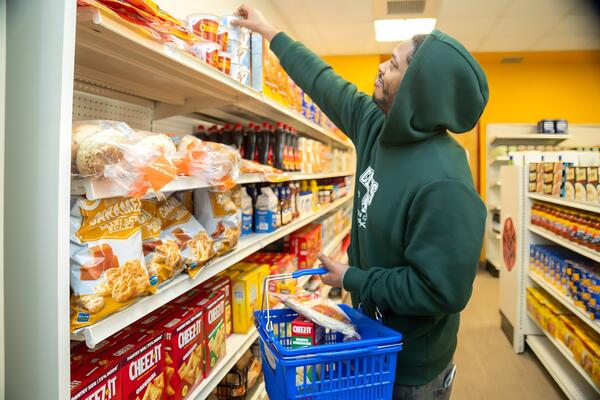
    Roxbury Community College students shop for food and personal care essentials at the Rox Box.

    Roxbury Community College

    Designed to mirror a neighborhood grocery store, the pantry carries items such as food, diapers and personal care essentials and is funded entirely by the community.

    “If I find myself going to class thinking about how I didn’t go grocery shopping this weekend, I know I can pick up something from the Rox Box,” Wright said, adding that students receive 30 points each month to redeem for items they need.

    “That lets me be more present in class … [and] really does allow peace of mind,” Wright said.

    Like Wright, nearly 60 percent of college students nationwide have experienced at least one form of basic needs insecurity in the past year, according to a recent Hope Center survey.

    According to Swipe Out Hunger, a nonprofit dedicated to ending college student hunger, student visits to campus food pantries have increased by 30 to 50 percent over the past year across its more than 900 campus partners nationwide.

    Origin story: The Rox Box started as an extension of Project Access, an initiative designed to address the nonacademic issues that can prevent degree completion at the Boston-area college.

    Santos said the Rox Box has met a strong need, serving more than 300 students each month.

    “It’s really taken off,” Santos said. “We see the athletes and everyone walking around with their little bags that say ‘Rox Box,’ and they’re proud that they’re going.”
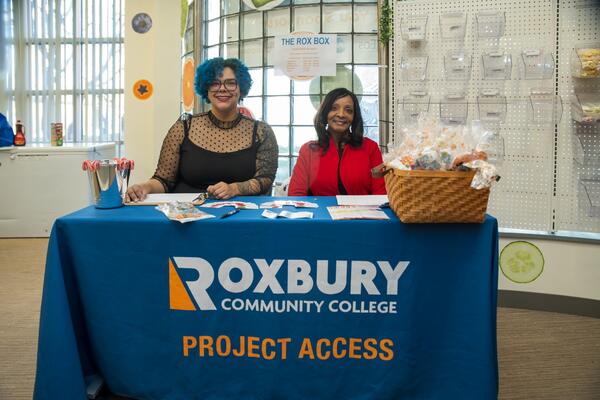
    Two women, one with blue hair wearing a black dress with a sheer overlay, and one with shoulder-length dark hair wearing a red top, sit behind a table with a blue tablecloth that says "Roxbury Community College Project Access."

    Roxbury Community College Project Access director Nancy Santos (right) sitting with a student worker at the Rox Box.

    Roxbury Community College

    She noted that demand continues to rise, with more than 1,700 visits from over 1,500 students between September and December 2025.

    “We know the need is out there, because 1,700 visits on our campus is a large number when we only have 2,400 students enrolled,” Santos said, noting that RCC’s student body is predominantly Black, Latino and Pell Grant eligible.

    Santos said she regularly surveys students who rely on the Rox Box and has found that nearly 40 percent worry their food won’t stretch until the next time they can afford to buy more, while nearly 30 percent have changed their eating habits to make the provisions last longer.

    She underscored how the federal government shutdown last fall contributed to growing “uneasiness” and “insecurity” around RCC students’ food needs.

    This comes as nearly 40 percent of public college students in Massachusetts experienced food insecurity last year.

    “The numbers are alarming to us,” Santos said. “Our faculty have even shared that they can sometimes see students are distracted or they don’t come to school if they’re hungry … [and] it really does affect their grades.”

    To ensure the Rox Box runs smoothly, Santos said, they hired a coordinator who is an RCC alum and had previously relied on the pantry.

    “She started as a work-study, so she worked in the pantry with us, and when she graduated we hired her back,” Santos said. “In doing so, the students identify with her and they see there’s a path. They see where they are isn’t where they’ll always be.”

    Santos said the pantry helps students feel supported and actively works to reduce the shame around needing help.

    “I often say that the shame is not that you are food insecure, the shame is that [food insecurity] exists,” Santos said. “Don’t pretend it isn’t happening. Address it and embrace it and let’s figure out a way to wipe it out.”

    What’s next: Santos said starting a campus food pantry is a “big undertaking” but worthwhile for other institutions looking to create their own.

    “We are a small college, but we care for our students,” Santos said. “When students are fed and when they’re able to concentrate and really study, it helps them go across the finish line.”

    Wright agreed, adding that actively listening to students’ needs and implementing those changes really fosters a sense of trust and community.

    “We tell them our views and what we need and everything, and then we see things being done about it,” Wright said. “It really allows us to feel seen, heard and supported.”

    Ultimately, Wright said, RCC really gets it right about seeing students “holistically.”

    “We’re not just students—we’re entrepreneurs, we’re parents, we’re our parents’ caregivers,” Wright said. “A lot of us are already full-grown people who have lived life and know how to survive, [but] we just need a bit more support that shows [the college is] here for your success.”

    Want to help students battling food insecurity? You can support The Rox Box here.

    Get more content like this directly to your inbox. Subscribe here.

    Source link

  • Food Insecurity Is Surging Among Child Care Providers – The 74

    Food Insecurity Is Surging Among Child Care Providers – The 74


    Join our zero2eight Substack community for more discussion about the latest news in early care and education. Sign up now.

    Hunger is on the rise for the early care and education workforce, according to recent research from the Stanford Center on Early Childhood, and signs suggest the challenge is unlikely to improve in the short term. 

    In June, 58% of early care and education providers surveyed by the RAPID Survey Project at Stanford said they were experiencing hunger, which researchers measured using six questions about food insecurity developed by the U.S. Department of Agriculture. These providers, who span a variety of roles and settings, are not just dealing with sticker shock at the grocery store; they are skipping meals, eating smaller portions to stretch food supplies further, and going hungry because they’ve run out of money to purchase food.

    The RAPID Survey Project measured hunger using six food security criteria developed by the U.S. Department of Agriculture:

    1. The food that we bought just didn’t last, and we didn’t have money to get more.
    2. We couldn’t afford to eat balanced meals.
    3. Did you or other adults in your household ever cut the size of your meal or skip meals because there wasn’t enough money for food?
    4. If yes, how often did this happen?
    5. Did you ever eat less than you felt you should because there wasn’t enough money for food?
    6. Were you ever hungry but didn’t eat because there wasn’t enough money for food?

    RAPID has charted provider food insecurity for the past four years. Rates of hunger held steady between 20% and 30% from summer 2021 until early 2024, then began rising precipitously. 

    Phil Fisher, director of the Stanford Center on Early Childhood, said the status quo rates of provider hunger were “unacceptable to begin with,” but that this recent spike is both “alarming” and “concerning.” 

    “The early care and education workforce is incredibly vulnerable to economic trends,” Fisher said, explaining the rise. “Part of it is just how close to abject poverty many [educators] are.”

    Indeed, early educators earn a median wage of $13.07 per hour, making it one of the lowest-paid professions in the United States. An estimated 43% of the workforce relies on public benefits, such as Medicaid and food stamps, to get by. 

    So when prices go up, early educators are among the first to feel the effects, and lately, food prices have done nothing but climb. The cost of groceries has increased almost 30% since February 2020. 

    “Food is very expensive,” said Isabel Blair, a home-based child care provider of almost 20 years who recently decided to close her program in Michigan. “It’s hard for families earning minimum wage to cover their basic needs — housing, child care and food.”

    Blair has noticed price inflation among eggs and produce, in particular. Both are staples in an early education program. 

    “You go to the grocery store, and the fresh vegetables are very expensive. For a tomato, you pay like three bucks. Or a dozen eggs, you play close to $4 now,” she said. “Feeding the children, you have to provide breakfast, a snack and lunch. Some programs offer dinner. Add those up, and it’s very costly.”

    In the RAPID survey, providers shared written responses to open-ended questions, and some highlighted how high grocery prices are affecting their own families. 

    “We’re skipping meals so the kids can eat,” a teacher in Colorado said. “Grocery prices are through the roof.” 

    “Grocery bills continue to rise and we are having to cut back on what we buy and redo our menu at home to be able to afford the same amount of food we were buying just months ago…” wrote a center director in Washington.

    “[My biggest concern right now is that] we don’t go hungry in the street someday,” a teacher at a center-based program in Georgia wrote. 

    A center director in Indiana said the “cost of groceries is going up and I can’t afford enough food … to last the entire month. We have to skimp on meals or bring leftovers from work home for the kids to eat.” 

    “Keeping food in the house and meeting our nutritional needs as a family [are my biggest concerns],” wrote a home-based provider in Ohio.

    Cristi Carman, director of the RAPID Survey Project, said the difficult choices providers must make, between buying more groceries or paying off a bill, is “really, really devastating.” Carman and Fisher separately noted that it becomes harder for caregivers to provide a nurturing, high-quality environment for kids when their stomachs are growling and they’re worried about how to put food on the tables for their own families before their next paycheck hits.

    “That’s not humane circumstances for individuals in any role, especially when they’re caring for the youngest children,” Carman said. “They’re not operating under the best set of circumstances. They’re operating at reduced need.”

    What’s more, Fisher said, is that early care and education providers often aren’t just buying groceries for themselves, but for the kids in their programs as well. (Rising costs have hit unlicensed family, friend and neighbor providers who care for millions of children from birth to age 5 in the U.S. especially hard, because while they are technically eligible, many remain excluded from the federal food program for child care providers.) So when providers are going hungry, it usually means the kids they’re serving are affected too. Maybe fresh fruits and vegetables are replaced with canned items, or proteins are replaced with carbs. Corner-cutting becomes unavoidable. 

    Despite the severity of food insecurity among providers, grocery prices are not expected to stabilize anytime soon, with the Trump administration’s tariffs forcing up the cost of imported foods. Meanwhile, the Supplemental Nutrition Assistance Program, which helps low-income households offset the cost of food, was disrupted during the government shutdown this fall, leaving many recipients without benefits for weeks. RAPID researchers have not yet finished analyzing survey data from that period, but Fisher acknowledged it may only show a worsening situation.

    “We’re not expecting these things to get better in the short term,” Fisher said. “If anything it will either reach a ceiling or continue to spiral.”


    Did you use this article in your work?

    We’d love to hear how The 74’s reporting is helping educators, researchers, and policymakers. Tell us how

    Source link

  • SUNY Service Corps Fights Food Insecurity in New York

    SUNY Service Corps Fights Food Insecurity in New York

    As food insecurity continues to rise across New York, the State University of New York’s public service program has stepped in to address the growing need.

    The SUNY Empire State Service Corps, a paid, student-driven initiative with more than 500 members, has ramped up its on-the-ground efforts in recent months.

    Launched in May 2024, the group was funded with $2.75 million from the state budget and is New York’s largest AmeriCorps program. SUNY Corps students assist New York residents in high-need communities with K–12 tutoring, Supplemental Nutrition Assistance Program and basic needs outreach, peer mental health support, sustainability projects, hate and bias prevention, nonpartisan civic engagement, and FAFSA completion.

    SUNY chancellor John B. King Jr. said the program played an integral role during the federal government shutdown this fall as New York residents faced cutbacks to federal food-assistance benefits.

    “The threats to the SNAP program presented a huge challenge for New York,” King said. “Many of our food pantries saw a significant uptick in usage before the shutdown, and then certainly during the shutdown as people anticipated not being able to access SNAP benefits.”

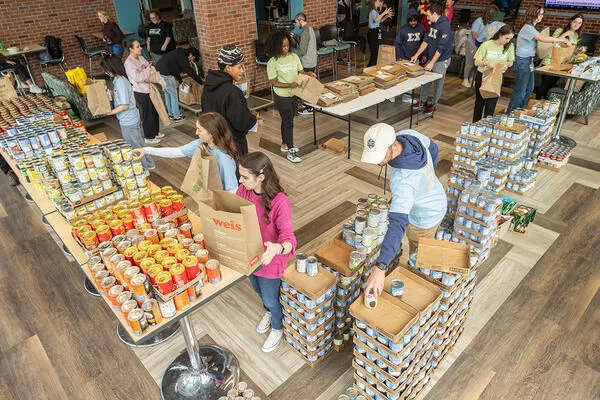
    SUNY chancellor John B. King Jr. (center, in light blue shirt) joins students and staff as they pack backpacks with supplies for New York elementary students.

    State University of New York at Binghamton

    In response, New York governor Kathy Hochul provided $200,000 in additional funding to bring on more SUNY Corps students to help families at risk of losing aid. The funding will support the added students for the remainder of the academic year.

    King said the additional paid hours were essential and allowed campuses to quickly mobilize students to support food pantries and community centers.

    “Many of our students know what it’s like to be in a situation where your family finances feel incredibly fragile,” King said. “So when our students see classmates who are food insecure, who are skipping meals in order to make ends meet or who are distracted in class because they’re hungry, they worry a lot about them.”

    Inside the Service Corps

    SUNY Corps students dedicate at least 300 hours to paid community service and are eligible to receive an AmeriCorps Segal Education Award of up to $1,500.

    “They’re from every part of the state, every socioeconomic background, every ethnic background, every faith background, and they are excited to work together to make the community better,” King said. “It’s exactly what we should be doing in higher ed, and it’s exactly what we need as a country.”

    More than 500 students from 45 SUNY campuses participated in the program this year, and interest continues to outpace availability; applications exceeded campus placements by more than three to one over the last two years.

    Sarah Hall, an Empire State Service Corps coordinator and senior assistant director at the State University of New York at Binghamton, said her campus received more than 200 applications for just 50 spots this year.

    “Every time I talk to a student who is part of our Empire State Service Corps, you can really feel how meaningful this is to their own personal and professional growth,” Hall said. “I really think this is setting them on a path of service in their future.”

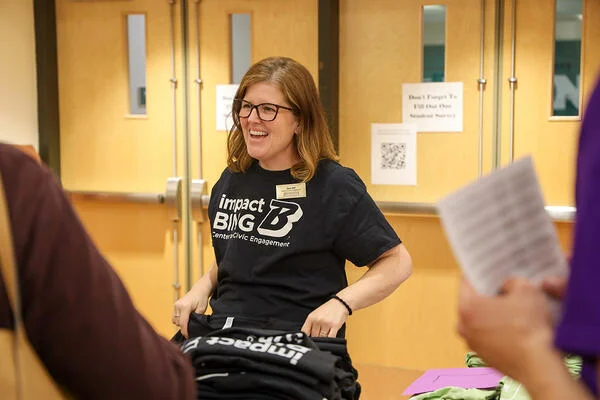
    Sarah Hall, an Empire State Service Corps coordinator at SUNY Binghamton, a white woman with shoulder-length brown hair, wearing glasses and a black Impact Bing T-shirt.

    Sarah Hall, an Empire State Service Corps coordinator at SUNY Binghamton.

    State University of New York at Binghamton

    Following the federal government shutdown, Hall said, her students quickly mobilized a meal kit assembly effort after Hochul provided the additional funding.

    “We purchased over $4,000 worth of food … so when families go to a pantry or food bank, they’re able to just pick up an entire meal that will feed a family of four,” Hall said, adding that her students put together more than 560 kits.

    Beyond Binghamton, the first cohort of SUNY Corps students statewide, logged over 100,000 hours of service and served more than 70,000 New York residents during the 2024–25 program year.

    “It’s a reflection that young people really want to serve and want to contribute to the community and are eager for these opportunities,” King said.

    What’s Next

    The chancellor said the government shutdown underscored how essential sustained investment in public service programs will be in the years ahead.

    “I’d love to see federal investment in this space,” King said. “There continues to be bipartisan support for the AmeriCorps program, so my hope is that we can continue to grow national service efforts around the country.”

    He noted that New York was recently selected as one of four states—along with California, Colorado and Kentucky—to join the Service Year Alliance, an inaugural cohort seeking to grow the number of paid service opportunities throughout the United States.

    Looking ahead, King said the SUNY Empire State Service Corps could serve as a model for colleges and states seeking to build or expand their public service initiatives because it’s “highly replicable.”

    “There’s a lot of reasons for people to feel discouraged about the health of our democracy,” King said. “But when you’re with these students who are committing 300 hours plus a year to service, it makes you quite hopeful.”

    Get more content like this directly to your inbox. Subscribe here.
    Source link

  • US Department of Education’s Failure to Address Food Insecurity Among College Students (Government Accountability Office)

    US Department of Education’s Failure to Address Food Insecurity Among College Students (Government Accountability Office)

    Nearly 25% of college students in 2020 reported
    limited or uncertain access to food. Despite being potentially eligible,
    most didn’t receive Supplemental Nutritional Assistance Program (SNAP)
    benefits—formerly known as “food stamps”—which could help them pay for
    food.

    A recent law gave the Department of Education
    authority to share students’ Free Application for Federal Student Aid
    data with federal and state SNAP agencies to identify and help students
    who may be eligible for benefits.

    But Education hasn’t made a plan to start sharing this data—nor have states received guidance about this opportunity.

    We recommended ways to address these issues.

    What GAO Found

    The U.S. Department of Agriculture (USDA) and the Department of
    Education have taken some steps to connect college students with
    Supplemental Nutrition Assistance Program (SNAP) benefits to help them
    pay for food, but gaps in planning and execution remain. Effective July
    2024, a new law gave Education authority to share students’ Free
    Application for Federal Student Aid (FAFSA) data with USDA and state
    SNAP agencies to conduct student outreach and streamline benefit
    administration. However, according to officials, Education had not yet
    developed a plan to implement these complex data-sharing arrangements.
    This risks delays in students getting important information that could
    help them access benefits they are eligible for. Following the passage
    of this new law, Education began providing a notification about federal
    benefit programs for students who may be eligible for them. However, it
    has not evaluated its method for identifying potentially eligible
    students. According to GAO analysis of 2020 Education data, Education’s
    method could miss an estimated 40 percent of potentially SNAP-eligible
    students.

    USDA encouraged state SNAP agencies to enhance student outreach and
    enrollment assistance. However, USDA has not included important
    information about the use of SNAP data and other student data in its
    guidance to state SNAP agencies. These gaps in guidance have left states
    with questions about how to permissibly use and share students’ data to
    help connect them with benefits.

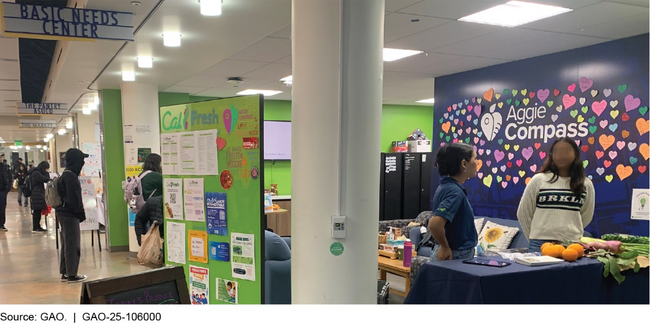
    Student Food Assistance at a College Basic Needs Center

    Officials from the three selected states and seven colleges GAO
    contacted described key strategies for communicating with students about
    their potential SNAP eligibility. These include using destigmatizing
    language, linking students directly to an application or support staff,
    and coordinating outreach efforts with SNAP agencies. Officials from the
    states and colleges GAO contacted said it is helpful to have staff
    available on campus to assist students with the SNAP application. Some
    colleges have found it helpful to partner with their respective SNAP
    agencies to obtain information on the status of students’ applications.

    Why GAO Did This Study

    According to a national survey, almost one-quarter of college
    students were food insecure in 2020, yet GAO found many who were
    potentially eligible for SNAP had not received benefits. The substantial
    federal investment in higher education is at risk of not serving its
    intended purpose if students drop out because of limited or uncertain
    access to food. Studies have found using data to direct outreach to
    those potentially eligible can increase benefit uptake.

    GAO was asked to review college student food insecurity. This report
    addresses (1) the extent to which Education and USDA have supported data
    use to help college students access SNAP benefits, and (2) how selected
    states and colleges have used student data to help connect students
    with SNAP benefits.

    GAO reviewed relevant federal laws and agency documents. GAO also
    interviewed officials from Education, USDA, and national higher
    education and SNAP associations. GAO selected three states and
    interviewed officials from state SNAP and higher education agencies and
    seven colleges in these states. GAO visited one selected state in person
    and interviewed two virtually. States were selected based on actions to
    support food insecure students and stakeholder recommendations.

    Recommendations

    GAO is making five recommendations, including that Education develop a
    plan to implement FAFSA data-sharing and assess its benefit
    notification approach; and that USDA improve its SNAP agency guidance.
    The agencies neither agreed nor disagreed with these recommendations.

    Recommendations for Executive Action

    Agency Affected Recommendation Status
    Department of Education The
    Secretary of Education should develop a written plan for implementing
    provisions in the FAFSA Simplification Act related to sharing FAFSA data
    with SNAP administrators, to aid in benefit outreach and enrollment
    assistance. (Recommendation 1)
    Department of Education The
    Secretary of Education should, in consultation with USDA, evaluate its
    approach to identifying and notifying FAFSA applicants who are
    potentially eligible for SNAP benefits and adjust its approach as
    needed. (Recommendation 2)
    Department of Education The
    Secretary of Education should inform colleges and state higher
    education agencies that FAFSA notifications are being sent to applicants
    who are potentially eligible for SNAP benefits. (Recommendation 3)
    Department of Agriculture The
    Administrator of USDA’s Food and Nutrition Service should, in
    consultation with Education, issue guidance to state SNAP agencies—such
    as in its SNAP outreach priority memo—to clarify permissible uses of
    student data, including FAFSA data, for SNAP outreach and enrollment
    assistance. (Recommendation 4)
    Department of Agriculture The
    Administrator of USDA’s Food and Nutrition Service should issue
    guidance to state SNAP agencies—such as in its SNAP outreach priority
    memo—to clarify the permissible uses and disclosure of SNAP data to
    support SNAP student outreach and enrollment assistance. (Recommendation
    5)

    Source link

  • 39% of colleges rely on donors to address food insecurity

    39% of colleges rely on donors to address food insecurity

    Jason Koski, Cornell University

    College students are more likely to experience food insecurity, compared to the general population, but funding and support for programs that address basic needs in higher education remains limited.

    A 2024 survey by Swipe Out Hunger, a nonprofit group that addresses hunger among college students, found while a majority of colleges have a pantry for student supports, most are supported by philanthropy and not the institution.

    The campus leader survey, released last month, included responses from 347 of Swipe’s 850 partner campuses, representing over 766,600 students who engaged with basic needs resources, whether through the food pantry, SNAP enrollment program or a basic needs hub.

    The most popular campus support program was a food pantry, with almost all respondents (95 percent) indicating their college offers one for students. In 2024, campus pantries distributed over eight million meals and 687,000 additional items, such as toiletries, diapers or appliance lending.

    Campus leaders shared their primary win in the past year was expanding their program (56 percent) and supporting students (20 percent), but only 1 percent of respondents said they had administrative support, and 8 percent indicated they earned additional funding to aid expansion.

    In a similar vein, when asked what their primary challenges were, the greatest share identified funding (47 percent), followed by staffing (16 percent), space (11 percent) and support (10 percent).

    Two in five campuses identified donations as their primary funding source, which included staff payroll deductions and crowdsourcing. Only 5 percent of campus leaders said they had a dedicated budget from campus as their primary source of funding for programming.

    “This severe lack of sustainable funding for antihunger programs is preventing students from accessing the food they need to survive, which in turn affects their ability to stay enrolled,” says Jaime Hansen, executive director of Swipe Out Hunger. “With rising food costs and the lack of government support, campus food pantries and similar resources are becoming the only lifeline for students. If these programs continue to be overburdened and underfunded, we can expect to see less students being able to afford to stay in college.”

    A corresponding student experience survey found 40 percent of program users engaged with on-campus services weekly, and an additional 8 percent used resources every day.

    The top barriers to accessing nutritious food, students reported, were time constraints due to multiple responsibilities; the cost of meal plans, including on-campus food costs; anxiety about resource scarcity (taking away from peers who need it more); elevated costs of diet-specific foods; and living far away from affordable foods.

    Tackling basic needs insecurity: Some of the ways other organizations and institutions are addressing college student hunger include these efforts:

    • Believe in Students created an online curriculum to empower faculty to engage in basic needs support, providing relevant data and insights as well as how-to advice and encouragement.
    • Community colleges utilize FAFSA data to notify learners of their eligibility for SNAP or other state-level food assistance programs.
    • A group of students at Anne Arundel Community College contributed to a faculty-led cookbook featuring students’ nostalgic recipes adapted to utilize campus pantry ingredients.
    • New Jersey built a centralized website to help college students identify basic needs resources across the state.
    • Virginia Commonwealth University built miniature food pantries, modeled off little lending libraries, to increase access to shelf-safe food items across campus.

    How is your campus addressing food insecurity among students? Tell us more.

    Source link

  • Food insecurity is a problem on campuses: How can we fix it?

    Food insecurity is a problem on campuses: How can we fix it?


    Food insecurity is not just a growing issue at a societal level, it’s an urgent crisis for students at Australian universities.

    Please login below to view content or subscribe now.

    Membership Login

    Source link