Latin America sometimes flies below the radar in discussions of global higher education. It’s too poor to have major players in the world-class universities game, but it’s too rich to be among the attention-getting new highfliers like Vietnam. And even within Latin America, not every country gets the same attention. Colombia also kind of flows below the radar, lacking the size of Mexico or Brazil, not punching above its weight like Chile, and not being stark raving tonto like Venezuela. But Colombia actually is pretty special because of the size and shape of its system. It’s actually in the middle of a range of debates going on across the world, making it a kind of miniature of the globe as a whole. A move to gratuidad, like in Chile? Colombia is doing that. Constant pressures on quality assurance, given its 207 public and private institutions? Check. Creating new popular universities on the Mexican model? Yep, that’s happening too. Working out how to improve student loan repayment? Well, ICETEX, the country’s national student loan agency—actually the oldest such agency in the world—is working on that too. In short, this is a country whose thinking on higher education deserves a lot more attention than it usually gets.
The current government of Colombia, led by left-wing President Gustavo Petro, came to office with big ideas about higher education. But without a majority in Congress, things are not going his way. It’s not clear that he can pay for the gratuidad he promised young voters three years ago during his election campaign.
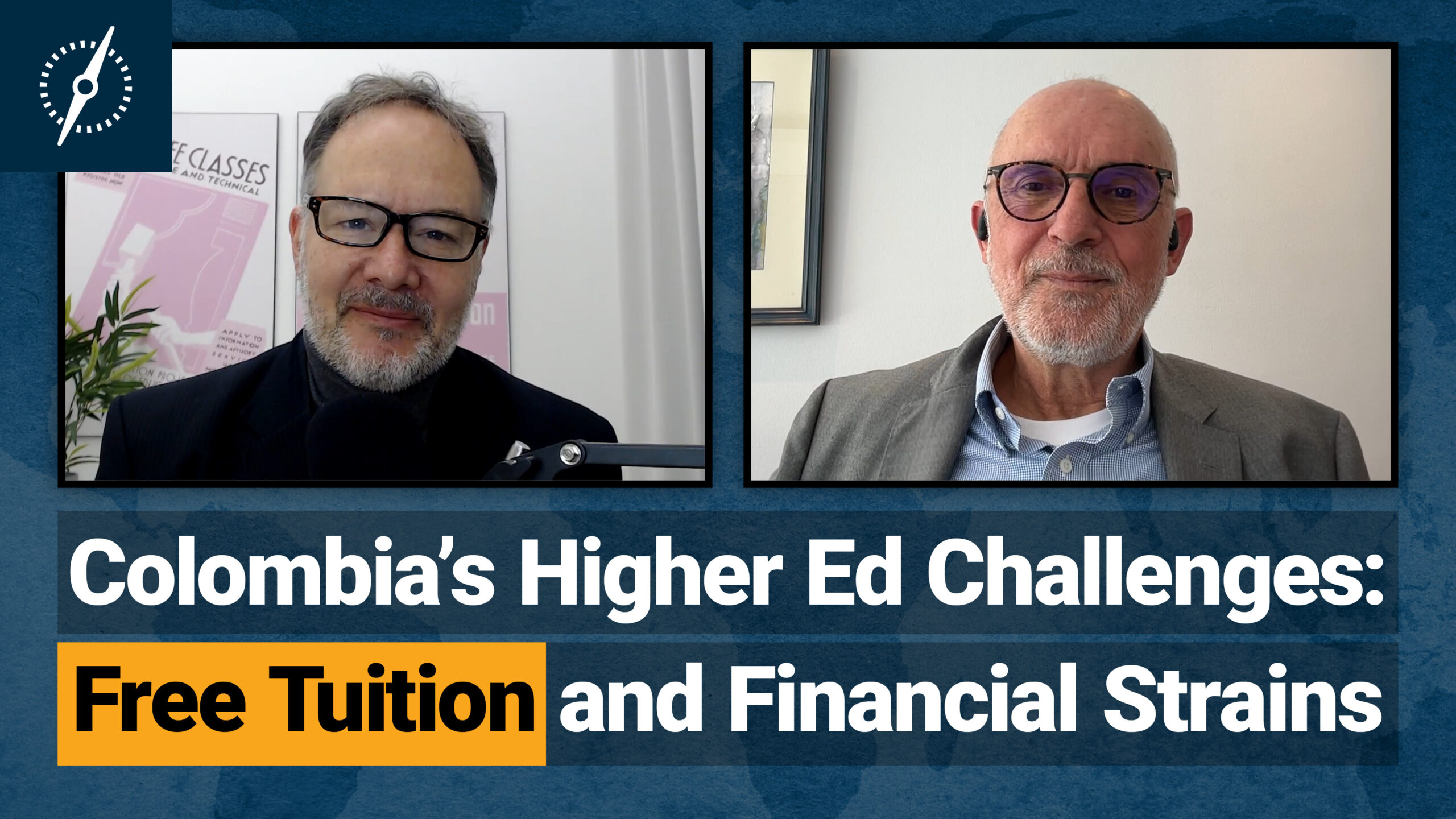
With me today is Javier Botero, a lead consultant at the World Bank and formerly the Vice Minister of Higher Education in Colombia. He’s here to walk us through the latest developments in that country around free tuition, student assistance, and an intriguing case of institutional closure at the University of Antioquia.
This was a fun, fast interview, and I enjoyed it a lot. I hope you do too. So, without further ado, let’s hand things over to Javier.
The World of Higher Education Podcast
Episode 3.18 | Colombia’s Higher Ed Utopia or Illusion? Insights with Javier Botero
Transcript
Alex Usher (AU): Javier, the last time you were on, we discussed President Petro’s ambitious plans for the higher education sector. One of his goals was to increase enrollment by half a million students. Two years later, have we seen much progress on that promise?
Javier Botero (JB): Well, really, not as much as one would have expected. Of course, at the very beginning—and I’m sure I said this in that interview—I thought it was far too ambitious, you know, something in the clouds. But I think they’ve achieved about 20–25% of that.
Mostly, this growth has been in technical education through SENA, this huge public institution that offers free technical education. Very little has happened in private education, where enrollments have actually decreased. Some state universities have increased their enrollments, but much less than what the government expected.
AU: So it’s as much a shift in enrollments as it is an addition to enrollments.
JB: That’s right. I mean, it is an addition in some sense because it’s true that some students who would have had difficulty accessing higher education have been able to do so—mainly through technical education or state universities. So there has been an increase in access for students from lower economic sectors of society.
AU: That’s good. So, late last year—or maybe it was the year before—the president signed a law guaranteeing free tuition at Colombian public universities. Now, we have to be careful about that word because, for instance, in Chile, you have gratuidad, but it only applies to certain students, under specific conditions, like an income cutoff. So, what does the Colombian promise about free tuition consist of? Does it really mean free tuition for everyone?
JB: Yeah, of course not. But the first thing I’d say is that this isn’t actually a policy of this government—it started under the previous government. What Petro did was clarify some points and widen the scope of the policy. Still—and I’m glad about this—it’s not for everyone. It’s targeted at certain groups, based on income. We have something called estratos, and it’s for the three lowest estratos. There are also other groups included, like Indigenous people, some Afro-descendants, and others who have faced significant disadvantages for years. So, yes, it has restrictions, but this is something Colombia has been working on for about six years now.
AU: So, it is targeted free tuition, but not just based on income. As you said, there are some ethnic categories involved as well. That’s interesting.
JB: And not just ethnicity. You all know Colombia has been through a peace process. People involved in or victimized by the violence during that period also qualify for free tuition in public institutions—and there are quite a lot of them.
AU: All the groups involved in the peace negotiations, or their children, would benefit from this?
JB: Yeah, and not just them. People who declared themselves victims during the period of violence in Colombia also qualify.
AU: How much does this commitment cost? I’ve noticed there’ve been stories in the Colombian press about the government losing a tax reform vote just before Christmas, which must make it harder to afford these programs. So what’s the government’s financial ability to keep this promise?
JB: You know, that’s one of the main issues—and a big question—because no one really knows how much it costs. In Colombia, universities have a lot of autonomy. Each university sets its own tuition, even public ones. So there’s a huge variety in tuition rates.
Some public universities were almost free for poor students, while others charged tuition based on income, and some had relatively high tuition rates. This diversity makes it very difficult to calculate the cost.
Chile faced a similar challenge when implementing gratuidad, but I’d say it’s even worse here because of the variation. For example, universities that used to charge very little would continue to receive little funding, while those that charged a lot would get much more. To resolve this, they came up with an average subsidy amount based on factors like the type of university, research output, and number of professors.
AU: I’s a per-student subsidy based on the institution, not tuition?
JB: That’s right. That’s the free tuition program.
AU: I remember in Chile, when they were setting up their policy of gratuidad, they asked a question that made no sense in English: “Where do we set tuition so that tuition can be free?” It was funny, but it made sense in context.
JB: Exactly, because that determines how much money the university gets from the government per student.
AU: So I understand that while the government is trying to lower tuition costs, it’s also reducing expenditures on the student loan program, ICETEX. That feels like robbing Peter to pay Paul. What’s the logic behind this—free tuition but lower student aid?
JB: First of all, free tuition in Colombia is not like in Chile—it’s only for public institutions. Private institutions don’t qualify for free tuition, so they don’t receive any subsidies for it. ICETEX, which is our student loan agency with over 50 years of experience, is mainly used for students attending private universities.
Your point is valid, though. The logic is mostly ideological—the idea that education should be public and free. The private sector is seen as unnecessary, so the government focuses on public institutions and doesn’t assist students attending private ones.
But this hasn’t helped at all with the goal of increasing enrollment by 500,000 students. ICETEX’s budget has already been cut, and the situation for 2025 looks critical. Not only because of these ideological choices, but also because of the budget deficit. We’re starting the year already in deficit, and I’m sure ICETEX will face more cuts.
AU: Javier, I remember that quite early on in his tenure that President Petro seemed to be quite taken by the Mexican model of the Benito Juarez universities in remote locations. Maybe there may be some Venezuelan model he has in mind as well because they’ve opened a lot of new universities too. Has there been much movement on this front in the last two years?
JB: A little bit, I would say, but also let me add that that’s not a either a new policy either. You know, we did this 20 years ago when I was working with the government with what we called the regional centers of higher education. The idea was to bring higher education to rural and small towns in Colombia because what you see is that for those who can—students from those towns that can go to a university, to higher education—they have to go to the big cities, and most of them stay there. So, it’s actually a brain drain from the small cities to the big cities, and that’s an issue. You really want more equity and homogeneous development in a country.
So, many countries—Venezuela, at the time we did this, that was 2002 or 2003—were also starting what they called aldeas universitarias, like small-town universities, with the same idea. Mexico did that and has now a big program. But there are still many issues with that. One of them is the academic part—students from these regions have relatively low academic levels, so you have to work a lot to get them to a level where they can actually start a university program.
The second issue, as with most things, is funding. How do you fund this? Of course, it’s very hard to expect that students will pay tuition to private universities in those regions, and those issues have not yet been resolved.
AU: Recently—I think it was in September or October—the University of Antioquia in Medellín was the center of some very significant protests, some of which turned a little bit violent. What sparked those demonstrations? Was it something about specific issues at that institution, or was it about wider issues within higher education in Colombia?
JB: I would say both. It’s wider issues—issues that are common to most universities—but at the University of Antioquia, these issues have brought the institution to a more difficult situation. And it’s really the funding, the financing of the universities. The University of Antioquia was one of those that actually charged very little tuition. Most students paid just a couple of dollars to study a semester, and they increased enrollment numbers significantly. They joined the policy, 10 to 15 years ago, of opening different regional campuses in small towns at very high cost. But they haven’t gotten the money to cover all of that, so they’ve been in a very difficult financial situation.
Students started asking, “What will happen with this university?” There were delays in paying teachers, especially the type of teachers we have here in Colombia who are not regular faculty but teach specific classes and get paid for those hours. The university delayed those payments, and students and unions joined the protests—particularly the union of those types of teachers. This eventually led to the university closing. The university is now closed, and we are discussing how they will end last year’s final semester. It seems they won’t be able to.
AU: So, did they close because of the protests, or did they close because they couldn’t make payroll?
JB: Both. The teachers joined the demonstrations and the strike, so it wasn’t possible to keep the university open. They tried to keep some programs running virtually, using what they had learned from the pandemic, but it’s been very difficult.
AU: To regain some stability—both there and in the rest of the country—you need a stable government. But the president has never had a majority in Congress. He’s losing key votes on taxes, recently lost a finance minister to a graft scandal, and he’s only about 18 months away from the end of his term. Is there any prospect he regains the initiative and can forge a renewed policy in this area, or is this going to be a really long lame-duck period?
JB: I think the latter is most probable. It’s been less than three years, and we’ve had three ministers already. It looks like there will be another change in the ministry, so there’s no continuity in policies. The political situation is not getting better—it’s getting worse. As the elections approach next year, it will get even worse. The opposition will polarize further. And President Petro is not the type to try to calm things down; instead, he often throws gasoline on the fire.
Maybe two years ago, they tried to pass a statutory law on education, but they couldn’t. Now, the minister is talking about passing a law just to change the funding model, which I must say is very archaic. It doesn’t incentivize universities to do much. With free tuition, it pushes them a little to admit more students, but that’s not a good solution because, as we see in Antioquia, it only worsens the problem. I don’t think much will happen in the remaining 20 or 22 months of this administration.
AU: We’re already seeing the 2026 presidential elections start to take shape. Are any of the leading candidates likely to pursue policies in higher education that are radically different from the current government? You mentioned that, to a large extent, what President Petro is doing is a continuation of the previous government. So, do we expect continuity or change as we head towards those elections?
JB: I would say there will be very different positions among the candidates. What you said isn’t totally true—Petro kept the free tuition policy, but there are many other aspects behind that. I expect some candidates, like Alejandro Gaviria—who was Petro’s first minister, though only for a few months—will bring higher education to the forefront. Gaviria is already a pre-candidate, and higher education is very popular as an issue because students vote, unlike primary and secondary students.
Higher education in Colombia needs a deep reform, going far beyond just funding. Funding is an important issue, but the system requires much deeper changes. I expect some candidates will propose strong policies, but we’ll have to wait and see what happens with those proposals and who gets elected. The political situation in Colombia, like in many parts of the world, is very polarized, and in polarized environments, the best choices don’t always get into office.
AU: Javier Botero, thank you so much for joining us today.
JB: It was my pleasure. Thank you very much.
AU: And it just remains for me to thank our excellent producers, Tiffany MacLennan and Sam Pufek, and you—our viewers, listeners, and readers—for joining in. If you have any questions or comments about today’s episode, please don’t hesitate to get in touch at [email protected]. Don’t forget to subscribe to our YouTube channel so you never miss an episode of The World of Higher Education. Join us in one week’s time when our guest will be freelance writer Ben Wildavsky. He and I are going to chat about the 15th anniversary of his influential book, The Great Brain Race. Bye for now.
*This podcast transcript was generated using an AI transcription service with limited editing. Please forgive any errors made through this service.