This audio is auto-generated. Please let us know if you have feedback.
The higher education sector saw several notable examples of college president turnover in September, at a time when the position is becoming increasingly fraught.
In some cases, presidents announced their intention to retire or move on to a new institution with ample lead time. But in others, they stepped down abruptly after facing pressure campaigns from politicians or from within their college.
Below, we’re rounding up some of last month’s most significant college leadership changes.
President: Mark Welsh Institution: Texas A&M University Coming or going?: Going
Mark Welsh stepped down as president of Texas A&M University on Sept. 19 after the content of one of the institution’s classes created a political maelstrom. Earlier in the month, a conservative state lawmaker shared a video of a Texas A&M professor teaching about gender identity and called for the instructor to be fired. Welsh quickly complied, but the lawmaker then began calls for the president to be fired as well.
The Texas A&M University System Board of Regents authorized a settlement with Welsh on Sept. 26 but declined to share specifics until the details are finalized, The Texas Tribune reported.
President: Michael Schill Institution: Northwestern University Coming or going?: Going
On Sept. 4, Michael Schill announced he would step down as president of Northwestern University, pending the selection of an interim leader. Northwestern named Henry Bienen, who previously led the university for over two decades, as interim president on Sept. 16.
Schill’s departure followed a three-year tenure marked by increased federal scrutiny.
Last May, conservative lawmakers opened an investigation into Northwestern’s handling of pro-Palestinian protests on its campus and ordered the private Illinois university to turn over extensive paperwork related to student and employee discipline and conduct cases. Schill, along with other college leaders, was also called to testify regarding campus protest responses.
Schill and Northwestern’s board chair announced in April that the university would self-fund vital research that has been threatened by the Trump administration cuts.
President: Andrés Acebo Institution: New Jersey City University Coming or going?: Coming
Andrés Acebo became New Jersey City University’s permanent president on Sept. 10, after serving as the institution’s interim president since January 2023. He will be the youngest known president to lead a public New Jersey university, according to NJCU.
Acebo joined NJCU at a turbulent time for the beleaguered university. A year into his tenure, a state-appointed monitor directed NJCU to find an academic partner to help stabilize its finances. NJCU is now on track to become part of fellow public institution Kean University.
In its announcement, NJCU credited Acebo with helping orchestrate “a remarkable financial and academic recovery.”
President: Sean Huddleston Institution: Martin University Coming or going?: Going
Martin University announced on Sept. 11 that President Sean Huddleston will step down this fall. Huddleston has led Indiana’s only predominantly Black institution for six years.
Martin has faced a number of financial and organizational challenges in recent years, including declining enrollment, increased borrowing and a 2022 cyberattack that affected its transcripts. All these factors were cited in a 2023 audit that found that “substantial doubt exists about the university’s ability to continue.”
Since then, Huddleston has overseen a number of new initiatives, including a forthcoming “virtual campus,” a significant tuition reset, and a tuition forgiveness program that erased up to $10,000 in debt for qualifying students.
Huddleston’s last day is set for Nov. 28.
President: Kimberly Espy Institution: Wayne State University Coming or going?: Going
The announcement came after the Detroit News reported the Michigan university’s board of governors intended to oust Espy, citing disapproval of her management style and her decision to put the dean of the university’s medical school on paid leave with little communication.
As part of her separate agreement, Espy relinquished her contractual right to remain with Wayne State as a faculty member and vacated the university president’s residence by the end of the month, Detroit Free Press reported. Espy’s husband, a senior administrator at the university, also resigned as part of the agreement. In exchange, Espy received $760,499 — about a year’s pay — and two years of health care for herself and her husband.
The university’s board named Richard Bierschbach, Wayne State’s dean of law, as interim president.
President: Marlene Tromp Institution: The University of Vermont Coming or going?: Coming
The University of Vermont formally installed Marlene Tromp as president on Sept. 30, following her assumption of the office over the summer. Tromp came to the institution from Boise State University, where she was president from 2019 to 2025.
President: Bethami Dobkin Institution: Westminster University Coming or going?: Going
Westminster University President Bethami Dobkin announced on Sept. 4 that she will retire at the end of the 2025-26 academic year. During her eight-year tenure, she oversaw the institutional transition from college to university and became the longest-serving university president in Utah,according to Westminster. Dobkin was also the only Utah university leader to join more than 400 college leaders in signing an April letter condemning President Donald Trump’s “unprecedented” attempts to control higher education, The Salt Lake Tribune reported.
President: Emir Caner Institution: Truett McConnell University Coming or going?: Going
Truett McConnell University “decided to part ways with” President Emir Caner on Sept. 25, per a vote from the Georgia institution’s board. Caner had been on leave since June following a sexual misconduct scandal involving a former faculty member and allegations of an administrative cover-up.
The board’s vote came the same day during a closed meeting at which a third-party auditor orally reported his findings into the allegations. Truett McConnell did not publish or share further details.
John Yarbrough, who has served as acting president during Caner’s leave, will remain on as interim president while the private university finds a permanent replacement.
President: Garnett Stokes Institution: The University of New Mexico Coming or going?: Going
The University of New Mexico announced on Sept. 16 that President Garnett Stokes would retire in July 2026.Stokes joined the public institution in 2018, becoming the first woman to hold the role.
The U.S. Department of Educationis ending funding to several grant programs for minority-serving institutions, calling them racially discriminatorybecause colleges must enroll certain shares of underrepresented students to qualify for the awards.
In fiscal 2025, the department had been expected to award $350 million in grants to benefit institutions serving large shares of Alaska Native, Asian American,Black, Hispanic, Native American, Native Hawaiian and Pacific Islander students.The agency said on Wednesday it will redirect the funding to other programs “that advance Administration priorities.”
The announcement quickly drew criticism from college leaders, lawmakers and higher education organizations, who argued that cutting the grants would harm students and damage colleges that rely on the funding.
Dive Insight:
The cut grants have supported myriad initiatives at MSIs, such as purchasing laboratory equipment, improving buildings and classrooms, supporting student services like tutoring, and establishing endowment funds.
Eliminating the funding will irreparably harm students, Mildred García, chancellor of the California State University system, said in a Wednesday statement. She panned the move, noting that all but one of the CSU system’s 22 universities are Hispanic-serving institutions.
“Without this funding, students will lose the critical support they need to succeed in the classroom, complete their degrees on time, and achieve social mobility for themselves and their families,” García said.
Higher education leaders also said the funds benefit all students.
“The funds granted to HSIs have never supported only Latino students,” David Mendez, interim CEO of the Hispanic Association of Colleges and Universities, said in a statement on Wednesday. “These funds strengthen entire campuses, creating opportunities and resources that benefit all students, especially those pursuing STEM fields, as well as enhancing the communities where these colleges and universities are located.”
University of Hawaiʻi President Wendy Hensel voiced concernsspecifically about the impact the move would have across the public 10-campus system.
“It will affect all of our students, the programs that support them and the dedicated staff who carry out this work,” Hensel said in a Wednesday statement.
However, the Education Department took issue with the eligibility requirements for colleges to receive grants.
For instance, to be eligible for grants for the Developing Hispanic-Serving Institutions program, colleges must have student bodies where at least 25% of learners are Hispanic. For grants under the Minority Science and Engineering Improvement program, which is meant to encourage underrepresented students to enter STEM fields, colleges must have student bodies where 50% of learners belong to underrepresented racial or ethnic minority groups.
“To further our commitment to ending discrimination in all forms across federally supported programs, the Department will no longer award Minority-Serving Institution grants that discriminate by restricting eligibility to institutions that meet government-mandated racial quotas,” U.S. Education Secretary Linda McMahon said in a statement on Wednesday.
McMahon said the department wants to work with Congress to “reenvision these programs to support institutions that serve underprepared or under-resourced students without relying on race quotas.”
The Education Department’s decision Wednesday targets some of the very grants over which it is currently being sued by the state of Tennessee and Students for Fair Admissions, the anti-affirmative action group that successfully sued to end race-conscious admissions at colleges.In a lawsuit filed in June, the plaintiffs argued that grants for HSIs are discriminatory due to their eligibility requirements.
In a July memo, the U.S. Department of Justice said it would not defend the grant programs. Solicitor General D. John Sauer said the agency determined that they violated the constitutional right to equal protection under the law.
The Education Department said it will still disburse roughly $132 million in grant funding for fiscal year 2025 that Congress has mandated to be spent for MSIs. “The Department continues to consider the underlying legal issues associated with the mandatory funding mechanism in these programs,” the agency added.
The Education Department did not answer Higher Ed Dive’s questions Thursday but cited a Wednesday article from online news publication RealClearPolitics.
A senior administration official told RealClearPolitics that the changes would not impact historically Black colleges and universities.The federal designation of HBCU does not include any enrollment criteria. Instead, a college must have been established prior to 1964 and have a principal mission that “was, and is, the education of Black Americans,” according to federal statute.
Email remains one of the most effective ways for colleges and universities to connect with their audiences. Unlike social platforms that limit reach through algorithms, email marketing for educational institutions provides a direct line to prospects, parents, students, alumni, and partners, people who have already chosen to hear from you. It’s measurable from start to finish, integrates easily with CRMs and student information systems, and can be automated to deliver timely, relevant messages.
The numbers back it up: across industries, email consistently produces one of the strongest returns on investment of any channel. In higher education, the impact is even greater when schools combine clean data with thoughtful segmentation, personalization, and creative storytelling. In practice, email often becomes the foundation of a recruitment strategy, supporting everything from initial outreach to alumni engagement.
This guide brings together proven email marketing best practices for educational institutions. Alongside examples and trusted resources to help your team build campaigns that not only perform but also feel authentic and meaningful to the people you’re trying to reach.
Struggling with enrollment and retention?
Our email marketing services can help you generate more leads!
Where Email Fits in the Student Journey
Email plays a role at every stage of the student journey, from the first moment of discovery through to lifelong alumni engagement. What makes it so effective is its ability to deliver the right message to the right person at the right time.
Awareness: Introduce programs, highlight scholarships, and showcase campus life with engaging stories that spark curiosity.
Consideration: Share degree guides, student experiences, faculty spotlights, and invitations to virtual or in-person events.
Decision: Provide deadline reminders, financial aid instructions, advisor booking links, and follow-up checklists that help prospects commit with confidence.
Onboarding & Retention: Support new students with orientation details, academic advising reminders, wellness resources, and career services updates that strengthen their connection to your institution.
Alumni & Advancement: Keep graduates engaged with mentorship opportunities, continuing education offers, impact reports, and giving campaigns that showcase the value of staying involved.
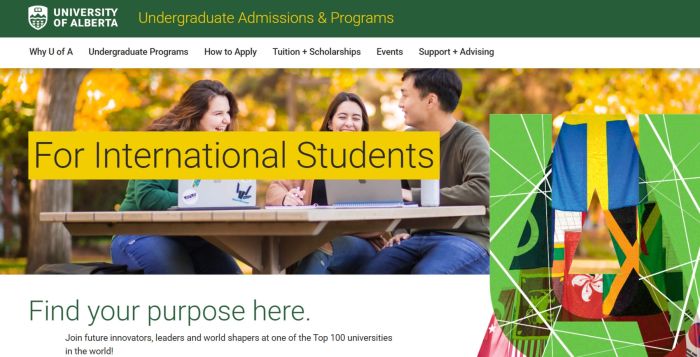
Example in practice:The University of Alberta has built a structured email journey for international prospects, connecting them with advisors and surfacing key requirements at each stage of the process. This ensures that students receive timely, relevant information tailored to their current stage in the decision-making process.
Best Practices for Higher Education Email Marketing
To make email marketing for educational institutions truly effective, schools need more than just frequent sends; they need strategy, structure, and respect for their audience. The best-performing campaigns are built on trust, relevance, and timing.
That means starting with a clean, permission-based list, segmenting by intent, and delivering value at every step of the journey. Each best practice below focuses on how colleges and universities can move beyond “batch and blast” tactics to create meaningful, high-ROI conversations with students, parents, alumni, and partners.
1. Build a Permission-Based, High-Intent List
The strength of your email marketing starts with the quality of your list. Buying addresses might look like a shortcut, but it usually leads to poor engagement and deliverability issues. Instead, focus on capturing leads through owned, value-driven channels.
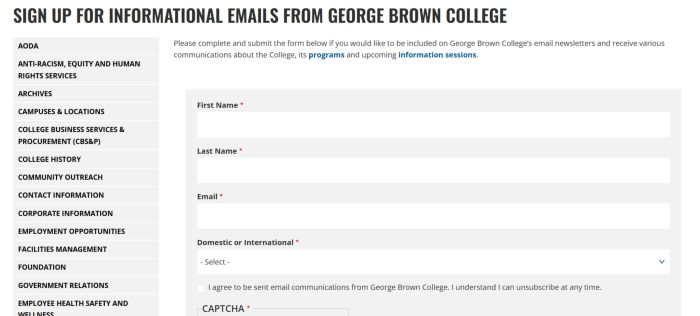
Program pages with downloadable guides, open house registrations, scholarship calculators, and career snapshots are all proven ways to attract high-intent prospects. Keep sign-up forms short, just name, email, and one preference field, then use progressive profiling to enrich data over time.
Example: George Brown College attracts prospective students by offering downloadable program guides in exchange for email sign-ups. Because students self-select the guide they want, the college immediately knows their area of interest and can trigger tailored follow-up campaigns. This approach builds a fully permission-based list where every contact has explicitly indicated their intent, making subsequent outreach more relevant and effective.
Segmentation is the most consistent way to boost engagement and conversions in higher ed email marketing. Instead of sending broad blasts, divide your audiences by lifecycle stage, program interest, geography, or even behaviour, for example, attending a webinar or abandoning a form. This allows every recipient to receive content that feels timely and relevant. Segmentation also prevents fatigue by cutting down on irrelevant sends, which in turn protects your sender reputation and keeps unsubscribe rates low.
How can segmentation improve the effectiveness of email marketing for higher education? Segmentation makes emails more relevant, which increases engagement. For example, international prospects segmented by country can receive updates on visas and housing, while domestic students see local funding options. Segmenting by lifecycle stage, program, and behaviour helps improve click-throughs and leads to better-qualified student interactions.
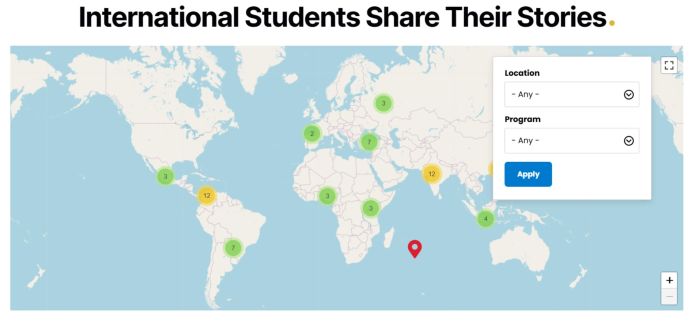
Example:Humber College’s international portal structures content by region and need, ensuring students see information on study permits, housing options, and support services tailored to their home country. This kind of geo-segmentation can be mirrored in email journeys, for instance, sending region-specific pre-arrival checklists or visa guidance, so that communications land with stronger relevance for each subgroup of students.
True personalization goes deeper than inserting a first name in the subject line. In higher education, it means dynamically adjusting content blocks based on program interest, geography, or behaviour.
For example, prospective Nursing students should see different resources than prospective Business students. International applicants may need tuition estimates in local currency or immigration guidance. Behavioural triggers, like a reminder to finish an application, show prospects you’re paying attention to their journey.
Why is personalization important in higher education email marketing? Personalization helps students see themselves at your institution. Tailoring emails by program, start term, or action, such as reminding them of an unfinished application, makes communication feel relevant and timely. This reduces fatigue and unsubscribes while guiding students toward conversion more effectively than generic messages.
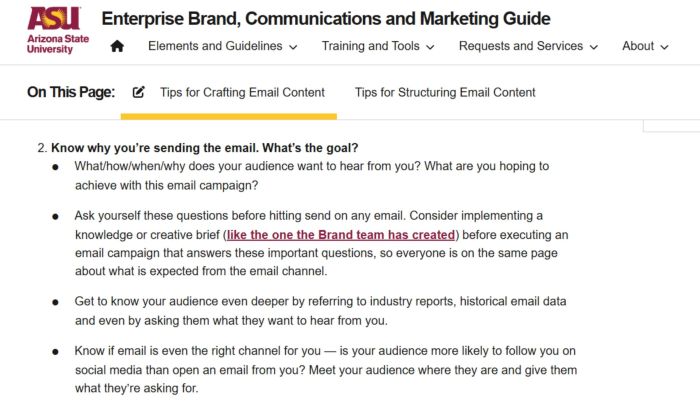
Example:Arizona State University has invested in dynamic email content that highlights degree options, campus resources, and next-step reminders based on each student’s profile data. ASU’s own email marketing guidelines encourage the use of personalized fields and scripting for tailored messaging, ensuring that outreach feels individually relevant and helpful rather than generic.
4. Write Subject Lines and Previews That Earn the Open
Subject lines and preview text are the most decisive factors in whether an email gets opened. In higher education, a few consistent principles stand out:
Specificity: call out the program or event directly (“Early Childhood Education: Virtual Info Session Tomorrow”).
Urgency and utility: use time-sensitive reminders, but avoid spammy tactics (“Last 48 hours for residence priority”).
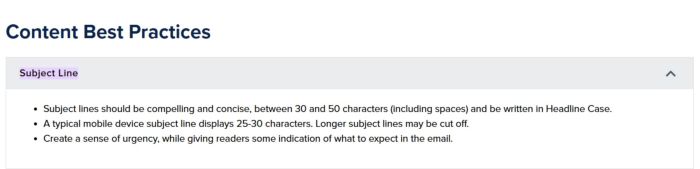
Length: keep subject lines to 45–50 characters, and use preview text to complete the thought and front-load value.
Testing: run A/B tests where possible: subjects, preheaders, and sender names (e.g., “Admissions at Seneca”) are all worth experimenting with. Emoji can work sparingly for student audiences.
Example:The University of Arizona’s marketing team advises keeping subject lines concise (30–50 characters) and imbued with a sense of urgency, while still indicating the email’s content. Their guidelines echo what many have found: clear, direct subject lines (often including deadlines or event details) tend to lift open rates, because recipients immediately grasp the email’s value.
In a nutshell, what are the best practices for creating engaging subject lines in higher education email marketing?Keep subject lines clear, specific, and under 50 characters. Highlight benefits like deadlines, outcomes, or events, and use preheaders to expand the message. Test frequently with A/B experiments, and consider humanized sender names (e.g., “Admissions at [School]”) to increase open rates without relying on gimmicks.
5. Design Mobile-First and Accessible
Most students and parents first open emails on their phones, so mobile-first design isn’t optional. Use responsive templates, 16-pixel body text, and tappable CTAs with enough space to avoid errors. Break content into scannable blocks with headings and subheads, and avoid image-only buttons.
Accessibility should be built in: add alt text, maintain contrast ratios, and caption videos. Keeping one clear CTA helps prevent distraction while making the path forward obvious. Load times matter, too. Opt for system fonts, compressed images, and videos hosted externally.
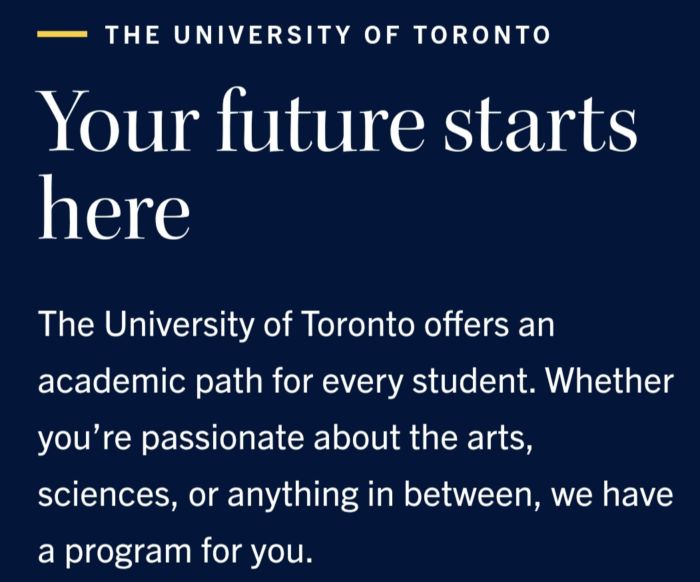
Example:The University of Toronto’s Future Students portal provides a good model for digestible, mobile-friendly content blocks. Information is organized in concise sections and bullet points that mirror best practices for responsive email design. By structuring content for quick scanning on a small screen, U of T ensures that key messages (from program highlights to “Apply Now” links) remain prominent and actionable even on mobile devices.
How often you email matters as much as what you send. A thoughtful cadence keeps your audience engaged without overwhelming them. Consider these practical benchmarks:
Prospects: 1–2 emails per week; increase frequency near application deadlines or events, then cool down.
Applicants/Admitted Students: Send transactional updates and personalized nudges; shield them from generic blasts.
Enrolled Students: A weekly digest from student affairs or the registrar is usually sufficient, plus urgent communications when needed.
Alumni: monthly updates with stories, impact reports, and targeted appeals tied to affinity or giving campaigns.
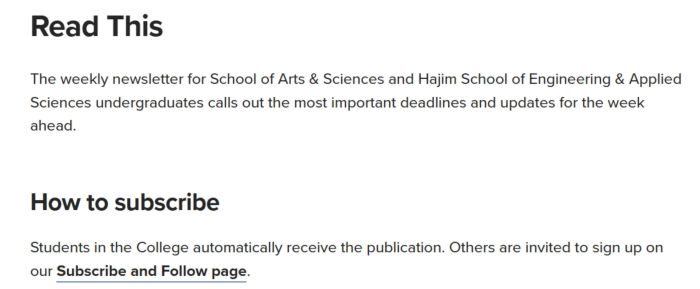
Example:The University of Rochester balances its email frequency by audience: it sends all current students, faculty, and staff a brief daily bulletin for campus-wide announcements, but for undergraduates, it also delivers a focused weekly newsletter highlighting only the most important deadlines and updates for the coming week. This approach keeps students informed and on track (e.g., keeping current on scholarship deadlines or add/drop dates) without inundating them with multiple emails per day, illustrating how strategic timing and pacing can improve engagement.
The best emails guide students toward small, progressive steps that build confidence and commitment. Think of calls-to-action (CTAs) as a series of micro-conversions leading to the big one: enrollment.
Early stage: “Download the Business Degree Guide.”
Mid stage: “Register for the Sept 12 Virtual Info Session.”
Late stage: “Finish Your Application” or “Book a 1:1 with Admissions.”
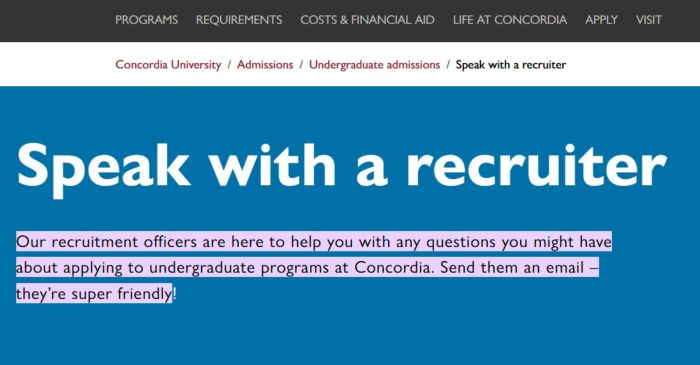
Example: Concordia University encourages one-on-one engagement by making it easy for prospects to connect with recruitment advisors. In their outreach and on their website, Concordia invites prospective students to “Speak with a recruiter” and provides direct contact links for regional advisors.
By embedding advisor contact/booking links in recruitment emails, they effectively turn email into a two-way channel, and prospects can immediately take the next step of scheduling a conversation, which is often a key conversion on the path to enrollment. This kind of CTA (e.g., “Book a 1:1 Advising Appointment”) helps move students from interest to action at the decision stage.
Automation ensures no student falls through the cracks. It also frees staff time by replacing one-off sends with structured flows. At a minimum, schools should build:
Welcome or nurture series by program cluster (3–5 emails over 10–14 days).
Event workflows: registration confirmation → reminder emails (24 hours and 2 hours before) → post-event follow-up with recording and next step.
Application rescue: reminders for incomplete applications, missing documents, or deposits.
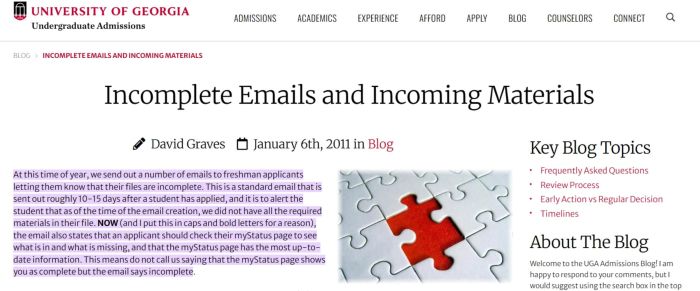
Example:The University of Georgia’s admissions office uses automated “incomplete application” emails to prompt action from applicants. About 10–15 days after a student applies, if any required materials are still missing, UGA’s system sends a notification to alert the student. This kind of trigger-based outreach (in UGA’s case, coupled with a status portal for real-time updates) helps increase completion rates by nudging students at the right moment. Ensuring more prospects finish their applications and none are unknowingly left behind due to missing paperwork.
Testing makes email performance predictable. Without it, you’re guessing. To get reliable insights, follow a structured method:
Hypothesis: define what you’re testing and why (e.g., “Clearer subject line → higher open rate”).
Minimal variable: test one change at a time: subject, CTA wording, or design. Not everything at once.
Sample & duration: send to enough recipients for statistical significance, and let the test run its course.
Centralize learnings: record results in a shared log and bake winners into future templates.
This discipline helps schools turn experimentation into ongoing optimization, rather than one-off guesswork.
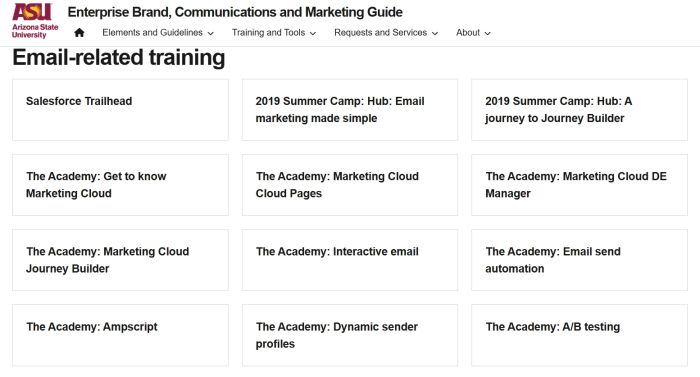
Example: Arizona State University’s email marketing team bakes A/B testing into its processes and training. In fact, ASU’s internal Marketing Academy offers specific sessions on email A/B testing best practices. By systematically experimenting, for instance, testing whether an email from “Admissions at ASU” versus a personal advisor name yields a higher open rate, or which subject line phrasing drives more clicks, universities like ASU turn anecdotal hunches into data-backed decisions. The result is a cycle of learning where each campaign performs better than the last, based on real audience insights.
A great email program doesn’t just send, it learns. Schools should define KPIs at each stage of the student journey and connect systems so results tie back to outcomes that matter.
Top of funnel: track deliverability, open rates (adjusted for privacy changes), and click-through rates (CTR).
Mid-funnel: measure landing-page engagement, event registrations, and advisor bookings.
Bottom of funnel: monitor application starts and completions, offers accepted, and deposits paid.
Lifetime value: go further with retention term-to-term, alumni engagement, and giving participation.
Tools make this possible. Google Analytics 4 allows schools to set and track conversion goals across web and email touchpoints. Marketing automation platforms like HubSpot, Mailchimp, and HEM’s Mautic provide email-level reporting, lifecycle attribution, and integration with CRMs or student information systems.
The real power comes when those metrics are connected—so you can see not just who opened, but who enrolled. That’s how email proves its ROI in higher education.
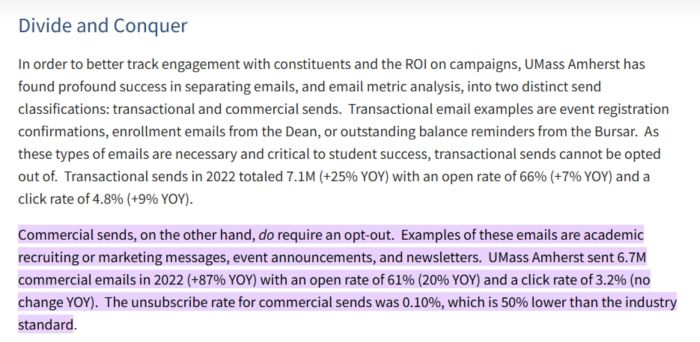
Example: UMass Amherst provides a powerful case study in data-driven email marketing. After consolidating campus communications onto a single platform, they now rigorously track email performance and outcomes. In 2022, UMass separated its email sends into transactional vs. commercial categories to better gauge effectiveness. The university sent 6.7 million marketing (commercial) emails with a 61% open rate and only a 0.10% unsubscribe rate, about half the industry benchmark.
These granular metrics (including year-over-year improvements in opens and clicks) are tied back to student engagement and enrollment outcomes. By monitoring and sharing such results, the UMass team can conclusively demonstrate email ROI in higher education, for instance, showing that automated, targeted campaigns directly led to more applicants completing their files and more students registering for classes
Deliverability, Privacy, and Compliance Essentials
Even the best-designed email is wasted if it never reaches the inbox. To protect deliverability and ensure compliance, schools need to focus on three pillars: technical health, consent, and governance.
Authenticate your domain with SPF, DKIM, and DMARC. Align subdomains for bulk mail so your institution sends with a verifiable identity.
Maintain list hygiene by removing hard bounces automatically and applying “sunset rules” for long-inactive contacts. This keeps the sender’s reputation strong.
Comply with Canadian Anti-Spam Law (CASL): capture express opt-in, include your institution’s physical mailing address, and provide a one-click unsubscribe.
Offer preference centres so subscribers can opt out of specific program streams rather than unsubscribing from all communications.
Monitor sender reputation and complaint rates across platforms. Coordinate centrally across departments to avoid overlap that leads to over-messaging.
Schools that treat deliverability and compliance as core practices, not afterthoughts, protect both their brand and their audience’s trust, while ensuring every message has a fair chance of being read.
Content Strategy: What to Send (And When)
The most effective email marketing calendars are tied to the academic cycle. By planning content around what matters most to students at each stage, schools can stay relevant, reduce last-minute scrambles, and guide prospects and current learners smoothly from interest to enrollment, and beyond.
September–October: Focus on discovery. Send “Explore Programs” series, scholarship primers, and fall open house invitations to capture interest early in the cycle.
November–December: Support applications. Share step-by-step application checklists, portfolio preparation guides, and alumni career stories that reinforce outcomes.
January–February: Address financial and career considerations. Feature financial aid tutorials, co-op or internship spotlights, and “Ask an Advisor” live chats to build trust and reduce barriers.
March–April: Drive urgency. Countdown emails for application deadlines, residence selection reminders, and campus life reels or shorts work well here.
May–June: Transition from admission to enrollment. Focus on onboarding with orientation sign-ups, registrar instructions, and personalized next-step communications.
July–August: Provide last-mile support. Send guidance on IDs, transit, and housing, plus international arrival instructions to prepare students for day one.
A calendar like this ensures that your emails are not just timely, but also aligned with the emotional and practical needs of your audience throughout the year.
Turning Best Practices Into Results
Email remains one of the most powerful tools available to higher education marketers, but only when strategy and technology work hand in hand. The best practices outlined here are: permission-based lists, segmentation, personalization, accessibility, automation, and compliance. Ensure every message is not just delivered but resonates with the right audience at the right time.
This is where Higher Education Marketing (HEM) makes the difference. With deep sector expertise, we help schools design and execute email strategies that align with recruitment, retention, and advancement goals.
Central to this is our use of Mautic CRM, an open-source higher education email marketing automation platform customized for educational institutions. Mautic allows institutions to manage campaigns, segment audiences, automate journeys, and integrate seamlessly with student information systems, all while keeping data governance and compliance front and center.
By combining best-practice strategy with the flexibility of Mautic CRM, HEM enables institutions to run smarter, more personalized campaigns that drive measurable ROI across the student lifecycle. The result is simple: stronger engagement, higher conversion rates, and a more connected experience for every student, from prospect to alumni. Do you need help crafting an effective marketing strategy for student recruitment for your institution? Contact HEM for more information.
Struggling with enrollment and retention?
Our email marketing services can help you generate more leads!
Frequently Asked Questions
Question:How can segmentation improve the effectiveness of email marketing for higher education? Answer: Segmentation makes emails more relevant, which increases engagement. For example, international prospects segmented by country can receive updates on visas and housing, while domestic students see local funding options. Segmenting by lifecycle stage, program, and behaviour helps improve click-throughs and leads to better-qualified student interactions.
Question: What are the best practices for creating engaging subject lines in higher education email marketing? Answer: Keep subject lines clear, specific, and under 50 characters. Highlight benefits like deadlines, outcomes, or events, and use preheaders to expand the message. Test frequently with A/B experiments, and consider humanized sender names (e.g., “Admissions at [School]”) to increase open rates without relying on gimmicks.
Question: Why is personalization important in higher education email marketing? Answer: Personalization helps students see themselves at your institution. Tailoring emails by program, start term, or action, such as reminding them of an unfinished application, makes communication feel relevant and timely. This reduces fatigue and unsubscribes while guiding students toward conversion more effectively than generic messages.
The departure and replacement of school principals represents one of the most significant organizational changes within educational institutions, creating ripple effects that permeate every aspect of school operations. This phenomenon, increasingly prevalent in contemporary education systems, deserves thorough examination for its profound impact on institutional effectiveness, academic achievement, and organizational stability.
When a principal exits an educational institution, the immediate effects reverberate throughout the entire school system. The administrative vacuum extends far beyond mere personnel changes, as new principals invariably bring distinct leadership philosophies, strategic priorities, and management approaches that can fundamentally reshape the school’s operational framework. Current research in educational leadership suggests that schools typically require between three to five years to fully stabilize following leadership transitions, indicating that frequent turnover can trap institutions in continuous cycles of adjustment and reorganization.
The principal’s role transcends traditional administrative leadership, functioning as the cultural architect of the school community. During leadership transitions, the delicate fabric of established relationships between administration, faculty, and staff enters a period of uncertainty and realignment. The school’s cultural identity, carefully constructed through years of shared experiences and mutual understanding, often undergoes substantial transformation as new leadership implements alternative approaches to community building and professional collaboration. This cultural shift can significantly impact teacher motivation, student engagement, and overall school climate.
Academic program integrity and student achievement metrics frequently experience fluctuations during principal transitions. New leaders typically introduce fresh perspectives on curriculum implementation, instructional methodologies, and resource allocation strategies. While innovation and new approaches can catalyze positive change, frequent shifts in academic direction may disrupt educational continuity and student progress. Empirical studies have consistently demonstrated that schools experiencing frequent principal turnover often exhibit temporary declines in student achievement metrics, with particularly pronounced effects in high-poverty areas where stability serves as a crucial factor for student success.
The impact extends deep into stakeholder relationships and community partnerships. Parents, community organizations, and local partners must adapt to new leadership styles, communication protocols, and institutional priorities. The critical process of building and maintaining trust, essential for effective school-community partnerships, frequently requires renewal with each leadership change. This cyclical process can affect various aspects of school operations, from volunteer program effectiveness to community support for school initiatives and funding proposals.
Professional development trajectories and staff retention patterns often undergo significant changes during principal transitions. Different leaders may emphasize various areas of professional growth or implement modified evaluation systems, directly affecting teacher satisfaction and career advancement opportunities. Research indicates a strong correlation between principal turnover and increased teacher attrition rates, creating compound effects on institutional stability and educational continuity. This relationship suggests that leadership stability plays a crucial role in maintaining a consistent and experienced teaching staff.
The challenges of strategic planning become particularly acute in environments characterized by frequent leadership changes. Multi-year improvement initiatives risk interruption or abandonment as new principals implement different priorities and approaches. This instability can affect various aspects of school development, from technology integration plans to curriculum development initiatives, potentially compromising the institution’s ability to achieve long-term educational objectives and maintain consistent progress toward established goals.
Educational institutions can implement various strategies to minimize the negative impacts of principal turnover, including developing comprehensive transition protocols, maintaining detailed documentation of ongoing initiatives, creating strong distributed leadership teams, establishing clear communication channels during transitions, and building robust institutional memory through systematic record-keeping. These mitigation strategies prove essential for maintaining organizational stability and educational effectiveness during periods of leadership change.
The implications of principal turnover extend throughout the educational ecosystem, influencing everything from daily operations to long-term strategic initiatives. Understanding these complex dynamics becomes increasingly crucial for educational stakeholders, policymakers, and administrators in developing effective strategies to maintain institutional stability and educational quality during leadership transitions. As educational institutions continue to evolve in response to changing societal needs and expectations, the ability to manage leadership transitions effectively becomes paramount for ensuring consistent, high-quality education for all students.
This comprehensive analysis of principal turnover effects provides valuable insights for educational professionals, administrators, and policymakers working to create more stable and effective learning environments. The ongoing challenge lies in balancing the potential benefits of new leadership perspectives with the fundamental need for institutional stability and continuous educational improvement, all while maintaining focus on the ultimate goal: providing optimal learning opportunities for students in an ever-changing educational landscape.
Dr. Jason Richardson, Garden City Elementary School & the International University of the Caribbean
Dr. Jason Richardson is a Teacher Leader at the Garden City Elementary School in Savannah, Georgia and a Professor of Graduate Studies at the International University of the Caribbean (Jamaica). He holds a Diploma in Principalship from the National Leadership College of Jamaica, Bachelor of Education from the International University of the Caribbean, Master of Science in Counseling and Consulting Psychology from the International University of the Caribbean, Educational Specialist Degree and a Doctor of Education Degree in Leadership and Management from the William Howard Taft University.
Latest posts by eSchool Media Contributors (see all)
Jin Hee LeeColleges and universities play a critical role in American democracy. By bringing together young adults, faculty, and employees to live and learn in a shared educational setting, higher education institutions shape the future citizens and leaders of our country. But they can only achieve this mission if their campuses reflect the multiracial society that we all live in. Unfortunately, Columbia’s recent settlement with the Trump administration calls into question whether it can fulfill its educational mission to foster a dynamic learning environment for its campus community. Given longstanding problems with unfair underrepresentation and academic exclusion, Black students and faculty likely will bear the brunt of this troubling settlement. Other colleges and universities must not make the same mistake.
Columbia’s settlement agreement with the Trump administration gives the federal government unprecedented oversight into the university’s operations. Under the agreement, Columbia will allow administration officials to review, and potentially reject, any effort by the university to advance equal opportunity through admissions, hiring, and promotion. Notably, these conditions advance the administration’s express agenda to suppress and ban efforts to ensure an inclusive and welcoming educational environment for Black students and faculty, thereby preventing them from fully contributing their expertise and lived experiences to the larger campus community.
Such unprecedented scrutiny by the federal government is especially troubling given the administration’s flawed interpretation of our constitution and civil rights laws in recent guidance issued by the U.S. Department of Justice. For example, the Trump administration believes that programs open to people of all races, such as those geared towards first-generation college students or rural areas, are unlawful if they are intended to break down unfair barriers to equal access and opportunities for disadvantaged students, including disadvantaged students of color. Thus, according to the administration, higher admissions or hiring rates of Black students and faculty, following the implementation of more equitable practices that do not rely on any applicant’s race or ethnicity, could expose Columbia to legal sanctions pursuant to the Department of Justice’s inaccurate interpretation of equal protection and civil rights laws.
The settlement also causes Columbia to be subsumed into the Trump administration’s campaign to silence lawful protest and target immigrant communities. It requires Columbia to increase the number of employees trained and authorized to arrest and remove students for protesting in ways that the administration or Columbia, in their full discretion, deem inappropriate. Based on the settlement, student groups are subject to “sanction . . . including by defunding, suspending, or de-recognizing them” for “discriminatory conduct,” which threatens erasure of affinity spaces for underrepresented groups given the administration’s inaccurate understanding of “discrimination.”Student groups that express views disfavored by the Trump administration or Columbia’s leadership are particularly at risk. If an international student is arrested during a protest, the agreement requires Columbia to notify the Department of Homeland Security and disclose their identity.
Such government interference with campus protest, which has been integral to expressions of dissent and the free exchange of ideas throughout American history, undoubtedly will chill the speech of many students and faculty, thus eroding their First Amendment rights. It is particularly ironic that the settlement agreement requires student protesters, including those wearing masks, to identify themselves upon request,while masked ICE officers can abduct and detain college students without even charging them with a crime. As a consequence of the agreements’ terms, Columbia’s campus will become less welcoming to students, including Black students, who already struggle with discrimination and exclusion. This, in turn, will deter many talented students and faculty from joining Columbia’s campus, thereby degrading the university’s reputation and academic scholarship.
Other colleges and universities must not follow Columbia’s capitulation. Instead of being centers of learning, where people from diverse backgrounds can engage in a free flow of ideas, opinions, and perspectives, the current administration seeks to use these institutions to actualize an undemocratic vision of an America, where dissent is silenced and resources and opportunities are hoarded for the wealthy and powerful. In many ways, this cynical vision of America aims to turn back the clock to an era, not so long ago, when institutions of higher learning were reserved for the privileged few and either explicitly or implicitly excluded Black students and faculty as unwelcome and undeserving outsiders.
___________
Jin Hee Lee is director of strategic initiatives at the Legal Defense Fund (LDF), where she leads a department that integrates litigation, policy, organizing, communications, research, and public education to advance community-centered racial justice advocacy—most notably through the Pro Truth Initiative.
The crises we are facing globally, from climate change and climate change dispossession to drought and food insecurity, are intersecting social and environmental issues, which need to be recognized and addressed accordingly through integrated and holistic measures. This can only be achieved by eschewing the tendency of existing governance and economic systems to silo social and environmental problems, as if they are separate concerns that can be managed – and prioritised – hierarchically. Much of this requires a better understanding of environmental injustice – the ways in which poor, racialised, indigenous and other marginalized communities are overlooked and/or othered in this power hierarchy, such that they must face a disproportionate burden of environmental harm.
This is happening with disconcerting regularity around the world, often going under the radar but sometimes making headlines, as for example in May this year, when institutionalised environmental racism in the U.S. manifested in the placement of a copper mine on land inhabited by and sacred to the Apache indigenous group (Sherman, 2025). With limited political power to challenge it they are left to face dispossession, loss of livelihood and physical and mental health ill-effects (Morton-Ninomiya et al, 2023). We have seen this making headlines closer to home recently too, with evidence suggesting that toxic air in the UK is killing 500 people a week and most affecting those in socioeconomically disadvantaged areas (Gregory, 2025). An environmental problem (such as air pollution) cannot be disentangled from its social causes and effects. Or to put it another way, violence done to the environment is violence done to a particular group of people.
A transformative response to our global challenges that re-centres environmental justice will require a paradigm shift in the ways that we govern, construct our societies, build our communities, run our economies, design our technologies and engage with the non-human world. The role of higher education will be critical to even a modest move in this direction. This is because, as they are probably tired of hearing, this generation of students will shape our collective futures, so it matters that they are literate in the deep entanglement of environmental and social justice challenges. Moreover, as Stickney and Skilbeck caution, “it is inconceivable that we will meet drastic carbon reduction targets without massive coordinated efforts, involving policymakers and educators working in concert at all levels of our governments and education systems (Stickney and Skilbeck, 2020).
In Ruth Irwin’s article ‘Climate Change and Education’ she alerts us to Heidegger’s treatise in Being and Time (1962) that the effectiveness of a tool’s readiness is ‘hidden’ – only revealed when it ceases to function. Climate might be viewed as a heretofore ‘hidden’ tool, in that it affords opportunities for human action; it has “smoothly enabled our existence without conscious consideration” (Irwin, 2019). Yet its dynamic quality is now an overt, striking, looming spectre threatening the existence of all life on earth; the ‘environment’ writ large is revealing itself through ecological and social breakdown, surfacing our essential reliance upon it as natural beings. Thus unless higher education is competent in dealing with the issues of environmental crisis at all of its registers – social, environmental, political and ecological – the institution of education will be unable to fulfil its fundamental task of knowledge transfer for what is a clear public good (Irwin, 2019). Put another way, “HEIs have a responsibility to develop their educational provision in ways that will support the social transformation needed to mitigate the worst effects of the environmental crisis.” (Owens et al, 2023).
Indeed, HE requires a paradigm shift in itself given that these realities are unfolding alongside widespread scrutiny of higher education institutions; including about decolonising the academy (Jivraj, 2020; Mintz, 2021), free speech on university campuses and how they are preparing students to meet these pressing issues (Woodgates, 2025). To keep pace with these changes and meet such challenges, educators from across disciplines will need to commit to embedding environmental justice education more widely across programme curricula, session design and teaching practices. It must be recognised as a vital – rather than token – component of environmental education. Doing so fully and effectively also requires us to recognise that environmental justice education encompasses not only subject matter but pedagogical practice. This is the case for all academic disciplines – including those that might seem peripheral to the teaching of environmental issues.
EJE in HE is a developing area of scholarship and field of study that has gathered pace only over the last decade. Much of the research to date has been focused on the US, where studies have shown that environmental justice remains marginal to or excluded from the curricular offerings of most environmental studies programmes – let alone those not directly related to environmental education (Garibay et al, 2016). A report by the North American Association for Environmental Education (NAAEE), which studied the policies of 230 public U.S. HE institutions and 36 state boards of higher education, found that only 6% of institutions with climate change content in their policies referred to climate justice issues and indigenous knowledge practices (MECCE Project & NAAEE, 2023). Other work has shown that STEM education has tended to frame questions around exploitation of natural resources or technological development as disconnected from social and economic inequalities, though this is starting to be challenged (Greenberg et al, 2024).
Emerging research into EJ in HE encompasses pedagogical approaches (Rabe, 2024; Moore, 2024); classroom and teaching practices (Walsh et al, 2022; Cachelin & Nicolosi, 2022; D’Arcangelis & Sarathy, 2015), the relationship between sustainability and climate justice education (Haluza-DeLay, 2013; Kinol et al, 2023) and curriculum development (Garibay et al, 2016). In identifying what EJE looks like these studies foreground the importance of community-engaged learning (CEL), providing students with the opportunity to learn about a socio-environmental problem from those with lived experience; critical thinking with regards to positionality, power structures and (especially indigenous) knowledge systems, and a deep concern with place. These critical components are crucial because tackling an act or acts of environmental injustice against marginalised populations often cannot be achieved without addressing systemic power imbalances.
What also links these studies is an acknowledgement of the complexity of EJE. It is a difficult subject and practice to grapple with for several reasons. Firstly, it means exposing students (and educators) to “an onslaught of bad news,” (Cachelin & Nicolosi, 2022) which can elicit feelings of hopelessness and helplessness, so it is little wonder that expressions of anxiety and alarm are growing within these cohorts (Wallace, Greenburg & Clark, 2020) and that needs to be borne in mind. Secondly EJE requires us to find a way to meaningfully connect with philosophical, discursive, historical and practical questions about power, ethics and the relationship between human beings and the natural environment, within the disciplinary parameters of a specific curricula. This means doing difficult work not only to change current systems and processes (Forsythe et al, 2023) but also to make transformative rather than piecemeal efforts. For example, this might mean actively absorbing students into a community partner’s work in an engaged rather than service-learning model, or moving beyond a simple ‘guest lecture’ format to invite more in-depth input into modules or programmes from a community partner.
This is a challenge that we shouldn’t understate for many academics and institutions already coping with high workloads (Smith, 2023), stress (Kinman et al, 2019) and job insecurity across a beleaguered sector (The Independent, 2024; The Guardian, 2025). Through this emerging EJE scholarship literature, we are starting to see that, “promoting opportunities for HE educators to develop and enact critical and transformative environmental pedagogy… is a complex business mediated by a variety of (personal, material and social) factors. It involves negotiating conflict, and understanding and confronting entrenched structures of power, from the local and institutional to the national and global.” (Owens et al, 2023).
A third (though by no means final) challenge in teaching and learning EJ in higher education is in finding and making space for it in a landscape that is strongly oriented towards sustainability education. Although there is certainly overlap – for example to the extent that the liberal logic underpinning the latter also informs distributive justice – sustainability education has different intellectual and ideological origins to EJ scholarship. Both are valuable, but we should be questioning whether we can justify a lack of explicit EJ practice and framing simply because we are already having sustainability conversations, and instead find space for both. It can be easy to (inadvertently) depoliticise environmental education by avoiding the perceived messiness and complexity of justice in favour of the more technocratic and measurable ‘sustainability’ (Haluza-DeLay, 2013).
My research seeks to develop a better understanding of the state of environmental justice education in the HE landscape, beginning by mapping its development in the UK. This will reveal the extent and means by which EJE is being incorporated across programme curricula, session design and teaching practices in the UK HE context. In doing so we can identify the intersections of EJE with other dominant pedagogies, including sustainability education and solutions-focused approaches. To pursue a provincialising agenda and avoid the parochial perspective that EJE is the preserve of HEIs in the global North, there is also much value in exploring what EJE looks like in HEIs in the global South, and where cross-cultural lessons can be shared. The questions we need to be asking are:
How is environmental justice being taught and learnt and where do we go from here?
How are educators overcoming the challenges involved in engaging with EJE?
What best practices could we champion?
Sharing methods, strategies and pedagogical approaches for EJE cross-institutionally and cross-culturally will be a step towards helping us build a better collective, collaborative response to the urgency of our intersecting socio-environmental crises.
Dr Sally Beckenham is Lecturer in Human Geography and Programme Lead and Admissions Tutor for the BA Human Geography & Environment in the Department of Environment & Geography, University of York. She is also Chair of the Teaching Development Pool and member of the Interdisciplinary Global Development Centre (IGDC). She is an interdisciplinary political geographer with degrees in Modern History, International Politics and International Relations, and welcomes collaboration. Email: [email protected] Bluesky: @sallybeckenham.bsky.social.
Why Centralized Marketing Matters for Online Programs in Higher Ed
At Archer, we’ve onboarded hundreds of institutional partners to help them grow their online programs. And while every partner is unique, there’s one pain point we encounter time and again: decentralized school-level marketing that creates more friction than momentum.
In many institutions, individual colleges or schools manage their own marketing campaigns, budgets, and creative direction. While this siloed approach offers an initial promise of agility and autonomy, it often leads to deeper problems in the market, such as:
Fragmented messaging
Inconsistent branding
Internal competition
Wasted spend as schools bid against each other
Missed opportunities for reach and impact at the brand and portfolio level
The result? Confused students consuming competing voices from the same institution, and internal marketing teams scrambling to scale best practices and measure impact — often without apples-to-apples data and reporting for performance comparisons.
Universities need an integrated marketing strategy that balances a holistic brand and portfolio-level approach with maintaining individual school-level autonomy for certain decisions and activities. This hybrid model unlocks collaboration, reduces conflict, and lifts visibility for all programs within a portfolio.
With shared goals, aligned messaging, and coordinated tactics across all of their schools, universities can amplify their brand and stretch their budgets further — delivering clear, compelling stories across myriad channels to prospective students.
Risks of Decentralized Marketing
In some models of governance, decentralization can be a strength — empowering local leadership and ensuring responsiveness to specific community needs. But when it comes to marketing online university programs in a highly competitive environment, decentralization alone as a strategy is more often a liability than an asset.
Having different departments, schools, or programs run their own campaigns and technology stacks may seem like a way to move faster, but in practice, it creates challenges that can hinder online program growth. Let’s explore some examples.
Brand Confusion
As prospective students evaluate your institution’s online offerings, they are not concerned with the internal structures of your institution. They expect clarity and consistency in the information you provide. When each college or division presents a different tone, design style, and creative messaging approach, you’re left with a weakened institutional brand.
Mixed marketing across digital ads, program pages, email drips, and even tuition and scholarship messaging can erode the trust and credibility you’ve been building with prospective students. For example, inconsistent explanations of scholarships or conflicting tuition information (e.g., on program pages and via tuition calculators) can trigger frustration or skepticism.
In short: Your audience — the prospective student — sees one university. If your university is in conflict with its own marketing, the brand loses power.
Inefficiency and Internal Competition
Without centralized marketing oversight, different teams often end up targeting the same audiences with overlapping campaigns — sometimes even bidding against each other in paid channels. This dilutes your paid marketing efficacy by driving up your cost per lead, wasting precious budget dollars, and undermining the collective impact of your institution’s marketing investments.
Inconsistent Student Experience and Success Metrics
Perhaps the most concerning result of decentralized marketing is a fragmented and uneven student journey. One program might offer seamless inquiry-to-enrollment processes, while another loses momentum after the application process due to poor follow-up and disconnected systems.
When your programs use different customer relationship management (CRM) platforms, it becomes difficult to track leads accurately and measure outcomes with consistency. Reporting becomes murky. Success metrics vary. Problems get misdiagnosed.
Instead of addressing the root causes of problems, your teams might blame each other (e.g., the marketing team and the admissions team) for the other’s perceived performance issues, when the real problem is systemic disconnection.
The Case for Centralized Marketing
Centralization doesn’t mean turning every school or program into a cookie-cutter version of the institution’s mission statement, and it doesn’t mean taking any team’s autonomy away. It’s about aligning around a shared strategy — one that empowers individual teams to execute effectively within a cohesive, coordinated framework.
Unified Brand Messaging
A strong, centralized brand platform allows your university to speak with one clear voice about its online programs, telling the story of:
What your programs offer
Who your programs serve
Why your programs matter
This shared narrative should be rooted in your institution’s values and designed to build trust with prospective students. When every program draws from the same story and messaging pillars, it strengthens your presence across every touchpoint — from digital ads and landing pages to nurture emails and program brochures. Each program’s value propositions may differ, but the institution’s story endures.
Additionally, a unified approach enables your institution to leverage the brand and portfolio-level marketing that raises visibility across all your programs. For example, some institutions have an integrated marketing program for their undergraduate experience but lack a cohesive approach for their online graduate programs. This is a missed opportunity to build a portfolio-level branded presence through channels that individual schools may not be able to afford on their own.
A robust YouTube presence that highlights the benefits of your online graduate education experience (program agnostic), showcases your alumni and graduate education outcomes, and forefronts your strategic organizational partnerships that span individual schools and programs increases the impact for the entire institution with one investment.
Integrated Campaign Planning
Centralized marketing brings together your paid media, content marketing, email strategy, and organic social media into one master plan.
Gone are the days of multiple teams across your institution launching disconnected campaigns, as central calendars and shared audience strategies help ensure each tactic contributes to every team’s strategic goals. This means reduced duplication, avoidance of internal bidding wars, and maximization of every marketing dollar.
However, your individual schools can and should have decision-making authority over the key value proposition definitions, target personas, and positioning of programs within their fields. This requires a collaborative conversation in an integrated campaign-planning scenario.
And schools should continue to develop campaigns where the impact is greatest for them — for example, hosting prospective student events and webinars, offering ambassador programs for prospective student questions, and attending events meaningful to their specific program field, such as at conferences and exhibit halls.
Shared Data and Measurement
In a world of data, perhaps the greatest and most immediate impact of centralized marketing will be felt in how your institution tracks performance holistically. With unified key performance indicators (KPIs) and shared access to insights, marketing teams at all levels — central and within academic schools — can identify what’s working for them, pivot when needed, and scale successful tactics across programs.
Teams can review where the branded portfolio-level efforts are causing the greatest lift in impressions and leads and determine together how school-level marketing activities can make the most impactful use of funds.
What Centralized Marketing Looks Like in Practice
At Archer, we’ve seen institutions achieve dramatic improvements simply by unifying their marketing strategy — even if execution remains shared and distributed. With a strong central foundation in place, teams tap into shared creative resources, coordinate campaigns across programs, and drive stronger performance through unified media buying and consistent messaging.
At its best, centralized marketing can:
Empower programs to amplify one another rather than compete
Allow creative strategy to be produced once then repurposed widely
Create paid efforts that are smarter, more cost effective, and better targeted
In sum, when your institution implements an integrated marketing model that fosters collaboration among academic schools, it can result in performance that is greater than the sum of its parts.
Archer Education knows what it takes to bring siloed departments together. Our unique partnership-based approach allows us to truly understand your institution, then implement efficiencies to ignite your online programs’ potential through a centralized marketing strategy that is balanced with school autonomy and meaningful participation. Contact us today to learn more.
Institutions spend a lot of time surveying students for their feedback on their learning experience, but once you have crunched the numbers the hard bit is working out the “why.”
The qualitative information institutions collect is a goldmine of insight about the sentiments and specific experiences that are driving the headline feedback numbers. When students are especially positive, it helps to know why, to spread that good practice and apply it in different learning contexts. When students score some aspect of their experience negatively, it’s critical to know the exact nature of the perceived gap, omission or injustice so that it can be fixed.
Any conscientious module leader will run their eye down the student comments in a module feedback survey – but once you start looking across modules to programme or cohort level, or to large-scale surveys like NSS, PRES or PTES, the scale of the qualitative data becomes overwhelming for the naked eye. Even the most conscientious reader will find that bias sets in, as comments that are interesting or unexpected tend to be foregrounded as having greater explanatory power over those that seem run of the mill.
Traditional coding methods for qualitative data require someone – or ideally more than one person – to manually break down comments into clauses or statements that can be coded for theme and sentiment. It’s robust, but incredibly laborious. For student survey work, where the goal might be to respond to feedback and make improvements at pace, institutions are open that this kind of robust analysis is rarely, if ever, the standard practice. Especially as resources become more constrained, devoting hours to this kind of detailed methodological work is rarely a priority.
Let me blow your mind
That is where machine learning technology can genuinely change the game. Student Voice AI was founded by Stuart Grey, an academic at the University of Strathclyde (now working at the University of Glasgow), initially to help analyse student comments for large engineering courses. Working with Advance HE he was able to train the machine learning model on national PTES and PRES datasets. Now, further training the algorithm on NSS data, Student Voice AI offers literally same-day analysis of student comments for NSS results for subscribing institutions.
Put the words “AI” and “student feedback” in the same sentence and some people’s hackles will immediately rise. So Stuart spends quite a lot of time explaining how the analysis works. The word he uses to describe the version of machine learning Student Voice AI deploys is “supervised learning” – humans manually label categories in datasets and “teach” the machine about sentiment and topic. The larger the available dataset the more examples the machine is exposed to and the more sophisticated it becomes. Through this process Student Voice AI has landed on a discreet number of comment themes and categories for taught students and the same for postgraduate research students that the majority of student comments consistently fall into – trained on and distinctive to UK higher education student data. Stuart adds that the categories can and do evolve:
“The categories are based on what students are saying, not what we think they might be talking about – or what we’d like them to be talking about. There could be more categories if we wanted them, but it’s about what’s digestible for a normal person.”
In practice that means that institutions can see a quantitative representation of their student comments, sorted by category and sentiment. You can look at student views of feedback, for example, and see the balance of positive, neutral and negative sentiment, overall, segment it into departments or subject areas, or years of study, then click through to see the relevant comments to see what’s driving that feedback. That’s significantly different from, say, dumping your student comments into a third party generative AI platform (sharing confidential data with a third party while you’re at it) and asking it to summarise. There’s value in the time and effort saved, but also in the removal of individual personal bias, and the potential for aggregation and segmentation for different stakeholders in the system. And it also becomes possible to compare student qualitative feedback across institutions.
Now, Student Voice AI is partnering with student insight platform evasys to bring machine learning technology to qualitative data collected via the evasys platform. And evasys and Student Voice AI have been commissioned by Advance HE to code and analyse open comments from the 2025 PRES and PTES surveys – creating opportunities to drill down into a national dataset that can be segmented by subject discipline and theme as well as by institution.
Bruce Johnson, managing director at evasys is enthused about the potential for the technology to drive culture change both in how student feedback is used to inform insight and action across institutions:
“When you’re thinking about how to create actionable insight from survey data the key question is, to whom? Is it to a module leader? Is it to a programme director of a collection of modules? Is it to a head of department or a pro vice chancellor or the planning or quality teams? All of these are completely different stakeholders who need different ways of looking at the data. And it’s also about how the data is presented – most of my customers want, not only quality of insight, but the ability to harvest that in a visually engaging way.”
“Coming from higher education it seems obvious to me that different stakeholders have very different uses for student feedback data,” says Stuart Grey. “Those teaching at the coalface are interested in student engagement; at the strategic level the interest is in strategic level interest in trends and sentiment analysis and there are also various stakeholder groups in professional services who never get to see this stuff normally, but we can generate the reports that show them what students are saying about their area. Frequently the data tells them something they knew anyway but it gives them the ammunition to be able to make change.”
The results are in
Duncan Berryman, student surveys officer at Queens University Belfast, sums up the value of AI analysis for his small team: “It makes our life a lot easier, and the schools get the data and trends quicker.” Previously schools had been supplied with Excel spreadsheets – and his team were spending a lot of time explaining and working through with colleagues how to make sense of the data on those spreadsheets. Being able to see a straightforward visualisation of student sentiment on the various themes means that, as Duncan observes rather wryly, “if change isn’t happening it’s not just because people don’t know what student surveys are saying.”
Parama Chaudhury, professor of economics and pro vice provost education (student academic experience) at University College London explains where qualitative data analysis sits in the wider ecosystem for quality enhancement of teaching and learning. In her view, for enhancement purposes, comparing your quantitative student feedback scores to those of another department is not particularly useful – essentially it’s comparing apples with oranges. Yet the apparent ease of comparability of quantitative data, compared with the sense of overwhelm at the volume and complexity of student comments, can mean that people spend time trying to explain the numerical differences, rather than mining the qualitative data for more robust and actionable explanations that can give context to your own scores.
It’s not that people weren’t working hard on enhancement, in other words, but they didn’t always have the best possible information to guide that work. “When I came into this role quite a lot of people were saying ‘we don’t understand why the qualitative data is telling us this, we’ve done all these things,’” says Parama. “I’ve been in the sector a long time and have received my share of summaries of module evaluations and have always questioned those summaries because it’s just someone’s ‘read.’ Having that really objective view, from a well-trained algorithm makes a difference.”
UCL has tested two-page summaries of student comments to specific departments this academic year, and plans to roll out a version for every department this summer. The data is not assessed in a vacuum; it forms part of the wider institutional quality assurance and enhancement processes which includes data on a range of different perspectives on areas for development. Encouragingly, so far the data from students is consistent with what has emerged from internal reviews, giving the departments that have had the opportunity to engage with it greater confidence in their processes and action plans.
None of this stops anyone from going and looking at specific student comments, sense-checking the algorithm’s analysis and/or triangulating against other data. At the University of Edinburgh, head of academic planning Marianne Brown says that the value of the AI analysis is in the speed of turnaround – the institutionl carries out a manual reviewing process to be sure that any unexpected comments are picked up. But being able to share the headline insight at pace (in this case via a PowerBI interface) means that leaders receive the feedback while the information is still fresh, and the lead time to effect change is longer than if time had been lost to manual coding.
The University of Edinburgh is known for its cutting edge AI research, and boasts the Edinburgh (access to) Language Models (ELM) a platform that gives staff and students access to generative AI tools without sharing data with third parties, keeping all user data onsite and secured. Marianne is clear that even a closed system like ELM is not appropriate for unfettered student comment analysis. Generative AI platforms offer the illusion of a thematic analysis but it is far from robust because generative AI operates through sophisticated guesswork rather than analysis of the implications of actual data. “Being able to put responses from NSS or our internal student survey into ELM to give summaries was great, until you started to interrogate those summaries. Robust validation of any output is still required,” says Marianne. Similarly Duncan Berryman observes: “If you asked a gen-AI tool to show you the comments related to the themes it had picked out, it would not refer back to actual comments. Or it would have pulled this supposed common theme from just one comment.”
The holy grail of student survey practice is creating a virtuous circle: student engagement in feedback creates actionable data, which leads to education enhancement, and students gain confidence that the process is authentic and are further motivated to share their feedback. In that quest, AI, deployed appropriately, can be an institutional ally and resource-multiplier, giving fast and robust access to aggregated student views and opinions. “The end result should be to make teaching and learning better,” says Stuart Grey. “And hopefully what we’re doing is saving time on the manual boring part, and freeing up time to make real change.”
This audio is auto-generated. Please let us know if you have feedback.
Dive Brief:
The state of Tennessee and Students for Fair Admissionssued the U.S. Department of Education Wednesday over allegations the agency’s decades-long practice of designating federal grant funding for Hispanic-serving institutions is unconstitutional.
The plaintiffs argued that the department’s eligibility requirements for HSI grantsare discriminatory and undercut opportunities for all students, including those who are Hispanic and attend colleges that aren’t HSIs. To qualify as an HSI, a college must be nonprofit and enroll a full-time undergraduate student body that is at least 25% Hispanic.
Asserting that all colleges serve Hispanic students, Tennessee and SFFA are asking the federal court to strike down the HSI grant program’s ethnicity-based requirements and allow all institutions to apply for the grants “regardless of their ability to hit arbitrary ethnic targets.”
Dive Insight:
Edward Blum, president of SFFA, said the advocacy organization is suing to ensure equal opportunity for all, not “denying opportunity to any racial or ethnic group.”SFFA successfully challenged race-conscious admissions before the U.S. Supreme Court, getting the practice banned in 2023.
“This lawsuit challenges a federal policy that conditions the receipt of taxpayer-funded grants on the racial composition of a student body,” Blum said in a statement Wednesday. “No student or institution should be denied opportunity because they fall on the wrong side of an ethnic quota.”
HSI is a designation first established in 1992 as part of the Higher Education Act, and the federal government began distributing funds to qualifying institutions three years later.
The Education Department’s HSI division exists to distribute grant funding to “expand the educational opportunities for Hispanic Americans and other underrepresented populations,” according to its website.
Though a majority of states have at least one HSI, the institutions are clustered in areas with higher Hispanic populations.
Seven states — California, Texas, New York, Illinois, Florida, New Mexico and New Jersey — and Puerto Rico are home to 81% of HSIs,according to an analysis of federal data by the Hispanic Association of Colleges and Universities.
The Hispanic and Latino population is one of the fastest-growing minority groups in the country. In 2023, 65.2 million Hispanic and Latino people lived in the U.S., accounting for nearly a fifth of the population.The Hispanic population is expected to grow to roughly a quarter of the U.S. population by 2060, according to federal data.
In Tennessee, Hispanic students made up just over 8% of undergraduates in the 2023-24 academic year, according to HACU. The state has just one HSI — Southern Adventist University, a private nonprofit.
No public Tennessee college qualifies for HSI funding, despite all serving some population of Hispanic students, state officials said in Wednesday’s lawsuit. This puts public college students at a disadvantage and harms the institutions, they argued.
Tennessee Attorney General Jonathan Skrmetti alleged that the HSI grant system “openly discriminates against students based on ethnicity.”
“The HSI program perversely deprives even needy Hispanic students of the benefits of this funding if they attend institutions that don’t meet the government’s arbitrary quota,” he said in a Wednesday statement.
Both Skrmetti and Blum invoked the 2023 Supreme Court ruling on race-conscious college admissions in their statements. Blum argued the court “made clear” that federal funding practices like the HSI grant program are “patently unconstitutional.”
That interpretation of diversity-focused federal funding has yet to be tested judicially. The high court’s 2023 decision only addressed admissions practices. But since then, conservative policymakers and those opposed to diversity initiatives have sought to apply it to a wide range of college affairs, including scholarships and diversity programs for students.
Now, they are turning their attention to a long-standing federal program through this lawsuit, filed in U.S. District Court in Tennessee.
The Education Department did not immediately respond to a request for comment Thursday.
However, the department under Trump has already sought to apply the Supreme Court’s 2023 ruling against Harvard University and the University of North Carolina to diversity, equity and inclusion efforts at federally funded institutions.In February, the agency threatened to pull all funding from colleges and K-12 schools that considered race in their programs and policies.
On the first day of his second term, President Donald Trump issued an executive order repealing a Biden-era initiative aimed at boosting educational access via Hispanic-serving institutions. Among several goals, that program sought to expand the educational capacity of Hispanic-serving institutions through federal support.
Trump’s order — which revoked dozens of Biden-era executive actions — described the repealed policies as a move to “restore common sense” in the federal government.