Tag: Institutions

  • Dr. Jennifer T. Edwards: A Texas Professor Focused on Artificial Intelligence, Health, and Education: Preparing Our Higher Education Institutions for the Future

    Dr. Jennifer T. Edwards: A Texas Professor Focused on Artificial Intelligence, Health, and Education: Preparing Our Higher Education Institutions for the Future

    As we prepare for an upcoming year, I have to stop and think about the future of higher education. The pandemic changed our students, faculty, staff, and our campus as a whole. The Education Advisory Board (EAB) provides colleges and universities across the country with resources and ideas to help the students of the future.

    I confess, I have been a complete fan of EAB and their resources for the past ten years. Their resources are at the forefront of higher education innovation.

    🏛 – Dining Halls and Food Spaces

    🏛 – Modern Student Housing

    🏛 – Hybrid and Flexible Office Spaces

    🏛 – Tech-Enabled Classrooms

    🏛 – Libraries and Learning Commons

    🏛 – Interdisciplinary Research Facilities


    Higher education institutions should also focus on the faculty and staff as well. When I ask most of my peers if they are comfortable with the numerous changes happening across their institution, most of them are uncomfortable. We need to prepare our teams for the future of higher education. 

    Here’s the Millennial Professor’s Call the Action Statements for the Higher Education Industry

    🌎 – Higher Education Conferences and Summits Need to Provide Trainings Focused on Artificial Intelligence (AI) for Their Attendees

    🌎 – Higher Education Institutions Need to Include Faculty and Staff as Part of Their Planning Process (an Important Part)

    🌎 – Higher Education Institutions Provide Wellness and Holistic Support for Faculty and Staff Who are Having Problems With Change (You Need Us and We Need Help)

    🌎 – Higher Education Institutions Need to Be Comfortable with Uncommon Spaces (Flexible Office Spaces)

    🌎 – Faculty Need to Embrace Collaboration Opportunities with Faculty at Their Institutions and Other Institutions

    Here are some additional articles about the future of higher education:

    Higher education will continue to transition in an effort to meet the needs of our current and incoming students. 

    For our particular university, we are striving to modify all of these items simultaneously. It is a challenge, but the changes are well worth the journey.

    Here’s the challenge for this post: “In your opinion, which one of the items on the list is MOST important for your institution?”

    ***. 

    Check out my book – Retaining College Students Using Technology: A Guidebook for Student Affairs and Academic Affairs Professionals.

    Remember to order copies for your team as well!


    Thanks for visiting! 


    Sincerely,


    Dr. Jennifer T. Edwards
    Professor of Communication

    Executive Director of the Texas Social Media Research Institute & Rural Communication Institute

    Source link

  • New Research Finds Higher Ed Institutions Are at Risk of Losing Supervisors to Other Employers – CUPA-HR

    New Research Finds Higher Ed Institutions Are at Risk of Losing Supervisors to Other Employers – CUPA-HR

    by CUPA-HR | January 11, 2023

    As previous research from CUPA-HR has shown, America’s colleges and universities are in the midst of a talent crisis, as many employees are considering other employment opportunities due to a number of factors. As a follow-up to the initial findings of CUPA-HR’s 2022 Higher Education Employee Retention Survey, CUPA-HR has released new findings focused specifically on those in supervisory roles, and the data show that many supervisors are overwhelmed, under-resourced, and struggling to fill positions and maintain morale.

    The newly published report, The CUPA-HR 2022 Higher Education Employee Retention Survey: Focus on Supervisors, explores supervisors’ likelihood of looking for new employment, their current challenges and working environments, and which job aspects specific to supervisors are associated with their retention. The report analyzes data from the 3,815 higher ed administrators, professionals and non-exempt staff, most (57 percent) of whom were supervisors, who responded to CUPA-HR’s 2022 Higher Education Employee Retention Survey.

    Findings

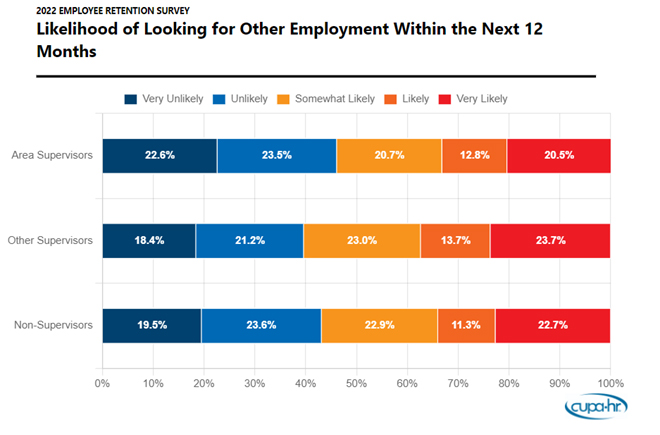
    Higher ed supervisors are looking for other employment opportunities, and less than half would seek new opportunities at their current institution. Nearly two in five (36 percent) supervisors indicate they are likely to look for other employment in the next 12 months, and only 40 percent say they would seek job opportunities at their current institution. The most common cited reason for seeking other employment is pay.
    Most higher ed supervisors work long hours and have absorbed more duties since the onset of the COVID-19 pandemic. Data show that supervisors are more likely than non-supervisors to work additional hours. Fewer than half (47 percent) of non-supervisors work more hours than what is considered full-time. However, 89 percent of area supervisors and 76 percent of other supervisors work more hours per week than what is considered full-time at their institution. Additionally, supervisors are more likely than non-supervisors to agree that they have absorbed additional responsibilities of other staff who have left the institution since the onset of COVID-19. Supervisors are also more likely than non-supervisors to report that they experienced an increase in job expectations since the start of the pandemic.

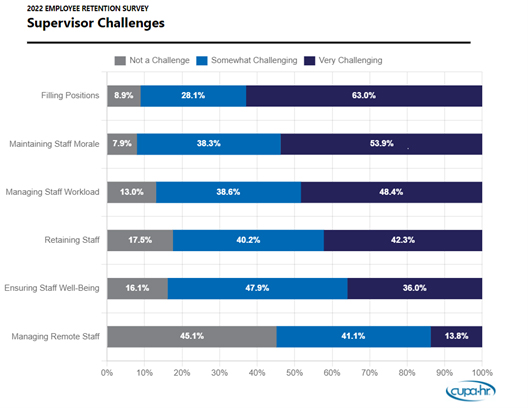
    Filling positions and maintaining morale are supervisors’ top challenges. As shown in the figure below, almost two-thirds (63 percent) of supervisors indicated they find filling positions very challenging and over half (54 percent) found maintaining staff morale very challenging.
    Higher ed supervisors report a lack of adequate training and support. Only three in five supervisors agree that they have resources and support in their supervisory role. Less than half (46 percent) agree that they have been provided with adequate management training for their supervisory role. However, when supervisors have more resources and support in their supervisory roles, more power to advocate for their staff, more power to allow flexible schedules, and more power to allow their staff to work remotely, they are less likely to seek other employment.

    Implications of Supervisor Turnover and How to Combat It

    Turnover in any role can impact an institution due to loss of talent, institutional knowledge and team or interdepartmental rapport. However, turnover in a supervisor role has more far-reaching implications. Supervisor turnover also impacts direct reports, who must adjust to a new supervisor and may need to adapt to new team priorities and vision. Loss of supervisors also equates to a loss of leaders who are key to succession plans.

    In light of what the data show, there are several actions higher ed institutions can take to keep their supervisors:

    • Provide supervisors with resources and support in their capacity as supervisors, particularly around filling empty positions and managing staff morale.
    • Ensure supervisors have the ability, knowledge and resources to advocate for their staff.
    • Give supervisors more autonomy to determine their staff’s working arrangements, as the data show that supervisors who have more power to allow their staff to work remotely and have flexible schedules are less likely to seek other employment.
    • Commit to reducing supervisor workload.
    • If possible, raise salaries for supervisors (but not at the expense of non-supervisors).

    For a deeper look into the data, read the full report.

    Note: In the findings, “area supervisors” refer to those supervisors who are the top-most leaders in their department, units or areas (self-identified in the survey; 26 percent of respondents). “Other supervisors” are those who self-identified as having at least one direct report but were not the top-most leader in their department (31 percent of respondents). “Non-supervisors” are those employees who have no direct reports (43 percent of respondents).

    CUPA-HR Research

    CUPA-HR is the recognized authority on compensation surveys for higher education, with its workforce surveys designed by higher ed HR professionals for higher ed HR professionals and other campus leaders. CUPA-HR has been collecting data on the higher ed workforce for more than 50 years, and we maintain one of the largest workforce databases in existence. CUPA-HR also publishes numerous research publications and interactive graphics highlighting trends and issues around higher ed workforce planning, pay equity, representation of women and racial/ethnic minorities and more. Learn more about CUPA-HR research.


    Source link

  • Reassessing Your Institution’s EAP: Steps for HR Pros to Increase Awareness and Accessibility – CUPA-HR

    Reassessing Your Institution’s EAP: Steps for HR Pros to Increase Awareness and Accessibility – CUPA-HR

    by Lakyn Whaley | May 2, 2022

    May is Mental Health Month. Throughout the month, be sure to join the Connect discussion in the General Discussion group to discuss challenges and successes, as well as pose questions and offer advice to higher ed HR peers on the topic of mental health. A Zoom discussion will also take place mid-May. Stay tuned for the link to be posted in the Connect discussion. 

    Employee Assistance Programs (EAPs) are nothing new. In fact, 97 percent of large employers offer an EAP as part of their benefits package. Yet, the utilization rate of these programs is abysmally low, clocking in at an average of less than 5 percent even as concerns around mental health continue to grow. EAPs should be a key resource for struggling employees, so why isn’t anybody using them?

    Lack of Awareness

    Lack of awareness, on multiple levels, plays a large role in the underutilization of EAPs. Usually, employees are introduced to their organization’s EAP and other benefits during their onboarding process. However, the deluge of information new employees are exposed to during this time can easily wash out any memory of an EAP mention.

    In addition, there’s a general lack of awareness as to how EAPs function. People may form their own incorrect assumptions, such as thinking that participating in an EAP will incur an immediate cost or that EAP use will be reflected on performance evaluations, which keep them from accessing this benefit.

    Distrust and Stigma

    From grief counseling to connecting employees to legal resources, the situations that EAPs are designed to provide support for can often be deeply personal. Because of this, some employees may be concerned that personal details or other information related to their EAP access will be shared with their employers, since the EAP is an employer-sponsored program. Others may be hesitant to interact with EAPs due to the stigma surrounding mental and behavioral health topics.

    Accessibility

    If employees are aware and comfortable accessing their organization’s EAP, the next challenge they often have to surmount is the myriad steps required to connect with the resources and services they need. Many of the individuals who would benefit from using an EAP are already operating under higher levels of stress and may be more fatigued than their peers. This can mean that these employees are less likely to have the energy needed to engage with extended processes, even when they’re the ones who need it most.

    How Can HR help?

    It might feel like the issues listed above are too big for one department — and in some cases one person — to overcome, but there are steps you can take to help.

    Start by looking at your organization’s EAP from an employee perspective and map out the steps someone needs to take to access services. Ask questions along the way such as: How many steps are there? How do employees learn more about their EAP? What options are there for contacting someone? Might the hours of service be prohibitive to some? Are the services provided meeting a variety of needs? Note too where you notice the potential for confusion or frustration within the process and remember that if something can be simplified, it should be simplified!

    Once you’ve reassessed the EAP process, take some time to examine how your campus is talking about mental health in general. While communication about the EAP is necessary for program awareness, by itself it’s not enough to improve utilization. Double down on efforts to reduce stigma around mental health and mental illness. Creating a culture where employees feel safe to talk about their mental health and welcome to bring their whole selves to the table has myriad benefits — only one of which is improving EAP usage.

    Related resources:

    Mental Health Toolkit (CUPA-HR members-only resource)

    Destigmatizing Mental Health on Campus: What Can HR Do (Higher Ed HR Magazine)

    Right Direction – Free Turnkey Resources for Organizations to Address Mental Health in the Workplace


    Source link

  • New Report on the Representation of Women and Racial/Ethnic Minorities in the Workforce of Minority-Serving Institutions – CUPA-HR

    New Report on the Representation of Women and Racial/Ethnic Minorities in the Workforce of Minority-Serving Institutions – CUPA-HR

    by CUPA-HR | February 23, 2022

    Minority-serving institutions (MSIs) play an important role in ensuring students from underrepresented races and ethnicities receive a quality education.

    While there is an abundance of research on students who attend MSIs, little research has examined the MSI workforce, specifically, how the racial/ethnic representation of faculty, administrator, professional and staff reflects the student populations being served.

    The latest CUPA-HR report, The Representation of Women and Racial/Ethnic Minorities in the Workforce of Minority-Serving Higher Education Institutions targets this gap by providing an overview of MSI representation among all U.S. higher ed institutions and showing their geographic spread across the country; providing a closer examination of racial/ethnic and gender composition of faculty, administrators, professionals and non-exempt staff; and assessing how well the racial/ethnic composition of the higher ed workforce at MSIs reflects their student populations and matches the minority-serving mission of the institutions.

    Key findings from the report:

    • MSIs have higher racial/ethnic minority representation among their workforce than non-MSIs.
    • HBCUs have the highest representation of racial/ethnic minority employees.
    • Overall, the representation of racial/ethnic minority faculty at MSIs does not match the representation in students.
    • Overall, administrators, professionals, and staff at MSIs have similar racial/ethnic minority representation when compared to students.

    For more findings on the representation of women and racial/ethnic minorities in the workforce at MSIs, read the full report.


    Source link

  • Diversity and Inclusion Start With the Hiring Process: Two Institutions Getting It Right – CUPA-HR

    Diversity and Inclusion Start With the Hiring Process: Two Institutions Getting It Right – CUPA-HR

    by Jill Thompson | February 16, 2022

    For institutions to become diverse, equitable and inclusive workplaces for faculty and staff, HR must take a critical look at current hiring processes and analyze not only who’s being hired, but who’s doing the hiring. Are search committee members trained in DEI issues and prepared to conduct interviews in a way that exemplifies the institution’s commitment to DEI?

    As we wrap up the first two weeks of the 21-Day Equity Habit Building Challenge: Less Talk, More Action, we’re calling attention to inspiring higher ed hiring initiatives and resources from two institutions. HR pros will want to bookmark these resources to help them think through small adjustments or total redesigns of their institution’s hiring processes and DEI training for search committees.

    UC Davis’ Guide for Hiring Managers

    To helping hiring managers develop skills related to diversity and inclusion, UC Davis’ HR team created a guide to attracting, selecting and hiring diverse talent. The guide lists ways the institution can improve its reach for open positions and the diversity of candidates, as well as tips for incorporating inclusive language, targeting outreach, selecting recruitment panels, developing interview questions and making accommodations for applicants with accessibility issues.

    Oakland University’s Diversity Advocate Program

    Oakland University’s Diversity Advocate (DA) faculty hiring program was highlighted in-depth in the Fall 2021 issue of Higher Ed HR Magazine. The goal of the program is to mitigate bias in the hiring process. At one of the 21-Day Challenge Town Halls, OU’s team discussed the advantages of applying its DA model to the hiring process, namely ensuring equity doesn’t fall between the cracks by designating a DA to be an attentive participant in the search process.

    While Oakland University created the DA program for faculty hiring, they have gone on to create the Diversity Equity Advocate (DEA) program aimed at staff hiring. Although the DEA program is still considered a pilot program, it’s a great example of how Oakland University is shaking up search committees to achieve a more diverse workforce.

    Search committees are one of the first points of contact for job candidates. It’s imperative that these committees are prepared and trained to conduct inclusive interviews with diverse candidates and to bring issues of equity to the forefront. HR practitioners can use the resources listed here to spark ideas and action within their institutions.

    Haven’t joined in on the latest 21-day challenge yet? There are still two weeks left! 21-Day Challenges are open to CUPA-HR members only.

    Check out these articles to see how other institutions are promoting diverse, equitable and inclusive hiring practices:

    Embedding Racial Equity Into HR Practices

    The Equity Case for Competency-Based Hiring

    Breaking Down Hiring Barriers for Veterans: The Journey to Becoming a Military-Friendly Employer

    Hiring Heroes: Providing Employment Opportunities for Military Veterans

    How Two Universities Are Building Community Partnerships to Strengthen Local Hiring

    Removing Hiring Barriers for the Disability Community

    Examining Implicit Bias and Its Effect on Hiring and Inclusiveness

    e-Learning Courses:

    Building a Successful, More Inclusive Search (Individual)

    Building a Successful, More Inclusive Search (Group)


    Source link

  • New Research Shows Women in the Leadership Pipeline in Higher Education Have Better Representation and Pay in Institutions With Female Presidents and Provosts – CUPA-HR

    New Research Shows Women in the Leadership Pipeline in Higher Education Have Better Representation and Pay in Institutions With Female Presidents and Provosts – CUPA-HR

    by CUPA-HR | January 24, 2022

    New research by CUPA-HR has found that U.S. colleges and universities with women presidents or provosts have higher representation of women in administrative, dean and faculty positions than institutions led by men. The study also found that colleges and universities with women presidents have higher pay for women in administrative positions than institutions led by men. These positions tend to be pipelines for the senior-most executive positions in higher ed, which underscores the significance of the findings.

    Women Administrators Pay and Representation in Institutions With Female Presidents

    Findings show that institutions with female presidents have a higher percentage of women in all administrative categories — senior institutional officers, institutional administrators and heads of divisions. Although female administrators are generally paid less than male administrators in the same positions regardless of the sex of the president, female senior institutional officers, institutional administrators, and heads of divisions are paid more equitably at institutions with a female president than at institutions with a male president.

    Female Deans and Faculty Pay and Representation in Institutions With Female Provosts

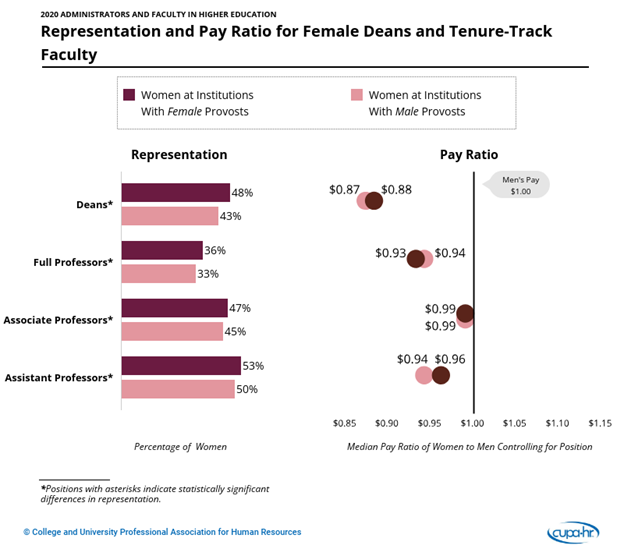
    Institutions with female provosts have a significantly higher representation of women in dean positions and in all faculty ranks. Provost sex does not have a strong or consistent impact on pay equity for deans and faculty; however, it is worth noting that better representation at higher faculty ranks and in dean positions has an impact on pay, as these positions make higher salaries.

    The representation of women drops with successive faculty ranks (from assistant to associate to full professor). These promotions represent the few times in a faculty member’s career when appreciable salary increases are granted. If women are not being promoted, they are not receiving these pay raises. In addition, those in dean positions are generally promoted from senior faculty ranks. Therefore, if women are not adequately represented in senior faculty, they will not have the same likelihood as men of being considered for a higher-paying dean position.

    To sum up the findings, higher ed institutions with female executives have better representation of women throughout their institutions in positions that: a) are paid higher salaries and b) serve as key points in the executive leadership pipeline. Jackie Bichsel, CUPA-HR’s director of research and co-author of the new report, noted that, “In an era where institutions are adapting to shifting workforce expectations, adjusting to continuous decreases in budgets, contemplating changes in enrollment, addressing challenges of recruitment and retention, and rethinking their mission, more openness to change and less tolerance of risk may be just what is needed to navigate this new landscape. Providing more (and more equitable) opportunities for women to advance within higher education seems an obvious path forward in this navigation.”

    Read the full report, Women in the Leadership Pipeline in Higher Education Have Better Representation and Pay in Institutions With Female Presidents and Provosts.


    Source link