Tag: Insurance

  • High-Risk Hobbies That Shape Your Insurance Options

    High-Risk Hobbies That Shape Your Insurance Options

    For many professionals, especially physicians, dentists and business owners, higher income opens the door to hobbies that were once out of reach — things like flying lessons, backcountry skiing, scuba diving, or rock climbing.

    These hobbies are exciting, but they also change how insurers assess your risk. And in insurance, added risk often shows up as higher premiums, exclusions, or even an inability to qualify for certain coverage.

    This isn’t meant to discourage anyone from pursuing what they enjoy. The goal is to understand how these activities are viewed by life and disability insurance underwriters so you can make the best decisions long before you file an application.

    Why insurers care about hobbies

    Insurers are looking for patterns that increase the likelihood of a claim. For high-income professionals, the combination of disposable income and adventurous hobbies is common in underwriting files. Activities like:

    • Scuba diving
    • Skydiving
    • Bungee jumping
    • Rock climbing or bouldering
    • Backcountry skiing
    • Flying as a private pilot

    These can all trigger additional scrutiny. In some cases, they lead to exclusions similar to what you might find with a pre-existing condition. In others, they result in a higher premium or a denial altogether.

    In my experience, private piloting is the most common trigger for outright denials, especially with life insurance. Even training for a pilot’s license can affect your application.

    Get the best price on own occupation disability insurance

    SLP Insurance will find you the best price even if it’s not with us. Fill out the form below to get discounts of up to 30%.

    Get the best price on own occupation disability insurance

    SLP Insurance will find you the best price even if it’s not with us. Fill out the form below to get discounts of up to 30%.

    Hobbies most likely to affect coverage

    Insurers treat each activity differently, but several consistently show up in underwriting decisions for life and disability insurance.

    Private pilot licenses

    This is one of the biggest red flags in underwriting. Some carriers may decline the application entirely. Others might offer coverage but exclude aviation-related deaths.

    Importantly, applications ask whether you are currently flying, planning to take lessons, or expect to start within the next two years. Even if you intend to apply now and start flying later, the carrier expects full disclosure. If an aviation-related death occurs and the application wasn’t accurate, they may not pay the claim.

    Rock climbing and bouldering

    For disability insurance, a rock-climbing exclusion is extremely common if you are actively participating in this hobby. And for good reason — injuries to the wrist or hand can immediately affect the ability of a surgeon, dentist, or operator to perform their job.

    Backcountry skiing

    Backcountry skiing is typically covered under life insurance only if you pay an added premium. In one case I saw, that added cost essentially doubled the client’s annual premium.

    Is it worth paying for the coverage? For a healthy 30-year-old buying a 20-year term policy, the most likely non-illness causes of death are accidents, in this case, most likely from an avalanche. If backcountry skiing is part of your lifestyle, you generally want it included.

    Scuba diving

    Scuba is more nuanced. Traditional open-water recreational diving is often acceptable, especially if the frequency is low and you stay within standard depth limits.

    Where problems arise:

    • Very frequent diving
    • Deep or technical dives
    • Cave diving
    • Diving without recognized certifications

    Some carriers require a PADI certification before they’ll include scuba without an exclusion. Others vary widely in their approach, which is why insurer selection matters.

    How much details matter: frequency, depth, training

    When insurers ask about hobbies, they’re looking for specifics:

    • How often do you do it?
    • What level of training do you have?
    • How extreme is the activity? (Depth, altitude, terrain, etc.)
    • Do you plan to increase frequency in the next few years?

    Someone who scuba dives twice a year on vacation is treated very differently from someone diving every weekend. The same applies to climbers who occasionally top-rope indoors versus those who regularly do multi-pitch climbs outdoors.

    What exclusions and added premiums look like

    Life insurance tends to handle these risks with extra premiums. Disability insurance usually applies exclusions instead.

    Examples:

    • Life insurance: “This policy will not pay a death benefit if the insured dies while backcountry skiing unless an additional premium is paid.”
    • Disability insurance: “This policy will not cover disabilities resulting from rock climbing or bouldering.”

    In certain high-risk cases, the company may simply decline to offer coverage at all.

    Can exclusions be removed later?

    In most cases, no. Once a dangerous hobby exclusion is added, it stays on the policy. Even if you stop the activity, insurers assume you may return to it.

    And practically speaking, if you’re no longer doing the hobby, the exclusion doesn’t affect you anyway — there’s no remaining risk for them to insure.

    What to do if you participate in these hobbies

    Be fully honest on the application

    This part is non-negotiable. If you misrepresent your activity and a claim arises within the incontestability period (typically the first two years), the carrier can deny the claim. In cases of outright fraud, they may deny payment even after that period.

    The worst-case scenario is simple:

    You pay for a policy for years, and when you need it most, it doesn’t pay out.

    Be upfront with your broker

    Different insurers treat the same hobby very differently. Scuba diving is a prime example. Some carriers exclude it almost automatically, while others include it with no added cost.

    An independent broker can pre-check hobby guidelines across multiple carriers and guide you toward the one most favorable to your situation.

    Remember: What you do after the policy is issued is your business

    If you’re honest on the application and decide to take up scuba diving or piloting six years later, the policy generally still covers you. Insurers care about your activities and plans at the time of underwriting, they can’t stop you from doing something years down the road.

    What if you can’t get coverage?

    If you’re declined by standard carriers due to an extreme hobby, specialized insurers like Lloyd’s of London can sometimes provide coverage. It’s a niche solution, and the premiums are significantly higher, but for unique situations, it may be the only option.

    How to approach insurance when you have risky hobbies

    High-risk hobbies don’t automatically disqualify you from life or disability insurance, but they do change how insurers evaluate you. The best strategy is always the same:

    • Be honest with your broker.
    • Be accurate on the application.
    • Understand the exclusions and decide whether additional premiums are worth it.

    When buying life and disability insurance, the goal is simple: coverage that’s comprehensive, reliable, and aligned with the way you actually live.

    Compare disability insurance quotes and save

    SLP Insurance will find you the best price on own occupation coverage, even if it’s not with us. Fill out the form below for a quote with up to 30% discounts.


    Source link

  • Cost of DfE’s school insurance scheme to rise 7.4%

    Cost of DfE’s school insurance scheme to rise 7.4%

    Risk protection arrangement costs have risen by 61 per cent since 2020

    Risk protection arrangement costs have risen by 61 per cent since 2020


    The Department for Education has confirmed costs for its school insurance programme will rise again by 7.4 per cent this year, with the scheme now costing 60 per cent more than in 2020.

    The risk protection arrangement (RPA), first set up in 2014, provides state schools an alternative to commercial insurance.

    It covers risks such as material damage, personal accident and employers’ liability, with government covering the losses.

    Now, the DfE has confirmed the amount it charges will rise from £27 to £29 per pupil from April 2026. This 7.4 per cent increase is far above the current rate of inflation, around 3.5 per cent.

    It said costs were reviewed annually “to ensure breadth of cover and value for money are balanced”.

    While the DfE first charged £25 per pupil for schools in 2014, prices were lowered to £18 per pupil in 2019-20.

    Prices have since increased year on year, with a 61 per cent change from 2020 to 2026.

    Around 12,400 schools were signed up to the RPA in January 2025. The DfE opened the scheme to LA-maintained schools in 2020.

    It was originally launched to reduce the public cost of protecting academies against risk.

    While schools may join at any time of the year, multi-academy trusts can join in a phased manner, where some academies may still have commercial insurance contracts in place.

    The DfE has been approached for comment.

    Source link

  • Loan and Degree Insurance May Be Self-Defeating (opinion)

    Loan and Degree Insurance May Be Self-Defeating (opinion)

    Imagine you are the parent of an incoming college student who wants to study theology, ranked among the lowest-paid majors after graduation. You’re proud of their conviction, but also anxious because friends and family keep reminding you that theology is a major for which career prospects are uncertain at best. Then, in the thick of college decision season, you learn that the college your child is considering offers something called “degree insurance”: If your graduate doesn’t earn above a set threshold, the program will step in to cover part of the gap.

    The promise is meant to ease parents’ and students’ fears. Yet, it raises a deeper question: Why would a college degree, still the surest path to economic advancement and long-term financial stability, suddenly require insurance at all?

    Across the country, colleges and universities are rolling out a new suite of financial products targeting undergraduates, marketed as “loan” and “degree” insurance. Loan repayment assistant programs (LRAPs), sometimes also called loan repayment guarantees, are a form of loan insurance that protect students against default: If a graduate doesn’t earn above a certain threshold, their student loan payments are reimbursed to a certain amount. Degree insurance is a mechanism akin to public “wage insurance” programs, where if a graduate makes less than the average income in their field adjusted for regional differences, the insurance would “top up” the difference in wages for a period of time.

    These two tools have distinct origins and underlying rationales. Loan Repayment Assistance Programs (LRAPs) originated in Yale Law School in the 1980s, and spread to other law schools, as the rising cost of legal education began to deter graduates from pursuing lower-paying public interest careers. While they began as internal sources of funding, the privatization of LRAP offerings and search for profit have pushed the industry to expand into new markets, namely undergraduate education. Indeed, Ardeo Education Solutions, an early and prominent player in this sector, was founded by Yale Law graduate Peter Samuelson, who himself benefited from Yale’s loan assistance program. Ardeo positions itself as reassuring families about the risks of taking on debt in order to pay for undergraduate education, “increasing access to the life-changing impact of higher education,” and freeing students from having to choose “between their passions and a paycheck.”

    Degree insurance products take a different approach. Degree Insurance, which counts Augustana College in Illinois as a client, draws on the cultural cachet of the American dream to market itself as an income equalizer; its flagship product, “American Dream Insurance,” guarantees “equal pay for equal study,” where “no graduate will have to earn less than their peers, regardless of race or gender, because everyone will have the same safety net.” This is insurance against the uncertainties and inequalities of the labor market as well as against individual weaknesses of any particular candidate.

    While the current scope and reach of this sector is challenging to assess, Ardeo Education advertises that it’s provided LRAPs to more than 30,000 students at more than 200 American colleges and universities. Participating institutions range from a number of small, faith-based colleges like Lyon College and MidAmerica Nazarene University to a public research university like Eastern Michigan University. Eligibility for repayment assistance usually requires graduation from the offering institution, full-time work (30+ hours/week), and staying below the income cap.

    The extension of LRAPs and degree insurance into undergraduate programs represents a new dimension of risk management in higher education, which has gone through several phases since it began in earnest in the late 20th century when colleges and universities started responding to increased personal injury and campus safety litigation. These risk management programs, tailored to protect institutions, eventually expanded to include Title IX, Occupational Safety and Health Administration requirements, environmental regulations, reputation management, crisis communications, cybersecurity and, most relevantly for this topic, financial sustainability. Loan and degree insurance represent the latest iteration of such efforts.

    For now, colleges typically pay for these programs, though it is unclear how much of the cost is passed on to students through tuition. How students are selected for inclusion in these programs is also opaque. Institutions are free to determine which students and majors are offered the program. Augustana College’s website, for example, says that it offers degree insurance at no direct cost to the student, but participation is on an invitation-only basis.

    There are, of course, reasons to defend these programs. Scrutiny of the student loan system, which has resulted in a student debt crisis, has intensified across the political spectrum, as policymakers from both parties recognize the harm it has caused (even as they disagree on the solutions). LRAPs and degree insurance may decrease the rate of loan default and reassure low-income families who were unable to save for college and are averse to taking on loans to pay for college.

    In an environment marked by increasing competition for students, admissions professionals see offering LRAPs and degree insurance as a competitive advantage. Loan repayment and degree insurance plans also encourage students not only to enroll in college in general but to pursue degrees with more challenging career prospects, which are also often the ones at risk of being cut due to low enrollment. This is increasingly relevant given the almost daily news of program closures.

    The arrival of these financial instruments is perhaps an understandable response to the rising cost of a college education, increased competition for students, overall wage stagnation and shifting public views about the purpose, value and outcomes of higher education. The adoption of these tools, however, is not simply driven by the current circulation of the idea of college education as a risk; it also further reinforces that view.

    These programs are not simply a new and neutral financial option for students. By extending the logics of institutional risk management to the economic futures of students, these tools cement the troubling, and potentially self-defeating, idea that a college degree itself is a financial risk requiring protection rather than the most reliable path to upward mobility and a critical component of our continued economic and cultural prosperity. Their adoption by colleges and universities is a reflection of the “short-termism” that has increasingly marked higher education strategy. As more institutions inevitably adopt these programs, it is unclear how long they will remain a competitive advantage. Furthermore, as the trend spreads, we may see the labor market respond, with employers lowering entry-level salaries even further as they take into account insurance payouts. Indeed, like many aspects of higher education today, it feels like a race to the bottom.

    Comparisons between insurance products and other forms of income or employment assurances are difficult to make. Should families prioritize colleges with strong outcomes (e.g., graduation rates upward of 70 percent and reassuring post-graduation employment statistics), robust alumni networks, or loan and insurance programs? It is also too early to tell what the consequences of transferring the risk to third parties, a common higher education risk management strategy, might be for students and institutions in the long term. And, it further financializes education, such that in the process of character formation, managing risk, rather than other values or logics, becomes central to identity.

    Colleges and universities might want to ask themselves whether treating college degrees as a risk serves their long-term interests. Loan and degree insurance products may deliver short-term enrollment gains, ease families’ anxieties, and even encourage students to pursue majors often viewed as less “marketable.” In the long-term, however, these strategies relieve the pressure to address underlying structural challenges such as rising costs, stagnant wages and a flawed loan system. Ultimately, they undermine our ability to make the case for higher education as a public good, thus putting the future of the entire endeavor at risk.

    Margarita Rayzberg is an assistant professor of sociology and criminology at Valparaiso University.

    Source link

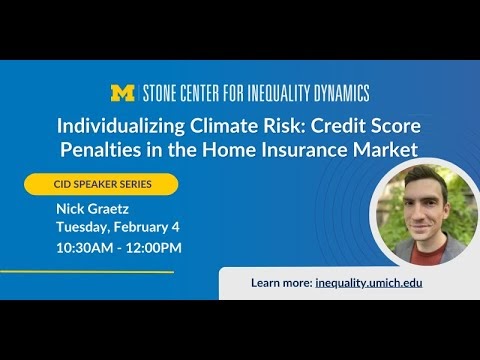
  • Credit Score Penalties in the Home Insurance Market (Nick Graetz)

    Credit Score Penalties in the Home Insurance Market (Nick Graetz)

    On February 4, Nick Graetz joined the University of Michigan’s Stone Center to present “Individualizing Climate Risk: Credit Score Penalties in the Home Insurance Market.”

    Nick Graetz is an Assistant Professor at the University of Minnesota in the Department of Sociology and the Institute for Social Research and Data Innovation. He is also a Fellow at the Climate and Community Institute, a progressive climate policy think tank developing research on the climate and inequality nexus. His work focuses on the intersection of housing, population health, and political economy in the United States. Learn more at ncgraetz.com.


    Source link