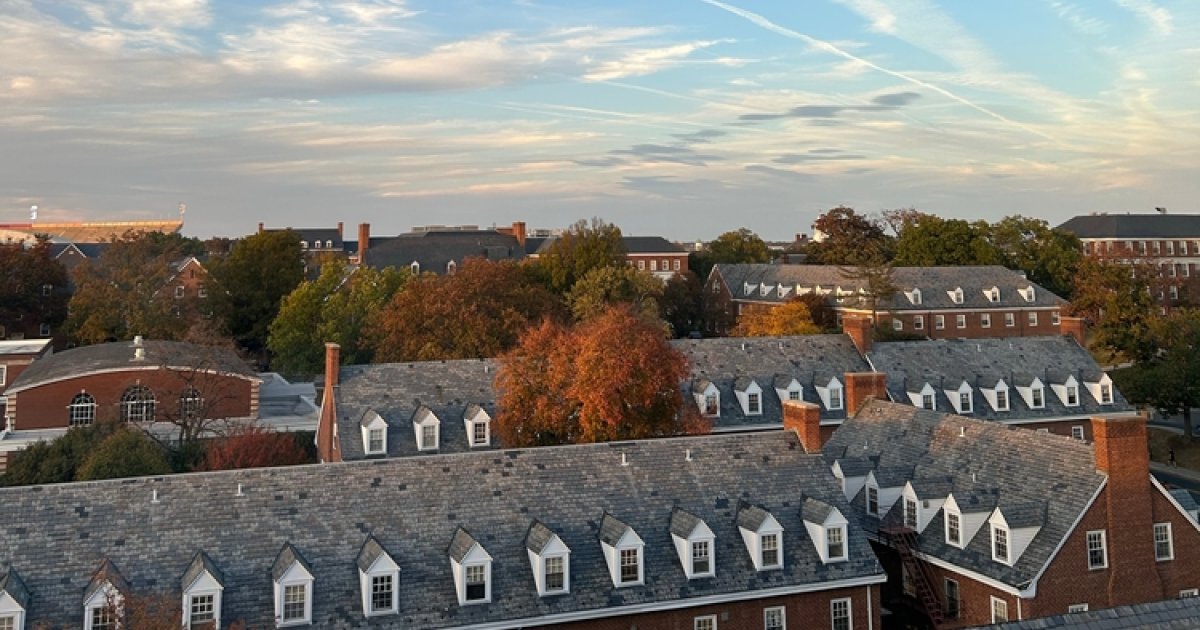
Riona Sheikh walked onto the University of Maryland’s campus her freshman year not knowing a soul. “I was a little lonely,” she recalls. It was September 2024, and the Maryland native didn’t have a large wave of high school classmates who’d joined her at UMD. These were uncharted waters.
In high school, Sheikh had been on the student paper, and she thought joining one at UMD could be her lifeboat. She saw the diverse array of student-run outlets on UMD’s campus staffed with journalists from a range of backgrounds: La Voz Latina, The Black Explosion, Mitzpeh, The Diamondback. The tradition of starting independent publications had run strong at UMD for decades. Her desire for community and passion for journalism could be melded together, she realized. What was stopping her from creating her own?
A month later, she founded Al-Hikmah, the campus’s first Muslim student newspaper. At first, she thought the idea would flounder. “I had zero confidence in starting it, but I did it anyway,” she remembers. She sent interest forms out to other students still feeling unsure. But within a year, they had a 16-member staff and an established digital presence.
Drawing on her experience as a high school student journalist, Sheikh wanted her tenure as founder and editor-in-chief to prioritize editorial independence. Her high school journalism teachers had generally been open to letting the students report on broad swaths of topics — until Oct. 7, 2023, that is. After the attacks, they said the school paper wouldn’t report on any aspects of the Israeli-Palestinian conflict, “because it’s too controversial,” Sheikh recalls them telling her. Al-Hikmah would be different: students would be able to report on events even if they were controversial.
It took almost exactly a year for Sheikh to be proven wrong.
On Oct. 21, Sheikh and one of her Al-Hikmah colleagues, Rumaysa Drissi, decided to cover protests outside of Jimenez Hall, where Students Supporting Israel were hosting an event that featured Israel Defense Forces soldiers. Prior to the event, Sheikh and Drissi had asked SSI if they could report on the event from the classroom and were told no. So they covered the protesters’ response outside, until they noticed protesters entering the building with their signs. Sheikh and Drissi decided to follow to capture first-hand footage and photography of a controversy as it unfolded — Sheikh filming on her cellphone, and Drissi taking photos on her camera.
That decision would prove consequential. Sheikh and Drissi were detained alongside two protesters in the building’s hallway, during which time the Al-Hikmah reporters repeatedly stated they were student journalists and offered to call their on-duty editor.
Footage from both the reporters and UMPD officers shows that after Sheikh reiterated that she was a student journalist, a UMPD officer responded, “That doesn’t mean anything. You were screaming and disrupting the event.” Despite the cameras capturing the entire interaction, no footage shows either Sheikh or Drissi shouting.
Nevertheless, Sheikh and Drissi were handed down student conduct charges from the university, including “intentionally and substantially interfering with the lawful freedom of expression of others” and “engaging in disorderly or disruptive action that interferes with University or community activities.” Their filming and photography — basic newsgathering — was now cloaked in terms of interference and disruption.
Reporting reshaped as disruption
In December, FIRE’s Student Press Freedom Initiative (SPFI) sent a letter to UMD’s Office of General Counsel, urging the school to drop the charges. SPFI’s letter called on the university to refrain from punishing the journalists who covered the disruptive protest. Student reporters documenting others who may be engaged in misconduct, SPFI argued, shouldn’t be exposed to the same charges, investigations, and punishments as the people they’re covering. So far, the school has refused to drop the charges.
An associate general counsel from UMD reasoned that “the students at issue are alleged to have done more than merely cover, as journalists, other individuals’ protest of the SSI event; instead, it is alleged they were aware of and participated in such protest, albeit by recording and planning on reporting on it, rather than waving signs and shouting.” Coverage of a protest, it seems, equals participation in said protest in the eyes of UMD officials.
“It’s like we’re being treated as if we just did something else entirely,” Sheikh says. “It makes me worry about our coverage of pro-Palestinian protests in the future.”
Sheikh and Drissi are awaiting their disciplinary hearings and face the possibility that their coverage will land them with sanctions.
‘A lens that I can keep’
During her sophomore year, Drissi joined Al Hikmah as a writer and photographer. She had always considered herself a creative person — picking up sketching, drawing and, from there, photography. It was photography that stuck. “It connects me to the world and lets me see it through a lens that I can keep,” she says.
Leading up to the coverage of the Oct. 21 protest, the Al-Hikmah photographer who originally had been assigned to go expressed their hesitancy. Drissi volunteered instead. “I switched in with them,” she recalls. “I’ll cover this event, because people deserve to see what’s actually happening,” she remembers thinking.
To that end, Drissi hasn’t allowed the university’s investigations to stop her reporting. Both she and Sheikh have continued their coverage, which includes community, global, and faith issues. Drissi described covering her community as a “duty” — especially since being detained and placed under investigation.
“It feels even more important to me to make sure that student voices are heard,” she says.
Al-Hikmah, like its staffers, has no plans of slowing down. The paper is taking additional steps to safeguard its journalists who report on protests, like getting press passes, Sheikh says. In the meantime, Al-Hikmah will keep sailing through uncharted waters.
“You’re always going to face obstacles and barriers when you’re carving out a new space, but we have to remember why we’re doing this, and who we’re doing it for.”