Tag: International

  • 5 Strategies to Create Inclusive Learning Environments for International Students – Faculty Focus

    5 Strategies to Create Inclusive Learning Environments for International Students – Faculty Focus

    Source link

  • CUPA-HR Joins Higher Education Letter Seeking Additional Information on International Students

    CUPA-HR Joins Higher Education Letter Seeking Additional Information on International Students

    by CUPA-HR | April 8, 2025

    On April 4, CUPA-HR joined the American Council on Education and 14 other higher education associations on a letter to Department of State (DoS) Secretary Marco Rubio and Department of Homeland Security (DHS) Secretary Kristi Noem seeking additional information on the agencies’ policy and planned actions for international students and scholars.

    The letter states that additional clarity is sought after reports that student visas are being revoked without additional information being shared with institutions where those students attend. According to the letter, such reports include messages to international students about their visas being revoked and requesting that they self-deport without providing additional information about the process to appeal such decisions. The letter argues that these actions hinder institutions’ ability to best advise their international students and scholars on what is happening.

    In order to provide more clarity to institutions, the higher education associations request that DoS and DHS schedule a briefing with the impacted community to better understand the actions being taken by the agencies. The briefings could provide the opportunity to understand the administration’s actions in this space and to allow the higher education community to better understand how they can best help address issues of national security.

    CUPA-HR will share any updates from these agencies related to the international student and scholar news and requests set forth in this letter.


    Source link

  • Coalition announces harsher international student caps – Campus Review

    Coalition announces harsher international student caps – Campus Review

    The Coalition has said it would cap international students at 240,000 and triple the visa application fee to $5,000 for those applying to Group of Eight universities to free up room in the rental market.

    Please login below to view content or subscribe now.

    Membership Login

    Source link

  • A turning point for UK international higher education

    A turning point for UK international higher education

    In 2019, the UK launched its first international education strategy – a landmark effort that set ambitious, cross-government targets for growing our international education footprint. The years since have exposed the fragility of a strategy without a built-in mechanism for review or refresh when buffeted by events. Changing geopolitics, tightening migration strategies and Covid might not individually have been expected, but exposure to global markets will always bring challenges.

    The 2019 roadmap lacked clarity on whether those targets were a floor or a ceiling and what we were to do when they were reached. In their absence, policy drifted. Reactive decisions replaced proactive planning. Universities, caught in the crosswinds of shifting geopolitics and domestic migration debates, have too often been left guessing what the government’s long-term vision really is.

    That’s why the International Higher Education Commission (IHEC) was formed; to fill this strategic vacuum with a coherent, forward-looking, and inclusive vision. Working across sectors – engaging university leaders, student bodies, recruiters, and policymakers – it’s been working on framework for a new UK international higher education strategy rooted in data, tempered by experience, and open to evolution.

    Our personal view is that we need nothing less than a reinvention of how we plan, manage, and grow international higher education; that we must hack a way through the many things we could do, or would like to do, to get to the essential priorities – what we must do – and be brave enough to make difficult decisions. 

    It is clear that the government wishes the sector well, but is not going to put its hand in its pocket any time soon. Our only way forward in the short term, then, is to ask for modest help, which will provide a short-term, concrete return on investment to trade our way out of the immediate difficulties.

    Our personal view is that we need nothing less than a reinvention of how we plan, manage, and grow international higher education

    If we steady the ship, we can in parallel put in place a framework, acknowledging the likely ongoing volatility in geopolitics and global markets, that moves us to a more strategic and sustainable approach in the medium and longer term. This may not be elegant policy making, but it is rooted in the pragmatic reality of the changes necessary to stabilise a system so economically, socially and culturally significant.

    We have shared our personal views in a number of fora over the past two years as IHEC has unfolded and reiterate them here as we anticipate the imminent publication of our final report. It is very timely now, having been delayed initially by the UK general election, in which higher education as a topic failed to appear. Then the focus of almost everyone was on the US election, and that was followed by the significant challenges in the sector that meant that policy suggestions would not have been appropriate. 

    Now, there is a more proactive, forward-looking context to which we hope we can contribute.

    • A living strategy with built-in review and flexibility

      The UK needs a dynamic framework, not a static document.

      Strategies must adapt to shifting global conditions, student preferences, and national needs. A ‘living’ strategy, reviewed regularly, updated transparently, and framed around multiple scenarios, not a single trajectory. Growth must be deliberate, not accidental.

      • Policy certainty and sustainable structures

          Confidence in the UK’s offer depends in part on consistency. The Graduate Route – allowing students to work post-study – has been a cornerstone of our recent successes, but its future must be secured through clearer legal and policy underpinning in the face of continuing threats from a still-changing migration policy context.

          We also need a more sustainable system that doesn’t rely solely on growth from a few key markets, but diversifies and balances recruitment in line with national capacity and ambition.

          • A competitive, student-centred offer

          International students are not just numbers; they’re individuals with aspirations and needs. Better engagement with the ‘student voice’ is critical, as is a re-examination of how we ensure student success as they enter the workforce.

          • Whole-government coherence and accountability

          Too often, policy is siloed across Whitehall. Education may do better than other areas, but there are key departments missing from discourse – the Home Office, the Department for Science, Innovation and Technology, among others – and they are necessary to provide coordinated oversight.

          It’s also vital to reflect regional priorities and the role of devolved nations, Metro Mayors, and local authorities in shaping recruitment and integration strategies.

          • Strategic marketing and market diversification

          The UK concentrates too heavily on a small number of international markets. We must be smarter.

          Study UK does the best it can with the woefully poor levels of investment, but we must invest in data-driven, market-specific campaigns and learn from countries like Australia that tie marketing to outcomes.  

          • Public-private partnership and institutional innovation

          Strategic delivery needs strategic partners. We must deepen collaboration with sector bodies like UKCISA, NISAU and BUILA to create a more integrated system that shares responsibility across institutions, government, and industry. 

          We also need to support the new found enthusiasm for TNE at scale to ensure that the new initiatives are robustly founded, and better data to inform national and institutional decision making.

          • Reframing migration and public narrative

          International students bring huge value to local economies, research, and the cultural fabric of our campuses. Yet in public discourse they too often become collateral in broader immigration debates.

          We must be able to show, and more effectively communicate, that almost all students return home. A confident, positive narrative is essential, based on evidence – not emotion.

          The road ahead

          This is a moment for boldness and clarity. The sector stands at a crossroads. It is under unprecedented threat, but it is also brimming with opportunity. If we get it right, the UK will not only remain a top destination for international students: we will lead globally on how it integrates education with diplomacy, soft power, and innovation.

    Source link

  • International students and asylum claims

    International students and asylum claims

    For at least a couple of years there’s been an issue percolating away without much clarity about its extent, causes and consequences – that of international students in the UK applying for asylum either during or following their studies. Staff in universities have at times told us of a noticeable rise in cases, and we also get rumours every now and then of it being on the Home Office radar.

    Over the weekend the government released for the first time some data on asylum claims by student visa holders – previously there have only been figures for successful applications, according to first visa held, which have been buried in the annual “migrant journey” report. These have not painted a particularly clear picture of the real situation.

    So we now learn that, of the 108,000 who claimed asylum in the UK in 2024, 40,000 were from people who had held a visa. Within this group, student visas were the highest share of the total, with 16,000 claims – those on work visas accounted for 11,500, and 9,500 were on visitor visas (all these figures have been rounded to the nearest 500, for some reason). There’s nothing here about the proportion of claims that were successful, or even resolved.

    The stats release with coordinated with an interview with home secretary Yvette Cooper on the front page of The Sunday Times, focusing on the effects of asylum claims on the government’s floundering accommodation system:

    One of the things that became clear as we examined this really rather chaotic system that we inherited is that we have people who are in the asylum accommodation system who arrived in the UK on a student visa, or a work visa, and who then only claimed asylum at the end of their visa. They have then gone into the asylum accommodation system even though when they arrived in the country they said they had the funding to support themselves.

    The Home Office data release highlights that “almost 10,000 people who claimed asylum after having entered on a visa were provided with asylum support in the form of accommodation at some point during 2024” – this figure isn’t broken down by visa type – and that the most common nationalities here were Pakistan, Nigeria and Sri Lanka.

    So what’s going on?

    In the run-up to last year’s MAC review of the Graduate route, there was a rather convenient Home Office leak to the Daily Mail of the numbers of international students who had gone on to claim asylum, covering the 12 months to March 2023 – and broken down by nationality and even institution. These figures, if accurate, showed 6,136 asylum claims made in that year, so the numbers have only increased since.

    The timing and the pick-up in anti-immigration media was sufficient for the Migration Advisory Committee, in its Graduate route review, to feel the need to comment, if only to damp down hopes that they would consider this as a form of “abuse of the visa system”:

    We note recent reports of an increase in asylum applications from those originally coming to the UK through work and study routes. The government may deem this behaviour undesirable and unintended usage of these routes. However, coming to the UK legally on a work or study visa and proceeding to make a legitimate, admissible asylum application does not constitute abuse. If the government is concerned by the rising number of such applications they should address this issue directly – it does not relate substantively to the Graduate route.

    But the issue hasn’t entirely gone away with the change of government and Labour’s relative de-politicisation of international students. In February, the BBC quoted border security and asylum minister Angela Eagle as having her eye on “those coming on work and student visas and then claiming asylum” – she pins the issue on the disorder the Conservatives left in the asylum system.

    This was then followed by Yvette Cooper’s comments at the weekend, along with the new Home Office data. The home secretary was announcing an expansion of right-to-work checks to gig economy and zero-hours roles in sectors like construction, food delivery, beauty salons and courier services.

    Meanwhile in Canada

    There’s an instructive international comparison here – Canada. Last autumn there was controversy in certain corners of the Canadian media when it emerged that almost 12,000 asylum claims had been made by international students in 2023, rising to more than 13,600 in the first nine months of 2024.

    The potential for political fallout was enough for immigration minister Marc Miller to write to the Canadian College of Immigration and Citizenship Consultants over the “important and concerning issue”, saying:

    I am concerned by reports that some of these students are being counselled by third parties to do so and to provide false information… I request that the College look into the possibility that licensed immigration consultants are illegitimately advising international students to claim asylum.

    This took place against a backdrop of the Canadian government instituting a series of caps on international student numbers, and restrictions on post-study work, ahead of a general election this year.

    Policy levers

    The UK government has pledged to substantially cut the number of people in temporary accommodation with claims or appeals pending – it’s a policy objective driven both by Treasury imperatives to cut the ballooning costs and political considerations around being “tough on migration.”

    If international students claiming asylum gains traction as an area for attention – and it’s worth reiterating that the figures show that just shy of 15 per cent of all claims in 2024 were from student visa holders – then probably the easiest policy lever for the government to pull is simply to throttle student and graduate route numbers: avoid overturning any of the restrictive policies introduced by the Conservatives, and harry away at the edges of the system to discourage any kind of return to the totals seen in 2022–23 and 2023–24.

    There’s a question here, though, about whether this is really an HE-related matter. As the statement from one of the universities in the above-mentioned Daily Mail splash said at the time:

    This particular issue is a result of the government’s own asylum policy, which allows visa switching in a way that is outside the direct control of the universities concerned and is not a failing of the higher education sector.

    And the National Audit Office’s recent report on the skilled worker visa found that the number of asylum claims from holders of that visa had risen from 53 in 2022 to 5,300 in the first ten months of 2024. So if it’s not a phenomenon that is restricted to student visa routes, and one that in many cases is about what happens after the period of study, it would appear an over-correction for the government to take any action specifically focused on the higher education system.

    But there are some issues that the government seems to have in its sights. In the Sunday Times interview, there’s a specific mention of the proof of funds that student visa applicants must demonstrate, and how this seemingly conflicts with asylum claims on economic grounds.

    Last September Labour announced an increase in the amount that students must evidence – though it’s still far from being sufficient to live on in most places. But there are plenty of rumours about this system being gamed by agents who assist applicants by parking temporary funds in their accounts, telling them that they will in fact be able to support themselves (and pay off all the debts they’ve accrued) by working while and after studying.

    It’s another example of failure to provide students with clear-cut, realistic information about visa costs leaving them open to exploitation – and an area where the sector should be arguing for more rigour and scrutiny in the proof of funds process, along with a higher sum required, rather than seeing it as a deterrent to prospective students. We’ve also previously covered – anecdotal – reports that students have been advised to apply for asylum when unable to complete degrees within the specified time limits, or potentially for other reasons such as non-payment of fees, though there’s no evidence that this is a widespread phenomenon.

    So there are specific issues here for institutions to get ahead of. Whether that’s enough to move the dial remains to be seen, especially if these latest figures gain prominence and newspapers investigate promises made by agents overseas.

    Protecting students

    Ensuring that vulnerable people are not exploited through misinformation about how they can, supposedly, game the UK’s dysfunctional immigration system should be a priority. If nothing else, there is the pragmatic benefit of heading off further international restrictions and another round of negative HE headlines.

    But more importantly, upholding the right for international students to claim asylum – as well as scientists, researchers and other staff – is of critical importance for preserving academic freedom (among many other things), not just in the UK but around the world. If the growth in claims, and the government’s flailing attempts to address it, ends up tarnishing the need for a humane, well-managed asylum process, everyone suffers. And the higher education sector being on the back foot over asylum, rather than standing up and advocating for its importance, would be a terrible turn of events.

    While the Daily Mail and others might report on growing application numbers from current and former international students as evidence that the UK is not tough enough, too permissive, too generous in the legal protections and recourse it offers to those seeking asylum, the fact remains that it’s an awful system for anyone to get caught up in.

    Just over a year ago in the House of Commons, the now former SNP MP Alison Thewliss reported on a a parliamentary visit to the Bibby Stockholm barge, used by the previous government for asylum accommodation:

    I will take this opportunity to put on record the sadness, confusion and frustration of those on board. Those men felt that they were being punished for some unknown misdemeanour – unable to get any peace and quiet, living in impossibly close proximity to people for months at a time, with no certainty as to when that will end, and their health needs not being properly assessed. The vessel was not intended to be lived on 24/7, and despite the tabloid rhetoric, none of those I met on that boat had come on small boats. Some had been international students, forced to claim asylum when the political situation in their home countries deteriorated. One told me: ‘the longer you are in here, you turn into a person you don’t know.’ How incredibly sad it is that the UK Government see fit to treat people in that way.

    Source link

  • Higher Education Inquirer continues to generate an international audience

    Higher Education Inquirer continues to generate an international audience

    HEI continues to generate a strong international audience.  While a substantial portion of our viewers are from the US, we have people (and bots) from across the globe reading our articles and Youtube posts. Our coverage lately, on the revocation of student visas, and of deportations, is particularly important for international students, particularly those who are concerned about US intervention in the Middle East, Asia, and Latin America. For some unknown reasons, we have little traffic from folks in African countries or Latin America countries (other than Mexico). We also have fewer than expected numbers from Canada and India. If there is anything we can do to increase those viewership numbers, please let us know. 

    Source link

  • Making a sustained case for international student mobility

    Making a sustained case for international student mobility

    Today on the HEPI blog, Professor David Phoenix OBE and Dr. Katerina Kolyva explore how England’s post-16 education system can move beyond competition to create a more integrated, collaborative approach that benefits learners, local economies, and national prosperity. You can read the blog here.

    Below, colleagues at the University of Surrey explore the evolving landscape of global student mobility, highlighting innovative programmes and making the case for a new approach to student placements.

    • Professor Amelia Hadfield is Associate Vice-President for External Engagement and Founding Director of the Centre for Britain in Europe, and Liz Lynch is International Mobility Manager, both at the University of Surrey.

    In recent years, the UK’s governments have developed new initiatives such as the Turing Scheme, the Taith Scheme in Wales, and the Scottish Government’s Scottish Education Exchange Programme (SEEP). These mobility programmes aim to support students’ global experiences. While they have undoubtedly provided valuable opportunities for students – particularly for those from disadvantaged backgrounds – what is truly needed is a longer-term commitment from government to sustain and expand these life-changing opportunities.

    At the end of February, the annual Global Mobility conference hosted by Universities UK International (UUKi) brought together higher education professionals and thought leaders to explore the latest developments in global student mobility and what the future looks like. The conference showcased how universities are leveraging these funding opportunities to create meaningful and impactful programmes. However, it also highlighted the significant challenges faced by UK institutions, particularly in the aftermath of Brexit, the Covid-19 pandemic, the UK’s withdrawal from Erasmus+ and the ongoing financial pressures on both universities and students. These factors have created a complex landscape, making investment in international mobility more crucial than ever.

    The Impact of Mobility on Student Outcomes: Insights from UUKi Research

    During the conference, UUKi presented early-stage findings from their latest research, Gone International: A New Generation, conducted in collaboration with Jisc and the Northern Consortium. While the data revealed a significant decline in the number of students going abroad, perhaps reflecting the impact of recent global challenges, there remains strong evidence of the benefits to students. Reaffirming 2019 findings, the data continues to show students participating in mobility programmes not only attain higher degrees but are also more likely to earn higher salaries, secure professional-level jobs and experience lower unemployment rates. The research underscores the important role of global mobility in fostering social mobility.

    Nevertheless, while those of us working in the sector already understand the intrinsic value of international experiences, having concrete data to back up these claims strengthens the case for continued support and expansion of such opportunities. The University of Manchester, for example, has been evaluating the impact of its international mobility programmes on student outcomes, and the findings have helped raise the profile and importance of these opportunities across their institution. This kind of evidence-based approach is essential for ensuring that the sector – and governments – remain committed to facilitating global mobility for students.

    The Broader Benefits of International Mobility

    The British Council highlights the broader societal benefits of international student mobility, particularly in fostering cross-cultural understanding and long-term relationships between nations. By participating in mobility programmes, students develop cross-cultural competence, language proficiency, and global perspectives – all vital skills for success in today’s interconnected world. Inbound mobility, in particular, contributes significantly to the UK economy, with international students bringing cultural diversity, innovation, and fresh perspectives to campuses. These exchanges also build cross-cultural networks, which can endure long after students return to their home countries, fostering greater trust and understanding between nations and supporting the UK’s soft power overseas.

    All of this is in addition to the economic benefit that stems from the UK’s ability to attract international students, as discussed recently on the HEPI blog.

    Blended Mobility: Enabling flexibility and accessibility

    Blended mobility programmes represent a forward-thinking solution for making global education more accessible and flexible. Cardiff Metropolitan University, for example, has embraced a hybrid model supported by the Taith funding, combining one week of virtual learning with one week of physical mobility. This approach not only maintains the essence of cultural exchange but also offers students the flexibility to engage in international experiences that might otherwise be logistically or financially out of reach. The combination of virtual, blended, and physical mobility opens doors for students who might not be able to commit to a full-term study abroad programme, making global learning more inclusive and scalable.

    Whilst the Turing Scheme in its current form does not include blended mobility, the recent reduction in minimum duration to 14 days is a positive step towards providing greater accessibility for students. Hopefully, in future years, blended mobilities and shorter 7-day mobilities could be incorporated into future Turing projects, taking the impactful examples from both Taith and Erasmus+ as evidence of the value and enabling engagement from the most disadvantaged and underrepresented groups.  This, along with funding for staff mobility (offered by both Taith and Erasmus+), will only serve to enhance Turing overall.

    Surrey’s Approach: Empowering Students through International Mobility

    At the University of Surrey, we are committed to increasing the participation of our students in a range of international opportunities, whilst simultaneously expanding the international dimension of the student experience at our Guildford campus. In this respect, placement training options, study abroad opportunities, enhanced ‘global and cultural intelligence’ and ‘collaborative online international learning’ (COIL) content in degree pathways, as well as our Global Graduate Awards, ‘international’ is necessarily widely defined, and ‘mobility’ can take place intellectually, culturally, and socially, as well as just physically,

    Mobility also brings together traditional approaches to cross-border opportunities with enhanced approaches to supporting new demographics. A key strategic objective at Surrey, therefore, is focusing on access for underrepresented groups. We target Turing funding and additional grant funds to students who meet Surrey’s widening participation criteria to address inequality amongst underrepresented groups who may wish to experience international mobility but are unable to do so without grants. The portfolio of both longer-term and shorter mobility options we have developed facilitates equal access for all. As previous placements have illustrated, longer-term mobility provides deeper cultural experiences and learning opportunities for those able to commit to a full semester/year abroad. Shorter options can widen access for students from disadvantaged backgrounds and underrepresented groups.

    Through their international experiences, our students build global academic and professional networks and improve their job prospects. They return to Surrey as confident, resilient, and globally minded individuals, prepared to tackle the challenges of tomorrow’s world. Feedback from students who participated in Surrey’s Turing 2023 project shows the impact mobility has on their personal and professional development. 94% reported an increase in intercultural awareness, and 93% felt the experience enhanced their employability and professional skills.

    Looking Ahead: The Future of Global Mobility

    The global mobility landscape is changing, with rapid technological advancements and a growing emphasis on inclusivity and sustainability. At Surrey, we are embracing technological innovations that will enhance both the student experience and the efficiency of mobility programme management. Process automation, for example, is helping streamline administrative tasks, freeing up resources to better support students. We are also starting to use virtual reality (VR) to promote international opportunities, allowing students to virtually explore campus life abroad. Future opportunities for blended learning, as well as the incorporation of COIL projects within the curriculum, will nurture the skills necessary for students to engage with the world and develop the confidence and curiosity needed to thrive in an interconnected society.

    By incorporating data-driven approaches, we will continue to assess the impact of our mobility programmes, identifying areas for improvement and ensuring that our offerings align with both institutional and student goals. As the sector evolves, collaboration and innovation will be key in ensuring that all students can access transformative international experiences.

    Source link

  • Scotland’s “sleeping giant” looks to international recruitment

    Scotland’s “sleeping giant” looks to international recruitment

    Although the history of the institution dates back over 100 years, it only achieved degree-awarding powers last year. Specialising in agriculture and life sciences, SRUC hopes to become an increasingly attractive choice for international students.

    “For many years, SRUC’s been a sleeping giant,” SRUC’s principal and chief executive Wayne Powell told The PIE News. “Now we’ve awoken and we can see huge amount of potential in what we can offer here in Scotland.”

    Offering international masters programs including international food and agriculture business, business consultancy and project management, Powell said the institution is “creating a future which is much more aligned to what students for the future will want to do” – with international recruitment efforts largely looking to students from India, Pakistan, Nigeria and other parts of sub-Saharan Africa.

    With six campuses located around Scotland, SRUC’s Edinburgh campus launched a £1.8 million vertical farming innovation centre in January, making it the first Scottish higher education institution in Scotland to create a commercial-sized vertical farm to help address global and local food production challenges.

    “Some of the things that we work on are at the nexus of the most important challenges facing society. So how do we feed a growing world?” explained Powell. “How do we support environmental sustainability?”

    He continued: “We are interested in attracting students that have an identity and an interest in sustainability and how the sustainability will play out over their lifetimes”.

    But while sustainability is undeniably a focus for the institution, Powell stressed that prospective students are also being enticed by curriculums focussing on business – especially as SRUC runs its own “successful consultancy business”.

    Now we’ve awoken and we can see huge amount of potential in what we can offer here in Scotland
    Wayne Powell, SRUC

    Learning about international agriculture, food and business in tandem is also a focus for programs, “particularly the potential for acquiring those business skills as part of a green economy”, Powell said.

    “And our location in Edinburgh [creates] a fantastic opportunity to come and live and work and study in a great city,” he added.

    “There’s something here which is going to be attractive and we’re keen to market that in the right way and creating the first cohort of students coming into something really special.”

    It comes as Scotland has taken steps to position itself as an attractive destination for international students. In late January, the country’s universities were encouraged to take “collective action” to promote Scotland as a study destination.

    In the same week, Scotland’s first minister John Swinney made the case for a bespoke visa for skilled international students graduating from the country’s colleges and universities. However, it is understood that the UK government has no plans to make good on these ambitions.

    Source link

  • International Students Navigate Escalating Threats

    International Students Navigate Escalating Threats

    International students across the country are on edge after a week of arrests, deportations and escalating threats from the Trump administration.

    So far the administration’s sights have been set primarily on Columbia University in New York. On March 8, immigration officials arrested recent graduate Mahmoud Khalil, intending to strip him of his green card and deport him for his role in pro-Palestinian campus protests last year. Over the next week, Department of Homeland Security agents raided students’ dorm rooms, arresting one international student and prompting another to flee to Canada.

    Elora Mukherjee, a law professor at Columbia and director of its Immigrants’ Rights Clinic, said international students have been flocking to the clinic for guidance: on whether their visas could suddenly be revoked, or if they should avoid traveling, delete their social media accounts or move off campus to make it harder for immigration officials to find them.

    She said she’s never seen anything like it.

    “Our clinic has been inundated with requests for legal consultation,” she said. “There is a palpable sense of fear among international students on campus.”

    Mukherjee said she’s been trying to quell international students’ anxieties. But in the wake of what she called an “unprecedented assault on due process, First Amendment rights and basic human decency,” she isn’t sure how.

    “They are worried about what may happen to their student visas. They are concerned that they may not be able to complete their degree programs if they are targeted. They’re wondering how they can make changes to their daily life to reduce the risk,” she said. “I don’t know what I can reassure them of right now.”

    Chief among the threats facing international students is the equation of protest activity and other protected speech with “terrorist activity.” In an interview with The Free Press last Monday, an unnamed White House official said that protesting made Khalil a national security threat, justifying his deportation. That strategy, the official added, is the administration’s “blueprint” for deporting other international students.

    In a post on Truth Social last Tuesday, Trump said that Khalil’s arrest was “the first of many,” calling international student protesters “not students, [but] paid agitators.”

    “We will find, apprehend, and deport these terrorist sympathizers from our country—never to return again,” Trump wrote. “We expect every one of America’s Colleges and Universities to comply.”

    Stephen Yale-Loehr, a retired Cornell University law professor who specializes in immigration law and international students in particular, said ICE officials’ activity at Columbia is the administration’s opening salvo in a battle against two of its most frequently invoked bogeymen: higher education and immigrants.

    “This administration has declared war on immigrants broadly and international students specifically,” he said.

    That war is currently centered on Columbia but is likely to spread across higher ed. On Sunday, Secretary of State Marco Rubio told Face the Nation that the administration plans to continue arresting and deporting international student activists. He added that the government is reviewing and revoking more student visas “every day.”

    It’s not clear if the Trump administration’s argument will hold up in court. If it does, experts say it would give the executive nearly unchecked power to deport noncitizens for disfavored speech, and there’s likely to be a fierce legal battle over that question. But international students have very few legal protections, Yale-Loehr said, and the administration has ample leeway to justify deporting them.

    “International students have the same constitutional rights as citizens, but immigration statutes are very broad and there are many grounds for deportability that could trip you up, even as a green card holder,” Yale-Loehr said. One of those potential grounds, he said, is donating to an overseas charity that the State Department deems suspicious or linked to terrorist activity—as it’s done with many charities for Palestinian children and families affected by the destruction of Gaza.

    “It’s easy for someone to unintentionally or unknowingly violate our immigration laws that way and get put into the deportation process,” Yale-Loehr said.

    When asked whether Columbia would protect current students approached by ICE or detained on campus, a university spokesperson pointed to a statement from earlier this month and said students were encouraged to familiarize themselves with university protocol in such cases.

    “Columbia is committed to complying with all legal obligations and supporting our student body and campus community,” the statement reads. “We are also committed to the legal rights of our students and urge all members of the community to be respectful of those rights.”

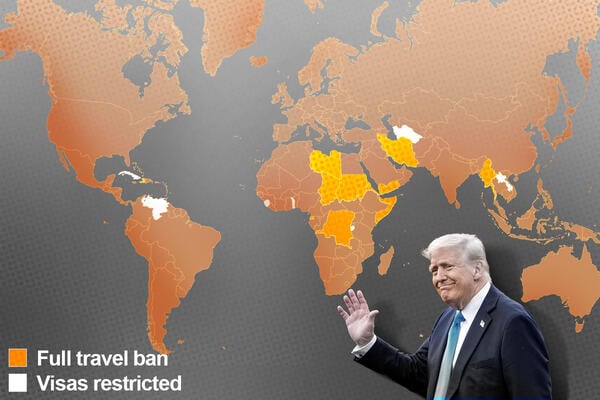
    The Trump administration is also considering instituting a travel ban similar to the one implemented during his first administration—except greatly expanded, from seven countries to 43, according to an internal memo circulating among media outlets.

    Some college officials are urging students not to travel until the details of such a plan become clear. On Sunday, Brown University advised its international student community, and any noncitizen staff and faculty, to avoid leaving the country or even flying domestically over the upcoming spring break.

    “Potential changes in travel restrictions and travel bans, visa procedures and processing, re-entry requirements and other travel-related delays may affect travelers’ ability to return to the U.S. as planned,” executive vice president for planning and policy Russell Carey wrote in a campuswide email.

    Jill Allen Murray, deputy executive director for public policy at NAFSA, an association of educators advocating for international students in the U.S., decried the student arrests as authoritarian and said they would have consequences for global views on U.S. colleges.

    “We as a nation hold dear freedom of speech and the right to protest. These are the very values that draw students from around the world to our shores,” Murray wrote in an email to Inside Higher Ed. “Americans and international students alike will certainly view this as an alarming attempt to crack down on freedom of expression.”

    Mounting a Legal Challenge

    Mukherjee said that even for students with longtime visa status or green cards, there are no guarantees. Trump’s invocation of an obscure wartime powers act to justify deporting student protesters, she said, is a “dramatic escalation” in anti-immigrant policy. She’s been cautioning students against appearing at protests or participating in research and academic opportunities abroad.

    The Columbia students aren’t the first to face potential deportation over pro-Palestine protests. Momodou Taal, a British graduate student at Cornell, was suspended for his activism last fall, and a university official told him he may need to “depart the U.S.” if his F-1 visa was subsequently nullified.

    On Sunday Taal filed a lawsuit against the Trump administration challenging two executive orders that empower immigration officials to deport noncitizens whom they determine to be national security threats. He said that threat amounts to unconstitutional repression of free speech.

    “The First Amendment is explicit and clear and extremely lucid in that it’s not protection for citizens alone; it is protection for persons within this country,” Taal told Inside Higher Ed.

    Taal successfully avoided deportation last year, but since his name has been well publicized, he’s been anticipating a knock on his door from ICE for weeks. He said that’s partly why he chose to pursue a legal challenge: to use his own vulnerability to try to protect other international students.

    “I know a lot of people are afraid … and I have had that fear, certainly, that something will happen to me. But I fundamentally reject the idea of sitting and laying in that fear and doing nothing,” Taal said. “This level of oppression is meant to stop people from talking about Palestine. When free speech is attacked, that is not the time to retreat, but rather double down.”

    Taal’s lawsuit joins another challenge to the administration’s deportation strategy. Last week legal advocacy groups filed a petition against Khalil’s arrest, and a federal judge ordered that Khalil be kept in the country while he reviews the case.

    ‘Much Higher Anxiety’

    Even before immigration officials raided dorm rooms, international students, recruiters and the institutions that serve them were anxious about President Trump’s second term.

    Last fall, colleges urged international students who had left for winter break to return to the U.S. before Trump’s inauguration on Jan. 20, fearing a possible travel ban or student visa suspension. Professionals in international student recruiting tell Inside Higher Ed that the crackdown on foreign students has been gradual but is ramping up fast.

    William Brustein, former vice president for global strategy and international affairs at West Virginia University, spent decades in international student recruiting and support. He said that international students in the U.S. have grown increasingly worried in recent years about their freedom to express public opinions, what kind of research they can work on, even their physical safety. Khalil’s arrest, he said, validated and escalated those concerns.

    “It just reinforces the sense of caution they have about what they can say in class, what they can post online, even what they can say in the cafeteria or around campus if someone is listening,” Brustein said.

    Brustein added that colleges have slashed spending on their international support offices, hampering their ability to respond to students’ needs at moments of crisis.

    “Colleges have limited resources, and there’s only so much they can do to help,” he said.

    Free speech restrictions and ICE raids aren’t the only challenges facing international students in the U.S. The Trump administration has promised to clamp down on approvals for new student visas, and Congress recently passed the Laken Riley Act, significantly lowering the threshold for visa revocation.

    Yale-Loehr said that such policies are beginning to manifest at the border. He’s heard stories of students with clearly marked visas in their passports being pulled aside and held for further inspection in airports across the country, some of them turned away by ICE and forced to challenge the decision from abroad.

    “In the past, these students would never have been put into secondary inspection,” Yale-Loehr said.

    Mukherjee said that while international students faced some of the same issues with visa crackdowns and travel restrictions under the first Trump administration, there is no comparison to the repressive tactics currently on display.

    “I’ve never seen a moment where international students are so worried about what may happen to them if they speak out about injustices in our country and across the world,” she said. “It’s an unprecedented time.”

    Source link

  • Connecting Universities in a Divided World: International Association of Universities’ Mission

    Connecting Universities in a Divided World: International Association of Universities’ Mission

    There are a lot of transnational associations of universities out there. Some are meant to advance specific political goals, like the European Universities Association. Others exist simply to support their members without engaging in lobbying or political work, such as the African Association of Universities, whose former president, Ernest Aryeetey, was a guest on the show last year.

    But the oldest of all these associations is the International Association of Universities (IAU), based in Paris and created by UNESCO in 1950. I had the pleasure of attending their annual meeting in Tokyo last November—a unique opportunity to see global higher education, in all its glorious diversity, reflected in a single room.

    While I was there, I asked their Secretary-General, Hilligje Van’t Land, to join us on the show. Graciously, she agreed, leading to today’s podcast.

    My chat with Hilligje revolved mainly around two issues. First, the state of global higher education—spoiler: it’s been better. And second, the challenges of maintaining an association across a membership spanning over 100 countries.

    How do you keep an organization relevant across institutions with such different capacity levels, facing such different problems in vastly different external environments? And at the global level, can universities even be considered a single community?

    Hilligje, who has one of the most interesting vantage points in global higher education, brings sharp insights to these big questions. And so, without further ado, let’s turn it over to Hilligje.


    The World of Higher Education Podcast
    Episode 3.23 | Connecting Universities in a Divided World: International Association of Universities’ Mission 

    Transcript

    Alex Usher (AU): Hilligje, I’m not sure all our viewers, listeners, or readers are familiar with the history of the International Association of Universities. I know it was founded in 1950, but how has it evolved since then? And what does your membership look like geographically?

    Hilligje Van’t Land (HVL): Yes, well, my name is indeed HVL, and I’m the Secretary-General of this wonderful organization, the International Association of Universities.

    As you mentioned, it was founded in 1950 under the auspices of UNESCO, and its secretariat is based in Paris. I point that out because it’s one of the most common questions I get—where are you based?

    At the same time, we represent a truly global higher education community, with universities from 130 countries across five continents.

    How has it evolved over time? In the beginning, the association was largely led by universities from the Global North, working to rebuild the world after World War II on a foundation of shared values—values that would help create peace among people through higher education. And today, that vision still underpins much of what we do. Our goal is to bring together voices from around the world to collaboratively shape a collective vision of what universities can stand for, ultimately helping societies develop toward something better.

    So what does our membership look like? We have 600 engaged members who contribute financially to the association, and it’s an incredibly diverse group of universities spanning all five continents. That diversity is central to our mission—not just representing one group, but bringing together many perspectives.

    AU: We often think of university associations in terms of rectors’ conferences, where their primary job is to lobby—whether at a national level or through organizations like the European Universities Association. The International Association of Universities (IAU) obviously doesn’t have that kind of function. So is it more about universities speaking to each other? What exactly is its role in the global higher education ecosystem? Who is it speaking to beyond just its membership?

    HVL: That’s a very good question—sorry if my English stumbles sometimes!

    Indeed, we are a truly global association of universities, but without a specific regional or local resonance. For example, the European Universities Association engages with the European Commission, the Arab Association of Universities works closely with ministries across the Arab world, and American universities are involved in national-level associations that influence policy, like the Association of American Universities (AAU). In Africa, university associations work closely with the African Union.

    Our role is to bring these voices together, encouraging universities to collaborate globally in ways that contribute to transforming the world. From where we sit, we advocate to the United Nations and UNESCO, influencing policy decisions within global agenda-setting bodies affiliated with UNESCO.

    Right now, we are approaching the end of the UN Agenda 2030. A new global agenda will have to be developed because we are far from achieving the current goals. Yet, those goals have played a crucial role in bringing universities together around essential topics. As we look ahead, universities worldwide will help shape this next agenda, ensuring higher education continues to be a key driver of global progress.

    AU: One thing that struck me when I attended your meeting in Tokyo last November—an amazing gathering, by the way—was how difficult it must be to create an institutional agenda that speaks to universities from such different parts of the world. How can I put it? Institutions in Australia, Indonesia, and Somalia—where I think you even had a delegate from Somaliland—are all dealing with vastly different domestic challenges. Given that universities are so deeply embedded in their national contexts, how do you find themes that resonate across all of them? How do you create a common agenda that works for everyone?

    HVL: It’s both a challenge and an opportunity, Alex.

    When institutions are deeply embedded in their national dynamics, it can be difficult to see beyond them. But without looking outward, how can they truly make the case for what they do? Staying in an echo chamber or only engaging in national-level discussions limits the ability to develop informed policies. That’s why bringing in diverse voices from the global higher education community is so important—it enriches conversations at institutional, national, and regional levels.

    The agenda we co-develop with our board is then put to the IAU membership every four years for discussion at the global level. Are these the right topics to focus on? Yes or no? From there, a strategy is developed, and universities engage by seizing opportunities for responsible and meaningful internationalization.

    For example, universities rally around themes like fair and inclusive leadership, the role of higher education in sustainable development, and, since COVID, the global conversation on digital transformation in higher education. A major focus now is open science and AI—how do these shape the future of universities?

    And while institutions may come from Somaliland, Ghana, Colombia, Reykjavik, or Paris, they often grapple with similar questions. University rectors and policymakers worldwide are asking themselves the same things. By facilitating global leadership meetings, we create spaces where these shared concerns resonate and where new perspectives can emerge.

    AU: You’ve mentioned the three big areas that IAU works in—sustainability, internationalization, and digital transformation. You also have those large surveys and studies that go out every couple of years. How do you engage institutions in these areas? What are universities doing in each of these three areas with IAU, and what are they getting out of it?

    HVL: Fair and inclusive internationalization—one of the key topics that resonates strongly, even within the name International Association of Universities—translates into at least 10 different ways for universities to engage.

    For example, just yesterday, we hosted a webinar on what responsible internationalization means today. Does it mean closing borders and fencing off countries that are perceived as threats to our intellectual work? Or, on the contrary, is responsible internationalization an opportunity to connect universities globally around key topics and foster international research collaborations? These collaborations are critical for addressing global challenges like climate change and crises in their many forms.

    So, these discussions are one way we engage institutions. We also offer a service called HEIAS (Higher Education Internationalization Strategies Advisory Service), which helps universities refine their internationalization approaches.

    Additionally, we maintain a network of internationalization associations, including NAFSA in the U.S., EAIE in Europe, and the African Association for Internationalization. By bringing these voices together, we co-develop statements that universities can adopt, ensuring that key topics remain at the forefront of global discussions.

    On sustainability, we created the Global Cluster on Higher Education and Research for Sustainable Development. This initiative invites universities worldwide to champion specific Sustainable Development Goals (SDGs) while ensuring their projects remain interconnected. The goal is not to work in silos but to collaborate and co-create solutions to pressing challenges—whether water issues, gender inequality, or unsustainable urban development.

    These efforts lead to research projects, joint initiatives, and meaningful impact across the global higher education community.

    AU: Hilligje, you held that meeting in Tokyo last November, which I mentioned earlier. What do you think were some of the main takeaways from that event? What did you learn about how universities are coping with the challenges of the 2020s?

    HVL: The 2020s—universities are coping with everything that comes their way, I would say.

    One of the major takeaways was something you might not expect: the theme itself—University Values for the Future in a Changing World. When planning the conference, we had many discussions with the program committee. People said, We need to talk about AI. We need to talk about sustainability. We have to discuss the financial sustainability of universities because that’s what institutions are struggling with.

    And I said—many organizations are already tackling these topics specifically. Let’s focus on values. Where do values stand today? What values do we need to cultivate to build a meaningful, impactful higher education system for the future?

    As you saw at the conference, we had an unusually large group of university leaders attending—more than in previous years. We brought together leadership from universities worldwide to discuss the values they stand for, each from their own unique perspectives.

    What this told me is that IAU has a unique opportunity to rally around topics that other organizations aren’t addressing. And these conversations are essential.

    We received a lot of feedback—messages and even letters—from participants saying these discussions were eye-opening. They allowed universities to develop new collaborations, whether by inviting each other to campuses or by looking at institutional challenges through a different lens.

    So the key takeaway? These conversations are crucial if we want to shape the future of higher education differently. Of course, IAU will continue to address the pressing issues on universities’ daily agendas, but leaders are also craving more space for these deeper discussions—discussions that are vital yet often overlooked.

    AU: At the meeting, one session in particular stood out to me—the one led by Fanta Aw from NAFSA in the United States. A lot of participants from North America, Australia, and other OECD countries came in very concerned about university values, feeling that they were under threat. This was just a week or two after the U.S. elections, so people were thinking about issues like that, as well as the rise of movements like Alternative für Deutschland in Germany and what these political shifts could mean for universities.

    What struck me, though, was the response from universities in other parts of the world—particularly in Asia and Africa. It wasn’t outright pushback, but more of a gentle chiding. Their message was, We live with these challenges all the time. From IAU’s perspective, that’s just another example of how institutions come from vastly different contexts. How do you bridge these experiences within IAU? How do you ensure that both perspectives are heard?

    HVL: Well, those perspectives were very much present on that panel, and the discussion continued long after the session ended.

    It’s important to recognize that these challenges aren’t confined to a single region or a divide between so-called “developed” and “developing” countries. In fact, I’d like to discard that terminology altogether—many of the countries we traditionally label as developing have advanced in ways that often surpass others.

    The key takeaway is that these conversations are essential. Just because one university or country is newly experiencing pressures from policymakers, threats to academic freedom, or restrictions on institutional autonomy doesn’t mean these issues are new globally. For some institutions, this is an everyday reality.

    But these challenges must be debated openly. If the future of higher education is one without institutional autonomy and academic freedom, what kind of education system are we building? What happens if governments dictate which topics can be discussed on campus, replace rectors at will, or shut down academic departments based on political agendas?

    These issues need to be confronted head-on. From these discussions, the conversation must be taken further—to the United Nations, to UNESCO policymaking forums, and to global decision-makers. If we don’t address them now, the future could be even bleaker than it already appears in many parts of the world.

    AU: A couple of weeks ago, we had American author Ben Wildavsky on the show. Of course, he wrote The Great Brain Race 15 years ago, and we invited him to discuss that book because it presented such an optimistic view of higher education—one where globalization would bring everyone closer together.

    But looking around the world today, I find myself questioning the future of globalization and internationalization. IAU is deeply tied to a version of internationalization—maybe not the one Ben was promoting, but still a vision of global academic collaboration. If globalization really does roll back over the next four or five years, what do you see as IAU’s role?

    HVL: Globalization is a complex phenomenon, with many facets—and it’s often questioned because it brings challenges alongside opportunities. Increasingly, it also comes with fear.

    What IAU fosters, however, is global cooperation. Cooperation starts at the institutional level, extends to national and regional levels, and then reaches the global stage. But cooperation is never a given—it must be nurtured carefully, strategically, and consistently.

    Just yesterday, during our Futures of Higher Education webinar series—which now includes 75 recorded sessions available on our website—we hosted Ayesha Maikundi, the new Vice Chancellor of the University of Abuja. She was asked about responsible internationalization and what globalization means today.

    She raised an important point: We send the best and brightest into the world, but they rarely come back. Some return as expats, contributing to higher education in their home countries occasionally, but not in a sustained way. The challenge of brain drain remains significant.

    While brain gain and brain circulation are often discussed—though, of course, brains don’t literally circulate on their own—the real issue is ensuring meaningful global academic connections. Different models have been used over time, but we need to continuously rethink how we facilitate these exchanges.

    For example, not every system is easy to engage with—Nigeria, as Ayesha noted, presents logistical challenges. But beyond that, there are many places around the world that remain overlooked, not because they lack value, but because we fail to recognize them as worthy academic destinations.

    That’s why global collaboration and mobility must be continuously worked on—strategically, deliberately, and persistently—to strengthen the international higher education ecosystem.

    AU: Beyond issues like globalization and state intrusion into university decision-making, from your vantage point, what are the other major trends shaping higher education globally today? Are we seeing a convergence of concerns at the university level? In other words, are institutions becoming more similar—more isomorphic, so to speak? Or, at a global level, are we seeing more diversification among institutions?

    HVL: Universities are institutions with many, many faces.

    There are certainly harmonization processes underway in different parts of the world. In Europe, for instance, you have the European Higher Education Area and the Bologna Process, along with ministerial meetings aimed at creating greater alignment among institutions.

    But the goal isn’t to make every university the same. In Europe, the aim is to embrace diversity while fostering better dialogue and collaboration across institutions. A similar trend is slowly emerging in Asia as well.

    Now, if you look at the United States—it’s technically one country, but in reality, it has so many states, so many systems, and so many different kinds of universities within those systems. That diversity is significant.

    This is why, right from IAU’s founding in 1950, we began developing the World Higher Education Database. At the time, it included just 50 universities. Today, we track and document over 21,000 institutions worldwide, mapping entire higher education systems in order to foster better understanding and appreciation of their differences.

    In the end, this work also feeds into UNESCO’s Global Convention on the Recognition of Higher Education Qualifications, which aims to improve system compatibility. Harmonization is important in the sense that it allows students and scholars to navigate different systems more easily and become true global citizens.

    If systems are entirely disconnected—with different academic calendars, study periods, and structures—it creates barriers. So yes, harmonization is happening, but there is no one-size-fits-all model. Universities will remain distinct, and that’s the beauty of it.

    AU: So, maintaining harmonization while preserving diversity—that could be one of the major global trends over the next 15 to 20 years. How do you see IAU evolving over the next 10 to 15 years as sustainability, internationalization, and digital transformation continue to accelerate? Will you stick with these three focus areas, or do you anticipate new priorities emerging? And will new ways for institutions to collaborate globally develop as well?

    HVL: I’m convinced that this will remain a movable feast, to borrow a phrase—because universities are never static. Their interests and priorities evolve over time.

    We host International Conferences annually, but every four years, we hold a General Conference where we elect a new board and bring together the global higher education community to define our next strategic plan.

    Right now, we have four priority areas—though leadership is a major focus as well. These priorities may shift over time, as they have in the past. While the core mission remains, new challenges continue to emerge.

    For instance, we need to address the massification of higher education, as more people around the world seek university degrees. We must also consider the commodification of higher education, which is becoming an increasing concern. At the same time, there is a strong push for skills-based education, which we try to balance by advocating for the continued importance of the humanities.

    Another tension that remains unresolved is collaboration versus competition—how universities navigate national interests while engaging in global partnerships. The rise of digital education also raises new questions about what it means to be a university in a rapidly changing world.

    In terms of IAU’s membership, we currently have 600 institutions that financially support our vision and mission. But many more universities align with our values and participate in our initiatives.

    Looking ahead 10 years, where do I see IAU? Well, in an ideal world, I’d love to see 21,000 universities as members—creating a truly global dialogue, not just about the future of higher education, but about how universities shape society itself.

    Because ultimately, we’re not just looking inward—we’re asking what universities contribute to the world.

    AU: Hilligje, thank you so much for joining us today.

    HVL: You’re welcome.AU: And before we wrap up, I’d like to thank our excellent producers, Tiffany MacLennan and Sam Pufek, as well as you—our viewers, readers, and listeners—for tuning in. If you have any questions or comments about today’s episode, please reach out to us at [email protected]. And don’t forget to subscribe to our YouTube channel so you never miss an episode of The World of Higher Education. Join us next week when our guest will be Dendev Badarch, a professor at the Mongolian University of Science and Technology. He’ll be with us to discuss the future of higher education in Mongolia. Bye for now.

    *This podcast transcript was generated using an AI transcription service with limited editing. Please forgive any errors made through this service. Please note, the views and opinions expressed in each episode are those of the individual contributors, and do not necessarily reflect those of the podcast host and team, or our sponsors.

    This episode is sponsored by Studiosity. Student success, at scale – with an evidence-based ROI of 4.4x return for universities and colleges. Because Studiosity is AI for Learning — not corrections – to develop critical thinking, agency, and retention — empowering educators with learning insight. For future-ready graduates — and for future-ready institutions. Learn more at studiosity.com.

    Source link