Tag: International

  • Harvard Wins Injunction to Protect International Enrollment

    Harvard Wins Injunction to Protect International Enrollment

    APCortizasJr/iStock Unreleased/Getty Images

    Less than a day after having its ability to host international students revoked by the federal government, Harvard University successfully sued the Trump administration to block the move. A judge granted a temporary restraining order late Friday morning.

    Department of Homeland Security Secretary Kristi Noem announced Thursday afternoon that the Trump administration had stripped Harvard’s Student and Exchange Visitor Program certification in a letter that vaguely accused Harvard of a “failure to adhere to the law.” 

    However, the letter did not name any specific violations of the law by Harvard.

    On Friday morning, Harvard threw a legal counterpunch, filing a lawsuit challenging the revocation of SEVP certification and seeking a temporary restraining order to halt the action, which could cost Harvard to suddenly lose more than 6,000 students if they are unable to enroll. (International enrollment typically makes up about a quarter of Harvard’s head count.) Beyond blocking new enrollments, the revocation would require current international students to transfer. 

    Harvard president Alan Garber blasted the SEVP revocation as “unlawful and unwarranted” and said it was a punitive effort by the Trump administration in response to Harvard’s rejection of demands to reform governance, admissions, hiring processes and more following allegations of antisemitism and harassment that stemmed from pro-Palestinian protests last year. (Harvard filed a separate lawsuit pushing back on those demands last month, prompting the Trump administration to retaliate by freezing $2.7 billion in grants and contracts, or about a third of its federal research funding.)

    “It imperils the futures of thousands of students and scholars across Harvard and serves as a warning to countless others at colleges and universities throughout the country who have come to America to pursue their education and fulfill their dreams,” Garber wrote in a message to campus.

    He added, “We will do everything in our power to support our students and scholars.”

    Harvard’s lawsuit echoed Garber’s points in an even sharper tone, accusing the federal government of blatantly violating the First Amendment and Harvard’s due process rights.

    “With the stroke of a pen, the government has sought to erase a quarter of Harvard’s student body, international students who contribute significantly to the University and its mission,” lawyers representing Harvard argued in Friday’s early-morning legal filing.

    Harvard’s lawsuit named DHS, Noem and other officials within the department as defendants, as well as the U.S. Departments of Justice and State and agency leaders.

    Assistant DHS secretary Tricia McLaughlin fired back at Harvard in a response to Inside Higher Ed.

    “This lawsuit seeks to kneecap the President’s constitutionally vested powers under Article II. It is a privilege, not a right, for universities to enroll foreign students and benefit from their higher tuition payments to help pad their multibillion-dollar endowments. The Trump administration is committed to restoring common sense to our student visa system; no lawsuit, this or any other, is going to change that. We have the law, the facts, and common sense on our side,” she wrote.

    Another Legal Setback

    A judge swiftly agreed with Harvard’s argument, signing off on the temporary restraining order to prevent revocation of the university’s SEVP certification within hours of the lawsuit being filed.

    In a brief opinion, a district court judge in Massachusetts wrote in response to Harvard’s legal filing that the temporary restraining order was “justified to preserve the status quo.” The judge blocked DHS from stripping SEVP certification, at least temporarily, and granted a hearing. 

    A date for the hearing was not specified in court documents.

    The temporary restraining order is one of multiple legal setbacks the Trump administration has faced recently as it has sought to pull student visas over minor infractions (and for constitutionally protected speech), cap federal research funding reimbursement rates, and slash staff at the Department of Education and other agencies. Many of those efforts face ongoing challenges.

    On Thursday, for example, a federal judge barred the Trump administration from firing thousands of Department of Education employees as part of a sweeping reduction of force.

    The federal government has already appealed that decision.

    ‘Do This Everywhere’

    The Trump administration’s latest action against Harvard prompted broad condemnation from academics and free speech groups, who argued that the federal government did not follow legal processes for stripping SEVP certification and had ignored the university’s due process rights.

    “The administration has clearly targeted Harvard in recent months. In doing so, it has violated not only Harvard’s First Amendment rights, but also the rights of the university’s students and faculty,” the free speech group Foundation for Individual Rights and Expression wrote in a Friday social media post. “We commend Harvard for standing up for itself. Free speech and academic freedom are essential to higher education. They are values worth fighting for.”

    Despite widespread concerns from academics and lawyers that stripping Harvard’s SEVP certification is not legal, multiple Republican officials have endorsed Noem’s actions.

    Rep. Randy Fine, a Republican who represents Florida and a member of the House Education and the Workforce Committee, cheered on the move in a Friday appearance on FOX Business. Fine, a two-time Harvard graduate, said the Trump administration should “do this everywhere” amid concerns about antisemitic behavior and harassment on college campuses.

    Fine also took a dim view of international students exercising their First Amendment rights.

    “We should not be bringing people into America to get an education who hate us. They should be coming here to get an education, and frankly they should keep their mouths shut beyond that. I don’t go into someone else’s house and complain about it when I’m there,” Fine said.

    Source link

  • U.K. Invests $40M to Attract International Researchers

    U.K. Invests $40M to Attract International Researchers

    The Royal Society has announced a $40 million fund designed to attract global research talent to the U.K.

    The Faraday Fellowship “accelerated international route” will provide up to $5.4 million per academic or group willing to relocate to British universities and research institutes, over a period of five to 10 years. The society said that it would be willing to consider larger awards “in exceptional circumstances.”

    The announcement comes as countries around the world vie to attract leading scholars who are considering fleeing the U.S. in protest of President Donald Trump’s attacks on research funding and diversity initiatives.

    Adrian Smith, president of the Royal Society, said that international science was “in a state of flux with some of the certainties of the postwar era now under question.

    “With funding streams and academic freedom coming under threat, the best scientific talent will be looking for stability. The U.K. can be at the front of the queue in attracting that talent,” Smith said.

    “Our new opportunity, combined with schemes from [UK Research and Innovation] and the Royal Academy of Engineering, is a step in the right direction.”

    The society said that two-thirds of the initiative’s budget would come from the Faraday Discovery Fellowship Fund, part of a $335 million government endowment set aside in 2023 to support attempts to attract midcareer academics to the U.K. The society will top this up with $13.4 million of its own, enabling the plan to be widened to cover researchers at other career stages.

    Full eligibility criteria will be published by the end of June.

    The announcement follows the European Union’s unveiling of a $565 million fund to attract researchers, including doubling to $2.25 million the maximum grant available to those arriving from outside the bloc to set up a laboratory or research team.

    Individual European countries and universities have also launched initiatives to attract international researchers following Trump’s election, including a $9.8 million scheme in Norway. France’s University of Aix-Marseille is providing nearly $17 million in grants for those seeking “scientific asylum” from the U.S.

    Leading scientists have been calling on the U.K. to launch a similar initiative. However, the House of Lords Science and Technology Committee has warned that such attempts could be stymied by U.K. immigration policies, including high visa and health-care costs.

    Source link

  • Trump administration revokes Harvard’s ability to enroll international students

    Trump administration revokes Harvard’s ability to enroll international students

    This audio is auto-generated. Please let us know if you have feedback.

    Dive Brief:

    • The U.S. Department of Homeland Security on Thursday pulled Harvard University’s authorization to enroll international students, dramatically escalating the already-tense battle between the Trump administration and the Ivy League institution. 
    • The agency accused Harvard of creating a “toxic campus climate” by accommodating “anti-American, pro-terrorist agitators.” Kristi Noem, head of the department, also accused the university of “coordinating with the Chinese Communist Party on its campus.”
    • The move, which the university on Thursday called unlawful, endangers the visas of Harvard’s international students, as they must transfer to another college or they will lose their legal status. Almost 6,800 international students attended Harvard in the 2024-25 academic year, making up 27.2% of the university’s student body, according to institutional data.

    Dive Insight:

    In April, DHS threatened to revoke Harvard’s Student and Exchange Visitor Program certification if the university did not comply with an extensive records request about its “foreign student visa holders’ illegal and violent activities” by the end of the month. International students studying in the U.S. can only attend colleges that are SEVP-approved.

    But DHS’ threat against Harvard, while substantial, was largely sidelined from public attention amid the Trump administration’s vast interruptions and cuts to the university’s federal funding. 

    That includes the Trump administration’s decision to freeze $2.2 billion of Harvard’s funding the same day the university publicly rebuked the government’s demands for academic, hiring and enrollment changes. 

    Since then, Harvard has sued the federal government over the withheld funding, arguing it is being used “as leverage to gain control of academic decisionmaking” and has “nothing at all to do with antisemitism” and compliance with civil rights laws as the Trump administration claims. 

    The university now faces another attack on its financial well-being: the loss of tuition revenue from international students.

    “It is a privilege, not a right, for universities to enroll foreign students and benefit from their higher tuition payments to help pad their multibillion-dollar endowments,” Noem said in a statement Thursday.

    In an email Thursday, a Harvard spokesperson called DHS’ actions unlawful and said the university’s international students and scholars enrich it immeasurably.

    “We are working quickly to provide guidance and support to members of our community. This retaliatory action threatens serious harm to the Harvard community and our country, and undermines Harvard’s academic and research mission,” the spokesperson said.

    Last month, Harvard’s undergraduate admissions office notified prospective international students that they may want to have a “backup plan” in place amid DHS’ threats, The Harvard Crimson reported. To that end, the university began allowing them to accept admission to both Harvard and another non-American institution.

    However, Harvard still bans international students from accepting spots at other U.S. colleges. In addition to legal reasons, the university said “the situation at Harvard might be replicated at other American universities,” according to the Crimson.

    Noam signaled her willingness to do just that.

    “Let this serve as a warning to all universities and academic institutions across the country,” she said Thursday, arguing that Harvard had “had plenty of opportunity to do the right thing” and refused.

    Free speech advocates immediately panned DHS’ decision.

    “The administration seems hellbent on employing every means at its disposal — no matter how unlawful or unconstitutional — to retaliate against Harvard and other colleges and universities for speech it doesn’t like,” the Foundation for Individual Rights and Expression said in a statement Thursday.

    FIRE also called DHS’ wide-ranging records request from Harvard “gravely alarming.” 

    “This sweeping fishing expedition reaches protected expression and must be flatly rejected,” the organization said.

    SEVP, a bureaucratic program not typically in the national limelight, gained attention as DHS under President Donald Trump abruptly canceled scores of visas held by international students studying in the U.S.

    These revocations, often enacted by the agency without warning or explanation, have prompted numerous lawsuits against DHS. 

    On April 25, the Trump administration doublebacked and reinstated the canceled visas, the exact number of which is unknown. The move came after judges in more than 50 lawsuits issued temporary injunctions against the visa cancellations, according to Politico.

    However, just days later, the Trump administration shared a policy expanding the authority of U.S. Immigration and Customs Enforcement to terminate educational visas through Student and Exchange Visitor Information System, the records management system run by SEVP.

    Under the policy, evidence of an international student’s failure to comply with the terms of their legal status — not proof or “clear and convincing evidence” — would be enough for ICE to revoke it, according to guidance issued Thursday by the law firm Hunton.

    The guidance also noted that the new policy did not address the federal government’s practice of terminating students’ visas without notifying them — meaning they may still have their legal status pulled without either them or their colleges being informed.

    Source link

  • Trump bars Harvard from enrolling international students in alarming crackdown on speech

    Trump bars Harvard from enrolling international students in alarming crackdown on speech

    Today, the Trump administration revoked Harvard University’s ability to enroll international students.

    Homeland Security Secretary Kristi Noem ordered her department to end Harvard’s Student and Exchange Visitor Program certification, citing the university’s failure to hand over the behavioral records of student visa holders.

    The Department of Homeland Security’s decision to escalate its assault against Harvard University by revoking its ability to enroll international students is retaliatory and unlawful.

    Secretary Noem’s letter warns that the Trump administration seeks to “root out the evils of anti-Americanism and antisemitism in society and campuses.” But little is more un-American than a federal bureaucrat demanding that a private university demonstrate its ideological fealty to the government under pain of punishment.

    The Department’s demand that Harvard produce audio and video footage of all protest activity involving international students over the last five years is gravely alarming. This sweeping fishing expedition reaches protected expression and must be flatly rejected.

    The Department is already arresting and seeking to deport students for engaging in protected political activity it disfavors. Were Harvard to capitulate to Secretary Noem’s unlawful demands, more students could face such consequences. The administration’s demand for a surveillance state at Harvard is anathema to American freedom. 

    The administration seems hellbent on employing every means at its disposal — no matter how unlawful or unconstitutional — to retaliate against Harvard and other colleges and universities for speech it doesn’t like. This has to stop. 

    Since 1999, FIRE has fought for free speech and academic freedom at Harvard and campuses nationwide, and we will continue to do so. We know there is work to do. Whatever Harvard’s past failings, core campus rights cannot and will not be secured by surveillance, retaliation, and censorship.

    No American should accept the federal government punishing its political opponents by demanding ideological conformity, surveilling and retaliating against protected speech, and violating the First Amendment.

    Source link

  • English language requirements under the microscope: Do you have what it takes to meet your university’s English language entry requirements for international students?

    English language requirements under the microscope: Do you have what it takes to meet your university’s English language entry requirements for international students?

    • By Tamsin Thomas, Senior Strategic Engagement Manager, Duolingo English Test.

    The English language proficiency of international students is once again under the microscope. Heightened scrutiny is being driven by media coverage of international admissions, including The Times and BBC Radio 4’s File on 4, as well as the new immigration white paper. The Home Office is currently tendering for an English test for immigration purposes and has also undertaken a review of university English testing arrangements.

    There are growing questions about how UK universities assess English proficiency, which tests are accepted, and what governance arrangements are in place to ensure that students have the level of English they need to succeed. These are valid and necessary discussions.

    But it’s also true that much of the debate is happening without lived experience. Most contributors to this conversation — from media commentators to admissions professionals and policymakers — have never sat a high-stakes English language test themselves, certainly not as an entry requirement for studying in another country. That gap matters.

    How Do International Students Currently Meet English Language Requirements?

    UK universities have built robust and nuanced systems for assessing English proficiency, shaped by decades of global engagement. These typically fall into three broad categories:

    • Secondary school qualifications: Many countries offer high school-level English that meets UK university entry standards. For example, iGCSEs, the IB, Hong Kong’s HKDSE, or Germany’s Abitur are often accepted without additional testing.
    • Standardised English proficiency tests: Many international students – especially those from countries where English is not the primary language of instruction – take tests like IELTS, TOEFL, or the Duolingo English Test (DET) in addition to their school diplomas.
    • Evidence of prior study in English: If a student has completed at least three years of education in English at the tertiary level, this can meet requirements under a “Medium of Instruction” policy.

    In countries like India and Nigeria, the situation is more complex. Both operate parallel education systems – some in English, others in regional languages. Students with strong English scores in the Indian Standard XII (CBSE, ISC) or the West African WAEC are often accepted without further testing. Graduates of other boards may need to take a test.

    These frameworks are diverse by design – reflecting the deep, often country-specific, relationships and expertise UK universities have developed over time.

    While the media sometimes focuses on the small minority of international students whose English may fall short, it’s worth remembering that perfection is not the benchmark. Most international students meet entry requirements – and universities have systems in place to support language development throughout the degree. After all, only a small percentage of UK students get a Grade 9 in GCSE English, and developing academic English skills is part of what universities train students to do. Language proficiency exists on a spectrum – the question isn’t whether students are fluent on entry, but whether they have the foundation to succeed.

    What Happens When a New Test Enters the Market?

    As a relatively new entrant to this space, the Duolingo English Test – now accepted by over 40 UK universities – has seen firsthand how institutions evaluate and onboard new tests.

    Typically, the process reflects a practical need to expand the range of tests, paired with a careful scrutiny process – usually via committee:

    • Recruitment teams identify a test that meets student demand or addresses market access barriers.
    • Admissions teams assess delivery method, validity, and the external evidence base.
    • English-language colleagues evaluate whether the test provides evidence that students can succeed academically on campus.
    • Compliance teams consider immigration implications and policy compatibility – is the test secure?

    Tests are often accepted provisionally, with performance tracked for one to two years, however long it takes to build up enough data to make an informed decision. Institutions benchmark outcomes against long-accepted credentials: Do the score thresholds align, and are there heightened compliance risks?

    The process is rarely quick, but it is thorough.

    What Does Good Governance Look Like?

    While most UK universities use similar criteria for test evaluation, governance structures vary. In some institutions, decisions sit with dedicated English policy working groups; in others, with international admissions committees. Sometimes responsibility is split between professional services and academics. In others, it’s entirely devolved to professional services.

    This variation isn’t necessarily a problem but it does mean there’s no single ‘sector-wide’ process for evaluating or monitoring English tests.

    As an online test provider, one gap that has always seemed under-discussed is the practical reality of actually taking a test. If you’re a student in Afghanistan, where crossing borders is difficult and test centres don’t operate, how are you supposed to prove your English proficiency? If you’re a mobility-impaired test taker in a country without inclusive building regulations, how do you sit a test at all? The global distribution of test centres is far from comprehensive.

    Join the Conversation — Enter the DET University Challenge

    Here’s the challenge: put yourself in an international student’s shoes. Could you meet your own university’s English language entry requirements?

    The DET University Challenge 2025 invites UK university staff – whether English is their first language or not – to sit an English proficiency test similar to those taken by millions of international students each year.

    The Challenge offers a practical, engaging way for staff to experience a process usually reserved for students. It’s a prompt for reflection – and yes, maybe a little fun along the way.

    At a time when English requirements are under increasing public, political, and policy scrutiny, there’s real value in taking a closer look at the systems we rely on – and at how they feel from the other side.

    So: do you have what it takes to meet your university’s English language entry requirements?

    The DET University Challenge is open until 31 May 2025 with participants able to win up to £5,000 in prize money for their university or a designated Higher Education access charity. Terms and conditions apply.

    Source link

  • Globally Competitive? What International Students Are Really Experiencing in the UK 

    Globally Competitive? What International Students Are Really Experiencing in the UK 

    In recent years and months, the UK has seen considerable debate over immigration policy, with proposed changes that could make studying here less attractive for prospective students.  

    The Government’s new Immigration White Paper includes plans to cut the post-study Graduate Route visa to 18 months and impose new levies on universities. Against this backdrop, the Russell Group Students’ Unions (RGSU), in partnership with the UK Council for International Student Affairs (UKCISA) and with support from the All-Party Parliamentary Group (APPG) for International Students, launched Globally Competitive: A Report on the International Student Experience at a Parliamentary event on 14 May 2025. The report draws on surveys from nearly 5,000 international students at Russell Group universities (about 40% of the UK total), making it one of the most comprehensive studies of its kind. 

    A mixed picture of success and struggle 

    The report’s findings present a striking varied picture. On one hand, it reaffirms the UK’s position as a leading global study destination, with one in seven respondents stating the UK’s high-quality education and globally recognised universities were their main motivations for studying here. For three in four students, the UK was their first-choice destination. Students are also attracted by the shorter course lengths, multicultural environments and post-study work opportunities offered through the Graduate Route. 

    Alongside this positive narrative, the report reveals a deeply challenging reality for many students once they arrive. Half of the international students we surveyed reported struggling with poor mental health during their time here, a statistic that will resonate with academic and professional services staff who see students day in, day out.  

    Living costs are also having a direct impact on student wellbeing, with monthly expenses (excluding tuition fees) averaging £1,402 and rising to £1,635 for students in London. For many, studying in the UK means short- and medium-term financial hardship and consignment to long-term debt. Over 30 per cent of postgraduate taught students rely on bank loans or credit cards. One in five worries about money all the time. Those most affected by financial stress are also more likely to report poor mental health. 

    Despite these pressures, current visa rules prevent international students from pursuing freelance work or self-employment, even in areas where their skills are in high demand. These restrictions are not only impractical but risk undermining both the student experience and the UK’s wider economic priorities. 

    Barriers to belonging 

    Just as concerning are the social barriers many students face. One in three international students reported they had experienced racism while in the UK. While 94% reported feeling safe and welcome on campus, that sense of belonging often didn’t extend to the wider community, with only 73% stating they feel safe and welcome in the UK more generally. These experiences can leave lasting impacts and send the wrong message to future students weighing up their study options against other international destinations. 

    Ultimately, these findings highlight a simple reality: the UK remains a top choice, but we cannot take that status for granted. Negative public rhetoric, which sometimes labels international students as a ‘problem’, ignores evidence that they contribute billions to our economy, volunteer in our local communities and improve our universities’ teaching and contribute to our world-leading research. International students are our peers, colleagues and future leaders. Therefore, it’s important we balance any concerns about immigration with the fact that international students are part of our future. 

    A roadmap for reform 

    This report centres students’ experience of studying here and sets out a roadmap for meaningful change. At a national level, we are calling on the Government to: 

    • Freeze visa application fees and the Immigration Health Surcharge;
    • Allow greater flexibility in term-time work and permit self-employment and freelance work during study; and
    • Conduct a cross-departmental impact assessment on how immigration policies and public messaging affect the international student experience. 

    These policies are essential if we want to keep the UK globally competitive.  

    Shared responsibility across the sector 

    But change cannot come from Westminster alone. Universities and higher education sector bodies must also act. We’re asking universities to consider: 

    • Fixing international students’ tuition fees at the point of entry;
    • Providing equitable access to hardship funds with clear eligibility criteria;
    • Delivering culturally competent mental health support that truly meets students’ needs;
    • Call on employers and careers services to better understand the Graduate Route and provide more tailored advice and job opportunities for international students; and
    • Adopt UKCISA’s #WeAreInternational Student Charter as a framework to improve the international student experience. 

    Working together for a welcoming UK 

    Our report is a call to action. We invite government ministers, MPs and Peers, and university leaders to work with their students’ unions to engage with the report’s findings and work collaboratively on solutions. The APPG for International Students and UKCISA have helped amplify the student voice; now we ask on all stakeholders to join the conversation and implement evidence-based policies. 

    Source link

  • International education in Australia needs an urgent rethink – Campus Review

    International education in Australia needs an urgent rethink – Campus Review

    The federal government’s recent decision to again raise the international student visa application fee to $2,000 has reignited concerns about the country’s approach to international education.

    Please login below to view content or subscribe now.

    Membership Login

    Source link

  • How to design an international student tuition fee levy

    How to design an international student tuition fee levy

    “The Government will explore introducing a levy on higher education provider income from international students, to be reinvested into the higher education and skills system. Further details will be set out in the Autumn Budget.”

    35 words that have put the sector into a spin, spun out tens of thousands of words of analysis and rebuttal, and set into motion a shared panic that the government is not only going to reduce the number of international students but tax the students that universities manage to recruit.

    Design

    The only things that we know about the levy is that the government has used a six per cent tax on international fees as an “illustrative example” in its technical annex, the government assumes this cost would be passed on to international students, and that passing on these costs will depress international student numbers by around 7,000. In terms of the levy design there is the promise that the money will be ringfenced for higher education and skills but which parts and how is not defined. It is of course also not guaranteed.

    The sector’s response has been to point out that reducing the number of international students and devaluing the unit of resource they bring with them will put additional financial pressure on universities. The impact will also be uneven with the largest recruiters of international students paying the highest levy.

    The government has made a hugely consequential policy signal with no details, scant impact assessment, and no analysis of the consequences. However, if a levy of some form is going to happen the sector should think carefully about which kinds of levy they believe would be preferable. Not all levies are built equally.

    Australia

    The idea for a levy seems to have come from the Australian Universities Accord. The UK government does not seem to have noticed that the idea was heavily edited and caveated in the final report but in the interim report it was noted that:

    The Review notes various submissions support establishing a specific fund that could be used for future infrastructure needs, as well other national priorities. This could include consideration of a levy on international student fee income. The use of this revenue for sectoral-wide priorities could reflect the collaborative nature of the sector in building a strong and enduring system. The Review notes further examination is required, including consideration of some level of co-investment from governments.

    There is a little bit more detail here but not much. Like the UK version the fund would be hypothecated toward higher education and used to fund things on a system wide basis. The politics on the face of it appear progressive that the institutions that benefit most from private capital, the flow of international students, pay a proportion of it back to fund public goods in the wider higher education system. The less progressive element is that international students pay once to their institution, they would then pay a levy which their provider would pass on to them in increased fees, and they then prop up an education system of a nation in which they are not permanently resident.

    The University of Melbourne did some follow up work looking at the implications of such a levy. Some of the issues they picked up are whether this would be a levy on all international students in all kinds of education, whether it is reasonable to distribute funding from high income to low income institutions, whether the idea of a levy in and of itself would dampen demand, and whether the impact of taxing income from individual providers is more harmful than the collective benefits they may receive from a shared fund.

    Depending how the government chooses to apply its levy we would expect to see very different results. An Australian model which redistributes funding from the wealthiest institution to the least wealthy would have a very different set of consequences to a levy which took a six per cent flat tax and put it into a general fund for infrastructure. It feels odd within a market based higher education system to make one provider dependent on the success of another. It also feels odd to make international students who are studying at a specific institution responsible for the health of the wider sector.

    Some would see an intra-university levy as a recognition that the success of the system is the success of each provider. Some would see it as an unjustifiable tax on the most financially successful institutions.

    New Zealand

    Australia’s Antipodean partner already has a form of student levy.

    New Zealand’s Export Education Levy is charged as a proportion of the fee international fee-paying students pay to their providers. Depending on the kind of institution this is charged at between .5 per cent and .89 per cent of tuition fees.

    The levy has a direct relationship between funders and beneficiaries. Although it is a tax on learners, and by extension a tax on providers, the funding is used for the development of the export education sector, a recovery scheme should a provider be unable to continue teaching, the administration of the international element of The Education (Pastoral Care of Tertiary and InternationalLearners) Code of Practice 2021 (this includes a range of safety, wellbeing and advice support), and the funding of the International Student Contract Dispute Resolution Scheme (a scheme for students to resolve disputes with their providers on contracts and financial issues.)

    This system has been in place with some variations and the occasional suspension since 2002. The international education system is much smaller in New Zealand than the UK and the amount of funding the levy raises is modest at close to three million dollars in 2022/23. The model in operation here is a relatively small tax to fund things which providers have a shared interest in. It’s not a direct cash transfer between providers but a collective pot to reinvest into the economic commodity of international education. The scheme was suspended during COVID-19 as a measure to support the sector, so its financial impacts are clearly not negligible, but post COVID-19 international enrolments are recovering strongly. Whether they would have recovered even more strongly without a levy is impossible to know.

    This is a light-touch, shared endeavour, we all should have some investment in international education, kind of a levy and it is not the only levy New Zealand has.

    The Student Service Levy is a fee applied to all student fees to fund non-academic services. The University of Auckland surveys students every year on what they would like their fees to be spent on and in 2024, in descending order by amount, funding was spent on sports, recreation and cultural activities, counselling services and pastoral care, health services, child care services, clubs and societies, careers advice, legal advice, financial advice, and media.

    This is a general levy but the principle has broader applications. It would be entirely possible to levy international student fees to pay for non-academic services. For example, university access budgets are effectively paid for by a levy on fees. This system seems fairer in some ways than a general levy. The place where a student studies is the primary beneficiary of their fees. From a policy perspective it would allow the government to move institutional behaviour toward things they care about by stipulating what the fee could be spent on. However, given that international student fees subsidy much of university work already it would again feel like they are paying twice. Additionally, if providers didn’t have to redistribute their funding on a national basis the providers with the most international students would be able to spend the most on non-academic elements.

    Where else

    It is also worth stating the government’s proposed levy would not function like the Apprenticeship Levy. The Apprenticeship Levy is a tax on employer’s payroll but employers are able to access the funds they contribute to spend on apprenticeships with any underspend clawed back by the government. Plainly, if government allowed providers to access the fees they contribute to the levy for the education of their own students there would be no point in having a levy in the first place beyond giving universities the political coverage to raise fees. Presumably, not an outcome the government is intending.

    The argument against a levy of international student fees will dominate the sector for months to come. Should a levy come to pass universities would be well disposed to think of which kinds of levy they might prefer. A model which redistributes funding across providers and if so which providers and for what projects. A model which internally redistributes funding toward student support. Or, likely the least popular, a model which allows the government to reinvest the funding broadly and perhaps outside of higher education.

    In making the case of the harm a levy could cause the sector may also win over more sympathy if it can explain which kinds of levies in which places have what kinds of effects depending on how they are applied. A levy may generally be a bad idea but some versions are much more harmful than others.

    Source link

  • Plotting the impact of an international fee levy

    Plotting the impact of an international fee levy

    There’s not many in the higher education sector that would have welcomed any part of the recent immigration white paper.

    The reduction in the graduate route time limit would have been difficult enough. The BCA changes to duties on providers in order to sponsor international students will cause many problems. The possibility of financial penalties linked to asylum claims for those on student visas was as unexpected as it is problematic.

    But it is the levy that has really attracted the ire of UK higher education.

    The best form of defence

    On one level it is simply a tax – on the income from international student fees, which is one of a vanishingly few places from which universities can cross-subsidise loss-making activity like research and teaching UK-domiciled students.

    Yes, the funds raised are promised variously to “skills and higher education” or just “skills”, and the suggestion seems to be that the costs will be passed on entirely to international students via rises in tuition fees. There’s not any real information on the assumptions underpinning this position, or credible calculations by which the proportion of students that may be deterred by these rises and other measures has been estimated.

    But details are still scant – the government has, after all, only promised to “explore” the introduction of a levy – and used the idea of a six per cent levy on international tuition fees as an “illustrative example”. We have to look forward to the Autumn statement (not even the skills white paper – remember joined-up, mission-led, government?) for more – and do recall that the white paper is a consultation and responses need to be made in order to finesse the policy.

    Thinking about impact

    There’s no reliable way to assess the impact of this policy with so little information, but we do know a lot about the exposure of each university to the international market.

    For starters here’s a summary of provider income from overseas fees since 2016–17 – both for individual providers and (via the filters) for the sector as a whole.

    [Full screen]

    The story has been one of growth pretty much anywhere you care to look – with only limited evidence of a cooling off in the most recent year of data. Some institutions have trebled their income from this source over the eight years of available data, with particular growth in postgraduate taught provision.

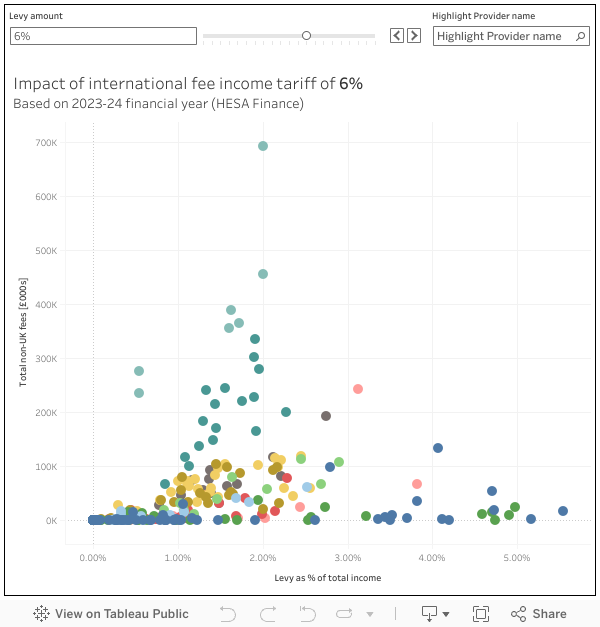
    In considering the financial impact of a potential levy I have used the most recent (2023–24) year of financial data – showing the total non-UK fee income on the vertical axis and the proportion of total income represented by the value of the levy on the horizontal. By default I have modelled a levy of six per cent (you can use the filter to consider other levels).

    [Full screen]

    Who’s up, who’s down?

    In the majority of large universities the cost of levy is equivalent to around two per cent of total income. In the main it is the Russell Group that sees substantial income from international fees – the small number of exceptions (most notably the University of Hertfordshire and the University of the Arts London) would see a levy impact of closer to three per cent of total income.

    What we can’t realistically model is university pricing behavior and the impact on recruitment. Universities generally charge what the market will stand for international courses – and this value is generally higher for providers that are better known from popular league tables.

    Subject areas and qualifications also have an impact (the cost of an MBA, for example, may be higher than a taught creative arts masters – a year of postgraduate study may cost more than a year of an undergraduate course), as does the country from which students are arriving (China may be charged more than India, for example).

    Some better off universities in the middle of the market may choose to swallow more of the cost of the levy in order to increase their competitiveness for applicants making decisions on price – this would put pressure on the currently cheaper end of the market to follow suit as well as direct competitors, and may lower the overall floor price for particular providers (though, to be fair, private providers are still better positioned to undercut should they have access to funds from investment or other parts of the business).

    There is an obvious impact on the quality of the provision if providers do cut the amount of fee income – and this as well could have an impact on the attractiveness of the whole sector. For more hands-on courses in technical or creative subjects, provision may become unviable overall – surrendering the soft power of influence in these fields.

    A starting point

    It’s not often that we see a policy proposal on university funding launched with so little information. Generations of politicians have learned that university funding policy changes are the equivalent of poking a wasps nest with a sharp stick – it may be something that needs doing but the short term pain and noise is massive.

    It could be that it is a deliberate policy to let the sector (and associated commentariat) go crazy for a month or so while a plan is developed to avoid the less desirable (for ministers) consequences. But the idea that international students will gladly pay more to support an underfunded sector is one that has been at the heart of university activity for decades – the only real change here is that the government feels it can put some of the profits to better use than some of our larger and better-known providers.

    In all of this there appears to have been little consideration of the fairness of putting extra costs onto the fees of international students – particularly where they personally don’t see any value from their additional spend. But this has been an issue for a good few years, and it seems to have taken the possibility of a tariff (which could be considered unfair to cash-strapped universities too) to drive this problem further up the sector’s agenda.

    Source link

  • ICE Warns International Students of More SEVIS Terminations

    ICE Warns International Students of More SEVIS Terminations

    Immigration officials sent letters to international students on short-term work visas Thursday night, threatening to terminate their legal status in the Student Exchange and Visitor Information System and remove them from the country. The number of affected students is still unknown, but Inside Higher Ed can confirm at least 35.

    It’s the first sign that the Trump administration is resuming its campaign to deport student visa holders, weeks after restoring the statuses of thousands of students. ICE recently released an updated policy that significantly expands the agency’s authority to terminate students’ SEVIS status and pave the way for deportation proceedings. 

    This time, they’re targeting students on Optional Practical Training visas, or OPTs, which allow international postgraduates the opportunity to work in a field relevant to their study on a short-term extension. Students on OPT are allowed a total of 90 days of unemployment every 12 months before falling out of compliance. It’s still not known whether any of the affected students were on a special visa extension known as OPT for STEM, awarded to graduates in high-demand technology, science and engineering fields. 

    One international student adviser, who spoke with Inside Higher Ed on the condition of anonymity, said 28 of his institution’s students on OPT received the letter in the past day, and he expects that number will grow. 

    In a copy of one letter received by an international student and obtained by Inside Higher Ed, Immigration and Customs Enforcement warned those who have not reported employment status within 90 days of starting their OPT visa that they must do so in 15 days. If they don’t, the Student Exchange and Visitor Program “will set your SEVIS record to ‘terminated,’” the letter reads, which “may result in the initiation of immigration proceedings to remove you from the United States.”

    The letter is nearly identical to those sent by officials during the first Trump administration in 2020. The only difference: Back then, the Student Exchange and Visitor Program was the letter’s sole signatory. This time, ICE and the Department of Homeland Security are also named. 

    The 2020 letters were sent two years after officials issued an update to designated school officials informing them that the administration had begun a review of OPT students’ employment status to find noncompliant visa holders. But that notice also said SEVP would not automatically terminate students’ SEVIS status for going over the 90-day unemployment limit before notifying students. 

    It’s not clear whether immigration officials engaged in a review process before beginning to notify students of potential SEVIS terminations this week. Spokespeople for ICE and DHS did not respond to questions in time for publication. 

    It was also not immediately clear if OPT students’ SEVIS terminations would result in subsequent visa revocations, which are the purview of the State Department. A spokesperson for the State Department wrote in an email that they “cannot preview future visa-related decisions, which are made on a case-by-case basis, based on the individual facts relevant to the case,” and deferred other questions sent by Inside Higher Ed to DHS.

    In an internal communication sent to international student advisers and support specialists, NAFSA, an organization of international educators, urged college officials to regularly check the SEVIS database for notices of OPT students’ compliance with “accrued unemployment days” and to reach out to any students who are over the 90-day limit as soon as possible. 

    Immigration officials began systematically terminating thousands of students’ SEVIS statuses along with their visas in late March, an unprecedented move that threw international student support offices into chaos and left students scrambling to avoid deportation. 

    Last month, immigration officials restored the SEVIS statuses of more than 5,000 international students after losing dozens of court cases challenging the legality of efforts to revoke foreign students’ legal residency at a breakneck pace.

    The anonymous international student adviser said students on OPT often forget to report their employment details before the 90-day deadline. Many are distracted by graduations and finals well after they receive approval for the visa and forget, he said; in other cases, the lapse can be due to technical issues within SEVIS.

    Because of that, they’re often given some leeway, and he said he’s never seen or heard of a student having their SEVIS status terminated for not reporting employment details on time, including the last time these letters were sent in 2020. Then again, much of the Trump administration’s treatment of student visa holders is unprecedented, and he’s worried this could be a real danger for them.

    “There’s a lot of panic and uncertainty as our students are waiting to see what will happen, and we’re waiting to see if they’ll really go through with it,” he said. “I think this is the real deal.”

    Source link