Tag: International

  • UKVI is tightening the rules on international student attendance

    UKVI is tightening the rules on international student attendance

    Back in April you’ll recall that UKVI shared a draft “remote delivery” policy with higher education providers for consultation.

    That process is complete – and now it’s written to providers to confirm the detail of the new arrangements.

    Little has changed in the proposal from last Spring – there are some clarifications on how it will apply, but the main impact is going to be on providers and students who depend, one way or another, on some of their teaching not being accessed “in person”.

    The backstory here is that technically, all teaching for international students right now is supposed to be in-person. That was relaxed during the pandemic for obvious reasons – and since, the rapid innovations in students being able to access types of teaching (either synchronously or asynchronously) has raised questions about how realistic and desirable that position remains.

    Politics swirls around this too – the worry/allegation is that students arrive and then disappear, and with a mixture of relaxed attendance regulation (UKVI stopped demanding a specific number of contact points a few years ago for universities) and a worry that some students are faking or bypassing some of the attendance systems that are in place, the time has come, it seems, to tighten a little – “formalising the boundaries in which institutions can use online teaching methods to deliver courses to international students”, as UKVI puts it.

    Its recent burst of compliance monitoring (with now public naming and shaming of universities “subject to an action plan”) seems to have been a factor too – with tales reaching us of officials asking often quite difficult questions about both how many students a provider thinks are on campus, and then how many actually are, on a given day or across a week.

    The balance being struck is designed, says UKVI, to “empower the sector to utilise advances in education technology” by delivering elements of courses remotely whilst setting “necessary thresholds” to provide clarity and ensure there is “no compromise” of immigration control.

    Remote or “optional”?

    The policy that will be introduced is broadly as described back in April – first, that two types of “teaching delivery” are to be defined as follows:

    • Remote delivery is defined as “timetabled delivery of learning where there is no need for the student to attend the premises of the student sponsor or partner institution which would otherwise take place live in-person at the sponsor or partner institution site.
    • Face-to-face delivery is defined as “timetabled learning that takes place in-person and on the premises of the student sponsor or a partner institution.

    You’ll see that that difference isn’t (necessarily) between teaching designed as in-person or designed as remote – it’s between hours that a student is required to be on campus for, and hours that they either specifically aren’t expected to come in for, or have the option to not come in for. That’s an important distinction:

    Where the student has an option of online or in-person learning, this should count as a remote element for this purpose.

    Then with those definitions set, we get a ratio.

    As a baseline, providers (with a track record of compliance) will be allowed to deliver up to 20 per cent of the taught elements of any degree level and above course remotely.

    Then if a provider is able to demonstrate how the higher usage is consistent with the requirements of the relevant educational quality standards body (OfS in England, QAA in Wales and Scotland) and remains consistent with the principles of the student route, they’ll be able to have a different ratio – up to 40 per cent of the teaching will be allowed to be in that “remote” category.

    Providers keen to use that higher limit will need to apply to do so via the annual CAS allocation process – and almost by definition will attract additional scrutiny as a result, if only to monitor how the policy is panning out. They’ll also have to list all courses provided to sponsored students that include remote delivery within that higher band – and provide justification for the higher proportion of remote learning based on educational value.

    (For those not immersed in immigration compliance, a CAS (Confirmation of Acceptance for Studies) is an electronic document issued by a UK provider to an international student that serves as proof of admission, and is required when applying for a student visa. The CAS includes a unique reference number, details of the course, tuition fees, and the institution’s sponsorship license information – and will soon have to detail if an international agent is involved too.)

    One question plenty of people have asked is whether this changes things for disabled students – UKVI makes clear that by exception, remote delivery can permitted on courses of any academic level studied at a student sponsor in circumstances where requiring face to face delivery would constitute discrimination on the basis of a student’s protected characteristics under the Equality Act 2010.

    A concern about that was that providers might not know if a student needs that exception in advance – UKVI says that it will trust providers to judge individual student circumstances in cases of extenuating circumstances and justify them during audits. The requirement to state protected characteristics on the CAS will be withdrawn.

    Oh – and sponsors will also be permitted to use remote delivery where continuity of education provision would otherwise be interrupted by unforeseen circumstances – things like industrial action, extreme weather, periods of travel restriction and so on.

    Notably, courses at levels 4 and 5 won’t be able to offer “remote delivery” at all – UKVI reckons they are “more vulnerable to abuse” from “non-genuine students”, so it’s resolved to link the more limited freedoms provided by Band 1 of the existing academic engagement policy to this provision of “remote” elements – degree level and above.

    Yes but what is teaching?

    A head-scratcher when the draft went out for consultation was what “counts” as teaching. Some will still raise questions with the answer – but UKVI says that activities like writing dissertations, conducting research, undertaking fieldwork, carrying out work placements and sitting exams are not “taught elements” – and are not therefore in scope.

    Another way of looking at that is basically – if it’s timetabled, it probably counts.

    Some providers have also been confused about modules – given that students on most courses are able to routinely choose elective modules (which themselves might contain different percentages of teaching in the two categories) after the CAS is assigned.

    UKVI says that sponsors should calculate the remote delivery percentage on the assumption that the student will elect to attend all possible remote elements online. So where elective modules form part of the course delivery, the highest possible remote delivery percentage will have to be stated (!) And where hours in the timetable are optional, providers will have to calculate remote delivery by assuming that students will participate in all optional remote elements online.

    The good news when managing all of that is that the percentage won’t have to be calculated on the basis of module or year – it’s the entire course that counts. And where the course is a joint programme with a partner institution based overseas, only elements of the course taking place in the UK will be taken into account.

    What’s next

    There’s no specific date yet on implementation – IT changes to the sponsor management system are required, and new fields will be added to the CAS and annual CAS allocation request forms first. The “spring” is the target, and there’s also a commitment to reviewing the policy after 12 months.

    In any event, any university intending to utilise (any) remote delivery will need to have updated their internal academic engagement (ie attendance) policy ahead of submitting their next annual CAS allocation request – and UKVI may even require the policy to be submitted before deciding on the next CAS allocation request, and definitely by September 2025.

    During the consultation, a number of providers raised the issue of equity – how would one justify international and home students being treated differently? UKVI says that distinctions are reasonable because international students require permission to attend a course in the UK:

    If attendance is no longer necessary, the validity of holding such permission must be reassessed.

    There’s no doubt that – notwithstanding that providers are also under pressure to produce (in many cases for the first time) home student attendance policies because of concerns about attendance and student loan entitlements – the new policy will cause some equity issues between home and international students.

    In some cases those will be no different to the issues that exist now – some providers in some departments simply harmonise their requirements, some apply different regs by visa status, and some apply different rules for home students to different dept/courses depending on the relative proportion of international students in that basket. That may all have to be revisited.

    The big change – for some providers, but not all – is those definitions. The idea of a student never turning up for anything until they “cram” for their “finals” is built into many an apocryphal student life tale – that definitely won’t be allowed for international students, and it’s hard to see a provider getting away with that in their SFE/SFW/SAAS demanded home student policy either.

    Some providers won’t be keen to admit as such, but the idea of 100 per cent attendance to hours of teaching in that 80 per cent basket is going to cause a capacity problem in some lecture theatres and teaching spaces that will now need to be resolved. Module choice (and design) is also likely to need a careful look.

    And the wider questions of the way in which students use “optional” attendance and/or recorded lectures to manage their health and time – with all the challenges relating to part-time work and commuting/travelling in the mix – may result in a need to accelerate timetable reform to reduce the overall number of now very-much “required” visits to campus.

    One other thing not mentioned in here is the reality that UKVI is setting a percentage of a number of hours that is not specified – some providers could engage in reducing the number of taught hours altogether to make the percentages add up. Neither in the domestic version of this agenda nor in this international version do we have an attempt at defining what “full-time” really means in terms of overall taught hours – perhaps necessarily given programme diversity – but it’ll be a worry for some.

    Add all of this up – mixing in UKVI stepping up compliance monitoring and stories of students sharing QR codes for teaching rooms on WhatsApp to evade attendance monitoring systems – and for some providers and some students, the change will be quite dramatic.

    The consultation on the arrangements has been carried out quite confidentially so far – I’d tentatively suggest here that any revision to arrangements implemented locally should very much aim to switch that trend away from “UKVI said so” towards detailed discussion with (international) student representatives, with a consideration of wider timetabling, housing, travel and other support arrangements in the mix.


    Source link

  • New UK government video targets international students

    New UK government video targets international students

    Secretary of state for education, Bridget Phillipson, addressed students considering studying abroad, highlighting the benefits of a UK education and promoting the country’s post-study work opportunities.

    “In the new academic year, we will welcome thousands of international students who will be starting courses in our universities and I hope to see many more in the future,” Phillipson said in the video shared by the UK Council for International Student Affairs (UKCISA).

    “The UK is a wonderful and safe place to study. Our country is home to some of the very best universities in the world – four of the world’s top 10 can be found right here in the UK.

    “An education from a British university has been the springboard for success for so many global trailblazers, from politics to business, from the arts to the sciences, in fact dozens of current and recent world leaders studied here in the UK and our universities have driven some of the most exciting and valuable research anywhere in the world.

    “You could be part of the next groundbreaking wave of research and join a new generation of inspiring leaders,” she told prospective students.

    Phillipson went on to describe some of the ways in which UK universities support their international students through pastoral support, work experience, scholarships and bursaries.

    “You’ll also get have the chance to join Alumni UK – a global group of people from around the world who have studied here. It’s a fantastic professional network that you can tap into to get great advice and guidance.”

    Phillipson went on to promote the UK’s Graduate Route, describing the opportunity which lets graduates “work, live and contribute” in the UK.

    International students forge international friendships so by studying abroad, you can help build bridges between our countries, and these connections help make the world a better, brighter place.

    Bridget Phillipson, UK secretary of state for education

    “Studying in the UK sets you up for success in your career, but it’s more than that. International students forge international friendships so by studying abroad, you can help build bridges between our countries, and these connections help make the world a better, brighter place.”

    Phillipson previously addressed international students in a video not long after stepping into the role in July 2024.

    On the release of the latest video, Anne Marie Graham, UKCISA chief executive, said she was “encouraged” to see the continuing messages of welcome and support from the UK’s education secretary.

    “Current and prospective students will also welcome the secretary of state’s ongoing support for the graduate visa and her reflections on the mutual benefits of a UK education – not just the contributions that international students make to the UK, but the positive impact on their own careers and ambitions,” she told The PIE.

    “We look forward to continuing to work with the UK government to ensure international students are welcomed and supported, from pre-arrival visas to post-graduation work opportunities, so that all international students have a positive experience studying here.”

    Pedram Bani Asadi, chair of the UKCISA’s Student Advisory Group commented: “I welcome the support from this government for international students’ hopes and dreams, and recognition of all the contributions we make to both UK culture and the economy.

    “Having access to the Graduate Route has been absolutely essential for me to be able to reinforce the skills I learnt in my studies and contribute to the UK. I appreciate all the friends and experiences I’ve had here and look forward to continuing my role as a #WeAreInternational student ambassador, and working with the UK government to support my fellow international students to have a positive experience.”

    Since Labour took came into power, sector stakeholders have noted the government’s more welcoming tone toward international students, a marked contrast to the rhetoric of the previous Conservative government.

    Despite a change in rhetoric, the Labour government has shown no intention of reversing the Conservative’s decision to ban international students on UK taught master’s courses from bringing dependants with them to the UK.

    “While the new government has said many positive things about international students, the focus on immigration remains acute,” said Jamie Arrowsmith, director of Universities UK International in an update to sector earlier this month.

    The UK’s international educations strategy is currently under review, and the rollout of the new approach is set for April.

    Sector leaders gathered at the QS Reimagine Education summit in London late last year to discuss priorities for the UK’s international education sector going forward, giving suggestions for a refreshed strategy, which included improved post-study work rights.

    Source link

  • One country wants to close math achievement gaps by ending academic tracking

    One country wants to close math achievement gaps by ending academic tracking

    CHRISTCHURCH, New Zealand — Many students in New Zealand have a story to tell about “streaming” — being grouped into separate math classes based on their perceived ability to master the subject.

    Manaaki Waretini-Beaumont, now 18 and an environmental science major at the University of Canterbury, learned about the downside of streaming when she enrolled in Avonside Girls’, a 1,000-student high school in Christchurch.

    Avonside starts at Year 9, equivalent to eighth grade in the United States, and ends at Year 13, equivalent to 12th grade. Before the start of her Year 9 term, Waretini-Beaumont and her fellow students were divided up into groups to take tests in “maths,” reading comprehension, and patterns and shapes.

    Afterward, the students were separated into lettered groups that spelled out the word B-I-N-O-C-U-L-A-R-S. Waretini-Beaumont was a “9-N” student in mathematics — as she describes it, “the top of the middle block.”

    But she said she didn’t feel comfortable as one of the few Māori students in the class.

    “I felt like I wasn’t good enough to be in that space,” said Waretini-Beaumont, whose iwi, or tribal affiliations, are Te Āti Haunui-A-Pāpārangi, Ngāti Rangi, Ngāti Apa, Ngāti Paoa. “If there was something I wasn’t understanding, I felt like I wasn’t able to say that, because I’m supposed to be in the smart class with all these smart people.”

    So she shifted to another mathematics class with her Māori friends, who were in the “S” classes. 

    “Being in two different spaces, I could really see the change,” Waretini-Beaumont said. “At the top classes, the teachers’ language towards the students was always positive and it was always encouraging. And they really wanted students to learn and were trying to help them.”

    Manaaki Waretini-Beaumont experienced the effects of “streaming,” or academic ability tracking, during her time as a high school student at Avonside Girls’ School in Christchurch, New Zealand. Credit: Image provided by Richie Mills/Ngāi Tahu

    In the classroom where her friends were assigned, in contrast, the mathematics work mostly amounted to simple worksheets — “coloring pages and word find,” Waretini-Beaumont said.

    Related: Sign up for a limited-run newsletter that walks you through some of the most promising solutions for helping students conquer math.

    For years, much like in the United States, New Zealand has worried about sliding student proficiency in mathematics, as captured by both national and international test scores. Later this month — the beginning of the New Zealand school year — the country is launching an overhaul of mathematics instruction that education leaders hope will reverse the trend.

    But other groups in the country have been trying to approach the problem of academic achievement from a different angle. They believe that streaming is driving achievement gaps in the country, including in mathematics. Tokona te Raki/Māori Futures Collective, a think tank focused on youth, has been working since 2019 to persuade schools to voluntarily end the practice by 2030. The initiative is called “Kōkirihia”— Māori for “take action.”

    Streaming is just one of many ways that schools group students by academic ability. Ability grouping can include separating students into vocational or university tracks at different schools as early as age 10, as is common in Germany and other Western European countries. But it could also include teachers creating informal and non-permanent groupings within their own classrooms to provide enrichment or extra support to students who need it.

    In New Zealand, critics say streaming pushes two groups into so-called “cabbage,” or lower-level mathematics, at a disproportionate rate: Māori students, who are indigenous to New Zealand, and students who are Pasifika, the New Zealand term for people from Samoa, Tonga and other nations in the Pacific Islands.

    In the 14th century, the Polynesian ancestors of today’s Māori migrated thousands of miles by canoe to what they called Aotearoa, the land of the long white cloud. Hundreds of years later, English settlers came to engage in trade and now represent the majority ethnic group in New Zealand. In 1840, the two groups signed the Treaty of Waitangi that established New Zealand’s bicultural identity.

    Many youth with Pacific Island backgrounds are descended from people who were encouraged to move to New Zealand after World War II to address a labor shortage.

    Both Māori and Pasifika are a fast-growing, and young, population. By the 2040s, more than a third of children in the country are expected to identify as Māori, according to Stats NZ, the country’s official data agency.

    Related: Eliminating advanced math ‘tracks’ often prompts outrage. Some districts buck the trend

    The New Zealand Ministry of Education’s official stance discourages streaming, but the country’s more than 2,500 schools operate with a great deal of independence: Principals have similar powers and responsibilities as school superintendents in the United States, and each school has an elected board that sets policy and manages budgets.

    New Zealand does not track streaming or ability grouping by race or ethnicity, but surveys show it is common: Eighty percent of students are in schools that group students by ability level in mathematics, according to a 2022 survey conducted by the Program for International Student Assessment.

    Other data shows a wide academic gap among students of different ethnicities in New Zealand.

    Students at May Road School in Auckland, New Zealand, work through a lesson on fractions. Credit: Becki Moss for The Hechinger Report

    In the Auckland region, the country’s most densely populated of 16 regions in all, 76 percent of Asian students left secondary school with the highest of three levels on the country’s National Certificate of Educational Achievement in 2022. Like a high school diploma, the NCEA Level 3 is a minimum qualification to enter college in New Zealand.

    About 66 percent of Pākehā, or white, students left school with that credential. About 46 percent of Pasifika students and 40 percent of Māori students did the same.

    In comparison, the high school graduation rate by race and ethnicity in the United States in the 2021-22 school year was 94 percent for Asian American/Pacific Islander students, 90 percent for white students, 83 percent for Hispanic students, 81 percent for Black students and 74 percent for American Indian/Alaskan Native students.

    Misbah Sadat, the newly appointed principal at Kuranui College, a high school 50 miles northeast of the capital of Wellington, began actively working to “destream” mathematics courses soon after emigrating to New Zealand in 2009 and becoming a teacher there.

    As head of mathematics at a high school called Horowhenua College, she started by identifying promising Māori students on her own, moving them to higher level classes, and mentoring them, as described in a Ministry of Education newsletter.

    Related: OPINION: As a middle-class Black student, I was tracked into lower-level math classes that kept me back

    Eventually she convinced her colleagues at Horowhenua to create mixed-ability classes rather than dividing the students. She continued the same work as deputy principal at Onslow College in suburban Wellington, where she worked before her new appointment.

    The streaming practice comes from a patronizing mindset, said Sadat, who was also a math teacher in Montgomery County, Maryland.

    Schools are telling parents that their children might be lost and overwhelmed in a more rigorous class. In actuality, “We have demoted some students to learn crap,” she said. “And then we are saying that at age 16, ‘You are dumb at maths.’ How dare we decide what a young person is capable of or not capable of?” 

    Students at Kaiapoi North School in suburban Christchurch, New Zealand, work through a multiplication problem in chalk on the playground blacktop. Credit: Becki Moss for The Hechinger Report

    Both of New Zealand’s unions for elementary and secondary teachers signed onto the pledge to end streaming by 2030. In a newsletter to members, the elementary teachers union noted that its members have noticed “a sense of ingrained hopelessness that comes with being in the ‘cabbage’ classes.”

    But in the same newsletter, another teacher said educators struggle with the mix of abilities in one classroom, along with managing behavior challenges.

    David Pomeroy, a senior lecturer in education at the University of Canterbury in Christchurch, is studying schools that have committed to reducing their reliance on streaming.

    It’s a difficult task, he said. So many teachers are accustomed to the practice, since they went through it in school themselves. Parents of students in high-level classes are worried their children will be shortchanged. Teachers also say that it is easier to work with students who are all roughly on the same skill level.

    And then there is an emotional connection to the practice, Pomeroy said. Unlike in the United States, lower-level mathematics classes are often taught by teachers who have a lot of classroom experience and who express real fondness for their students, he said. Pushing students too hard is seen as setting them up for repeated failure, which teachers were reluctant to do.

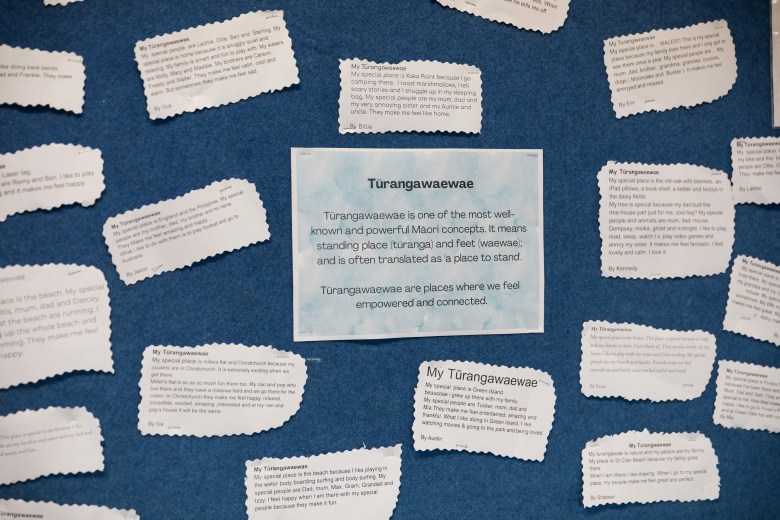
    Abby Zonneveld’s bulletin board at St. Clair School in Dunedin, New Zealand, asked students to describe their “tūrangawaewae,” or place where they feel a special connection. Credit: Becki Moss for The Hechinger Report

    “Even if they accepted streaming wasn’t the right next step, they wanted to protect them from anything that could damage their confidence,” Pomeroy said.

    For schools that have made a commitment to reducing or ending streaming, he said, one useful tool has been to bring mathematics teachers in different schools together so they can work through challenges, such as lesson planning, and share successes.

    Related: Racial gaps in math have grown. Could detracking help?

    The research into the benefits or harms of academic tracking or streaming show mixed results. In 2016, a group of researchers compiled all the best U.S-based research on ability grouping and acceleration at that point, going back for a century. They found certain kinds of ability grouping, such as placing highly gifted students together, was a benefit to those students. But grouping students in high- or low-performing classes did not show any benefit or detriment for students.

    The New Zealand Initiative, a right-of-center think tank, said that the country should conduct its own research on the effects of streaming in the country, rather than relying primarily on research done elsewhere and on qualitative reports that primarily capture feelings about the practice. “Research suggests that lowerstream students are often taught less engaging content by less experienced teachers. So, it may not be streaming itself that increases gaps in achievement but streaming done poorly,” the initiative said in a report.

    But the efforts to reduce streaming voluntarily seem to be catching on.

    When looking at all academic subjects, not just mathematics, principals on a 2022 PISA survey said 67 percent of students in New Zealand are grouped by ability into different classes for at least some subjects. That’s a drop from 2015, when 90 percent of principals reported that students were grouped into different classes in their schools.

    The change is welcome, said Waretini-Beaumont, who works on social media for Tokona te Raki. Streaming “has more impact than just cutting off some opportunities and stopping someone from doing calculus,” she said. “Our grandparents have been streamed and they don’t know it was even a thing. They just thought they were dumb.”

    Contact Christina A. Samuels at 212-678-3635 or [email protected].

    This story was produced with support from the Education Writers Association Reporting Fellowship program.

    This story about academic tracking was produced by The Hechinger Report, a nonprofit, independent news organization focused on inequality and innovation in education. Sign up for the Hechinger newsletter.

    The Hechinger Report provides in-depth, fact-based, unbiased reporting on education that is free to all readers. But that doesn’t mean it’s free to produce. Our work keeps educators and the public informed about pressing issues at schools and on campuses throughout the country. We tell the whole story, even when the details are inconvenient. Help us keep doing that.

    Join us today.

    Source link

  • The essential guide to sources of university funding for international students

    The essential guide to sources of university funding for international students

    January 7th, 2025 by IEFA

    How do students secure funding for their university education and support their academic journey? Students can access funding through government grants, private donations, scholarships, and research grants. This article explores these sources of university funding to help students understand how they can sustain their educational pursuits and receive financial aid.

    Financial aid for students

    Financial aid bridges the gap between what students can afford and the actual cost of education. As educational expenses rise, this support becomes indispensable. It can come from government funding, private loans, and university-specific funds.

    In the U.S., federal student aid significantly helps domestic students with educational costs. Private loans and scholarships also offer substantial support, particularly for those ineligible for federal aid – such as international students. Colleges and universities often have their own financial aid packages to meet the needs of their students.

    Federal student aid (U.S. students only)

    Federal student aid is for U.S. students, covering grants, loans and work-study programs. Accessing these funds requires completing the Free Application for Federal Student Aid (FAFSA) form, which determines eligibility. This comprehensive aid package includes Pell Grants, federal loans, and work-study opportunities provided by the federal government.

    Private loans and scholarships

    When federal aid is insufficient or unavailable (e.g. for international students), private loans can cover educational costs. However, unlike grants and scholarships, private loans must be repaid with interest, so students should carefully consider their borrowing options.

    Conversely, scholarships offer a debt-free way to finance education. Often based on need or merit, they do not need to be repaid and can significantly reduce the cost of attending college.

    Institutional financial aid

    Colleges and universities can also provide significant financial aid. Institutional financial aid includes grants, scholarships, loans, and work-study programs tailored to students. This aid is often more flexible and can be customized to address unique financial situations.

    Many universities allocate specific funds within academic departments to support international students, recognizing their unique challenges. These funds often include special scholarships and grants to make higher education more accessible to students from abroad.

    International student funding

    For international students, finding the right funding sources is essential to cover tuition and living expenses while studying abroad. Various avenues, such as scholarships, financial aid programs, and university-specific funds, are available to alleviate the financial burden.

    Scholarships specifically for international students can significantly reduce the cost of education, making it more accessible to talented individuals globally. Additionally, international financial aid programs provide grants and loans to eligible students, ensuring they have the support needed to succeed.

    Many universities offer specific funds and grants tailored to assist international students in their academic pursuits. These resources are vital for helping students manage the financial challenges of studying abroad.

    Scholarships for international students

    Merit-based scholarships are significant for international students, awarded for exceptional abilities in academics, arts or athletics. These scholarships provide financial support and recognize students’ talents and achievements.

    Scholarships can be crucial for international students, making higher education more accessible and less financially burdensome.

    International financial aid programs

    International students often face unique challenges in securing financial aid, particularly in the U.S. Many financial aid options are primarily allocated to graduate studies, making it harder for undergraduate international students to access necessary funds.

    To navigate these challenges, international students should check with their financial aid offices and explore the range of aid options available. These offices can provide valuable guidance and support in identifying suitable financial aid programs.

    University-specific funds for international students

    Many universities offer specific programs and scholarships to support international students and some, like Harvard University, treat all students equally regardless of nationality or citizenship when dealing with financial aid.

    University-specific funds and grants help international students cover tuition and living expenses, ensuring students can fully focus on their studies.

    What we’ve learned about university funding sources

    Successfully funding your higher education requires a thorough understanding of the various funding sources available. From federal student aid to private loans, scholarships and institutional financial aid, students have multiple options to explore. For international students, specific scholarships, financial aid programs, and university-specific funds play an important role in making education accessible.

    Frequently Asked Questions

    What is federal student aid and how can I apply for it?

    Federal student aid is funding from the U.S. government to help U.S. students pay for college. U.S. students must fill out the FAFSA form to apply.

    Are there scholarships available specifically for international students?

    There are tons of scholarships out there specifically for international students. It’s definitely worth looking into!

    How can international students find financial aid programs?

    You can find financial aid programs by checking with your university’s financial aid office for scholarships and specific funds available for international students. They usually have a bunch of resources to help you out.


    Source link

  • Getting an MBA for international students in the U.S.

    Getting an MBA for international students in the U.S.

    December 18th, 2024 by IEFA

    The Master of Business Administration (MBA) degree is the pinnacle of business qualifications for students dreaming of becoming captains of industry. Earning a highly sought-after MBA can ensure a bright future full of opportunities for advancing a career in business. With a median $125,000 starting salary for MBA graduates in the U.S., it’s no wonder international students want to attend American business schools in record numbers. 

    This post explores what it means to earn an MBA for international students in the U.S. We look at what an MBA is all about and why these qualifications are in such high demand. Read on to discover more about the best U.S. schools for getting an MBA and what you’ll need to do to get into one. 

    Master of Business Administration (MBA) 101

    Earning an MBA is a significant achievement. Professionals holding this prestigious degree are recognized as individuals who’ve met and passed the stringent MBA requirements. 

    Known for covering the high-level essentials of modern business administration through specialized topics and themes, MBA programs are designed to prepare students to manage dealings across various industries and contexts. 

    Ultimately, MBA graduates join a select membership of professionals recognized as leaders in business around the world.

    What’s an MBA? 

    A Master of Business Administration degree is a professional master’s level academic qualification. It’s recognized around the world as a critical requirement for advancing to the upper echelons of modern business careers. MBA programs in the U.S. are offered by business schools associated with universities providing the resources, faculty and accreditation for MBAs. 

    How long does it take to complete an MBA program?

    MBAs generally take two years to complete. The degree requires intensive work, and most students entering programs hold prior real-world work experience. MBAs typically culminate with the submission of a dissertation. Some programs require students to complete a major project or to pass a comprehensive exit examination.

    MBA course structure and content

    Most MBAs follow a course structure built around core courses. These cover the essentials of business administration, including analytical, functional and ethical subjects. The first year of the MBA program usually consists of core courses followed by a second year of elective courses. These electives allow students to specialize in their chosen MBA field, exposing them to business administration theory and practice. 

    Most MBA course content in U.S. programs follows a case method structure. This helps students develop critical strategic decision-making skills in real-world scenarios using practical learning activities and simulated consulting projects to reinforce concepts. Many MBA programs also involve exposure to corporate experts and business executives, providing MBA students with a higher level of experience and opportunity than many other master’s level programs.

    Who’s eligible for MBA programs?

    A prerequisite for almost all U.S. MBA programs is that applicants hold an undergraduate degree, usually with a focus on business or commerce. Applicants must meet various MBA program entry criteria. These may include demonstrating previous academic excellence, a comprehensive work history, and submitting essays and letters of recommendation. 

    Students will likely be required to write and pass an entrance examination before gaining entry to an MBA program. In the U.S., MBA program applicants will likely need to complete one of two exams:

    • The Graduate Management Admission Test (GMAT)
    • The Graduate Record Examination (GRE)

    Students should also be able to demonstrate previous work experience, often exceeding five years and, in some cases, 10. This includes applicants for an MBA for international students in the U.S. 

    International student MBA eligibility

    International students must meet the same work experience, academic performance and entry exam requirements as American applicants. However, non-U.S. students will be required to complete relevant language proficiency tests, including TOEFL, IELTS, TOEIC, PTE, or, in some cases, Duolingo accreditation. International students who complete their undergraduate degrees at U.S. colleges are exempted from these English proficiency requirements. 

    All U.S. university business schools accept international student MBA program applications, with some even offering scholarships and incentives to attract more foreign participants. 

    Why international students pursue MBAs in the U.S. 

    While most universities around the world offer MBA programs, and a growing number of private institutions are doing the same, the U.S. still sets the gold standard for business administration qualifications. That’s why thousands of ambitious students from around the world seek to earn an MBA for international students in U.S. colleges and universities.  

    STEM-eligible OPT visa extension

    Many U.S. business schools full-time MBA programs are STEM-designated degrees. This means that qualifying international student graduates may apply for the F-1 24-month STEM-optional practical training (OPT) extension. The visa extension allows three years of authorized work in the U.S. before requiring sponsorship for any employment-based nonimmigrant or immigrant visas. Not all schools offer this benefit, but those that do attract international students looking to remain in the U.S. for work purposes after earning their MBA. 

    Earning potential and employability

    Different MBAs around the world hold varying degrees of power – and earning potential. Stanford’s Graduate School of Business 2023 MBA graduates, for example, could expect a $248,000 average base salary, with 84% finding work within three months of graduating. By comparison, MBA graduates of the Frankfurt School of Finance and Management in Germany attracted salaries of under $103,000 on average, with just 75% employed within three months of receiving their degrees. A 2023 study indicated that over 90% of employers in the lucrative finance, consulting and technology industries expect to hire MBA graduates. 

    Reputation and the experience

    Four of the world’s top five business schools (and 11 out of the top 20) are in the U.S. The unprecedented access to academic resources, business expertise, facilities and knowledge offered by these institutions is hard to find elsewhere. Students receive next-level support, and the very best business administration professors are linked predominantly to top U.S. universities. Students rub shoulders with the finest talent, allowing for unrivaled networking opportunities. And knowing you hold an MBA from a U.S. institution provides confidence and prestige.  

    Understanding MBA programs

    Here’s a quick overview of the various MBA programs for international students in the U.S. and specializations available at most U.S. business schools. 

    Types of MBAs

    Like many other undergraduate and postgraduate degrees, MBA programs offer a range of structures and configurations. 

    • Full-time MBAs – These in-person programs follow a set course curriculum with students attending classes and submitting coursework. Full-time MBAs are the most common type of program and generally take two years to complete.
    • Part-time MBAs – An alternative to the full-time MBA, the part-time MBA allows students the flexibility of continuing with work or careers while still studying. These MBAs take longer to complete, often three years or more. 
    • Online MBAs – This increasingly popular form of MBA allows students to obtain their degrees remotely. All lectures, exams and project submissions are done online. However, distance learning may restrict exposure to expertise and limit access to resources. 
    • Executive MBAs (EMBA) EMBAs are designed for corporate managers and executives with work experience, often 10 years or more. This MBA caters to business leaders looking to improve their management and leadership skills. 
    • Flexible MBAs – These programs allow students to combine different MBA structures to accommodate work needs. Students can, for example, opt for a modular course approach or blend in-person attendance with distance learning. Not all U.S. business schools offer this option.

    Whichever MBA type works for you, ensure you fully understand what each one entails. Also, not all business schools offer MBA programs in various structures, so make sure you know what’s available and what isn’t. 

    MBA specializations

    Most MBA programs require students to specialize in a chosen field or business profession. You can pick your elective subjects, usually in the program’s second year. While there are many MBA specializations available, these are among the most common U.S. MBA programs currently. 

    • MBA in business analytics – This increasingly in-demand MBA program is centered around managing and interpreting complex data. It’s geared towards students looking to enter tech industries and data-intensive fields like insurance, which require advanced modeling visualization and analytical skills. 
    • MBA in marketing management – A traditional MBA focusing on marketing and related communications and advertising fields. This multifaceted MBA covers various areas and topics, including promotional strategy, brand management and product development. 
    • MBA in financial management – This program is designed for the financial industry. Many of these MBA graduates work in banking, corporate finance, economics and careers on Wall Street.
    • MBA in human resource management – A popular management MBA. This specialization is essential for HR managers looking to take their corporate people management capabilities to the top level. 
    • MBA in international business – Also known as a “global MBA,” this specialization focuses on international business and commerce. An excellent option for international students looking to study in the U.S. 

    There are many other MBA specializations available at U.S. business schools, such as entrepreneurship, health administration, IT, logistics, and even agriculture. Every year, new MBA programs are emerging to meet the changing needs of the business world. 

    Top U.S. business schools for international students

    There are nearly 400 business schools in the U.S., and over 270 U.S. universities offer MBA courses and degrees. Many of these business schools rank in the top 50 globally, with the likes of Harvard, Stanford and Wharton business schools consistently taking spots in the top five. 

    We’ve picked five of the most recognized and respected U.S. business schools offering sought-after MBA programs for students thinking about earning an MBA for international students in the U.S.

    1. The Wharton School

    University of Pennsylvania | Intl. Student Ratio: 31% | Admission Tests: TOEFL, IELTS, PTE

    The University of Pennsylvania’s Wharton School is a top MBA destination for students looking to specialize in the finance field. Recognized as one of the best finance MBA degrees in the world, Wharton’s innovative course offerings and extensive research programs make it an attractive prospect for students from around the globe. Learn more about Wharton’s application requirements for international students. 

    1. Harvard Business School

    Harvard University | Intl. Student Ratio: 39% | Admission Tests: TOEFL, IELTS, PTE, Duolingo

    Harvard’s Business School ranks in the top three for its business management MBA, global MBA and entrepreneurship MBA qualifications. The school’s extensive networks and high-profile faculty make this business school a top pick for international students hoping to reach the top of the business world. HBS’s admission requirements are famously tough, but the massive opportunities an HBS MBA provides make applying for one here worth the effort. 

    1. Stanford Graduate School of Business

    Stanford University | Intl. Student Ratio: 36% | Admission Tests: TOEFL only

    The Stanford Graduate School of Business is seen as offering the best MBA qualifications for students with entrepreneurial dreams. With close ties to Silicon Valley and groundbreaking innovation, the Stanford Graduate School of Business often tops the rankings lists for most valuable MBAs. With a 7% acceptance rate, It’s no surprise that only the best international students will be admitted into the program

    1. Booth School of Business

    The University of Chicago | Intl. Student Ratio: 36% | Admission Tests: TOEFL, IELTS, PTE, Duolingo

    Chicago’s Booth School of Business offers a well-balanced range of MBA qualifications, though many graduates end up working as world-class consultants. Booth’s finance and economics MBA qualifications are recognized as among the finest in the world, and the school’s diverse student body accommodates many international students. Admission requirements for Booth are also less rigorous than other top business schools. 

    1. Kellogg School of Management

    Northwestern University | Intl. Student Ratio: 39% | Admission Tests: TOEFL, IELTS, Duolingo

    Located just north of Chicago, the Kellogg School of Management’s myriad MBA programs are particularly attractive to international students hoping to become top-level tech and financial sector management consultants. MBA graduates of this prestigious institution have access to a  55,000-strong alumni network across the globe. Visit their international students admissions page to learn more about applying for an MBA at the Kellogg School of Management. 

    Financing your MBA education

    Like other undergraduate and postgraduate degrees at U.S. universities, studying for an MBA for international students in the U.S. can be expensive. 

    The average tuition for attending a full-time MBA program at a U.S. business school varies widely, but most top programs cost between $30,000 and $60,000 per year. The best schools, like those mentioned above, can reach as high as $75,000 a year or more, just for tuition. That doesn’t include living expenses.

    Financing your MBA education can come through various avenues. Not very many international students can afford to pay so much up-front. But they can turn to resources that make funding an MBA possible. 

    Business school scholarships and fellowships

    Some business schools offer scholarships and fellowships to assist applicants with covering their tuition and living expenses during their program. International students are generally excluded from applying for federal financial aid. However, some business schools don’t discriminate between U.S. and non-U.S. citizen applicants when awarding scholarships or fellowships. You can browse some of them here

    Private financial aid options

    It may be worth exploring external, non-university financial aid options to assist with funding an MBA for international students in the U.S. Some organizations and private entities, both inside and outside the U.S., have programs to assist international MBA students specifically. 

    Student loans

    The most accessible, flexible and popular way to fund your MBA education is through student loans. Widely available and effective at providing the necessary funds to cover the costs of the degree, student loans can make these programs accessible to talented students around the world.  Some student loans are even available without a cosigner or collateral opening up MBA programs to support all of the world.

    What we’ve learned about MBA programs for international students

    Aside from being the first nation to offer advanced degrees in business, the U.S.’s status as the leading economy in the world makes earning a U.S. MBA valuable. The country is home to many of the globe’s largest companies and organizations. This gives top business schools access to leading corporate executives, resources and, importantly, networking opportunities. 

    Though ranking as one of the most expensive master’s-level qualifications available, the return-on-investment potential of pursuing an MBA outranks almost every other qualification. With more and more employers seeking top MBA talent and these degrees boasting a remarkably higher starting salary for MBA graduates over their peers, earning an MBA at a U.S. business school can lead to business success. Discover the MBA opportunities available to international students in the U.S. (and around the world) and how to access financial aid to pay for it. Visit International Education and Financial Aid.


    Source link

  • Secretary Cardona celebrates International Education Week 2024

    Secretary Cardona celebrates International Education Week 2024

    Since February 2007, International Higher Education Consulting Blog has provided timely news and informational pieces, predominately from a U.S. perspective, that are of interest to both the international education and public diplomacy communities. From time to time, International Higher Education Consulting Blog will post thought provoking pieces to challenge readers and to encourage comment and professional dialogue.

    Source link

  • SBO Weinhold International Education Week 2024

    SBO Weinhold International Education Week 2024

    Since February 2007, International Higher Education Consulting Blog has provided timely news and informational pieces, predominately from a U.S. perspective, that are of interest to both the international education and public diplomacy communities. From time to time, International Higher Education Consulting Blog will post thought provoking pieces to challenge readers and to encourage comment and professional dialogue.

    Source link