
Tag: internship

  • ‘Man versus machine’ up for debate at the International Internship Conference

    ‘Man versus machine’ up for debate at the International Internship Conference

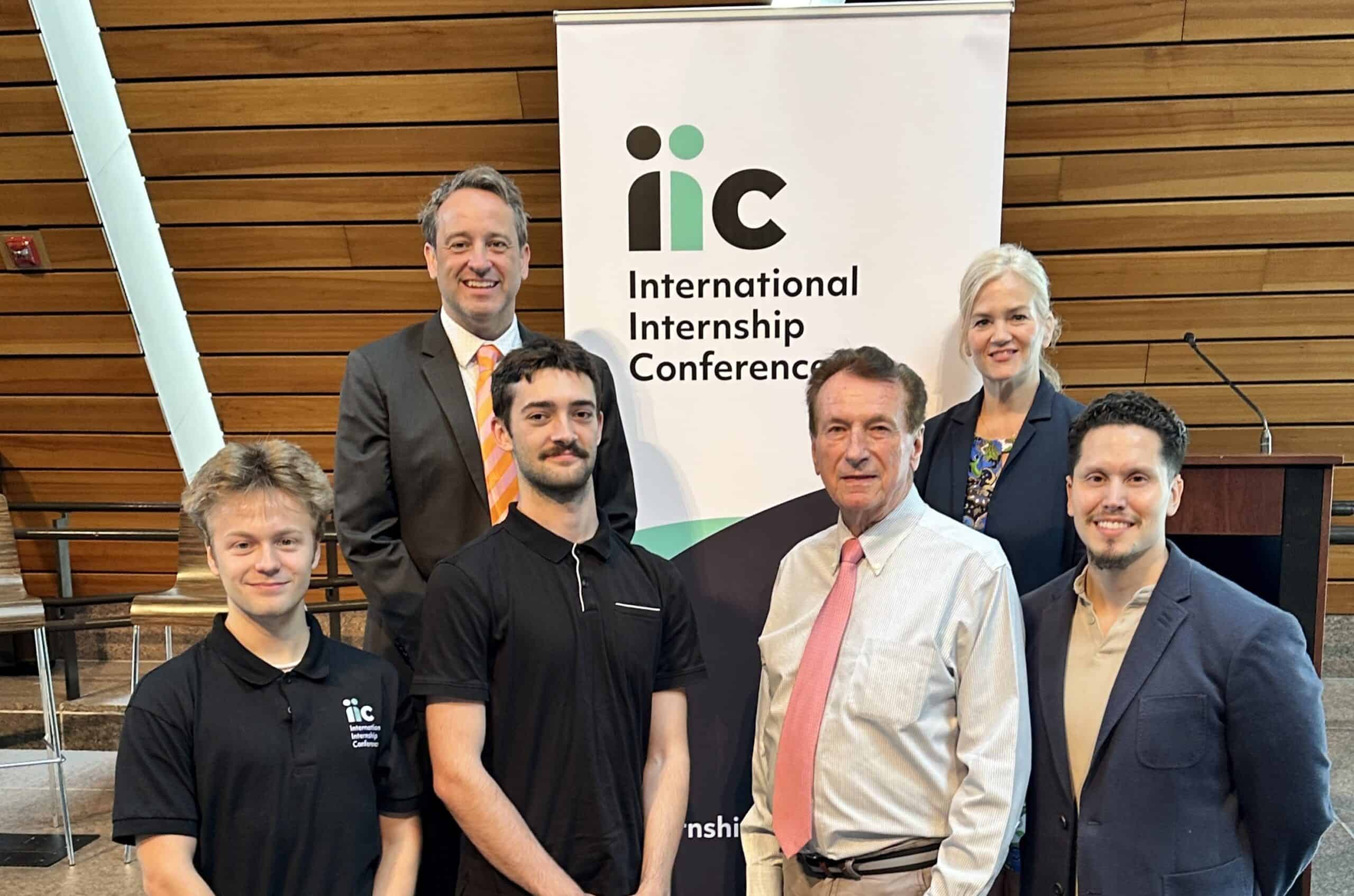
    Welcoming delegates with a lyric from Minnesotan, Bob Dylan, International Internship Network founder and conference organiser, Matt Byrnes, set a reflective tone: “Come in… I’ll give you shelter from the storm.” 

    “We’re in the midst of a storm in post-secondary education,” explained Byrnes, who believes that IIC can offer colleagues a refuge from the onsalught on recent policy decisions that are impacting international education globally.

    “IIC fosters an environment of tranquillity and confidence, where attendees explore study abroad solutions and partnerships that benefit their institutions and students,” he said.

    Attendees from across the globe gathered to engage in sessions that ranged from employer site visits to focused panels and social receptions. Delegates included international internship providers, faculty, government representatives, employers, and students.

    Central to the program was the conference’s annual debate. This year’s square off was entitled ‘Man vs Machine’ and tackled questions surrounding AI’s role in internship design and delivery. Moderated by The PIE‘s Maureen Manning, the session featured Kate Moore, principal and co-founder of the Global Career Center (GCC), Balaji Krishnan, vice provost at the University of Memphis, Greg Holz, assistant director for global engagement at the Univerity of Central Missouri, and Rishab Malhotra, founder and CEO of AIDO.

    The panellists brought diverse perspectives, from AI ethics and corporate supervision to startup innovation and campus life. They debated how technology can support rather than supplant the human experience in relation to international expeiences.

    Krishnan emphasised the importance of ethical frameworks in guiding AI development, warning against unchecked reliance on algorithmic tools without human oversight. Malhotra noted that while artificial intelligence can optimise logistics and placement processes, it cannot replicate human empathy or intercultural sensitivity – qualities central to global internships. Meanwhile, Holz offered a perspective from the corporate side, suggesting that when used thoughtfully, AI can streamline operations and free up supervisors to provide more meaningful mentorships. Moore closed by framing technology as an enabler rather than a replacement; a tool, not a teacher.

    These discussions reflected a core concern echoed throughout the conference: how to maintain the integrity and purpose of internships while leveraging digital tools to scale access and impact.

    Byrnes commented on the relevance of the conference’s direction: “IIC’s focus on the future of internships and technology is on point. At a time when academia is pivoting to prepare students for how AI is transforming the workplace, IIC attendees return to their campuses with much more knowledge about emerging technologies and how they can evolve internship programs to meet the needs of their students.”

    The event also highlighted the important role of government partnerships in advancing work-integrated learning. International Experience Canada (IEC), one of the central partners of the conference, stated: “We congratulate IIC for its role as a leading organisation in advancing dialogue and partnerships on international experiential education, work-integrated learning and internships, and as one of IEC’s newest recognised organisation partners.”

    Tech knowledge alone is not enough. We must support students to think critically, navigate complexity, and adapt with agility
    Maria Angeles Fernandes Lopez, Universidad de Camilo Jose Cela

    Throughout the three-day event, many delegates indicated to the PIE that it is not a question of whether technology will shape the future of internships, but rather how to ensure that these tools enhance, not eclipse, the human dimensions of learning: mentorship, reflection, and cross-cultural understanding.

    “Tech knowledge alone is not enough. We must support students to think critically, navigate complexity, and adapt with agility,” asserted Maria Angeles Fernandes Lopez, vice rector at Universidad de Camilo Jose Cela, the host institution for the IIC in 2026. At the passing of the torch ceremony at the conclusion of the conference, Byrnes and Lopez indicated their hope to build on the momentum and dialogue sparked in Minneapolis on the intersection between technology and humanity.

    Source link

  • 12% of college students won’t participate in an internship

    12% of college students won’t participate in an internship

    The value of internships for students’ career navigation and future employment opportunities is clear for colleges and many employers. But what do students think of internship experiences, and how do they benefit them in their future planning?

    A new report from Handshake, published Feb. 20, highlights trends across students who have and have not participated in internships, the impact on their goals beyond college, and the barriers that hinder engagement.

    Among the trends present: More interns are participating in paid internships and earning above minimum wage while doing so, and company culture can influence students’ willingness to return for a full-time position.

    Methodology

    Handshake’s Internship Index was assembled with data from a November 2024 survey of more than 5,605 students and 834 recent graduates, as well as job posting and application data from the platform. Recent graduates are those who completed their degree in 2022, 2023 or 2024.

    Why intern? A majority of students said they pursue internships to build valuable skills (87 percent), to identify possible career opportunities (72 percent), to make professional connections (70 percent) or to get a leg up in their future job hunt (70 percent). About 59 percent say participating in an internship is an essential step toward clarifying their career goals.

    Only one-third of students identified fulfilling a degree requirement as a primary factor for pursuing an internship, and just over half indicated financial motivation for interning.

    Among students who have completed an internship, more than 80 percent say the experience shaped their preferences for industries and job roles. Around 54 percent of students said their internship made them more confident in their career goals, and 56 percent said it was essential for making progress toward career goals. One-quarter said it inspired them to set new career goals, which can be similarly valuable.

    A winter 2023 Student Voice survey by Inside Higher Ed and College Pulse found 10 percent of students identified an internship as a top influence on their career decisions for after college.

    What hinders internships: Around 12 percent of students in the Handshake study have not participated in an internship and do not expect to do so prior to finishing their degree. The greatest share of these students say they’re limited by time (33 percent)—overwhelmed by coursework and other commitments—or they’ve applied for roles and haven’t been selected (33 percent).

    “Students may feel shut out of internships for a variety of reasons, ranging from packed schedules to financial and geographic constraints,” the report says. “Even for students who have ample time and resources, landing an opportunity has become more difficult as hiring contracts and competition increases, and the application process may feel overwhelming given the variation in hiring timelines across employers and industries.”

    Internal data shows demand for opportunities among students that is outpacing the supply. The number of internship postings on Handshake declined 15 percent from January 2023 to January 2025, but applications surged, with 41 percent of the Class of 2025 having applied to at least one internship through Handshake, compared to 34 percent of the Class of 2023.

    Only half of recent college graduates participated in an internship while enrolled in an undergraduate program. Even among students who do land an internship, time continues to be limited, with 56 percent of interns simultaneously taking classes and 36 percent working a part-time job. Around one in eight students said that their internship required them to work 40 hours a week or more.

    First-generation students were more likely to say they completed an internship while taking classes or working (80 percent) compared to their continuing-generation peers (70 percent).

    Pay day: As colleges and employers consider the importance of experiential learning for student career outcomes, more attention has been placed on the value of fair compensation to reduce equity gaps in who is able to participate in internships. Some colleges will provide stipends or scholarships for learners who take on an unpaid or underpaid internship, allowing them to still receive financial support for their work.

    Almost all internships (95 percent) posted on Handshake in the past year were paid, which students say is important to them in selecting an internship role.

    A majority of students who participated in an internship had an hourly wage (57 percent) or a fixed salary or stipend (24 percent). The highest average rate was for student interns working in professional services ($35 an hour) or financial services ($31 per hour). Students working in hospitality or education received the lowest average rate of $17.50 an hour.

    A talent pipeline: Internships can be a great way for a student to get a foot in the door of a company and for the employer to offer training and a career pathway for early talent. Handshake’s data shows that the interpersonal experiences students have while in their internships can influence their desire to hold a full-time role in that company.

    Three in five interns said the mentorship they received or didn’t receive had a major impact on their level of interest in working full-time for their internship employer. About 89 percent of students said team culture at least somewhat impacted on their interest in working full-time for their internship employer, and 90 percent said the same of their interactions with colleagues.

    Similarly, pay was a factor that impacted students’ consideration of a full-time role at their employer. Eighty-two percent of interns who had a fairly compensated role would likely accept a full-time offer from their internship employer, compared to 63 percent of those who didn’t feel their pay was fair.

    After finishing their internship, 59 percent of students said their experience impacted their interest in working for their employer at least moderately, but only 30 percent said they would definitely accept a full-time offer from their employer.

    Get more content like this directly to your inbox every weekday morning. Subscribe here.

    Source link