This audio is auto-generated. Please let us know if you have feedback.
The U.S. Department of Education announced a string of Title IX investigations Wednesday into over a dozen colleges and state and local school systems with policies that allow transgender students to play on sports teams aligning with their gender identity.
The 18 investigations come just a day after the U.S. Supreme Court heard arguments in a case that could decide the future of transgender student athlete participation on sports teams.
“These policies jeopardize both the safety and the equal opportunities of women in educational programs and activities,” the Education Department’s Office for Civil Rights said in a Wednesday announcement.
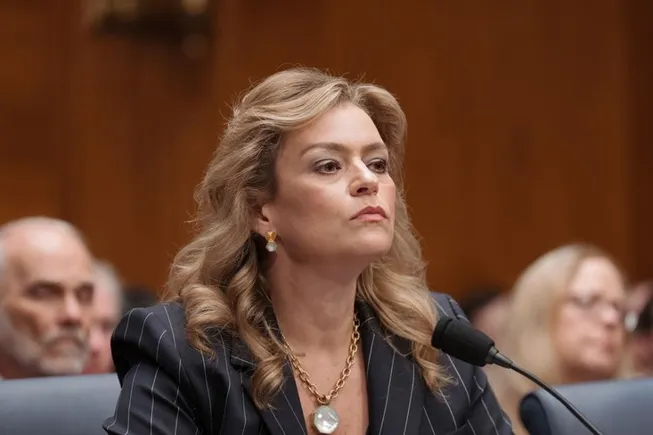
Assistant Secretary for Civil Rights Kimberly Richey said in a statement that her office is “aggressively pursuing” complaints about alleged discrimination in women’s sports, which it says is a result of transgender student participation on women’s and girls’ sports teams.
“We will leave no stone unturned in these investigations to uphold women’s right to equal access in education programs,” Richey said.
The investigations were launched into large and small public education systems and colleges, including the New York City Department of Education, Washington’s Tacoma Public Schools, and the Hawaii State Department of Education.
A handful of investigations were also launched into districts in California and Maine — states that have already been the target of Education Department investigations that resulted in U.S. Department of Justice referrals and threats to federal funding loss.
The Justice Department sued Maine following a Title IX investigation that said the state had discriminated against cisgender women and girls. However, as of last week, there have been no recent major developments in that case despite the lawsuit being announced last April, according to a Maine state attorney general office spokesperson.
On Tuesday, the Supreme Court heard arguments in West Virginia v. B.P.Jand Little v. Hecox, in which justices were asked to weigh the constitutionality of state bans limiting transgender athlete participation on sports teams aligning with their gender identities and whether such bans violate Title IX.
While the high court’s conservative majority seemed inclined to uphold state bans, justices on both sides of the ideological spectrum questioned what their limits should be, considering the role of student age, hormone therapy and puberty blockers.
“I’ve been wondering what’s straightforward after all this discussion,” said Justice Neil Gorsuch in court on Tuesday.
The outcome of the cases could change the course of transgender students’ rights in schools, school district policies allowing or barring their participation on sports teams under Title IX, and the Education Department’s enforcement of the sex discrimination statute.
The new investigations also come as Office for Civil Rights employees have been indefinitely reinstated to their positions after the department’s rescission of their layoff notices. The employees were laid off as part of the Trump administration’s efforts to downsize the federal government and to shutter the Education Department.
The civil rights employees were put on administrative leave but were in limbo as legal challenges to the layoffs worked their way through the courts and resulted in temporary blocks. However, the Education Department abandoned its efforts last month to push some of the layoffs through, which resulted in the employees’ indefinite reinstatement as of December.
The full list of new investigations includes:
Jurupa School District (Calif.)
Placentia-Yorba School District (Calif.)
Santa Monica College (Calif.)
Santa Rosa Junior College (Calif.)
Waterbury Public Schools (Conn.)
Hawaii State Department of Education (Hawaii)
Regional School Unit 19 (Maine)
Regional School Unit 57 (Maine)
Foxborough Public Schools (Mass.)
University of Nevada, Reno (Nev.)
Bellmore-Merrick Central High School District (N.Y.)
by Felicia Mello, The Hechinger Report December 23, 2025
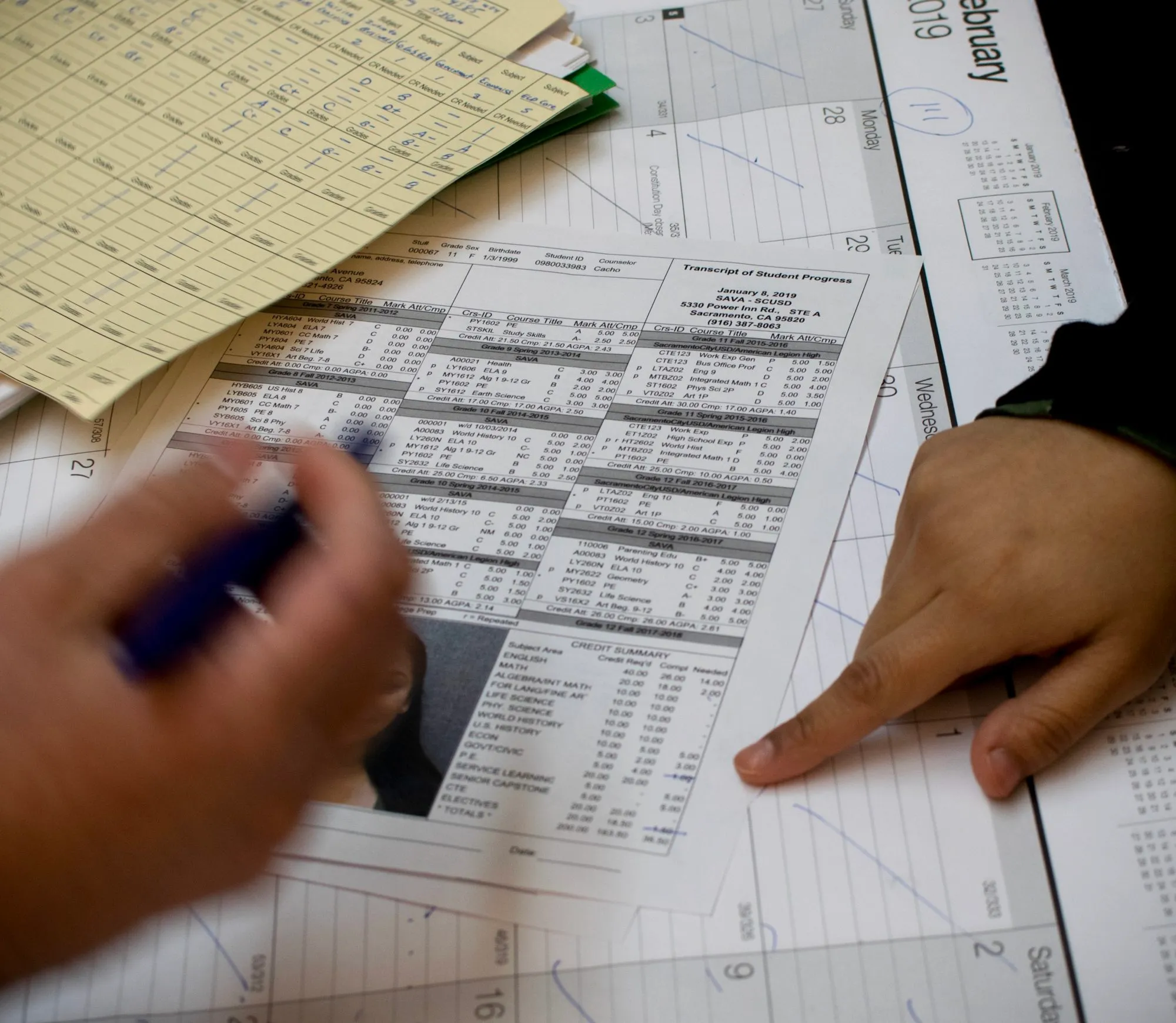
OAKLAND — In 2020, California led the nation in outlawing transcript-withholding, a debt collection practice that sometimes kept low-income college students from getting jobs or advanced degrees. Five years later, 24 of the state’s 115 community colleges still said on their websites that students with unpaid balances could lose access to their transcripts, according to a recent UC Merced survey.
The communications failure has been misleading, student advocates said, although overall, the state’s students have benefited from the law.
It “raises questions about what actual institutional practices are at colleges and the extent to which colleges know the law and are fully compliant with the law,” said Charlie Eaton, a UC Merced sociology professor who led the research team that conducted the survey in October.
California community colleges say they are following the law, which prohibits them from refusing to release the grades of a student who owes money to the school — anywhere from a $25 library fine to unpaid tuition. The misinformation on some college websites is a clerical problem that campuses have been asked to update, the California Community Colleges chancellor’s office said in an emailed statement.
Without an official transcript, students can’t prove they’ve earned college credits to admissions offices elsewhere or to potential employers. Millions of students nationwide have lost access to their transcripts because of unpaid fees, according to estimates from the higher education consulting firm Ithaka S+R.
Student advocates argued that the practice made little money for colleges, while costing graduates opportunities that could help them pay back their debts.
California lawmakers agreed; in 2019, they passed legislation that took effect on Jan. 1 2020, barring colleges from using transcript holds to collect debts.
At least 12 other states have followed California’s lead, passing laws limiting or banning colleges from withholding transcripts.
A similar but less stringent federal rule approved during the Biden administration took effect last year.
The new rules have raised awareness about colleges’ debt collection practices and inspired some to find ways to help their students avoid falling behind on their payments in the first place or to pay off what they owe — including by forgiving their debts.
Related: Interested in innovations in higher education? Subscribe to our free biweekly higher education newsletter.
Colleges and universities, however, argued that withholding transcripts was one of the few ways they had to prevent students from bouncing among institutions and leaving unpaid bills in their wake. Some use another tactic, blocking them from registering for new courses until bills are paid.
When colleges choose to withhold transcripts, the burden falls more heavily on low-income students and students of color, according to the American Association of Collegiate Registrars and Admissions Officers. Often those students accrue debts when they withdraw partway through a course, leading the college to return part of their financial aid to the federal government and charge the bill to the student.
In states with laws limiting transcript withholding, many colleges have begun communicating earlier and more often with students about their debts and offering flexible payment plans, said Elizabeth Looker, a senior program manager at Ithaka S+R. Some have added financial literacy training or required students with unpaid bills to meet with counselors.
Eight public colleges and universities in Ohio went further, offering a deal to former students with unpaid balances: Reenroll at any of the eight, and get up to $5,000 of the outstanding debt forgiven. Called the Ohio College Comeback Compact, the program, which began in 2002 and concludes this fall, was open to former students who had at least a 2.0 GPA and had been out of school a year or more.
The program was designed to give a second chance to students whose educations stalled because of events outside their control, such as losing a job in the middle of the semester, said Steve McKellips, vice president for enrollment management at the University of Akron.
Since the Ohio College Compact’s inception, 79 students have returned to the university under the program, at a cost to the state of $54,174 in debt forgiven. The university netted five times that, or $271,924, in additional tuition, McKellips said. More than 700 students have used the compact to reenroll, according to Ithaka S+R, which helped coordinate the program and is studying the results.
“I think sometimes people have this image of somebody walking away from a tuition bill because they just don’t care,” McKellips said. “But sometimes there’s just a boulder in the way and somebody needs to move it. Once the boulder was moved and they could move forward, we’re finding them continuing happily along the way they always intended to.”
The University of California cited expected cuts to federal and state funding as one reason it opposed the bill. “UC believes that maintaining the ability to hold registration is essential for its ability to reasonably secure unpaid student debt,” UC legislative director Jessica Duong wrote to lawmakers.
Cal State spokesperson Amy Bentley-Smith said that Cal State wanted a flexible approach to debt collection and that campuses had started eliminating registration holds for minor debts such as parking tickets and lost library books.
“Students are able to move forward with their enrollment even with institutional debts in the low hundreds to the low thousands of dollars, depending upon the university,” she said.
Supporters of the failed bill — which also would have barred colleges from reporting a student’s institutional debt to credit agencies — said curbing aggressive debt collection doesn’t just help low-income students; it speeds up the training of workers in industries crucial to the state’s economy.
“Schools think about these institutional debts in a way that is very penny-wise and pound-foolish, and it’s preventing people from participating in the economy,” said Mike Pierce, executive director of Protect Borrowers.
Annette Ayala of Simi Valley, hoping to become a registered nurse, took her for-profit college to court to force it to comply with California’s debt collection law.
She had earned her vocational nursing license from the school, the Professional Medical Careers Institute, and wanted to continue her studies to become a registered nurse. But the college refused to release her transcript — citing a $7,500 debt that Ayala argued in court records she did not owe — and without the transcript she could not apply to other colleges.
In her case, California’s Bureau for Private Postsecondary Education, which regulates for-profit colleges under the state’s Department of Consumer Affairs, cited her former school for violating the state’s transcript-withholding law.
The college was fined $1,000 and ordered to update its enrollment agreement. The school forgave the debt it said Ayala owed. It’s the only case in which a school has been cited for withholding a transcript since the bureau started monitoring compliance with the law more closely two years ago, said Monica Vargas, a spokesperson for consumer affairs.
School officials had been unaware of the California law at the time Ayala sued, the school’s controller, Joshua Taylor, said, and have since updated their catalog to comply with it.
With her vocational nursing license, Ayala has been working in home health care. Now that she has her transcript, she’s applying for RN programs, and said her salary would roughly double once she has the new degree, allowing her to save for the future and help her son pay for college.
“You’ve got to give people the chance to get through their program and pay their debts as they’re working,” she said. “You can’t hold them back from being able to make top dollar with their abilities to pay back these loans.”
This <a target=”_blank” href=”https://hechingerreport.org/5-years-after-california-banned-holding-college-students-transcripts-hostage-for-unpaid-debt-some-colleges-neglect-the-law/”>article</a> first appeared on <a target=”_blank” href=”https://hechingerreport.org”>The Hechinger Report</a> and is republished here under a <a target=”_blank” href=”https://creativecommons.org/licenses/by-nc-nd/4.0/”>Creative Commons Attribution-NonCommercial-NoDerivatives 4.0 International License</a>.<img src=”https://i0.wp.com/hechingerreport.org/wp-content/uploads/2018/06/cropped-favicon.jpg?fit=150%2C150&ssl=1″ style=”width:1em;height:1em;margin-left:10px;”>
Inside an unoccupied house, a student gingerly pushes open a creaky door and takes a wary step into a dark room—only to find the walls completely splattered with blood.
It sounds like the cliché climax in a horror movie, but for students in the criminal justice program at Gwynedd Mercy University, it’s a regular class assignment.
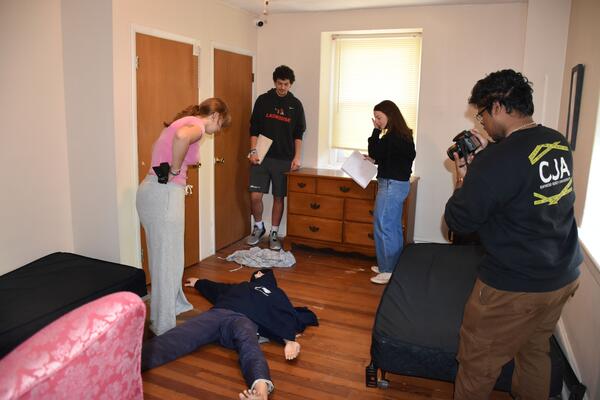
This fall, Gwynedd Mercy unveiled a new Crime Scene House, a three-story home that features various staged rooms for experiential learning in forensic science. Students now have a space for simulated criminal investigations, with each room configured to resemble a different crime scene they might encounter, including the blood spatter room.
Gwynedd Mercy is one of a dozen-plus colleges across the country that turn houses into mock crime scenes; West Virginia University claims the title for largest hands-on training complex in the U.S., boasting four crime scene houses, a vehicle processing garage, a ballistics test center and designated grounds for excavation.
The not-so-haunted houses are designed to give students a safe, supervised space to immerse themselves in a crime scene. Plus, it’s a great enrollment draw for students who get a thrill out of murder mysteries.
“We’re very excited about the opportunity to have students come into our program and learn the how-to, so then they walk out of here and they say, ‘This is what I want to do,’” said Patrick McGrain, associate professor of criminal justice and the program director at Gwynedd Mercy. “It really is for the benefit of creating a more professional law enforcement community.”
From convent to crime scene: McGrain and university leaders aspired to open a crime scene house on campus for years. In July, the dream became a reality when the Catholic university’s administrators identified an older building that used to house the Sisters of Mercy. The building was in disarray, and when McGrain was offered the opportunity to revamp it for students, he jumped at the chance.
The Crime Scene House holds a variety of staged rooms to practice different investigations including a kitchen, a bathroom, two bedrooms and an office. In addition, the house features spaces for other simulated experiences, including an interrogation room, an evidence area to analyze fingerprints and a model “flophouse,” or a low-rent motel room used for drugs. And of course, the blood spatter room.
“We’re going to teach students how to analyze blood splatter, the analysis of the trajectory,” McGrain said.
Every element of the house is available for students to manipulate and investigate, even the flooring.
“We have carpet laid down that they cut out pieces, use luminol and then take it over to the lab, well, what is it that we have?” McGrain explained. “Is it feces, it is urine, is it semen, is it blood? What is it that we’re looking at and what do you think happened in this room?”
Faculty can track students’ progress solving the investigations through cameras mounted in each of the rooms.
While the home at times may resemble an escape room, with CCTV cameras and a mystery to solve, “the only person locked in is the one who’s been kidnapped, and that’s been planned, and it’s a dummy,” McGrain said.
The university allocated a small budget for furniture, but a significant number of items came directly from campus community members, who donated household items or clothing.
“I even had two students who found a couch on the side of the road, grabbed it, put it in their trunk and brought it in,” McGrain said. “It is now the couch that sits in the living room.”
Because the house is designed to be ransacked and torn up by “criminals,” the university also keeps backup furniture and wall decor.
“If we want to break something, if we need to tear something, we do,” McGrain said. “The hands-on learning knows no limits.”
Experiential learning: Other academic programs, including nursing, psychology and social work, have simulation labs integrated into the curriculum to allow students to practice their skills. In the same way, the house gives criminal justice students a chance to gain career skills.
Before the Crime Scene House was established, Gwynedd Mercy faculty would set up a classroom to resemble the crime scene.
“It’s not nearly as detailed,” McGrain said. “You don’t have the furniture. You don’t have the fake drugs or guns.”
The facility has also served as a resource for law enforcement to train new detectives on how to use tech tools, such as digital photography and indoor drones.
Jerome Mathew, a junior criminal justice student, said having the Crime Scene House is a game-changer—especially for getting incoming students amped about studying criminal justice.
“They were really thrilled about seeing all the different fake drugs, money, different rooms, the cameras and how monitored everything was,” Mathew said.
Gwynedd Mercy has plans to grow the criminal science major and launch a forensic science minor. The Crime Scene House will be an integral piece of that, McGrain said. “We’re expecting to see a spike in applications and a spike in admissions.”
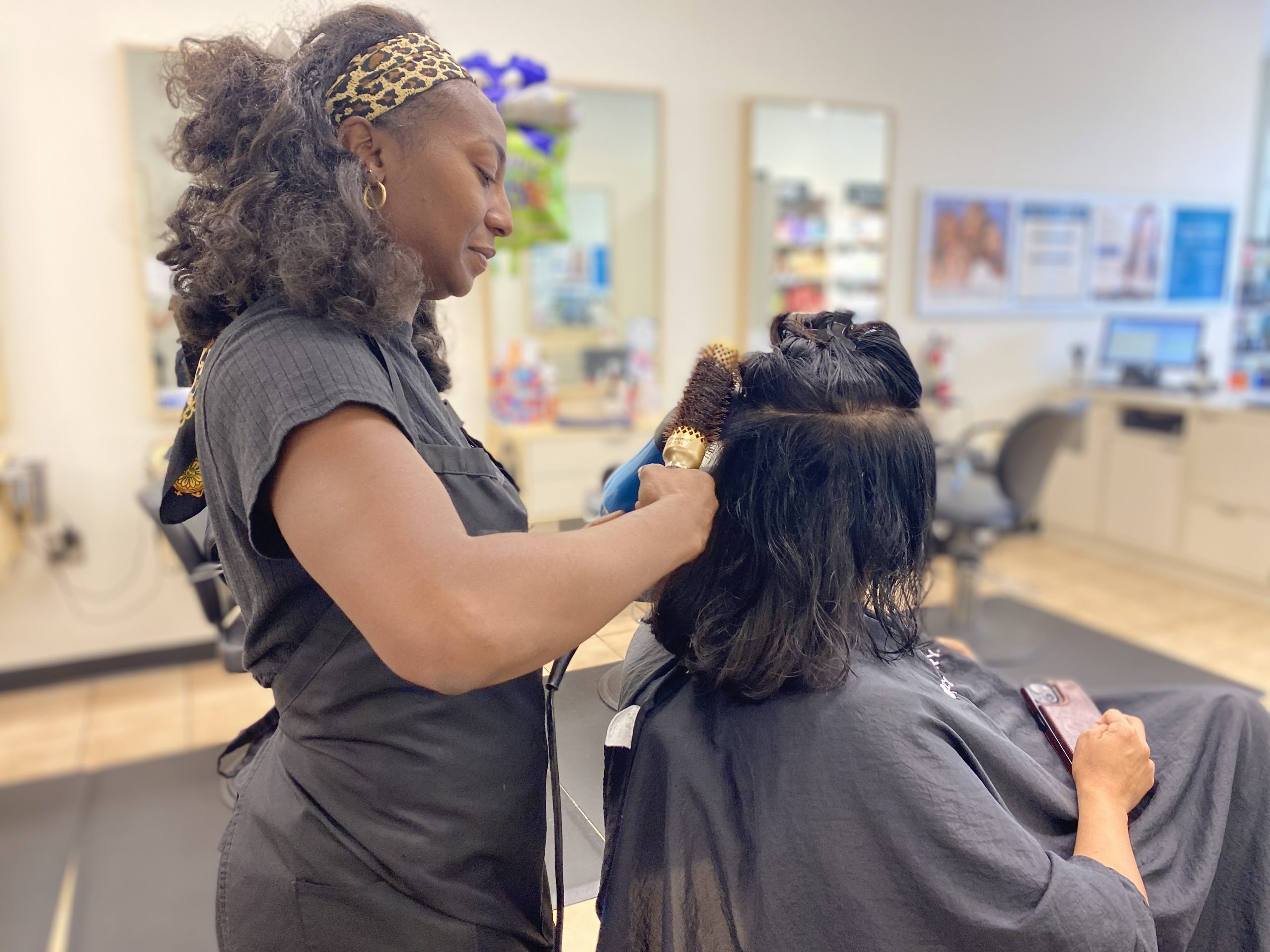
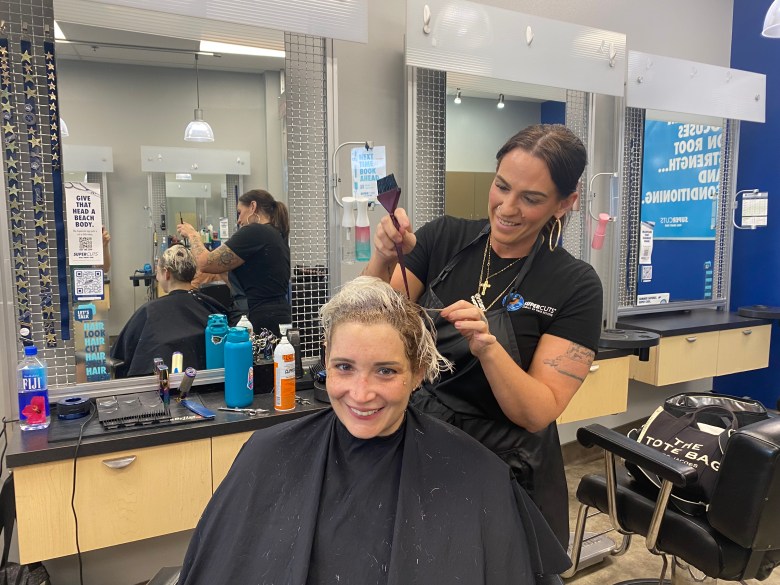
Remiah Ward’s shift at the SmartStyle salon inside Walmart was almost over, and she’d barely made $30 in tips from the haircuts she’d done that day. It wasn’t unusual — a year after her graduation from beauty school, tips plus minimum wage weren’t enough to cover her rent.
She scarcely had time to eat and sleep before she had to drive back to the same Walmart in central Florida to stock shelves on the night shift. That job paid $14 an hour, but it meant she sometimes spent 18 hours a day in the same building. She worked six days a week but still struggled to catch up on bills and sleep.
The admissions officer at the American Institute of Beauty, where she enrolled straight out of high school, had sold her on a different dream. She would easily earn enough to pay back the $10,000 she borrowed to attend, she said she was told. Ward had no way of knowing that stylists from her school earn $20,200 a year, on average, four years after graduating. Seven years later, her debt, plus interest, is still unpaid.
In July, Republicans in Congress pushed through policies aimed at ensuring that what happened to Ward wouldn’t happen to other Americans on the government’s dime; colleges whose graduates don’t earn at least as much as someone with a high school diploma will now risk losing access to federal student loans. But one group managed to slip through the cracks — thousands of schools like the American Institute of Beauty were exempt.
Remiah Ward worked two jobs while trying to make it as a hair stylist but never made enough to pay her all her bills and has had to put her dream career on hold. Credit: Courtesy Remiah Ward
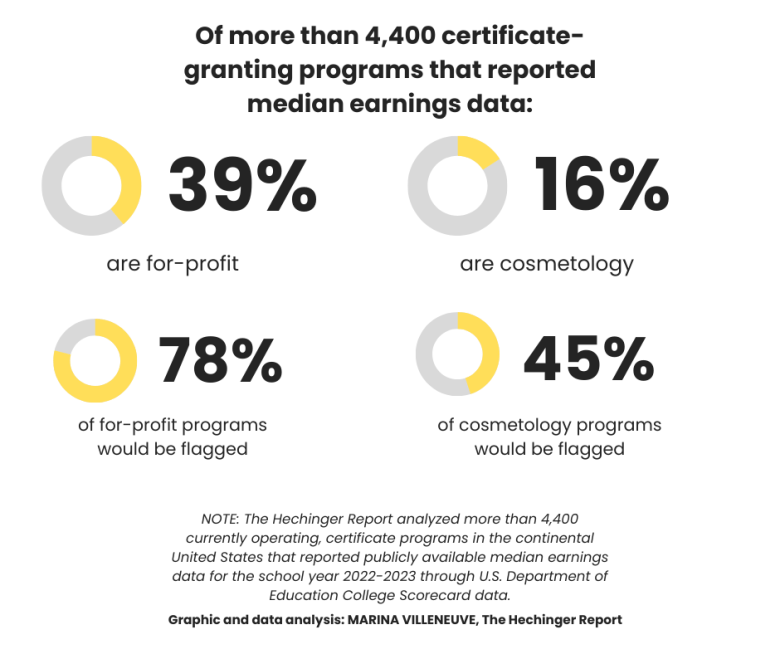
Certificate schools succeeded in getting a carve-out. The industry breathed a collective sigh of relief, and with good reason. At least 1,280 certificate-granting programs, which enrolled more than 220,000 students, would have been at risk of losing federal student loan funding if they had been included in the bill, according to a Hechinger Report analysis of federal data. [See table.] About 80% of those are for-profit programs, and 45 percent are cosmetology schools.
“There is this very strange donut hole in accountability where workforce programs are held accountable, two-year degree programs are held accountable, but everything in between gets off without any accountability,” said Preston Cooper, a senior fellow at the conservative think tank American Enterprise Institute.
The schools spared are known as certificate programs and, with their promise of an affordable and relatively quick path to economic security, are the fastest growing part of higher education. They usually take about a year to complete and train people to be hair-stylists, welders, medical assistants and cooks, among other jobs.
As with traditional colleges, there are big differences in quality among certificate programs. Some hair stylists can make a middle-class living if they work in a busy salon. But for people who have to pay back hefty student loans, the low wages for stylists in the early years can be an insurmountable obstacle.
Ward found herself facing that dilemma. When she could no longer sustain the lack of sleep from her double shifts at Walmart, she pressed pause on her styling career and took a job with Amazon, loading and unloading planes. She wasn’t ready to give up her dream career, though, so in addition to her 10-hour days moving boxes, she took part-time gigs at local hair salons. She didn’t have family to help pay rent, not to mention loan payments, so she couldn’t afford to work fulltime at a salon, which is essential to build up a regular clientele — and bigger tips. Without that, she couldn’t get much beyond minimum wage.
A representative from the American Institute of Beauty denied that Ward was told she would easily repay her loan.
“No admissions representative, not at AIB or elsewhere, would ever make such a statement,” Denise Herman, general counsel and assistant vice president of AIB, said in an email.
The high cost of many for-profit cosmetology schools — tuition can be upward of $20,000, usually for a one-year program — can leave former students mired in debt. In May, the government released data showing 850 colleges where at least a third of borrowers haven’t made a loan payment for 90 days or more, putting them on track to default. About 42 percent of those were for-profit cosmetology and barbering schools (including AIB).
Brittany Mcnew says she loves working as a stylist but that her income takes a hit when traffic is slow in her salon in Bethlehem, Pennsylvania. Credit: Meredith Kolodner/The Hechinger Report
Herman blamed the Biden administration policy that after the pandemic let borrowers forgo payments without any penalty.
“Debtors became ‘comfortable’ not making payments,” said Herman. “AIB provides the graduate with the information graduates need to make their payments. What that graduate decides to pay, or not pay, is not influenced by AIB.”
Under the “big beautiful bill” passed in July, two- and four-year colleges must ensure that, after four years, graduates on average make at least as much as someone in their state who has only a high school diploma. The colleges must inform students if they fail that test, and if it happens for two out of three years, the college will be ineligible to receive federal loan funds.
Some for-profit certificate schools lobbied hard for an exemption. The American Association of Career Schools, which represents proprietary cosmetology schools, spent $120,000 lobbying the Education Department and Congress, including on the “big beautiful bill,” in the first six months of this year. At the group’s major lobbying event in April, Sen. Bill Cassidy, chairman of the Senate Health, Education, Labor and Pensions Committee, was the keynote speaker.
Cassidy declined to answer questions about why certificate programs were excluded, but a fact sheet from his committee noted that they are already covered by something else, the gainful employment rule, which is also being challenged by the for-profit cosmetology industry.
That federal gainful employment regulation, updated in 2023, requires in essence that graduates from career-oriented schools earn enough to be able to pay back their loans and earn more than a high school graduate. It also requires that consumers, like Ward, be given more information about how graduates from all colleges fare in the workplace.
The rule posed an existential threat to a huge swath of cosmetology schools.
In 2023, the American Association of Career Schools sued to block the gainful employment rule.
“AACS supports fair and reasonable accountability measures,” Cecil Kidd, the AACS’s executive director, said in an email. “However, we strongly object to arbitrary or discriminatory policies such as the US Department of Education’s Gainful Employment rule, which unfairly targets career schools while exempting many public and private non-profit institutions that fail to meet comparable outcomes.”
He pointed to public comments in which AACS has argued that the rule imposes an unfair burden on cosmetology schools since stylists are predominantly women, who are more likely to have “personal commitments” that affect their earnings, and who rely on tips that are often pocketed as unreported income.
Cameron Vandenboom is a successful hair stylist but says the high cost of her private beauty school wasn’t worth thousands of dollars in student debt: “I absolutely should have gone to community college.” Credit: Courtesy Shanna Kaye Photo
In a twist that surprised advocates on both sides, the Education Department in May asked the court to effectively dismiss AACS’ lawsuit.
If the court rules in favor of the cosmetology schools, certificate programs will be free of all accountability requirements on their graduates’ earning levels, because they got the carveout in July.
Even if the court rules against cosmetology schools, advocates are pessimistic that the Trump administration will implement the gainful rules. The first Trump administration got rid of the original rules back in 2019 and Nicholas Kent, now the U.S. undersecretary of education, was previously the chief policy officer for Career Education Colleges and Universities, or CECU, the trade group that represents for-profit colleges, including certificate programs. He is a well-known critic of the rule.
“I would be very surprised, if the unlikely scenario plays out that the Biden rule is upheld, that this Department of Education would just say, OK, the court has spoken,” said Jason Altmire, CECU’s executive director. “We are not opposed to accountability for certificate programs, so long as it’s fair to everybody and we have a voice in how you’re measuring programs.”
Altmire said CECU didn’t lobby for certificate programs to be carved out of Congress’ bill, but did argue against the earnings formula that Congress landed on. Altmire said it doesn’t take into account part-time work and the gender gap in wages.
One objection from AACS, raised by CECU as well, is that the earnings measured don’t include tips, which are crucial to hair stylists’ income. Analyzed without including tips, 576 of 724 cosmetology schools in the Hechinger Report analysis would fail Congress’ earnings test. But even if tips were included and raised stylists’ income by 20 percent, 526 cosmetology schools would still fail.
Earlier this year, Remiah Ward made the difficult decision to leave Florida and move to Kentucky, where the cost of living was more forgiving. She’s working from 7 p.m. to 7 a.m. at an aluminum factory for $19.50 an hour.
One day, she might go back to styling after her debt is paid off. Like many former beauty school students, she wishes she’d had more information when she decided to enroll.
“They really sugar-coated it. I was 18 years old, and I needed a trade that I was already pretty good at,” said Ward, who is now 26. “Everybody thinks they’re going to make a high return, and it’s just not the reality.”
Marina Villeneuve contributed data analysis to this story.
The Hechinger Report provides in-depth, fact-based, unbiased reporting on education that is free to all readers. But that doesn’t mean it’s free to produce. Our work keeps educators and the public informed about pressing issues at schools and on campuses throughout the country. We tell the whole story, even when the details are inconvenient. Help us keep doing that.
Schools that train hairstylists, dental assistants and health aides will be able to keep getting federal student loan dollars even if the professionals they turn out don’t end up earning any more than a high school graduate.
That’s because programs like those, which don’t end in a college degree, were granted an exemption from new accountability measures under President Donald Trump’s ”big, beautiful bill.”
A Hechinger Report analysis of federal data found at least 1,280 such certificate programs could have been at risk of their students losing access to federal student loans — but a successful lobbying effort excluded them from the accountability measures.
Related: Become a lifelong learner. Subscribe to our free weekly newsletter featuring the most important stories in education.
Under the new law, most graduates of associate, bachelor’s and graduate degree programs must earn at least as much as someone who has only a high school diploma. If programs fail to hit that benchmark for two out of three years, their students will no longer be eligible for federal student loans. (And the schools must warn students of this possibility if they miss the mark for just one year). Without that borrowing power, many students could not afford to attend. And without those students, some of the schools might not survive.
Using the table below, see which certificate programs might have been flagged under the Trump law if not for the exemption. If graduates of a particular program ended up earning less than adults with only a high school diploma, that program could have faced losing eligibility for federal student loans under the Trump law.
Methodology
What exactly does the “big, beautiful bill” call for?
The legislation requires the Department of Education to compare earnings of working adults who have only a high school diploma to the earnings of adults four years after they complete a degree program or graduate certificate. If a postsecondary program’s graduates fail to outearn adults with only high school degrees for two out of three years, students can no longer obtain federal student loans to attend that program.
The law also sets up an appeals process and a way for programs to apply to regain eligibility for federal student loans.
What data was analyzed?
The law directs the education secretary to use census data to calculate median earnings for working adults with only a high school degree in the state where a program is located. The Department of Education will release regulations that spell out exactly how to do that math. For example, the law does not spell out whether it will look at census data averaged out over 12 months or a longer period of time.
For earnings data for high school graduates, The Hechinger Report relied on calculations from the Department of Education, which were derived from the 2022 American Community Survey 5-Year Estimates Public Use Microdata Sample from the U.S. Census Bureau.
To calculate median earnings for graduates, the law directs the Education Department to put together earnings data for a cohort of at least 30 graduates who received federal student aid for postsecondary education — which typically includes grants, loans or work-study. Graduates are excluded if they’re currently enrolled in another higher education program. If there are fewer than 30 students in a cohort, the Education Department can lump together several years of data to get to 30 students.
To get earnings data for graduates of certificate programs, Hechinger used a federal database known as College Scorecard. We downloaded field of study data for the 2022-23 school year. From this data, The Hechinger Report extracted information about certificate programs, at their main campuses, and included only programs that had median earnings data. The federal database suppresses earnings data for small programs. That left 4,431 currently operating certificate programs.
How was a program determined to be at possible risk of failing the accountability measure?
For each program, The Hechinger Report compared median graduate earnings to the high school graduate earnings data of the state where the program was located. If the graduates earned less, the program was considered to be at risk.
Under the law, postsecondary programs that don’t meet the earnings benchmark for one year have to inform all current students that they are at risk of losing their eligibility for federal student loans.
Are there any limitations to the data?
The “big, beautiful bill” takes online programs into account by considering whether students live in the same state where their academic program is based. Under the law, student earnings are compared with national data rather than state data when fewer than half of enrolled students live in the state where the school is located, which may be the case for online programs.
The Hechinger Report’s analysis instead compares every program with state earnings. That’s because the College Scorecard field of study data set is limited and only includes information about graduates employed within the same state as the institution, not whether enrolled students live in the same state as the program. In addition, College Scorecard data provides earnings data for all graduates without a breakdown for whether they receive federal aid.
Also, the Hechinger database looks at the available median earnings of all students four years after graduation for the school year 2022-23, regardless of the number of graduates. Though College Scorecard suppresses data on smaller programs, median earnings data is available for programs with 16 or more working graduates. The “big, beautiful bill” directs the Department of Education to instead lump together years of data to create cohorts of at least 30 students.
The Hechinger Report provides in-depth, fact-based, unbiased reporting on education that is free to all readers. But that doesn’t mean it’s free to produce. Our work keeps educators and the public informed about pressing issues at schools and on campuses throughout the country. We tell the whole story, even when the details are inconvenient. Help us keep doing that.
Last August, Republican Rep. Gino Bulso looked out at a room filled with dozens of fellow state lawmakers as he touted new legislation he had just helped become a reality in Tennessee. Under the law, a fetal ultrasound or a video of a computer-animated fetus developing in the womb had become mandatory viewing for students in the state’s sex education classes.
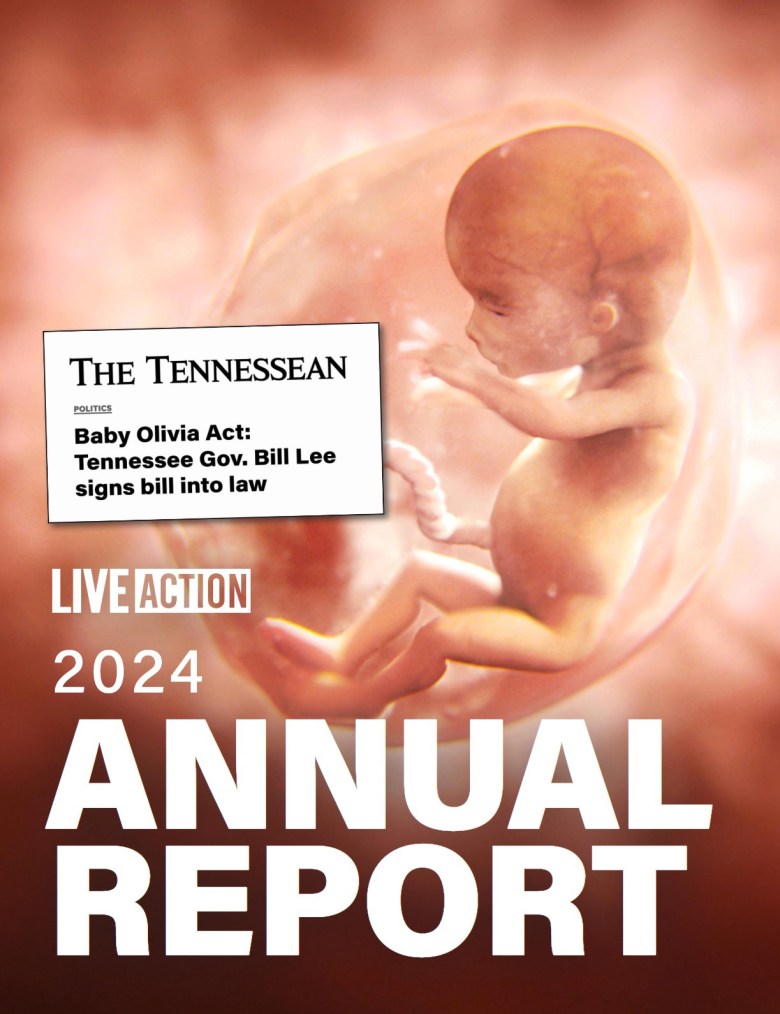
Bulso was there at the request of the event’s host, anti-abortion advocacy nonprofit Live Action. The group had gathered legislators from across the country to provide them “with the policy information and persuasion strategies they need to end abortion,” according to its annual report.
Bulso’s panel, “The Agenda for Life in Schools and Beyond,” focused on how he had successfully shepherded his bill into becoming the second so-called fetal development education law in the country.
When lawmakers returned to their home states after the Live Action event, The Hechinger Report found, at least 10 of them sponsored bills similar to Bulso’s, in some cases proposing that students as young as third grade watch fetal development videos. Another legislator who introduced such a bill had sent his chief of staff and wife to the event. And the volume of legislation stemming from the gathering may be higher: Live Action keeps its list of attendees private, though many lawmakers posted about the event on social media or were featured in Live Action’s promotional materials.
Since 2023, when North Dakota became the first state to pass fetal development education legislation, anti-abortion lawmakers in more than 20 additional states have proposed such bills; 6 of those states, including Bulso’s, have passed them. As a result, this fall, nearly 4 million children will attend school in a state that requires them to watch a video or ultrasound of a fetus in the womb during sex education classes. And this year, legislators in four states tried to go even further: Their proposals would have required students to view depictions of abortions, including computer-animated videos.
After the fall of Roe v. Wade in 2022, public schools have become an increasingly important battleground in the fight over abortion rights. Even though 12 states now ban abortion in all circumstances, the number of procedures has increased nationwide since the Supreme Court’s decision to overturn Roe.Public support for abortion rights has also risen. Many anti-abortion advocates hope that getting their message in front of students can help them win the hearts and minds of young people and change these trends in the long run.
While critics, including medical professionals and some parents, say that the fetal development education materials being introduced to schools are manipulative and little more than propaganda, Live Action and other groups that produce them maintain they are medically accurate and unbiased. Experts in sex education and abortion policy say a related problem is the dearth of sex education in schools — students, on average, receive only about six hours during their high school years — that creates a vacuum for anti-abortion groups to move into.
“They’re attempting to reach children at an age where I would assume most haven’t been exposed to issues of an abortion,” says Alisa Von Hagel, a political science professor at University of Wisconsin-Superior who has studied the strategies of the anti-abortion movement. “They’re attempting to be the first to imprint this quote, unquote ‘knowledge’ or opinion about these issues.”
During a debate earlier this year in the Arkansas Senate, Republican Sen. Alan Clark referred to his state’s proposal as “one of the most important pro-life bills that’s ever come before us.” He also said, “It will shape the minds of kids from now on.”
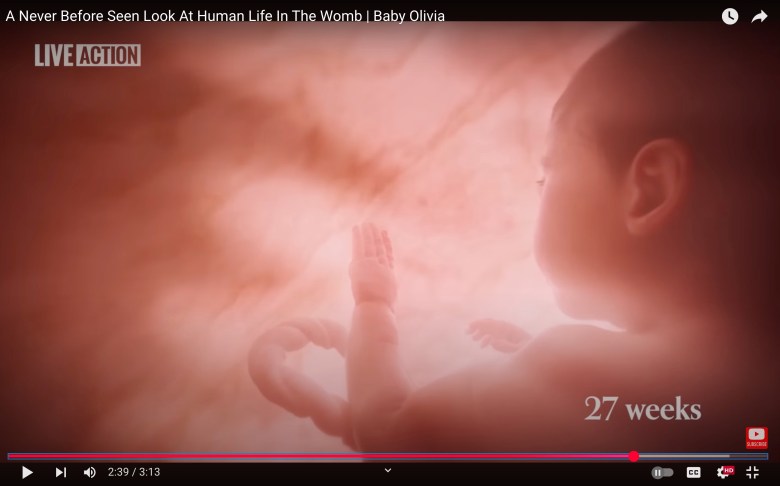
The proposal would have required showing a video created by Live Action to students starting in sixth grade. In the video, titled “Meet Baby Olivia,” a narrator tells the viewer that life begins at conception and says the fetus, named Baby Olivia, begins playing and exploring as early as 11 weeks.
In an annual report, Live Action noted that its “Meet Baby Olivia” video caused a “37-point shift towards the pro-life perspective among viewers.” The organization also highlighted the impact its materials can have on kids, in particular, to help “instill a reverence for life as children at impressionable ages develop their world view.”
Tennessee state Rep. Gino Bulso sponsored the nation’s second fetal development education law. He credits the anti-abortion group Live Action with helping him get it passed. Credit: George Walker IV/AP Images
Both Bulso and Noah Brandt, Live Action’s vice president of communications, have said the only goals of Baby Olivia and fetal development education are to teach and inform students — but they also expected it to leave an impression. “It is intuitive that, after watching that, people would be less likely to support abortion on demand,” Brandt said.
Live Action’s work to connect with students is also part of playbooks for other anti-abortion organizations. Take Heartbeat International, for example, a group that supports clinics known as “crisis pregnancy centers,” which provide limited medical care and encourage people not to have abortions. Heartbeat also offers in-person and online training, including one program on how to “Change the Nation with Pro-life Education,” featuring specific tactics for working with public schools. One speaker at Heartbeat’s 2023 national conference described performing an ultrasound on a pregnant woman in front of public school students to “plant a seed of life.”
Before creating “Meet Baby Olivia,” Live Action was best known for anti-abortion campaigns and undercover stings against Planned Parenthood, and largely worked outside of policymaking. But as the organization has grown in recent years, it has begun to coordinate directly with legislators.
Live Action held its inaugural lawmaker summit in 2022, two months after Roe was overturned. The following spring, North Dakota passed a fetal development education law, the nation’s first.
Many proposed fetal development education bills mention the video “Meet Baby Olivia” by name. Critics say that the video is designed to manipulate the viewer’s emotions, while its creator, Live Action, says it is accurate. Credit: Live Action
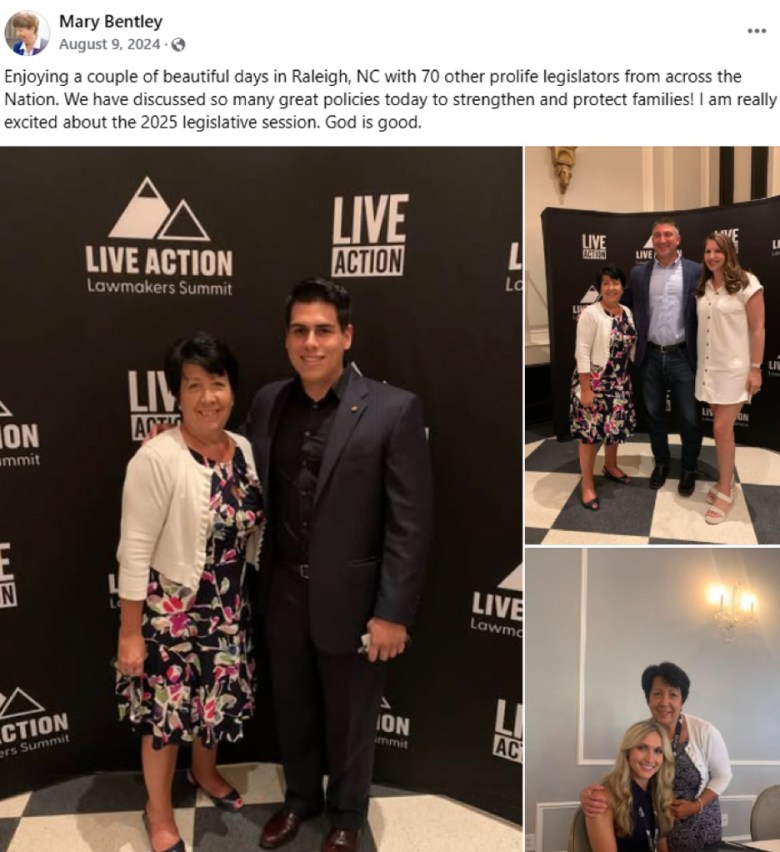
By 2024, the summit had doubled in size to host 70 lawmakers at a four-star hotel in Chapel Hill, North Carolina. Lawmakers attended panel discussions titled “Saving Our Children and Helping Their Mothers” and “Communications and Persuasion: Winning the Messaging War.” Live Action also screened its abortion videos, including “Meet Baby Olivia.”
On his panel, Bulso walked through every step of creating Tennessee’s law, from filing the bill to committee deliberations to its eventual passage. He gave Live Action credit for providing him with resources to help make the case that “Meet Baby Olivia” was scientifically accurate.
Most of the proposed fetal development education bills don’t prescribe a specific video, but many suggest the Baby Olivia video. Two bills in Texas do mention alternatives: A 1983 film by PBS’s NOVA called “The Miracle of Life” and a video produced by the St. John Paul II Life Center, a crisis pregnancy center.
Said Brandt, it’s up to “lawmakers, school board members, teachers, that kind of thing, to try to make prudential judgments about, ‘Is the actual resource I’m using a good resource to accomplish the goal that I’ve been tasked to accomplish?’”
“Meet Baby Olivia” in particular, has been sharply criticized by medical experts since Live Action released the video in 2021. Many doctors have raised concerns about its language and portrayal of the timeline of fetal development. Parents and students in Fargo, North Dakota, used arguments such as these to convince the school district to use a different video to meet the state law.
“The Baby Olivia video is designed to manipulate students’ emotions rather than to share objective facts about embryonic and fetal development,” Nisha Verma, senior advisor of reproductive health policy and advocacy for the American College of Obstetricians and Gynecologists, said in a statement. “The video attempts to advance anti-abortion policies such as fetal personhood and uses non-scientific language about conception, pregnancy, embryos, and fetuses to evoke an emotional response.”
Live Action maintains the video is medically accurate — and has its own roster of anti-abortion doctors who endorse it, including a handful who collaborated with the organization on the video’s creation.
The approval of some medical professionals was part of the appeal of “Meet Baby Olivia” and another Live Action video series called “What Is Abortion?” for New Hampshire Rep. John Sellers, another Republican who attended the group’s lawmaker summit. The series shows a computer rendering of three different points in the pregnancy process.
Since 2023, getting fetal development education into public schools has been a priority for the anti-abortion group, Live Action. Credit: Live Action
In January, Sellers filed two bills to make Live Action’s videos required viewing for New Hampshire students — including college students in the case of “Meet Baby Olivia.” Both bills, however, faced opposition: Nearly 700 residents officially recorded their objection with the state or submitted testimony opposing the fetal development bill, and 1,080 registered their opposition to the abortion video legislation. By comparison, the number of residents who registered in favor was 23 and 30, respectively.
Many of those who submitted written testimony called the bill an attempt to indoctrinate students; Sellers maintained the legislation was nonpolitical. “We’re just trying to get the information out to the kids so they’re educated,” he said in an interview. “I don’t know how you indoctrinate somebody with the truth of the development of life … or the truth that these are the types of procedures of abortions. I can’t see that being indoctrination.”
Sellers said further that he hoped education could help people “make a better decision of, ‘Should I get an abortion or not?’”
Several people who opposed Sellers’ bills agreed that the videos contained some factual information and that topics such as fetal development and abortion could be useful to learn about in schools, but it was the presentation of the information — and that it came from an anti-abortion group — that worried them, they explained.
“My biggest concern is that it’s set up to come from a moralistic and fear-based place as opposed to a medical or wellness model,” said Stephanie Vazzano, a therapist who lives in New Hampshire who submitted written testimony opposing the abortion video bill. “They do have some facts. When you watch them you can be really seduced by those facts … but then these other things get slipped in.”
During the hearing for his bills, Sellers repeatedly said he was open to other abortion videos being shown but didn’t know of any. This lack of alternativeshas allowed Live Action to succeed in getting into schools so far, said Mary Ziegler, a law professor at University of California-Davis and author of several books on the history of abortion debates. “Part of what they’ve exposed is that there are gaps in the way we’ve done sex education,” she points out. “There’s truth in the sense that sex education programs across the board, including those favored by progressives, don’t have enough information about pregnancy, childbirth, abortion or fetal development.”
In many ways, Live Action’s efforts — as well as those of Heartbeat International and other organizations working to reach K-12 students — are a response to groups that run comprehensive sex education programs. Five states require comprehensive sex education, and individual districts in other states also provide it. These programs typically cover an array of topics including contraception, gender identity, consent, and options if one becomes pregnant. Planned Parenthood offers such a program to schools and has become the single-largest provider of sex ed nationwide.
“I’m sympathetic if someone says we wouldn’t want any organization that has any point of view creating any materials for our public school system,” Brandt of Live Action said. “But I would just say that’s not the reality that’s happening across the country. It’s tough to find curriculum that is from a group that no one would oppose.”
Even some anti-abortion Republicans have drawn a line at directly promoting the use of Live Action materials in public schools. Among them is Arkansas Sen. Breanne Davis, who led the opposition to a bill that specifically called for “Meet Baby Olivia” to be shown in schools. She raised concerns about requiring content from “a political advocacy group.” Davis said in an interview, “That’s just out of bounds for what we should be putting into law.”
At least 11 state legislators who attended Live Action’s Lawmaker Summit, including Arkansas Rep. Mary Bentley, introduced fetal development legislation during the 2025 legislative session. Credit: Facebook
In hearings, Arkansas representative and bill sponsor Mary Bentley argued it would be easier and better for school districts to be told which video to use rather than have to make that determination themselves. She remains staunchly in support of the Baby Olivia video: “I think it’s so good to help kids understand the process of fetal development,” she said. “I just assumed that it would get the support that we needed in the most pro-life state in the nation.”
Davis proposed a competing bill, one that would require the Arkansas department of education to adopt standards for age-appropriate fetal development education, including showing an ultrasound, in the future. No video would be required, but districts could still show one, such as “Meet Baby Olivia,” if they chose to.
In the end, Bentley’s bill died and Davis’s legislation was signed into law in April.
For Brandt, of Live Action, the law falls short of what he considers the “gold standard” of fetal development education, but “We’re happy that they passed some version of it,” he said. “That is definitely better than nothing, and maybe can even be improved upon in the future.”
Contact investigations editor Sarah Butrymowicz at [email protected] or on Signal: @sbutry.04.
The Hechinger Report provides in-depth, fact-based, unbiased reporting on education that is free to all readers. But that doesn’t mean it’s free to produce. Our work keeps educators and the public informed about pressing issues at schools and on campuses throughout the country. We tell the whole story, even when the details are inconvenient. Help us keep doing that.
The Trump administration has accused Harvard University officials of failing to comply with an ongoing civil rights investigation into alleged campus antisemitism, The Boston Globe reported.
The U.S. Department of Health and Human Services said in a letter to Harvard president Alan Garber that it was referring the civil rights investigation to the U.S. Department of Justice, which it is permitted to do in cases where “compliance under Title VI cannot be obtained voluntarily.”
The letter, written by Paula Stannard, director of the HHS Office for Civil Rights, also referenced legal actions taken by Harvard, which has fought back against frozen federal research funding and other matters.
“Rather than voluntarily comply with its obligations under Title VI, Harvard has chosen scorched-earth litigation against the Federal government,” Stannard wrote. “The parties’ several months’ engagement has been fruitless.”
Harvard did not respond to a request for comment from Inside Higher Ed.
The letter comes as Harvard is reportedly considering a $500 million settlement with the Trump administration to close current investigations and unfreeze $2 billion in federal research funding. Harvard is reportedly mulling a settlement even though a judge appears to view its case favorably.
If Harvard settles, it will add to the list of wealthy and highly visible institutions that have yielded to the Trump administration’s demands in recent weeks. Columbia University agreed to far-reaching changes and a $221 million settlement to restore federal funding and close investigations into antisemitism on campus that stemmed from pro-Palestinian protests in 2024. Brown University also struck a deal with the Trump administration to restore $510 million in research funding, agreeing to various concessions but no payout to the federal government.
As a potential settlement with the Trump administration looms, some Harvard faculty members sent a letter to the president and board, urging Garber to push back on what they called “the Trump administration’s assault on the vibrancy and inclusiveness of U.S. higher education.”
Signed by multiple well-known scholars, the letter exhorted Garber not to “compromise core university and academic-freedom values that generations before us have worked to define and sustain,” and to resist ceding power to the federal government over hiring and admissions.
Federal officials are accusing Duke University’s law journal and medical school of racial discrimination.
Duke University file photo
The Departments of Education and Health and Human Services are investigating Duke University and the Duke Law Journal for allegedly violating Title VI of the Civil Rights Act of 1964, which bars discrimination based on race and national origin, the agencies announced Monday.
The New York Timesreported Tuesday night that the Trump administration froze $108 million in federal grants and contracts at Duke’s medical school and health system.
On Monday, ED and HHS sent a letter detailing their concerns about potentially discriminatory practices at Duke Health and threatening the medical school’s federal funding.
“These practices allegedly include illegal and wrongful racial preferences and discriminatory activity in recruitment, student admissions, scholarships and financial aid, mentoring and enrichment programs, hiring, promotion, and more,” the letter states, though officials didn’t offer specifics.
The departments want Duke to “review all policies and practices at Duke Health for the illegal use of race preferences, take immediate action to reform all of those that unlawfully take account of race or ethnicity to bestow benefits or advantages, and provide clear and verifiable assurances to the government that Duke’s new policies will be implemented faithfully going forward—including by making all necessary organizational, leadership, and personnel changes to ensure the necessary reforms will be durable.”
Additionally, the agencies want Duke to convene a “Merit and Civil Rights Committee” that can negotiate with the federal government on behalf of university leaders and “avoid invasive federal engagement,” according to the letter. This request appears to be a new ask for the Trump administration as officials work to expand their scrutiny of higher education, based on what’s publicly known about investigations at other colleges.
“We hope this arrangement will enable the parties to move quickly toward a mutually agreeable resolution of outstanding concerns and complaints,” officials wrote in the letter. “If the alleged offending policies, practices, and programs are found to exist and remain unrectified after six months, or if at any time the Merit and Civil Rights Committee and federal government reach an impasse, the federal government will commence enforcement proceedings as appropriate.”
Duke has 10 days to respond to the request to form the committee.
Meanwhile, the Duke Law Journal investigation, led by the Education Department’s Office for Civil Rights, centers on allegations that the journal uses factors such as race or national origin to select editors. The department opened a similar investigation into the Harvard Law Review.
The Washington Free Beacon, a conservative news outlet, reported last month that the Duke Law Journal prepared a special application packet for affinity groups that noted applicants could get a three- to five-point bump if they have “meaningfully advanced the interests of communities with diverse perspectives and experiences either at school or in their community.”
The Trump administration moved quickly after taking office to open dozens of investigations into schools and universities nationwide. Most of those announced publicly mark a dramatic shift in priorities from previous administrations.
The Education Department and other agencies are looking into allegations of antisemitism and racial discrimination against white students at dozens of colleges. The agency also has begun investigating policies that protect transgender athletes and, in some cases, targeted entire state departments of education as part of that work.
Related: Become a lifelong learner. Subscribe to our free weekly newsletter featuring the most important stories in education.
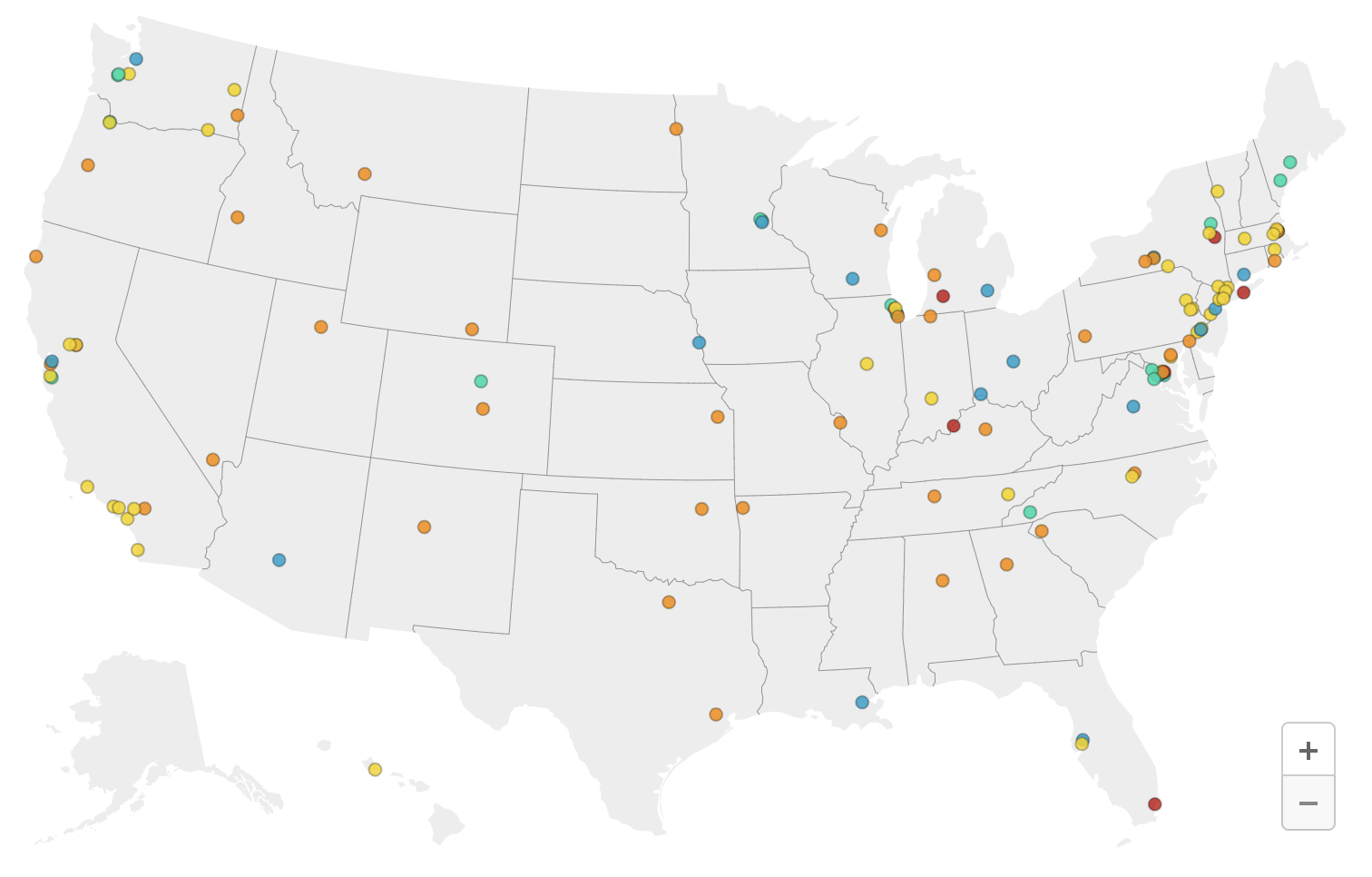
Here’s a look at investigations the Trump administration has announced. This map and list will be updated. Know of an investigation we missed? Tell us: [email protected].
Although the majority of investigations that have been opened are in states considered to be liberal, almost every state in the country has at least one entity under scrutiny. And many institutions face more than one investigation.
To date, colleges and universities have received the most attention from the administration, with more than 60 targeted over alleged incidents of antisemitism and another 45 under scrutiny over their work with a program that aims to increase diversity among Ph.D. candidates. Most of the K-12 investigations involve transgender policies, including those about access to sports and locker rooms.
Contact investigations editor Sarah Butrymowicz at [email protected] or on Signal: @sbutry.04
The Hechinger Report provides in-depth, fact-based, unbiased reporting on education that is free to all readers. But that doesn’t mean it’s free to produce. Our work keeps educators and the public informed about pressing issues at schools and on campuses throughout the country. We tell the whole story, even when the details are inconvenient. Help us keep doing that.
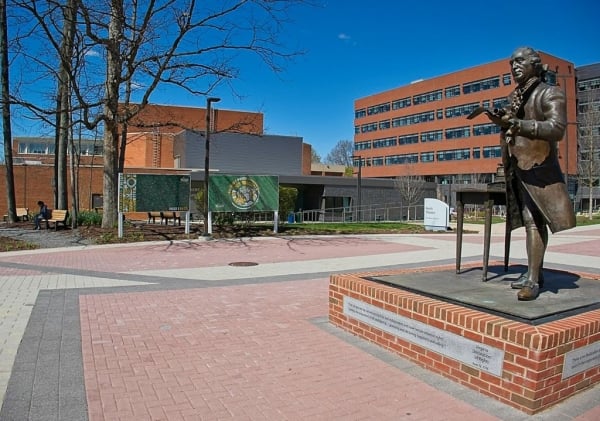
George Mason University in Virginia is under investigation for alleged violations of Title VI of the Civil Rights Act, the Department of Education announced Thursday.
Multiple university professors reportedly filed complaints that the institution “illegally uses race and other immutable characteristics in university policies, including hiring and promotion,” according to the news release.
The accusations come less than two weeks after the University of Virginia’s president was pressured to resign by the Department of Justice for similar DEI-related complaints. Thursday’s announcement sparked concerns among some higher education professionals that George Mason president Gregory Washington, who is Black, could face similar pressure. This is the second civil rights investigation that the Education Department has opened at George Mason this month. The other one is focused on allegations that university didn’t sufficiently respond to antisemitic incidents.
“It looks like the Trump administration is trying to force out George Mason’s president,” Robert Kelchen, an education policy professor at the University of Tennessee, wrote on BlueSky.
“When people ask why Higher Ed presidents aren’t being publicly vocal—here’s why,” responded Dan Collier, a higher education professor at the University of Memphis.
Department officials said in the news release that the investigation is justified by the university’s “unlawful DEI policies.” The release cited policies aimed at ensuring a diverse applicant pool and that departments at George Mason embrace antiracism and inclusiveness. The department declared race-based programming and activities illegal in guidance earlier this year, but a federal judge blocked that directive.
“This kind of pernicious and wide-spread discrimination—packaged as ‘anti-racism’—was allowed to flourish under the Biden Administration, but it will not be tolerated by this one,” said Acting Assistant Secretary for Civil Rights Craig Trainor in the release.