Tag: investigative

  • Help Us Uncover the Best Investigative Stories from College Newspapers Across the Country

    Help Us Uncover the Best Investigative Stories from College Newspapers Across the Country

    In the shifting landscape of higher education, some of the most courageous and insightful journalism comes not from national outlets, but from the campus newspapers that quietly dig into the stories shaping student life, faculty struggles, and university governance.

    At the Higher Education Inquirer (HEI), we believe that student investigative reporting holds the key to revealing systemic problems and sparking meaningful change. Yet these stories too often remain local, unamplified, and overlooked beyond campus borders.

    That is why we are launching “Campus Beat”—a new series dedicated to curating and amplifying the best investigative research coming from college newspapers, whether from large flagship universities, small liberal arts colleges, or commuter-based community colleges.  

    Student reporters regularly expose tuition hikes, mismanagement, labor abuses, campus safety failures, and other urgent issues affecting millions of students and workers. These investigations often anticipate or push back against narratives set by university administrations and mainstream media. From uncovering adjunct faculty exploitation at large state schools to revealing discriminatory housing policies at private colleges, student journalists perform vital watchdog work under difficult conditions—limited resources, censorship, and often threats from administration.

    We want to highlight investigative or deeply reported pieces that expose systemic problems affecting students, faculty, or staff; illuminate trends in higher education policy or campus governance; tell stories of activism, resistance, or community impact; or offer data-driven or document-based reporting rather than opinion or commentary.

    We especially encourage reporters who have faced censorship or suppression to submit their work or share their experiences. Your voice is critical to uncovering truths that might otherwise be silenced.

    If you are a student journalist or adviser with an investigative story you are proud of, or if you know of exceptional reporting from your campus, please send us links or documents. Selected stories will be featured in our Campus Beat roundup, accompanied by context and analysis connecting them to the broader higher education landscape.

    By sharing and spotlighting the work of student journalists, HEI hopes to build bridges across campuses and contribute to a more informed, equitable conversation about the future of higher education. We invite student reporters, advisers, and readers alike to help us identify the stories that deserve national attention. Together, we can amplify voices too often unheard and push for the systemic change our colleges and universities desperately need.

    For submissions or questions, our email contact is [email protected].

    Source link

  • Investigative Journalism Drives Unprecedented Growth

    Investigative Journalism Drives Unprecedented Growth

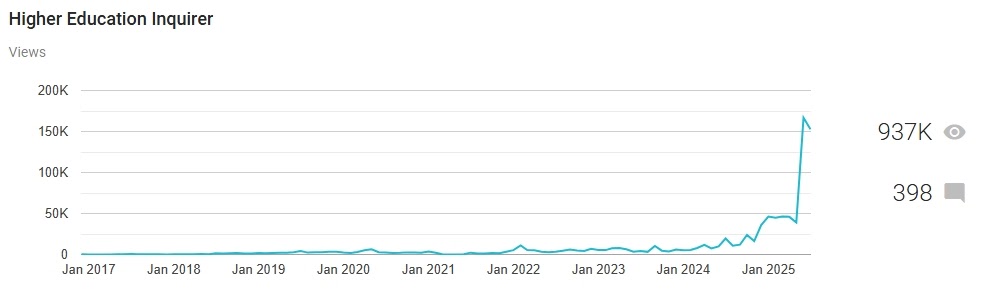
    The Higher Education Inquirer (HEI) is approaching a significant milestone: nearly one million total views expected by September 2025. This achievement underscores the growing demand for investigative journalism that holds higher education institutions accountable.

    HEI’s traffic growth has been steady for more than a year with an explosive rise over the last few months. In the first quarter of 2025, the site recorded about 132,000 views, showing increased interest. By June, monthly views passed 160,000. The highest single-day traffic came yesterday, July 21, 2025, with 10,391 views, breaking previous records. This peak coincided with the release of several articles on economic and social issues facing students, student loan debtors, and young workers.

    Key articles included Bryan Alexander’s examination of whether higher education still makes financial sense for students. Our staff contributed reports on young workers’ declining confidence in the job market and the expanding role of fintech companies like SoFi in student loans.

    HEI also covers broader social and political topics. An article on June 25 about Gaza’s humanitarian crisis and campus dissent drew hundreds of views, showing the publication’s interest in global issues related to academic freedom and student activism.

    One of the most significant examples of HEI’s investigative reporting has been its ongoing coverage of corruption and scandal in the Los Angeles Community College District (LACCD). In May and June 2025, HEI published detailed exposés documenting alleged fraud, retaliation against whistleblowers, grade manipulation, wage theft, and falsification of faculty credentials. These stories brought to light longstanding issues within LACCD, including actions by administrators such as Annie G. Reed, whose conduct has repeatedly raised serious concerns since at least 2016.

    The impact of HEI’s coverage extended beyond readership numbers. After critical articles published by allied independent media outlets were removed from online platforms, HEI stood firm in reporting these issues, highlighting the challenges faced by whistleblowers and the vital role of independent journalism in holding institutions accountable.

    In July 2025, HEI published an in-depth investigation revealing the Pentagon’s longstanding relationship with for-profit colleges, particularly through the Council of College and Military Educators (CCME). The investigation uncovered how these institutions have exploited military-connected students, veterans, and their families, benefiting from federal programs like the Post-9/11 GI Bill and Department of Defense Tuition Assistance. Despite multiple Freedom of Information Act (FOIA) requests, the Department of Defense has withheld critical documents, raising questions about transparency and accountability in military education partnerships.

    Additionally, HEI’s reporting on the exploitation of veterans under the guise of service highlighted how politicians, government agencies, and nonprofits have failed to protect those who have served. The investigation revealed that instead of supporting veterans, these entities have perpetuated systems that prioritize self-interest over the well-being of veterans, leading to wasted benefits and poor educational outcomes.

    Several factors explain HEI’s growth. The publication relies on original documents obtained through Freedom of Information Act requests, legal filings, and insider accounts to reveal facts often missed by mainstream media. This research appeals to readers seeking solid information.

    Contributions from scholars and activists like Bryan Alexander, Henry Giroux, David Halperin, and Michael Hainline add context that helps readers understand education trends and policies.

    HEI focuses on long-term issues such as adjunct faculty exploitation, college closures, student debt, and the privatization of public education, rather than fleeting news. This approach builds a loyal audience interested in ongoing analysis.

    The site offers free access without paywalls or advertising, encouraging sharing and reader interaction through comments, tips, and feedback. Its presence on social media and forums like Reddit helps reach more readers organically.

    Central to HEI’s mission is a commitment to transparency, accountability, and value in higher education. The publication seeks not only to reveal problems but also to hold institutions and policymakers responsible. HEI stresses that higher education must deliver real financial, social, and intellectual value and that openness is key to achieving this.

    The political and economic context has also contributed to HEI’s growth. Lasting effects of Trump-era policies—such as changes in Title IX enforcement, rollbacks of diversity efforts, and disputes over federal funding—have increased public interest. HEI’s clear, evidence-based coverage helps readers understand these complex changes.

    Public concerns about rising student debt, now over $1.7 trillion nationwide, and doubts about the value of college degrees have also driven readers to HEI. At the same time, debates around campus culture and diversity heighten demand for balanced reporting.

    As HEI nears its million-view goal, it plans to expand investigative work, grow its viewership base, and increase community engagement through interactive features and reader participation. The publication intends to continue monitoring higher education’s power structures and highlight factors affecting students, faculty, and institutions.

    In a time of declining trust in mainstream media and widespread misinformation, HEI’s growth shows a strong need for journalism that is thorough, honest, and focused on those involved in higher education.

    For readers seeking clear, direct insight on changes in colleges and universities, HEI offers an essential platform—living up to its motto, “Ahead of the Learned Herd.” Its rise marks a shift toward more accountable journalism in the field.

    Source link

  • The Untimely Disappearance of Investigative Reporter Mike Vasquez

    The Untimely Disappearance of Investigative Reporter Mike Vasquez

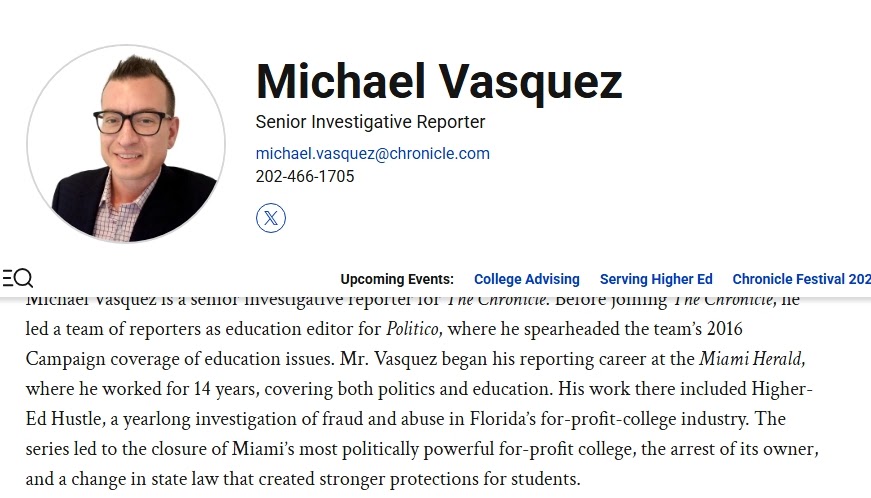
    Michael Vasquez, a veteran investigative journalist known for his dogged reporting on the for-profit college industry and higher education corruption, appears to have been quietly laid off by The Chronicle of Higher Education in 2024even though he is still listed on their website as a senior investigative reporter.

    Vasquez’s last byline for The Chronicle appeared in August 2024, with no public announcement of his departure from the publication. His silence since then has raised questions among media observers and watchdogs who followed his work. Given the importance of his investigations—often exposing powerful institutions that exploit vulnerable students—his absence is conspicuous and troubling.

    Before joining The Chronicle, Vasquez led education coverage at Politico and served as a longtime reporter at The Miami Herald. His career has been marked by award-winning investigations into fraudulent colleges, political influence in higher education, and the failings of accreditation and oversight systems. In a time when public interest journalism is shrinking, his work stood out for its rigor, clarity, and impact.

    That Vasquez was laid off in a year of wider cutbacks and financial uncertainty in journalism is hardly surprising. But his continued listing on The Chronicle’s website could reflect an industry practice of obscuring layoffs to protect institutional reputation, or a lack of transparency about the ongoing hollowing out of serious investigative reporting.

    His departure comes as the for-profit college industry appears to be regaining political momentum under a second Trump presidency, and as student borrowers, whistleblowers, and contingent faculty face mounting challenges. Without voices like Vasquez’s, the public may lose one of its fiercest advocates for truth and accountability in U.S. higher education.

    If Michael Vasquez has moved on to other work—or has been pushed out by institutional pressures—he hasn’t said so publicly. But the silence speaks volumes.

    Source link

  • Freelance investigative journalist Sammy Sussman to headline FIRE’s student press workshop

    Freelance investigative journalist Sammy Sussman to headline FIRE’s student press workshop

    FIRE’s Student Press Freedom Initiative is thrilled to announce that freelance investigative journalist Sammy Sussman will keynote our third annual Free Press Workshop on June 14! The workshop brings college journalists together to learn about the First Amendment, media law, and using the law as a tool in reporting.

    Sussman is based in New York and has written for a variety of publications. He serves as the lead reporter on “Behind the Badge,” an investigative collaboration with MuckRock dedicated to publishing police misconduct files from departments throughout New York State. He has previously written for New York magazineVAN Magazine, and New York Focus. Sussman covers policing and prison abuses as well as sexual misconduct. He has experience doing extensive public records reporting both domestically and abroad.

    This free workshop will bring together student journalists from across the country to learn how to assert their right to press freedom.

    Sussman began as a student journalist at the University of Michigan, where he founded and directed The Michigan Daily’s investigative section, Focal Point. While at the Daily, Sussman used public records to break stories numerous stories about sexual harassment allegations and the university’s use of non-disclosure agreements to silence former employees.

    Sussman’s experience leveraging the law to build an impressive portfolio, first as a student and now as a professional reporter, makes him well-suited to speak to student journalists getting ready to embark on their own careers.

    We still have a handful of spots available for student journalists who want to hear from Sussman, meet fellow journalists from other schools, and learn about using the law in their newsrooms. Make sure you register here. This conference is free for accepted students and includes meals and a $350 travel stipend. Additional travel scholarships are available by application. 

    Our team is excited to hear what Sussman has to say to the next generation of journalists, and we look forward to welcoming students from across the country to Philadelphia this summer!

    Source link