Tag: isnt

  • Fixing Michigan’s Teacher Shortage Isn’t Just About Getting More Recruits – The 74

    Fixing Michigan’s Teacher Shortage Isn’t Just About Getting More Recruits – The 74

    The number of vacancies is likely an undercount, because this number does not include substitutes or unqualified teachers who may have been hired to fill gaps.

    Local news reports and job boards suggest that at least some Michigan districts are still struggling to fill open positions for the fall of 2025.

    The teacher shortage is a nationwide problem, but it is especially acute in Michigan, where the number of teachers leaving teaching and the overall teacher shortage both exceed the national average. This shortage is particularly severe in urban and rural communities, which have the most underresourced schools, and in specialization areas such as science, mathematics and special education.

    For more than two decades, my work at Michigan State University has centered on designing and leading effective teacher preparation programs. My research focuses on ways to attract people to teaching and keep them in the profession by helping them grow into effective classroom leaders.

    Low pay and lack of support

    Teacher shortages are the result of a combination of factors, especially low salaries, heavy workloads and a lack of ongoing professional support.

    A report released last year, for example, found that Michigan teachers and teachers nationwide make about 20% less compared to those in other careers that also require a college education.

    From my experience working with teachers and district leadership across the state, I know that beginning teachers – especially those in districts which have severe shortages – are often given the most challenging teaching loads. And in some districts, teachers have been forced to work without the benefit of any kind of planning time in their daily schedule.

    The shortage was made much worse by the COVID-19 pandemic, which led many educators to leave the profession. Yet another culprit is the many teachers who, in Michigan as well as nationally, were hired during the 1960s and early ’70s, when school enrollments saw a massive increase, and who in the past decade have been retiring in large numbers.

    Creating pathways to certification

    One recent strategy to address the teacher shortage in Michigan has been to create nontraditional routes to teacher certification.

    The idea is to prepare educators more quickly and inexpensively. A variety of agencies – from the Michigan Department of Education, state-level grants programs such as the Future Proud Michigan Educator program, as well as private foundations and businesses – have helped these programs along financially.

    Even some school districts, including the Detroit Public Schools Community District, have adopted this strategy in order to certify teachers and fill vacant positions.

    Other similar programs are the product of partnerships between Michigan’s intermediate school districts, community colleges and four-year colleges and universities. One example is Grand Valley State University’s Western Michigan Teacher Collaborative, which targets interested students of college age. Another is MSU’s Community Teacher Initiative, designed to attract students into teaching while they are still in high school.

    Perhaps even more visible are national programs such as Teachers of Tomorrow and Teach for America. Candidates in such programs often work as full-time teachers while completing teacher training coursework with minimal oversight or support.

    ‘Stuffing the pipeline’ is not the solution

    But simply “stuffing the pipeline” with new recruits is not enough to solve the teacher-shortage problem in Michigan.

    The loss of teachers is significantly higher among individuals in nontraditional training programs and for teachers of color. This starts while they are preparing to be certified and continues for several years after certification.

    The primary reasons for the higher attrition rates include a lack of awareness of the complexity of schools and schooling, the lack of effective mentoring during the certification period, and the absence of instructional and other professional guidance in the early years of teaching.

    How to repair the leaky faucet

    So how can teachers be encouraged to stay in the profession?

    Here are a few of the things scholars have learned to improve outcomes in traditional and nontraditional preparation programs:

    Temper expectations. Teaching is a critically important career, but leading individuals to believe that they can repair the damage done by a complex set of socioeconomic issues – including multigenerational poverty and lack of access to healthy and affordable food, housing, drinking water and health care – puts beginning teachers on a short road to early burnout and departure.

    Give student teachers strong mentors. Working in schools helps student teachers deepen their knowledge not only of teaching but also of how schools, families and communities work together. But these experiences are useful only if they are overseen and supported by an experienced and caring educator and supported by the organization’s leadership.

    Recognize the limits of online learning. Online teacher preparation programs are convenient and have their place but don’t provide student teachers with real-world experience and opportunities for guided discussion about what they see, hear and feel when working with students.

    Respect the process of “becoming.” Professional support should not end when a new teacher is officially certified. Teachers, like other professionals such as nurses, doctors and lawyers, need time to develop skills throughout their careers.

    Providing this support sends a powerful message: that teachers are valued members of the community. Knowing that helps them stay in their jobs.

    This article is republished from The Conversation under a Creative Commons license. Read the original article.

    Source link

  • From where student governors sit, Dundee isn’t the only institution with governance challenges

    From where student governors sit, Dundee isn’t the only institution with governance challenges

    There are a couple of typical ways to “read” Pamela Gillies’ investigation report into financial oversight and decision making at the University of Dundee.

    One is to imagine that the issues in it are fairly unique to that university – that a particular set of people and circumstances were somehow not picked up properly by a governing body apparently oblivious to what was happening below the surface.

    In that extreme, the key failing was not doing all the Scottish Code for Good Higher Education Governance asks its governors to do.

    Another is to wonder whether, even with a clean bill of “good governance” health, it could happen elsewhere.

    One of the things that is fascinating about organisational failure is the way in which governance tends to be picked up as a problem – because it can lead to the conclusion that because organisational failure is not widespread, the governance issues must be local.

    If you position governance exclusively as scrutiny, it could of course be the case that the culture of governance is weak across the board – it’s just that most senior teams in universities don’t make the mistakes that were evidently made at Dundee, and thus we’d never know.

    After all, nobody questions governance when things are going well, when funding is flowing and when student numbers are on the up. If anything, in that positioning, the danger is in complacency – because governance needs to come into its own to avoid mistakes and catch issues before they become catastrophes.

    When Gillies’ report was published, I couldn’t avoid recalling countless conversations I’ve had over the years with student members of governing bodies about everything from the lateness of papers to the culture of decision making.

    So to test the waters, I pulled out 14 governance issues from the investigation and put a brief (anonymous) survey out to students’ union officers who are members of their Board, Council or Court.

    I can’t claim that 41 responses (captured in the second half of June and the first half of July) are representative of the whole sector, and nor are they representative of the whole of the governing bodies on which respondents have sat.

    But there is enough material in there to cause us concern about how universities around the UK are governed.

    A culture of control

    One issue that Pam Gillies picked up was leadership dominance, where the vice chancellor and chair were found to have “behaved like they have everything under control” while governing bodies failed to provide adequate challenge.

    When we asked whether student governors had experienced leadership that “routinely dominates discussions, controls narratives to present overly positive pictures, or makes it difficult for governors to raise concerns,” 68 per cent said they’d experienced this “a lot”. Another 27 per cent said “a little.”

    That’s 95 per cent of respondents experiencing some level of what one might generously call “narrative management” by their senior teams.

    The comments flesh out what this looks like in practice. One student governor observed:

    You are told at the start that your job is to manage the VC and the SMT but they manage the governors. The Chair and the VC behave like they have everything under control. The room just does not seem interested in education or the student experience, more whether it is running as a business.

    Another captured the emotional impact:

    Whenever I have asked a question or said something even questioning let alone critical about UEG it’s like I have suggested burning down their office. They are allowed to be both over-defensive and over-reassuring rather than treat contributions from me and some of the other more vocal governors as contributions to thinking. It makes the whole thing quite pointless.

    It’s not just about dominance – it’s also about active silencing. Gillies found that dissenting voices were marginalised and that “critical challenge was not welcomed.” Our survey bears this out.

    When asked about governors being “shut down, spoken over, dismissed as ‘obstructive,’ or otherwise discouraged when trying to challenge decisions,” 51 per cent reported experiencing this “a lot”. Another 37 per cent said “a little”.

    The mechanisms are subtle but effective. One respondent noted being warned at the start of their term that the previous student president had not been “constructive” and that to get things done, they needed to be “constructive” instead. The implied threat was clear – play nice or be frozen out.

    It was made very clear to me at the start that the previous President had not been ‘constructive’ and that if I wanted to get things done I needed to be ‘constructive’. All year I have felt torn – other governors would regularly ask me at the meal what was ‘really going on’ but I never felt like I could be critical in the actual meeting because of the ‘partnership’. I feel like the VC was under a lot of pressure to perform for the governors, and that makes it impossible to say anything about what you think is going wrong.

    Another described the choreography of exclusion:

    The power dynamics are fascinating if you’re into that sort of thing. Watch who the Chair makes eye contact with, whose contributions get minuted vs. ‘noted’, who gets interrupted vs. who can ramble for 10 minutes unchecked. I never got the premium treatment – I feel that the Chair needs some feedback on whose thoughts they obviously value.

    That isolation extends beyond meetings. Multiple respondents noted deliberate strategies to separate them from support:

    One tendency we picked up on a lot was to isolate me from support, I wasn’t allowed to discuss the papers with my CEO or have my CEO in the room. It’s only student on the board. They say that’s for confidentiality, but everyone else in the room is clearly discussing their issues with people who can put everything into a context. I think it should be the law that two students are on the board.

    The theatre of governance

    Gillies found that important decisions at Dundee were made outside formal governance structures, with a “small inner circle” controlling key outcomes. Our survey question on decision-making transparency suggests this is far from unique.

    When asked whether “important decisions are made by a small inner circle before reaching the governing body,” 51 per cent said this happened “a lot”, with another 44 per cent saying “a little”.

    The comments reveal how that manifests. One student governor described discovering a shadow governance structure:

    I think there’s a huge element of culture at my institution which prevents effective governance but it’s also the structure. There’s a meeting which isn’t included in the governance structure but everything goes to it before it can go anywhere else and it’s restricted to senior managers at the university. If it isn’t approved there, it won’t happen, even if things like rent negotiations have taken place in the ‘proper’ meetings, they can just scrap it and say ‘no, this is what needs to happen’ and then we’re just told. It feels like secret meeting which secretly governs everything and every other meeting is a rubber stamp for decisions made there.

    Another put it more bluntly:

    The meetings are very odd places, we don’t have any input at all on anything. Everything that comes to the Court is finished, and our job seems to be to politely probe what is in front of us (always once, follow ups frowned upon). Eye-opening but completely pointless.

    Gillies highlighted how late papers and missing documentation hampered effective governance at Dundee – the control of information emerges as a critical tool in maintaining this system across the sector. Over half (54 per cent) of respondents in our survey reported experiencing late papers, missing documentation, or “critical updates given verbally rather than in writing” frequently.

    But it goes deeper than administrative incompetence. When asked about financial information quality – an area Gillies found particularly problematic at Dundee – 37 per cent said they’d frequently received reports that “were unclear, seemed to obscure the true position, contained unexplained anomalies, or lacked integrated information.”

    One respondent shared a particularly telling anecdote:

    Training – our old CFO was a dick. He said that he wouldn’t train student members of Council in the finances because we ‘wouldn’t understand it’ which, in my mind, seems like something to a) find out and b) entirely irrelevant to a governor asking to see financial information.

    The systematic exclusion of student perspectives from board papers then compounds it:

    Many of the budget requests and department updates did not reflect the student experience accurately whether it was missing data from specific feedback routes or lacking in student perspective entirely, it made approvals difficult for me and difficult for the board as I would then be asked for the data and even though I can share some of the issues I know of I cannot represent the entire student body. With only 48hrs notice.

    The message seems to be that knowledge is power – and student governors aren’t meant to have it.

    Living in fantasy land

    Gillies found that Dundee’s governing body had been presented with “overly positive pictures” that obscured institutional reality. Quite striking in our survey is the disconnect between the institution presented in governance meetings and the one students actually experience.

    Multiple respondents described sitting through presentations that bore no resemblance to reality:

    The university that gets presented isn’t the university I was at as a student.

    Another elaborated:

    It feels a lot like a fantasy world in there but they really don’t know how the university actually works, and the questions they ask are so weird, like they are desperate for the university to be as good as they imagine it is when there are really a lot of problems with how it runs especially at school level.

    This fantasy is then maintained through what we might call the tyranny of positivity. When asked whether they’d felt “pressure to maintain positive messaging even when you have legitimate worries,” 61 per cent said they’d experienced this “a lot”.

    The enforcement mechanisms vary. Some are explicit:

    They love talking about ‘student voice’ in the abstract but hate it when we actually speak. I raised concerns about library hours during exams and the DVC literally rolled his eyes. Later the Chair pulled me aside and said I should ‘pick my battles more carefully’ and focus on ‘strategic matters’.

    Others are more subtle. Multiple respondents described being praised for contributions that never led to change:

    I was often praised in the minutes. ‘Thoughtful contribution from the student member.’ But praise without change feels hollow – a polite pat on the head.

    This disconnect between fantasy and reality is exacerbated by what several respondents identified as an unhealthy fixation on rankings:

    A lot of the meetings were really interested in what I had to say, but the obsession with league tables is bizarre. We spent easily an hour at the last meeting discussing how to game NSS metrics but when I suggested actually fixing the issues students raise – timetabling chaos, inconsistent feedback, broken IT systems – I got blank stares. One governor literally said ‘can’t we just manage student expectations better?’ What’s the point?

    Another observed:

    There are about sixteen of us in theory but really there are six people who speak at every meeting, and it is always about whether we are beating other universities. I don’t think the governors have any way to judge how well the university is doing other than by thinking about other universities. It is very weird.

    This comparative obsession substitutes for genuine evaluation of institutional health – where things become filtered through the lens of institutional positioning rather than student experience.

    The survey responses also reveal how regulatory compliance has become another distorting filter. Several respondents noted how the Office for Students has inadvertently created perverse incentives:

    It is very weird to me that whenever I’ve talked about student issues they are responded to with things like ‘that would not be an issue for the OfS’, like we are only supposed to worry about the student experience if OfS are doing a visit.

    It suggests that governing bodies are more concerned with regulatory perception than addressing underlying problems – a dangerous conflation of compliance with quality.

    The impossible position

    A particularly Byzantine aspect of student perceptions of governance emerges in the contradictions around representation. Multiple respondents noted being told explicitly that they were “not a representative” of students, only to have governors constantly ask them about student views:

    At the start of the year it is drilled into you that you are not a representative, and then at every meeting someone has asked me what students think, what students are saying, how students would react, and so on. It really is ridiculous.

    It creates an impossible position – student governors are simultaneously expected to embody the student voice whilst being forbidden from claiming to represent it, and are consulted when convenient but dismissed when challenging.

    The tokenism extends to how “the student experience” is conceptualised:

    There is a pressure not to rock the boat too much or the SU funding will be under threat. One other thing is that the other governors see ‘the student experience’ as one homogeneous thing. I represent 30,000 students – disabled students, commuters, mature students, international students, care leavers – but I get 5 minutes at the end of every meeting to cover ‘student matters.’ When I highlight different needs across student groups, eyes glaze over.

    One response powerfully captured another dimension of the problem:

    Too many decisions are made by white upper-middle class men who have no real understanding of student demographics or experiences and the effects that rushed, ill informed decisions can have on the student body.

    This homogeneity problem compounds all the others – if governance doesn’t reflect the communities it serves, how can it possibly understand their needs?

    Throughout the responses runs a theme of performative partnership that masks fundamental power imbalances. Student governors describe being valued for their “input” on predetermined decisions whilst being told their contributions are “premature” on anything still under genuine consideration:

    Two types of agenda items, ones where student input is ‘valued’ (anything they’ve already decided) and those where student input is ‘premature’ (anything they haven’t decided yet). Its never the right time for meaningful student contribution.

    The contrast between public and private behaviour is also revealing:

    I feel that the UET are like Jekyll and Hyde, they have listened to me outside of the meetings but when I have asked about things during Board meetings they react very defensively. I’m not supposed to be a rep for students but nobody else ever talks about students unless we count recruiting students.

    When push comes to shove

    Gillies found that committees at Dundee operated as “rubber stamping exercises” rather than providing genuine oversight. Our survey revealed similar patterns, with 46 per cent reporting committees feeling like “rubber stamping exercises.”

    Even when committees try to assert themselves, the resistance is telling:

    We had an issue with the auditors and the closest I’ve seen us come to blows as a Council was when the exec tried to treat the issue as annoying but closed and move on but Council had to say ‘actually, no, we’d like an audit of our auditors to work out how [confidential] was missed.’

    The fundamental problem, as one respondent observed, may be structural:

    I honestly think that the huge number of things the council are expected to know about and make decisions on are beyond them. They don’t meet often enough and they really do not understand their responsibilities.

    Gillies documented how Dundee’s governance processes were abandoned during crisis periods. Our survey asked about governance during “difficult periods,” and of those who didn’t say “N/A”, 51 per cent reported seeing “normal governance processes abandoned, informal advisory groups bypass committee structures, or key oversight bodies become inactive when they’re most needed.”

    It suggests that whatever thin veneer of good governance exists in normal times rapidly dissolves under pressure – precisely when robust governance is most essential:

    Student input in governance is at a real risk of just becoming a box ticking exercise as I have sat in meetings where the student experience is discussed by everyone but the students in the room. Once decisions need to be made at speed all thought for student and staff is ignored and it is often because of their own burdensome governance structures that inhibit the agility needed for such a volatile time in HE.”

    The human cost

    The emotional toll shouldn’t be underestimated. Multiple respondents described feeling “out of place,” “invalidated,” or like they were “betraying everyone” simply by asking questions.

    One particularly poignant comment came from a sabbatical officer who left their role early:

    It was a really tough experience as I had students relying on me. I wish that I could’ve stayed in my role for longer but the lack of transparency and wish to subdue the view for students contradicted my individual beliefs and leadership style. I was supportive and I wanted students to know what I was doing. This wasn’t always possible.

    And the lack of institutional learning is telling:

    It is telling that they spent so much time with me at the start but haven’t spent any time with me to get my feedback at the end. I feel that they should do exit interviews to learn about how intimidating the atmosphere can be.

    Perhaps most damning is the response to our final question. When asked whether they “feel confident that your governing body would identify and respond appropriately to serious institutional risks,” only 32 per cent expressed confidence.

    That means 68 per cent of student governors – governors who usually have the most intimate knowledge of how their institutions actually operate – doubt their governing body’s ability to spot and address serious problems.

    One captured the fundamental dysfunction:

    If I compare it to being on my union board I think the governors is a joke. If I ask why or how in the union we have a decent conversation. If I do it at governors the atmosphere is like I’ve betrayed everyone. And if I say something isn’t clear that is turned into something I’ve not done or read. We’re not governors. We’re an audience.

    Another summed up the experience with clarity:

    I feel that the whole thing is engineered to make the vice chancellor and her team to look good rather than gather our input or ideas, I would have side conversations with some of the community governors who shared my view but there just is not any part of any meeting where ‘input’ is welcome.

    We’re not governors. We’re an audience

    Some of the most problematic critiques came in respondents’ final reflections on what governance actually means in practice:

    What frustrates me most is the wasted potential. These are genuinely smart, accomplished people who could transform this place. But they’re trapped in this weird bubble where everything’s fine and any criticism is disloyalty. I know I’m not the only one.

    The sense of governance as performance came through repeatedly:

    In the January meeting I was invited to do a presentation before the formal meeting on what student life is like and I got a lot of praise from the Chair about how eye-opening it was. But about half of the governors were not there and the PVC-E went off on one about how the university’s surveys contradicted some of the things we were saying. I feel that the whole body just doesn’t have a clue about students or staff and what it is like to be a student in 2025.

    One respondent captured the Kafkaesque nature of their experience:

    The whole ‘critical friend’ thing is such a con. We’re meant to be critical but every time I challenge something I get ‘well, Council can only advise, we cannot instruct the executive.’ So we’re legally responsible for decisions we can only ‘advise’ on? The Vice Chancellor keeps saying Council is ‘not a court’ whenever we try to hold them accountable. I’ve started asking ‘what CAN Council actually do?’ because honestly I’m not sure anymore.

    The broader implications were spelled out starkly:

    The big, big, BIG thing for us as student leaders has been ‘what Council is and is not for’. Often, when we’ve brought issues for discussion or ‘airing’ at Council, I have had every variation of ‘Council is not a court’ ‘Council can only advise the exec, it cannot instruct it’ ‘Council is for critical challenge but cannot dictate’ some of which is absolutely at odds with then being legally responsible for the decisions you have only ‘advised on’ and ‘cannot dictate’.

    And perhaps most damningly:

    As a new Sabbatical officer, I felt extremely out of place with the culture of Court meetings, as if I wasn’t supposed to be or welcome there. It made my input feel invalidated and overlooked. Structurally, important decisions are already decided upon within committees before reaching court.

    What next?

    It’s important to set what I’ve gathered in context. Student governors have a particular perspective and a specific set of confidence and cultural capital asymmetries that are bound to make being on a body of the “great and good” a difficult experience.

    41 responses is not the whole sector (and may not even be from 41 universities), and it was a self-selecting survey. But we should be worried.

    Out of the back of the Dundee episode, both Graeme Day and the Scottish Funding Council have committed to exploring ways to strengthen governance to avoid a repeat.

    Universities Scotland has committed to collective reflection on Gilles’ findings and the lessons it shares to give “robust assurance” of financial management and good governance to funders, regulators, supporters and all who depend on universities.

    It has also said it will “connect” to Universities UK’s work to consider the leadership and governance skills required in the sector in times of transformation and challenge.

    As such, the same issue that students see in governing bodies is playing out nationally – there are questions that suggest a loss of autonomy, and reassurance about “performance” designed to retain it.

    There is therefore a real danger that the processes will conclude what these sorts of things always conclude – that with the right “skills” and adherence to a given Code, all will be well.

    But the experiences from students suggest that neither “getting the right skills” nor calls for better codes will solve the fundamental problems. The issue isn’t just about getting the “right” people around the table or training them better – it’s about reconsidering what we’re asking governance to do.

    Vertical or horizontal?

    As I noted here and here, the Dutch experience offers an alternative. Following a series of governance scandals in the early 2000s, the Netherlands rejected both excessive state control and unfettered institutional autonomy. Their 2016 Education Governance Strengthening Act created a “third way” – creating multi-level democratic participation from program to institutional level.

    Rather than imposing rigid rules, the framework promoted “horizontal dialogue” where students, staff, management, and supervisors engage in ongoing conversations about their university.

    A 2021 evaluation found meaningful channels for student and staff input had been created, with improved dialogue quality between stakeholder groups. If there’s enough of them, staff and students have turned out to be better at scrutiny than skilled lay members or someone from the funding council sat in the corner.

    It’s also partly about what is discussed. Most boards operate primarily in fiduciary mode (overseeing budgets, ensuring compliance) or strategic mode (setting priorities, deploying resources). While essential, these modes often crowd out what governance scholars call the “generative mode” – critical thinking, questioning assumptions, and framing problems in insightful ways.

    Generative governance asks probing questions: “What is our fundamental purpose?” and “How does this decision align with our core values?” It involves scenario planning, delving into root causes rather than symptoms, and actively considering ethical implications beyond legal compliance. And it allows senior staff to participate, rather than perform – a culture that then improves scrutiny in fiduciary mode.

    It is where staff, student, and community governors could add most value – yet it’s often where their contributions are most dismissed as inappropriate or “operational.” The standard line that governors should be “concerned with the university rather than as representatives” misses the point that understanding the lived experience of those working and studying there is essential to good governance, and actually improves fiduciary scrutiny.

    Put another way, maybe better fiduciary mode scrutiny could have probed more on the Nigerian students focussed business plan at Dundee. But it’s more likely that better generative mode governance could have explained what was starting to happen to the currency in Nigeria, how tough students were funding it to pay their fees, and what families were going through as the Naira went into collapse.

    It’s also partly about what we think “effectiveness” means. Universities facing unprecedented challenges – financial pressures, technological disruption, legitimacy crises – need governance capable of navigating complexity, not just ticking out risk registers. They need what the Dutch reforms sought – genuine accountability to the communities they serve, not just reassuring compliance with regulatory requirements.

    Universities at their best are spaces where different forms of knowledge encounter each other, and where democratic values are modeled and sustained. Their governance should reflect this reality.

    As such, we need to ensure we’re solving the right problem. The issue isn’t governors who need better training or institutions that need tighter control. It’s a governance model designed for a different era and different types of organisation, struggling to cope with contemporary complexity while excluding the voices that could help navigate it.

    What we do next requires courage to move beyond the false choice between corporatisation and collegial nostalgia. A third way is possible – one that takes seriously both institutional sustainability and democratic participation, that values both expertise and lived experience, that reconciles the university interest with the interests of those who study and work there rather than separating them or elevating one of them, and that governs for the public good rather than just institutional survival.

    The students sitting in those boardrooms, feeling like audiences rather than governors, deserve better. So do the staff, the communities universities serve, and democracy itself.


    Source link

  • Sharing is good, except when it isn’t

    Sharing is good, except when it isn’t

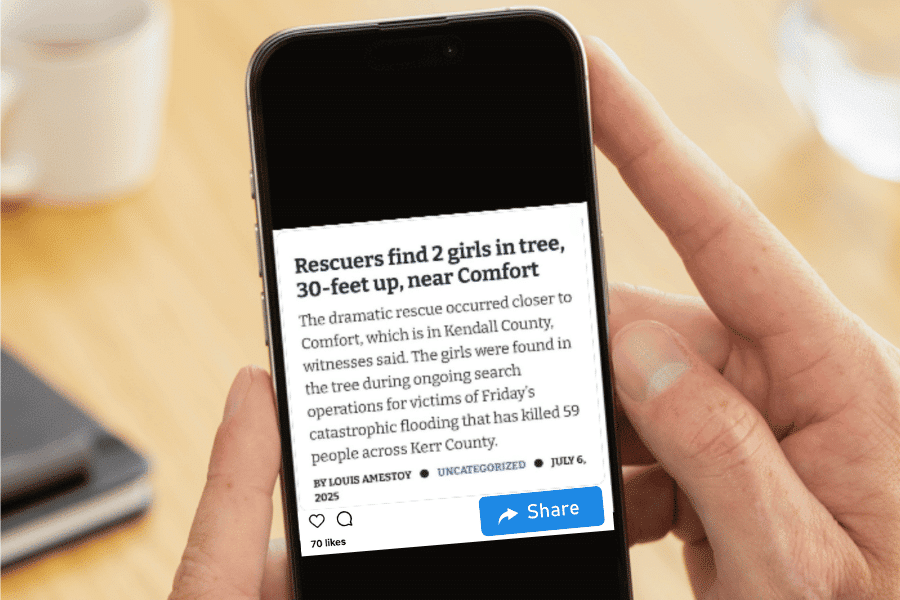
    In the wake of the floods in the U.S. state of Texas earlier this month news circulated on social media of two girls being rescued. One of the first posts sharing the story included a screenshot of a post to social media that read:

    Rescuers find 2 girls in tree, 30-feet up, near Comfort

    The dramatic rescue occurred closer to Comfort, which is in Kendall County, witnesses said. The girls were found in the tree during ongoing search operations for victims of Friday’s catastrophic flooding that has killed 59 people across Kerr County.

    A Facebook search of the post’s keywords returned dozens of identical or similarly-worded posts retelling the harrowing rescue. Other versions of the story were also shared across social media platforms like Instagram Threads, as well as in now-deleted articles across various news outlets

    But the story was fabricated. 

    It was a prime example of a type of misinformation known as “copypasta.” 

    Inciting fear

    Social media posts that utilize copypasta — a portmanteau of “copy” and “paste” — are often used to incite fear or evoke emotions, prompting users to like and share the content. These posts are used for various reasons, whether to polarize different political groups further or to attract a broader audience and spread misinformation. 

    Alex Kasprak is an investigative journalist who reported for the digital fact-checking website Snopes for nearly a decade. In his experience, Kasprak says copypasta plays a central role in online misinformation. (For more on Snopes’ take on copypasta, head to this link.) 

    “The simplest way to put it, is that copypasta is a text that you see that is identical or nearly identical posted either with somebody’s name as an author or without it in an identical form on multiple posts such that it’s clear that whoever is posting it copied it from somewhere else,” said Kasprak. 

    “What you end up getting in that sort of phenomenon is a game of telephone.”  

    Copypasta serves as a new-age version of chainmail, seen in the early days of email, which promised good luck for forwarding a message or foretold misinformation if you let the email sit in an inbox. 

    Lacking credibility

    In the case of copypasta, social media users are encouraged to comment, share or tag their friends in a post to boost engagement. Such emotion-evoking messages can serve as an entry point into more polarizing content, which is often rife with false information. 

    To identify copypasta, look for signs of vague or generic information that lacks a credible source or call to action. The way a post is written can also serve as an indication that it may be a copy-and-paste text. 

    “With copypasta, everything generally kind of travels forward, including errors in grammar or mistranslations,” Kasprak said. “If there are weird sentences that just kind of end or don’t fully make grammatical sense, that is an indicator that the tone of the message doesn’t match.”

    If the post is shared by someone that you know on your feed, but the tone is different than how they usually post or talk, the content likely originated from another source — credible or not, Kasprak said. 

    In addition to spreading false information, copypasta can be used as part of bigger campaigns to push particular sentiments or ideologies. For example, back in 2017, U.S. government officials found evidence that Russian “trolls” took to social media and also deployed social media campaigns to connect certain users to various organizations or movements.

    Danger to the infosphere

    During these online campaigns, nefarious actors meddled in the election by posting emotional content to get users to engage, gradually bringing them down a digital rabbit hole of more polarizing issues.

    Kasprak adds that copypasta content also harms the “infosphere,” or public knowledge otherwise rooted in fact. When copypasta becomes widespread and is presented as a “pseudofact,” people begin to cite it as common knowledge. A commonly held belief that many people cite as fact, for example, is that a mother bird will abandon its offspring if a human touches it. Experts agree that this notion is not true. 

    Another tactic behind those who post copypasta is to poison AI models in a similar way that fake news websites do. When enough content on the internet makes a particular claim, AI technologies may focus on this noise and refer to it as fact. In this way, AI programs are “trained” to focus and “believe” those posts over other sources of information.

    Emotion-evoking posts may also fall into the copypasta category if they are not rooted in unbiased facts. If emotional language used in the post immediately sparks anger, sadness or another strong emotion, it may be a fake post. 

    “In general, the big thing to watch out for is if something fits perfectly into your notion of how the world works,” said Kasprak. Posts that validate a person’s view of the world or evoke strong emotions in a positive or negative way are more likely to be a red flag. 

    Kasprak advises users to check their biases when reading potential copypasta content; if something makes you angry or sad, double-check its source and legitimacy. 

    “Pause if you feel strongly about wanting to share something, because those posts are the ones where the risk of copypasta is higher,” said Kasprak. When he comes across a post he believes to be copypasta, Kasprak says that he tries to “tear apart” the argument, primarily if it supports his beliefs, until it dissolves. 

    “Check your blind spots and be vigilant in checking your work,” said Kasprak. 

    When in doubt, don’t share.


    Questions to consider:

    1. What is meant by “copypasta”?

    2. How can something false become part of commonly believed?

    3. Can you remember the last thing you reposted on social media? What kind of things do you share with your network?


    Source link

  • Creative higher education isn’t a skills pipeline, it’s a cultural force

    Creative higher education isn’t a skills pipeline, it’s a cultural force

    Creative education is not a conveyor belt. It’s a crucible.

    In the UK’s industrial strategy, the creative industries are rightly recognised as a pillar of national growth. But this recognition comes with a familiar risk: that education will be seen merely as a supplier of skills, a passive pipeline feeding talent into pre-existing systems.

    This is a pervasive attitude, which so strongly influences the possibilities for students, they can be anxious about being “industry ready” before they’ve had the chance to explore or define fully what kind of practitioners they want to become. This is a reductive view and one we must resist. Creative higher education is not a service department for industry. It is a cultural force, a site of disruption, a collaborator and a generator of futures not yet imagined.

    Partners not pipelines

    Creative education does not simply serve industry – it co-shapes it. Our job is not just to deliver talent into predefined roles, but to challenge the boundaries of those roles altogether. We cultivate new forms of knowledge, artistic practice, and cultural leadership. As Michael Salmon has noted, HE’s relationship with the industrial strategy needs rethinking – we think especially in fields where “skills” are not easily reduced to training targets or labour force projections. Education is not just about plugging gaps; it’s about opening space for new kinds of thinking.

    Christa van Raalte and Richard Wallis have called for “a better quality of conversation” about the skills agenda in screen and creative sectors. Their point that simplistic, linear approaches to “skills gaps” are not fit for purpose should land hard within our own walls too. We need a better quality of conversation around the creative skills agenda. Narrow, supply-side thinking is not only reductive, it risks cutting off the very dynamism on which the industry depends.

    Our graduates don’t only “enter” the creative industries. They redefine them. They found new companies, invent new formats, challenge power structures, and expand what stories get told and who gets to tell them. To conceive of specialist creative HE as mainly a workforce provider is to misunderstand its essence. Our institutions are where risk-taking is possible, where experimentation is protected, and where the creative freedoms that industry often cannot afford are made viable.

    Resistance from within

    The danger isn’t just external. It’s internal too. Even within our own institutions, we sometimes absorb the language and logic of the pipeline. We begin to measure our worth by the requirement to report on short-term employability statistics. We are encouraged by the landscape to shape curricula around perceived “gaps” rather more than emerging possibilities. The pressure of metrics, league table and reputation help us to believe that our highest purpose is to serve, rather than to shape.

    This internalisation is subtle and corrosive. It narrows our vision. It makes us reactive instead of generative. And it risks turning spaces of radical creativity into echo chambers of industry demand. It is a recipe for sameness and status quo, a situation many call to change.

    We must be vigilant. We must ask ourselves: are we designing education for the world as it is, or for the world as it could be? Are we opening access, nurturing the disruptors, the visionaries, the cultural architects — or only the job-ready?

    When creative institutions start to measure their value predominantly through short-term employability metrics, or shape curriculum mainly around perceived industry gaps, we lose the distinctiveness that makes us valuable in the first place.

    We risk:

    • Designing education around current norms, not future needs
    • Prioritising technical proficiency over critical inquiry
    • Favouring students most likely to succeed within existing structures, rather than supporting those most likely to change them

    If we define our purpose only in terms of industry demand, we abandon much responsibility.

    From pipeline to ecosystem

    What we need is a new compact: not “education as service provider,” but “education as ecosystem partner.” A pipeline feeds. An ecosystem nurtures, nourishes and grows.

    This approach:

    • Recognises specialist creative HE as a site of research, innovation and values-driven practice
    • Treats industry as a collaborator, not a master – collaboration is especially present in research activity and creative projects led by industry professionals
    • Encourages co-creation of skills agendas, not top-down imposition
    • Embraces long-term thinking about sector health, sustainability, and inclusion – not just short-term workforce readiness

    The creative economy cannot thrive without imagination, critical thinking, inclusion, and cultural complexity; all things specialist institutions are powerfully placed to nurture. But this can only happen if we reject limiting narratives about our role. The industrial strategy may frame education as an economic lever to support the growth in the creative industries, but we must resist being reduced to a lever alone. Meeting the opportunities in the strategy is both an invitation to engage with sector needs, help shape the future and a challenge to the cultures of training, pedagogy and research whose long roots exercise power in specialist HE.

    If we want to protect and evolve the value of creative higher education, we must speak with greater clarity and confidence to government, to industry, and to ourselves. This is not about resisting relevance or rejecting partnership. It’s about ensuring that our contribution is understood in full: not only as a supply chain, but as a strategic and cultural force.

    Importantly, we must acknowledge that our graduates are not just contributors to the UK’s creative economy – they are cultural ambassadors on a global stage. From Emmy, Oscar and BAFTA winning actors to internationally celebrated designers, technical artists, writers and directors (and so much more) UK-trained creatives shape discourse, aesthetics, and industries across the world. To frame their education in purely national economic terms is to limit its scope and power.

    Because the purpose of creative education isn’t just to help students find their place in the industry. It’s to empower them – and us – to shape what that industry becomes.

    Source link

  • Change Management in Higher Ed Isn’t a One-Off, It’s a Leadership Discipline

    Change Management in Higher Ed Isn’t a One-Off, It’s a Leadership Discipline

    Heraclitus once said, “The only certainty in life is change.”  I don’t often quote ancient philosophers, but that line feels especially true in the context of higher education.”

    We hear a lot about change and change management in higher ed, but we don’t hear enough about how to successfully navigate it and use it as a springboard to propel institutions forward. But change in our industry is no longer episodic; it’s constant. From evolving student expectations to emerging technologies and shifting funding models, institutions are facing wave after wave of disruption. The sheer volume of change within higher education makes effective change management not just important, but essential to success.

    Too often, change management in higher education is treated like a checklist: a one-and-done plan that lives and dies with the project at hand. A new technology platform. A revised advising model. A restructured academic department. Each initiative gets a task force, a timeline, maybe a town hall or two. Then it ends.

    This reactive, fragmented approach may get things over the finish line, but it can also lead to burnout, resistance, and a lack of long-term adoption. Change fatigue is real, and without a strategic change management plan, it can lead to staff turnover and a revolving door of changes that fail to realize their full potential. Institutions get stuck in a perpetual loop of short-term fixes and long-term frustration.

    We can’t continue to treat change management in higher education as a one-time initiative but need to start thinking of it as a core leadership discipline.

    Higher ed change management deserves a seat at the table

    Higher ed leaders are navigating an environment where agility is essential. Budgets are tighter. Competition is fiercer. Student needs are more complex. And digital transformation is an ongoing reality that will drive constant change.

    But too often, higher education views change management as a reactive function, kicking in when something is already in motion, such as implementing a new CRM, redesigning an advising model, or centralizing key functions and departments. The focus is often on damage control: How do we minimize pushback, smooth over disruptions, and reach the finish line without too much friction?

    Start by elevating change management to the strategic level, not only giving it a seat at the leadership table, but also providing it with the same structure, dedicated resources, and strategic oversight as any other core function. Schools that do this are better equipped to:

    • Improve cross-campus alignment
    • Reduce resistance and increase buy-in
    • Accelerate the adoption of new systems or models
    • Minimize disruption to students and staff
    • Deliver better outcomes, faster

    The bottom line? In this climate, the ability to manage change effectively is a competitive advantage. If you want your institution to be resilient, you need to be deliberate about how you manage change.

    Build the muscle: 3 strategies for better change management in higher ed

    To help get you started, here are three practical ways you can help your institution build confidence, strengthen its change management muscle, and create a culture that’s ready to adapt.

    1. Create a change management playbook and use it

    Successful change management cannot be ad hoc or reactive.  A change management playbook brings clarity and consistency. It outlines the steps, tools, and best practices for managing change from start to finish. When creating your playbook, consider:

    • Stakeholder mapping: Who are the executive sponsors? Who is affected? Who are the influencers? Who needs to be consulted early and often?
    • Communication protocols: What do different audiences need to know and when? How will you keep them informed and engaged? How will the messages be delivered? How will we gather feedback?
    • Training and support: What tools, resources, or guidance will people need to succeed in the new environment?

    Having a playbook doesn’t mean every change looks the same. It means every change follows a thoughtful, proactive approach, building institutional memory and contributing to a proven, repeatable model. It also sends a clear signal to your campus community: We take change seriously, and we’re investing in doing it well.

    Don’t silo your playbook. Make it a shared resource across IT, academic affairs, student services, and marketing. The more aligned your teams are, the more cohesive your change efforts will be.

    2. Appoint change champions across the institution

    Change doesn’t stick because a VP says so. It sticks because people at every level understand it, own it, and advocate for it.

    That’s why identifying change champions is essential. Change champions are individuals with influence in their peer groups who understand the value of the change and are willing to help others navigate the transition. They can be faculty, staff, or student leaders. When building your network, identify advocates across departments and at all levels.

    Empower these individuals with context, talking points, and direct lines of communication to leadership. Let them surface concerns early and share success stories along the way. Peer advocacy goes a long way in building trust, momentum, and reinforcing key messages.

    The result? Change doesn’t feel imposed. It feels supported, even co-owned.

    3. Make Communication your top priority

    Communication is the lifeblood of effective change management in higher education. But too often, it’s treated as an afterthought. You can’t lead change in silence, and exceptional leaders should communicate early and often

    Your institution should approach communication with intention and discipline:

    • Start with the “why” behind the change. People are more likely to support change when they understand its purpose.
    • Tailor messages to each audience. Faculty care about different things than students or staff. Don’t send one-size-fits-all emails and expect engagement.
    • Use multiple channels. Email, intranet, in-person forums, social media, video — different people absorb information in different ways.
    • Be transparent, even when things aren’t going according to plan. Share what you know, when you know it. When things change, explain why.

    Clear, frequent communication is one of the most powerful tools you for building trust and reducing resistance. And remember: Communication is a two-way street. Build feedback channels into your plan. Listen actively. Adapt as needed.

    Change management as a strategic function

    So, what does it look like when an institution treats change management as a true leadership discipline? It looks like this:

    • A standing change management office or role, reporting into strategy or operations.
    • A centralized playbook that guides every major initiative.
    • Regular training and coaching for leaders on how to lead through change.
    • KPIs and feedback loops that track engagement, adoption, and outcomes.
    • An inclusive culture where stakeholders are part of the process, not just recipients of it.

    In this model, change is no longer a disruption. It’s a capability. Something your institution can do reliably, thoughtfully, and at scale.

    Lead like change is the constant

    If you take one thing away from this, let it be that change management isn’t a project, it’s a leadership discipline. It deserves the same strategic attention as budgeting, enrollment planning, or accreditation. Because, when done right, it unlocks the potential of your people, your technology, and your mission.

    Change will keep coming, and by making change management a core part of how your institution operates every day, you can take control of it and effectively drive your desired outcomes.

    Innovation Starts Here

    Higher ed is evolving — don’t get left behind. Explore how Collegis can help your institution thrive.

    Source link

  • Mobility Isn’t a Choice: How Higher Education Can Better Serve Military Learners

    Mobility Isn’t a Choice: How Higher Education Can Better Serve Military Learners

    This post is excerpted from a forthcoming book on learner mobility to be published in July 2025 by the American Association of Collegiate Registrars and Admissions Officers.


    Every few years, they pack up their lives, move across states—or oceans—and start over. New schools, new systems, new expectations.

    For military learners, this isn’t a study abroad adventure or a career move; it’s a way of life. Yet while their reality is defined by mobility, too many of our systems in higher education still assume stability.

    Military learners make up about five percent of the undergraduate population—roughly 820,000 students nationwide. But they aren’t a monolith. They’re active-duty service members juggling college coursework with operational demands like exercises, surprise inspections, and even deployments. They’re veterans navigating civilian life, often in isolation, and often while supporting a family. They’re National Guard and reserve members wearing multiple hats that opposing forces demand they change on command. And they’re spouses and dependents navigating new colleges, mid-degree or mid-semester, again and again, with each relocation.

    Their stories are different, but the friction points are the same: staying on track academically while managing a life defined by mobility.

    Unlike traditional students, military learners don’t choose when or where they go—on orders, deployments, or other permanent or temporary service-related relocations. And each move can derail progress. Credits don’t transfer, residency rules reset, tuition costs spike, and financial aid doesn’t always follow the same logic. These students bring resilience, discipline, and lived experience into our classrooms, but higher education hasn’t fully adjusted to meet them where they are.

    The transfer tangle and financial aid maze

    One of the biggest hurdles is transfer credit. While articulation agreements—formal arrangements for transferring credits between institutions—do exist, they often don’t reflect the realities of military learners, especially when it comes to military training or nontraditional learning experiences. Some accumulate credits from multiple institutions, only to be told their new school won’t accept them.

    The result? Lost time, lost money, and unnecessary frustration.

    Add to that the patchwork of residency rules. Even when learners are stationed in a state under military orders, they may not qualify for in-state tuition. While states like Virginia and Florida have implemented inclusive policies, others continue to lag, turning mobility into a penalty as well as a reality.

    Financial aid adds another layer of complexity. Programs like tuition assistance and the GI Bill are essential, but they often fall short. Tuition assistance differs by branch and may not cover full tuition at private or out-of-state schools. The Post-9/11 GI Bill is a powerful benefit, but its eligibility rules and transfer limitations don’t always align with the unpredictable, stop-and-go nature of military life.

    What states and institutions are doing right

    There are promising models to build on. In Ohio, Military Transfer Assurance Guides standardize how public institutions accept military training as credit. Texas and New York offer additional tuition support for veterans, while Florida helps cover housing and textbook costs when GI Bill payments lapse between terms.

    At the institutional level, schools like Grand Valley State University, Syracuse University, and the City University of New York (CUNY) are raising the bar. Their “Veteran Promise” programs guarantee admission, recognize military training, and offer wraparound support tailored to military-connected students.

    That’s not charity—that’s what equity looks like. When institutions commit, military learners succeed.

    The power and promise of credit for prior learning

    Credit for prior learning (CPL) may be one of the most powerful—and underused—tools to support military learners, who bring extensive work and life experience to their postsecondary studies that can be translated into credit.

    CPL recognizes that learning happens outside the classroom: through military training, job experience, CLEP exams, or portfolio assessments. When applied effectively, it can shorten the path to graduation, reduce student debt, and boost confidence for learners who’ve already mastered real-world skills.

    Tools like ACE’s Military Guide help institutions apply CPL consistently and responsibly. But here’s the problem: CPL isn’t consistently communicated, awarded, or valued. In some cases, it’s limited to elective credits rather than core degree requirements, undermining its purpose.

    CPL isn’t just about transfer and awarding credit; it’s also about unlocking opportunity. Validated learning can, and should, play a role in admissions, satisfying prerequisites, waiving introductory or duplicative coursework, and advising military learners on the path that is best for them. When institutions fully embrace the broader utility of CPL, they open more doors for military learners to engage meaningfully with higher education from the very start of their journeys.

    To change that, institutions need more than buy-in—they need system-wide strategies. CPL should be central to transfer reform conversations, especially when supporting learners who are older, more experienced, and balancing school with work or caregiving.

    The role of advising and ecosystem support

    Too often, military learners don’t get the tailored advice they need. On-base education centers can be vital entry points, but they need stronger bridges to campus advising teams who understand military culture, CPL, and transfer systems. Institutions sometimes resist broader CPL use over concerns about revenue loss or academic rigor, while students are left unaware of opportunities due to poor communication or advising gaps. Aligning on-base education centers with well-trained campus advisors is one step forward; improving internal communication across departments is another.

    Student Veterans of America’s Success Hub, which includes the SVA Advising Center, supports all service members, veterans, and their families in making informed decisions about higher education opportunities and meaningful careers through the use of AI, success coaches, and expertise where the military, veterans, and higher education intersect.

    Organizations like NACADA are doing the work to improve professional development in this area, but we need deeper, sustained collaboration. Cross-sector partnerships between colleges, employers, and the U.S. Department of Defense are where real impact happens.

    Programs like Syracuse’s Onward to Opportunity and ACE’s Reimagining Transfer for Student Success illustrate what’s possible when higher education and workforce systems align.

    The BLUF, or Bottom Line Up Front

    Military learners aren’t asking for special treatment. They ask for systems to make sense for the lives they actually lead. With the right policy changes, institutional commitments, and collaborative frameworks, we can turn mobility from a barrier into a bridge.

    But we also need better data, better pathways, and a better understanding of what success looks like for these students—not just access, but degree completion and career readiness. Military learners aren’t an exception. They are the future of an inclusive, prepared, and resilient workforce.

    It’s time higher education met these students where they are because they’re already leading the way.


    If you have any questions or comments about this blog post, please contact us.

    Source link

  • This isn’t just about Harvard

    This isn’t just about Harvard

    Maybe you’re sick of hearing news about Harvard. We can’t blame you.

    But as free speech defenders, we go where the censorship is. The government picks the targets, not us. And — once again — the government is unconstitutionally targeting Harvard.

    You don’t have to like Harvard to oppose the government’s recent demands of the university.

    FIRE has plenty of problems with that “small school outside of Boston.” It has been at the bottom of our College Free Speech Rankings for the last two years. We’ve defended students and faculty rights at the university since our founding in 1999, and we know better than anyone that there’s plenty of work to do.

    But you can’t fight censorship with censorship.

    Yesterday, the Department of Homeland Security revoked Harvard’s ability to enroll international students.

    In doing so, DHS conditioned future international enrollment on Harvard turning over a slew of information within 72 hours, including “all audio or video footage…of any protest activity involving a nonimmigrant student on a Harvard University campus in the last five years.” [emphasis added]

    That’s shocking.

    The feds are demanding more than just information involving illegal activity or violations of the student code of conduct. They want footage of “protest activity” — including speech protected by the First Amendment.

    And unless those protests involve only international students, American citizens will also find their constitutionally protected speech in the hands of America’s national security apparatus.

    Fortunately, a federal judge quickly issued a temporary restraining order, preventing the government’s action from taking effect — for now. But as Harvard alleges in its lawsuit, the federal government’s shakedown isn’t limited to these demands. DHS’s decision is part of a broader bullying campaign by the administration to undermine the First Amendment and due process in the name of enforcing federal civil rights law.

    Make no mistake: The federal government has a duty to enforce civil rights law. But it must do so in a manner consistent with the First Amendment and guarantees of due process.

    The feds can’t force Harvard to eviscerate academic freedom in order to maintain federal funding. They can’t revoke the university’s tax-exempt status because they don’t like what it teaches. And they can’t enlist the university in a surveillance program of constitutionally protected speech.

    FIRE has long opposed the weaponization of civil rights law to undermine free speech and due process protections. Indeed we spent more than a decade opposing — successfully — the Obama and Biden administrations’ efforts to do just that. And because we stand for principle, not partisanship, we’ll fight the good fight no matter who’s in the White House.

    Attacks on our rights often begin with unpopular targets. We know Harvard isn’t popular in many quarters, and we know many strongly believe it violated civil rights law. But the government has to follow the law. Free speech rights aren’t contingent on a popularity contest. Nothing justifies the government taking shortcuts that themselves violate the law — and the Constitution.

    Our rights are not divisible. We must protect free speech and due process for all — or we don’t protect them at all.

    Source link

  • For those in HE cold spots, higher education isn’t presenting as a good bet

    For those in HE cold spots, higher education isn’t presenting as a good bet

    Bridget Phillipson has said she wants to work with universities to widen access, and participation for those from lower income backgrounds is one of the government’s five priorities for higher education.

    But the words of a 17-year-old trainee legal assistant in Doncaster reveals how much of a challenge it will be to overcome the scepticism towards the value of a university education in a “cold spot”’ town;

    I love jobs and I can’t wait to get another job, because I just love getting paid. I want to go to uni, to live on my own and to get drunk all the time – the uni party lifestyle, right? But if I do it just for that, then I’m getting into debt. If I just go straight into work, then I don’t have anything to pay back.

    This quote underlines the findings from the opening paper of the UPP Foundation’s inquiry into widening participation, which showed how alongside gender- and class-based inequalities in rates of progression to HE, there are huge gulfs in the rate at which young people progress to university at 18 across different areas of the country. Almost 70 per cent of Wimbledon 18-year-olds go to university, compared to just 25.9 per cent of those in Houghton and Sunderland South – Bridget Phillipson’s own constituency.

    With some local authorities lacking a university and also exhibiting rates of progression to HE lower than one might expect based on young people’s academic attainment, our new paper, published today, sets out how and why these “cold spots” for progression to HE struggle to inspire young people to go to university.

    Daunted by costs

    During our research trip to Doncaster – one of England’s worst-performing local authorities for progression to university at eighteen, and a case study for cold spots as a result – the scepticism towards university that our trainee legal assistant exhibited came up time and time again. None of the eight parents in our focus group selected university as their preferred post-18 option for their children, and only one of the 16-18 year olds we spoke to in our focus group intended to apply to university. The primary objection was cost.

    Parents, young people, and adults of all ages that we spoke to in our immersive work thought that university was simply too great an expense for most people in the area to justify. Among those who had been to university, or knew those who had, it seemed that everyone had a horror story to tell about a friend or relative who had been burned by astronomical living expenses, or resented being mired in debt after doing a degree that had only passing relevance to their eventual career.

    Even when the long-run opportunities that university provides seem enticing, the mounting cost of maintaining an undergraduate degree is a daunting prospect to many. Few thought that universities, colleges or schools had done a good job of making pathways through higher education seem clear, achievable and valuable.

    Crowd in communities

    The challenge for places like Doncaster is that the opportunities that university provides are anything but obvious. Residents were at pains to stress that Doncaster is a place that feels like the economy has left it behind, with jobs few and far between and graduate careers a luxury seemingly reserved for other places.

    As one woman we spoke to put it: “The jobs in Doncaster, a lot of them you don’t require a degree for – we’re an industrial type of town.” Across our conversations in the area, it became clear that since the job market could not provide the security, stability and prospects that people wanted, family and community took on that role instead.

    In this context, then, going to university is a double-edged sword: the aspirational youngsters we spoke to were excited by the opportunities that university could provide, but they recognised that this probably meant getting out of Doncaster and staying out. To many people we spoke to, leaving home, and one’s hometown, was a hidden psychological cost heaped on top of the very real financial burden of university.

    With all this in mind, the ambivalence of cold spot residents towards university seems not reckless, but rational. If we think of university as a “bet” that people make on the understanding that the “payoff” is a higher graduate salary in the long run, then it is easy to see why those in areas with no university and few graduate jobs would be reluctant to make that sort of commitment.

    If the government wants to make good on its commitment to widen university participation, it will require a multifaceted approach that crowds in whole communities, not just bright teenagers with good prospects. They will need to work with schools, colleges, universities and local employers to make the value of university clear across generations. Cold spots can make university feel like a reckless gamble – it’s up to the government to make it a good bet.

    This article is published in association with the UPP Foundation.

    Source link

  • Eliminating grade inflation isn’t as easy as ABC

    Eliminating grade inflation isn’t as easy as ABC

    A perfect grade point average isn’t what it used to be. As grade inflation continues worldwide, more students are earning top marks, but it isn’t always deserved. Critics argue that inflated grades make it harder to distinguish truly exceptional students, while supporters say they reduce stress and improve confidence. 

    From high schools in the United States to universities in Europe, the debate over grade inflation is shaping education systems and college admissions. But is this trend helping students succeed, or is it setting them up for failure?

    Grade inflation is the trend of rising student grades over time without a corresponding increase in academic achievement, often making higher grades less reflective of actual learning or ability. 

    High school is meant to prepare students for higher education, but with grade inflation, many students feel unprepared. 

    Take high school senior Ruby Schwelm. “As a student who has dealt with inflation, I’ve noticed I don’t receive grades and feedback that reflect my actual understanding of the content,” Schwelm said. “I feel like I’m just going through the motions of my courses, completing assignments without really engaging with the material. This makes it hard to track progress, see where I need improvement and feel prepared for college.”

    The rising GPA

    According to a study by ACT, a non-profit organization that runs one of two standardized tests used in the United States used for college admissions, the average adjusted grade point average (GPA) of students in the United States has risen from 3.17 in 2010 to 3.36 in 2021. 

    The report said that grade inflation “calls into question the degree to which we should rely on grades to measure academic achievement or predict future grades.” This shift challenges the typical role of grades as a reliable measure of knowledge, starting a debate over whether they still hold value in measuring students’ abilities.  

    Many educators believe that the shift in grading has led to a lack of rigor and academic accountability. Josh Hsu, a high school English teacher at the Tatnall School in Wilmington, Delaware where I go to high school, said that many students now equate a C with failure, despite it being historically recognized as an average grade.

    “There seems to be a threshold of how low grades will go, and that bar gets pushed higher and higher,” Hsu said.

    This trend has caused concern among educators who feel that the traditional grading system no longer differentiates students based on their academic performance. 

    “What does an A mean if everybody has an A, right?” Hsu said. 

    The psychological effects of grade inflation

    Proponents of grade inflation argue that it helps students maintain self-confidence and reduces academic stress. 

    Sara Gartland, a high school math teacher at the Tatnall School and adjunct professor at the University of Delaware School of Education, said that “there’s a lot of tension in what a grade is.” 

    She worries that students today see grades as a measure of their worth rather than as a tool for learning. Grades should function as a feedback loop between teachers and students rather than a rigid measure of success, Gartland said. 

    She also emphasized the importance of second chances. “I tend to see that really what students are looking for is, ‘Do I have a second chance if today is not my best day?’,” she said. 

    This perspective aligns with educational philosophies that prioritize mastery over memorization. Many teachers now allow students the opportunity to make corrections and retake assessments to make sure that students truly understand the material, which can also lift the burden of test stress off of students. 

    Elevated grades and equity

    While grade inflation is happening across the country, there have been concerns over whether grade inflation is proportionally impacting students of different incomes and communities. 

    Hsu said that parents of students in private schools often expect their children to earn high grades to get into a top college in return for the price of tuition. While this belief may lead people to assume that wealthier students have proportionately higher grades than lower-income students, this actually is not the case. 

    The ACT’s study shows that the average GPA of students in a household with an income of under $36,000 a year has grown much faster than the GPA of students in a household with an income of $100,000 from 2012 to 2021. This could be due to teachers inadvertently trying to give a break to students from low-income families to try and level the playing field. 

    Gartland argues that teachers should provide students with the tools they need for success and take into consideration things that may impact a student’s performance outside of the classroom. 

    “That [grade on a test] doesn’t necessarily take into consideration your drive to school that day, whether or not you forgot your lunch that day, or let’s say you had a particularly exciting life event or a particularly upsetting life event, and you didn’t get to spend the amount of time studying that other students did, all sorts of other things,” she said. 

    With this mindset in education, students are being treated with equity, allowing them the opportunity to experience the same academic success, even if there are barriers in their way. 

    Global patterns in how students are graded

    While the issue of grade inflation is often discussed in the context of schools in the United States, grade inflation is a global issue. A 2024 study, by researchers at the College of New Jersey, found that many countries, including the United Kingdom, Germany and Canada have all experienced rising average grades over time. 

    However, the extent of grade inflation varies from country to country. Australia, for example, maintains relatively strict grading standards through the use of relative grading and limited reliance on student achievement.

    This study also showed that there are many differences in grading practices from region to region. In the United States, professors were significantly more likely to use curved grading, a practice strongly associated with grade inflation. 

    In contrast, educators in Europe and the South Pacific gave lower average grades and curved fewer grades, suggesting a more conservative approach to grading. Asian countries showed grading patterns similar to the United States, with higher usage of grade curves and slightly elevated grade averages.

    These disparities have real implications. Grade inflation complicates international admissions, making it harder to fairly compare students from different educational systems. 

    It can also distort hiring practices. The international study on grade inflation found that in Sweden, students from schools with inflated grades were shown to earn up to 5% more than peers with equivalent abilities. Ultimately, when grades become inflated, they lose their value as an objective measure of performance, creating global challenges in education, employment, and equity. 

    A shift in college admissions 

    As I went through the process of applying to college, I learned from my college counselors how grade inflation has affected the college admissions process. As grade inflation rises, colleges and employers are shifting their focus away from GPAs and toward other indications of student potential. Admissions officers are increasingly looking at extracurricular activities, personal essays and recommendation letters to evaluate applicants.

    According to a report by the group FairTest, which works for equity in educational assessments, standardized tests, which once served as a counterbalance to inflated grades, are also becoming optional at many colleges and universities, further complicating the process of evaluating students.

    Hsu said he worries that without clear academic standards, the education system could lose its credibility. “If you don’t have a set of standards, then it just becomes the Wild West, and then you have everyone getting A’s and B’s and you have students with GPAs that they didn’t earn,” he said.

    Employers, too, are placing greater emphasis on internships and real-world experience rather than assuming high grades equate to a strong work ethic and mastery of material. 

    With the recent trends of grade inflation, we can expect the average GPAs of students across the country to continue to rise. Hsu worries some students have become lazier in recent years. This raises concerns about how this will impact the future of education and if students will be prepared for life post-graduation.

    “Everyone wants instant gratification now,” Hsu said. “They don’t want to work at things as hard because if they have challenges, they’re not willing to stumble through those challenges or fight through them.”


    Questions to consider:

    • What is meant by grade inflation?

    • How can student achievement be measured without letter or number grades?

    • Do you think that getting an A on an assignment should be difficult? Why?


    Source link

  • “Portrayed as a place that isn’t what I know it to be”: Professor Bell on ANU’s public perception

    “Portrayed as a place that isn’t what I know it to be”: Professor Bell on ANU’s public perception

    ANU vice-chancellor Genevieve Bell with Rachel Marape at James Marape, the Prime Minister of Papua New Guinea’s address to the ANU in February, 2024. Picture: Martin Ollman

    Australian National University’s (ANU) vice-chancellor Genevieve Bell has made a statement confirming she plans to stand by her university after a “four-month negative media campaign.”

    Please login below to view content or subscribe now.

    Membership Login

    Source link