Tag: Israel

  • Law professor sues University of Kentucky after suspension over criticizing Israel

    Law professor sues University of Kentucky after suspension over criticizing Israel

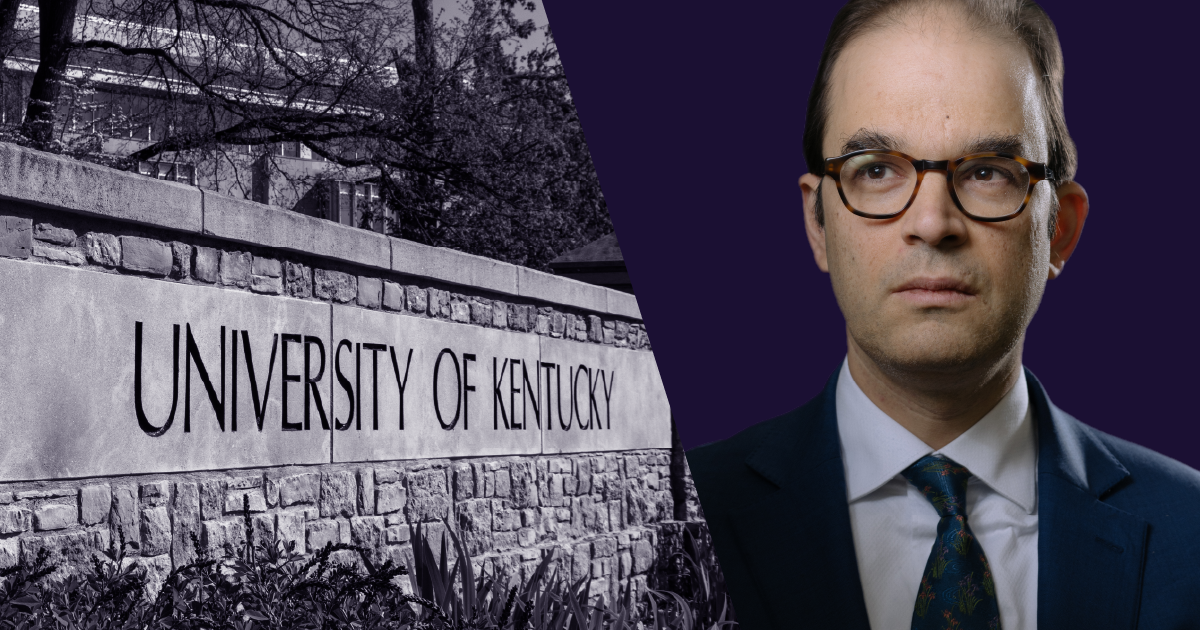
    The University of Kentucky suspended tenured professor Ramsi Woodcock in July for his comments about Israel. Now, Woodcock is suing his university for violating his First Amendment rights.

    Woodcock’s lawsuit, filed last week in federal district court in Kentucky, asks the judge for two things: let him go back to teaching and stop the university from enforcing the International Holocaust Remembrance Alliance’s definition of antisemitism

    TAKE ACTION: Stop University of Kentucky’s Free Speech Crackdown

    The lawsuit lays out a damning timeline of UK’s abuse of his First Amendment rights. Woodcock, long an outspoken critic of Israel, remained steadily employed at UK for seven years, gaining tenure in 2022 and a promotion to full professorship this year. But less than two weeks after his promotion, UK removed him from teaching and banned him from campus. This was purportedly because of unspecified complaints about his  petition to a faculty listserv in March 2024, more than a year earlier, calling for global war against Israel and its annihilation. On his website, antizionist.net, he claims Israel is waging a genocide and that the world has a “moral duty” to step in. 

    After UK suspended Woodcock, describing his online petition as “calling for the destruction of a people based on national origin,” FIRE’s Faculty Legal Defense Fund, which provides legal resources for faculty free of charge, intervened with UK to explain that Woodcock’s speech was protected by the First Amendment. While members of the public or UK’s community may have taken offense to Woodcock’s strong views about Israel, faculty members have the First Amendment right to present arguments on matters of public concern outside the classroom. Using Woodcock’s speech as a cudgel to remove him from the classroom was a clear violation of his expressive rights as a faculty member at UK.

    The FLDF also announced that Joe Childers, a Kentucky-based attorney, would defend Woodcock through the university’s investigative process. Now Woodcock is taking his fight to court. The Council on American-Islamic Relations (CAIR) is representing Woodcock in the lawsuit, with help from the Chicago-based law firm Kapitan Gomaa Law. Childers is serving as local counsel. 

    “The University’s suspension of Professor Woodcock violates his First Amendment right of freedom of expression and his right to procedural due process, discriminates against him in violation of the Civil Rights Act of 1866, threatens the democratic principles which sustain this Country’s form of government, and degrades the quality of education at the University of Kentucky,” the lawsuit states.

    A university cannot censor the ideas it dislikes out of existence. And it certainly cannot punish its own faculty for making provocative arguments both at the university and in the court of public opinion. FIRE will keep readers apprised about the status of Woodcock’s lawsuit. 

    If you are a public university or college professor facing investigations or punishment for your speech, contact the Faculty Legal Defense Fund: Submit a case or call the 24-hour hotline at 254-500-FLDF (3533).

    Source link

  • Ky. Professor “Reassigned” After Call for War on Israel Sues

    Ky. Professor “Reassigned” After Call for War on Israel Sues

    BD Images/iStock Editorial/Getty Images Plus

    The University of Kentucky law professor who was removed from teaching amid his calls for a global war on Israel to end its existence as a state is now suing his institution and the U.S. education secretary.

    On his website, antizionist.net, Ramsi Woodcock asks fellow legal scholars to sign a “Petition for Military Action Against Israel.” He says Israel is a colony and war is needed to decolonize, and he calls for the war to continue until “Israel has submitted permanently and unconditionally to the government of Palestine everywhere from the Jordan River to the Mediterranean Sea.”

    In his lawsuit, filed Thursday in U.S. District Court for the Eastern District of Kentucky, Woodcock asks a judge to order the university and top officials to restore his normal teaching and other duties, allow him back into the College of Law building, end the university’s investigation of him, and pay monetary damages. But he also asks the judge to order Education Secretary Linda McMahon to “refrain from requiring or using” the controversial International Holocaust Remembrance Alliance definition of antisemitism when enforcing Title VI of the Civil Rights Act of 1964.

    The IHRA says antisemitism “might include the targeting of the state of Israel,” “comparisons of contemporary Israeli policy to that of the Nazis” or claims “that the existence of a State of Israel is a racist endeavor.” Earlier this year, Kentucky state lawmakers ordered public universities to use the IHRA definition in their policies combating antisemitism. Woodcock is also asking the judge to declare that that order violates the First Amendment.

    His lawsuit alleges the state and federal actions are related to his “suspension,” saying the university’s tolerance of his speech “ended in summer 2025” after the federal government threatened to withdraw funding from universities and moved to enforce the IHRA definition. He also cited the passage of the state legislation that “enabled and pressured administrators to suppress speech critical of Israel and Zionism.”

    The Education Department didn’t respond to requests for comment Friday. A university spokesperson said Woodcock hasn’t been suspended but was “reassigned pending the outcome of an investigation,” adding that the university will be “limited in our comments while that investigation is ongoing.”

    In an email to Inside Higher Ed, Woodcock responded, “Israel is a colonization project that practices apartheid and is currently exterminating two million Palestinians in Gaza. The scandal is not that I am calling for immediate military action to end Israel but that the university is willing to violate our nation’s constitution in order to preserve Israel. Every American scholar has a First Amendment right to oppose Israel and I look forward to holding the university accountable for breaking the law.”

    Source link

  • The University of Kentucky suspended a professor for criticizing Israel. Now, FIRE’s Faculty Legal Defense Fund is stepping up to defend him.

    The University of Kentucky suspended a professor for criticizing Israel. Now, FIRE’s Faculty Legal Defense Fund is stepping up to defend him.

    LEXINGTON, K.Y., Aug. 7, 2025 — A University of Kentucky professor suspended for criticizing Israel’s conduct in the Gaza war now has legal representation thanks to the Foundation for Individual Rights and Expression.

    Ramsi Woodcock had established a steady career as a law professor at UK, where he has taught for seven years. He earned tenure in 2022 and was promoted to full professor on July 1.

    Less than two weeks later, the vice provost of the university informed the professor that the university received unspecified complaints about Woodcock’s criticisms of Israel outside the classroom on his personal website and at conferences. 

    The university failed to respond to Woodcock’s requests for copies of the complaints. On July 18, university officials removed Woodcock from teaching and banned him from campus. The university also sent a message to its campus condemning Woodcock’s views as “repugnant” and publicly announcing an investigation. 

    Specifically, the university took issue with a petition Woodcock circulated to other law professors across the country that called for military action against Israel because of its war in Gaza, as well as his arguments that Israel should cease to exist. 

    “This isn’t complicated,” said Graham Piro, FIRE’s Faculty Legal Defense Fund fellow. “Woodcock’s arguments about Israel are clearly protected speech on a matter of public concern, and as a faculty member at a public institution, he has the right to voice his ideas, regardless of whether others find them objectionable. And reprimanding a professor over one set of views opens the door to further restrictions on other opinions down the road.”

    With the help of the FLDF, Woodcock is being represented by Joe F. Childers of Joe F. Childers & Associates. Childers will work to lift Woodcock’s suspension so he can return to teaching in the classroom and continue speaking freely outside of it. 

    “Punishing me for my views on Israel sends a terrifying message to students and colleagues: voice the ‘wrong’ opinion on a sensitive subject and face consequences from the university,” Woodcock said. “It’s not only my career that’s at stake — it’s about whether the University of Kentucky will continue to exist as an institution that encourages and permits free thought and expression.”


    The Foundation for Individual Rights and Expression (FIRE) is a nonpartisan, nonprofit organization dedicated to defending and sustaining the individual rights of all Americans to free speech and free thought—the most essential qualities of liberty. FIRE recognizes that colleges and universities play a vital role in preserving free thought within a free society. To this end, we place a special emphasis on defending the individual rights of students and faculty members on our nation’s campuses, including freedom of speech, freedom of association, due process, legal equality, religious liberty, and sanctity of conscience.

    CONTACT:

    Karl de Vries, Director of Media Relations, FIRE: 215-717-3473; [email protected]

    Source link

  • Col. Larry Wilkerson: Defeated Once, Israel Faces a Collapse It May Not Survive (Dialogue Works)

    Col. Larry Wilkerson: Defeated Once, Israel Faces a Collapse It May Not Survive (Dialogue Works)

    Dedicated to dialogue and peace, “Dialogue Works” is hosted by Nima Rostami Alkhorshid.

    At Dialogue works, we believe there’s nothing more unstoppable than when people come together. This group’s mission is to create a global community of diverse individuals who will support, challenge, and inspire one another by providing a platform for Dialogue. We encourage you to share your knowledge, ask questions, participate in discussions, and become an integral part of this little community. Together we can become a better community and provide our members with a much better experience.

    Source link

  • Ky. Prof. Calling for War Against Israel Pulled From Teaching

    Ky. Prof. Calling for War Against Israel Pulled From Teaching

    Since Oct. 7, 2023, scholars and members of the broader public have debated whether Israel’s war against Hamas in Gaza actually constitutes a genocide of Palestinians. Fights have erupted over scholarly association resolutions, course descriptions and assignments calling it such.

    Ramsi Woodcock, a University of Kentucky law professor, says it’s a genocide. On his website, antizionist.net, he says that the ongoing genocide—combined with his expectation that Israel would violate any future ceasefire and continue killing—creates a “moral duty” for the world’s nations.

    That duty, he writes in the “Petition for Military Action Against Israel,” is to wage war on Israel until it “has submitted permanently and unconditionally to the government of Palestine everywhere from the Jordan River to the Mediterranean Sea.” He asks fellow law scholars to sign the petition, adding that Israel is a colony and war is needed to decolonize.

    This month—just after Woodcock says he was promoted to full professor—the university removed him from teaching. In a July 18 message to campus that doesn’t specifically name Woodcock, UK president Eli Capilouto wrote that legal counsel was investigating whether an employee’s “conduct may violate federal and state guidance as well as university policies.”

    “We have been made aware of allegations of disturbing conduct, including an online petition calling for the destruction of a people based on national origin,” Capilouto wrote. Woodcock told Inside Higher Ed that characterization of his petition is “obviously defamatory, creates a hostile environment for me and makes me potentially physically unsafe.” He said he’s considering suing Capilouto and the university for defamation.

    Capilouto further wrote that the petition, which the unnamed university employee seemed to be “broadly” circulating online, “can be interpreted as antisemitic in accordance with state and federal guidance.” Woodcock responded that “what Palestinians resist, and what those who advocate for them resist, is colonization, apartheid and a currently unfolding genocide—they are not opposed to any particular religion or any particular people.”

    But Shlomo Litvin, chairman of the Kentucky Jewish Council and rabbi for the Chabad at UK Jewish Student Center, told Inside Higher Ed that “calling for the establishment of a state that is free of Jews in a land that currently has seven million Jews is calling for the death of seven million Jews,” including “families and relatives of [Woodcock’s] students.”

    “What he’s calling for is a second Holocaust,” Litvin said, adding that “this idea that there is a possibility of the Jews coming to some imaginary country and being safe there is a fantasy that not even he believes.”

    Woodcock countered, “Rabbi Litvin is trying to distract us from an actual second Holocaust that Israel is committing right now in Gaza and which only immediate military intervention will stop.”

    Woodcock has become another example of pro-Palestine faculty across the country being investigated for their writing or speech about the conflict while they aren’t teaching. During the Biden era, investigations at other universities led to discipline and terminations. The current Trump administration has stripped universities of federal funding and punished them in other ways for allegedly failing to address campus antisemitism. And Woodcock’s case continues the debate about when denunciations of Israel or Zionism are or aren’t antisemitic.

    But why UK began investigating Woodcock now remains unclear.

    ‘Not Academic Discourse’

    In a July 18 email obtained by Inside Higher Ed, UK’s general counsel, William E. Thro, wrote to Woodcock that “recently, the university became aware of your writings on certain websites, your conduct at academic conferences, and your postings on American Association of Law Schools [sic] list serves [sic], and other actions.”

    “These activities may create a hostile environment for Jewish members of the university community or otherwise constitute harassment as defined by the Supreme Court,” Thro wrote. “The university has concerns that your actions may violate Title VI of the Civil Rights Act of 1964, the equivalent state laws, and various university policies.”

    Title VI prohibits discrimination based on shared ancestry, including antisemitism.

    But the letter didn’t provide further details, such as what conference conduct or writings the university was concerned about, or how university officials became aware of this expression. A UK spokesperson said, “At this time, we are not going to comment beyond [Capilouto’s] statement, as there is an active investigation.”

    Woodcock said he made a statement about “Israel’s genocide of Palestinians” at a conference over a year ago. He later shared a link to his antizionist.net site on Association of American Law Schools online discussion forums, triggering “really lively debate about whether Israel has a right to exist.”

    “Nobody wants to talk about that question, and as soon as you bring it up, you see how hungry people are to debate it,” Woodcock said.

    He says he created the antizionist.net website late last year but didn’t share it broadly until the start of this month. It’s a site for what he dubs the Antizionist legal studies movement.

    “Israel is committing genocide against Palestinians in Gaza,” Woodcock wrote on the site in December. “No genocide in the 20th century ended without armed intervention. For more than a year now, the international community has been in denial about the implication of these two facts.”

    He listed various failed international efforts to stop the genocide, ending with “Even the most outspoken international lawyers dare not speak the name of the only thing that history suggests might actually stop Israel. That is, of course, war—by the international community against Israel.”

    Woodcock says he wants Israel defeated and replaced with a Palestinian state, and he doesn’t insist the vast majority of Jews be automatically allowed to remain. He says Palestinians should get to decide. His definition of “antizionist legal scholars” includes that they oppose “any right of self-determination for Jewish people as such in Palestine.” He does say that “the tiny minority of Jewish people whose ancestors lived in Palestine immediately prior to the arrival of the first Zionist colonizers in Palestine in 1882 … share in the right of Palestinians to self determination.”

    “Palestinian people alone should decide how Palestine should be governed after independence, including the legal status of the colonizer population,” he says.

    The Kentucky Jewish Council and State Sen. Lindsey Tichenor, a co-chair of the state General Assembly’s Kentucky-Israel Caucus, praised the decision to remove Woodcock from the classroom. In a statement, Tichenor wrote that the “reports coming out of our taxpayer-funded flagship university are incredibly disturbing. A law professor calling for the destruction of Israel and against the right for the Jewish people to have self-determination is not a policy disagreement, but a call to violence.”

    “That is not academic discourse. It’s antisemitism and racism and abuse of his power, plain and simple,” Tichenor wrote. She thanked Capilouto “for his strong and unequivocal condemnation of this hateful message” and for reinforcing “the importance of moral clarity and swift institutional accountability.”

    But Capilouto’s message also hinted at the academic freedom concerns at play. He wrote that the situation “compels us to address questions other campuses are grappling with as well—chiefly, where and when does conduct and the freedom to express views in a community compromise the safety and well-being of people in that community?”

    In a statement to Inside Higher Ed, Connor Murnane, the Foundation for Individual Rights and Expression’s campus advocacy chief of staff, said, “FIRE is actively investigating this case, and we’re concerned that Professor Woodcock may have been punished for protected activities.”

    Jennifer Cramer, president of UK’s American Association of University Professors chapter, said that “assuming he did not pose a threat in any meaningful way to our campus, I think that the treatment of this case seems outside of the bounds of the norm.” She said that “whether we agree with what he says or not shouldn’t matter, because that’s the point of academic freedom.”

    Woodcock hasn’t stopped calling for war on Israel, posting on X, “Zionists are frustrated that their intimidation campaign hasn’t shut me up.”


    Source link