Tag: IT strategy

  • Regis University Partners with Collegis Education to Modernize IT Infrastructure and Strengthen Denver’s Higher Ed Innovation Footprint

    Regis University Partners with Collegis Education to Modernize IT Infrastructure and Strengthen Denver’s Higher Ed Innovation Footprint

    Multi-year collaboration to strengthen cybersecurity, streamline systems, and drive operational innovation across campus.

    DENVER, Colo. — [November 11, 2025]Regis University today announced a new five-year partnership with Collegis Education, a nationally recognized provider of higher education technology and data solutions, to modernize and strengthen the university’s IT infrastructure. The collaboration marks a major step in Regis’ ongoing digital transformation strategy, designed to enhance cybersecurity, improve data integration, and deliver more efficient, 24/7 technology services across campus.

    In the fall of 2023, Regis launched a comprehensive assessment of its IT infrastructure. The results made clear that gaps in existing systems limited the university’s ability to serve students, faculty, and staff efficiently. Addressing these challenges required reimagining how technology services are delivered to ensure systems are reliable, responsive, and aligned with the needs of a modern learning environment.

    “Technology is foundational to how we teach, learn, and work, and this partnership represents a major investment in Regis University’s future,” said Stephanie Morris, Vice President and Chief Financial Officer of Regis University. “Partnering with Collegis allows us to modernize our IT operations, strengthen security, and provide a more unified and responsive experience for our community, all while maintaining our commitment to operational excellence and fiscal responsibility.”

    Regis selected Collegis through a competitive RFP process, following staff recommendations based on prior positive experiences with the company at other institutions. Throughout the evaluation, Collegis distinguished itself by demonstrating a deep understanding of universities’ operational complexities and by recognizing the central role technology plays in supporting teaching, learning, and student success. 

    As part of the partnership, Collegis will help Regis integrate core systems, including Colleague, Salesforce, and Workday, to create a more seamless experience for students, faculty, and staff.  This will allow Regis to improve efficiencies, access diverse levels of expertise, provide 24/7 service availability, and improve system integrations. 

    The collaboration will provide Regis with access to a broad range of higher education IT expertise and scalable resources. Collegis’ team will collaborate closely with Regis leadership to deliver high-performing systems, improved uptime and reliability, and integrated data systems that strengthen university operations and inform decision-making.

    “We are proud to partner with Regis University, an institution with a deep commitment to innovation and service,” said Kim Fahey, CEO of Collegis Education. “Our role is to help Regis leverage technology to empower its mission to support a secure, connected, and efficient digital ecosystem that enhances the student experience and strengthens institutional resilience.”

    Under the agreement, Collegis will assume management of day-to-day IT infrastructure operations, while Regis will continue to oversee technology strategy and governance. Faculty, staff, and students will continue to access support through familiar channels—including the online self-service portal and ITS help desk—with the added benefit of 24/7 availability and expanded system monitoring.

    The transition will take place over the coming year, with listening sessions and open forums held throughout the process to ensure transparency, collaboration, and feedback from the Regis community.

    “Partnership success is realized when operational excellence, trust, and shared purpose combine to deliver reliable technology services; improved faculty, staff, and student experiences; and measurable value to the university’s mission,” said Morris. “With Collegis as a strategic partner, we will be able to evolve to meet changing institutional needs and empower our faculty to teach, our students to learn, and our community to thrive.”

    About Regis University

    Established in 1877, Regis University is a premier, globally engaged institution of higher learning in the Jesuit tradition that prepares leaders to live productive lives of faith, meaning and service. Regis University, one of 27 Jesuit universities in the nation, has two campus locations in the Denver metro area and extensive online program offerings with more than 6,000 enrolled students. It is a federally designated Hispanic-Serving Institution. For more information, visit www.regis.edu.

    About Collegis Education

    As a mission-oriented, tech-enabled services provider, Collegis Education partners with higher education institutions to help align operations to drive transformative impact across the entire student lifecycle. With over 25 years as an industry pioneer, Collegis has proven how to leverage data, technology, and talent to optimize institutions’ business processes that enhance the student experience. With strategic expertise that rivals the leading consultancies, a full suite of proven service lines —including marketing, enrollment, retention, IT —and its world-class Connected Core® data platform, Collegis helps its partners drive impact and generate revenue, growth, and innovation. Learn more at CollegisEducation.com or via LinkedIn.

    Media Contacts:

    Collegis Education

    Alyssa Miller

    [email protected]

    973-615-1292

    Regis University

    Sheryl Tirol

    [email protected]

    Source link

  • Higher Education Needs to Prioritize for Impact

    Higher Education Needs to Prioritize for Impact

    Last month, a few of our Collegis leaders attended the Google Public Sector Leaders Connect summit in Chicago. This event brought together technology, education, and government leaders to address one major question: How can public institutions unlock the true value of AI?

    Institutions are grappling with a fast-changing AI landscape

    The summit served up plenty of insight, data, and dialogue about the promises and pitfalls of artificial intelligence in higher ed. One stat that hit home: 80% of students think universities are falling short when it comes to integrating AI.

    That’s not just a tech gap, it’s a relevance gap. Today’s students are living in an AI-powered world, and if institutions can’t keep pace, they risk losing credibility and connection.

    They are also failing to prepare students for a new job market, where AI is “attacking” entry-level jobs that their graduates would previously fill. With many entry-level jobs being fulfilled by AI, what are schools doing to help their graduates get the skills they need to thrive in this new world?

    Fragmented priorities are holding higher ed back

    As we listened to leaders at the summit and reflected on our partner conversations, it became clear that the challenges institutions face go beyond AI adoption.

    Other concerns surfaced as well:

    • 71% of institutions say their top priority is attracting and retaining students.
    • 56% are worried about data security threats like phishing, ransomware, and breaches.
    • 42% cite operational pressures as a major barrier, from business model constraints to process inefficiencies.

    On their own, these numbers signal urgency. But together, they reveal something deeper:

    Institutions aren’t just overwhelmed by change, they’re unsure where to focus and where to invest.

    Competing priorities and limited resources make it hard to know what matters most. These three statistics may look unrelated, but they are all very much related and impact each other. Operational pressure can heighten data security risks, which can trigger breaches that erode student trust and enrollment. Those same pressures often stem from — and lead to — inefficient processes that hurt the student experience and, ultimately, retention.

    Throughout the day, multiple speakers kept reinforcing the importance of “prioritizing for impact.” Because while AI offers enormous potential, the technology itself won’t drive transformation — leadership will.

    It’s not about adopting more tech — it’s about focusing on impact

    Now this struck a chord with me, especially given how we approach partner onboarding at Collegis. Even during early conversations with potential partners, our first question is always the same: “What are you trying to impact?”

    It’s a simple question, but the answers we hear are very telling, and can drastically vary depending on who at the institution is answering. What I like about this question is that it helps focus the conversation on a desired end result, providing an immediate opportunity to pressure test strategies, tactics, and competing priorities.

    Is this getting you closer to, or further away from, your desired impact? If the latter, perhaps it’s time to consider reallocating resources and budget to what gets you toward the finish line faster.

    How to prioritize for impact in higher ed

    Take the AI example. Instead of asking, “What AI tools should we adopt?” instead ask, “Where can AI meaningfully move the needle for our institution AND our students?” That shift from solution-first to strategy-first is everything.

    Here are a few guideposts we recommend:

    1. Start with your outcomes. Whether it’s student success, operational efficiency, or enrollment growth, define what success looks like before introducing any new technology.
    2. Connect C-suite ambition with frontline reality. Consider forgoing a top-down approach that prioritizes selling to leadership. To enable real change, your strategies must reflect on-the-ground needs. Build from the bottom up and bring the insight and intel back to your cabinet leaders to help inform prioritization conversations.
    3. Break down the silos. So many institutions are decentralized and highly matrixed, which means that critical data, digital infrastructure, and internal departments are often disconnected. Aligning them is essential to enable AI to operate at scale. Consider cloud platforms like Connected Core®, which extract, clean, and connect data across systems, applications, and third-party tools. This enables actionable institutional intelligence across the student lifecycle.
    4. Build AI literacy, institution-wide. Google shared that only 14% of campuses have adopted AI literacy as a learning outcome. That’s a missed opportunity to empower both staff and students to engage with AI responsibly and effectively.
    5. Don’t go it alone. With 62% of institutions lacking the internal expertise to fully leverage AI, choosing the right partner matters. Not someone just trying to sell you tech, but to help you translate it into impact. This is the talent component of Collegis Education’s data, tech, and talent approach. It does you no good to own a plane if you don’t have a pilot, crew, and maintenance team. When you align your data, tech, and talent, you’ve enabled impact, and sustainable impact at that.

    The Google event confirmed what we see every day: Higher ed has a prioritization problem. Leaders have been sold more tech tools than they can use; what they truly need is help implementing them for impact.

    A smarter path forward for institutional leaders

    Institutional leaders know their schools better than anyone and have a clear vision of where they need to go to thrive.  Building a strategic plan focused on the areas that will drive the greatest impact to that vision is the next critical step.  A great way to start is by finding a partner who understands that progress isn’t about doing more, it’s about doing what matters.

    Prioritize for impact. We’ll help you make it happen.

    Innovation Starts Here

    Higher ed is evolving — don’t get left behind. Explore how Collegis can help your institution thrive.

    Source link

  • What Is IT Governance and Why Is It So Important in Higher Ed?

    What Is IT Governance and Why Is It So Important in Higher Ed?

    Technology can be one of the most powerful tools an institution has to advance its mission. But without clear, strategic guidance, that same technology can quickly become a source of frustration, inefficiency, and risk. That’s where IT governance comes in.

    Today’s colleges and universities are navigating rising cybersecurity threats, tighter budgets, and an expanding ecosystem of platforms and tools. In this environment, IT governance isn’t just an operational necessity — it’s a strategic imperative.

    In this article, I’ll define what higher ed IT governance is, why it matters more than ever, and how institutions can build a framework that aligns technology investments with institutional priorities.

    What is IT governance in higher ed?

    Put simply, IT governance is the structure that ensures every technology investment and decision supports the institution’s goals and strategies. While IT management focuses on maintaining day-to-day systems — like patching servers or updating networks — IT governance answers a different set of questions, such as:

    • Which projects should we prioritize?
    • How do we allocate limited resources for the greatest impact?
    • Who needs to be involved in shaping these decisions?

    A thoughtful approach to IT governance isn’t just a collection of policies. It’s an intentional structure that fosters transparency, collaboration, and accountability across the entire institution.

    When done well, governance clarifies how decisions are made, who is responsible for making them, and what criteria determine success. This clarity reduces confusion, builds trust, and ensures that technology investments consistently support the institution’s mission and priorities.

    An effective governance framework typically includes:

    • Decision-making structures such as IT governance committees with representation across academic and administrative areas
    • Policy development that guides how technology projects are evaluated and approved
    • Risk management and compliance oversight to keep pace with evolving regulations and security requirements

    When institutions embrace governance as a shared responsibility, technology becomes a strategic asset rather than a departmental concern.

    Why higher ed IT governance matters more than ever

    The complexity of higher ed technology ecosystems has grown exponentially. Many institutions now rely on cloud platforms, ERP and student information systems, learning management systems, and emerging tools like AI.

    Without governance, it’s easy for tech investments to become siloed or redundant — especially when departments act independently. This fragmentation can lead to:

    • Financial waste due to functional redundancy
    • No clear system of record/unclear data access policies
    • Missed opportunities for collaboration and efficiency

    External pressures are also intensifying. Regulatory requirements such as FERPA and GLBA have expanded. Accrediting bodies increasingly expect transparent, documented technology processes. And stakeholders — from faculty to students — demand seamless, secure digital experiences.

    In an era of constrained budgets, institutions can’t afford to treat IT governance as an afterthought.

    Ready for a Smarter Way Forward?

    Higher ed is hard — but you don’t have to figure it out alone. We can help you transform challenges into opportunities.

    The risks of poor or nonexistent IT governance

    When governance isn’t in place, institutions face serious consequences that extend far beyond the IT department. Gaps in oversight and alignment can ripple across every facet of the organization, undermining financial stability, operational efficiency, and stakeholder confidence. Over time, these issues can erode the very foundation of an institution’s mission and reputation.

    Some of the most common (and costly) problems include:

    • Financial inefficiency and wasted resources: With shrinking enrollments and limited funding, institutions can’t afford investments that fail to deliver measurable value or duplicate existing capabilities.
    • Missed opportunities to maximize impact: When IT resources are spread thin across too many projects, even high-priority initiatives can stall or underperform.
    • Increased security vulnerabilities: Technology risks are growing faster than most budgets. Without clear governance to prioritize spending on solutions that mitigate the most critical threats, institutions are more exposed to breaches and compliance failures.
    • Resistance to change: If end users feel excluded from decisions, adoption suffers—and so does return on investment.
    • Reputational damage: Failed implementations and security incidents can erode trust with students, staff, and stakeholders.
    • Inability to scale or innovate effectively: Disconnected systems and uncoordinated efforts make it harder to keep pace with evolving needs.

    We’ve seen this firsthand, where IT leadership at institutions make major platform decisions without involving departmental leaders. The result was widespread resistance and a perception that technology was imposed rather than collaborative. When people don’t have a seat at the table, they’re far less likely to champion change.

    “When people don’t have a seat at the table, they’re far less likely to champion change.”

    What effective higher ed IT governance looks like

    Good governance is intentional, inclusive, and transparent. It doesn’t happen by accident — it requires clear structures and a shared commitment to align technology decisions with institutional goals. When these elements come together, colleges and universities create an environment where technology can thrive as a strategic asset rather than a siloed expense.

    To build this kind of foundation, governance should include:

    • Cross-functional committees: Cabinet members typically designate representatives from key areas (e.g., academic affairs, enrollment, finance) to ensure diverse perspectives.
    • Clear processes: Policies that define how projects are proposed, prioritized, and evaluated.
    • Defined success metrics: Criteria for measuring whether investments deliver the intended impact.
    • Regular reviews: Governance frameworks should be revisited at least annually to keep pace with evolving needs and regulations.

    Moving forward: IT governance as a strategic imperative

    IT governance in higher ed isn’t just about compliance or risk avoidance. Done well, it empowers colleges and universities to:

    • Use technology as a force multiplier
    • Align financial and technology resource investments with strategic goals
    • Build a culture of collaboration and shared accountability

    As institutions navigate emerging priorities — from AI policies to hybrid learning environments — governance will only grow more critical. If you haven’t assessed your governance framework recently, now is the time.

    Ready to strengthen your IT governance?

    At Collegis, we help institutions develop and operationalize IT governance models that balance innovation with accountability. Our team brings decades of expertise with deep experience aligning technology strategy with institutional vision.

    If you’re ready to move beyond reactive technology decisions and build a governance model that drives lasting success, let’s connect!

    Innovation Starts Here

    Higher ed is evolving — don’t get left behind. Explore how Collegis can help your institution thrive.

    Source link

  • AI Runs on Data — And Higher Ed Is Running on Empty

    AI Runs on Data — And Higher Ed Is Running on Empty

    Let’s cut to it: Higher ed is sprinting toward the AI revolution with its shoelaces untied.

    Presidents are in boardrooms making bold declarations. Provosts are throwing out buzzwords like “machine learning” and “predictive modeling.” Enrollment and marketing teams are eager to automate personalization, deploy chatbots, and rewrite campaigns using tools like ChatGPT.

    The energy is real. The urgency is understandable. But there’s an uncomfortable truth institutions need to face: You’re not ready.

    Not because you’re not visionary. Not because your teams aren’t capable. But because your data is a disaster.

    AI is not an easy button

    Somewhere along the way, higher ed started treating AI like a miracle shortcut — a shiny object that could revolutionize enrollment, retention, and student services overnight.

    But AI isn’t a magic wand. It’s more like a magnifying glass, exposing what’s underneath.

    If your systems are fragmented, your records are outdated, and your departments are still hoarding spreadsheets like it’s 1999, AI will only scale the chaos. It won’t save you – it’ll just amplify your problems.

    When AI goes sideways

    Take the California State University system. They announced their ambition to become the nation’s first AI-powered public university system. But after the headlines faded, faculty across the system were left with more questions than answers. Where was the strategy? Who was in charge? What’s the plan?

    The disconnect between vision and infrastructure was glaring.

    Elsewhere, institutions have already bolted AI tools onto outdated systems, without first doing the foundational work. The result? Predictive models that misidentify which students are at risk. Dashboards that contradict themselves. Chatbots that confuse students more than they support them.

    This isn’t an AI failure. It’s a data hygiene failure.

    You don’t need hype — You need hygiene

    Before your institution invests another dollar in AI, ask these real questions:

    • Do we trust the accuracy of our enrollment, academic, and financial data?
    • Are we still manually wrangling CSVs each month just to build reports?
    • Do our systems speak the same language, or are they siloed and outdated?
    • Is our data governance robust enough to ensure privacy, security, and usefulness?
    • Have we invested in the unglamorous but essential work (e.g., integration pipelines, metadata management, and cross-functional alignment)?

    If the answer is “not yet,” then congratulations — you’ve found your starting point. That’s your AI strategy.

    Because institutions that are succeeding with AI, like Ivy Tech Community College, didn’t chase the trend. They built the infrastructure. They did the work. They cleaned up first.

    What true AI readiness looks like (a not-so-subtle sales pitch)

    Let’s be honest: there’s no shortage of vendors selling the AI dream right now. Slick demos, lofty promises, flashy outcomes. But most of them are missing the part that actually matters — a real, proven plan to get from vision to execution.

    This is where Collegis is different. We don’t just sell transformation. We deliver it. Our approach is grounded in decades of experience, built for higher ed, and designed to scale.

    Here’s how we help institutions clean up the mess and build a foundation that makes AI actually work:

    Connected Core®: Your data’s new best friend

    Our proprietary Connected Core solution connects systems, eliminates silos, and creates a single source of truth. It’s the backbone of innovation — powering everything from recruitment to reporting with real-time, reliable data.

    Strategy + AI alignment: Tech that knows where it’s going

    We don’t just implement tools. We align technology to your mission, operational goals, and student success strategy. And we help you implement AI ethically, with governance frameworks that prioritize transparency and accountability.

    Analytics that drive action

    We transform raw data into real insights. From integration and warehousing to dashboards and predictive models, we help institutions interpret what’s really happening — and act on it with confidence.

    Smarter resource utilization

    We help you reimagine how your institution operates. By identifying inefficiencies and eliminating redundancies, we create more agile, collaborative workflows that maximize impact across departments.

    Boosted conversion and retention

    Our solutions enable personalized student engagement, supporting the full lifecycle from inquiry to graduation. That means better conversion rates, stronger persistence, and improved outcomes.

    AI wins when the infrastructure works

    Clean data isn’t a project — it’s a prerequisite. It’s the thing that makes AI more than a buzzword. More than a dashboard. It’s what turns hype into help.

    And when you get it right, the impact is transformational.

    “The level of data mastery and internal talent at Collegis is some of the best-in-class we’ve seen in the EdTech market. When you pair that with Google Cloud’s cutting-edge AI innovation and application development, you get a partnership that can enable transformation not only at the institutional level but within the higher education category at large.”

    — Brad Hoffman, Director, State & Local Government and Higher Education, Google

    There are no shortcuts to smart AI

    AI can only be as effective as the foundation it’s built on. Until your systems are aligned and your data is trustworthy, you’re not ready to scale innovation.

    If you want AI to work for your institution — really work — it starts with getting your data house in order. Let’s build something that lasts. Something that works. Something that’s ready.

    Curious what that looks like? Let’s talk. We’ll help you map out a real, achievable foundation for AI in higher ed.

    You stuck with me to the end? I like you already! Let’s keep the momentum going. If your wheels are turning and you’re wondering where to start, our Napkin Sketch session might be the perfect next step. It’s a fast, collaborative way to map out your biggest data and tech challenges—no pressure, no sales pitch, just a conversation. Check it out!

    Innovation Starts Here

    Higher ed is evolving — don’t get left behind. Explore how Collegis can help your institution thrive.

    Source link

  • How a Napkin Sketch Can Unlock Higher Ed Innovation at Your Institution

    How a Napkin Sketch Can Unlock Higher Ed Innovation at Your Institution

    In higher education, it’s easy to feel stuck.

    You know something isn’t working — maybe enrollment processes are clunky, or student support services feel disconnected. You’ve tried new tools, updated systems, created initiatives to create change, and added staff, but the problem persists.  It’s like there’s a giant boulder in your way, and no matter how hard you push, it doesn’t budge.

    It turns out, you don’t need a bulldozer – just a napkin sketch to start building momentum to move the boulder standing in the way.

    It’s a surprisingly simple concept, using visual design thinking exercises to help colleges and universities get unstuck. Not with more tech, or a fancy AI solution, but with more clarity to understand how things work today to create a framework for change tomorrow.

    Because real innovation in higher education doesn’t come from software or a technology — it starts with understanding the systems and the processes you already have so you can visualize what they could be.

    What is a napkin sketch?

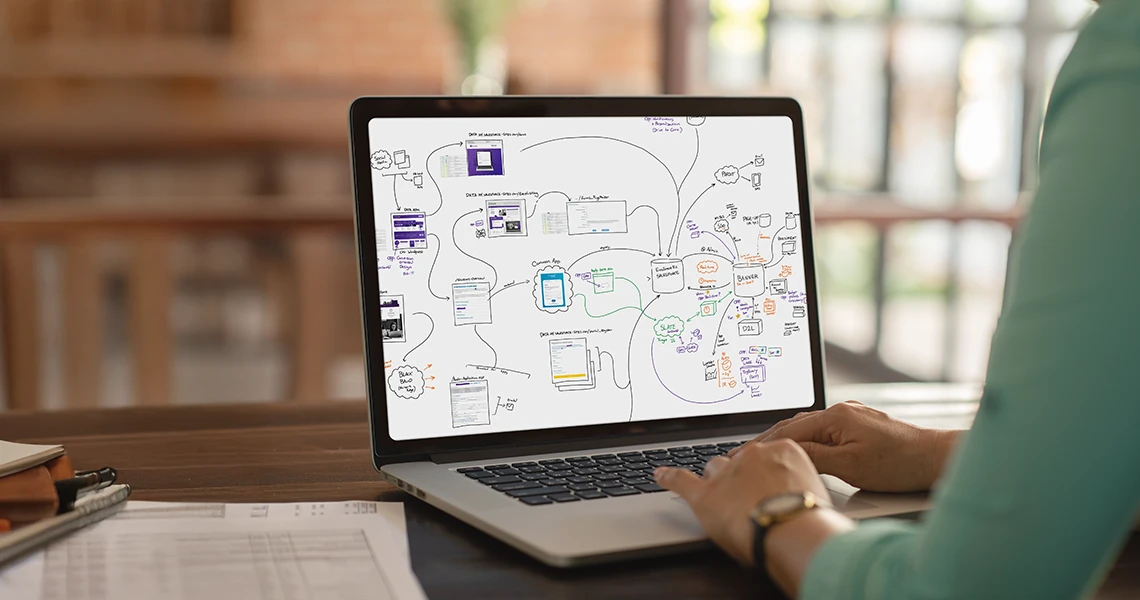
    The napkin sketch is exactly what it sounds like: a back-of-the-napkin-style drawing that quickly maps out how a particular process actually works in your institution so it can be reimagined.

    It’s low-tech, but high-impact.

    Think of it as building a gameboard for players to play. Like a Monopoly board, everyone knows the players, the rules, and the steps. It makes the choices that need to be made for each player’s turn clear.  When these choices are laid out visually, it becomes much easier to pinpoint where the real opportunities (and challenges) are.

    What does the napkin sketch exercise entail?

    I usually start these sessions by asking one simple questions with a key follow-up

    • What’s the opportunity for ‘impact’? (What are you trying to accomplish?)
    • What’s preventing progress?

    Then we get to work. Together, we sketch out the entire process: from first interaction to the final outcome. We account for every step, system, and stakeholder that’s involved. We highlight the costs, the tools and technology handoffs, potential delays, and where things might be falling through the cracks.

    We typically conduct the sketch in a virtual drawing space, where we can collaborate in real time to map out the full process. It’s not about polished visuals — it’s about building a shared understanding of how things operate today.

    And in about 60-90 minutes, we always have at least one person in the group say out loud “I didn’t realize that’s how it actually works.” And another will inevitably ask “You’re going to send us this napkin sketch, right? I want to print it out.”

    Ready for a Smarter Way Forward?

    Higher ed is hard — but you don’t have to figure it out alone. We can help you transform challenges into opportunities.

    What can the napkin sketch reveal?

    In our experience working with hundreds of institutions of all shapes and sizes, we’ve found that many face surprisingly similar challenges. This exercise consistently shines a light on hidden opportunities, creating a blueprint for change.

    Common things we uncover include:

    • Manual, repetitive tasks that could be automated or streamlined
    • Workarounds that have become permanent fixtures without anyone questioning them
    • Disconnects between departments, systems, or technologies
    • Operational silos that prevent teams from seeing the full picture or collaborating effectively
    • Missed opportunities to better track, analyze, or act on data
    • Unclear ownership of key steps in the process

    In short, the napkin sketch helps institutions see what’s really going on — and what needs to change to move forward.

    Why does it work?

    Higher ed innovation often stalls because teams are too close to the problem or too deep in their own silo to see the bigger picture. The napkin sketch breaks through that by creating a space for everyone involved to step back and collaborate.

    Here’s why it’s effective:

    • It’s fast — most sessions take an hour or two.
    • It’s visual — helping teams align quickly and clearly.
    • It’s collaborative — bringing together voices from across departments.
    • It’s actionable — revealing next steps that are grounded in reality.

    Most importantly, it shifts the focus away from jumping to solutions and toward understanding the system. Once you understand the system, smart solutions become much more obvious — and effective.

    Real examples of the napkin sketch in action

    Whether it’s enrollment workflows, transcript processing, student communications, or data handoffs between systems or teams, the napkin sketch exercise can help untangle a wide variety of operational challenges. No two institutions are exactly alike, but many face similar complexities — manual processes, siloed teams, and unclear ownership that stall progress.

    Here are a few discoveries we uncovered in recent napkin sketch sessions I’ve led:

    • One institution realized how many steps were involved in processing transcripts — with staff toggling between platforms, uploading the same file in multiple places, and doing manual comparisons. Once the process was mapped, we explored how AI could handle the course match evaluations — saving hours of staff time each week.
    • Another team sketched out their enrollment outreach process and discovered they were sending multiple conflicting messages to students at the same time. The sketch helped them realign their communications and reduce student confusion.
    • A third school wanted to integrate a new tool into their tech stack, but the sketch revealed that the underlying workflow was broken — and that no tool would help until the foundational process was improved.

    In each case, the aha moment didn’t come from buying something new — it came from clearly seeing what was already happening so it could be improved upon.

    What could your napkin sketch uncover?

    If you’re wrestling with outdated processes, disconnected systems, or unclear handoffs — you’re not alone. Many institutions are trying to drive higher ed innovation with limited resources and overwhelming complexity.

    But you don’t need to have all the answers right now. You just need a clearer view of the problem so you can develop a thoughtful solution.

    That’s what the napkin sketch offers: a simple, collaborative way to map your reality, uncover opportunity, and take a smarter next step forward.

    Let’s sketch it out — and see what we find!

    Ready to uncover what’s holding you back?

    Reach out to schedule your own session and take the first step toward smarter solutions.

    Source link

  • Future-Proofing Your Higher Education Ecosystem ebook

    Future-Proofing Your Higher Education Ecosystem ebook

    Facing challenges in enrollment, retention, or tech integration? Seeking growth in new markets? Our strategic insights pave a clear path for overcoming obstacles and driving success in higher education.

    Unlock the transformative potential within your institution – partner with us to turn today’s roadblocks into tomorrow’s achievements. Let’s chat.

    Source link

  • Impact of Technology on Student Retention Report

    Impact of Technology on Student Retention Report

    Facing challenges in enrollment, retention, or tech integration? Seeking growth in new markets? Our strategic insights pave a clear path for overcoming obstacles and driving success in higher education.

    Unlock the transformative potential within your institution – partner with us to turn today’s roadblocks into tomorrow’s achievements. Let’s chat.

    Source link

  • How To Use AI To Build Toward Impact In Higher Ed [Webinar]

    How To Use AI To Build Toward Impact In Higher Ed [Webinar]

    AI is the latest buzzword in higher ed, but without a clear strategy and solid data, institutions risk overinvesting in additional products, platforms, and applications they can’t fully support or operationalize. Instead, take a step back and ask, “What’s the impact I want to achieve, and how can AI fit or support my broader goals?”

    In this webinar, AI Jumpstart Kit: How to Build Toward IMPACT with AI in Higher Ed, Collegis Education’s AVP of Analytics & Technology Solutions, Dan Antonson, and Senior Director of Strategy and Innovation, Wes Catlett-Miller, will guide attendees through an interactive discussion about how to approach key use cases with AI in higher education. We’ll whiteboard out what an AI-enabled institution can look like, how it all works, and live demo actual AI initiatives Collegis has deployed for its partners.

    No clunky PowerPoint slides. Just a clear path for approaching AI enablement.

    What you’ll walk away with:
    • A thorough understanding of how AI fits into the broader ecosystem (add-ons vs. platform)
    • A model for making decisions on when to build and when to buy
    • A clear understanding of the role tech and data play in AI enablement
    Who should attend:
    • Presidents + Provosts
    • CFOs + COOs + CMOs
    • Enrollment + Marketing leaders

    Source link