Tag: jawboning

  • What I told the Senate Commerce Committee about ‘jawboning’

    What I told the Senate Commerce Committee about ‘jawboning’

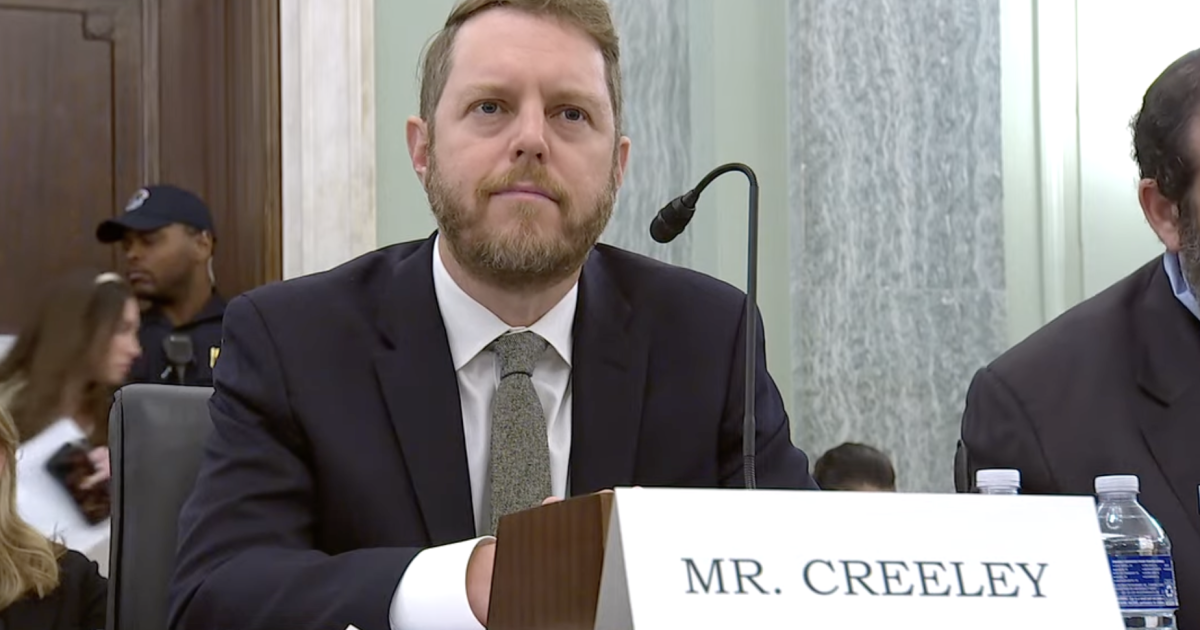
    This prepared statement was delivered before the U.S. Senate Committee on Commerce, Science, and Transportation on Oct. 29, 2025.


    Chairman Cruz, Ranking Member Cantwell, and honorable members of the Committee,

    Good morning, and thank you for the opportunity to testify today. My name is Will Creeley, and I am the legal director of FIRE — the Foundation for Individual Rights and Expression, a nonpartisan nonprofit dedicated to defending the rights of all Americans to free speech and free thought, the essential qualities of liberty.

    I’ve spent nearly 20 years defending the First Amendment rights of speakers from every point on the ideological spectrum. At FIRE, we have one rule: If speech is protected, we’ll defend it.

    Typically, the censorship we fight is straightforward: The government punishes a speaker for saying things the government doesn’t like. That’s a classic First Amendment violation, a fastball down the middle. Unfortunately, that kind of textbook censorship isn’t the only way government actors silence disfavored or dissenting speech.

    Far too often, government officials from both sides of the partisan divide engage in “jawboning” — that is, they abuse the actual or perceived power of their office to threaten, bully, or coerce others into censoring speech. This indirect censorship violates the First Amendment just as surely as direct suppression.

    What is jawboning? And does it violate the First Amendment?

    Indirect government censorship is still government censorship — and it must be stopped.


    Read More

    This isn’t new law. The First Amendment’s prohibition against coerced censorship dates back decades, to the Supreme Court’s 1963 ruling in Bantam Books v. Sullivan. In that case, the Court confronted a Rhode Island state commission that sent threatening letters, “phrased virtually as orders,” to booksellers distributing “objectionable” titles — with follow-up visits from police, to ensure the message had been received.

    The Court held the commission’s “operation was in fact a scheme of state censorship effectuated by extra-legal sanctions; they acted as an agency not to advise but to suppress.” And in the decades since, courts have consistently heeded Bantam Books’ call to “look through forms to the substance” of censorship, and to remain vigilant against both formal and informal schemes to silence speech.

    But government officials regularly abuse their power to silence others, so the lesson of Bantam Books bears repeating. And in deciding National Rifle Association of America v. Vullo last year, the Supreme Court unanimously and emphatically reaffirmed it.

    In Vullo, New York State officials punished the NRA for its views on gun rights by threatening regulatory enforcement against insurance companies that did business with the group and offering leniency to those who stopped. New York’s backdoor censorship was successful — and unlawful.

    This regulatory carrot-and-stick approach was designed to chill speech, and the Court reiterated that “a government official cannot do indirectly what she is barred from doing directly: A government official cannot coerce a private party to punish or suppress disfavored speech on her behalf.”

    A government official cannot do indirectly what she is barred from doing directly.

    To be sure, the government may speak for itself, and the public has an interest in hearing from it. But it may not wield that power to censor. As Judge Richard Posner put it: The government is “entitled to what it wants to say — but only within limits.” Under no circumstances may our public servants “employ threats to squelch the free speech of private citizens.”

    So the law is clear: Government actors cannot silence a speaker by threatening “we can do this the easy way or we can do this the hard way,” as the chairman of the Federal Communications Commission did last month. Nevertheless, recent examples of jawboning abound: against private broadcasters, private universities, private social media platforms, and more. The First Amendment does not abide mob tactics.

    Despite the clarity of the law, fighting back against jawboning is difficult. Targeted speakers can’t sue federal officials for monetary damages for First Amendment violations, removing a powerful deterrent. And as a practical matter, informal censorship is often invisible to those silenced.

    That’s particularly true in the context of social media platforms, as demonstrated by another recent Supreme Court case, Murthy v. Missouri.

    Jawboning betrays our national commitment to freedom of expression.

    Murthy involved coercive demands by Biden administration officials to social media platforms about posts related to Covid-19, vaccines, elections, and other subjects, resulting in the suppression of speech the administration opposed. But the Court held the plaintiffs lacked standing to sue, because the causal link between their deleted posts and the administration’s pressure wasn’t sufficiently clear.

    Murthy illustrates a severe information disparity: Users whose speech is suppressed have no way to know if government actors put their thumb on the scale. Only the government and the platforms have that knowledge, and usually neither want to share it. 

    That’s why FIRE authored model legislation that would require the government to disclose communications between federal agencies and social media companies regarding content published on its platform, with limited exceptions. But transparency is not enough. Federal officials must be meaningfully deterred from jawboning, and held accountable when they do.

    Jawboning betrays our national commitment to freedom of expression. Congress should take action to stop it.

    Thank you for your time. I welcome your questions.
    View FIRE’s full testimony with briefs for the U.S. Senate Committee on Commerce, Science, and Transportation on October 29, 2025

    Source link

  • Carr’s threats to ABC are jawboning any way you slice it

    Carr’s threats to ABC are jawboning any way you slice it

    In 1867, the Supreme Court ruled in Cummings v. Missouri that the state could not use loyalty oaths to bar ex-Confederates from teaching, preaching, or practicing law. The oaths themselves were (at the time) lawful, but Missouri was using them to unlawfully punish past conduct — and that was the problem.

    “What cannot be done directly cannot be done indirectly,” Justice Stephen Johnson Field wrote for the majority. “The Constitution deals with substance, not shadows.”

    Over 150 years later, ABC suspended Jimmy Kimmel hours after FCC Chair Brendan Carr suggested they could face consequences for remarks Kimmel made in the aftermath of Charlie Kirk’s murder.

    Unlike the formal government pressure in Cummings, this was informal government pressure to influence private action, otherwise known as jawboning. But the age-old principle is the same. It was echoed in last year’s landmark jawboning case NRA v. Vullo “a government official cannot do indirectly what she is barred from doing directly.”

    Carr’s defenders try to deny any connection between Carr’s threats and Kimmel’s ouster.

    This has one big problem. Courts have said it doesn’t matter whether a threat produces results. In Backpage.com v. Dart, the Seventh Circuit held that the constitutionality of government conduct turns on what the threat tries to accomplish, not whether it accomplishes it.

    Given that, Carr’s threat still runs headlong into the First Amendment. 

    The bar was laid out clearly in last year’s Vullo: “to state a claim that the government violated the First Amendment through coercion of a third party, a plaintiff must plausibly allege conduct that, viewed in context, could be reasonably understood to convey a threat of adverse government action in order to punish or suppress the plaintiff ’s speech.”

    Let’s see how that squares with the timeline. 


    July 22 – Days after CBS cancels the Late Show with Stephen Colbert, with the question of FCC approval for parent Paramount Global’s merger with Skydance looming large over it, Trump posts:

    August 6 – Trump tells the press pool regarding Kimmel and Late Night host Jimmy Fallon, “They’re next, they’re going to be going — I hear they’re going to be going.” 

    August 11 – Sinclair Broadcast Group shares surge 27% after it announces efforts to explore merger-and-acquisition opportunities in broadcast TV. Any transfer of broadcast licenses requires FCC approval, which FIRE has written extensively about regarding Carr using the government as a “point of leverage.”

    August 19 – Nexstar Media Group, the nation’s largest TV station owner, announces plans to buy rival media giant Tegna in a deal that will require FCC approval and FCC willingness to lift their 39% cap on how many households one company can reach through TV station ownership. Nexstar now has 38.9% of stations covered by the FCC.

    September 4 – The Center for American Rights files a complaint with the FCC over Jimmy Kimmel’s alleged bias and conflict of interest towards Democrats. CAR’s 60 Minutes complaint launched the now infamous FCC probe into CBS, which informed Trump lawsuit, and their complaints against ABC and NBC were revived by Carr early this year. 

    September 10 – Charlie Kirk is murdered while giving a talk at Utah Valley University.

    September 15 – Kimmel says in his opening monologue:

    We hit some new lows over the weekend with the MAGA gang desperately trying to characterize this kid who murdered Charlie Kirk as anything other than one of them and doing everything they can to score political points from it.

    It’s worth noting the accuracy of his statement hinges on whether the “MAGA gang” was trying to avoid association with Kirk’s killer, not on whether the killer was part of the “MAGA gang.” It’s an important distinction when official actions are being considered.

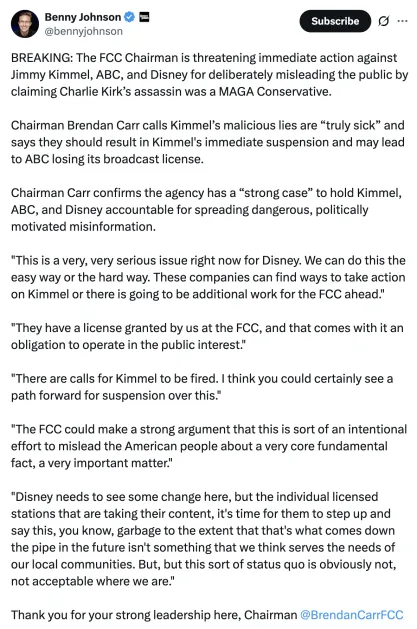
    September 17 – Carr appears on The Benny Johnson Show, with Johnson posting a summary at 1:01 pm, Carr addressing ABC parent Disney says:

    This is a very, very serious issue right now for Disney. We can do this the easy way or the hard way. These companies can find ways to take action on Kimmel or there is going to be additional work for the FCC ahead.

    Carr also addresses the station owners: 

    Disney needs to see some change here, but the individual licensed stations that are taking their content, it’s time for them to step up and say this, you know, garbage, to the extent that that’s what comes down the pipe in the future, isn’t something that we think serves the needs of our local communities.

    Benny Johnson post on X describing interview with FCC Chair Brendan Carr

    6:18 pm – Later that day, it’s reported that Nexstar has said it will suspend Kimmel’s show “indefinitely beginning tonight.”

    6:24 pm – Minutes later, it’s reported that Disney’s ABC says it is pulling the show.

    6:49 pm – Sinclair joins Nexstar in indefinitely suspending Kimmel’s show.

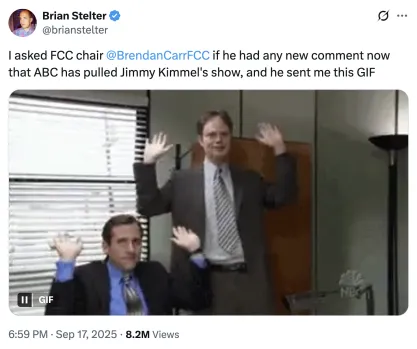
    6:59 pm – CNN reporter Brian Stelter says when asked about ABC pulling Kimmel’s show, Carr sent him a celebratory GIF:

    Brian Stelter post on X.com: "I asked FCC chair @BrendanCarrFCC if he had any new comment now that ABC has pulled Jimmy Kimmel's show, and he sent me this GIF"

    7:00 pm – Carr writes on X, “I want to thank Nexstar for doing the right thing … I hope that other broadcasters follow Nexstar’s lead.”

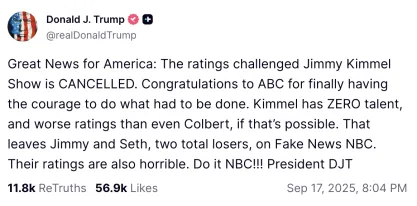
    8:04 pm – Trump celebrates:

    Donald Trump post on Truth Social celebrating the cancellation of Jimmy Kimmel's show

    8:38 pm – Sinclair says its ABC stations will air a special remembrance of Charlie Kirk this Friday during Jimmy Kimmel Live’s timeslot, adding: “Sinclair also calls upon Mr. Kimmel to issue a direct apology to the Kirk family. Furthermore, we ask Mr. Kimmel to make a meaningful personal donation to the Kirk Family and Turning Point USA.”

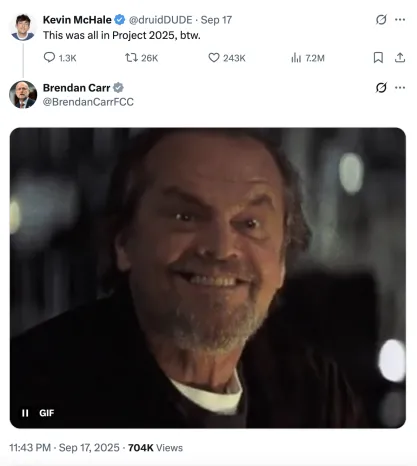
    11:43 pm – Carr responds to a post on X saying, “This was all in Project 2025, btw”:

    Brendan Carr GIF response to post on X.com claiming that Project 2025 called for cancelling late night hosts

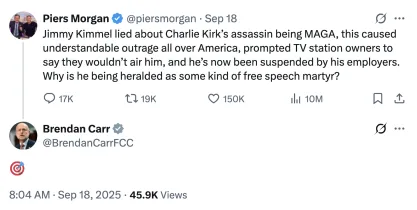
    September 18 – Carr replies to a post from British commentator Piers Morgan, attributing Kimmel’s suspension to “outrage all across America.” It’s difficult to find evidence of “outrage all across America” before September 17. 

    Brendan Carr responds to a Piers Morgan post on X claiming Jimmy Kimmel lied about Charlie Kirk with a dart hitting a bullseye

    That’s the timeline, so let’s break it down.

    Carr tells ABC that “we can do this the easy way or the hard way” and that “there’s going to be additional work ahead for the FCC” if they don’t “take action.” There’s the threat and the adverse action — possibly in the form of an FCC probe into Carr’s complaint — if they don’t accede to the threat. 

    We also see Carr prompt affiliate station owners like Nexstar and Sinclair — seeking regulatory favor in pressing business before the government — to dial up the pressure on Disney in the lead up to Kimmel’s ouster. The specter of disfavorable treatment from the government poisons the chain from top to bottom. Finally, Trump and Carr celebrate after ABC suspends Kimmel indefinitely. 

    Asked to respond to those condemning him for “bullying ABC” on The Scott Jennings Show, Carr says “we’re reinvigorating the public interest standard for broadcasters. If people don’t like that … If  you’re a broadcaster and you don’t like being held accountable for the first time, in a long time, to your public interest standard, you can turn your broadcast license in to the FCC.”

    The public-interest standard is the nearly century-old mandate that broadcasters use the spectrum medium in service of the public. But the FCC’s public-interest standard has never made it okay to censor people. Even the FCC clearly states in no uncertain terms that “the public interest is best served by permitting free expression of views.”

    That’s because the public interest standard is a creature of statute, subordinate to the Constitution and the First Amendment. The FCC’s governing rules accordingly deny the FCC “the power of censorship” as well as the ability to promulgate any “regulation or condition” that interferes with freedom of speech.

    And Carr has long understood this. As he wrote in 2019, “The FCC does not have a roving mandate to police speech in the name of the ‘public interest.’”

    He’s not alone either. 

    Republican members of Congress leading telecommunications regulation share his familiarity with the limits on the FCC’s power to regulate speech, as demonstrated by their cold reception to his recent threats. Brett Guthrie, chair of the House Committee on Energy and Commerce, said: “We have to be extremely cautious to try to use the government to influence what people say.” 

    Senator Ted Cruz, chair of the Senate Committee on Commerce, Science, and Transportation, was more explicit. “That’s right out of Goodfellas. That’s right out of a mafioso coming into a bar going, ‘Nice bar you have here. It’d be a shame if something happened to it’” he said, referring to Carr’s threats.

    He went on to make an important point, recognizing that Carr’s “dangerous as hell” action was setting a troubling precedent because his Republican Party won’t always hold the keys to the FCC. 

    Three years ago, Carr wrote: “The government does not evade the First Amendment’s restraints on censoring political speech by jawboning a company into suppressing it—rather, that conduct runs headlong into those constitutional restrictions, as Supreme Court law makes clear.” 

    That’s exactly right, and if anyone knows what Brendan Carr is doing right now is unconstitutional jawboning — it’s Brendan Carr, as the record clearly shows.

    Source link