ALLOWAY TOWNSHIP, N.J., Nov. 20, 2025 — A local school board member’s Facebook post to community members about a tax hike should have started a conversation — instead, it led to censorship.
The Foundation for Individual Rights and Expression is suingthe commissioner of New Jersey’s Department of Education and members of the state’s School Ethics Commission to stop them from abusing a law to chill the speech of an elected school board member who used social media to seek her constituents’ input.
“I didn’t join the school board to be told to shut up,” said Gail Nazarene, an elected school board member, Navy veteran, and grandma in Alloway Township. “New Jersey officials claim the authority to punish me simply for asking folks questions about important issues, particularly when it affects their wallets. I should be free to communicate with constituents and get their views without being censored by state officials.”
In April, Gail used Facebook to discuss tax increases and other school issues with constituents. In one post, she asked, “As a resident of Alloway, I am wondering what other residents think about a 9-15% school tax increase?” She clarified in her later posts that she was asking in her personal capacity. But another school board member saw the posts and filed a complaint against her, claiming Gail had violated New Jersey’s School Ethics Act because she allegedly had spoken on the board’s behalf. The complaint is pending before the state’s School Ethics Commission.
“Americans deserve to know what their elected officials think about important issues,” said FIRE attorney Daniel Zahn. “New Jersey is muzzling elected officials and preventing them from talking with their community, the very people they were elected to represent.”
The state broadly interprets the School Ethics Act to bar elected officials from discussing issues relating to schools on social media. And this isn’t the first time it’s done so. The School Ethics Commission has previously warned elected officials against engaging with constituents on social media and previously interpreted the act to prevent elected school board members from discussing matters of public concern on social media and in op-eds.
But the First Amendment protects Gail’s right to speak freely on such issues.
Gail has stopped soliciting constituent feedback online. She fears any posts about school board issues will lead to punishment, including reprimand, censure, suspension, or removal. But she also is concerned about the loss of First Amendment freedoms for her and her constituents.
“When the state silences school board members, parents and taxpayers are kept in the dark,” said FIRE attorney Greg Greubel. “The School Ethics Act can’t be turned into an unconstitutional gag rule.”
Today’s federal lawsuit asks the court to declare New Jersey’s School Ethics Act unconstitutional as interpreted by the state and stop its use against elected officials speaking out about public issues.
The Foundation for Individual Rights and Expression (FIRE) is a nonpartisan, nonprofit organization dedicated to defending and sustaining the individual rights of all Americans to free speech and free thought — the most essential qualities of liberty. FIRE educates Americans about the importance of these inalienable rights, promotes a culture of respect for these rights, and provides the means to preserve them.
Senate lawmakers on Monday advanced legislation that would launch the most comprehensive overhaul of New Jersey’s regulation of charter schools in 30 years.
The bill advanced by the Senate Education Committee on Monday would outright ban for-profit charter schools, require them to post a range of documents online, and impose residency requirements for some charter school trustees.
“We have not looked at charter schools as a whole legislatively in this committee since the 1990s, so this is an opportunity where we’re trying to do that,” said Sen. Vin Gopal (D-Monmouth), the panel’s chair and the bill’s prime sponsor.
The bill comes as New Jersey charter schools have faced scrutiny after reporting revealed top officials were paid far more than their counterparts at traditional public schools, including, among others, a Newark charter school CEO who was paid nearly $800,000 in 2024.
The proposal, which Gopal said was the product of a year of negotiations, would require charter schools to post user-friendly budgets that include the compensation paid to charter school leaders and school business administrators. They must also post existing contracts.
Charters would be required to post meeting notices, annual reports, board members’ identities, and facility locations online. Some critics have charged that charter schools routinely fail to provide notice of their public meetings.
The legislation would also require the state to create a dedicated charter school transparency website to host plain language budgets, 990 disclosure forms filed with the IRS, contracts with charter management organizations, and a list of charter schools on probation, among other things.
It would also ban fully virtual charter schools.
“We support the bills as a step forward in holding all public schools in our state accountable for fiscal and transparency requirements that will ultimately best serve our students,” said Debbie Bradley, director of government relations for the New Jersey Principals and Supervisors Association.
The two sides remained at odds over the membership of charter school boards.
Charter critics argued residency for those positions — which, unlike traditional public school boards, are largely appointed rather than elected — should mirror those imposed on regular public schools.
In New Jersey, school board members must live in the district they serve. That’s not the case for charter schools, whose trustees face no residency or qualification limits under existing law.
The bill would only impose a residency requirement on one-third of a charter school’s trustees, and rather than forcing them to live in the district, the bill would require charter trustees to live in the school’s county or within 30 miles of the school.
That language was criticized by statewide teachers union the New Jersey Education Association, which has called existing law governing charter schools outdated and flawed.
“School board representation should remain primarily local, and when we mean local, we don’t mean within a 30-mile radius. A 30-mile radius of Newark could include Maplewood, South Orange, communities that don’t necessarily represent what Newark looks like as a community,” said Deb Cornavaca, the union’s director of government relations.
Charter school supporters said their boards need flexibility because their leadership has broader responsibilities than counterparts in traditional public schools.
“Running a charter is a little different than running a traditional district. You need experience in school finance. You need to fundraise a bunch of money on the front end because you’re not getting paid on the front end,” said New Jersey Charter School Association President Harry Lee, adding they also needed familiarity with real estate and community experience.
Amendments removed provisions that would have required charter school board members to be approved by the state commissioner of education, though the commissioner retains sole power over whether to allow the formation of a new charter, a power that gives the commissioner some veto power over a charter’s board.
Gopal acknowledged the 30-mile residency rule was a sticking point and said legislators would discuss it before the measure comes before the Senate Budget Committee. Earlier, he warned the bill was likely to see more changes as it moved through the Legislature.
Some argued enrollment in charter schools should be more limited by geography, arguing that out-of-district enrollments that are common at New Jersey charters could place financial strain on the students’ former district.
Most per-pupil state and local funding follows students who enroll in charter schools, even if their departure does not actually decrease the original district’s expenses because, for example, those schools still require the same number of teachers and administrators.
Charter operators said that would make New Jersey a national outlier and argued that a separate provision that would bar new charter schools when there are empty seats in existing area charters should come out of the bill.
“It could be read as a moratorium on charters, so we want to revisit that provision,” Lee said.
Such vacancies could exist for various reasons, they argued, including student age distributions.
Alongside that measure, the panel approved separate legislation that would bar charter schools from setting criteria to enroll students, ban them from imposing other requirements on a student randomly selected to attend, and place new limits on how such schools can enroll children from outside their district.
That bill would also bar charter schools from encouraging students to break with the district. Some opponents have charged that charter schools push out low-performing students to boost their metrics.
The committee approved the bills in unanimous votes, though Sens. Owen Henry (R-Ocean) and Kristin Corrado (R-Passaic) abstained from votes on both bills, saying they are broadly supportive but need more time to review amendments.
New Jersey Monitor is part of States Newsroom, a nonprofit news network supported by grants and a coalition of donors as a 501c(3) public charity. New Jersey Monitor maintains editorial independence. Contact Editor Terrence T. McDonald for questions: [email protected].
Did you use this article in your work?
We’d love to hear how The 74’s reporting is helping educators, researchers, and policymakers. Tell us how
Caldwell has served as president of Centenary University since 2023.
Eduardo Munoz Alvarez/Getty Images
As running mate to Governor-elect Mikie Sherrill, Centenary University president Dale Caldwell, a Democrat, won the New Jersey gubernatorial race on Tuesday in a 56 percent–to–43 percent victory over Republicans Jack Ciattarelli and James Gannon.
“Every single day of this campaign has been a reminder of what a special place New Jersey is,” Caldwell wrote on X Wednesday. “I’m humbled and honored to be your next Lieutenant Governor.”
Caldwell has served as president of Centenary, a Methodist university in Hackettstown, N.J., since 2023. Prior to assuming the presidency, he served on Centenary’s board, and he is also a pastor at Covenant United Methodist Church in Plainfield. Caldwell was the university’s first Black president and in January will become New Jersey’s first Black lieutenant governor.
“Centenary University would like to congratulate Gov. Elect Mikie Sherrill and Lt. Gov. Elect Dale Caldwell, Ed.D., on their victory in the recent New Jersey gubernatorial election,” university officials wrote in a statement Wednesday.
Centenary officials have not yet announced who will serve as interim president or their plans to find a permanent replacement when Caldwell departs in January.
New Jersey City University has signed a definitive agreement to become part of nearby Kean University, the institutions announced in a joint press release Wednesday.
The agreement — approved unanimously by both universities’ governing boards — is subject to accreditor approval by the Middle States Commission on Higher Education as well as by state and federal regulators. Officials expect the merger to be completed by July.
Once complete, NJCU will become “Kean Jersey City.” The two public institutions signed a letter of intent to merge in May after recent years of financial and governance turmoil at NJCU.
Under the merger terms, Kean will take on NJCU’s assets and liabilities. It will also honor NJCU students’ academic credits, need-based financial aid commitments and merit scholarships if they transition to Kean. Once they do, students will pay Kean’s tuition and fee prices, which amounted to $15,300 for full-time undergraduate students in the 2025-26 academic year.
A steering committee will oversee the next steps of the merger, including the complicated work of academic and operational integration, as well as navigating regulatory and governmental reviews.
As part of the agreement, NJCU students will gain access to Kean’s student services, clubs and organizations after the merger.
As for student sports, the agreement establishes a separate advisory committee to look at athletic programming at NJCU post-merger. The university currently competes in more than a dozen NCAA Division III sports, including men’s basketball, women’s softball, and men’s and women’s volleyball and track and field. The committee is expected to make its final report to Kean’s president in December.
As part of the fiscal 2026 state budget, New Jersey lawmakers lined up $10 million for Kean to help fund its merger with NJCU. The money is to help with feasibility studies, planning and legal work as the two institutions integrate.
NJCU’s board voted in March to pursue a merger with Kean. The move came after years of financial distress followed by recovery and turnaround work led by Andrés Acebo, who joined NJCU as interim president in January 2023 before being named permanent president this September.
About six months prior to his appointment, NJCU had declared a financial emergency. Declining enrollment and funding shortfalls led the university to increase scholarships, add academic programs, and spend more on student services and real estate expansions. Those moves failed to turn enrollment around and “instead served to dramatically increase NJCU’s expenses,” New Jersey’s comptroller said in 2023.
But by fall 2024, Fitch Ratings lifted the NJCU’s outlook from negative to stable, with analysts citing “significant progress toward achieving fiscal balance despite continued pressure on student enrollment.” The improvements were the product of both state aid and cost cutting at the institution.
In fall 2023, NJCU’s student headcount stood at 5,833 students, down 27% from 2018 levels, according to federal data. By fall 2024, the university’s total enrollment fell another 6% year over year, though first-year, full-time students grew by 3% and transfers surged 28%, NJ.com reported.
In a statement Wednesday, Acebo said the merger with Kean represents “a significant milestone in a process designed to secure the future of our institution and the communities we have proudly served for nearly a century.”
This audio is auto-generated. Please let us know if you have feedback.
At LEAP Academy University School — a K-12 public charter school in Camden, N.J. — parents are required to volunteer at the school for 40 hours over the academic year.
School officials say volunteer engagement builds strong home-school connections and helps LEAP — which stands for Leadership, Education and Partnership — better understand and respond to parents’ needs. Parents, meanwhile, say volunteering gives them more voice and authority in school activities and helps build trust among the school community.
“The child sees that the parent trusts the school, and the parent is learning from the school and getting resources from the school,” says Cheree Coleman, a parent of rising 8th and 9th graders. “So now the student looks at the school like, ‘This is family. This is a place that I can go if I can’t get help from my parents or, you know, other resources.’ It’s stability.”
The school works with families to try to ensure the 40-hour requirement is not burdensome. Maria Cruz, director of LEAP’s Parent Engagement Center, says school leaders work with each family to find ways for them to help out within their own schedules or situations. Students’ relatives can also contribute to the families’ volunteer hours.
Volunteer hours can be gained by participating in any event at the 1,560-student school, including reading to students, planning special events, fundraising, attending parent workshops, serving on committees, sending emails to school groups, or any other activity that supports school efforts.
Cruz adds that while the school tracks the volunteer hours, no student would lose their spot if their family failed to meet the 40 hours.
“We work with them” to fill the hours, Cruz says. “We don’t tell them that the volunteer hours are mandatory. The word ‘mandatory’ is kind of like a negative term for them, so we don’t use it. We talk to them, let them know that the reason why we’re doing the volunteer hours is so they can be engaged in the school.”
The school, founded in 1997, has a long history of parent engagement, says Stephanie Weaver-Rogers, LEAP’s chief operation officer. “We opened based on parent needs so parents have always been integral and we are very focused on having parents involved in every aspect of the school.”
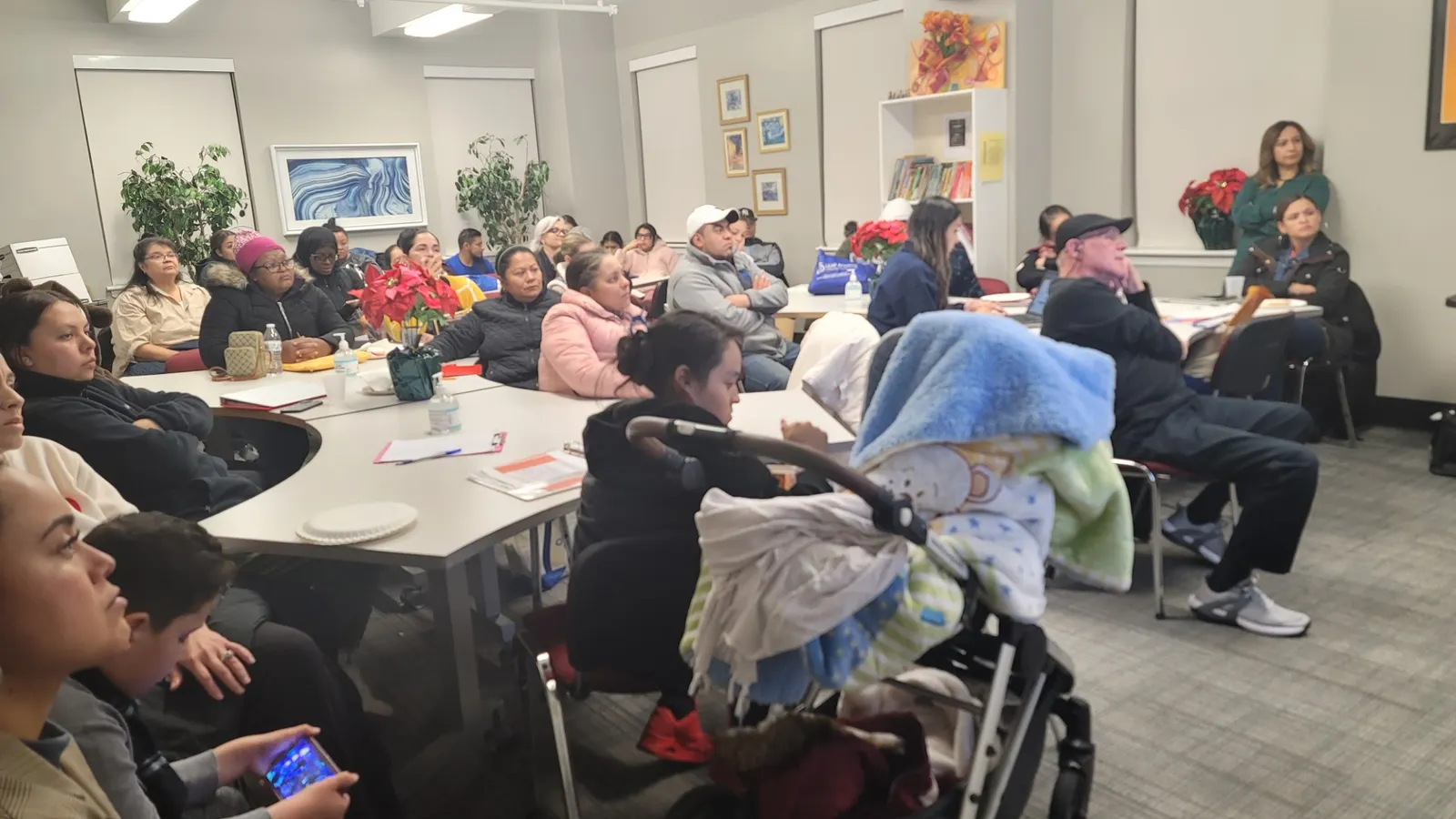
Parents attend a workshop on special education topics at LEAP Academy University School in Camden, N.J. in May 2025.
Permission granted by LEAP Academy University School
Educating students and parents
In addition to volunteering, the school engages parents through workshops specifically for them. Held weekly at the school, these optional parent workshops offer learning on a variety of topics and skills, such as homeownership, English language, employment, nutrition and technology.
Along with the free classes, parents get dinner, child care and parking also at no charge, Cruz says. She and other school staff work to recruit experts in the community — including other parents — to lead the classes.
The skills-based classes help parents “move forward” in their lives “and also help them better themselves for their children,” Weaver-Rogers says.
To further parent engagement efforts, the school encourages parents to apply for open positions, but Cruz noted that hires are made based on skills, experience and job fit. Currently, approximately 10-15% of LEAP staff are parents of current or former students.
Having parents on staff has several benefits, Weaver-Rogers said. It can give parents “a step up economically.” Plus, students behave better knowing their parents or their friends’ parents are in the building.
“It’s an all-around win,” Weaver-Rogers says.
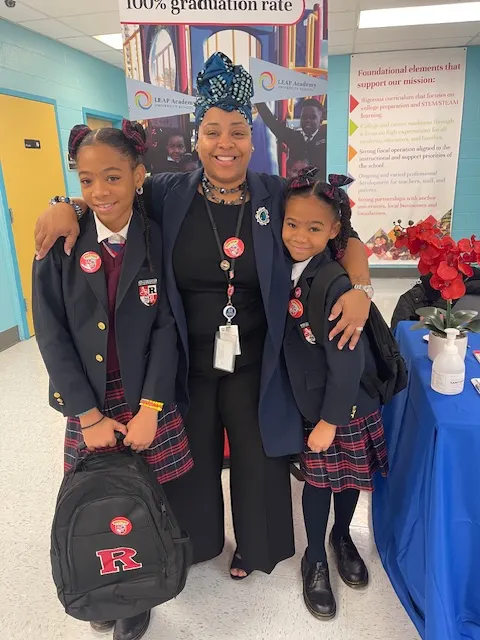
Cheree Coleman and her daughters Cy’Lah Coleman (left) and Ca’Layla Coleman attend a school ceremony on May 29, 2024, at LEAP Academy University School in Camden, N.J.
Permission granted by Cheree Coleman
Coleman, who worked at the school as a parent ambassador for three years, adds, “What I love the most when it comes to the parent engagement with LEAP Academy is the fact that they don’t just educate the student, they educate the parents as well.”
Being engaged in the community
The home-school connections at LEAP don’t end at graduation. The school, which has four buildings within two blocks, makes efforts to stay in touch with and support alumni through job awareness efforts, networking opportunities and resources for struggling families.
Coleman says LEAP staff and families have also supported students and families in need at other schools in the community.
The school opens its doors to the public for certain school events and celebrations — for instance, with community organizations and government service providers setting up information tables, Cruz says.
Hector Nieves, a member of the school’s board of trustees and chair of the parent affairs committee, says parents are encouraged to bring friends, neighbors and family to some school get-togethers, especially those held outside to accommodate larger crowds. “We have music. We have all kinds of games for the kids. There’s dancing,” he says.
Cruz added that this “all are welcome” approach helps the school recruit new students, too.
The whole school community participates in LEAP Academy University School’s holiday fundraiser, last held Dec. 5-14, 2024, at the school in Camden, N.J.
Permission granted by LEAP Academy University School
Additionally, LEAP’s partnership with Rutgers University provides support to families for their children from birth through postsecondary education. LEAP is located along Camden’s “Education Corridor,” which includes campuses for Rutgers University-Camden and Rowan University. Both Rutgers and Rowan provide dual enrollment, early college access and other learning opportunities for LEAP students.
Nieves, who had three children graduate from LEAP — including one who now teaches English at the school — says the holistic approach of serving students and families has empowered the school community over the years and helped families improve their financial situations.
“I believe that somehow, whether they came and worked here, we gave them classes, we helped them along, all of a sudden, I see this growth,” says Nieves. “I believe we had a lot to do with that.”
This audio is auto-generated. Please let us know if you have feedback.
SEATTLE — For almost a decade, Hamilton Township Public Schools in New Jersey has seen major gains in chronic absenteeism — despite the bumps that came with the COVID-19 pandemic.
During the 2016-17 school year, 21 of the district’s 23 schools exceeded the state’s average chronic absenteeism rates, said Mary Beth Currie, coordinator of special projects at the New Jersey Principals and Supervisors Association.
With the help of a grant-funded initiative at the association’s Foundation for Educational Administration, Hamilton Township Public Schools eventually changed course. As of June 2025, only two of its 23 schools surpass the statewide average for chronic absenteeism, Currie said.
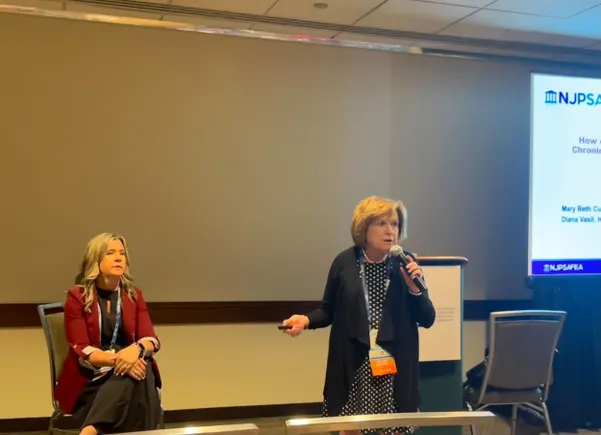
Currie and Kisthardt Elementary School Principal Diana Vasil shared how the FEA’s partnership with Hamilton Township Public Schools contributed to a long-term drop in chronic absenteeism rates during a Friday session at UNITED, the National Conference on School Leadership in Seattle.
A team-based approach to boosting attendance
In 2018, FEA received a $10,000 grant from the Princeton Area Community Foundation to create a plan to combat chronic absenteeism in the district, Currie said. Later on that year, FEA received an additional five-year $30,000 grant from the foundation to carry out the plan across all 23 schools at Hamilton Township.
FEA hired coaches to meet monthly with every school to help address their chronic absenteeism rates, Currie said. FEA trained the coaches beforehand on best practices in English language arts and math, legal knowledge on attendance, climate and culture, and data analysis, she added.
Then, FEA helped each school identify members for their own “Be There Team,” a group focused on school climate and attendance. The teams often included school leaders, nurses, counselors and teachers, Currie said. The FEA coaches met with these teams to identify student target groups and develop action plans based on Attendance Works’ tiered approach for combatting chronic absenteeism.
During the first school year of the program’s implementation in 2018-19, Currie said, attendance soared while chronic absenteeism fell significantly. That trend continued into the first semester of the 2019-20 school year until the COVID-19 pandemic began in March 2020. Once the pandemic hit, FEA modified its plan and shifted all of its meetings to be virtual gatherings with coaches and central office administrators.
When students returned to in-person classes in 2021-22, attendance dropped in line with national trends, Currie said. But as the in-person coaching and team meetings picked back up, attendance began to rebound again in 2023-24 as did the district’s climate and culture, she added.
In fact the district’s chronic absenteeism rate fell by 3.9% between the 2021-22 and 2023-24 school years — a decline from 18.4% to 15.2%, said Vasil. RAND Corp. and the Center on Reinventing Public Education estimated that 19% of students were chronically absent nationwide during the 2023-24 school year.
One elementary school’s approach
Vasil, who was principal at Sayen Elementary School from 2019 to 2025, said her previous school’s Be There Team was already established before she was hired into the role.
As Vasil’s team explored how to address the school’s chronic absenteeism rates, she said, it was important to remember that fixing attendance isn’t just about getting students in the door. “It’s getting them to want to come tomorrow.”
To better understand the root of the school’s attendance problem, Vasil’s team did a deep dive scoring their school’s climate using a rubric and found there was a lot of work needed to improve school culture. In 2019-20, the team identified three areas they needed to address: the school’s mission statement, its social-emotional learning programs and professional norms for staff, she said.
Vasil said that the team was able to meet their goals during the pandemic by revisiting and tightening the school’s mission statement, consolidating the school’s many scattered SEL programs, and establishing a set of professional norms for staff meetings to ensure everyone has a voice.
As the team worked toward improving the school’s climate, parents talked to the school about what they wanted in the mission statement. Teachers established their own norms in meetings, and students shared what SEL programs and activities they liked, Vasil said.
Because of this work, Vasil said, the school saw a more positive climate and culture, especially after the pandemic, which was a key factor for boosting attendance. She added that another contributor to the school’s success in tackling chronic absenteeism was the school’s ability to monitor student attendance over time and by grade level. The FEA coaches, community partnerships and improved communication with families also helped, she said.
Sayen Elementary saw its chronic absenteeism rates jump from 7.2% to 15.1% between 2018-19 and 2022-23 as a result of the pandemic, Vasil said. By the 2024-25 school year, however, that figure dropped below prepandemic levels to 6.2%.
“Everyone that’s involved in our school community, they all had a voice,” in helping address issues of school culture and ultimately chronic absenteeism, Vasil said.
New Jersey students with disabilities are the least likely in the nation to spend their days surrounded by peers without disabilities.
One underlying reason: a sprawling network of separate schools that allows districts to outsource educating them.
New Jersey has more than a hundred private schools, plus eight county-run districts specifically for students with disabilities.
Districts spend hundreds of millions of dollars placing students in private schools rather than investing in their own staffing and programs — placements that cost New Jersey taxpayers $784 million in 2024, not including transportation. That’s up from about $725 million the year before. This can create a self-perpetuating cycle that increases reliance on separate schools and, experts say, may violate students’ federal right to spend as much time as possible learning alongside students without disabilities.
In many cases, parents say school administrators are too quick to send children out of district and pressure families to agree to those settings. Other times, parents choose to send their child to a separate school, sometimes feeling that they have no choice after repeatedly failing to get their kids the help they need in their local school.
“Whatever it is that their kids need within the district, they’re not getting,” said special education parent and advocate Amanda Villamar, who works with families throughout New Jersey. “The question becomes: Why are these services in private schools and not necessarily integrated into our public school system?”
In all, about 30,000 students with disabilities in New Jersey — or 13 percent— attend separate private or public schools, according to The Hechinger Report’s analysis of federal data. That’s the highest percentage in the country. Nationwide, 4 percent attend separate schools.
New Jersey’s history of failing to include children with disabilities in public school classrooms dates back to the 1910s. That’s when the state began promoting separate schools for students with disabilities as a more humane alternative to barring them from schools altogether.
Nationwide, only 1 in 5 students with disabilities were enrolled in the public school system in the 1970s, when Congress passed the Individuals with Disabilities in Education Act or IDEA. The law enshrines integration by saying students with disabilities have a right to learn alongside students without disabilities to the “maximum extent” possible and that they should be placed in the “least restrictive environment.”
Across the nation, parents and children fought state laws excluding students with disabilities from public schools — with fights in Washington D.C. and Pennsylvania fueling the passage of IDEA. It wasn’t until 1992 that New Jersey repealed its statutes allowing public schools to exclude “untrainable” children with disabilities. By then, separate schools were an integral part of the state’s highly decentralized education system, which today comprises roughly 600 districts.
New Jersey Department of Education officials said the state is committed to ensuring students with disabilities are in the most appropriate school setting based on individual needs, and that includes out-of-district programs.
“New Jersey is uniquely positioned in this regard, with a longstanding infrastructure of out-of-district options and many small local public school districts,” department spokesman Michael Yaple said in an email. “These and other factors have contributed to the state’s historical reliance on a wide array of specialized programs designed to offer diverse, individualized educational options for students with disabilities.”
The rate at which New Jersey school districts place students in separate schools has declined over the past two decades. In the same period, however, more parents chose to send their children to private schools, sometimes because they felt they had no other viable options.
Some parents say there are significant trade-offs when their child leaves their district school.
Ellen Woodcock’s son, a fifth grader, attends a county-run school for students with disabilities where she says teachers understand his autism much better than they did in her home district.* Despite her son’s fascination with geography, however, teachers spend little time on science or social studies. The school has no library, and the day ends an hour earlier than his district elementary school. School staff focus on teaching social skills, but he’s lost the chance to model the behavior of peers without disabilities.
Left out
New Jersey has the nation’s lowest inclusion rates for students with disabilities. The Hechinger Report investigated why — and visited places that show how it doesn’t need to be that way.
Do you have experiences with special education you’d like to share with our journalists?
“I feel like he’s not being challenged, like he’s kind of pigeonholed,” Woodcock said. “We just felt like we didn’t have a choice.”
Her son spent kindergarten through second grade learning in general education classrooms at his local neighborhood school in Haddonfield, New Jersey, and she was happy with the social and academic progress he was making. In third grade, however, things changed. The school shifted him into a separate classroom for significant parts of the day. Woodcock said school staff seemed unable, or unwilling, to address how his autism affected his learning and provide the right support to account for it. She felt he was unwanted.
In the middle of fourth grade, she said she reluctantly transferred him to a specialized school where he spent his day with other students with autism.
“It was almost out of desperation,” Woodcock said. “It was like, let’s get him out of the school district, because we feel like they can’t support him. It was a fight all the time to get him what he needed.”
Haddonfield district officials said privacy laws prevent them from commenting on individual students but noted that the percentage of students with disabilities who spend almost all of their time in general education classrooms is significantly higher than the state’s average. About 69 percent of Haddonfield students with disabilities spend at least 80 percent of the school day in general education classrooms, compared with 45 percent statewide, according to state Education Department data.
“We are proud of our inclusive practices and the strong sense of belonging we strive to create for all students,” district officials said in a statement. “The least restrictive environment can look different for each student.”
In Haddonfield, 19 percent of parents with students with disabilities choose to enroll their children in private schools, compared with 7 percent statewide.
Woodcock decided to move her son back to the district next year, where he’ll start sixth grade at the local middle school. She understands that her son may need to be pulled out of class to learn a subject like math in a special education resource room — but she believes he can, and should, learn in general education classrooms as well.
Under IDEA, students with disabilities should be placed in separate schools or classes only if their disability makes it too difficult for them to learn in a regular classroom, even with extra help and support. A team made up of a child’s parents, teachers, school district officials and, when appropriate, the child, decide on a placement together and must review it each year.
The federal Department of Education says those teams have to make this decision based on an individual child’s needs — not solely because of the kind of disability, how significant the child’s needs are or whether the school has the money or the staff. In New Jersey, however, some parents say schools too often determine placement on a child’s diagnosis alone.
Observers, including special education advocates and attorneys, say school districts and leaders of separate schools tend to argue it would be too difficult for all of New Jersey’s hundreds of public school districts to provide services for all types of disabilities. That’s fueled a reliance on private and county-run separate schools, many of which have classrooms or programs focused on a specific disability, such as autism or dyslexia, with specially trained teachers.
Districts sometimes launch specific special education programs — applied behavioral analysis classrooms for students with autism, for example — only to abandon them after challenges paying for them or finding qualified staff, said Paul Barger, a special education lawyer in Irvington, New Jersey.
“Instead of continuing to develop their own programs in the districts, they went ahead and just said they’re placing out into state-approved private school programs,” Barger said.
Returning some students with disabilities to in-district schools would require more money. Lawmakers in New Jersey are debating the governor’s proposal to boost funding for special education services in public schools by $400 million for the next school year. Advocates say that’s an opportunity to build stronger special education systems in public schools. The governor also proposed flat funding of $420 million for private school tuition payments for students with disabilities.
Some parents, unhappy with the services they see in public districts, prefer private schools: A growing number pay for their children to attend. That’s despite the fact that those parents who choose private schools lose federal protections, including the rights to raise formal complaints.
ASAH, the group representing New Jersey private schools for students with disabilities, which enroll more than 10,000 students, points out the lack of special education services in public districts. It tells parents that poorly trained paraprofessionals in public schools can be stigmatizing, and placing students in self-contained classrooms doesn’t make students feel valued or included. The group, formerly known as the Association of Schools and Agencies for the Handicapped, argues private schools may not be more costly to the state than public schools once pensions are factored in.
Students with disabilities have the right to options like private schools, the association’s executive director John Mulholland said in an interview.
“It really is an individualized determination, and merely just being a part of your home district isn’t always a least restrictive environment,” he said.
Unlike for public schools, the federal government doesn’t collect data from private schools about how often their students interact with peers without disabilities. According to the association’s recent study of 5,300 students served by ASAH schools, 262 students planned to leave their private schools in the 2022-23 school year to return to their home district. That report suggests such a move was less likely for children with autism and multiple disabilities.
Mulholland said private schools may offer some interaction with students without disabilities through community service or sporting events. His association’s analyses have found that students who start at a private school earlier are more likely to return to their public school district.
“If students come to us younger, they can get the intensive support they need or return to their school districts — many of our members pride themselves on that turnaround,” Mulholland said.
Nicole Lannutti, of Washington Township in Gloucester County, said her daughter Sophia, who is non-verbal and has multiple disabilities, attended a private preschool for one year at a cost to the district of roughly $90,000. (New Jersey requires school districts to provide preschool for students with disabilities.)
Lannutti pushed to get Sophia into the public school system for a second year of preschool and then elementary school, where she said her daughter thrived in a school that prioritized inclusion. But that changed in middle school, where her mom says she’s had to push to have her daughter included even in lunch, recess and extracurricular activities. Washington Township school district did not respond to requests for comment.
Lannutti said her local public school is still the most appropriate setting for her child, who will enter seventh grade in the fall and has made friends by participating in the school play. The school agrees, and said as much in her education plan. Lannutti said private schools play an important role, but public schools should work harder to serve more students and fulfill their civil right to an education. “When it comes to my kid, it’s not that she should go because this district can’t handle it,” Lannutti said. “They should learn how to do it.”
*Correction:This story has been updated to correct Ellen Woodcock’s son’s current grade level.
The Hechinger Report provides in-depth, fact-based, unbiased reporting on education that is free to all readers. But that doesn’t mean it’s free to produce. Our work keeps educators and the public informed about pressing issues at schools and on campuses throughout the country. We tell the whole story, even when the details are inconvenient. Help us keep doing that.
CINNAMINSON, N.J. — Terri Joyce believed that her son belonged in a kindergarten classroom that included students with and without disabilities.
The year before, as a 4-year-old, he happily spent afternoons in a child care program filled with typically developing children, without any extra support. Like other kids his age, her son, who has Down syndrome, was learning about shapes and loved sitting on the rug listening to the teacher read books aloud. His speech delay didn’t prevent him from making friends and playing with children of differing abilities and, during the summer, he attended the same program for full days and would greet her with big smiles at pick up time.
But when Joyce met with school district administrators ahead of her son’s kindergarten year, they told her that he would need to spend all day in a classroom that was only for students with significant disabilities.
“They absolutely refused to even consider it,” Joyce said. “They told us, ‘We move so fast in kindergarten, he needs specialized instruction, he’ll get frustrated.’”
It was the separate classroom that left him frustrated.
Terri Joyce said her son, who has Down syndrome, has thrived after she fought for him to be included in a general education classroom. Credit: Yunuen Bonaparte for The Hechinger Report
Under federal law, students with disabilities — who once faced widespread outright exclusion from public schools — have a right to learn alongside peers without disabilities “to the maximum extent” possible. That includes the right to get accommodations and help, like aides, to allow them to stay in the general education classroom. Schools must report crucial benchmarks, including how many students with disabilities are learning in the general education classroom over 80 percent of the time.
More than anywhere else in the country, New Jersey students with disabilities fail to reach this threshold, according to federal data. Instead, they spend significant portions of the school day in separate classrooms where parents say they have little to no access to the general curriculum — a practice that can violate their civil rights under federal law.
Just 49 percent of 6- and 7-year-olds with disabilities in the state spend the vast majority of their day in a general education classroom, compared with nearly three-quarters nationally. In some New Jersey districts, it was as low as 10 percent for young learners. Only 45 percent of students with disabilities of all ages are predominantly in a general education classroom, compared to 68 percent nationwide.
For over three decades, the state has faced lawsuits and federal monitoring for its continued pattern of unnecessarily segregating students with disabilities and regularly fails to meet the targets it sets for improving inclusion.
Surrounded mostly by children who had trouble communicating, Terri Joyce’s son’s speech development stalled. He wasn’t exposed to what his peers in the general education classroom were learning — like science and social studies.
For Terri Joyce, getting her son included in a general education classroom “was a part-time job” and meant staying on top of, and documenting, his academic and social progress. Credit: Yunuen Bonaparte for The Hechinger Report
Joyce tried mediation with the Cinnaminson district but they refused to budge. In the end, she hired a lawyer, filed a due process claim with the state and succeeded in having her son placed in a classroom that included students with and without disabilities the next year, repeating kindergarten to see if he could regain the skills he had lost. The process cost her family thousands of dollars.
Related: Become a lifelong learner. Subscribe to our freeweekly newsletter featuring the most important stories in education.
The Hechinger Report spoke with more than 80 parents, researchers, lawyers, advocates and school officials across the state who described a widespread failure to devote resources to integrating students with disabilities — and a decentralized system that gives enormous power to district leaders, who have long been able to refuse to prioritize inclusion without facing consequences from the state or federal government.
New Jersey is known nationally as a leader in public education, but the state’s governance system has led to inclusion rates that vary dramatically between districts. As a result, a child who is placed in a separate classroom for the entire day in one district could be included all day in a general education classroom in a neighboring one.
“Mindset is the biggest barrier,” said Michele Gardner, executive director of All In for Inclusive Education and previously an administrator for 15 years in the Berkeley Heights district. “There are educators, parents, administrators and physicians who truly believe that separate is better for children with and without disabilities. With more than 600 districts, local control makes change harder.”
Experts say integrating students with disabilities in general education should be easiest, and can be the most beneficial, in the early years. Researchers have found students with and without disabilities — particularly the youngest learners — can benefit when inclusion is done with enough staffing and commitment. Young children also learn from watching each other, and parents worry denying students with disabilities this chance can have lasting damage on them academically and emotionally. Worldwide, inclusion is considered a human right helping all children develop empathy and prepare for society after graduation.
Too often, New Jersey parents say, young learners are placed right away in separate classrooms based on a diagnosis — as Joyce’s son was — rather than an assessment of what support they actually need.
Just over a decade ago, New Jersey settled a class-action lawsuit filed by parents and advocacy groups over student placement, which required years of state monitoring, a new stakeholder committee, and training and technical assistance for districts with the lowest rates of inclusion.
But since then, the proportion of young students in the general education classroom the vast majority of the day actually decreased by about 5 percentage points, from 54 percent in the 2013-14 school year. Nationwide, there was no such drop.
“We are certainly seeing a trend that, even at younger ages, students are being shuttled into segregated schooling and never really starting in inclusive experiences,” Syracuse University inclusive special education professor Christine Ashby said of New Jersey and other states.
Ashby, who also runs the university’s Center on Disability and Inclusion, said students then tend to stay in separate — commonly called self-contained — classrooms, where they may receive individualized instruction alongside peers with disabilities but may be less prepared for life after high school.
For Terri Joyce, the opportunity she fought for her son to have proved worth it. It took him time to adjust, but with the help of an aide, he settled in and, now in first grade, is thriving alongside his general education peers once again.
“It was like night and day,” said Joyce. “His speech improved. He loves school. He has friends. He gets invited to birthday parties.”
Terri Joyce is happy with how her son’s writing skills have developed in first grade while learning in a general education classroom. Credit: Yunuen Bonaparte for The Hechinger Report
New Jersey Department of Education officials declined a request for an interview, but said in a statement that the agency is working with schools statewide to improve how often students with disabilities are placed in general education classrooms through training, technical assistance and programs promoting inclusion. A new website provides a detailed look at each district’s data, broken down by grade and type of disability.
“All placement decisions must be made on an individual basis and there is no one-size-fits all standard or outcome that should be applied to every district, school or student,” Laura Fredrick, the department’s communication director, said in the emailed statement.
Fredrick said districts that fail to meet state goals for increasing inclusion may face more intensive monitoring, but there are no direct financial penalties or automatic consequences for failing to improve. She also noted that the state pays for voluntary trainingto increase inclusion in K-12 schools.
That program has helped in some districts, but a limited number of schools have participated so far and space is limited — some that have applied for the training have been turned away.
In Cinnaminson, district officials said they could not comment on specific students but that school officials and parents work together on placement decisions.
“To the fullest extent possible, we strive to place students in general education classrooms for the most inclusive educational experience,” Superintendent Stephen Cappello said in a statement.
Some experts said the data suggests that, unlike other states, New Jersey districts do a good job providing individualized services that students need. Autism New Jersey clinical director Joe Novak said in contrast, “There are certain districts, or states, where the default may simply be to place the child in general education and say, ‘Well, best of luck.’”
Indeed a frequent complaint from some parents is the lack of specialized services in general education classrooms, especially because of staffing shortages or lack of expertise. In those cases a student may be counted as included in a general education classroom but without the support they need, which advocates on both sides of the debate say can be harmful.
“New Jersey is probably doing a lot of things right, because it means we’re probably really customizing what makes sense for the individual,” Novak said
Yet others say the state can improve inclusion rates that are sharply lower than the nation’s.
The federal government doesn’t say how many students should be included or for how much of the school day. States set targets for inclusion rates but typically don’t fine or sanction districts for not meeting them. States can also take other steps like requiring training or administrative changes for districts. Advocates say New Jersey districts have little to lose for repeatedly falling below the state’s own targets for including children with disabilities.
Left out
New Jersey has the nation’s lowest inclusion rates for students with disabilities. The Hechinger Report investigated why — and visited places that show how it doesn’t need to be that way.
Do you have experiences with special education you’d like to share with our journalists?
Oversight from the federal government could also diminish going forward. Although the Trump administration pledges to continue funding special education, advocates warn the planned dismantling of the Department of Education, including its civil rights enforcement arm, will harm students with disabilities.
“It’s sort of petrifying, from my end, for these families,” said Jessica Weinberg, a former New Jersey school district attorney who now runs a special education law firm.
“It could be completely disbanded,” she said of the Education Department. “The uncertainty is really unsettling.”
Federal law says students should be placed in separate classrooms “only if” they can’t learn in the general education classroom with services detailed in IEPs, or individualized education programs — the document that outlines a student’s needs, the services they should receive and where they’ll receive them. Teachers, school officials and parents sit on their child’s IEP team, which is supposed to review placement decisions each year.
And parents across New Jersey say it takes time and money to fight for access to general education classrooms — which means whether a child is included can reflect existing racial disparities and whether families can afford lawyers and advocates. Parents say when a school argues their child must be taught separately, their best way of fighting that decision is lawyers and experts — if they can afford it.
Districts with less poverty and a larger share of white students tend to have higher inclusion rates and test scores, according to The Hechinger Report’s analysis of state data. Overall, just 37 percent of Black students in kindergarten, first or second grade in New Jersey are included in the general education classroom for the vast majority of the school day, compared to half of white students.
It’s challenging to get special education services in urban and lower-income districts in the first place, said Nicole Whitfield, a mother of a child with a disability who founded an advocacy group in Trenton for families fighting for special education services.
Urban “districts are so overloaded with so many kids, they don’t do a good job in managing it,” she said.
In all districts, arguments against including more students often hinge on money. Administrators may say they can’t afford all the services every child needs, like an aide assigned to work with one child, and some parents worry providing comprehensive services could strain budgets or cut services for students without disabilities. As special education costs rise, the federal government has long failed to provide as much special education funding as it pledged.
The way New Jersey funds schools doesn’t consider how many students have disabilities. The governor’s proposed budget for the upcoming school year would take that into account and increase overall special education spending by about $400 million — though some districts will lose money. Lawmakers are debating the governor’s proposal, which has some support from the chair of the state Senate Education Committee, Sen. Vin Gopal.
Yet districts spend hundreds of millions of dollars a year to pay tuition at private schools ($784 million last year statewide) and fight legal battles — money advocates say could boost public special education.
It cost Washington Township school district about $90,000 to send Nicole Lannutti’s daughter, who is non-verbal and has a developmental delay, to a private preschool for a year rather than educate her in one of its schools.
“If you can come up with the money for lawsuits, why can’t you put it into the district right now?” Lannutti said. “That makes no sense.”
Washington Township school district did not respond requests for comment.
Whittier Elementary School in Teaneck, New Jersey, rearranged its classrooms to improve how many students with disabilities are included in classes with their peers. Credit: Meredith Kolodner/The Hechinger Report
In some districts, officials say inclusion doesn’t cost more in the long run, even if there are upfront costs. Administrators in Sparta Township, for example, said improving inclusion rates didn’t require more spending. Its schools got help from the New Jersey Inclusion Project — the state-funded training program that helps districts provide students with the least restrictive learning environment appropriate for them.
“[It] has really changed the way we educate our students,” said Adrienne Castorina, Sparta’s director of special services. Teachers found that they were able to provide specialized instruction in reading inside a general education classroom, for example, instead of pulling children out and teaching them in separate rooms.
In 2024, a special education parent advisory committee in Bernards Township School District asked administrators to apply to the New Jersey Inclusion Project. Parents thought the program would be a no-cost, collaborative path forward.
District officials refused.
Many parents in the wealthy district say Bernards’ classroom staff are committed and skilled, but they also say there’s an unwritten policy of separating children based on their diagnosis — close to three-quarters of children with autism, for example, spend the vast majority of their day without contact with their general education peers.
For years, Trish Sumida pleaded with staff at her daughter’s elementary school in Bernards to allow her to have contact with her non-disabled peers. But every day, starting in kindergarten, she learned only alongside other children with autism. Most years, she was the only girl in the room, and she longed for someone to play with who shared her interests.
“Those early years are so important,” said Sumida, whose daughter is now in fifth grade and still spends most of her time in a separate classroom. “I feel like we’ve missed our window.”
Many Bernards parents are particularly frustrated by the refusal to set up co-taught classrooms, a nationally used approach where a general education and special education teacher work together to educate students with and without disabilities.
Jean O’Connell, Bernards’ director of special services, rejected the idea of co-taught classes in elementary school, saying they made it harder to support individual students, particularly in reading. “We had this model in place for many years and found it ineffective,” she said in an email.
Research suggests even students with significant disabilities can learn alongside general education peers with help from co-teachers or paraprofessionals. And a large body of evidence suggests inclusion doesn’t harm learners with or without disabilities.
Some scholars say inclusion research is flawed because students who appear to benefit may need less support and have fewer academic struggles. Such experts point out that a separate classroom may be the appropriate setting for some children, who could languish without intensive support in a general education classroom. And schools with high inclusion rates on paper may place students with disabilities in general education without needed aides and accommodations — which federal data does not capture.
Even a prominent researcher who has questioned the benefits of inclusion, however, said most children don’t need to be taught separately all day.
“Most students with disabilities do not need very intensive forms of instruction,” said Vanderbilt University special education professor Douglas Fuchs.
O’Connell did not respond to questions about why Bernards refused to participate in the New Jersey Inclusion Project and said only that the district has participated in inclusion workshops. She added that the district has no “blanket district-wide policy on inclusion” and involves parents in all placement decisions.
Yet several Bernards parents said they met intense resistance from administrators. One mom said her child who has autism that requires limited support was in an inclusion classroom for pre-K without any problems, but Bernards administrators insisted he be placed in a self-contained classroom for kindergarten.
“He would cry to me every morning and say he didn’t want to go to school,” said the mom, who asked not to be named, afraid her child could experience discrimination because of his disability if identified. “I just felt heartbroken every day.”
She tried repeatedly to have him moved, eventually turning to mediation and filing a complaint with the state. Ultimately, she felt her child couldn’t wait for a resolution. She moved to another district last fall, where he learns alongside his general education peers all day. She said her child is now happy and doing well academically and socially.
Other districts that have struggled with low levels of inclusion have embraced outside help — including from the Inclusion Project. The program helped Whittier Elementary School in Teaneck create its first co-taught classrooms two years ago. Teachers there said the shift requires a lot of planning and they wish they had more staff to provide support, but they’ve seen their students develop academically and socially.
“When you think about the conversations that kids have — turn to your partner, talk to your table, those opportunities aren’t there in self-contained,” said Janine Lawler, who has been a special education teacher for 18 years, mostly in self-contained classrooms, and is now co-teaching in a first-grade class.
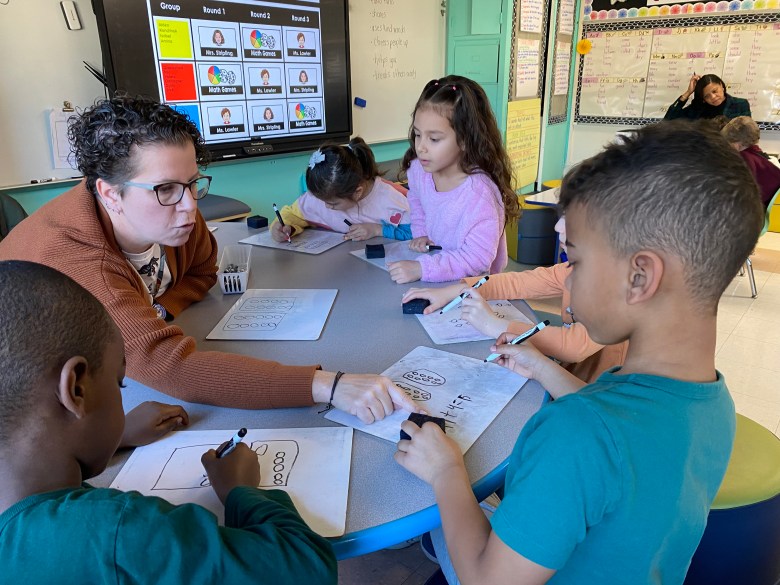
Janine Lawler teaches math to a group of first graders in Teaneck, New Jersey. Her classroom includes students with and without disabilities. Credit: Meredith Kolodner/The Hechinger Report
Educators say they can provide intensive instruction without having to separate children for large portions of the day.
“Do we have to isolate young people to give them a service, or can we include them and provide the same service or greater service?” said André Spencer, superintendent of Teaneck Public Schools. “We believe we can include them.”
For decades, New Jersey education officials have failed to support or pressure districts to improve their inclusion rates. A 2004 report found a lack of consequences — such as financial penalties — for New Jersey districts who repeatedly failed to increase inclusion of students with disabilities despite years of promises to improve.
“There’s a culture in New Jersey, which is that you teach kids with impairments in segregated classes,” said Carol Fleres, a long-time special education administrator in New Jersey who is now a special education professor and department co-chair at New Jersey City University.
A 2018 report by the National Council on Disability, an independent federal agency, found “serious contradictions” in New Jersey’s regulations that lay out how schools have to provide special education services. For example: The state categorizes students as having mild, moderate or severe disabilities and says that students with similar behavioral or academic needs should be grouped together.
Those issues make it easy for New Jersey schools to lump students with disabilities together in violation of federal requirements, according to the report.
A spokesman for New Jersey’s education department defended the regulations as doing the opposite. “This arrangement helps ensure that students who require more individualized instruction, especially those whose needs cannot be met in a general education setting, even with supplementary aids and services, are educated in smaller, more supportive environments,” Michael Yaple said in an email.
Despite settlements and scrutiny, advocates want more accountability: New Jersey’s State Special Education Advisory Council, which advises the state Education Department on special education issues, recommended required training for districts with low inclusion rates.
Special education parent and advocate Amanda Villamar, who works with families throughout New Jersey, said education officials try to educate the state’s over 600 school districts — but those efforts only go so far.
“We have a lot of districts that just say: ‘Well, it’s guidance. We don’t have to do it,’” Villamar said. “They literally just don’t even give it the time of day. Then you have other districts that put a lot of work and thought and effort into it.”
Lawyers representing families said young children with behavioral challenges or intellectual disabilities often wind up in separate classrooms for years, even if behaviors improve. Promises of inclusion in gym class or at lunch don’t always happen, they said.
Many parents said they felt forced to agree to separate classrooms, with the promise of inclusion, eventually. That day never came.
“Once you start restricting them, how are you going to get them back and get them increasingly more time within the classroom?” said Elizabeth Alves, a member of the State Special Education Advisory Council.
For Terri Joyce’s son, learning in the co-taught classroom meant accessing the general education curriculum, including social studies. The lessons on civil rights inspired him.
“He became obsessed with Martin Luther King,” she said. “He still will sit for hours and watch YouTube videos of his speeches.”
Like other students with disabilities, her son’s IEP is subject to an annual review, which means that inclusion in the general education classroom isn’t guaranteed in the years to come. Joyce says that means constant vigilance in a process that feels like a part-time job.
But her efforts to have her son included are about more than academics. He’s on the flag football team. He rides the school bus. Other kids recognize him and say hello in the grocery store.
“It’s much bigger than just his education and being included in the classroom,” she said. “Being included in school means he’s more included in life, and he’s more included in our community, and he’s more valued.”
The Hechinger Report provides in-depth, fact-based, unbiased reporting on education that is free to all readers. But that doesn’t mean it’s free to produce. Our work keeps educators and the public informed about pressing issues at schools and on campuses throughout the country. We tell the whole story, even when the details are inconvenient. Help us keep doing that.
New Jersey City Universityis set to become part of nearbyKean Universityafter the two public institutions signed a letter of intent Thursday to combine by June 2026. The merger would be subject to accreditor and regulatory approvals.
Under the plan, Kean would assume NJCU’s assets and liabilities and operate the institution as “Kean Jersey City,” the universities said.Executive oversight would fall to Kean’s president, who would appoint a chancellor to lead Kean Jersey City.NJCU will have some representation on Kean’s board of trustees, per the letter.
NJCU signaled in March that it planned to pursue a merger with Kean after past years of budgetary struggles and a directive from a state-appointed monitor to find a financial partner.
Dive Insight:
In Thursday’s release, Kean and NJCU said that their combination would “preserve NJCU’s mission of serving first-generation, adult and historically underserved students while advancing Kean’s role as the state’s urban research university and a newly designated R2 research university.”
Luke Visconti, chair of the NJCU’s trustee board, said Thursday’s letter of intent “provides an important framework for the detailed discussions that will follow.”
Still to come are full due diligence, a definitive agreementand a detailed outline for combining the two public universities. That process will be collaborative and “rooted in student and community engagement” so that the merger with Kean celebrates the two “distinct cultures” of the universities, NJCU Interim President Andrés Acebo said in a statement.
According to the institutions, an integration planning team with representatives from both universities will begin work immediately,coordinating with New Jersey’s state higher education office. The two universities will develop shared services agreements to streamline operations and boost student success, officials said.
Kean is the larger institution of the two, with 13,352 students in fall 2023,which was down by 5% from five years prior, according to federal data.NJCU, meanwhile, had 5,833 students in 2023,down 10.8% from the year beforeand 27% lower than 2018 levels.
NJCU’s enrollment declines have contributed to its recent financial turmoil. A little over three years ago, the university declared a full-blown financial crisis after heavy spending on real estate expansions, student services and scholarshipsfailed to reverse its enrollment slowdown and enlarged the university’s expenses.
In 2023, the state comptroller’s office issued a scathing report that accused administratorsof failing to fully inform NJCU’s board of the dire financial state, and which also suggested the university “likely” broke federal law by using emergency pandemic funding for an existing scholarship program.
Since then, Acebo has taken the reins, and the state has appointed a monitor to help ensure NJCU rights its finances and operations. State lawmakers also provided $17 million in critical stabilization funding to the institution.
In November, Fitch Ratings lifted the university’s outlook from negative to stable, citing “significant progress toward achieving fiscal balance despite continued pressure on student enrollment.”
Attorneys representing a group of New Jersey parents and activist groups are asking a state appellate court to weigh in on a case that could reshape the state’s public education system.
At the center of the fight is whether New Jersey schools are unconstitutionally segregated by race and socioeconomic status. A lower court judge in October 2023 acknowledged the state’s public schools are segregated by race and that the state must act, but also found that the plaintiffs had failed to prove the entire system is segregated across all its districts.
“It is imperative that no more students be deprived of these rights by the trial court’s avoidance of the straightforward conclusion compelled by the facts and the law in this case — that the state defendants, who are legally obligated to take action to desegregate public schools regardless of the reasons for that segregation, have acted unconstitutionally by failing to do so,” the attorneys wrote in the filing.
Gov. Phil Murphy and the state Department of Education have until April 28 to respond to the plaintiffs’ new filing. A spokesman for the Murphy administration declined to comment.
The case dates to 2018, when the Latino Action Network, the NAACP New Jersey State Conference, and several other families and groups sued the state alleging New Jersey failed to address de facto segregation in public schools. The plaintiffs cited data showing that nearly half of all Black and Latino students in New Jersey attend schools that are more than 90% non-white, in districts that are often just blocks from predominantly white districts.
In New Jersey, students typically attend schools in the municipality where they live. Plaintiffs argued that long-standing housing policies that led to segregated residential neighborhoods led to segregated schools also. New Jersey is the seventh-most segregated state for Black and Latino students, the plaintiffs say.
In October 2023, after Superior Court Judge Robert Lougy issued his ruling that acknowledged racial segregation in New Jersey schools but said it was not widespread, both sides entered mediation talks in hopes it would resolve more quickly than continued litigation.
Attorneys for the parties said in February that it’s unlikely continuing the talks would “be constructive.”
The plaintiffs’ attorneys say the lower court’s October ruling should be reversed. They want a judge to review what they say are six errors in the 2023 order, like the fact that Lougy did not identify a disputed fact.
“Rather than reach the only logical conclusion that followed — that the state defendants violated plaintiffs’ constitutional rights — the trial court left the question of liability for another day,” the filing reads.
If the appellate court denies the motion, the case would return to the trial court, or could be appealed to the state Supreme Court.
New Jersey Monitor is part of States Newsroom, a nonprofit news network supported by grants and a coalition of donors as a 501c(3) public charity. New Jersey Monitor maintains editorial independence. Contact Editor Terrence T. McDonald for questions: [email protected].