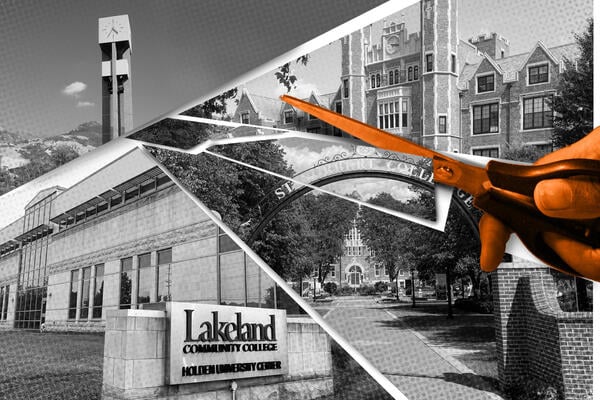
March brought layoffs, buyouts and the elimination of multiple academic programs as universities sought to plug budget holes wrought by sector challenges and state budget issues.
While many universities have announced hiring freezes and other moves due to the uncertainty of federal funding under Trump, the cuts below are not directly tied to the administration’s efforts to slash budgets and shrink the government. Instead, they are linked largely to dwindling enrollment or the loss of state funding.
University of Dayton
Officials at the private, Catholic research institution in Ohio announced cuts last month that affect 65 employees; 45 faculty members will not have their contracts renewed and 20 staff positions have been eliminated, The Dayton Daily News reported.
Affected employees will reportedly be offered severance packages.
Total cuts are projected to save the university $25 million over three years, the newspaper reported. Officials at the university said the moves were “focused on financial sustainability,” noting that while Dayton does not currently have a budget deficit, the change better positions it for the future.
Wagner College
The private liberal arts college in New York is looking to phase out as many as 21 programs in an effort to reverse recent enrollment declines, The Staten Island Advance reported.
The changes reportedly could affect up to 40 full-time faculty members.
Less popular academic programs—including anthropology, chemistry, English, history, math, modern languages, sociology, philosophy and physics—are among those that may be wound down. Officials told the newspaper that the process will be completed over the next 12 to 18 months.
Kent State University
Up to 30 administrative positions and nine majors are being eliminated at the public university in Ohio as part of a phased academic realignment that was approved by the board last month, WKYC reported. Kent State will also shrink the number of academic colleges from 10 to nine.
The changes are part of a phased plan to be completed in 2028.
The plans cites two goals: “First to strengthen academic affairs by reorganizing and realigning our academic units so that we are more cost efficient and therefore sustainable, and second, to ensure that we are providing the most in-demand, up-to-date and relevant academic programs and services for our learners,” executive vice president and provost Melody Tankersley said in an announcement last month following approval of the restructuring plan by Kent State’s board.
Lakeland Community College
Facing a $2 million budget deficit, the public two-year college in Ohio is laying off 10 faculty members and not replacing 14 professors set to retire, Ideastream Public Media reported.
Another eight faculty members who will retire next year will also not be replaced.
Between the cuts and retirements, Lakeland expects to save $2.3 million this year and another $800,000 next year. It will reinvest $225,000 in three faculty positions in manufacturing, welding and electrical engineering as it prioritizes workforce development.
Lakeland also plans to close an unspecified number of low-enrollment programs.
St. Norbert College
The private, Catholic college in Wisconsin announced plans last month to lay off 27 professors and cut more than a dozen programs to address its budget deficit, Wisconsin Public Radio reported.
Cuts will shave an estimated $5 million off the $12 million budget deficit. Of the 27 affected faculty members, 21 are set to lose their jobs in May, and the remaining six will be let go in 2026.
Averett University
Grappling with financial pressures, the small, private institution in Virginia announced plans last month to eliminate 15 jobs as part of cost-cutting measures, The Chatham Star-Tribune reported.
Additionally, Cardinal News reported this week that Averett listed its equestrian center for sale.
The university has navigated steep financial issues since last summer, when officials discovered a financial shortfall brought about by unauthorized withdrawals from the endowment by a former employee. While they said there was no evidence of embezzlement or misuse of the funds, the fiscal mismanagement prompted Averett to take a series of ongoing measures to fix its finances.
Oklahoma State University
Fallout continues at Oklahoma State, where the university laid off 12 Innovation Foundation employees after a recent audit uncovered financial missteps there, Oklahoma Voice reported.
Affected staffers will not receive severance but will remain employed through June 1.
In February, Oklahoma State president Kayse Shrum stepped down abruptly amid a review of improper transfers of legislatively appropriated funds. An audit later found that $41 million in state appropriations “were not properly restricted and in some instances were co-mingled with other funds” in violation of state laws and policies. In one instance, $11.5 million intended for other programs had been directed without board approval to OSU’s Innovation Foundation instead.
St. Joseph’s University
Officials offered buyouts to some faculty and staff last month as the private Jesuit university seeks to close a budget deficit following recent mergers, The Philadelphia Inquirer reported.
St. Joseph’s absorbed the University of the Sciences in 2022 and added Pennsylvania College of Health Sciences in 2023, which officials told the newspaper left them with a “small deficit.” President Cheryl McConnell did not specify a dollar figure in an interview with the Inquirer.
She added that there was no specific target number for buyouts, but when asked about potential layoffs, McConnell said it “depends on the nature of voluntary separation plan results.”
Utah State University
Voluntary buyouts are on the table and layoffs could be on the horizon at the public university following $17.3 million in budget cuts from the State Legislature, The Cache Valley Daily reported.
Those cuts were spread across two years, with the university taking a $12.5 million hit this year. However, USU could restore that money through the state’s strategic reinvestment initiative, which allows universities to regain funding if leaders can identify areas for cuts and shift resources toward strategic initiatives favored by the state.
Weber State University
Elsewhere in Utah, Weber State is also grappling with budget issues imposed by the state.
With anticipated budget cuts of $6.7 million due to the same strategic realignment initiative, Weber State is also offering voluntary separation incentives to employees, Deseret News reported. The university also plans to restructure some academic programs, including the College of Education.
Budget changes in Utah will also affect the other six state institutions, but not all have made their plans public yet.
If you’ve been watching the rollingthunderstorm of executive orders affecting higher education and thinking, simultaneously, “what a loss to the world” and “what a loss for those scholars” … you are right.
It is a massive and increasingly uncorrectable loss to the world that life-enriching and life-saving research is being stopped in its tracks. We will now not know things that we might have otherwise learned, and we will not think thoughts that might have otherwise given us joy or revelation. These consequences are now unavoidable.
But societal impacts are not the only consequences to consider. The loss of knowledge that is being widely grieved right now goes hand in hand with immediate or forthcomingloss of livelihood for individual scholars. And even though academics have become adept at mourning these individual losses—we write mike-drop essays, lobby our professional associations and contribute to GoFundMe accounts—we have generally limited ourselves to catharsis and critique.
Our current moment calls for more. What we are now experiencing in American higher education and what we will continue to experience for the foreseeable future is a generational loss. We need to understand why it is this kind of loss. We need to be able to explain this to others in ways that do not trigger fresh complaints about ivory tower academics. And we need to grasp the nature of the obligation on those of us left behind.
Put simply, we need to acknowledge, contextualize and equip. With apologies to Erin Bartram for repurposing her excellent title—without any of the irony—we have to sublimate the grief of the left behind.
Academic Job Loss Is Different
Industries change, businesses close and employers lay off existing employees or fail to hire new ones. While this is never easy, people find new jobs all the time. Why can’t a tenured professor or a recent hire or an eager postdoc do likewise? Why isn’t this just another instance of scholars being snowflakes?
Here are just three reasons why job loss is especially fraught for academics. There are more than three reasons, of course—and I discuss many in my forthcoming book, The War on Tenure. But these three are a good place to start.
Institutionalized Employment
To begin with, academia is a highly institutionalized industry.
What does that mean? It means that if you want to be a professor, you need to find one specific type of employer—a university—that will hire you to be that. Sure, without a university employer, you can still be a scholar, a public intellectual, a researcher, a writer or a teacher. Often you can be two or more of these simultaneously. But you cannot be a professor if you are not employed by a university.
Many of academia’s peer professions are not institutionalized to the same degree. You can be a lawyer, an accountant, an architect or a psychologist—you can even practice many types of medicine—all without being hired by specific types of employers. You can, for example, practice the very specific type of law that I teach, employment law, as a solo practitioner, or in a law firm that’s small, medium or large, or as part of a company’s in-house counsel, or for the government (in which case you are exceptionally busy right now). You are not limited to one type of employer if you want to practice employment law. In other fields—like human resources, information technology, sales or communications—you not only can work for different types of employers, you probably should do so to become a well-rounded practitioner.
But there is only one way to be a professor: get hired (and stay employed) by a university.
Because of this institutionalization, when universities stop hiring, as they are increasingly doing in response to federally induced chaos, it isn’t simply that a difficult job market has become harder: It’s that a difficult job market is ceasing to exist altogether. That’s the first reason why academic job loss—and specifically academic opportunity loss—really is different.
Quasi Monopsony
The institutionalized nature of academic employment makes the academic labor market difficult. But that bad situation is made worse by the fact that the academic market consists of a few geographically dispersed employers seeking highly specialized employees. This makes academia a quasi monopsony.
As of 2020, according to U.S. News, there were around 1,400 accredited nonprofit institutions offering four-year degrees and serving at least 200 students each. That may sound like a wealth of job opportunities for aspiring professors. But having just half a dozen potential employers within driving distance of one another is considered an exceptionally dense job market in academia. In other industries—again, say, law—the same market would be considered exceptionally shallow. (Try comparing the number of law schools in Atlanta, where I currently live, with the number of law firms and companies that maintain in-house counsel.)
Thanks to this shallow, thin and quasi-monopsonistic job market, aspiring professors know that whenever a job does arise, you go where it takes you and whether or not it suits you and your family. Or, particularly if you’re a heterosexual woman, maybe you just forgo having family at all.
(The same job market picture gets worse still when you remember that universities don’t just hire professors or even law professors: They hire, for instance, labor and employment law professors or intellectual property law professors … and they usually only need one or two of each. And that job market keeps getting worse when you factor in the adjunctification that has characterized academia for decades, and that I’m largely bypassing in this essay. Forget driving distance: In many subfields, job candidates are lucky if there are half a dozen jobs available nationwide in a given year.)
Given all these difficult market dynamics, what happens when a job that you already have disappears? What happens when four years into a tenure-track position—or 20 years after tenure—your lab or your department is forced to close?
Well, if you’ve committed to a labor market characterized by “a few geographically dispersed employers seeking highly specialized employees,” either you find a comparable employer within your existing geographic market, or you relocate to a new geographic market, or—if neither of these options is available to you—you exit the industry altogether.
This is a second reason why academic job loss is different. Although I can’t offer statistical evidence of this given the lack of prior data collection (and the unlikelihood of future data collection), the scholarship strongly suggests that institutional exits are likely to coincide with industry exits because academic workers often have no other choice.
Autodepreciation
In the influential essay whose title I’ve borrowed, Erin Bertram notes that we avoid grappling with the loss of colleagues who have been forced out of academia by “reminding the departing scholar about all the amazing skills they have.” We tell the departing scholar, “You can use those skills in finance! Insurance! Nonprofits! All sorts of regular jobs that your concerned parents will recognize!” But as Bartram and other commentators observe, you could probably have won those jobs just as easily without the Ph.D. at all.
What even these critics often overlook is that you could actually have won many of those jobs more easily without the Ph.D.
I’m not talking about the mountain of debt and the lost decade or so of earning capacity that come with many Ph.D.s. I’m not even talking about the way in which academic training leaves you with valuable but fairly generic skills (“critical reading”) as well as specific skills that won’t help you in the general labor market (e.g., assembling a syllabus that students find interesting, that strikes the right balance between challenging and feasible assignments, and that accounts for institutional resources, for different learning styles and for applicable accommodations, all without relying on an overly pricey set of books). These things matter, but they are still only some of the ways in which competing to enter and succeed in academia harms the people who do it.
Instead, what I’m referring to here is a phenomenon that many commentators implicitly understand but few explicitly articulate: Academic training, expectations and norms force you to unlearn or forgo skills you might have otherwise had that could have served you well in the general labor market. Put differently, academic training forces you to engage in a kind of autodepreciation.
In my book, I use the example of Judith Butler’s famously critiqued and parodied writing to illustrate this. Butler’s writing is notoriously difficult—characterizing it as such is probably one of the few things their supporters and critics can agree on—but it’s just an extreme example of how scholars are often required to write and speak in ways that won’t serve them well outside academia. Phrases like “Althusserian theory” and “homologous ways,” both taken from Butler’s award-winning “bad sentence,” can be efficient shorthand for people who must contribute to complex debates that have evolved over decades or centuries. It’s not always possible to communicate complicated ideas via relatively short sentences written in the standard American English that I’m using right now. I certainly don’t write this way when I’m discussing worker classification doctrine or theories of democratic sovereignty.
To stand a chance of succeeding in academia, you need to regularly use that type of expert vocabulary and complex sentence structure. You need to write in it to publish scholarship, you need to speak in it to present research and teach students, and this means you must also learn to think in it. But once you’ve had to think, speak and write using expert shorthand for decades—for up to nine years of graduate school, a year or three of postdoctoral fellowships, not to mention any time spent as a full-fledged professor—you will understandably struggle to sound … not like Judith Butler.
What happens, then, if an acute financial shock prompts most universities to stop hiring new professors just as you’re finishing your degree? Or, supposing you’ve already scrambled into a full-time job, what if the same shock forces your department or program to be eliminated? Where does that leave you?
Where it leaves you, in many fields, is holding a too-fancy degree, a handful of irrelevant publications, skills that are either widely possessed (critical reading) or overly specialized (syllabus writing), and a tendency to speak and write in ways that nonacademics find unappealing or confusing, or unappealing because they’re confusing. Where it leaves you, in other words, is having depreciated your own generally valuable skills in order to become competitive for the highly specialized job you tried to get—or actually got—but that no longer exists. This is a third reason why academic job loss really is different.
Whither Now?
What I’ve just said is not uplifting. There is no uplifting way to spin the individual effects of the current assault on higher education. My goal in discussing dynamics like institutionalized employment, quasi monopsony and auto-depreciation was not to set the stage for a happy ending: It was to provide an explanation and a language for the trauma of job loss in academia. It’s not just you. It really is different.
But it’s not enough for us to understand and name these dynamics. If we believe that knowledge is power (and I’m assuming that if you are reading this article, you subscribe to that view on some level), then there must be some way to derive power from this knowledge. Here are a few possibilities.
First, having understood the nature of this loss and some reasons why it is so profound, acknowledge both publicly. Explain the dynamics that make academic job loss different. Explain them to your uncle, your cousin, your neighbor, your college friend. Learn to say them partially, and therefore inadequately, instead of either keeping silent or holding forth in the grocery aisle. It’s true that many nonacademics do not understand why our industry is so difficult and so seemingly distinct from the industries that are familiar to them. But that’s at least partly because we do not explain things to nonacademics nearly as often as we explain—and decry—them to each other. Hand-wringing illuminates nothing and helps no one.
Second, don’t be afraid to encourage early-career researchers to develop Plan B’s and Plan C’s (which they should already have, but that’s a different and well-trodden path). In fact, don’t be afraid to encourage them to pursue those alternative plans right now and even if it comes at some expense to their academic progress. Obviously, the A.B.D. who is one chapter away from finishing should probably finish that chapter given her sunk costs. But discuss with her whether she should postpone graduating until she can develop an alternative income stream.
Third, when academic hiring thaws—whether that is six months from now or several years into the future—give serious consideration to candidates with CV gaps dating to this period, the person who worked in a retail job or in an industry research position for which she was grossly overqualified needed to buy food and pay rent. If she is still qualified for the position you are later lucky enough to offer, do plan to consider her for it—and do plan on indicating that you will do so in the job advertisement so that she knows to apply.
And, fourth, don’t be afraid to ask colleagues who are forced out of academia whether they would like to stay involved somehow. Maybe they would like to work in journal operations (and maybe they would appreciate the small income this kind of work occasionally generates). Maybe they would like to participate in free virtual reading groups or brown-bag lunches. Maybe they would even like to join a mentorship circle, whether as mentor or mentee. Regardless of the nature of the opportunity, don’t be afraid to ask—and don’t take it personally if they decline. Bearing the discomfort of a curt no (or even a verbose one) is something those of us who are left behind can and should do.
Job loss is difficult in all industries, but it is not equally difficult. For the most part, we can’t avoid or undo the job loss that is now unfolding in academia. But we can understand it, name it and explain it to our nonacademic friends and family so that they better understand our grief. And we can work to mitigate the effects of job loss and opportunity loss for our colleagues in whatever small ways are open to us. It is time for academics to hunker down and try to keep each other warm, because winter, as they say, is coming.
Deepa Das Acevedo is a legal anthropologist and associate professor of law at Emory University. Her book, The War on Tenure, is forthcoming this fall from Cambridge University Press.
One of the most common questions I get from Ph.D. students and postdocs is “When should I begin my job search?” Most of the time, they are referring only to the application process—they are asking when they should start actually applying for jobs. While I generally recommend applying three to four months before you are available to start, the job search itself should begin much earlier. There is a lot of information and data that you need to gather in advance so that you are well positioned to recognize that a job is a good fit and make an informed decision with confidence.
I see a lot of similarities between the job search and the way you might approach committing to a large purchase such as that of a car or home: The more research and preparation you do, the more confident and informed you’ll be when the right opportunity comes along.
Like a house, a job needs to align with your values, interests and goals. However, compromise is inevitable. Just as home buyers must balance their wish list with budget constraints and market realities, job seekers must consider factors such as location, salary, job stability and growth potential. A strategic, long-term approach ensures that when the ideal opportunity presents itself, you can recognize it and act decisively.
That said, it’s important to recognize that in both job searching and home buying, there are many variables we can’t control. Many Ph.D. students and postdocs I speak with are understandably concerned about the uncertainty of the job market they’ll be entering into in light of federal employee layoffs and university hiring freezes. This is unfortunate but makes long-term, careful planning all the more important.
The House-Hunting Approach to Job Searching
When I was a postdoc, my husband and I wanted to buy our first home. Initially, I had a long list of must-haves: a safe neighborhood close to work, hardwood floors, a spacious updated kitchen, three bedrooms, two bathrooms, a fireplace, a deck, a two-car garage and a lush yard for gardening. We determined our budget and began our search.
For six months, we attended open houses and scoured online listings, refining our expectations along the way. We learned what features were common in our price range and which ones were unrealistic. We adjusted our priorities, and when we finally found the right home, even though it wasn’t exactly what we had first envisioned, we were confident in our decision because of the knowledge we had gained along the way.
The job search follows a similar process. The more job descriptions you analyze and the more people you talk to, the more attuned you become to industry norms, required skills and job value. This preparation allows you to confidently apply and evaluate offers, just as a seasoned home buyer recognizes a great deal when they see one.
To best position yourself for success, your job search should start long before you submit applications. Here’s a suggested timeline.
More Than One Year Out: Laying the Foundation
Identify your career interests: Before house hunting, you need a vision for your ideal home. Likewise, before applying for jobs, you need a clear sense of your desired career path. If you’re unsure, conduct informational interviews to learn from professionals in different fields. Ideally, these conversations would be taking place throughout your graduate and postdoctoral training. More about informational interviewing can be found at Live Career. Resources such as MyIDP (for the sciences) and ImaginePhD (for humanities and social sciences) can help you explore career options. Vanderbilt University’s “Beyond the Lab” video and podcast interview series explores a variety of biomedical career paths, and InterSECT Job Simulations offers job simulation exercises to help Ph.D.-level scientists and humanists learn about various career options. Finally, the Propelling Careers podcast is another resource I would recommend that provides valuable insights into career exploration topics and the entire job search process.
Build your professional presence: Just as no one starts house hunting without securing their financing and mortgage pre-approval, you shouldn’t enter the job market without your professional documents ready. A strong, polished application package is like a solid financial foundation—it ensures you’re taken seriously and can move quickly when the right opportunity appears.
Prepare your CV or résumé well in advance, tailoring it to the roles you’re considering. The National Institutes of Health Office of Intramural Training and Education has a great resource for these on their website. For jobs outside of academia, you will need a résumé, and this can take time to do well. Seek feedback from colleagues and career advisers to refine it. An up-to-date and well-crafted résumé also can be extremely valuable when you are conducting informational interviews to share with the professionals you meet; they will understand your background better, can provide feedback and may pass your document along to hiring managers.
Updating your LinkedIn profile is equally important—it serves as both your online résumé and a networking and research tool. A polished LinkedIn profile increases your visibility and credibility within your target industry.
One Year Out: Researching the Market
Track job postings: A year before you plan to transition, start monitoring job postings, just as you would start researching and looking at houses online and driving through neighborhoods. Save descriptions of roles that interest you and analyze them for common themes. This practice helps refine your job search keywords and informs the skills you should highlight on your résumé.
Identify skill gaps: By analyzing job descriptions early, you may discover missing skills that are crucial for your target roles. By recognizing this in advance, you can take online courses, join organizations or gain hands-on experience to strengthen your qualifications before applying.
Prepare for additional requirements: Depending on the field, you may be asked to share a writing sample or coding project. If you’ve been preparing throughout the year, you won’t be caught off guard.
Experiment with AI assistance: AI tools like ChatGPT can help analyze job descriptions to identify key themes and skills. They can also provide feedback on your résumé and help tailor application materials to specific roles.
Be open to exceptional opportunities: Occasionally, a job posting might appear that is a perfect fit—what I call a “Cinderella’s slipper” job. Even if it’s earlier than your planned timeline, consider applying or reaching out to someone in the organization. Expressing interest might open doors for a future opportunity.
Three to Four Months Out: Start Applying
Start submitting applications: At this stage, it’s time to actively apply for jobs while continuing to network. Informational interviews remain valuable, as many jobs are never publicly posted. Take this time to reach back out to the contacts you have made over the past year or so to let them know you are on the market.
Tailor your application materials: Customize your résumé and cover letter for each application, incorporating language from the job description to highlight your fit. If the application allows an optional cover letter, always include one—it may be the deciding factor between you and another equally qualified candidate.
Leverage networking for hidden opportunities: Identify organizations of interest and connect with employees to learn more. This proactive approach often leads to learning about openings before they’re publicly listed. We’ve all heard stories of people reaching out to homeowners with letters expressing interest in a house—even if it’s not for sale—hoping the owners might consider selling in the future.
Secure references: Consider who can provide strong recommendations. Reach out in advance to confirm their willingness to serve as references and keep them updated on your search.
Keep a job search log: Maintain a spreadsheet to track applications, including submission dates, job descriptions and tailored résumé and cover letter versions. This record will be invaluable when preparing for interviews and following up with employers.
Conclusion: Finding Your Dream Job
Job searching is a complex and important decision-making process, one that also has to remain flexible in light of changing market conditions and unique personal constraints. Just as home buyers don’t purchase the first house they see, job seekers shouldn’t rush into the first opportunity that arises. A strategic job search, like a well-planned home-buying journey, requires research, patience and flexibility. By starting early, refining your criteria, and actively engaging with your field, you’ll be well prepared when the right job—your “dream home” in the professional world—becomes available. With knowledge and preparation, you can confidently apply, interview and accept an offer, knowing you’ve found the right fit for this stage of your career.
Ashley Brady is assistant dean of biomedical career engagement and strategic partnerships and associate professor of medical education and administration at Vanderbilt University in the School of Medicine’s Biomedical Research, Education and Training Office of Career Development ASPIRE Program. She is also a member of the Graduate Career Consortium—an organization providing a national voice for graduate-level career and professional development leaders.
Troy Wright from the Community and Public Sector Union said staff have been left wondering if they have a job. Picture: David Swift
Planned job cuts at the University of Wollongong (UOW) could hit 270 after the university announced it will extend its cost-cutting measures to non-academic staff.
Please login below to view content or subscribe now.
The City University of New York’s Hunter College reposted a job listing for Palestinian studies scholars earlier this week, one month after New York governor Kathy Hochul ordered the system to remove an earlier listing that she called antisemitic.
The new job description does not include some of the phrases that initially angered pro-Israel activist groups who lobbied for the original posting’s removal.
The old posting said Hunter sought “a historically grounded scholar who takes a critical lens to issues pertaining to Palestine including but not limited to: settler colonialism, genocide, human rights, apartheid, migration, climate and infrastructure devastation, health, race, gender, and sexuality.” The revised version excised that entire list of issues.
Free speech advocates and Hunter staff told Inside Higher Ed last month that CUNY’s decision to pull the initial job posting and revise it in response to the governor’s order was an unprecedented breach of the institution’s academic autonomy in faculty hiring, an area normally sequestered from political influence.
Correction: an earlier version of this story reported that the posting had removed a description of Hunter as a “vibrant and dynamic community within a highly diverse urban setting.” That language is still in the revised post.
In a résumé workshop with a group of Ph.D. students, I shared a job description for a position for which they were qualified. The students had participated in an advanced pedagogy program at my university’s Center for Teaching and Learning, and the position was an instructional technologist at a small liberal arts college. Immediately, the students searched the job description for qualities and experiences they lacked and reasons why they were unqualified. Many were so turned off by the job title that they likely would not have continued reading had they come across this position on their own.
Then I encouraged the students to approach the position description with a bias toward “I’m qualified.” In other words, instead of starting with the assumption that they were not qualified for the role, do the opposite. Once they changed their mindset and believed that they were qualified, they were able to see many connections between their skills and experiences and what they read in the job description.
In my work as a graduate student career adviser, I have found that this tendency for Ph.D. students to approach descriptions for jobs outside their academic field from a deficit perspective is quite common. Graduate students who have trained for years with an eye toward an academic position in their field often see themselves as utterly unqualified when they begin to search for jobs in other sectors. This can even be the case for those who have spent considerable amounts of time on career exploration and self-reflection and feel committed to a career in a field other than academia. Once they get to the job search process, they get hung up on the job descriptions themselves.
When I told another career adviser about my “bias toward ‘I’m qualified’” approach, she said that this reminded her of the growth mindset concept. Psychologist Carol Dweck came up with the concept of the growth mindset nearly 20 years ago, and it has since been applied to everything from business to professional sports to early childhood education. In short, a growth mindset is, to cite Dweck’s definition, “based on the belief that your basic qualities are things you can cultivate through your efforts, your strategies, and help from others.” In other words, you can change and improve many aspects of yourself through hard work and help from others. This is in contrast to a fixed mindset, which is the belief that your qualities are “carved in stone” and cannot be changed.
This concept has many applications in work and life, and when we are stressed about a job search it is easy to let a fixed mindset take over. However, adopting a growth mindset in just one context—reading job descriptions—can help you be more positive and open-minded in your job search. Of course, not everyone can do every job, but a growth mindset will help you see and articulate both your qualifications and your potential in a new career field.
Consider the following ways in which reading job descriptions with a growth mindset can create more opportunities in your career exploration and job search.
See and articulate your transferable skills and experiences.
Talk to a career adviser for five minutes, and they are likely to discuss the importance of transferable skills. Yet it can be tough to conceive of your skills, know which skills are most important, see how they might come in handy in other contexts and then articulate those skills in a way that is appealing to other audiences. Here is an example from my own career about how reading a job description with a growth mindset helped me identify and articulate a skill set I didn’t know I had.
Shortly after finishing my Ph.D., I came across a job posting for a school relations manager at a nonprofit organization, liaising between high school teachers and the organization. The job fit my interests, but at first glance it didn’t seem to match my skill set. In particular, the job description asked for relationship-building skills, which I had never thought about as a skill set, let alone one that I possessed. As I reflected on my experience throughout my time in graduate school, I thought about a short-term, part-time position I had meeting once a month with high school history teachers to help them design lesson plans. I enjoyed this work and was good at it and, though I had never thought about it before, realized that I could frame this experience as relationship building. In my application materials and job interviews, I emphasized this skill set and expressed confidence in continuing to grow in this area, and I got the job.
Open up new career fields.
Several years ago, I worked with a Ph.D. student in art history who was interested in a career in user experience research. Although she was still two years away from graduation, she started looking at job descriptions to get a better sense of the responsibilities and qualifications for the kinds of roles she desired. In her research, she noticed that many positions asked for evidence of user experience projects, and some even asked for a portfolio. While some students would have seen this as an insurmountable barrier (a fixed mindset), she instead let her growth mindset kick in and got to work building her portfolio through project-based online courses, independent projects and on-campus jobs, and continued to network with practitioners in the field. Her hard work and help from others paid off, and she was able to move into the field after she graduated.
Compete for jobs for which you may be somewhat underqualified.
Students often let the perception of being underqualified for a job prevent them from applying. This is a well-documented tendency among women and underrepresented groups, and, for graduate students, the impostor phenomenon often contributes to reduced confidence in relation to career possibilities. Most graduate students know about this tendency and the advice to apply if you meet 60 to 75 percent of the qualifications, Yet, many still have difficulty getting over the hump to apply when they don’t meet 100 percent of the qualifications in the job description. Or, if they do apply, they undersell their qualifications in their application materials.
When you approach a position description for a job that interests you but feels like a reach, start with the job responsibilities and imagine yourself performing the tasks listed. If there are things on the list you haven’t done before, imagine how you could build on the skills and capacities you have in a new setting and then improve over time. Next, go through each qualification and look for some connection, however tenuous, to something you have done before and write it down. If you have trouble doing this on your own, work with a career adviser who can help. Usually this process helps you see capacities and qualifications you didn’t know you had and will give you confidence that you can grow into a role that feels like a stretch.
Apply for jobs for which you may feel overqualified.
This next piece of advice addresses the other end of the spectrum—jobs for which you feel overqualified. Ph.D. students who are entering a field other than academia are making a career transition, which often requires spending some time in a role that might feel beneath your qualifications. This is especially true in certain industries like publishing, journalism, marketing and communications, and others. It can feel demoralizing for doctoral students to apply for jobs that only require a bachelor’s degree.
In this case, use a growth mindset to imagine how you could advance within the organization or how this first position could be a stepping-stone to another opportunity in a couple of years. Keep in mind that people with advanced degrees tend to get promoted to a higher level and more quickly than those with just a bachelor’s. You won’t be stuck in this first role forever, and it will give you a chance to demonstrate your skills in your new field.
Underlying these tips is a nudge to get online and read some job descriptions, even if you aren’t yet ready to apply. Just make sure that when you do, you suit up with your growth mindset first.
Rachel Bernard is the GSAS Compass Consultant at Columbia University’s Graduate School of Arts and Sciences, where she focuses on career development for master’s and doctoral students. She is a member of the Graduate Career Consortium—an organization providing a national voice for graduate-level career and professional development leaders.
SHINGLETOWN, Calif. — On a cold morning in October, the sun shone weakly through tall sugar pines and cedars in Shingletown, a small Northern California outpost whose name is a reminder of its history as a logging camp in the 1800s. Up a gravel road banked with iron-rich red soil, Dylan Knight took a break from stacking logs.
Knight is one of 10 student loggers at Shasta College training to operate the heavy equipment required for modern-day logging: processors to remove limbs from logs that have just been cut, skidders to pull logs out of the cutting site, loaders to stack and sort the logs by species and masticators to mulch up debris.
For centuries, logging was a seasonal, learn-on-the-job trade passed down from father to son. But as climate change and innovations in the industry have changed logging into a year-round business, there aren’t always enough workers to fill jobs.
“Our workforce was dying,” said Delbert Gannon, owner of Creekside Logging. “You couldn’t even pick from the bottom of the barrel. It was affecting our production and our ability to haul logs. We felt we had to do something.”
Related: Interested in innovations in higher education? Subscribe to our free biweekly higher education newsletter.
Around the country, community colleges are stepping in to run apprenticeship programs for heritage industries, such as logging and aquaculture, which are too small to run. These partnerships help colleges expand the workforce development programs central to their mission. The partnerships also help keep small businesses in small industries alive by managing state and federal grants and providing the equipment, courses and staff to train workers.
As industries go, logging is small, and it’s struggling. In 2023 there were only about 50,000 logging jobs in the U.S., but the number of logging companies has been on the decline for several years. Most loggers are over 50, according to industry data, and older generations are retiring, contributing to more than 6,000 vacant positions every year on average. The median annual salary for loggers is about $50,000.
Student logger Bryce Shannon operates a wood chipper at a logging site as part of his instruction at Shasta College in Redding, Calif. Credit: Minh Connors for The Hechinger Report
Retirements have hit Creekside Logging hard. In 2018 Gannon’s company had jobs to do, and the machines to do them, but nobody to do the work. He reached out to Shasta College, which offers certificates and degrees in forestry and heavy equipment operation, to see if there might be a student who could help.
That conversation led to a formal partnership between the college and 19 timber companies to create a pre-apprenticeship course in Heavy Equipment Logging Operations. Soon after, they formed the California Registered Apprenticeship Forest Training program. Shasta College used $3.5 million in grant funds to buy the equipment pre-apprentices use.
Logging instruction takes place on land owned by Sierra Pacific Industries lumber company — which does not employ its own loggers and so relies on companies like Creekside Lumber to fell and transport logs to mills.
Each semester, 10 student loggers like Knight take the pre-apprenticeship course at Shasta College. Nearly all are hired upon completion. Once employed, they continue their work as apprentices in the forest training program, which Shasta College runs in partnership with employers like Gannon. State apprenticeship funds help employers offset the cost of training new workers, as well as the lost productivity of on-the-job mentors.
For Creekside Logging — a 22-person company — working with Shasta College makes participation in the apprenticeship program possible.Gannon’s company often trained new loggers, only to have them back out of the job months later. It can cost tens of thousands of dollars to train a new worker, and Creekside couldn’t afford to keep taking the financial risk. Now Gannon has a steady flow of committed employees, trained at the college rather than on his payroll. Workers who complete the pre-apprenticeship know what they’re getting into — working outdoors in the cold all day, driving big machines and cutting down trees.
Workers who complete the apprenticeship, Gannon said, are generally looking for a career and not just a seasonal job.
Talon Gramps-Green, a student logger at Shasta College in Redding, Calif., shows off stickers on his safety helmet. Credit: Minh Connors for The Hechinger Report
“You get folks that are going to show up every day,” Gannon said. “They got to test drive the career and know they like heavy equipment. They want to work in the woods. The college has solved that for us.”
Apprentices benefit too. Workers who didn’t grow up around a trade can try it out, which for some means tracking down an elusive pathway into the work. Kyra Lierly grew up in Redding, about 30 miles west of Shingletown, and previously worked for the California Department of Forestry as a firefighter. She’s used to hard work, but when she looked into getting a job as a logger she couldn’t find a way in. Some companies had no office phone or website, she says. Jobs were given out casually, by word of mouth.
“A lot of logging outfits are sketchy, and I wanted to work somewhere safe,” said Lierly, 25. She worked as an apprentice with Creekside Lumber but is taking a break while she completes an internship at Sierra Pacific Industries, a lumber producer, and gets a certificate in natural resources at Shasta College.
“The apprenticeship made forestry less intimidating because the college isn’t going to partner with any company that isn’t reputable,” Lierly said.
Apprenticeships, with their combination of hands-on and classroom learning, are found in many union halls but, until now, was not known to be common practice in the forested sites of logging crews.
State and federally registered apprenticeships have gained popularity in recent years as training tools in health care, cybersecurity and telecommunications.
Federal funding grew steadily from $145 million in 2018 to more than $244 million during the last years of the Biden administration. That money was used to support apprenticeships in traditional building trades as well as industries that don’t traditionally offer registered apprenticeships, including teaching and nursing.
The investment aims to address the shortage of skilled workers. The number of working adults in the U.S. doesn’t align with the number of skilled jobs, a disparity that is only slowly recovering after the pandemic.
Labor shortages hit especially hard in rural areas, where trades like logging have an outsized impact on their local economies. For regional heritage trades like logging, just a few apprentices can make the difference between staying in business and shutting down.
Lucas Licea, a student logger at Shasta College in Redding, Calif., operates a loader. Credit: Minh Connors for The Hechinger Report
“There’s a common misconception of registered apprentices that they’re only in the building trades when most are in a variety of sectors,” said Manny Lamarre, who served as deputy assistant secretary for employment and training with the Labor Department during the Biden administration. More than 5,000 new occupations have registered with the department to offer apprenticeships since 2021, he said. “We can specifically support unique small occupations in rural communities where a lot of people are retiring.”
Education Secretary Linda McMahon, who was confirmed earlier this month, said in her confirmation hearing that she supports apprenticeships. But ongoing cuts make it unclear what the new federal role will be in supporting such programs.
However, “sharing the capacity has been an important way to get apprenticeships into rural and small employers,” said Vanessa Bennett, director at the Center for Apprenticeship and Work-Based Learning at the nonprofit Jobs for the Future. It’s helpful when employers partner with a nonprofit or community college that can sponsor an apprenticeship program, as Shasta College does, Bennett said.
Once Knight, the student logger, completes the heavy equipment pre-apprenticeship, he plans to return to his hometown of Oroville, about 100 miles south of Shingletown. His tribe — the Berry Creek Rancheria of Tyme Maidu Indians — is starting its own logging crew, and Knight will be one of only two members trained to use some of the most challenging pieces of logging equipment.
“This program is awesome,” said Knight, 24. “It’s really hands-on. You learn as you go and it helps to have a great instructor.”
Student logger Dylan Knight drives a masticator, which grinds wood into chips, as Shasta College instructor Chris Hockenberry looks on. Credit: Minh Connors for The Hechinger Report
Across the country in Maine, a community college is helping to train apprentices for jobs at heritage oyster, mussel and kelp farms that have struggled to find enough workers to meet the growing demand for shellfish. Often classified as seasonal work, aquaculture jobs can become year-round careers for workers trained in both harvesting shellfish and planning for future seasons.
“I love the farm work and I feel confident that I will be able to make a full-length career out of this,” said Gabe Chlebowski, who completed a year-long apprenticeship with Muscongus Bay Aquaculture, which harvests in Damariscotta, Maine. A farm boy from rural Pennsylvania, Chlebowski worked in construction and stone masonry after high school. When his parents moved to Maine, he realized that he wanted a job on the water. With no prior experience, he applied for an oyster farming apprenticeship and was accepted.
“I was the youngest by five years and the only person who’d never worked on water,” said Chlebowski, 22. “I grew up in a landlocked state surrounded by corn fields. I had the work ethic and no idea what I was doing in boats.”
The apprenticeship program was launched in 2023 by the Gulf of Maine Research Institute, which joined with the Maine Aquaculture Association and Educate Maine to create a yearlong apprenticeship with Southern Maine Community College. Apprentices take classes in shellfish biology, water safety, skiff driving and basic boat maintenance. Grants helped pay for the boots, jackets and fishing bibs apprentices needed.
“The workforce here was a bottleneck,” said Carissa Maurin, aquaculture program manager for GMRI. New workers with degrees in marine biology were changing their minds after starting training at aquaculture farms. “Farms were wasting time and money on employees that didn’t want to be there.”
Chlebowski completed the apprenticeship at Muscongus Bay in September. He learned how to repair a Yamaha outdoor motor, how to grade oysters and how to work on a 24-foot, flat-bottom skiff. He stayed on as an employee, working at the farm on the Damariscotta River — the oyster capital of New England. The company is known for two varieties of oysters: Dodge Cove Pemaquid and Wawenauk.
Oyster farming generates local pride, Chlebowski said. The Shuck Station in downtown Damariscotta gives oyster farmers a free drink when they come in and there’s an annual summer shucking festival. But the company is trying to provide careers, Chlebowski said, not just high-season jobs.
“It can be hard to make a career out of farming, but it’s like any trade,” he said, adding that there is work to do year-round. “Welding and HVAC have trade schools and apprenticeships. Why shouldn’t aquaculture?”
Chlebowski’s apprenticeship turned into a career. Back in Shingletown, students in the logging program hope for the same result when they finish.
Until then, they spend Mondays, Wednesdays and Fridays in the woods learning how to operate and maintain equipment. Tuesdays and Thursdays are spent on Shasta College’s Redding campus, where the apprentices take three classes: construction equipment operation, introduction to forestry and wood products and milling.
At the end of the semester, students demonstrate their skills at a showcase in the Shingletown woods. Logging company representatives will attend and scout for workers. Students typically get offers at the showcase. So far, 50 students have completed the pre-apprenticeship program and most transitioned into full apprenticeships. Fifteen people have completed the full apprenticeship program and now earn from $40,000 to $90,000 a year as loggers.
Mentorship is at the heart of apprenticeships. On the job, new workers are paired with more experienced loggers who pass on knowledge and supervise the rookies as they complete tasks. Pre-apprentices at Shasta College learn from Jonas Lindblom, the program’s heavy equipment and logging operations instructor.
At the logging site, Lindblom watches as a tall sugar pine slowly falls and thuds to the ground. Lindblom’s father, grandfathers and great-grandfather all drove trucks for logging companies in Northern California.
An axe sticks out of a freshly cut tree at a logging site used to train student loggers enrolled at Shasta College in Redding, Calif. Credit: Minh Connors for The Hechinger Report
This is a good area for apprentices to “just be able to learn at their pace,” he said. “They’re not pushed and they can get comfortable in the machines without developing bad habits along the way.”
Lindblom, who studied agriculture education at Chico State University, spent all his breaks during college working as a logger. He works closely with the logging companies that partner with the program to make sure he’s teaching up-to-date practices. It’s better for new loggers to learn in this outdoor classroom, he said, than on the job.
“The majority of these students did not grow up in logging families,” he said. “This is a great opportunity to pass on this knowledge and share where the industry is going.”
Contact editor Christina A. Samuels at 212-678-3635 or [email protected].
The Hechinger Report provides in-depth, fact-based, unbiased reporting on education that is free to all readers. But that doesn't mean it's free to produce. Our work keeps educators and the public informed about pressing issues at schools and on campuses throughout the country. We tell the whole story, even when the details are inconvenient. Help us keep doing that.
As an industrial/organizational psychologist, work is always on my mind. Naturally, I am interested in understanding ways to make work better for others, but I also regularly apply research and theory to my own job. One long-standing approach to building better jobs is to make them more interesting for employees. Work that is interesting is inherently more motivating, more satisfying, and reduces turnover (Parker et al., 2017 for a summary).
The leading theory in job design is Job Characteristics Theory (JCT) (Hackman & Oldham, 1976). Specifically, JCT outlines that jobs facilitating 1) skill variety, 2) task identity, 3) task significance, 4) autonomy, and 5) feedback will be the most motivating and interesting. Importantly, building classes that contain these elements for both students and instructors can lead to benefits for all.
Below, I outline details about the five components and ideas for both students and instructors. As with all course design choices, these ideas are not required for success; you are welcome to choose what feels authentic to your style.
1. Skill Variety
Skill variety refers to jobs that require the use of several different skills or abilities. An example of a job that is low in skill variety is that of a typical manufacturing line. The same motion is used over and over again to perform the work. In a class, an example might be only having students submit a discussion board post for every assignment.
For students:
Allow for variety in the way students learn the information (e.g., reading, watching videos, discussing with peers).
Create a variety of activities and/or assessments such as an oral presentation, case study analysis, paper, or quiz. Where flexibility of how a project is completed can be given, encourage students to try something new or try a new technology to implement their idea.
Bloom’s taxonomy is also helpful here for allowing a variety of assessments and knowledge demonstration.
For instructors:
Consider what skills you currently would like to further develop and use your course to build accountability. For example, maybe there is a new software you’d like to learn. Have students also learn it in a course and you can work through skill development together.
Keep teaching fresh for yourself by incorporating different case studies, materials, videos, or guest speakers (when it makes sense!).
2. Task Identity
Task identity focuses on the ability to execute an entire project from start to finish. If a project requires each student to contribute something different and then put the pieces together, the project may be low on task identity as the individual members did not contribute to the entire process of the project.
For students:
Scaffolding naturally fits under task identity. Slowly build up knowledge and skills until students are able to fully engage in process or project from start to finish.
Occasionally zooming out and discussing how the topic fits within the entire semester, area of study, or career path can help students appreciate how what they are working on is part of a larger whole.
For instructors:
Reflect on your decision latitude to design your course from start to finish.
If you teach a course that fits within a large sequence, meeting with instructors to ensure the sequence makes sense. You are not beholden to conform to other’s choices, but building cohesion can benefit all involved.
If you have a TA for your course, considering ways to get them involved in whole processes (e.g., designing an assessment in addition to grading it).
3. Task Significance
Task significance facilitates finding meaning in one’s work. Specifically, task significance is high when a job has a clear impact on others. Teaching is inherently a job with high task significance, which is perhaps why many of us are drawn to it.
For students:
Connect class information to how it helps benefit others.
Create opportunities for students to interact with guest speakers, community members, or others who may benefit from their knowledge. A final project that supports a community group, for example, may be developed. Service learning is great here.
For instructors:
To help ensure you are having an impact, regularly and systematically collect information from students (e.g., surveys).
Track learning by measuring knowledge at the beginning and at the end of the semester. Inevitably so much growth occurs! Having evidence helps you see your impact, but also helps students appreciate how much they have grown too.
Create an inbox folder so save any and all positive emails you receive about your work.
Consider ways in which you can support new colleagues after you have settled into your position and have tips to share.
4. Autonomy
Autonomy is about the various ways in which individuals have a say in how, when, and where their work is completed. In the classroom, low autonomy might be a discussion board on a specific topic, under a specific word requirement that has to be completed in a short window of time.
For students:
Allow choices when it comes to topics, formats, or types of projects, as much as is reasonable.
Develop opportunities for students to become an expert within a specific area and then be responsible for sharing that expertise with peers.
For instructors:
Reflect on the various ways in which you have control over how to design and implement courses, select your courses, select the time you teach, and when you work on your class. For many instructors, autonomy is relatively high.
Develop your courses in a way that fit into the rest of your job duties. For example, remembering to execute the ability to schedule final paper due dates for a week that is different from conference deadlines.
Balance your autonomy with student autonomy. You can allow as much choice as you like, but make it make sense for you too.
5. Feedback
A high level of feedback is present when an individual is provided information about their performance in a clear and timely manner. Courses with multiple assessments throughout the semester that are scored with comments provide significant feedback.
For students:
Provide a rubric and include rubric comments to make it clear where students are doing well and where they still need work.
Provide summary-level feedback to the entire class.
Remind students to regularly access their grades and to review their feedback.
For instructors:
Provide ways for students to provide feedback to you throughout the semester through surveys, discussion, etc.
On end of semester evaluations, include open-ended questions directing them to share what went well about the course and what they would recommend changing next time. Framing questions this way can lead to more constructive feedback for you, rather than criticize.
Use assignments as feedback about how the material is landing with students. Re-visit topics or adjust as needed.
Conclusion
JCT provides five distinct areas instructors can focus on to evaluate opportunities to make their courses and their own work engaging and interesting. Adjusting these five levers can make the “job” of student as well as the job of instructor motivating and satisfying.
Of course, no theory is without limitations. One note is that individuals who have a high need for growth tend to benefit from this type of job design more than individuals who are not as concerned with growth. The original theory generally neglects social components, though more recent work has corrected that oversight (Humphrey et al., 2007; Oldham & Hackman, 2010). Finally, the limits of too much enrichment are not known. It is possible that maximizing all five components may produce a course that is more stressful than interesting. To combat any potential over-enrichment, instructors are advised to balance motivating course design with structure, routine, and clear expectations.
Overall, job design provides five clear areas to consider enhancing in your course design, both to the benefit of your job as instructor, and the ‘job’ of students as learners.
Sarina Maneotis, PhD is currently a teaching assistant professor at Kansas State University where she oversees K-State’s applied Master’s in Industrial and Organizational Psychology (MIOP) program. Prior to joining K-State in 2020, she worked in industry, advising on a variety of safety, leadership, and human resource data analysis projects. She earned her undergraduate degree in psychology at Colorado State University and her PhD in Industrial/Organizational Psychology at Pennsylvania State University. Her research focuses broadly on intersections of employee performance, wellbeing, and motivation. She is passionate about developing teaching practices that help students hone skills for translating research findings for organizational purposes and use scientific inquiry within the real-world parameters of organizations. She recently received K-State’s 2023 Global Campus Excellence in Online Teaching Award in recognition for her teaching practices.
References
Hackman, J. R., & Oldham, G. R. (1976). Motivation through the design of work: Test of a theory. Organizational behavior and human performance, 16(2), 250-279.
Humphrey, S. E., Nahrgang, J. D., & Morgeson, F. P. (2007). Integrating motivational, social, and contextual work design features: A meta-analytic summary and theoretical extension of the work design literature. Journal of Applied Psychology, 92(5), 1332-1356.
Oldham, G. R., & Hackman, J. R. (2010). Not what it was and not what it will be: the future of job design research. Journal of Organizational Behavior, 31, 463-479.
Parker, S. K., Morgeson, F. P., & Johns, G. (2017). One hundred years of work design research: Looking back and looking forward. Journal of Applied Psychology, 102(3), 403-420.
Lately, I have been experiencing anger, occasionally edging toward rage (depending on my mood) when I open a new document in MSWord and I see the ghostly prompt urging me to use its Copilot generative AI tool.
I do not want to use this tool. I especially do not want to use this tool to start a draft of a document, because writing the first draft under the power of my own thoughts is the key to ultimately producing something someone else might want to read, and outcome on which my living depends, but it’s also, the point of all writing ever, in any context, as far as I’m concerned.
I am persuaded by Marc Watkins’s framing of “AI is unavoidable, not inevitable” for no other reason than the tech companies will not allow us to avoid their generative AI offerings. We can’t get away from this stuff if we want to, and boy, do I really want to.
But just because it is unavoidable and must be acknowledged and, in its way, dealt with, does not mean we are required to use or experiment with it. Over the period of writing More Than Words: How to Think About Writing in the Age of AI, and now spending a month or so promoting and talking about the book in various venues, I grow more and more convinced that if this technology is to have utility in helping students learn—and I mean learn, not merely do school—this utility is likely to be specialized and narrow and the product of deep thought and careful exploration and step-by-step iteration.
Instead, we’re on the receiving end of a fire hose spraying, This is the future!
Is it, really?
One of the reasons we’re being told it’s the future is because at this time, generative AI has no strong business rationale. Don’t take my word for it. Listen to Microsoft CEO Satya Nadella, who admitted in a podcast interview that generative AI applications have had no meaningful effect on GDP, suggesting they are not amazing engines of increased productivity.
Tech watcher Ed Zitron has been saying for months that there is no “AI revolution” and that we’re heading toward the bursting of a bubble that will at least rival the 2008 downturn caused by the subprime mortgage crisis.
So, while there is reason to believe that we are experiencing a bubble that is inevitably going to burst, as we imagine what our institutional and individual relationships should be with this technology, I think it’s useful to see what the people who are—literally—invested in AI envision for our futures. If they are right, and AI is inevitable, what awaits us?
Let’s check in with the people directly funding and developing AI technology what they foresee for the educators of the United States.
@elonmusk/X
That is the man who is apparently running—and running roughshod over—the United States government suggesting that AI-assisted education is superior to what teachers deliver. Now, we know this is not true. We know it will never be true—that is, unless what counts as outcomes is defined down to what AI-assisted education can deliver.
“But to be clear, the ‘better outcomes’ that Silicon Valley shit-posters Palmer Luckey and Elon Musk fantasize about in the image above do not involve the quality of education—of learning or teaching or schooling. (You’re not fooled that they do, right?) They aren’t talking about improved test scores or stronger college admissions or nicer job prospects for graduates or well-compensated teachers or happier, healthier kids or any such metric. Rather, this is a call for AI to facilitate the destruction of the teaching profession, one that is, at the K-12 level comprised predominantly of women (and, in the U.S., is the largest union) and at the university level—in their imaginations, at least—is comprised predominantly of ‘woke.’”
It is hard to know what to do about a technology that some intend to leverage to destroy your profession and harm the constituents your profession is meant to serve. More Than Words is not a book that argues we must resist this technology at all costs, but again, these people want to destroy me, you, us.
ChatGPT and its ilk haven’t even been around for all that long, and we already see the consequences of voluntary deskilling. Futurism reports, “Young coders are using AI for everything, giving ‘blank stares’ when asked how programs actually work.”
Namanyay Goel, a veteran coder who has been observing the AI-wielding coders who can’t actually code, says, “The foundational knowledge that used to come from struggling through problems is just … missing.” This is output divorced from process, a pattern that is already endemic to our transactional model of schooling, but which AI now supercharges.
There is no role for educational institutions in the world where we allow this sort of thing to substitute for knowledge and learning. That may be the least of our problems should the full deskilling result. (See the film Idiocracy for that particular flavor of dystopia.)
When Microsoft shoves its AI tools in the face of a student with less time, less freedom, less confidence and more incentive to use it, what are we giving them to make them want to resist, to commit to their learning, to become something other than a meat puppet plugging syntax into a machine with the machine spewing more syntax out?
At this point, where is the evidence the companies do not wish us harm?
New York governor Kathy Hochul took an unusual interest in the hiring practices of the City University of New York on Tuesday when she ordered the public system to take down a job posting for a professorship in Palestinian studies at Hunter College.
CUNY quickly complied, and faculty at Hunter are up in arms over what they call a brazen intrusion into academic affairs from a powerful state lawmaker.
The job posting was for “a historically grounded scholar who takes a critical lens to issues pertaining to Palestine including but not limited to: settler colonialism, genocide, human rights, apartheid, migration, climate and infrastructure devastation, health, race, gender, and sexuality.”
“We are open to diverse theoretical and methodological approaches,” the posting continued.
In a statement Tuesday night, Hochul said the posting’s use of the words “settler colonialism,” “genocide” and “apartheid” amounted to antisemitic attacks and ordered CUNY to “immediately remove” the posting.
A few hours later, CUNY complied, and system chancellor Félix Matos Rodríguez echoed Hochul’s criticisms of the posting.
“We find this language divisive, polarizing and inappropriate and strongly agree with Governor Hochul’s direction to remove this posting, which we have ensured Hunter College has since done,” he wrote in a statement.
Hochul also directed the university system to launch an investigation at Hunter “to ensure that antisemitic theories are not promoted in the classroom.” Matos Rodríguez appeared to imply the system would follow that order as well, saying, “CUNY will continue working with the Governor and other stakeholders to tackle antisemitism on our campuses.”
A CUNY spokesperson declined to say whether the system would launch a probe into the posting at Hunter but wrote in an email that “each college is responsible for its own faculty job posting.”
Hochul’s order came after pro-Israel activists, including a former CUNY trustee and current professor, publicly voiced concerns about the posting.
“To make a Palestinian Studies course completely about alleged Jewish crimes is akin to courses offered in the Nazi era which ascribed all the world’s crimes to the Jews,” Jeffrey Weisenfeld, who served as a CUNY trustee for 15 years, told The New York Post.
Faculty at Hunter are livid about the decision, according to multiple professors who spoke with Inside Higher Ed both on the record and on background. They say it’s a concerning capitulation to political pressure from an institution they long believed to be staunchly independent.
One longtime Hunter and CUNY Graduate Center professor, who spoke with Inside Higher Ed on the condition of anonymity out of fear for their job, said faculty across the system were “outraged at this craven act by our governor and our chancellor.”
“It shows that [Matos Rodríguez] has no commitment to academic freedom or moral compass that would allow him to stand up at this moment of political repression,” they said.
CUNY’s Professional Staff Congress, the union representing more than 30,000 faculty and staff members across the system’s 25 campuses, wrote a letter to Matos Rodriguez on Wednesday evening condemning the posting removal and calling on leadership to reverse their decision.
“An elected official dictating what topics may be taught at a public college is a line that should not be crossed,” the letter reads. “The ‘divisive concepts’ standard for universities is something devised in Florida that shouldn’t be exported to New York. What’s needed are inclusive ways of teaching, not canceling concepts and areas of study.”
It was unclear Wednesday whether the job posting would be edited and reposted or if the opening would be eliminated. A CUNY spokesperson declined to respond to questions about the job’s future, but the anonymous faculty member said they believed Hunter officials were revising the post, intending to relist it.
The anonymous professor said they were worried that Hunter president Nancy Cantor, who took on the role last August after leading Rutgers University–Newark for a decade, could face severe scrutiny after the posting.
“We fully support this initiative by our president to make this Palestinian studies cluster hire,” the anonymous professor said. “I’m very worried about Nancy Cantor’s tenure at Hunter. I think this is part of a campaign by the far right to get rid of Félix [Matos Rodríguez], and it would not surprise me in the least if he threw Nancy Cantor under the bus to save his own skin.”
Heba Gowayed, an associate professor of sociology at Hunter, said she was shocked that Hochul had made the job posting a priority, especially as threats to academic freedom and attacks on higher education from Republicans are intensifying.
“This is an unprecedented overstep in authority, but instead of coming from Republicans, it’s coming from a Democrat in one of the bluest states in the country,” she said. “They’re the ones that are supposed to be fighting to protect academic freedom. This is a tremendous abdication of that responsibility.”
‘A Climate of Fear’
The anonymous professor said their colleagues are grappling with contending emotions: rage and fear. There’s a great appetite to speak up, they said, but they also feel it’s more dangerous than ever, even for tenured faculty.
“People are worried across the board,” they said. “That is the kind of climate of fear that this sort of action creates.”
It’s not the first time CUNY has responded to pressure from pro-Israel activist groups in faculty workforce decisions. Since the Oct. 7, 2023, Hamas attacks, CUNY institutions have declined to renew contracts for two vocally pro-Palestinian professors: Danny Shaw at John Jay College of Criminal Justice, who says he was the target of a pro-Israel pressure campaign to get him fired after 18 years of teaching, and lecturer Lisa Hofman-Kuroda at Hunter, who was reported for pro-Palestinian social media posts.
Shaw, who is currently suing CUNY for breach of contract, told Inside Higher Ed that the decision to remove the job posting did not surprise him.
“This is McCarthyism 2.0,” he said. “Administrators won’t protect us. It’s been made pretty clear that at the end of the day, it’s either their necks on the chopping block or ours.”
Last spring, when the student-led pro-Palestinian encampment protests spread from Columbia University across town to the City College of New York, CUNY leadership drew criticism for calling the New York Police Department to disperse students. Gowayed said that decision shocked faculty across the system, who took pride in their institution’s progressive reputation and history of academic integrity.
Even then, she said she was “disturbed that they have let it get to this higher level of censoring faculty for a completely legitimate job posting.”
The Palestinian studies position was one of two Hunter planned to hire, and Gowayed said faculty and leadership at Hunter had been supportive of the plans to expand their research and teaching capacity in an area of growing interest.
“Whatever your feelings on Palestine, this is a research area in a widely recognized field of scholarship on genocide and apartheid,” Gowayed said. “These are well-established fields, whether you’re studying the Belgian Congo or Rwanda or Palestine, and the posting wasn’t even saying what approach the faculty should take … The reaction to this posting is so discrepant from the actual academic integrity of the job search.”