Tag: Job

  • This LSU law professor’s job has become a legal drama

    This LSU law professor’s job has become a legal drama

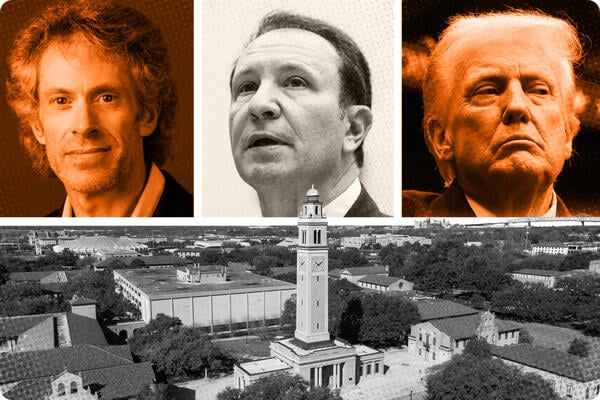
    In a Jan. 14 lecture, Ken Levy, Holt B. Harrison Distinguished Professor of Law at Louisiana State University, dropped f-bombs against then–president-elect Donald Trump and Louisiana governor Jeff Landry and told students who like Trump that they need his “political commentary.”

    Some students found the apparent attempt at political humor funny, according to an audio recording of the class obtained by Inside Higher Ed from a student who supports Levy.

    But at least one student in the administration of criminal justice class who subsequently complained, according to LSU, wasn’t amused—and neither were the university and the governor. An LSU spokesperson said the institution “took immediate action to remove Professor Levy from the classroom after complaints about the professor’s remarks.”

    Levy got a lawyer and took immediate action himself, pulling LSU into court instead of waiting for the university to take further steps internally regarding his job.

    In the month since that lecture, state district court judges have twice ruled that Levy should return to the classroom, only for a state appeals court to twice overrule that. The back-and-forth nature of the case has attracted attention in Louisiana and in law circles, including via headlines such as “The LSU Law School Professor Free Speech Hot Potato Saga Continues.”

    Landry also continues to discuss the case. A Republican governor who’s repeatedly inserted himself in LSU affairs, Landry used social media in the fall to call on the university to punish one of Levy’s law school colleagues for alleged in-class comments about Trump-supporting students. Landry has now repeatedly posted about Levy, recently saying an alleged exam he gave was incendiary and suggesting that “maybe it’s time to abolish tenure.”

    In and Out

    In the lecture in question, Levy referenced Landry’s previous criticism of his LSU colleague Nick Bryner, adding that he “would love to become a national celebrity [student laughter drowns out a moment of the recording] based on what I said in this class, like, ‘Fuck the governor!’”

    Levy also referenced Trump. “You probably heard I’m a big lefty, I’m a big Democrat, I was devastated by— I couldn’t believe that fucker won, and those of you who like him, I don’t give a shit, you’re already getting ready to say in your evaluations, ‘I don’t need his political commentary,’” Levy told students. “No, you need my political commentary, you above all others.”

    A few days after that lecture, LSU notified Levy he was suspended from teaching pending an investigation into student complaints, according to a letter from the university provided by Levy’s attorney, Jill Craft.

    On Jan. 28, Craft filed a request for a temporary restraining order against LSU to get Levy back in the classroom. The filing alleged that a student complained to the governor, not LSU, and calls were then made to LSU. A state district court judge granted the restraining order Jan. 30 without a hearing.

    In the first reversal, a panel of appellate judges wrote Feb. 4 that the lower court shouldn’t have approved the return-to-teaching part of the temporary restraining order without a full evidentiary hearing. But after the lower court held a two-day hearing last week, a different group of appellate judges overruled Levy’s return to teaching again—without explaining why.

    Local journalists who covered last week’s hearing reported that district court judge Tarvald Anthony Smith kicked an LSU deputy general counsel out of the courtroom because the lawyer told the law school dean, who was a scheduled and sequestered witness, about a student witness’s earlier testimony. The testimony was reportedly that the student had recorded a conversation with the dean.

    Smith ruled Feb. 11 that LSU policy required the university to keep Levy in class during the investigation of his comments, WBRZ reported. But a Feb. 4 statement from university spokesman Todd Woodward to Inside Higher Ed suggested the investigation was already over: “Our investigation found that Professor Levy created a classroom environment that was demeaning to students who do not hold his political view, threatening in terms of their grades and profane.” The university didn’t make anyone available for an interview about the case.

    Amid this legal back-and-forth, Landry continues to denounce Levy on social media. Last week, Landry posted on X an alleged exam from Levy that included potential sexual and other crimes committed by various fictitious individuals and asked students at the end to “discuss all potential crimes and defenses.” The narrative included a teen who put his penis into pumpkins on Halloween and was seen by trick-or-treating children, and a powerful Republican and suspected pedophile who invited the children inside to dance for him.

    “Disgusting and inexcusable behavior from Ken Levy,” Landry wrote on X regarding what he claimed was Levy’s test. “Deranged behavior like this has no place in our classrooms! If tenure protects a professor from this type of conduct, then maybe it’s time to abolish tenure.” Asked about this document, Craft said she believes the assignment was part of the sex crimes portion of Levy’s criminal law exam years ago, but she did not confirm it.

    After the latest appellate ruling in LSU’s favor, Landry wrote on X that “Levy should stay far, far away from any classroom in Louisiana!”

    Craft said Levy has received death threats on X due to Landry’s comments there. “This seems to be a situation entirely of the governor’s making,” she said. “He has been active on social media, trying to accuse my client of all kinds of bad things. He’s a lawyer himself. He attacked the courts and the judge.”

    Landry’s office didn’t respond to requests for comment.

    Craft also said Levy’s roughly 80 students remain with another 80 in another professor’s classroom.

    “I’m not sure how he can handle office hours for 160 law students,” Craft said of that second professor. The university says it’s doubled the number of student tutors for the course.

    No Longer the U.S.?

    Craft said Levy was set to return to the classroom Feb. 13, but Louisiana’s First Circuit Court of Appeal issued its two-sentence order around 9:30 a.m. that appeared to stay the part of the lower court’s order that returned Levy to teaching.

    LSU again kept Levy out of the classroom Tuesday, Craft said. But she said the rest of the lower court order remains in place, at least for now, and that prevents LSU from taking further employment action against Levy due to his expression.

    “This is a critical issue, and I feel like we have got to, as a nation, understand that there has to be academic freedom, there has to be free speech in this country, and there have to be protections against governmental intrusions without due process,” she said. “We take all that away and we are no longer the United States of America.”

    Source link

  • Job titles matter for inclusive and meaningful work

    Job titles matter for inclusive and meaningful work

    Job titles, and the names given to organisational roles, are important for the meaning that individuals derive from their work and their engagement with their work.

    Yet within many UK universities, and especially the post-92s, the trend is towards new job titles with potentially negative connotations for the job holders in terms of the meaning of their work and their commitment to it and to their institution.

    Such universities have been moving away from the conventional “lecturer” titles, adopting the US system of titles. US institutions typically designate their junior (un-tenured) academics as Assistant Professors, with an intermediate grade of Associate Professor and then a full Professor grade. Within the US system, most long serving and effective staff can expect to progress to full Professor by mid-career.

    Yet, in this new UK system, only around 15-20 per cent of academics are (and likely ever to be) full Professors and many academics will spend their entire careers as Assistant Professors or Associate Professors, retiring with one of these diminutive job titles.

    The previous, additive, job titles of Lecturer to Senior Lecturer and then to Principal Lecturer or Reader had meaning outside the university and, crucially, had meaning for the post-holders, giving a sense of achievement and pride as they progressed. Retiring as a Senior or Principal Lecturer was deemed more than acceptable.

    Status and self-esteem

    It is not hard to imagine the impact that the changes in job titles is having upon mid and late-career academics who may have little chance of gaining promotion to full professor, perhaps because quite simply they draw the line at working “just” 60 hours a week, 50 weeks a year. The impact on status and self-esteem is immense. Imagine explaining to your grandkids that you are, in essence, an assistant to a professor. As an Associate Professor, and particularly in a vocational discipline, one of the authors is often asked, “I can understand you wanting to work part-time for a university, but what’s your main job?” Associate, affiliate, adjunct – these names are pretty much the same thing to outsiders.

    Managerially, though, the change from designating academics as Senior Lecturer to Assistant Professors and from Principal Lecturers to Associate Professors is genius. These diminutive job titles confer inferiority – but with the promise that if you keep your nose to the grindstone and keep up the 60+ hour weeks, 50 weeks a year, you might be in with a chance of a decent job title, as a professor. What a fantastic, and completely friction-free, way of turning the performative screw.

    The UK university sector is not alone and other public sector organisations have similarly got into a meaning muddle from the naming of their jobs. For example, in the British civil service, a key middle management role is labelled “Grade B2+”, whereas a relatively junior operational role is designated a rather grand sounding “Executive Officer”. And just last autumn, the NHS acknowledged that names do matter, abandoning the designation of “junior” doctor which was used to encompass all medics that sit within the grades below what is known as “consultant”, and which their union described as “misleading and demeaning” – it’s been replaced with “resident” doctor.

    Meaningful work

    A name gives meaning to workers. It gives status, prestige, and identity. While those organisations such as universities who fail to realise the importance of job titles may be able to turn the screw in the short-term, extracting ever more work from their junior-sounding Assistant and Associate Professors, they will in the longer-term, for sure, have an ever more demoralised and demotivated workforce for whom the job has little meaning other than the pay.

    And, since pay for university academics in the UK has been so badly eroded in recent decades, job title conventions are a self-inflicted injury – one that risks academics’ engagement and wellbeing and, ultimately, their institutions’ performance.

    Source link

  • Higher Education Marketing Job Titles and Salaries

    Higher Education Marketing Job Titles and Salaries

    Elevate your marketing team with strategic expertise

    Does your higher education marketing team have what it takes to capture the attention of right-fit students in a competitive landscape? Marketing budgets can be tight, but without the right mix of talent, increasing your ability to reach and convert key audiences, clearly connect upstream efforts to enrollment outcomes, and producing actionable marketing intelligence will be a constant challenge.

    Dive into our latest infographic to uncover the key roles essential for enhancing the student journey and driving a robust return on investment.

    If you hired them all, you could spend $1M+ in annual salaries alone. But you don’t need all the roles all the time. Hire the ones you do and outsource the part-time or specialized roles where you can.

    Partner with Collegis to expand your marketing approach

    Ready to assemble a marketing super team that engages students with personalized, AI-driven experiences at scale? Join forces with Collegis Education to access tailored marketing services that maximize the data, tech, and talent you already have.

    Source link

  • JOB SATISFACTION QUESTIONNAIRE FOR MBA PROJECT

    JOB SATISFACTION QUESTIONNAIRE FOR MBA PROJECT

    Job Satisfaction Questionnaire for mba project

    Here is the Job Satisfaction Questionnaire for mba project  to give you an idea how to frame your project questionnaire for data analysis and help you to get top grade in your project. You must remember that the questions you are choosing should be unique and should fulfil the objective of the project. The goal should be to find the solution of the problem you are trying to solve.

    Questionnaire

    Please share the following details:

    NAME: ………………………………………….

    DESIGNATION: ……………………………….

    COMPANY: …………………………………….

    1. I am often stressed out at work.
    2. I you’ve been passed over for promotions multiple times in last two years.
    3. I spend parts of my daydreaming about a superior job.
    4. I find much of my job repetitive and boring.
    5. I am Mentally and emotionally exhausted  at the end of a day at work.
    6. I feel that my job has little impact on the achievement of the company.
    7. I have an increasingly awful attitude toward my job, supervisor, and managers .
    8. I am no longer given the working environments I need to successfully do my job.
    9. I am not being used to my full potential of my skills.
    10. I have received no better than unbiased evaluation and impartial evaluations recently.
    11. I feel as though my boss and colleagues have let me down at office time.
    12. I often feel sense of anxiety at workplace.
    13. I live for weekends away from the job.
    14. I find myself negatively comparing my situation to my peers.
    15. I feel my bad days at work outweigh the good ones.
    16. I often experience a sensation of time standing still when I am at work.
    17. I have been told that I am becoming a more cynical person.
    18. I feel as though my company have broken trust and commitment about my future with the workplace.
    19. I have lost my career goals.
    20. I no longer feel appreciated for my work.

    Tick the Answer

    • Strongly Agree
    • Agree
    • Neither Agree nor Disagree
    • Disagree
    • Strongly Disagree

    Conclusion

    Here in this content I have tried to solve all the Job Satisfaction Questionnaire For Mba Project related query which student need to prepare for mba project in hr. These are all close end questionnaire which you can prepare the data analysis using statistical tool and find the outcome of the report based on the report. If you need more in-depth Questionnaire feel free to get in touch with our academic writing team to help you prepare your Job Satisfaction Questionnaire as per university guidelines.

    Frequently asked questions

    Questionnaire to measure job pleasure,  work atmosphere, remuneration, and personal fulfillment.

    Respect , Job Security, Recognition, Engagement, Pay and benefits

    Today’s Genz looks for Respect, Job Security, Recognition, Engagement, Pay and benefits in companies

    It’s a  Smart Tool that finds employees opinions and experiences in workplace and happiness index.

    {“@context”:”https://schema.org”,”@type”:”FAQPage”,”mainEntity”:[{“@type”:”Question”,”name”:”What questionnaire measures job satisfaction?”,”acceptedAnswer”:{“@type”:”Answer”,”text”:”

    Questionnaire to measure job pleasure,u00a0 work atmosphere, remuneration, and personal fulfillment.”}},{“@type”:”Question”,”name”:”What are the 5 keys to job satisfaction?”,”acceptedAnswer”:{“@type”:”Answer”,”text”:”

    Respect , Job Security, Recognition, Engagement, Pay and benefits”}},{“@type”:”Question”,”name”:”What are the 5 keys to job satisfaction?”,”acceptedAnswer”:{“@type”:”Answer”,”text”:”

    Today’s Genz looks for Respect, Job Security, Recognition, Engagement, Pay and benefits in companies”}},{“@type”:”Question”,”name”:”What is the purpose of job satisfaction survey?”,”acceptedAnswer”:{“@type”:”Answer”,”text”:”

    It’s au00a0 Smart Tool that finds employees opinions and experiences in workplace and happiness index.”}}]}

    Source link

  • House Passes Bills to Protect Older Job Applicants and Strengthen Domestic Violence Prevention and Survivor Support Services – CUPA-HR

    House Passes Bills to Protect Older Job Applicants and Strengthen Domestic Violence Prevention and Survivor Support Services – CUPA-HR

    by CUPA-HR | November 9, 2021

    On October 26 and November 4, 2021, the House of Representatives passed H.R. 2119, the Family Violence Prevention and Services Improvement Act of 2021, and H.R. 3992, the Protect Older Job Applicants (POJA) Act of 2021, respectively. Both bills passed by a close bipartisan vote — the former by a vote of 228-200 and the latter 224-200 — and are supported by President Biden.

    POJA Act

    As originally written, the POJA Act amends the Age Discrimination in Employment Act of 1967 (ADEA) to extend the prohibition of limiting, segregating or classifying by employers of employees to job applicants. The bill comes after recent rulings in the Seventh and Eleventh Circuit Courts of Appeals that allow employers to use facially neutral hiring practices, which some have accused of being discriminatory against older workers. As such, the POJA Act amends the ADEA to make clear that the disparate impact provision in the original statute protects older “applicants for employment” in addition to those already employed.

    Before the final vote on the bill, the House also adopted an amendment to the POJA Act that would require the Equal Employment Opportunity Commission to conduct a study on the number of job applicants impacted by age discrimination in the job application process and issue recommendations on addressing age discrimination in the job application process.

    Family Violence Prevention and Services Improvement Act

    The Family Violence Prevention and Services Improvement Act amends the Family Violence Prevention and Services Act to reauthorize and increase funding for programs focused on preventing family and domestic violence and protecting survivors. One provision addressing higher education authorizes the Secretary of Health and Human Services to now include institutions of higher education among the entities eligible for departmental grants to “conduct domestic violence, dating violence and family violence research or evaluation.”

    Both the Family Violence Prevention and Services Improvement Act and the POJA Act now face the Senate where passage is uncertain as both require significant support from Republicans to bypass the sixty-vote filibuster threshold.

    CUPA-HR will keep members apprised of any actions or votes taken by the Senate on these bills.


    Source link