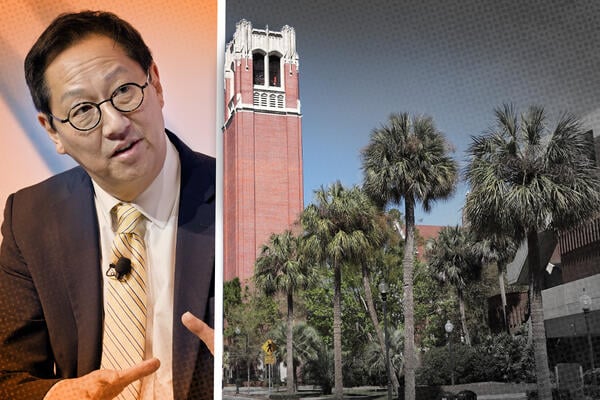
The Florida Board of Governors voted Tuesday to reject Santa Ono as the next president of the University of Florida, bowing to opposition from conservatives over his past support of diversity, equity and inclusion initiatives.
Anti-DEI activist Chris Rufo led the conservative backlash, while multiple elected officials in Florida alleged that Ono failed to protect Jewish students during his time as president of the University of Michigan.
Amid those concerns, the Board of Governors voted 10 to 6 to reject Ono for the UF job.
That process included a no vote from Paul Renner, a former Republican lawmaker in the state who had previously angled for the UF presidency, as became clear during board discussions. Throughout the meeting Renner grilled Ono on his past support for DEI, prompting fellow board members to push back, accusing him of “interrogating” Ono and questioning the fairness of his inquiries.
The vote comes after the UF Board of Trustees approved Ono’s hire last week following a public interview that focused largely on DEI. Ono distanced himself from DEI in that interview, arguing that the initiatives began with good intentions but ultimately became divisive. He said they siphoned resources away from student success efforts and stifled dialogue, which he said prompted his decision to close Michigan’s DEI office this spring. (Ono resigned from the Michigan presidency in May to pursue the UF job.)
“I am here to ensure that DEI never returns to the University of Florida,” Ono said Tuesday.
In the past, Ono had condemned systemic racism and argued for the necessity of DEI. But Tuesday—as he did in his public interview with UF’s Board of Trustees last week—Ono emphasized his ideological evolution, which ultimately failed to convince the board.
A Contentious Meeting
In the public comments portion of the meeting, both Ono’s supporters and detractors made their case.
Michael Okun, director of the Norman Fixel Institute for Neurological Diseases at UF, disputed claims that Ono failed to protect Jewish students. Okun, who is Jewish, argued Ono is an ally to the Jewish community, “and suggesting otherwise is factually incorrect and deeply harmful.”
But University of Michigan Medical School professor Joshua Rubin countered that claim, arguing that Ono had failed to stymie a culture in Michigan where antisemitism thrived. Rubin argued that Ono failed to fix problems at UM and “is complicit in that culture.”
Other speakers included Kent Fuchs, the former UF president called out of retirement to helm the university again when Ben Sasse exited the job abruptly last year. Fuchs, who is currently serving as interim president, supported Ono’s hire, telling the board the candidate was “unmatched nationally in both his credentials and his experience and his track record.”
UF Board of Trustees chair Mori Hosseini also made an impassioned plea to hire Ono.
“The bottom line is that Dr. Ono is globally recognized as one of the most respected leaders in higher education, and we are lucky to have him. Outside of Dr. Ono, there are very few people, if any, with a combination of ideological alignment in Florida and the operational experience to run a research powerhouse like you are,” Hosseini said in remarks to the Board of Governors.
He added that “the UF presidency is not a position where someone can learn on the job.”
But the Board of Governors bombarded Ono with a series of sharp questions.
Few had to do with how he would run the University of Florida; student and faculty representatives on the board asked how he would support and include their respective groups in his decision-making process, but most questions focused on DEI.
Jose Oliva, a former Republican lawmaker, told Ono his ideological shift was “nothing short of incredible.” He also asked Ono, who has a background in ophthalmology, what science his “decades-long, enthusiastic support and advocacy” for DEI initiatives was based on.
Ono argued that he was “not an expert in that area” and had not created any DEI programs; he said such efforts were already in place when he arrived at UM and his previous institutions, such as the University of British Columbia.
“Your words simply don’t support that you were just kind of sailing along,” Oliva responded.
Some trustees also pressed Ono on transgender care at University of Michigan Health, questioning whether the hospital had “cut off” the breasts or genitals of transitioning patients, particularly children.
As with many other questions, Ono demurred. In that case, he said he didn’t want to misspeak.
“I’m not an expert,” Ono said, in what became a common refrain throughout the day.
Hosseini, who was seated next to Ono and involved in the conversation at times—including when he revealed that Renner, who was one of Ono’s fiercest inquisitors of the day, had inquired about the UF job—appeared to bristle at the Board of Governors’ sharp questions for the candidate.
“You all decided today is the day you’re going to take somebody down,” Hosseini told the board.
Ono had been set to make up to $3 million a year as UF president. Now it appears Hosseini and the rest of the board will have to restart the search process.
Ono’s Opponents Celebrate
As news of Ono’s rejection spread, conservative critics took a victory lap.
“This is a massive win for conservatives—and an act of courage by the board,” Rufo posted.
Florida’s elected officials also weighed in.
“This is the right decision for @UF. UF’s students, faculty, and staff deserve a president who will stand for Florida values and against antisemitism,” Republican senator Rick Scott posted on X. (Scott had previously called for an investigation into the search that yielded Ono.)
But conservatives weren’t the only ones celebrating.
Multiple academics on BlueSky also seemed to take satisfaction in the news, with some indicating they thought Ono had done an about-face on DEI, only for the move to backfire.
“I don’t know how many times this needs to be said: there is no winning with these people. If you’re willing to sell your soul to try and appease them, then I’m sorry but you deserve whatever they do to you,” Neil Lewis Jr., a communication professor at Cornell University, wrote online.
Outside experts also noted how the Ono vote reflected the influence of state-level politics on decisions.
James Finkelstein, a professor emeritus of public policy at George Mason University who studies presidential contracts and hiring processes, told Inside Higher Ed by email that the outcome illustrated the growing complexity and politicization of picking a college leader.
“This episode is a stark reminder of how state-level politics are reshaping the presidential search process. The lesson is clear: until a contract is signed, nothing is guaranteed,” Finkelstein wrote.
We’re entering what would normally be the long-awaited reprieve of summer—a time to write, think, travel, to escape the demands of the academic year. But this will not be a normal summer.
Faculty may long for a break, but the government is actively operationalizing Project 2025, a blueprint for remaking every public institution, with higher education being the crown jewel of its antidemocratic agenda. At his 100-day rally in Michigan, Donald Trump declared, “We’ve just gotten started. You haven’t even seen anything yet.” Christopher Rufo, architect of the right-wing culture war, promises to plunge higher education still further into “an existential terror.”
We recommend mobilizing on two simultaneous fronts this summer: by operationalizing mutual academic defense compacts (MADCs), and through direct activism. We must forge powerful alliances for mass protest. We suggest one often-overlooked but deeply strategic constituency— veterans.
Recent opinion polls show that most Americans oppose the Trump administration’s approach to higher education. This public sentiment gives us a crucial opening—and we must seize the momentum as we move into summer.
Mobilize and Form Unlikely Alliances
Faculty can take simple, student-centered actions this summer—sharing stories of student impact over social media using #DegreesForDemocracy, or highlighting the real-world outcomes of their teaching and research with #WhatWeBuild—to demonstrate the value of higher education and help galvanize public support. Op-eds and blog posts that highlight how higher ed strengthens local communities, drives economic growth and improves American public health and well-being are also powerful tools.
In addition, faculty must begin to mobilize on the streets for mass peaceful protest. This will require reaching beyond our usual circles and forming big-tent coalitions. Now is not the time for ideological purity or partisan hesitation. The threat we face at this point goes beyond conventional liberal-versus-conservative disagreement; it is an attack on democratic institutions, civil liberties and public education itself.
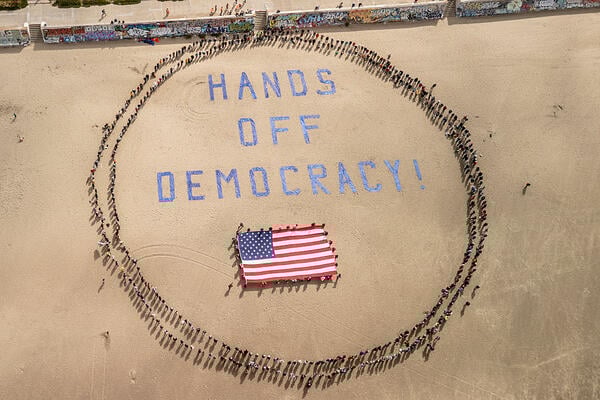
One particularly powerful, and perhaps surprising, potential partner in this moment is the veteran community. As a start, we urge faculty to consider aligning with veterans this Friday for the June 6 D-Day anniversary protest: Veterans Stand Against Fascism Nationwide at the National Mall, as well as at more than 100 other venues across the country. This is a great way for higher ed to show up in the lead-up to the June 14 No Kings Day protests.
Why Join With Veterans?
The shared legacy of the GI Bill links veterans and higher education. A public alliance with veterans has the potential to lend more political credibility to faculty and foster broader public empathy that will disrupt the Trump administration’s strategy of divide and conquer.
From Black WWII veterans who catalyzed the civil rights movement to anti–Vietnam War resistance, veterans have consistently served on the front lines of social change. Today, they are standing up to deep budget cuts to the Department of Veterans Affairs; the elimination of diversity, equity and inclusion initiatives; and dangerous reductions to the veteran workforce—issues that mirror the assaults on higher education.
Professors and veterans are natural allies in more ways than many realize. Since the passage of the GI Bill in 1944, millions of veterans have earned college degrees and experienced upward mobility through higher education. Veterans are a protected class under antidiscrimination law and recipients of DEI programming. The veterans’ centers and services we have created to support them are now under threat from the Trump administration’s ideological dismantling of DEI. While trust in most American institutions—including higher education—has declined, polling shows that the military remains one of the few institutions still trusted by a majority of Americans. This trust is rooted in the military’s demographic breadth: Its members come from every region, ethnicity, income bracket and political background.
In contrast, higher education suffers from an image problem—often caricatured as elite, out of touch and overly partisan. Yet many of the most trusted professionals in society—nurses, teachers, first responders, small business owners and veterans themselves—were trained and mentored in our classrooms. Building visible alliances with veterans can help reshape public perceptions of academia, challenging the dominant narratives that seek to isolate and delegitimize higher education.
Operationalize Mutual Academic Defense Compacts
While public protest builds pressure, cross-institutional coalition building creates networks for effective resistance. Faculty and university senates across the country are approving mutual academic defense compact resolutions, which call for universities to join in shared defense of any participating institution that comes under government attack. But this is just the beginning. We need more, and these resolutions need to be operationalized through the creation of MADC task forces of administrators and faculty on as many campuses as possible. Presidents and chancellors need to endorse both the compacts and the task forces.
We must use this summer to refine model MADC resolution language to align with institutional legal and financial requirements, to prepare for the passage of resolutions and creation of MADC task forces in the early fall, and to build the infrastructure that will allow these coalitions to function as coordinated networks of protection, resistance and shared strategy.
We’ve been struck by how many faculty members lack formal structures for self-governance on their campuses. Shared governance is a foundational pillar of academic freedom—though often overshadowed by the more visible right to pursue scholarship free from interference. We’re working with campuses to strengthen existing faculty governance organizations with the establishment of Stand Together groups, and where none exist, we’re helping to establish American Association of University Professors and other advocacy chapters to fill that crucial gap.
This summer, we must think strategically—and expansively. This summer calls for alliance building across our sister institutions of higher ed and across diverse nonacademic interest groups. The stakes are nothing less than the future of democracy.
Jennifer Lundquist is a professor of sociology at the University of Massachusetts Amherst.Kathy Roberts Forde is a professor of journalism at the University of Massachusetts Amherst.Together, the authors co-foundedStand Together for Higher Ed.
Networking events with alumni give students the chance to learn more about life after graduation and build career skills.
A May 2024 Student Voice survey by Inside Higher Ed and Generation Lab found that 29 percent of respondents believe their college or university should prioritize connecting students to alumni or other potential mentors. However, not every student has this opportunity before graduating; only one-third of graduates said their institution helped them to network with alumni while they were students, according to a 2024 National Alumni Career Mobility survey.
Administrators don’t always recognize this disconnect between current and former students; a 2024 survey of student success leaders found that 56 percent believe their career center effectively connects students with the institution’s alumni network.
Inside Higher Ed compiled six ways colleges and universities can invite alumni to partner with them to enhance students’ career development.
Mentorship Programming
Pairing students with graduates, particularly those in the same discipline or with similar career goals, is a common way to foster feelings of belonging among classes and with the institution.
Survey Says
A 2025 survey from Gravyty found that 80 percent of alumni engagement teams invite alumni to participate in community or networking events, but just over one-quarter ask alumni to become active volunteers. A survey of alumni also by Gravyty found that alumni who have served as mentors say they are 200 percent more likely to donate in the future.
The University of Massachusetts Dartmouth hosts a Meet and Mentor mixer to introduce current and past students, building organic relationships in an informal setting. Syracuse University extends mentorship opportunities for alumni far from campus through virtual mentorship meetings. The university has coordinated over 1,000 meetings between students and alumni mentors over the past five years.
In some cases, alumni can provide insights into evolving industries in ways that career services pros may be less equipped to.
Worcester Polytechnic Institute created a mentorship program for students interested in green or sustainable jobs and industries, in part to help them keep up with the rapid changes in the field. The program has found more mentors than mentees so far, including alumni from a variety of industries such as architecture and design, waste reduction, consulting, and energy.
Office Hours Programs
Establishing an informal space for students to meet with alumni allows them to create connections and helps students build confidence for venturing into more professional networking spaces. Clemson University’s business school invites alumni to participate in drop-in office hours to review résumés, provide career advice or engage in a casual conversation with students.
Some colleges and universities designate alumni in residence who provide one-on-one guidance, give presentations, engage in networking receptions and more, as needed. The University of Connecticut’s career center asks alumni in residence to devote at least four hours per month for virtual office hours and to participate in several career events and programs.
Job Shadows
While many students may know what field they’re interested in working in, understanding the day-to-day responsibilities of an industry professional can feel out of reach. Alumni connections can address the transition to work and help students establish work-life balance. Kalamazoo College connects students with local alumni for a short-term job shadow during spring break, showcasing local businesses and industries that hire graduates.
Grinnell College also taps alumni around the globe each spring to provide job shadows and homestays, giving soon-to-be graduates a deeper look at what their future may be after college. The visits, which can last from a day to a week, connect students to new cities, professional networks and careers.
Microinternships
Microinternships have grown as a way to engage students in project-based experiential learning connected to a potential employer. At Goucher College, microinternships also introduce students to alumni who share their career interests. The six-week virtual experiences take place across the winter break and January term, and students are paid a stipend by the university, reducing barriers for participation.
Projects vary depending on the needs of alumni, and in the past students have edited books, organized data, created presentations or conducted market research. The goal is to enable the student to walk away with a portfolio piece they can talk about in future interviews.
Early Alumni Engagement
Colleges can also help graduating students make the transition to being engaged alumni by establishing programs for recent graduates.
Boise State University created BOLD, short for Broncos of the Last Decade, an alumni group specifically for students who graduated in the past 10 years, which holds tailgate events and a champagne reception for new grads during commencement weekend. BOLD also offers discounts on football and basketball season tickets, helping alumni maintain connections to the institution even after graduation.
West Virginia University and Marshall University partnered to create a talent-development pipeline, called First Ascent, for recent graduates to reduce brain drain in the state and connect recent alumni to peers and mentors.
Financial Support
Alumni can also build institutional capacity and help sustain programs for current students through financial gifts and endowed resources. Supported through alumni donations, Brandeis University’s World of Work fellowship program provides stipends of up to $6,000 for students to participate in unpaid or underpaid experiential learning opportunities, helping build their career skills.
Many career centers are also endowed by alumni, including the University of Central Florida’s Kenneth G. Dixon Career Development Center, named for the 1975 alumnus who donated $5 million in 2024.
Do you have a career-focused intervention that might help others promote student success? Tell us about it.
During my first foray into marcomm leadership, every project seemed on fire. If the project was due at 3 p.m., the first draft was ready at 2 p.m., giving little time for adjustments. I noticed this happened with almost every project. As I did some research into the production calendar, I realized there were more projects than time. That meant if one project got behind, there was a ripple effect that continued to impact more and more projects the team was working on.
An initial strategy to address this involved offloading projects that were not the best use of marcomm’s time. The second strategy looked at increasing capacity through student workers and approved freelance partners. Despite implementing both, the team still struggled to accomplish all the tasks, finding many delays in the back-and-forth process with the campus partner. As I started exploring what would help the team, the idea of cross-functional teams emerged as a viable strategy to yield better alignment with key constituents, increase efficiency and create better products.
Cross-functional teams are groups of people from various areas in an organization who work together to achieve a common goal. I have used these teams with key university partners including enrollment, advancement and athletics. Each cross-functional team has several members from the marcomm team (usually a representative from communications, marketing, creative and web) and two or three members from the other unit. Together, these groups meet regularly and work as strategic partners to meet institutional goals.
Cross-functional teams are time-consuming but can have significant impact on outcomes, culture and organizational success when done well. Below are a few benefits of utilizing cross-functional teams when working with strategic campus partners.
Moving From Service Provider to Strategic Partner
One benefit of cross-functional teams is positioning marcomm teams as a strategic partner, not just an order taker. This shift allows marcomm to more meaningfully support institutional goals. Instead of executing someone else’s strategy, these teams can apply their individual expertise while collaborating on integrated strategies that support the partner and ultimately the organization. For example, the web team member can begin approaching the project thinking about the entire digital strategy, instead of just making a website pretty. This role’s shift helps improve relationships between the teams but ultimately drives results.
Operational Efficiency Creates Wins Faster
Familiar teams work faster. Less time is required to navigate procedural and relational decisions, such as who needs to review something or what the feedback process entails. In cross-functional teams, the members become comfortable with these aspects, allowing them to begin working faster. The speed comes not only from familiarity but also from intentionality. Shared institutional knowledge of the goals and the internal processes to complete tasks results in more thoughtful responses when adjustments are needed because of changes like enrollment shifts, market changes or budget adjustments.
Consistency Builds Brand Equity
Aligned teams also create consistent work. Regular collaboration leads to consistency in voice, tone and look on projects. For example, when cross-functional teams are collaborating on the goals for a piece, there is more likely to be synergy in the tactical execution of the piece or at a least a shared understanding of the approach. When there is no alignment, the teams may agree on the goal but are less likely to agree on the strategies and tactics, resulting in disjointed messaging and less effective outcomes.
Cohesive messages also build trust and recognition with external audiences, which is critical to support for university objectives. Ultimately, consistency across teams strengthens the university’s voice in the market and amplifies the impact of every communication.
Internal Alignment Supports Goals
One of the biggest benefits of cross-functional teams is how they strengthen internal alignment within marcomm. By collaborating closely with colleagues across disciplines, the marcomm team is better equipped to align its work with the goals and priorities of campus partners. For example, telling our story takes on an enhanced meaning when it is viewed through the lens of growing enrollment or raising private institutional support. In addition, this cross-functional collaboration fosters greater accountability and trust within the marcomm unit itself. From my experience, the team often internally aligns on the approach and presents a strategic (and united) front when pitching concepts or suggesting strategy shifts.
Empowered Teams Create Elevated Outcomes
Cross-functional teams facilitate learning from all members. Hearing new perspectives from other divisions creates new understandings, both within marcomm and outside of it. For example, web team members learn about graphic design and enrollment best practices. This occurs because cross-functional teams are collaboration-based, so all team members are empowered to contribute ideas instead of only giving feedback on their traditional roles. More broadly, the entire marcomm team benefits from cross-functional teams if there’s a way to share these learnings with the full group instead of just those in a specific meeting.
Working Toward Success
When I first stepped into marcomm leadership, the team was running full speed just to keep up, racing from one fire drill to the next with little time to pause, reflect or align. What initially seemed like a time-management problem turned out to be a deeper issue of structure, communication and partnership. Through the intentional creation of cross-functional teams, we began to shift from reactive executors to proactive strategic partners.
Cross-functional teams require time investment to create shared mission, collaboration frameworks and understanding of the work at hand. However, these teams generate shared ownership and strong trust, central to ongoing collaboration, partnerships and organizational innovation. Most importantly, the outcomes are usually a more agile, aligned and high-performing organization—better equipped to meet both immediate goals and long-term strategic priorities of the institution.
Carrie Phillips, Ed.D., is chief communications and marketing officer at the University of Arkansas at Little Rock.
City College of San Francisco announced last week that it had hired a new chancellor—but never voted to approve the candidate and later deleted the news release, leaving the process in limbo.
The San Francisco Chronicle reported that City College posted a news release on Tuesday announcing that it had selected Carlos O. Cortez as its next chancellor, pending approval at a Board of Trustees meeting on Thursday. However, the board spent several hours in a closed executive session before ultimately deciding not to make a decision on the candidate.
Trustees did not explain their inaction on the search, according to a review of the meeting. The board agenda shows trustees were also set to consider approval of a contract for Cortez, with an annual base salary of $350,000, but removed that action item after punting on the search.
Multiple speakers at the meeting expressed support for Cortez.
In the Tuesday news release that was later deleted, Anita Martinez, the Board of Trustees president, lauded the candidate for his “proven track record of success in academic innovation, fundraising, student success, and community engagement.”
Cortez was previously chancellor of the San Diego Community College District from July 2021 to May 2023 before he stepped down suddenly, a move he attributed to the need to take care of his ailing parents in Florida. Since then he has emerged as a finalist for six jobs at the chancellor or president level, including SFCC. Five of those jobs were in California and one was in Wisconsin.
The San Francisco Chronicle also reported that Cortez was arrested in Florida on suspicion of driving under the influence in January 2024 and later pleaded no contest to reckless driving. Cortez told the newspaper the charge was “due to a mixture of prescription medicine.”
Cortez told the San Francisco Chronicle last week that he didn’t know where his candidacy stands. He did not respond to a request for comment from Inside Higher Ed sent via LinkedIn on Monday.
City College officials also did not respond to a request for comment from Inside Higher Ed.
American universities are dynamic engines of deep technological innovation (deep tech), responding to a growing demand for STEM research innovations that can reach the market quickly and at scale. In order to remain competitive in a fast-moving global scientific landscape and strengthen national research dominance, universities need to accelerate their innovation outputs by shortening the time it takes for research products from graduate students and postdoctoral researchers in STEM fields to reach the market, while providing these early-career researchers with the necessary mentorship and resources needed to translate their academic research projects into high-impact startup companies. By targeting these highly qualified scientists at the juncture of innovative university research and entrepreneurial ambition, we can more effectively advance academic research discoveries from early-career STEM talent into commercially viable new companies (NewCos) at scale.
To fully capitalize on this immense potential, America must transcend the current national innovation paradigms. We argue that our nation’s global leadership in science and technology could be maintained through strategically scaled and nationally coordinated approaches to innovation, including cross-cutting and cross-sectoral approaches. Additionally, to retain American scientific and technological leadership on the global stage, we must confront the inherent risks of deep tech ventures head-on and decisively maximize our national “shots on goal,” which can lead to developing a truly robust and self-sustaining innovation ecosystem.
These programs have served as important launchpads for many academic entrepreneurs, including early-career scientists. However, early-phase SBIR/STTR grants typically range around $150,000 for durations of six months to one year. While this funding provides critical seed capital, it represents only a fraction of the substantial investment required for R&D, prototyping and market validation for deep tech ventures. Compounding this challenge, the acceptance rate for SBIR grants has declined sharply, from approximately 30 percent in 2001 to just 10 percent in 2024 in some sectors, further straining the pipeline necessary for deep tech innovation.
Current federally focused financial support systems are falling short. Start-up success rates remain low, and private venture capital is unlikely to close the funding gap, especially for university-based early-career scientists. As competition for SBIR funding intensifies and global venture capital investment drops by 30 percent, America’s scientific and technological competitiveness is at risk without stronger shared-risk models and expanded backing for academic innovation.
In today’s highly commercialized and globally competitive research landscape, the quality and quantity of start-ups emerging from academic labs are critical parameters for developing the next generation of entrepreneurs. A strong pipeline of NewCos enables more innovations to be tested in real-world markets, increasing the chances that transformative companies will succeed and attract external investment from industry. To meet this challenge, America needs a bold vision focused on maximizing national shots on goal through strategic scaling, proactive risk management and innovative risk-sharing models. This framework must not only rely on investment from the federal government but also from a strategically blended funding model that includes state and local governments, industry, philanthropy, venture capital, mission-driven investors, and other nontraditional funding sources.
A nationally coordinated cross-sector pooled NewCo fund, supported by federal agencies, universities, industry, philanthropy, private equity and venture capital, partnering together, is essential for rapidly advancing national innovation at scale.
This idea is not unique to us; it has been proposed in Europe and Australia and has been part of the science policy conversation for some time. However, the current historical moment in American science offers a unique opportunity to move from conversation to action.
Impacts of Research Funding Cuts
This year, significant reductions in federal funding for R&D at multiple federal agencies have posed substantial challenges to universities striving to remain global-leading STEM innovation hubs. Reductions in staff at the NSF have implications for SBIR programs, which rely on robust institutional support and agency capacity to guide early-stage innovation effectively. In addition, proposed reductions in indirect cost reimbursements for grantees at multiple agencies including NIH, DOD, NSF and the Department of Energy may also pose a challenge to research institutions and resulting start-ups in covering essential overhead expenses, impacting the transition of federally-funded research from labs to market-ready applications.
An Updated Framework
The national shots on goal framework is a potential remedy to the currently changing landscape imposed by federal science funding cuts. By emphasizing public-private-philanthropic partnerships, scaled seed investments and improved use of existing infrastructure within universities, this framework can help mitigate the impact of research funding cuts at federal agencies on early-career researchers.
This framework can be especially impactful for graduate students and postdoctoral researchers in STEM fields whose scientific projects, entrepreneurial endeavors and research careers require robust and sustained federal support from multiple funding sources over a longer period of time. It also allows universities to maintain and expand deep tech innovation without relying solely on federal agency funding.
For example, targeted one-year investments of $200,000 per NewCo can provide an essential and low-risk commercialization runway, similar in scale to the NIH R21 program. This fund would be sustained through contributions from a broad coalition of federal agencies, philanthropies, state governments, regional industries, universities and venture and private equity partners. By distributing risk across the ecosystem and focusing on returns from a growing pipeline of NewCos, this coordinated effort could partially counteract the losses sustained by the research enterprise as a result of federal agency funding cuts and accelerate university-driven scientific innovation nationwide.
To support the long-term sustainability of these start-up companies, a portion of national NewCo funds could be reinvested in traditional and emerging markets, including crypto. This would help grow the NewCo funds over time and de-risk a pipeline of start-ups led by early-career scientists pursuing high-risk research.
A Pilot Program
To validate the national shots on goal vision, we propose a targeted pilot program initially focused on graduate students and postdoctoral researchers in STEM fields pursuing NewCo formation at select U.S. land-grant universities. Land-grant universities, which are vital hubs for STEM research innovation, workforce development and regional workforce growth, are uniquely positioned to lead this effort. Below, we suggest a few elements of effective pilot programs, bringing together ideas for outreach, partnerships, funding and relevant STEM expertise.
Dedicated, national risk-mitigating funding pool: To minimize capital risk, provide one-year seed grants of $200,000, along with subsidized or free access to core facilities. By the end of the year, each venture must secure external funding from the commercial sector, such as venture capital, or it will be discontinued, given that follow-on support cannot come from additional federal grants or the seed fund itself.
Targeted, risk-aware STEM outreach and recruitment: Implement a national outreach campaign explicitly targeting STEM graduate students and postdoctoral researchers at land-grant universities, highlighting risk-managed opportunities and participation pathways. Industry and philanthropic partners should be included in outreach and recruitment steps, and promote projects that meet high-priority industrial and/or philanthropic R&D strategic interests.
Specialized, STEM-oriented risk management–focused support network: Develop a tailored mentorship network leveraging STEM expertise within land-grant universities. The network should include alumni with entrepreneurial talent and economic development partners. It should also include training for academic scientists on risk modeling and corporate strategy, and actively incorporate industry experts and philanthropists.
Earmarked funding for STEM-based graduate and postdoctoral programs: In addition to the above, new funding streams should be specifically allocated to graduate students and postdoctoral researchers in STEM fields. This framework would grant them an intensive year of subsidized financial support and access to the university’s core facilities, along with support from business experts and technology transfer professionals to help them launch a company ready for external venture funding within one year. Critically, during this process, the university where academic research was conducted should take no equity or intellectual property stake in a newly formed company based on this research.
Rigorous, risk-adjusted evaluation and iteration framework: Establish a robust national evaluation framework to track venture progress, measure performance and iteratively refine the framework based on data-driven insights and feedback loops to optimize risk mitigation.
Leverage existing programs to maximize efficiency and avoid duplication: Entrepreneurial talent and research excellence are nationally distributed, but opportunity is not. Select federal programs and initiatives can help level the playing field and dramatically expand STEM opportunities nationwide. For example, the NSF I-Corps National Innovation Network provides a valuable collaborative framework for expanding lab-to-market opportunities nationwide through the power of industry engagement.
Prioritize rapid deep tech commercialization through de-risking models that attract early-stage venture and private equity: Transformative multisector funding models can unlock NewCo formation nationwide by combining public investment with private and philanthropic capital. The Deshpande Center at MIT demonstrates this approach, offering one-year seed grants of $100,000, with renewal opportunities based on progress. These early investments can help deep tech entrepreneurs tackle complex challenges, manage early risk and attract commercial funding. ARPA-E’s tech-to-market model similarly integrates commercialization support early on. Additionally, the mechanism of shared user facilities at DOE national labs reduces R&D costs by providing subsidized access to advanced infrastructure for academic researchers in universities, thereby supporting the formation of NewCos through strong public-private partnerships.
Bridge the academic-industry gap: Given the central role of universities in national innovation, building commercially viable deep tech ventures requires bridging the science-business gap through integrated, campus-based STEM ecosystems. This requires strengthening internal university connections by connecting science departments with business schools, embedding training in risk modeling and corporate strategy and fostering cross-disciplinary collaboration. These efforts will support the creation of successful start-ups and equip the next generation of scientists with skills in disruptive and inclusive innovation.
Conclusion
As American scientific innovation continues to advance, this moment presents an opportunity to rethink how we can best support and scale deep tech ventures resulting in start-up companies emerging from university research labs. In the face of federal funding cuts and ongoing barriers to rapid commercialization at scale within universities, these institutions must adopt bold thinking, forge innovative partnerships and exhibit a greater willingness to experiment with new models of innovation.
By harnessing the strengths of land-grant universities, deploying innovative funding strategies and driving cross-disciplinary collaboration, we can build a more resilient and globally competitive national research and innovation ecosystem.
Adriana Bankston is an AAAS/ASGCT Congressional Policy Fellow, currently working to support sustained federal research funding in the U.S. House of Representatives. She holds a Ph.D. in biochemistry, cell and developmental biology from Emory University and is a member of the Graduate Career Consortium—an organization providing an international voice for graduate-level career and professional development leaders.
Michael W. Nestor is board director of the Government-University-Industry-Philanthropy Research Roundtable at the National Academies of Sciences, Engineering and Medicine. He directed the Human Neural Stem Cell Research Lab at the Hussman Institute for Autism, where his work led to the founding of start-ups Synapstem and Autica Bio, and contributed to early-stage biotech commercialization at Johnson & Johnson Innovation–JLABS. He holds a Ph.D. in neuroscience from the University of Maryland School of Medicine and completed postdoctoral training at the NIH and the New York Stem Cell Foundation.
The views expressed by the authors of this article do not represent the views of their organizations and are written in a personal capacity.
The Department of Health and Human Services cited fake publications in a report on children’s health issues issued last week, The New York Times reported.
The Make America Healthy Again Commission claims its report—which blamed chronic disease in children on ultraprocessed foods, pesticides, lack of physical activity and excessive use of prescription drugs, including antidepressants—was produced with a “clear, evidence-based foundation.”
However, some of the researchers it cited said they didn’t write the papers the report attributed to them.
In one example, the report cited a paper on the link between mental health and substance use in adolescents by Katherine Keyes, an epidemiology professor at Columbia University. But Keyes told the Times that she didn’t write the paper. And no paper by the title cited—written by anyone—appears to exist at all.
The report cited another paper about psychiatric medications and advertising that was allegedly published in 2009 in The Journal of Child and Adolescent Psychopharmacology by “Findling, R. L., et al.” But the Times confirmed that Robert L. Findling, who is a psychiatry professor at the University of Virginia, did not author the paper.
The newspaper also found numerous other instances of mischaracterized or inaccurate summaries of research papers.
After both the Times and NOTUS reported on the false citations Thursday, the White House promptly updated the report with corrections. In response to questions from reporters about whether generative artificial intelligence—which is notorious for “hallucinating” information and failing to provide accurate citations—was used to produce the errant report, Emily Hilliard, a spokesperson for HHS, did not provide an answer.
Instead, she characterized the false citations as “minor citation and formatting errors,” according to the Times, and doubled down on the report’s “substance” as “a historic and transformative assessment by the federal government to understand the chronic-disease epidemic afflicting our nation’s children.”
Math courses are often a barrier for students seeking to pursue a college credential, and for some, a lack of math curriculum during high school can make a STEM career seem out of reach.
A new course at Wentworth Institute of Technology in Boston serves as a stepping-stone for students who may not have had access to precalculus or calculus courses but are still interested in calculus-based learning. The university hopes the program will boost student enrollment and eliminate barriers to access for disadvantaged students.
What’s the need: The conversation about offering precalculus at Wentworth began in 2019, after university leaders saw that some students, despite having the same GPAs and high school transcripts as their peers, were less mathematically prepared, said Deirdre Donovan, Wentworth’s director of first-year math and interim associate dean of the School of Computing and Data Science.
At that time, Wentworth did not offer a math placement course, so all enrolled students launched at the calculus level.
Wentworth, like many colleges and universities, requires students to have already completed calculus coursework to enroll in specific major programs, which is “a barrier that can prevent otherwise qualified students from pursuing engineering and computing degrees,” Donovan said.
To complete calculus by the end of high school, students had to complete Algebra I in eighth grade, and not every student was ready, aware of or offered that course at their school, Donovan said.
Some high schools also push students to complete AP Statistics in lieu of calculus, and Donovan said this shift “can actually close more doors at STEM schools than it might open, because those AP credits can’t replace the calculus-based statistics required for engineering degrees.”
Campus leaders at Wentworth opted to review policies that were barring students from participating in STEM programs, starting with creating a math placement process and then developing a precalculus course.
How it works: In 2024, Wentworth removed precalculus as an admissions requirement for students, paving the way for the college to admit about 10 percent more students who might have previously received a conditional acceptance, Donovan said.
New students without calculus credit are now enrolled in a four-credit, first-semester course called Foundations of Calculus that helps them get up to speed. The investment in additional content hours is an indication of the university’s commitment to opportunities for students who may not have been able to enroll and succeed previously, Donovan said.
In addition to two hours of lectures each week, students also participate in two hours of labs that focus on engineering problem-solving skills, using real-world problems that are tied directly to a student’s major.
The course is also supported by embedded peer tutors who can address student questions, clarify confusing content and facilitate study groups outside of class time.
It was important to Donovan and her faculty team not to work from a deficit-minded perspective about students’ knowledge gaps. Language regarding the course and its content hours was specifically crafted to help students feel like they’re being guided onto an on-ramp, not held back or punished for not having precalculus experience.
The results: After the first semester, staff have seen promising results, Donovan said. “We are pinching ourselves that it went exactly how we had hoped it would go.”
In fall 2024, about 200 students participated in precalculus either because they lacked the course in high school or their placement exam results indicated it would benefit them.
Approximately 75 percent of precalc students passed their course in the first term, on par with national averages. When they attempted calculus in their second semester, students had similar passing rates to their peers who completed calculus in the first term.
University faculty and staff were encouraged to see that engineering programs received 20 percent more applications this year, signaling an increased level of interest in rigorous programs, Donovan said.
Fall-to-spring retention rates were slightly lower for precalc students, but that could be due to other factors, including students re-evaluating their chosen major or deciding whether they want to be at a STEM-focused institution.
The course has also expanded enrollment opportunities for students who otherwise might not have considered Wentworth. Overall applications were up 25 percent year over year this past application cycle, and deposits were up 30 percent, Donovan said.
What’s next: Student feedback from the first term has indicated a need for an additional credit hour of in-person, interactive lab work, which will be implemented this fall. The hour, which the university is calling a companion class, will function similarly to a first-year seminar, teaching students study skills and metacognition, as well as connecting back math concepts.
None of the downstream courses such as physics have undergone a curriculum change, requiring students to get up to speed in their first term to be successful over all in college. Students who complete precalc also may need to take summer classes to ensure they graduate in four years, but the university is looking to offer affordable online courses to accommodate learners, Donovan said.
Do you have an academic intervention that might help others improve student success? Tell us about it.
Erik Jacobsen, an associate professor of mathematics education at Indiana University, was nearing the end of a years-long project designed to address teacher biases with the goal of helping more students excel in math and pursue STEM careers. But that all stopped several weeks ago, when the National Science Foundation notified him that it had terminated the grant because it was “not in alignment with current agency priorities.”
Jacobsen’s grant, which was funding multiple graduate students and a postdoc, who are all now in limbo, is far from the only STEM education–focused grant the NSF recently canceled.
Of the approximately 1,500 grants the agency recently terminated, at least 750 came from the NSF’s education directorate, according to Grant Watch, an independent website that tracks terminated NSF grants. And that’s not the only shake-up happening at the NSF, which Congress created in 1950 to “promote the progress of science; advance the national health, prosperity and welfare; and secure the national defense.” The Trump administration has also laid off staff and proposed slashing the agency’s budget.
Additionally, NSF announced new priorities that include not funding projects aimed at recruiting more Americans from underrepresented backgrounds to the STEM workforce—a key focus for the agency historically.
The Trump administration says all these changes are part of its plan to reform the NSF, correct an alleged “scientific slowdown,” build a “a robust domestic STEM workforce” and “rapidly accelerate its investment in critical and advanced technologies such as artificial intelligence, quantum computing and biotechnology.” The NSF sends billions to colleges and universities to support STEM education and nonmedical scientific research.
Researchers and policy experts are worried that the major cuts to STEM education programs will jeopardize the long-term future of the STEM workforce and leave the nation with a deficit of scientists and other skilled workers who are capable of carrying out Trump’s vision of winning “the technological race with our geopolitical adversaries.”
“There may be enough scientists to do the projects that are left. But for how long? They’re eventually going to retire and there won’t be this robust pipeline,” Jacobsen said. “There’s so many kids in our country that learn math and science every day. And the reason they learn it as well as they do is because of NSF’s historic investment in education.”
‘Nearsighted’ Changes
Since Trump started his second term in January, the NSF has upended its operations and spurred chaos and uncertainty within the research community. In February, the agency fired 10 percent of its staff—many who help university researchers navigate the grant application and funding process—though a federal judge later ordered the NSF to reinstate some of those employees.
“Their absence means that even if the budget is sufficient to fund new projects, distributing that money fairly and appropriately is going to be delayed if not made impossible,” Suzanne Ortega, president of the Council of Graduate Schools, said. While those and other changes are already “having immediate effects on graduate students, postdocs and early-career scientists,” she said there will also be “major downstream consequences” that won’t come home to roost for at least five years.
According to the Bureau of Labor Statistics, employment in STEM occupations is expected to grow 10.4 percent between 2023 and 2033, more than double the projections for non-STEM careers. But decimating the NSF’s education directorate—which funds many projects focused on researching how to improve STEM education outcomes starting in K-12—will make it harder to cultivate the robust STEM workforce Trump says he wants, Ortega said.
“This kind of research tells us how we can develop curricula that makes the pathway from a Ph.D. program into industry more seamless. Or how we can create mentoring networks or other kinds of connections that foster more rapid degree completion,” she said. “To forget that education research itself is vital to improving the system that our research enterprise depends on is very nearsighted.”
Adding to the challenges is the Trump administration’s crackdown on international student visa holders—who make up a sizable portion of STEM graduate students—which could make strengthening the STEM career pipeline increasingly difficult, said Holden Thorp, editor in chief of the Science family of journals.
“We desperately need more effort to produce scientists who are U.S. citizens,” he said. “Regardless of whether those programs are devoted to marginalized groups or anyone else, there’s people we need to encourage to go into science. Even if you don’t accept the reason why some of these programs were set up. It’s a disastrous economic strategy to get rid of programs—especially when they were in midstream—that would be growing the supply of scientists in the American workforce.”
As these changes keep coming, the NSF remains without permanent leadership. Sethuraman Panchanathan—the Trump appointee who had run the agency since 2020—resigned in late April, stating that he’d done all he could “to advance the critical mission of the agency.”
Earlier this month, the NSF announced a plan to cap indirect cost rates—which fund laboratory space and other research supports that can be used for multiple projects—for universities at 15 percent. At the same time, Trump’s budget bill proposed cutting the NSF’s 2026 budget by 55 percent, which includes cutting $3.5 billion from the agency’s general education and research budget, $1.1 billion from the Broadening Participation programs and $93 million for agency operations and awards management.
A coalition of former NSF directors and National Science Board chairs blasted the proposal, saying it “would thwart scientific progress, decimate the research workforce and take a decade or more to recover” and “fast-track China’s plans for technological dominance.”
Although Congress will have to approve Trump’s budget proposal later this year for it to become law, the NSF is already preparing for a future with less funding.
According to Science, NSF has eliminated 37 divisions across its eight directorates and is also creating a new oversight body of unknown membership that will have the final say in reviewing a proposal to ensure it doesn’t violate the agency’s new anti-DEI priorities. Additionally, the NSF announced earlier this month that it plans to cut more than half of its senior administrations and slash the number of “rotators”—academic scientists who serve two- to four-year terms to help the NSF choose which research to fund—as part of its cost-saving strategies.
That has big implications for NSF-funded initiatives like the Advanced Technological Education (ATE), which is a congressionally mandated effort led by community colleges designed to improve and expand educational programs for technicians to work in high-tech STEM fields that drive the U.S. economy.
“ATE is heavily influenced by rotators from community colleges,” said Ellen Hause, associate vice president for academic and student affairs at American Association of Community Colleges. “With the rotators on the chopping block, we would lose some of this expertise not only in STEM technician education, but in the community college space, which is a unique piece of the STEM workforce and STEM education.”
Many of the future community college students who may want to participate in a program like ATE in the coming years are just now getting exposure to STEM fields in their K-12 classrooms. And projects like Jacobsen’s (the math education researcher at IU) were supposed to help more of those students get comfortable with the academic material required to pursue such careers. But canceling his and other STEM education research grants midstream is already undermining decades of federal investment in STEM education, he and others said.
“We’d already done most of the work and spent most of the money,” he said. “By not having the final amount, we can’t complete our work, which means the public doesn’t get the benefit of the knowledge we would have learned. We still don’t know if the tool we were developing works. And now we’ll never know. It’s just wasting that investment.”
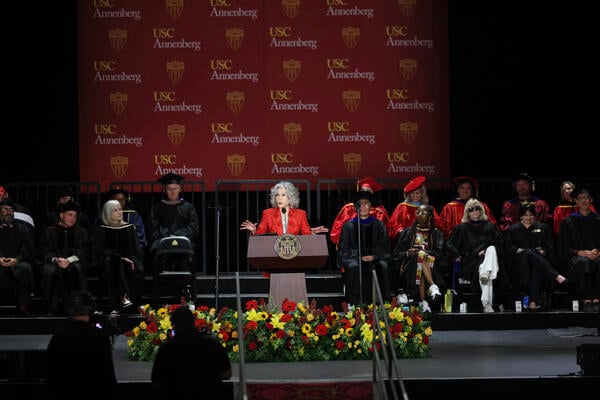
Commencement this year comes at a time of uncertainty for graduates, who find themselves entering a polarized country steeped in political and economic tumult. It’s a scenario many graduation speakers confronted head-on; actress Jane Fonda told the Class of 2025 that “the world has never faced anything like the challenges we face today.”
Much like 2024, this year’s commencement season has been marked by controversy, including at least twoinstances where student speakers were penalized for talking about the war in Gaza. Graduates also protested right-wing commencement speakers, including President Donald Trump himself, who spoke at the University of Alabama—which doesn’t traditionally invite guest speakers to commencement—and at the U.S. Military Academy at West Point, where his hourlong, meandering speech went viral.
But for many graduates, commencement went on as expected, with speakers doling out advice about how to survive—and even thrive—in these difficult times. Here’s what they had to say.
On the Current Political Climate
“Ignorance works for power. First, make the truth seekers live in fear. Sue the journalists and their companies for nothing, then send masked agents to abduct a college student who wrote an editorial in her college paper defending Palestinian rights and send her to a prison in Louisiana, charged with nothing. Then, move to destroy the law firms that stand up for the rights of others. With that done, power can rewrite history with grotesque false narratives. They can make criminals heroes and heroes criminals. Power can change the definition of the words we use to describe reality. ‘Diversity’ is now described as illegal. ‘Equity’ is to be shunned. ‘Inclusion’ is a dirty word. This is an old playbook, my friends. There’s nothing new in this. George Orwell, who we met on the street in London, 1949, he warned us about what he called ‘newspeak.’ He understood that ignorance works for power. But then it is ignorance, isn’t it, that you have repudiated every single day here at Wake Forest University? … Can the truth win? My friends, nothing else does.”
“I could never have imagined 55 years [after I graduated college] that a young woman would write her truth in your paper and find herself kidnapped and arrested for speaking her truth, somehow. And be put in jail. I could not have imagined that, 55 years later. But let me tell you that all of America salutes your president and Tufts University for supporting that student, Ms. Öztürk. It’s so important, and there’s the point when you think about Rümeysa. She said something recently. She said, ‘I still believe in this country and the right to free speech and to due process.’ … And so I can tell you when you say, ‘Oh, we’re going down the tubes.’ No, we are not. I believe in this country. As Rümeysa said, ‘We believe in the people.’ In you. This country will be OK.”
—Freeman Hrabowski III, education advocate and former president of the University of Maryland Baltimore County, May 18 at Tufts University
On Persistence
Maggie Rogers, pictured here in 2024, spoke at her alma mater, NYU, this month.
“My career arrived overnight. It’s this Cinderella story of a video—maybe you’ve seen it, maybe it was force-fed to you. If you haven’t seen it, I play a song for Pharrell Williams, he really likes it, his reaction goes on YouTube—ta-da, I’m famous. What people saw in that video was this moment of alignment; they saw a past life or the universe or whatever you want to call it come along and hold my hand to the flame. But no one saw all the hard work or all the times I almost quit. They never heard the songs that didn’t work or the shows that were just bad … I don’t know any artist that hasn’t considered quitting. But you didn’t get here because you wanted to do something easy; you got here because you wanted to do something great.”
“There’s a saying from one of America’s most practical minds, Benjamin Franklin, that I’ve used almost every day of my life: ‘Little strokes fell great oaks.’ It’s simple, it’s old, it’s absolutely true … I did run for governor in 1994 and lost, and one of the reasons I lost, I think, is I didn’t show my heart. I had five-point plans to cure every ailment in the state, but I didn’t really connect at a human level with people.
“So, in 1998, when I ran again, I vowed to campaign differently. For example, I went to visit 260 schools in a matter of a year. Back then, my views on education were considered pretty radical, so in essence I went into the lion’s den over and over and over again, trying to dehorn myself, I guess, with people that were skeptical of the ideas that I was advocating. I listened and learned, I shared my passion, I told stories of the challenges that teachers had. And I believe I became governor in 1998 because I was doggedly determined to show my heart. It’s easy to look at the world and believe that success happens overnight. We live in a world of immediate gratification, don’t we? Social media, movies, headlines often highlight the moments of triumph without showing the years of work, sacrifice and persistence that came before.”
“Don’t let anxiety or depression or hopelessness cause you to isolate. On the contrary, grow yourself a deep, solid community of people who share your values, have each other’s backs, check up on each other regularly, and be intentional about this. You know, in these uncertain times, we need to strengthen our ties to community, to our colleagues, our friends and family, because, more and more, we’re going to need this support for safety, for love, for help, for fun—let’s not forget fun—and for survival. You may not be aware of this, but since the 1980s, there’s been a concerted effort to promote individualism. You know, ‘I’m here for me and mine.’ And this shift to individualism is no accident; it’s being driven by people who want us disempowered. The myth of the rugged individual who needs no one is just that: It’s a myth created by stories through culture, told through culture, and the kinds of things that you all are going to be doing. So graduate students working with words and images—do the reverse. Encourage community versus individualism.”
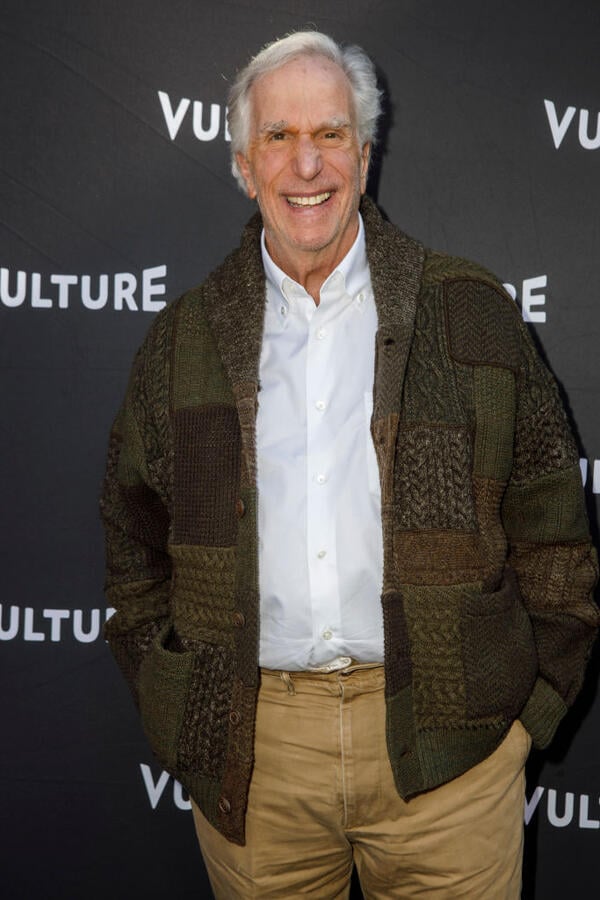
Henry Winkler, pictured here in 2024, gave the commencement address at Georgetown University.
Harmony Gerber/Getty Images
“I was a negative thinker. I wanted to beat the system. ‘I can’t, I won’t, I’ll never, oh, she won’t go out with me.’ So, I tried to find the answer to negative thinking. I found Gurdjieff. He’s an Armenian philosopher who wrote a gigantic book. But he doesn’t want you to finish the book unless you understand him—so I didn’t. ’Cause I didn’t know what the hell he was talking about. And I found a disciple of his, Ouspensky—also a big book. I got one sentence. OK, so, you’re walking to your dream. Never let your dream out of your brain. And when you decide what it is you want to do, just know it without a doubt, know it without ambivalence. So you’re walking to your dream, and you have your dream in your brain, and all of a sudden a negative thought comes in. Your shoulders drop, your head drops and then that negative thought, it blooms into a thesis of negativity. A negative thought comes into your mind—you say out loud, you say out loud, ‘I am sorry, I have no time for you now.’
“Yes, people will look at you very strangely, but it doesn’t matter, because it becomes your habit. A negative thought comes into your mind, you move it out, you move a positive in. For me, it is a Bundt cake with melty chocolate chips—no icing—and all of a sudden your shoulders fly back, your head flies up and you continue your dream. And then you get to stand here and talk to you.”
“[I was] sitting in a doctor’s office, facing one of the most difficult decisions I’ve ever had: continue living my life in pain, or consider having my leg amputated. In that moment, something clicked. I stopped letting the reality of my present circumstances dictate the potential of my future. I stopped coming from a place of victim mentality and realizing that everything happens for a reason and something bigger was going on. That shift in perspective gave me the courage to move forward, to make the decision to have my leg amputated and hope of a better future.
“Since then, I’ve come to realize something. Experiencing pain doesn’t disqualify you from discovering your purpose. It prepares you for it. The reality is, every single person here has lost something at some point, a dream, a loved one, a friend. You see, the promise in [James 1:2–3] wasn’t that trials would go away; it was that endurance would grow. That’s what trials do. They forge something in us that comfort never could. They teach us to keep going when nothing makes sense to believe, when hope feels distant, to see ourselves, not by what we’ve lost, but by who we’re becoming. That’s the hidden gift in pain, because it’s the journey, not the destination that shapes us the most. So if you’re in the middle of something broken, don’t run from it. Embrace it. Life is hard, but the journey is worth it.”
Rep. Jasmine Crockett spoke at the Southern University of New Orleans, an HBCU in Louisiana.
“I will start by saying your existence as a graduate of this HBCU alone is and will be seen as a resistance. Let me break it down this way: They never wanted us to be educated. This isn’t false. It is absolutely a fact. I know y’all know the history, but there is something special in this moment in time to be allowed to tell the story in the midst of the many haters and agitators being elevated to the highest positions of power and trying to use an old-school eraser—emphasis on old-school. You know, the old pink one? They want to use that old-school eraser to erase us. They have no idea that this big pink eraser can’t erase what was written in blood. Blood that was shed by the many who bled so that brighter days like this could come.
“Much like the creation of this school, nothing in this life will be given to you. You will always walk into spaces due to your meritocracy. And even the spaces they seek to disallow you from, just know that they fear your greatness. You see, in 1956, Act 28 of the Louisiana Legislature established SUNO, but only after local African American leaders in the ’40s pushed for public college for Black students during segregation. Turn to your neighbor and say, ‘SUNO wasn’t created out of generosity.’ [graduates repeat] ‘It was created out of segregation.’ [graduates repeat] You see, they sought to build barriers. But SUNO built beginnings.”
“So, you might wonder why I’m speaking here instead of at the business school. Well, it’s because the business school got Snoop Dogg. Hard to compete with Snoop. Even though I did later go to business school, I could not have navigated the business world the way I did without the liberal arts education I earned right here. USC is where I discovered what I liked and what I didn’t. I did not, for example, like writing. That’s ironic for the CEO of a publishing company, I know. Eventually I came around.
“Physics, though, that hooked me right away … Physics instilled something in me that was more valuable than equations and theories. It gave me confidence. It became second nature to think, ‘I don’t know how to solve this problem, but I do know that I will figure out how to solve it.’ And that, Trojans, is what your USC education is giving you. More than a degree, more than a line on a résumé. It’s equipped you with a way of thinking. You now know how to distinguish between fact and fiction, how to analyze and approach problems, how to craft arguments, and how to lead. And whether you know it or not, whether you study law or literature, physics, philosophy, political science or the lab-based kind of science, and whether it took you, like me, an extra year to finish quantum mechanics—that’s a true story—you now have the confidence to navigate the unknowns of life.”
“The artist de Kooning said, ‘The problem with being poor is that it takes up all your time.’ I came here as a scholarship kid, first-gen, loaded up with Pell Grants, work-study, which is actually quite isolating. I never went on a spring break. I never studied abroad. I never had an unpaid internship. I needed all my time to be billable. I was privileged to look like a rich girl, a city girl, a girl who had ridden in a yellow taxi and should rush Tabard. But no, I had, in fact, never ridden in a yellow taxi and should be a Tri Delt. I found a rusted 10-speed bike in the basement of a frat house, tuned it up, rode it around for three years, and left it unlocked on 40th and Irving the day I graduated. Why was I in the basement of a frat house? You know why.
“The point is, I didn’t come to Penn to pursue a career in the arts. I came here to use the best tool for class migration that’s ever existed: higher education. And that was it. It was a low bar: be employable, hopefully well-paid. When people ask me when I knew I wanted to be an actor, my answer is, when I got paid for it. Was I passionate about it? Sure. Did it bring me self-esteem and joy? It did. But I was practical, pragmatic. But during my time here, I began to think differently. I was in control of my life, and I was working hard to build the confidence, the life skills, the connections and the grit to believe success at anything I devoted myself to was possible.”