Tag: Jobs

  • Committee Withdraws Request for Northwestern Docs

    Committee Withdraws Request for Northwestern Docs

    The House Education and the Workforce Committee is no longer seeking records related to legal clinics at Northwestern University after a group of law professors sued over the request.

    The committee took issue with the university’s Community Justice and Civil Rights Clinic representing pro-Palestinian activists and sought information about the budget and funding sources for the Bluhm Legal Clinic and its more than 20 clinics and 12 centers. Two professors—one of them is Sheila Bedi, the director of the offending clinic—argued that the congressional probe violated their rights and the rights of their clients.

    “The Committee’s demands exceed its authority and have no valid legislative purpose; they are an attempt to investigate, intimidate, and punish institutions and individuals that the Committee has deemed ‘left-wing;’ and they violate the federal Constitution,” the complaint reads. “Immediate relief is necessary to prevent irreparable harm.”

    The committee withdrew the request during an emergency hearing in federal court in Chicago in response to the lawsuit, according to a news release Thursday from the plaintiffs.

    “I filed this suit to defend my clients’ rights to representation, my students’ rights to learn, and my right to teach,” Bedi said in the release. “But today’s decision won’t stop the federal government’s attacks on universities and the legal profession. Educators and institutions must stand united to protect our students, our communities, and each other.”

    Rep. Tim Walberg, a Michigan Republican and chair of the committee, said in a statement that the decision to withdraw the request doesn’t mean “our foot [is] off the gas.”

    “The failures of schools across the country to follow their own rules and federal law to ensure a safe environment for Jewish students and faculty is unacceptable,” Walberg said. “Discussions with Northwestern about our concerns will continue. We seek answers that are critical to informing legislation that will address this national problem, and all tools are on the table, including compulsory measures.”

    Source link

  • ED and USDA Should Do More to Close the SNAP Gap

    ED and USDA Should Do More to Close the SNAP Gap

    Alex Potemkin/E+/Getty Images

    A new Government Accountability Office report concludes that the Education and Agriculture Departments should be doing more to ensure college students receive federal food assistance. Despite reforms, too few students are notified they could be eligible for the Supplemental Nutrition Assistance Program, or SNAP.

    For instance, the GAO found that the Education Department’s plan to notify students about food assistance programs misses about 40 percent of those eligible for the aid.

    The report, released Thursday, partly blames faulty communication and data sharing between the Education Department, the USDA’s Food and Nutrition Service, colleges, and state agencies.

    “It’s crucial that ED and USDA collaborate effectively, so that all eligible students can access the resources they need to thrive,” Rep. Bobby Scott, a Virginia Democrat and ranking member of the House Committee on Education and the Workforce, said in a statement. (He also emphasized that for the Education Department to help students, it has to remain intact.)

    To reach its conclusions, the GAO interviewed officials at both federal agencies and at colleges and SNAP offices in California, Massachusetts and Washington, states actively working on student outreach, to learn more about students’ access to SNAP benefits. The report also based its findings on interviews with members of multiple higher education associations and an analysis of data from the Education Department’s 2020 National Postsecondary Student Aid Study. The audit took place between May 2023 and February 2025.

    ‘Gaps in Planning and Execution’

    The report pointed out that the Education Department and USDA have new legal avenues to help students obtain SNAP benefits.

    The FAFSA Simplification Act, which passed in 2020 and included provisions related to student outreach that took effect last summer, requires the Education Department to notify low-income students of federal benefits, like SNAP, based on their Free Application for Federal Student Aid. The law also allows the Education Department to share FAFSA data with the USDA and state SNAP agencies to reach out to potentially eligible students and streamline their enrollment in the program.

    The report commended the two federal agencies for taking steps to connect students with SNAP benefits, including a memorandum of understanding in September 2024 with commitments from both agencies to take action on student access to SNAP. Notably, the Department of Education agreed to send out annual emails with information about SNAP to colleges and potentially eligible low-income students, sending emails to approximately eight million students in November 2024.

    “But gaps in planning and execution remain,” according to the report.

    The GAO accused the Education Department of initially offering insufficient guidance as to how data sharing would work, leaving colleges and state higher ed agencies in the dark.

    In a December 2023 survey, 11 out of 19 state higher ed agency officials said it was unclear to them whether organizations could use student data for SNAP outreach, 15 out of 19 weren’t sure if they needed students’ consent to use certain data, and 12 out of 19 didn’t know which rules applied to which data sources. A 2023 survey of colleges by the Higher Learning Advocates and the National Association of Student Financial Aid Administrators similarly found that fewer than a quarter of 182 colleges did outreach to students about federal benefits because of worries they’d incorrectly use FAFSA data. The department later provided more clear guidance.

    The GAO also found that there still isn’t a clear, written process in place for data sharing between the Education Department and other federal and state SNAP agencies. The process involves obtaining student consent and establishing individual data-sharing agreements with each agency that administers benefits, according to department officials, but the details remain hazy.

    “While officials told us they intend to move forward with sharing FAFSA data with other agencies, Education does not have a formal plan in place for how it would implement this effort, nor has the agency estimated a timeframe for when it would begin sharing data,” the report noted. “This could lead to delays in vulnerable college students getting information that could help them access food and benefits they are eligible for.”

    The GAO also identified flaws in the Education Department’s system for notifying students about SNAP benefits.

    As of November 2024, students eligible for Pell Grants who report their households receive at least one federal benefit automatically get a notification on their FAFSA submission page about other federal benefit programs with a link to more information. But the GAO’s analysis of Education Department data found that an estimated 40 percent of students who could be eligible for SNAP don’t meet both criteria. For example, some Pell-eligible students don’t apply for federal benefits, and graduate students may be eligible for SNAP but can’t receive Pell Grants. The GAO critiqued the department for not consulting with the USDA or other agencies on its approach.

    The report also doesn’t let the USDA off the hook. The GAO argued that the USDA urged state SNAP agencies to target outreach to students but, like the Education Department, left out key details in its guidance, creating “areas of ambiguity.” College and state SNAP agency officials reported to the GAO that they weren’t sure if or when they could access or use students’ SNAP data and had trouble getting their questions answered at the USDA’s Food and Nutrition Service regional offices.

    “Without clear guidance on using and sharing SNAP data for student outreach and application assistance, states and colleges could inconsistently and inaccurately interpret what is allowable,” the report stated. “This could lead to missed opportunities for informing outreach and application efforts or some unintentionally engaging in noncompliance.”

    What’s Next

    The report offered a series of recommendations to the Education Department and the USDA to improve their work on behalf of students.

    Notably, the GAO urged the education secretary to write up a formal plan for sharing FAFSA data with SNAP administrators, consult with the USDA to evaluate its system for notifying potentially SNAP-eligible students and better inform colleges and state SNAP agencies about the notification system. The USDA was also tasked with issuing better, more updated guidance to state SNAP agencies, in partnership with the Education Department, to clarify how student data can be used in outreach.

    The GAO asserted that the stakes are high if these processes don’t improve.

    “In fiscal year 2023, the U.S. Department of Education spent approximately $31.4 billion dollars [sic] on Pell Grants to help over 6 million students with financial need attend college,” the report read. “This substantial federal investment in higher education is at risk of not serving its intended purpose if college students drop out because of limited or uncertain access to food.”

    Source link

  • Education Dept. Agrees to Push DEI Compliance Deadline

    Education Dept. Agrees to Push DEI Compliance Deadline

    State education agencies are no longer bound to certify their compliance with President Donald Trump’s executive orders and guidance memos banning diversity, equity and inclusion programs in order to continue receiving federal funds—at least for now.

    K-12 school districts were originally required to prove they had met the president’s standard by April 14. But now, as the result of an agreement reached Thursday in a lawsuit, the Department of Education cannot enforce that requirement or enact any penalties until April 24. The move to require school systems to certify their compliance was one of the department’s first actions since releasing the Feb. 14 Dear Colleague letter that declared all race-conscious student programming, resources and financial aid illegal.

    The National Education Association challenged that letter in a lawsuit and then moved for a temporary restraining order to block the certification requirement. (The department notified state educational agencies of the deadline April 3.)

    In addition to not enforcing the certification requirement, the Education Department also agreed not to take any enforcement action related to the Feb. 14 guidance until April 24, though that doesn’t cover any other investigations based on race discrimination.

    The plaintiffs, represented by the American Civil Liberties Union, still want to block the Dear Colleague letter entirely. But they see the agreement as a positive step.

    “This pause in enforcement provides immediate relief to schools across the country while the broader legal challenge continues,” the plaintiffs said in a news release.

    A judge will hold a hearing April 17 to consider the NEA’s motion for a preliminary injunction, which could block the guidance entirely.

    For more information on this case and others, check out Inside Higher Ed’s lawsuit tracker here.

    Source link

  • How a Drop in Ph.D. Students Could Affect Colleges

    How a Drop in Ph.D. Students Could Affect Colleges

    Under mounting financial and political pressures, universities have paused or rescinded graduate student admissions on an unprecedented scale, which could create cross-campus ripple effects next fall and beyond.

    The extent of the cuts to the graduate student workforce remains unclear and will vary from institution to institution. But if and when those losses come to pass, experts say that employing fewer graduate students—particularly Ph.D. students, who typically hold years-long research and teaching assistantships—will undermine universities’ broader operations, including undergraduate education, faculty support and the future of academic research, which is reliant on training the next generation of scholars.

    “First and foremost, a reduction in the number of graduate students may threaten that individualized, close attention for undergraduates,” said Julia Kent, vice president of best practices and strategic initiatives at the Council of Graduate Schools.

    That’s because many doctoral students work as teaching assistants, particularly for large introductory undergraduate courses, where they assist with grading, lead discussion sections, help students with assignments and supervise labs.

    “While a professor may be doing the lectures for those courses, they may not seem as approachable or accessible to undergraduates. In those cases, the graduate teaching assistant is the first point of contact for that student. They may go to them for questions or feel more comfortable asking for help with assignment,” said Kent, who added that graduate students also support universities’ learning missions in other ways, too. “They may also help staff in the writing center and support undergraduates writing essays for their classes and provide informal mentoring.”

    ‘Not Sustainable’

    Although colleges and universities haven’t felt the effects of losing a number of those roles yet, Kent said the uncertainty surrounding graduate admissions poses a “real risk” to undergraduate learning.

    If universities do want to maintain smaller class sizes with fewer graduate students, they may rely even more heavily on low-paid contingent faculty, said Rosemary Perez, an associate professor at the Center for the Study of Higher and Postsecondary Education at the University of Michigan.

    “That’s not sustainable for those instructors, who may be teaching five or six classes at multiple campuses and still not making enough to live,” she said. And with fewer graduate students in the pipeline, “we’ll also have fewer people who are trained to be faculty. People are going to retire. Who’s going to teach these college classes that have experience working with college students?”

    Nothing concrete has to happen for people weighing their futures to decide to take a different path where it seems like there may be more stability. Rational humans may decide that’s not the direction they want to go in anymore, and that’s going to be an immediate loss to the field.”

    —Marcel Agüeros, astronomy professor at Columbia University

    And with fewer spots available to prospective graduate students, Perez fears students who don’t attend top-ranked institutions will be the first to disappear from the academic pipeline. That’s because when resources are scarce, “the tendency is to rely on markers of prestige or GRE scores as predictors of success,” she said. “But those aren’t great predictors of what people are capable of doing in their careers.”

    Fewer graduate students will also likely mean a heavier workload for faculty, who in addition to teaching, also rely on them to help with research by assisting in running labs and research groups and co-authoring papers.

    “They help universities’ reputation, but they also help faculty funding prospects by making the faculty more productive, because funding agencies like to see productive faculty. A lot of that labor is happening through graduate students,” said Julie Posselt, a higher education professor at the University of Southern California, which last month revoked outstanding offers for numerous Ph.D. programs, including sociology, chemistry, sociology, molecular biology and religion. “Meanwhile, there’s also plenty of evidence that Ph.D. students are contributing to universities’ research output and are independently advancing knowledge in their respective fields.”

    Impact Will Reach All Fields

    Already, numerous universities across the country have said they’re reducing the number of Ph.D. students in the biomedical sciences as a result of drastic cuts to the National Institutes of Health, which each year sends universities billions of dollars in grants that indirectly and directly support graduate education.

    But it won’t just be those in the biomedical sciences that feel those cuts, especially as colleges downsize their budgets in light of the NIH’s plan to cap the amount of money it gives institutions for indirect research costs, which covers facilities maintenance, compliance with patient safety protocols and hazardous biowaste removal. Although a federal judge has blocked those cuts for now, the Department of Health and Human Services filed an appeal Monday; if the plan takes effect, it will force universities to find other areas they can cut from their budgets to make up the difference.

    “Even if you’re in the humanities, what’s happening right now in federal granting agencies that are far from the humanities has an impact on the humanities, because the overall budget for a university to do things like keep up their infrastructure and keep the lights on will go down,” said Jody Greene, associate campus provost and literature professor at the University of California, Santa Cruz. “And if we also don’t have international students, that’s also going to be a significant budget hit at institutions like ours.”

    International Students at Play

    In addition to drastic cuts in grant funding from the NIH, the National Endowment for the Humanities and the Department of Education, the government has also revoked scores of international graduate students’ visas and detained several others.

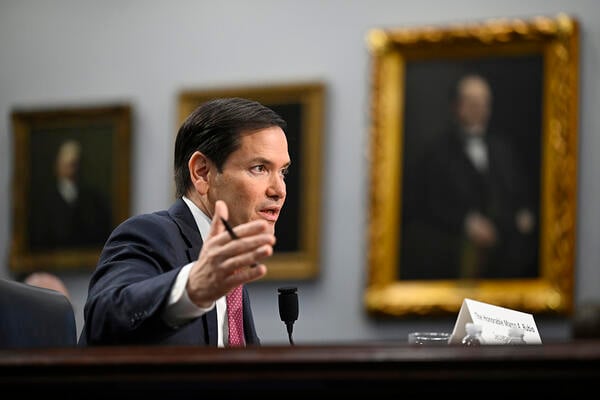
    U.S. Secretary of State Marco Rubio has characterized, with little concrete evidence, those students as “lunatics” who came to the United States “not just to study but to participate in movements that vandalize universities, harass students, take over buildings and cause chaos.” The administration is also considering a travel ban affecting 43 countries. (After Trump issued a travel ban for seven countries during his first term, the number of international applicants to U.S. colleges fell 5.5 percent for graduate students, though applications have been on the rebound post-pandemic.)

    But universities worry that targeting international students—who made up nearly one in four incoming graduate students in 2022—will create a chilling effect, cause international student enrollment to plunge and strip institutions of yet another vital revenue source. According to data from the Institute of International Education, 81 percent of international undergraduate students and 61 percent of graduate students completely fund their own tuition.

    Would-Be Ph.D.s Wary

    All this politically driven chaos and financial uncertainty is making graduate school—and a career as a faculty member—a harder sell for students interested in research careers.

    “Up until this year, we’ve been able to tell prospective graduate students that the university will cover the costs of their Ph.D.,” said Marcel Agüeros, an astronomy professor at Columbia University, where the Trump administration has frozen some $650 million in NIH funding. “We want to stay true to that commitment, but we’d be lying if we said that’s going to be 100 percent possible.”

    And even though his department is currently only expecting to offer one fewer Ph.D. slot, Agüeros said the uncertainty over the future of federal funding—and even what areas of research academics are allowed to pursue—is enough to push people out of academia.

    “Nothing concrete has to happen for people weighing their futures to decide to take a different path where it seems like there may be more stability,” he said. “Rational humans may decide that’s not the direction they want to go in anymore, and that’s going to be an immediate loss to the field.”

    And those are the questions would-be graduate students all over the country are asking themselves right now.

    “We don’t have any data yet, but anecdotally, I’m hearing that there are a ton of students who are choosing not to even try to go to graduate school this year and next year because they’re perceiving less funding and support,” said Bethany Usher, immediate past president of the Council on Undergraduate Research and provost at Radford University in Virginia.

    “Those Ph.D. students are the ones who push the boundaries of research,” she added. “They have the newest ideas, and if we reduce those, it will have a generational impact on higher education, industries and communities.”

    Source link

  • Key Takeaways From Higher Ed Free Speech Conference

    Key Takeaways From Higher Ed Free Speech Conference

    The University of California National Center for Free Speech and Civic Engagement held its annual virtual #SpeechMatters conference Thursday amid a speech environment that is vastly different and far more fraught than anyone could have imagined even a few months ago. The Trump administration is simultaneously punishing colleges for their failure to clamp down on pro-Palestinian protesters and detaining international students, in some cases for participating in those same protests.

    In her opening remarks, Michelle Deutchman, the center’s executive director, acknowledged as much: “Today we gather at a critical moment for higher education across the nation,” she said. “The role of colleges and universities in our democracy is being questioned. Trust in institutions is shifting. The impact of a historic national election and a year of campus protests continues to unfold.”

    The conference, which featured four panels and 15 speakers with expertise in free speech and higher education, covered not only campus speech but also the broader questions of trust in universities and the knowledge they produce. Here are five key takeaways from the event.

    1. College administrators can’t prevent the chilling effect President Trump’s actions are having on campuses.

    In one session, Deutchman asked Howard Gillman, chancellor at the University of California, Irvine, for 12 years, and Erwin Chemerinsky, dean of the UC Berkeley School of Law, how students can exercise their right to free speech despite the Trump administration’s crackdown on institutions and students alike for purported antisemitic speech.

    Gillman and Chemerinsky found a consensus—one that contradicts the widely held belief that universities should always be forums for political discussion: As long as Trump appears to be punishing individuals for constitutionally protected speech, now may not be the time to encourage students to speak out.

    “When you have an administration that has not yet been constrained by the courts sufficiently, it does create an environment where people might know they have, in theory, legal protections for the activities they engage in, but just because your activity may be protected doesn’t meant that you are not going to be put in a very complicated situation if the government does move forward,” Gillman said. “I don’t want to overstate the amount of reassurance that you can give. A chilling environment is a chilling environment.”

    Chemerinsky said it wasn’t tenable to assure students that he could protect them from the federal government. One student had asked him if the law school could prevent Immigration and Customs Enforcement officers from coming onto campus and detaining students, and Chemerinsky said he had to tell the student that wouldn’t be possible. (In February, Trump rolled back protections that stopped immigration enforcement actions from taking place in certain locations, including on college campuses.)

    “There’s a limit to what we can do to protect students. I don’t want to ever have students have the illusion that we can do more than we can,” he said.

    1. Rebuilding trust in higher ed requires a fundamental shift in culture.

    When discussing the lack of trust in higher education, Steven Mintz, a history professor at the University of Texas at Austin and a columnist for Inside Higher Ed, said the distrust exists not just between the government and colleges, or administrators and faculty, but at all levels of higher education. Students erode trust with faculty when they don’t put effort into their courses, he said. Faculty who care more about their own research and success than their students and institutions likewise fail to build trust with their students and peers. And administrators earn the faculty’s distrust by leaving them out of key decision-making processes.

    It’s all a result of Americans’ shifting view of higher education from a public good to a private one, he argued, with students as the consumers and administrators as the CEOs.

    “It is absolutely imperative that we rebuild trust within our campuses,” he said. “It’s not a matter of policy tweaks; it’s a matter of a fundamental cultural shift.”

    He noted that in his own classes at UT Austin, he has made an effort to help students undertake real-world projects, like building an educational webpage for a local museum. Such efforts position the student not as a consumer, but as a “partner and collaborator and creator of knowledge,” he said. And it shows communities that college instills in its students important skills—and isn’t always just an amorphous ivory tower.

    1. Fast turnover of college leaders is contributing to the lack of public trust.

    In the same panel about trust, multiple speakers touched on the fact that administrative turnover can be a major impediment to trust-building on campus.

    University presidents last, on average, just over five years on the job, which means that most students see at least one presidential turnover in their college career. Each new president must rebuild trust not only with the constituents on their own campus, but also with alumni, government officials, the local community and beyond.

    Short tenures also make it difficult for students and employees to buy in to key university initiatives, considering it’s not uncommon for a new president to scrap the previous administration’s projects in favor of new priorities.

    “Trust is about relationships … and you don’t build trust overnight. You build trust through listening. You build trust through showing up. You build trust through showing proof points. That’s how it happens. So, you can’t build trust when you’re a president that’s been there three months,” said Bobbie Laur, president of Campus Compact, a nonprofit focused on civic and community engagement in higher education. “Some of what we’re facing is the reality of the short tenure of leaders without the necessary support structures to support leaders right now.”

    Saanvi Arora, a UC Berkeley student and the executive director of the Youth Power Project, a nonprofit that encourages young people to participate in public policy, agreed, noting that she has met numerous college students who have no idea what their institution’s president looks like.

    “That’s a huge problem, if you’re not meeting with students directly, showing up to spaces where it really matters for students to see you there,” she said. “It really makes a difference and moves the needle.”

    1. Universities need to do more to stanch the spread of misinformation.

    Misinformation is pervasive in the current vitriolic political environment, according to a panel of experts, but so is anger and skepticism toward the very researchers who aim to better understand the phenomenon.

    Simone Chambers, chair of political science at UC Irvine, pointed out that research shows misinformation is more likely to circulate in right-wing communities. But that research is then called partisan, sometimes even by politicians themselves; mis- and disinformation experts who studied incorrect information ahead of the 2020 election earned intense ire from congressional Republicans, who accused them of censoring free speech and subpoenaed data about what was being marked as inaccurate information.

    That’s compounded by the perennial problem of most, if not all, academic research: Few people see it. Michael Wagner, who leads the Center for Communication and Civic Renewal at the University of Wisconsin at Madison, said that universities could make a greater effort to get the work of misinformation researchers into the public’s hands.

    Universities must do “a more aggressive job of promoting the work, even when it highlights partisan asymmetries, even when it highlights other kinds of things that might leave universities open to attack from those who don’t like the fact that universities exist,” said Wagner, who noted that his center has been subpoenaed by Congress. “[That] is something they need to do a better job of, to help the researchers who are trying to do this stuff get their work out there to folks so that they can engage with it and decide how they want to incorporate that information into how they live their lives.”

    1. More college leaders should stand up for higher education.

    Colleges have been capitulating to the Trump administration in everything from rolling back diversity, equity and inclusion programs to, in Columbia’s case, at least, agreeing to a list of the administration’s demands in the hopes of having its federal funding unfrozen.

    But a small number of college presidents—including Wesleyan University’s Michael Roth and Princeton University’s Christopher Eisgruber, who were both cited by panelists at the conference—have spoken forcefully against the Trump administration’s attacks on political speech, DEI and free scientific inquiry. In an op-ed in Slate about the arrest of Mahmoud Khalil, a Columbia University alumnus and pro-Palestinian activist who was detained a month ago by immigration officials, Roth wrote, “University presidents must speak out against this attempt to control the political culture of our campuses from the White House. Just as we should decry antisemitism and other forms of discrimination, we should insist that students and faculty have the right to make their voices heard about the issues of the day. Neutrality here is a betrayal of our academic mission.”

    Kristen Shahverdian, program director of campus free speech at PEN America, a free expression nonprofit, said she is glad she doesn’t have to be a part of any internal conversations about how a university under fire by the Trump administration will react. Still, she said, she wishes more higher education leaders would emulate Roth and Eisgruber and that the higher education sector as a whole could come together as a united front.

    “There’s probably multiple reasons why they’re able to speak out and others maybe can’t,” she said. “[But] we really need to push back, to hold on to the values of higher education, which include freedom of expression and academic freedom.”

    Source link

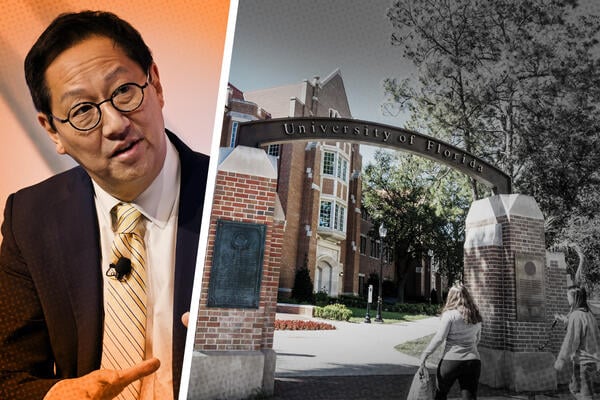
  • University of Florida Signs Agreement With ICE

    University of Florida Signs Agreement With ICE

    The University of Florida has signed an agreement to partner with U.S. Immigration and Customs Enforcement to help crack down on undocumented students, according to The Independent Florida Alligator, a student publication.

    The Florida Phoenix confirmed the report with a UF spokesperson, who said the university had agreed to deputize campus police as immigration officers but did not provide more details.

    The news broke the day after UF students held a rally on campus to protest the arrest and self-deportation of a Colombian student whom ICE agents stopped in late March for driving with an expired registration.

    UF is not the first institution in the state to commit to working with ICE; Florida Atlantic University signed a similar agreement earlier this month.

    Source link

  • Antisemitism Task Force Weighing Consent Decree for Columbia

    Antisemitism Task Force Weighing Consent Decree for Columbia

    The federal task force investigating Columbia University for its alleged failures to address antisemitism is considering putting the Ivy League institution under a consent decree, The Wall Street Journal reported, citing people familiar with the matter.

    A consent decree would add legal heft to the task force’s recent demands and hold Columbia accountable to following through on its recent commitments to overhaul disciplinary processes, ban masks at protests and review academic programs focused on the Middle East, among other changes. Under a consent decree, a federal judge would have oversight over the university.

    Columbia would have to agree to enter a consent decree, according to the Journal. The government has used consent decrees in the past to force police departments to make reforms, particularly after high-profile incidents of brutality, and also to hold companies, such as Live Nation, accountable.

    The university recently agreed to make a number of changes in order to restore its federal funds after the task force canceled $400 million in grants and contracts to Columbia. More recently, the Trump administration reportedly froze all of Columbia’s NIH funding, an additional $250 million. 

    The task force “doesn’t think Columbia is a good-faith actor willing to make the significant changes on campuses necessary to curb what it thinks are civil-rights infractions against Jewish students,” the Journal reported.

    Source link

  • NSF, NIH Slash Support for Early-Career Scientists

    NSF, NIH Slash Support for Early-Career Scientists

    Both the National Science Foundation and the National Institutes of Health are slashing funding support for graduate students and early-career researchers as President Donald Trump continues dramatic federal budget cuts. 

    Since Trump took office in January, the two agencies—which send billions in funding to research universities each year—have stalled grant reviews, fired scores of workers and terminated or flagged hundreds of active grants that conflict with the administration’s ideological goals.

    On Tuesday, Nature reported the NSF Graduate Research Fellowship Program awarded 1,000 fellowships—fewer than half of the record-setting 2,555 fellowship offers it made in 2023, and the second-smallest number of awards since 2008. 

    Prior to this year, the fellowship program’s stated goal was to “ensure the quality, vitality, and diversity of the scientific and engineering workforce,” though the Trump administration has since replaced the word “diversity” with “strength.” 

    Since 1952, the NSF’s fellowship program has funded more than 75,000 master’s and Ph.D. students pursuing science degrees. Fellows receive five years of funding, which includes a $37,000 annual stipend and the cost of tuition. The fellowships are highly competitive; of the more than 13,000 applicants who apply each year, only about 16 percent typically get an award. While the cuts made it even more competitive this year, a record 3,018 applicants also received “honorable mentions,” which don’t come with an award but can boost a CV nonetheless. 

    Over the past two weeks, the NIH has also canceled numerous institutional and individual training grants, including many that support scientists from underrepresented communities, according to The Transmitter

    The outlet reported that a chemistry professor at the University of Puerto Rico–Río Piedras Campus received a letter from the NIH terminating funding for the Undergraduate Research Training Initiative for Student Enhancement because the award “no longer effectuates agency priorities.”

    That justification is now central to a federal lawsuit researchers and advocacy groups filed against the NIH last week, which among other points argues that the Department of Health and Human Services (the NIH’s parent agency) hasn’t yet adopted rules that would allow it to terminate an award for not effectuating agency priorities. 

    Other terminated NIH training programs, according to The Transmitter, include the Maximizing Access to Research Careers program, which funded undergraduate researchers; the Post-Baccalaureate Research Education Program; the Bridges to the Doctorate program, which trained master’s students; the Initiative for Maximizing Student Development, which supported graduate students; and the Institutional Research and Academic Career Development Award, which aided postdoctoral researchers.

    Source link

  • DHS Formalizes Policy Screening Noncitizens’ Social Media

    DHS Formalizes Policy Screening Noncitizens’ Social Media

    The Department of Homeland Security is formalizing a policy to search the social media accounts of all foreign applicants for U.S. visas or other benefits, according to a memo issued Wednesday morning. 

    U.S. Citizenship and Immigration Services will collect applicants’ social media handles and scour their accounts for any “antisemitic activity.” Social media content “endorsing, espousing or promoting antisemitic terrorism, antisemitic terrorist organizations, or other antisemitic terrorist activity” is now “grounds for denying immigration benefit requests.”

    “This will immediately affect aliens applying for permanent resident status, foreign students and aliens affiliated with educational institutions linked to antisemitic activity,” the memo continued. 

    Secretary of State Marco Rubio proposed the policy last month, drawing criticism from free speech advocates. Others objected to the broad scope of the proposal, which included not just visa applicants but also current residents and green card holders. The new policy is just as broad.

    The news comes after weeks of escalating attacks on international students, many of whom have had their visas and legal resident status revoked for pro-Palestinian speech under an obscure legal clause that allows the secretary of state to determine if a visa holder is a “foreign policy threat.” An Axios report found that the State Department was already using artificial intelligence to scan student visa holders’ social media accounts looking for the allegedly antisemitic speech referenced in the new memo. 

    Many more students have had their visas revoked over minor criminal infractions; others have no clear understanding why their status was terminated. 

    An Inside Higher Ed analysis found that nearly 450 students have had their visas revoked as of Wednesday afternoon. Follow along with our interactive map and tracker

    Source link

  • Growing Orchids Amid Dandelions at Work (opinion)

    Growing Orchids Amid Dandelions at Work (opinion)

    Many of us working in higher education, including those of us in teaching and learning centers, might find that our work is dramatically accelerated by rapid technological change and increasing pressures to be more efficient and productive. Technology adoptions such as smartphones and Slack, video communication, and now generative AI all contribute to the acceleration of the organizational culture.

    In her recent essay “Teaching Centers Aren’t Dumping Grounds,” Kerry O’Grady argues that many academic leaders “focus on more instead of on effectiveness and efficiency.” O’Grady recounts continued calls to “create more workshops, more one-pagers or more training when attendance was dismal for initial sessions, or when the original documents went untouched.” She argues that educational developers are in a constant state of emergency response, in which they are tasked with “retroactive cleanup” as opposed to “the work of proactive planning for teaching and learning success.” O’Grady calls for a much-needed reset—something that feels wonderfully exciting—and institutionally unrealistic.

    Our collective teaching and working in higher education at more than 20 institutions over 50 years tells us that we are always working with limited agency to significantly change how our centers align with our strategic vision and the changing needs of the institution. Amid the dizzying pace of constant disruption, we feel a need to find a more sustainable and pragmatic approach. O’Grady’s essay inspired us to reflect on our strategic plans and how we support our respective communities. While the “dumping ground” metaphor importantly calls attention to current challenges, we consider a different metaphor that has guided our decisions as we direct centers and support educators.

    The Dandelion and the Orchid

    Dandelions are versatile flowers—resilient, fast-growing and abundant. In the context of educational development, dandelions represent the many ways developers adapt to institutional demands, producing quick outputs that propagate widely. Dandelion work is essential: It includes the programs and resources we create rapidly to meet pressing needs. However, as with real dandelions, the results of this work are often scattered, growing without the intentional design of a cultivated garden. When we run from meeting to meeting or throw together a one-off workshop to respond to emerging pedagogical issues, we rely on dandelions.

    In contrast, orchids require significant care and controlled environments to flourish. Orchid work symbolizes slow, intentional cultivation—projects that are thoughtfully nurtured over time. These efforts demand patience, consistency and a commitment to depth over breadth. While the process is slower, the results are uniquely meaningful, reflecting a product of deliberate focus. Orchid work requires long-term planning, collaboration across units and thoughtful engagement. While orchids can result in beautiful landscapes, the time taken to cultivate them can mean that we miss many emergent day-to-day needs.

    Together, this framework highlights a central question: Which systemic issues require sustained effort, and which challenges can be addressed through quick, one-off engagements? Balancing dandelion and orchid approaches helps educational developers respond to immediate needs while creating space for intentional growth.

    Growing Relationships

    Resilience does not sprout in isolation but through networks of care, mutual support and shared experiences. To push the floral metaphor further, if our goal in centers for teaching and learning is to help educators help students bloom, then we need to model and promote the space and time needed to learn, even if social pressures point in the opposite direction.

    Although meaningful relationships take time to develop, their benefits are powerful. Research supports the idea that individuals with a high relational self-construal—those who define themselves through their relationships with others—may be better able to embrace inconsistency and instability (two things that very much describe life in education today). Educational developers therefore can foster resilience and adaptability not only by caring for relational networks at their institution but also by defining their work based on such networks.

    In our own ways, we make space for orchids in our work and programming by emphasizing the ways in which relationships and time are necessary conditions for educational development. Some of the ways we do this as we go about our regular, day-to-day “dandelion” programming include:

    Balancing the orchid and the dandelion depends on priorities and time constraints. The dandelion approach can produce quick solutions when the pressure is high, and the orchid approach encourages us to carve out the time and tend to our relationships even in our constant push to maintain that field of flowers.

    While it may disrupt our metaphor, dandelions can give way to orchids and orchids can give way to dandelions. After all, the more often that deeper relationships develop, the more often we’re going to be in contact with faculty and colleagues, which will seed new ideas and possibilities, be they orchids or dandelions.

    The metaphor encourages us to ask how and where we can make space and time for deeper engagement. We cannot just grow a field of dandelions if we want to foster a culture of innovation, nor can we respond effectively and in a timely manner to an institution’s needs if we just focus on orchids. We have found that giving ourselves the permission to grow orchids amid the dandelions allows us to feel more agency and more relationally connected to the work we’re doing and the people we’re doing it with. The metaphor has helped us foster and model a more inclusive, supportive academic culture—one that balances collaboration with efficiency, collective resilience with institutional responsiveness and meaning with productivity.

    JT Torres directs the Houston H. Harte Center for Teaching and Learning at Washington & Lee University.

    Lance Eaton is an educator, writer and public speaker. He has worked in educational development for 15 years and recently became the senior associate director of AI in teaching and learning at Northeastern University.

    Deborah Kronenberg is an educator, consultant and public speaker who approaches communities of learning with creative, interdisciplinary, relationship-centric leadership in faculty and administrative roles in the greater Boston area.

    Source link