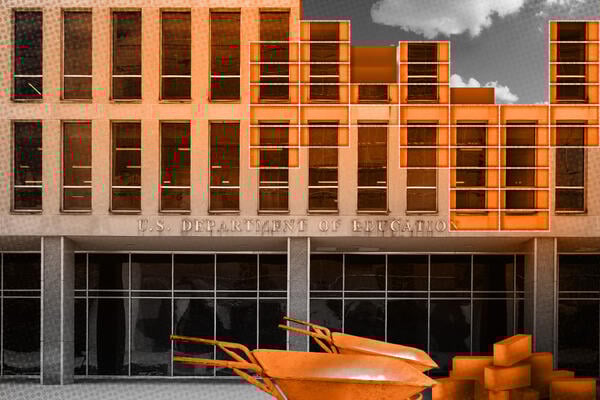
On Thursday a judge ordered more than 2,000 fired employees of the Education Department reinstated.
Photo illustration by Justin Morrison/Inside Higher Ed | Tierney L. Cross/Getty Images | Matveev_Aleksandr and raweenuttapong/iStock/Getty Images
A federal judge blocked the Trump administration from firing thousands of employees at the Department of Education in a decisive rebuke of this spring’s sweeping reduction in force and the executive branch’s efforts to weaken the Education Department.
Judge Myong Joun rejected the administration’s argument that the layoffs, which affected half of the department’s workforce, were part of a “reorganization” aimed at improving efficiency and said evidence showed the administration’s “true intention is to effectively dismantle the Department without an authorizing statute.” His order also prevents the department from implementing President Donald Trump’s March directive to dismantle the agency.
Joun of the District of Massachusetts also said the injunction to rehire the fired staffers was necessary in order to restore the department’s ability to accomplish its core functions and statutorily mandated responsibilities.
“Not only is there no evidence that Defendants are pursuing a ‘legislative goal’ or otherwise working with Congress to reach a resolution, but there is also no evidence that the RIF has actually made the Department more efficient,” Joun wrote in his 88-page ruling. “Plaintiffs have demonstrated that the Department will not be able to carry out its statutory functions—and in some cases, is already unable to do so.”
Reports of systemic failings and overloaded staff have streamed out of the beleaguered department ever since the March layoffs, from an untouched backlog of complaints at the Office for Civil Rights to the piling up of applications for student loan repayment and forgiveness plans.
The injunction, handed down Thursday morning, means the administration must reinstate more than 2,000 Education Department employees and reopen regional offices that were shuttered during the reduction in force.
The administration has already said it has issued a challenge to the ruling. Madi Biedermann, the department’s deputy assistant secretary for communication, said the administration has already appealed.
In an email to Inside Higher Ed, Biedermann decried the decision, calling Joun a “far-left judge” who “dramatically overstepped his authority” and maintaining that the layoffs were “lawful efforts to make the Department of Education more efficient and functional.”
“President Trump and the Senate-confirmed Secretary of Education clearly have the authority to make decisions about agency reorganization efforts, not an unelected Judge with a political axe to grind,” she wrote.
A spokesperson for the Association of American University Professors, one of the plaintiffs in the case, wrote in a statement that they were “thrilled” with the decision.
“Eliminating the [Education Department] would hurt everyday Americans, severely limit access to education, eviscerate funding for HBCUs and [tribal colleges and universities] while benefiting partisan politicians and private corporations,” they wrote.
Education Secretary Linda McMahon defended the layoffs at a budget hearing just a day prior to the ruling. She said the goal was to “wind down the bureaucracy” of the department, and that while she hoped to have congressional support to dismantle it eventually, the administration did not intend to so on its own.
Joun’s decision undercuts that defense. In the budget hearing, Rep. Rosa DeLauro, a Democrat of Connecticut, told McMahon that the cuts were “unlawful” and a usurpation of congressional authority.
“As long as you continue to deliberately and flagrantly defy the law, you will continue to lose in court,” DeLauro said.
The injunction is the latest in a string of court orders challenging the Trump administration’s rapid cuts to federal agencies in its first 100 days, often under the supervision of Elon Musk’s Department of Government Efficiency. DOGE was responsible for the vast majority of the Education Department layoffs, according to McMahon’s House testimony Wednesday.
Joun’s ruling wasn’t the only one aimed at undoing the administration’s Education Department cuts. Judge Paul Friedman of the U.S. District Court for the District of Columbia also ordered that the department restore grant funding to a Southern nonprofit that has helped further school desegregation efforts since the 1960s. The grant had been defunded as part of the administration’s push to eliminate spending on diversity, equity and inclusion.
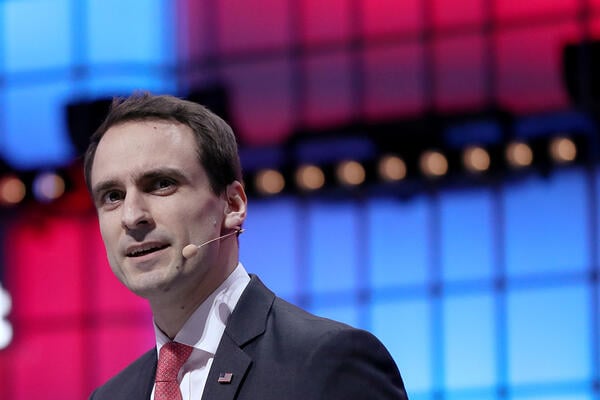
President Donald Trump’s science adviser and director of the White House Office of Science and Technology Policy believes the recent, seismic cuts to federal research funding offer “a moment of clarity” for the scientific community to rethink its priorities, including the government’s role in supporting research.
Michael Kratsios, who is pushing for increased private sector support of research, said that federal investment in scientific research—much of which happens at universities—has yielded “diminishing returns” over the past 45 years.
“As in scientific inquiry, when we uncover evidence that conflicts with our existing theories, we revise our theories and conduct further experiments to better understand the truth,” Kratsios, a former tech executive with ties to tech titan and conservative activist Peter Thiel, said at a meeting of the National Academy of Sciences on Monday. “This evidence of a scientific slowdown should spur us to experiment with new systems, new models, new ways of funding, conducting and using science.”
But some experts believe Kratsios’s comments mischaracterized trends in the nation’s academic research enterprise, which has been faced with decades of declining federal funding.
“Kratsios may have things exactly backward. Our growth has slowed down over decades—the same decades where we have been funding science less and less as a share of GDP,” Benjamin Jones, an economics professor at Northwestern University and former senior economist for macroeconomics for the White House Council of Economic Advisers, said in an email to Inside Higher Ed. “Federally supported research is near its lowest level in the last 70 years. If the U.S. really wants to be ‘first’ in the world, the key will be how fast we advance. Cutting science is just a huge brake on our engine.”
A wide body of literature confirms that federally funded research and development continues to produce enormous social returns. A 2024 paper from the Federal Reserve Bank of Dallas showed that rates of return on nondefense R&D spending range from 140 to 210 percent. Another report from United for Medical Research determined that for every dollar the National Institutes of Health spent on research funding in 2024, it generated $2.56 of economic activity. And yet another science policy expert has estimated that an additional dollar of government-sponsored R&D generates between $2 and $5 in public benefits via economic growth.
But those facts were absent from Kratsios’s remarks, which accused scientists of focusing on “trying to score political points” and diversity, equity and inclusion initiatives instead of so-called gold-standard science. “Spending more money on the wrong things is far worse than spending less money on the right things,” he said. “Political biases have displaced the vital search for truth.”
Kratsios also cited “stalled” scientific progress despite “soaring” biomedical research budgets and “stagnated” workforce training as proof that “more money has not meant more scientific discovery, and total dollars spent has not been a proxy for scientific impact.” Since 1980, he specified, “papers and patents across the sciences have become less disruptive,” and since the 1990s, “new drug approvals have flatlined or even declined.”
The White House OSTP did not respond to Inside Higher Ed’s request for Kratsios’s sources of information, but some outside experts said those specific claims have merit, even if they lack additional context.
A 2023 paper in Nature shows that patents and papers are indeed becoming less “disruptive” over time. But the authors themselves said the slowdown is “unlikely to be driven by changes in the quality of published science, citation practices or field-specific factors,” but rather “may reflect a fundamental shift in the nature of science and technology,” which is presenting increasingly difficult and complex problems for researchers. The authors also called on federal agencies to “invest in the riskier and longer-term individual awards that support careers and not simply specific projects.”
(Many of the federal research grants the Trump administration has terminated in recent months supported those aims, including funding for graduate and postdoctoral students and multiyear projects that weren’t yet complete.)
And even though new inventions may be decreasingly likely to push science and technology in new directions, as the Nature paper indicated, federally funded research has nonetheless expanded its reach to consumers since 1980—the same time frame Kratsios claims has been marked by diminishing returns that warrant an overhaul of federal research policy.
Prior to the 1980s, the government owned the intellectual property of any discoveries made using federal research dollars. The policy gave universities little incentive to find practical uses for inventions, and fewer than 5 percent of the 28,000 patents held by federal agencies had been licensed for use, according to the U.S. Government Accountability Office.
That changed when Congress passed the Bayh-Dole Act in 1980, allowing universities, not-for-profit corporations and small businesses to patent and commercialize federally funded inventions. Universities began transferring inventions to industry partners for commercialization. Between 1996 and 2020, academic technology transfers in the U.S. contributed $1.9 trillion in gross industrial output, supported 6.5 million jobs and resulted in more than 126,000 patents awarded to research institutions, according to data from the Association of University Technology Managers (AUTM).
As for Kratsios’s claim that drug approvals have “flatlined,” Matt Clancy, a senior research fellow at Open Philanthropy, said that’s a matter of interpretation. “If you think it means discovery is dead and not happening, that’s clearly false,” he said, noting that while drugs had been getting steadily more expensive to develop in the late 20th and early 21st centuries, costs have started falling over the past decade. “If you think it means the rate of discovery has not increased in proportion to the increase in spending, I think that is correct.”
‘The Enemy of Good Science’
Kratsios also tied those alleged declines in innovation to the assertion that researchers have fallen victim to a misguided “professional culture” and to “social pressures.” As an example, he pointed to the scientific community’s insistence on keeping schools closed to prevent the spread of the COVID-19 virus as an example of scientists’ unwillingness to question dominant viewpoints. “Convention, dogma and intellectual fads are the enemy of good science,” he said.
Administrative burdens have also hamstrung the scientific enterprise, he added.
“The money that goes to basic and blue-sky science must be used for that purpose, not to feed the red tape that so often goes along with funded research,” Kratsios said. “We cannot resign our research community and the laboratory and university staff who support them to die the death of a thousand 10-minute tasks. To assist the nation’s scientists in their vocation, we will reduce administrative burdens on federally funded researchers, not bog them down in bureaucratic box checking.”
Expanding the role of private funders is part of Kratsios’s solution.
“In particular, in a period of fiscal constraints and geopolitical challenges, an increase in private funding can make it easier for federal grant-making agencies to refocus public funds on basic research and the national interest,” he said at the NAS meeting, which was attended by university lobbyists and senior administrators.
“Prizes, challenges, public-private partnerships and other novel funding mechanisms can multiply the impact of targeted federal dollars. We must tie grants to clear strategic targets while still allowing for the openness of scientific exploration and so shape a general funding environment that makes clear what our national priorities are.”
According to Kratsios, private industry is well positioned to step in. He claims the sector spends “more than three times on R&D than does the federal government,” though it’s not clear from where he drew that statistic. Data from AUTM shows that in 2023, industry expenditures made up just 6.8 percent of all research spending in the United States, compared to 56.6 percent from the federal government. (Inside Higher Ed has previously reported on the challenges of looking to private funders to meaningfully make up for the Trump administration’s current and proposed cuts to academic research.)
Shalin Jyotishi, senior adviser for education, labor and the future of work at the left-leaning think tank New America, said that while some of the issues that Kratsios raised regarding federal science policy have merit, the administration hasn’t put forth a clear vision for reform.
“Instead, what we are seeing is ‘creative destruction’ playing out across the federal research enterprise—without the ‘creative’ part,” he said. “It’s not too late. The administration can and should still salvage the federal research enterprise and enact reform to make it even better.”
Weeks after Pasco-Hernando State College president Jesse Pisors resigned abruptly, the board named Florida Department of Juvenile Justice secretary Eric Hall interim president Tuesday.
Republican governor Ron DeSantis appointed Hall to the department in late 2021. Prior to that role, Hall served as senior chancellor of the Florida Department of Education from early 2019 to late 2021. Before that appointment, his educational experience was largely in the K-12 space.
Hall was a finalist in the 2023 PHSC presidential search that ended with Pisors in the top job.
Pisors resigned after less than 18 months as president. His departure followed the release of a critical report by Florida’s version of the Department of Government Efficiency, which indicated the college was among the worst in the state in terms of student growth and retention. Board members alleged that they had not been made aware of those numbers, despite requests.
However, The Tampa Bay Times reported that there has been skepticism around the validity of the report, which some critics argued was a flawed analysis of PHSC’s student outcomes.
The newspaper also noted that DeSantis appointed Hall to a government efficiency task force in late 2023, an effort that was ultimately a forebear of the state’s DOGE apparatus.
Hall is one of multiple DeSantis allies hired to lead a public institution in Florida this year. Others include Marva Johnson, a lobbyist, hired to lead Florida A&M University last week, and former Florida lieutenant governor Jeanette Nuñez at Florida International University, as well as former state lawmaker Adam Hasner at Florida Atlantic University, both of whom were hired in February. (Nuñez was hired as an interim but has since been named sole finalist for the job.)
Prior political hires include Ben Sasse, a former Republican U.S. senator from Nebraska, who briefly led the University of Florida before stepping down amid a spending scandal, and former state lawmaker Richard Corcoran at New College of Florida. Another former GOP lawmaker, Ray Rodrigues, was hired as chancellor of the State University System of Florida in 2022.
The Class of 2025 is prioritizing location, job stability and benefits when considering their first job postgraduation.
SDI Productions/E+/Getty Images
Commencement season brings excitement to college campuses as community members look to celebrate the accomplishments of the graduating class and usher them into their next chapter of life.
The Class of 2025, however, is gearing up to enter a challenging environment, whether that’s a competitive application cycle for gaining admission to graduate school or a tighter job market compared to previous years.
Inside Higher Ed compiled 25 data points regarding the Class of 2025 and the workforce they will enter, including levels of career preparedness, challenges in the workplace and the value of higher education in reaching career goals.
Over half of seniors feel pessimistic about starting their careers because they worry about a competitive job market and a lack of job security.
Seventy-eight percent of students rank job stability as a “very important” attribute in potential employers, followed by a healthy workplace culture.
Desired location is a top priority for 73 percent of 2025 graduates in deciding which jobs to apply for, followed by job stability (70 percent). Over two-thirds said they’re looking for a job near their family.
If they choose to relocate for work, cost of living is the most pressing issue for new graduates (90 percent), followed by a diverse and tolerant community (64 percent). Ninety-eight percent of young adults say cost of living is their No. 1 money stressor, as well.
Flexibility remains key for graduates, with 43 percent looking for hybrid work, defined as being on-site for two or three days a week. Forty-four percent cited the ability to work from home as an important benefit, and over half want more than two weeks of vacation or paid time off in their first year of work.
Roughly half of entry-level job postings employers plan to create will be hybrid, and about 45 percent will be for fully in-person roles.
Engineering students are expected to be the highest paid of all the majors pursued by the class of 2025, earning an average of $78,731 this year.
Recent college graduates who participated in experiential learning while in college earn on average $59,059, compared to their peers without internships, who earn an average of $44,048.
As of last fall, only half of first-generation students in the Class of 2025 had completed an internship, compared to 66 percent of their peers.
About 12 percent of students have not participated in an internship and do not expect to do so before finishing their degree—lower than the average of 35 percent of workers who enter the workforce without an internship or other relevant work experience.
Ninety-eight percent of employers say their organization is struggling to find talent, but nearly 90 percent say they avoid hiring recent grads—in part, as 60 percent noted, because they lack real-world experience.
One-third of hiring managers say recent graduates lack a strong work ethic, and one in four say graduates are underprepared for interviews.
As of March, nearly 6 percent of recent graduates (ages 22 to 27 who hold a bachelor’s degree or higher) were unemployed, compared with 2.7 percent of all college graduates. The unemployment rate for all young workers (ages 22 to 27) is approximately 7 percent.
Nearly 90 percent of students chose their major with a specific job or career path in mind.
Finding purposeful work is critical to Gen Z’s job satisfaction, and more than half say meaningful work is important when evaluating a potential employer.
One-quarter of young adults already have a side hustle, and 37 percent of Gen Z want to start a side hustle.
Ninety-seven percent of human resources leaders say it’s important that new hires have a foundational understanding of business and technology, including in such areas as artificial intelligence, data analytics and IT.
Gen Y and Gen Z workers are more likely than their older peers to worry they will lose their job or their job will be eliminated by generative AI.
A week does not pass without my hearing about the apparently sorry state of the current crop of students. They are lazy, disengaged, clueless and so on. It is the dusty trope that the old do not appreciate the young.
In a trip through the literature and news of the past, you will find Generation X described as underachieving, angry, psychologically damaged slackers who were indifferent to learning, brazenly rude, entitled, unprofessionalwhiners. Millennials were called “Generation Whine” and described as self-centered, unmotivated, disrespectful, depressed, anxious, disloyal, entitled cynics who were so overindulged and protected by their parents that they were incapable of working without constant hand holding.
If this all sounds familiar, it should. Professors now bemoan the current crop of Gen Z students who will not read, cannot handle stress, procrastinate, lack basic academic skills, refuse to engage in class, are psychologically needy and are more interested in preparation for a career than appreciating knowledge.
Meanwhile, every generation is described as being both skilled in and ruined by new technology. Boomers complained that Generation X could not write a proper formal letter and that Millennials expected email communication. Generation X now complains about Generation Z not attending to their email communication and lacking proper email etiquette. It is an ongoing cycle.
Much of the educational discourse seems to assume that each new generation of students differs from the last to such a degree that many accommodations will need to be made. Every generation is indeed affected by the events of their time. The educational disruption of the COVID-19 pandemic likely widened the already existing achievement gaps among different groups of Generation Z learners. However, learning is learning. Decades of research across multiple fields of psychology have shaped our understanding of the human mind and how we best learn. Teaching is hard work, and we make teaching harder when we remain fixated on stereotypes, tech temptations and societal trends.
Let’s refocus on what our trade is—learning. From my experience as a professor of more than 20 years specializing in educational psychology, and as a researcher and department chair, I offer these principles:
Engage in your discipline. Maintain your expertise over time and share the developments of your field. If you are bored with your discipline, it will show. And if your knowledge is out of date and students find out, you lose all credibility. As a professor, few things are as awkward as when a student shares incorrect information they learned in another course and you must contradict it with up-to-date, accurate information.
Figure out what type of teaching suits you and then master that type. If you are a lecturer, then study what makes someone the best lecturer. If you use PowerPoints, study best practices in their design. If you embrace group work, explore what types of assignments and student groupings are most effective. What pedagogy you use is less important than doing that pedagogy well. By all means, learn new techniques. But new does not always mean better, and not all techniques are going to fit with your content and style. I will be the first to admit that I am not the most dynamic speaker. I am, however, good at reading the room, pacing the delivery of knowledge and explaining ideas in many different ways. Lean into your strengths.
Create opportunities for multiple types of learning. Humans learn best by engaging different areas of their brain: their auditory and visual systems, their logic and expressive capabilities, and their abilities to apply and build personal connections to new knowledge. Research shows that students do not have unitary learning styles: However, everyone learns better when they engage multiple processing modes. You do not need to do everything all at once. But across your design of homework, class time and assessment, remember: Variety is key. My own action research in my measurement and statistics course bears this out. Concerted effort to allow students to use analytic, practical and creative means to express their knowledge resulted in a productive experience in a class that many students dreaded.
Do not let new technology pass you by. What is new in instructional technology now may become the norm tomorrow. Try new things and stay knowledgeable, but also consider how and why you would use the technology to improve teaching or other aspects of your course. For example, clickers did not work well for me, but many professors make great use of them. A useful strategy is to turn to your students and ask them how they would improve one of your assignments by integrating new technology. Guides such as the one here are available to help you make these decisions.
Express a genuine interest in your students. You are not their friend, but you can be courteous and friendly. It is good manners, after all. Be a human being. As students gather before class begins, you might consider asking how the semester is going. Perhaps reference an event that has taken place on campus. Do not be afraid to mention your own experiences if they are directly relevant to the course. There is continuing lore related to my courses that if you find a way to include cats while also demonstrating the content and skills of the course you will receive extra credit (true). Do not be afraid to be real.
Fulfilling these principles in your teaching career is not easy. It takes time, energy and a lifelong commitment to self-improvement—the same traits we wish for in our students. If you find that you are unwilling to strive to meet these principles, and then find the students are not living up to expectations, know that it is not them: It’s you.
Erin Morris Miller is an associate professor of psychology at Bridgewater College.
The University of California National Center for Free Speech and Civic Engagement launched in 2017, at a time when students were shouting down conservative speakers on campus, raising questions about what role the First Amendment did—and should—play in higher education.
Just eight years later, things have only gotten more complicated—first in the aftermath of an explosive protest movement against Israel’s war in Gaza and then in the wake of the Trump administration’s censorship across all areas of academe.
Amid the chaos, the center and its fellows—researchers from a breadth of disciplines who work on projects related to open expression and civic engagement—continue to educate universities about the First Amendment and investigate the day’s most pressing free speech issues.
Its executive director, Michelle Deutchman, who worked as an attorney for the Anti-Defamation League for 14 years before joining the center, stopped by the Inside Higher Ed office in Washington, D.C., last week to discuss the federal government’s attacks on free expression in higher education. The interview has been edited for length and clarity.
1.What are your biggest concerns with regard to the Trump administration and free speech and open expression in higher ed right now?
Well, sadly, there’s kind of a long list. I think, from my vantage point, one of the greatest concerns is seeing students, and particularly international students, being, basically, taken away on what appears to be the basis of viewpoints and opinions that they might have shared, either in the form of protest or, in one case, an op-ed. That really flies in the face of exactly what the First Amendment is supposed to protect against, especially in a public institution, which is that it’s supposed to be a restraint on government. In fact, what we’re seeing right now is the government stepping over the line of what is permitted, and that is definitely creating, I think, a chilling effect, not just for international students, but for students across the board, whether they’re protesting or not.
I also think that the specter of investigations on campuses—this list of 60 campuses [being investigated for alleged antisemitism], this idea that if you’re on a campus that’s potentially going to be under investigation—might impact what you say in class, outside of class, how you teach, everything that’s fundamental to the academy.
2.What are some of the most common questions you’re getting about what is going on?
Deutchman has led UC’s National Center for Free Speech and Civic Engagement for eight years.
Laurel Hungerford
I don’t get as many questions as you would think, because I don’t give legal advice, and right now, what a lot of people want is legal advice. But I think one of the things that I’m struggling with is, how do you talk about open expression and dialogue in a moment when it’s largely being suppressed on campuses? One of the questions that people have been asking is what to say to students about the risk factors in terms of being very vocal with your opinions, and how should administrators address that—both wanting to, of course, encourage them to use their voices, but also wanting to be transparent about what the risks might be.
There’s just a lot of other, bigger questions that are just about, what does this mean in general for higher education? Is this like an existential moment? What about the coercive use of money? A lot of questions of: Can the government do that? And I think it’s a really challenging situation where the answer is: Not sure that they should be doing it, but they are. So, how do we handle that sort of in-between space while we wait for the law to catch up to what’s going on on the ground?
3.There’s been a lot of emphasis on civic dialogue education as one antidote to tensions around political speech on campus. Do you feel like this moment is sort of setting those efforts back at all?
I don’t want to say they’re setting them back. I worry a little that they might be getting set aside. And that’s a concern that I’ve had, really, since after Oct. 7, where we saw so much time and energy go into the basics about the First Amendment and about time, place and manner, and about whether or not to use law enforcement, that there became a big focus on the enforcement regulations as opposed to sort of education. I think now, so much energy is being put into how to defend higher education against this assault that I worry that efforts that focus on how we teach not just students but all members of higher education communities to engage with one another and listen to one another and build the muscle of civic dialogue—I worry that there isn’t enough bandwidth to pay attention to that, and setting it aside, I think, is to the detriment of everyone at this moment.
4. How is Trump’s cutting of grants his administration deems related to diversity, equity and/or inclusion connected to the government’s other attacks on speech?
I think that the cutting of those kinds of grants is just another attempt at government censorship of speech. Expression and speech are the cornerstones of the creation and transmission of knowledge. So, I think that it you’re stopping grants about certain topics, topics that are either being researched or topics that are being taught, that is something that falls sort of in the viewpoint discrimination area and really runs afoul of the Constitution. We’ve certainly seen some successes in court cases and injunctions, but I think part of the problem is the gap between when an executive order is signed and when an injunction happens, the chilling effect that happens across the university, and this idea that I don’t know that you can unring certain bells.
5. Though many are calling the Trump administration’s attacks unprecedented in many ways, there have been other moments in history when free speech on college campuses has been under assault. What do those moments teach us about what is happening today?
I wish I could tell you that I am a historian, but I’m a lawyer, so I don’t necessarily have that historical perspective. Certainly, I think people say that this is the greatest threat to academic freedom and to the autonomy of the university since McCarthyism. It’s hard to know how, then, to take that information and do something with it, right? I mean, the hopeful take is: Well, we made it through that, even though it was a dark time.
I mean, look, I’m a [University of California, Berkeley] Cal Bear. UC had people do loyalty oaths; it was not a good moment, and look where we are now. I think that is sort of the optimistic hope.
I think the less optimistic [perspective] is that, in some ways, what we’re experiencing is much more far-reaching, and we will just have to wait and see what happens.
In January I wrote a piece asking whether America’s research universities would make it to their 100th birthday, marking their birth with the creation of the National Science Foundation in 1950—its 75th birthday was May 10. The article built on concerns that our research universities are in a precarious state, with their resources stretched thin supporting their dual missions of education and research. At the end I added a new concern: with the beginning of the Trump administration would these institutions survive the year?
In only the first 100-odd days, the precipitous cancellation of grants and freezing of research support and now the proposed slashing of the budgets of the NSF and the National Institutes of Health and dramatic increase in the tax on university endowments have made my worst fears real. Are we really trying to end the partnership that has led to the greatest period of innovation in history?
With the creation of the NSF, the government and universities established a research partnership to feed the American economy and national defense and to train the R&D labor force. The partnership was supported by funding from both sides, coupled with an unrelenting commitment to research excellence and impact. By any measure it has been wildly successful, generating new knowledge, inventions and cures and educating generations to lead our economy and society.
In 2022 alone, the 174 Carnegie R-1—very research intensive—universities filed more than 20,000 patent applications and were granted nearly 6,000. But perhaps to understand why sustaining this partnership is vital to our future we only need to recall that the mRNA vaccines that spelled the end of the COVID-19 pandemic were built on research supported over decades by the NIH.
The scale of the partnership is apparent in the data: In 2022, university research spending totaled $97.8 billion, with $54.1 billion coming from the federal government. What has not been widely acknowledged is that universities contributed $24.5 billion of this total in the form of self-supported research and cost sharing, especially supporting the misunderstood indirect costs of research. Many of these expenses are not so “indirect,” as they support specialized spaces, facilities and instruments—you cannot do research in a parking lot.
Universities invested 45 cents for each federal research dollar received— this is the financing of the partnership. It seems like a bargain for the government to contribute only 0.2 percent of GDP (or less than 1 percent of the federal budget) to fuel innovation and the labor force of the world’s largest economy. Federal support of university research has grown only 44 percent since 2010. This compares to China’s threefold growth in investment in its universities.
The Chinese investment highlights the increasing competition for research talent, and we risk falling behind. Other countries are emulating us, building research universities and trying to attract the stream of talent that has come to the U.S. to learn, work and live. Our chilling climate for immigrants is making it much easier to lure this talent abroad.
American universities have done what they can to stay in front, with their own support of research growing twice as fast as federal funding, up from 30 cents to a federal dollar in 2010. It will be difficult for universities to continue to grow this investment. Following the pandemic, inflation has taken its toll. Now the funding cuts already imposed, and the enormous ones in the administration’s proposed budget, will shift billions in research costs to universities—costs they cannot afford. The proposed 15 percent cap on indirect costs alone—spread across all federal support—could cost the R-1 universities more than $10 billion, doubling their support relative to the federal government.
The result will be catastrophic, with universities retreating from research, essentially destroying in a few months the innovation ecosystem built over three-quarters of a century. The long-term impact will be devastating for all Americans, as measured in undiscovered inventions and cures, the global competition for ideas and people, and the country’s future economic prosperity.
Our innovation ecosystem will be hamstrung by the loss of a generation or more of research talent, who are either not trained or who go elsewhere. Already our talent pipeline is being constricted by cutting in half the number of NSF fellowships awarded to the most promising scientists and engineers. Reports also are mounting of scientists moving to countries where they are warmly welcomed with substantial government support. Is this our national strategy to strengthen America’s knowledge-based economy?
We are on the verge of an innovation winter that will last decades when we can ill afford it as we respond to demands to improve health care, compete for global dominance in AI and other critical technologies, and create a secure and peaceful world. Universities do face important challenges, such as expanding access, educating more Americans to be informed and thoughtful citizens, and giving them the skills to thrive in an AI-driven world. Universities can meet these challenges if they are supported.
We must avoid the innovation winter by continuing the partnership so our research universities remain the beacons for innovation and education that they have been for three-quarters of a century. This is the only way to keep America at the forefront, not at the back of the pack.
This choice is what is at stake for all of us.
Robert A. Brown is president emeritus of Boston University.
The Trump administration has ended $60 million in federal grant funding for Harvard University amid an ongoing fight with the private institution over concerns about alleged campus antisemitism.
The Department of Health and Human Services announced the move late Monday night.
“HHS is taking decisive action to uphold civil rights in higher education,” the agency posted on social media. “Due to Harvard University’s continued failure to address anti-Semitic harassment and race discrimination, HHS is terminating multiple multi-year grant awards—totaling approximately $60 million over their full duration. In the Trump Administration, discrimination will not be tolerated on campus. Federal funds must support institutions that protect all students.”
HHS also linked to a report from The Daily Caller, a right-wing website, which noted that the $60 million in grants came from funding via the Centers for Disease Control and Prevention.
A CDC official, according to The Daily Caller, told the university that funding an institution that the Trump administration perceives as discriminatory would be inconsistent with the CDC’s mission. The CDC official concluded that “no corrective action is possible here.”
Harvard did not respond to a request for comment from Inside Higher Ed.
The latest move comes as the Trump administration has already pulled other grants and federal contracts and frozen more than $2.7 billion in federal funding—about a third of Harvard’s federal funds.
Harvard is also facing several investigations from the Trump administration.
The university has been locked in conflict with the federal government for months since it spurned Trump’s demands to overhaul governance, hiring, admissions and more, which prompted retaliation in the form of a funding freeze. Harvard sued the Trump administration last month, arguing that it sought to “impose unprecedented and improper control over the university.”
The image of the suffering artist is a cliché that faculty and staff who work with students in the performing and visual arts are trying to dispel. They believe that creative inspiration doesn’t have to come at the expense of health and well-being.
“You definitely have to be able to connect on some level to that artistry. But that doesn’t mean necessarily that you have to suffer mental health issues to be able to access this,” said Frank M. Diaz, professor in the Indiana University Jacobs School of Music.
A growing awareness of young people’s mental health and the challenges depression and anxiety pose to student retention and college completion has inspired services for students of underrepresented minority backgrounds, student athletes and other populations on campuses.
More performing arts programs have also begun embracing education on emotional and physical well-being to equip students to succeed in college and beyond.
Under pressure: Performing arts students, like many college attendees, face academic pressures—as well as financial responsibilities to pay for college—that can put them under immense stress. A 2024 survey by Inside Higher Ed and Generation Lab found that just under half of respondents indicated their top stressor while enrolled was balancing academics with personal, family or financial responsibilities.
Performers also juggle rehearsals, whether individual training or as part of an ensemble, that can require several hours of work outside of regularly scheduled classes. Musicians are often in practice rooms for hours each day, causing them to deprioritize their well-being.
“Some of them practice for six hours,” Diaz said. “That does not include their academic courses, their music courses, their ensembles that they’re in, their lessons and their studio classes. While you pile all that on, it’s a lot.”
Young people in general are more open to talking about mental health compared to previous generations, but performing arts students often feel cultural pressures to maintain certain appearances.
“There’s a lot of stigma around the arts and mental health,” Diaz said. “Music students—we also have ballet here—don’t like to admit that they have issues. It’s seen as a weakness, so it’s been traditionally not talked about in our field.”
Additionally, the performing arts can put pressure on students’ physical health if they’re not trained or properly supported. A research study of music schools in Switzerland and the U.K. found music students had lower levels of physical and psychological health compared to the general population.
This unique combination of factors has pushed some colleges and universities to invest in specialized resources dedicated to students studying music.
Institutional change: Members of the National Association of Schools of Music, the accrediting body for most music programs, are required to provide music students with information about physical and mental health. Most institutions meet this requirement through a dedicated webpage where students can browse campus and external services. If you ask James Brody, director of the Musicians’ Wellness Program (MWP) at the University of Colorado, Boulder, College of Music, that’s just the tip of the iceberg.
Brody and his colleagues have been engaging in this work informally for over a decade. In 2020 the university rolled out an embedded counseling program, which provided the College of Music with a dedicated mental health clinician, Matthew Tomatz, to lead outreach and deliver services to music students. Tomatz, a former musician himself, receives referrals from faculty and staff to meet with students and provides regular group therapy for student musicians to engage with peers and talk about their struggles.
MWP was officially established in 2021, providing physical and social wellness education to learners across CU Boulder’s school of music to prevent and recover from injuries for long-term thriving.
Approximately 160 students participate in MWP offerings each year, and more than 130 music students accessed counseling and psychiatric services in the 2022–23 academic year, according to a university press release.
The Office of Wellness and Arts Health Initiative (OWAHI) at the Jacobs School of Music was established in 2023 as a way to increase student access to supports. The school is home to 1,600 students, making it one of the largest music schools in the U.S. The size can make music students more isolated from the larger campus community of Indiana University, because “everything [within the music school] is in one place and our students never go out and venture into this Big Ten campus that we have,” Diaz said.
Instead of making students seek out resources, the school centralized offerings into the OWAHI, creating a one-stop shop for a variety of support services that are student-centered and student-led.
Social wellness: One of the undertones of performing arts programs is competition; students fought hard to win a spot at an accredited music program, which can create feelings of rivalry and isolation from their peers.
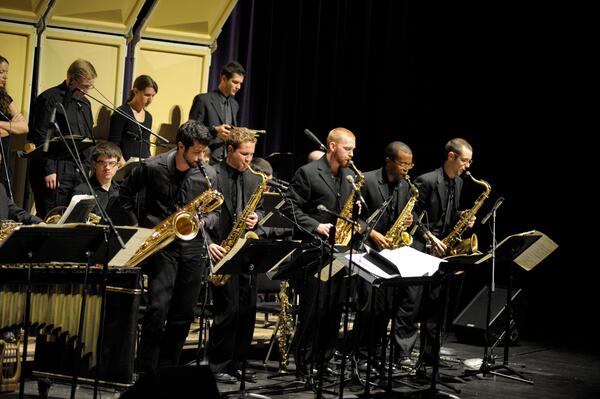
Jacobs School of Music students enjoy a holiday party thrown by the Office of Wellness and Arts Health Initiatives in partnership with the Jacobs School’s Health and Wellness Committee.
Wendi Chitwood/Indiana University
To combat this narrative, Diaz created events centered on relationships. “Our data basically indicates that people are seeking community. They don’t know how to find it; they don’t know how to build good relationships. They know they want them. So, to me, that’s the basis of everything we do.”
OWAHI offers drop-in office hours for students to get snacks, talk with their peers and engage in destressing activities, including mindfulness training, massage, games and yoga. In addition, the office partners with the School of Social Work to provide student-led wellness coaching, which both connects learners with peers and gives social work students needed supervised practicum hours.
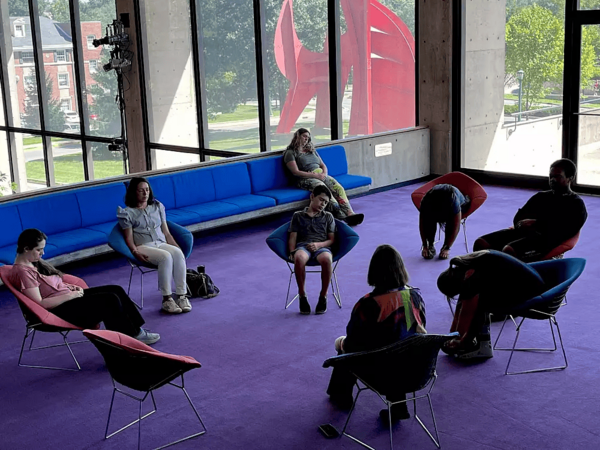
Jacobs students participate in a meditation session provided by the Office of Wellness and Arts Health Initiatives.
Jacobs School of Music/Indiana University
OWAHI offered about 70 coaching sessions in 2023–24 and an estimated 300 sessions during this academic year, which Diaz attributes to increased engagement on campus, student-led marketing and positive partnerships. Students who participate in services are also demographically representative of the school’s population, and Diaz has been pleased to see high participation rates among male students (41 percent of participants), given perceived barriers to engagement in mental health supports for men.
At New York Film Academy in Los Angeles, acting professor Victor Verhaeghe noted that his students tended to arrive with fewer socio-emotional skills, making it harder for them to engage. Verhaeghe has started using class time to lead meditation and shared affirmations, allowing students to become more vulnerable and connected to each other, as well as create self-love.
“I say, ‘Let’s start with sharing who you are; let’s open up to discussion,’” Verhaeghe said. “Some people are not ready to share, but I’ll share my story … It’s all about rewiring, it’s about changing the programming. As an artist, vulnerability is essential. You have to be able to tap into that.”
Physical wellness: Injuries among college students often come from late-night recklessness, sports, accidents or overwork. Less common is the physical strain improper musical technique can have on musicians.
“People don’t understand that musicians get injured, and the injury rate is high—as high as 80 percent of college students,” Brody of CU Boulder said.
Brody offers one-on-one consultations and lessons with students to help them recover from injury, misuse, anxiety or physical tension, helping them connect music and the body to ensure they can continue playing for many years. “I am continually amazed at how anatomically illiterate most musicians are,” he said.
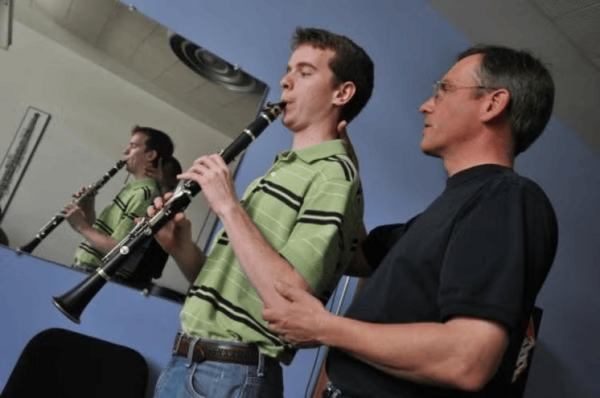
Professor James Brody, director of the Musicians Wellness Program, instructs a student musician on clarinet.
University of Colorado, Boulder
He’s passionate about physical wellness education for musicians, and admits he sometimes has to pull back from overloading students with anatomy lessons.
“Some people say, ‘No pain, no gain,’” Brody added. “I say, ‘No pain, no pain.’ It really shouldn’t hurt.”
CU Boulder music students can also receive free hearing tests, a common practice for music schools to ward against noise-induced hearing loss.
The University of North Carolina at Greensboro offers two elective courses within the school of music that connect physical health to performance, encouraging students to move strategically and reduce tension.
In the future, Brody would love to see donor support for more resources to support musician well-being, including specially designed hearing protection and vocal health support from a laryngologist.
Occupational wellness: College students in general are anxious about their careers—71 percent of students say they feel at least somewhat stressed thinking about life after college—but the performing arts has always been an especially challenging field. Recent data from the Bureau of Labor Statistics found that only about 20 percent of students with a fine arts degree actually work in arts, design, entertainment or media occupations.
“Every single student is terrified right upon getting out because of the complete unpredictable nature of this business,” Verhaeghe said.
Brody noted student musicians’ anxiety levels are high regarding their future plans, particularly due to a shrinking number of symphony orchestras and full-time opportunities. “Still, folks line up to do it,” he said. “We don’t have any lack of talent and motivation.”
In class, Verhaeghe talks about the challenging elements of being an actor, from not having work to playing demanding roles with long hours. “I think it’s important that we talk about the next phase,” he said. “I believe this is a calling to do this work, and not everybody’s called … if you really want to have a craft, then you will invest.”
Performing arts students also often live with the tension of trying to balance passion and work. Many people consider art to be a healing or soothing experience, allowing them to engage in mindfulness or relaxation. “The evidence is pretty clear that musicians and artists in general are the exception to the, ‘I do art and I feel good’ thing, like, we don’t experience that because it’s vocational,” Diaz said.
There’s one exception to this work, Diaz noted: when art becomes a service. At IU, students can participate in performances at senior centers through the Senior Outreach Program.
“Instead of going as ‘I’m going to perform this awesome thing with you,’ [it’s] ‘I’m going to connect with you, I’m going to go learn your name and learn what you like and perform for you at these senior community centers,’” Diaz said.
Faculty members agreed there’s a need to encourage students not to burn out or overexert themselves for the sake of their art, because it’s not sustainable in the long term and reduces their career potential.
“The culture is gradually changing because it has to,” Brody said. “If it doesn’t, it’s like feeding people into a wood chipper.”
Is something in the water—or, more appropriately, in the algorithm? Cheating—while nothing new, even in the age of generative artificial intelligence—seems to be having a moment, from the New York magazine article about “everyone” ChatGPTing their way through college to Columbia University suspending a student who created an AI tool to cheat on “everything” and viral faculty social media posts like this one: “I just failed a student for submitting an AI-written research paper, and she sent me an obviously AI-written email apologizing, asking if there is anything she can do to improve her grade. We are through the looking-glass, folks.”
It’s impossible to get a true read on the situation by virality alone, as the zeitgeist is self-amplifying. Case in point: The suspended Columbia student, Chungin “Roy” Lee is a main character in the New York magazine piece. Student self-reports of AI use may also be unreliable: According to Educause’s recent Students and Technology Report, some 43 percent of students surveyed said they do not use AI in their coursework; 5 percent said they use AI to generate material that they edit before submitting, and just 1 percent said they submit generated material without editing it.
There are certainly students who do not use generative AI and students who question faculty use of AI—and myriad ways that students can use generative AI to support their learning and not cheat. But the student data paints a different picture than the one presidents, provosts, deans and other senior leaders did in a recent survey by the American Association of Colleges and Universities and Elon University: Some 59 percent said cheating has increased since generative AI tools have become widely available, with 21 percent noting a significant increase—and 54 percent do not think their institution’s faculty are effective in recognizing generative Al–created content.
In Inside Higher Ed’s 2025 Survey of Campus Chief Technology/Information Officers, released earlier this month, no CTO said that generative AI has proven to be an extreme risk to academic integrity at their institution. But most—three in four—said that it has proven to be a moderate (59 percent) or significant (15 percent) risk. This is the first time the annual survey with Hanover Research asked how concerns about academic integrity have actually borne out: Last year, six in 10 CTOs expressed some degree of concern about the risk generative AI posed to academic integrity.
Stephen Cicirelli, the lecturer of English at Saint Peter’s University whose “looking glass” post was liked 156,000 times in 24 hours last week, told Inside Higher Ed that cheating has “definitely” gotten more pervasive within the last semester. But whether it’s suddenly gotten worse or has been steadily growing since large language models were introduced to the masses in late 2022, one thing is clear: AI-assisted cheating is a problem, and it won’t get better on its own.
So what can institutions do about it? Drawing on some additional insights from the CTO survey and advice from other experts, we’ve compiled a list of suggestions below. The expert insights, in particular, are varied. But a unifying theme is that cheating in the age of generative AI is as much a problem requiring intervention as it is a mirror—one reflecting larger challenges and opportunities within higher education.
(Note: AI detection tools did not make this particular list. Even though they have fans among the faculty, who tend to point out that some tools are more accurate than others, such tools remainpolarizing and not entirely foolproof. Similarly, banning generative AI in the classroom did not make the list, though this may still be a widespread practice: 52 percent of students in the Educause survey said that most or all of their instructors prohibit the use of AI.)
Academic Integrity for Students
The American Association of Colleges and Universities and Elon University this month released the 2025 Student Guide to Artificial Intelligence under a Creative Commons license. The guide covers AI ethics, academic integrity and AI, career plans for the AI age, and an AI toolbox. It encourages students to use AI responsibly, critically assess its influence and join conversations about its future. The guide’s seven core principles are:
Know and follow your college’s rules
Learn about AI
Do the right thing
Think beyond your major
Commit to lifelong learning
Prioritize privacy and security
Cultivate your human abilities
Connie Ledoux Book, president of Elon, told Inside Higher Ed that the university sought to make ethics a central part of the student guide, with campus AI integration discussions revealing student support for “open and transparent dialogue about the use of AI.” Students “also bear a great deal of responsibility,” she said. They “told us they don’t like it when their peers use AI to gain unfair advantages on assignments. They want faculty to be crystal clear in their syllabi about when and how AI tools can be used.”
Now is a “defining moment for higher education leadership—not only to respond to AI, but to shape a future where academic integrity and technological innovation go hand in hand,” Book added. “Institutions must lead with clarity, consistency and care to prepare students for a world where ethical AI use is a professional expectation, not just a classroom rule.”
Mirror Logic
Lead from the top on AI. In Inside Higher Ed’s recent survey, just 11 percent of CTOs said their institution has a comprehensive AI strategy, and roughlyone in three CTOs (35 percent) at least somewhat agreed that their institution is handling the rise of AI adeptly. The sample size for the survey is 108 CTOs—relatively small—but those who said their institution is handling the rise of AI adeptly were more likely than the group over all to say that senior leaders at their institution are engaged in AI discussions and that effective channels exist between IT and academic affairs for communication on AI policy and other issues (both 92 percent).
Additionally, CTOs who said that generative AI had proven to be a low to nonexistent risk to academic integrity were more likely to report having some kind of institutionwide policy or policies governing the use of AI than were CTOs who reported a moderate or significant risk (81 percent versus 64 percent, respectively). Leading on AI can mean granting students institutional access to AI tools, the rollout of which often includes larger AI literacy efforts.
(Re)define cheating. Lee Rainie, director of the Imagining the Digital Future Center at Elon, said, “The first thing to tackle is the very definition of cheating itself. What constitutes legitimate use of AI and what is out of bounds?” In the AAC&U and Elon survey that Rainie co-led, for example, “there was strong evidence that the definitional issues are not entirely resolved,” even among top academic administrators. Leaders didn’t always agree whether hypothetical scenarios described appropriate uses of AI or not: For one example—in which a student used AI to generate a detailed outline for a paper and then used the outline to write the paper—“the verdict was completely split,”Rainie said. Clearly, it’s “a perfect recipe for confusion and miscommunication.”
Rainie’s additional action items, with implications for all areas of the institution:
Create clear guidelines for appropriate and inappropriate use of AI throughout the university.
Include in the academic code of conduct a “broad statement about the institution’s general position on AI and its place in teaching and learning,” allowing for a “spectrum” of faculty positions on AI.
Promote faculty and student clarity as to the “rules of the road in assignments.”
Establish “protocols of proof” that students can use to demonstrate they did the work.
Rainie suggested that CTOs, in particular, might be useful regarding this last point, as such proof could include watermarking content, creating NFTs and more.
Put it in the syllabus! (And in the institutional DNA.) Melik Khoury, president and CEO of Unity Environmental University in Maine, who’s publicly shared his thoughts on “leadership in an intelligent era of AI,” including how he uses generative AI, told Inside Higher Ed that “AI is not cheating. What is cheating is our unwillingness to rethink outdated assessment models while expecting students to operate in a completely transformed world. We are just beginning to tackle that ourselves, and it will take time. But at least we are starting from a position of ‘We need to adapt as an institution,’ and we are hiring learning designers to help our subject matter experts adapt to the future of learning.”
As for students, Khoury said the university has been explicit “about what AI is capable of and what it doesn’t do as well or as reliably” and encourages them to recognize their “agency and responsibility.” Here’s an excerpt of language that Khoury said appears in every course syllabus:
“You are accountable for ensuring the accuracy of factual statements and citations produced by generative AI. Therefore, you should review and verify all such information prior to submitting any assignment.
“Remember that many assignments require you to use in-text citations to acknowledge the origin of ideas. It is your responsibility to include these citations and to verify their source and appropriateness.
“You are accountable for ensuring that all work submitted is free from plagiarism, including content generated with AI assistance.
“Do not list generative AI as a co-author of your work. You alone are responsible.”
Additional policy language recommends that students:
Acknowledge use of generative AI for course submissions.
Disclose the full extent of how and where they used generative AI in the assignment.
Retain a complete transcript of generative AI usage (including source and date stamp).
“We assume that students will use AI. We suggest constructive ways they might use it for certain tasks,” Khoury said. “But, significantly, we design tasks that cannot be satisfactorily completed without student engagement beyond producing a response or [just] finding the right answer—something that AI can do for them very easily.”
In tandem with a larger cultural shift around our ideas about education, we need major changes to the way we do college.”
—Emily Pitts Donahoe, associate director of instructional support in the Center for Excellence in Teaching and Learning and lecturer of writing and rhetoric at the University of Mississippi
Design courses with and for AI. Keith Quesenberry, professor of marketing at Messiah University in Pennsylvania, said he thinks less about cheating, which can create an “adversarial me-versus-them dynamic,” and more about pedagogy. This has meant wrestling with a common criticism of higher education—that it’s not preparing students for the world of work in the age of AI—and the reality that no one’s quite sure what that future will look like. Quesenberry said he ended up spending all of last summer trying to figure out how “a marketer should and shouldn’t use AI,” creating and testing frameworks, ultimately vetting his own courses’ assignments: “I added detailed instructions for how and how not to use AI specifically for that assignment’s tasks or requirements. I also explain why, such as considering whether marketing materials can be copyrighted for your company or client. I give them guidance on how to cite their AI use.” He also created a specialized chat bot to which students can upload approved resources to act as an AI tutor.
Quesenberry also talks to students about learning with AI “from the perspective of obtaining a job.” That is, students need a foundation of disciplinary knowledge on which to create AI prompts and judge output. And they can’t rely on generative AI to speak or think for them during interviews, networking and with clients.
There are “a lot of professors quietly working very hard to integrate AI into their courses and programs that benefit their disciplines and students,” he adds. One thing that would help them, in Quesenberry’s view? Faculty institutional access to the most advanced AI tools.
Give faculty time and training. Tricia Bertram Gallant, director of the academic integrity office and Triton Testing Center at the University of California, San Diego, and co-author of the new book The Opposite of Cheating: Teaching for Integrity in the Age of AI (University of Oklahoma Press), said that cheating part of human nature—and that faculty need time, training and support to “design educational environments that make cheating the exception and integrity the norm” in this new era of generative AI.
Faculty “cannot be expected to rebuild the plane while flying it,” she said. “They need course release time to redesign that same course, or they need a summer stipend. They also need the help of those trained in pedagogy, assessment design and instructional design, as most faculty did not receive that training while completing their Ph.D.s.” Gallant also floated the idea of AI fellows, or disciplinary faculty peers who are trained on how to use generative AI in the classroom and then to “share, coach and mentor their peers.”
Students, meanwhile, need training in AI literacy, “which includes how to determine if they’re using it ethically or unethically. Students are confused, and they’re also facing immense temptations and opportunities to cognitively offload to these tools,” Gallant added.
Teach first-year students about AI literacy. Chris Ostro, an assistant teaching professor and instructional designer focused on AI at the University of Colorado at Boulder, offers professional development on his “mosaic approach” to writing in the classroom—which includes having students sign a standardized disclosure form about how and where they’ve used AI in their assignments. He told Inside Higher Ed that he’s redesigned his own first-year writing course to address AI literacy, but he is concerned about students across higher education who may never get such explicit instruction. For that reason, he thinks there should be mandatory first-year classes for all students about AI and ethics. “This could also serve as a level-setting opportunity,” he said, referring to “tech gaps,” or the effects of the larger digital divide on incoming students.
Regarding student readiness, Ostro also said that most of the “unethical” AI use by students is “a form of self-treatment for the huge and pervasive learning deficits many students have from the pandemic.” One student he recently flagged for possible cheating, for example, had largely written an essay on her own but then ran it through a large language model, prompting it to make the paper more polished. This kind of use arguably reflects some students’ lack of confidence in their writing skills, not an outright desire to offload the difficult and necessary work of writing to think critically.
Think about grading (and why students cheat in the first place). Emily Pitts Donahoe, associate director of instructional support in the Center for Excellence in Teaching and Learning and lecturer of writing and rhetoric at the University of Mississippi, co-wrote an essay two years ago with two students about why students cheat. They said much of it came down to an overemphasis on grades: “Students are more likely to engage in academic dishonesty when their focus, or the perceived focus of the class, is on grading.” The piece proposed the following solutions, inspired by the larger trend of ungrading:
Allow students to reattempt or revise their work.
Refocus on formative feedback to improve rather than summative feedback to evaluate.
Incorporate self-assessment.
Donahoe said last week, “I stand by every claim that we make in the 2023 piece—and it all feels heightened two years later.” The problems with AI misuse “have become more acute, and between this and the larger sociopolitical climate, instructors are reaching unsustainable levels of burnout. The actions we recommend at the end of the piece remain good starting points, but they are by no means solutions to the big, complex problem we’re facing.”
Framing cheating as a structural issue, Donahoe said students have been “conditioned to see education as a transaction, a series of tokens to be exchanged for a credential, which can then be exchanged for a high-paying job—in an economy where such jobs are harder and harder to come by.” And it’s hard to fault students for that view, she continued, as they receive little messaging to the contrary.
Like the problem, the solution set is structural, Donahoe explained: “In tandem with a larger cultural shift around our ideas about education, we need major changes to the way we do college. Smaller class sizes in which students and teachers can form real relationships; more time, training and support for instructors; fundamental changes to how we grade and how we think about grades; more public funding for education so that we can make these things happen.”
With none of this apparently forthcoming, faculty can at least help reorient students’ ideas about school andtry to “harness their motivation to learn.”