Tag: Jobs

  • ED Panel Divided Over New Earnings Test Rules

    ED Panel Divided Over New Earnings Test Rules

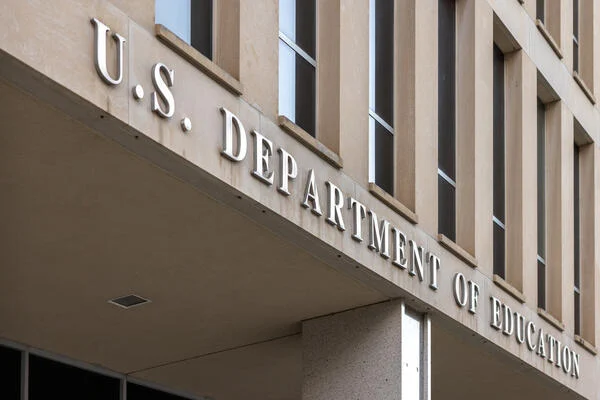
    With just one more meeting to go, the Department of Education and an advisory committee tasked with ironing out the details of how to hold college programs accountable appear far from reaching consensus.

    The 13-member panel, comprised largely of state officials, think tank researchers and higher ed lawyers, spent the last four days negotiating the rules of a new college earnings test called Do No Harm—which applies to all degree programs—as well as changes to the existing gainful-employment rule, an accountability metric that only applies to certificate programs and for-profits.

    The department’s proposal, which aligns the two accountability metrics and holds all programs to the Do No Harm’s standards, has gone largely unchanged in the first four days of negotiation.

    Under Do No Harm, all college programs, except undergraduate certificates, that fail to prove their students earn more than someone with only a high school diploma could lose access to federal loans, whereas the current version of gainful employment requires programs to show their graduates pass the earnings test and can reasonably pay off their debt. Programs that fail either test are cut off from all federal student aid.

    Although officials have agreed to a series of smaller changes and said they were open to considering larger ones, none made so far address the key issues that are dividing the committee—axing the debt-to-earnings ratio and the Pell Grant penalty.

    If the committee doesn’t reach consensus, the department is free to propose any changes to the regulation it wants, which could include scrapping gainful employment entirely. The department met with different committee members in private meetings Thursday, but it’s unclear if those talks will lead to compromises or flip votes.

    “Consensus seems pretty unlikely at this point, since negotiators are still disagreeing on key provisions of the department’s drafted text,” said Emily Rounds, an education policy adviser at Third Way, a left-of-center think tank. “Anything is possible, and these caucuses could be productive, but I would be surprised if they reached consensus.”

    Institutional representatives on the committee generally back the overall plan, while consumer protection advocates have taken issue with the department’s changes to gainful employment.

    Reaching consensus at this point would likely require ED to significantly rework its original proposal.

    “We have moved well into the vote-tallying stage,” one committee member said on the condition of anonymity to maintain good faith in the negotiation process. “The question is, does ED think it can get certain negotiators on board without caving on their original proposal to integrate gainful employment and Do No Harm.”

    Department officials acknowledged the differences of opinion but said they would work to bring committee members together.

    “The department is going to work on some language overnight based on the things that we’ve talked about today in our various caucuses,” Dave Musser, ED’s negotiator, said at the end of Thursday’s meeting. “We plan to come back in the morning prepared to share some of that language, recognizing that it may not be enough alone to get us to consensus. However, we want to show that we are doing everything that we can to get to a place where everyone can get to an agreement.”

    2 Key Issues, 2 Key Sides

    The Education Department and institutional representatives said the proposal plan creates a level playing field, calling it a more fair and simple means of accountability. State higher education officials and employers also joined in at times, agreeing that this plan would be the most legally sound and could end years of political ping-pong over higher ed accountability.

    But committee members representing taxpayers and legal aid organizations as well as left-leaning research groups and consumer protection advocates argue that the department’s plan waters down existing standards, could put students at risk and may lead to legal challenges.

    Although negotiators representing students who receive Title IV aid and students who are veterans have also expressed concerns about the changes to gainful employment, Tamar Hoffman, the committee member representing legal aid organizations, was the most outspoken throughout the week, saying there were “inherent issues” with the department’s current proposal.

    “It does not make sense that we would allow the most economically disadvantaged students to use up very precious resources that they have in their lifetime Pell eligibility on programs that the department has deemed to be inadequate to receive loans,” she said at the close of Thursday’s meeting.

    Ideally, Hoffman and others would like to see the debt-to-earnings test reinstated as well, though Pell appears to be the top priority.

    Preston Cooper, the committee member representing taxpayers and the public interest, voiced more opposition at the beginning of the week as he highlighted his analysis of department data that showed ED’s plan would disburse an estimated $1.2 billion in Pell dollars annually to programs that failed the earnings test.

    By Thursday, however, multiple of Cooper’s smaller concerns had been addressed through amendments, and he appeared poised to support the department’s proposal. The changes included added clarity about the ability to separate gainful employment and Do No Harm if courts strike down either test and that failed programs must pass the earnings test for at least two years before regaining loan eligibility.

    Some Changes Made

    Despite their overall support for the department’s plan, institutional advocates—particularly Jeff Arthur, the negotiator representing for-profit institutions, and Aaron Lacey, who represented nonprofit institutions—did try to change parts of the earnings test that they argued were unfair, like the age and work experience of high school graduates that college students were compared to, or the way rural institutions were held to the same standard as urban ones. So far, they haven’t been successful.

    They had better success with an amendment that allowed existing students in failing programs to maintain the loan access needed to complete their degree. The department agreed to the change under a few conditions: The program will have to voluntarily agree to shut itself down after the first year of failure, terminate all enrollment for new students and enter a formal teach-out plan for those who remain.

    Hoffman, however, said the change would only further water down existing accountability standards.

    “To me, this seems like a giant loophole for institutions to try to maintain eligibility for Title IV funds when they aren’t actually delivering adequate services to students,” she said. “There isn’t anything here that prevents institutions from ceasing new enrollment in a failing program [while] at the same time standing up a [new] substantially similar program within the same institution.” (Title IV of the Higher Education Act authorizes federal financial aid programs such as the Pell Grant.)

    The regulations do include some restrictions on starting new programs, but Hoffman and other student advocates from think tanks don’t believe they are strong enough to prevent institutions from developing other similarly poor-performing certificates and degrees.

    By the end of Thursday’s meeting, the department had not yet publicly proposed any concessions to address Hoffman’s concerns on the teach-out plan or the core changes to gainful employment.

    But talks appeared to continue after the meeting ended. One department official told Hoffman he’d be amenable to talking over happy hour about what changes would be needed to get her on board.

    Source link

  • How a Northwestern Program Tackles Student Stress

    How a Northwestern Program Tackles Student Stress

    The stress of managing her engineering classes at Northwestern University didn’t just weigh on Fiona Letsinger mentally—it began to take a toll on her academic performance.

    In her second year, Letsinger’s dean introduced her to PATH, a peer mentor–led program housed in the engineering school that helps students manage stress, perfectionism and personal growth.

    “From the second he described it, my jaw was on the floor,” said Letsinger, a fourth-year civil engineering major. “I was like, ‘Yep—that’s exactly what I need.’”

    Launched in 2016, PATH—short for Personal Advancement Through Habits—is an eight-week program that guides students through reflection and personal development using a mix of online coursework and small-group discussions.

    During the 2024–25 school year, 88 students completed the program. About 90 percent reported a positive personal change, and more than 60 percent said they experienced growth in self-awareness; roughly half said it improved their motivation and goal-setting skills.

    Letsinger said the program gave her the language to recognize and name the ways stress and perfectionism were shaping her college experience.

    “I thought I couldn’t be a perfectionist because I wasn’t performing highly enough,” Letsinger said. “It wasn’t until PATH when I was able to get the vocabulary to identify how stress showed up in my life.”

    Impact on students: Joe Holtgrieve, assistant dean for undergraduate engineering, said his experience supporting students in both short-term and systemic crises inspired him to start the PATH program nearly 10 years ago.

    At the time, Holtgrieve said, Northwestern was reassessing its withdrawal policies and considering making it easier for students to drop courses later in the term. That prompted him to engage in difficult conversations with students about whether withdrawing was the best option—or whether they were experiencing what he calls an MOI, or “moment of intensity.”

    “How you respond is going to be really important for your future success and resilience,” said Holtgrieve, who remains a PATH faculty member. He added that students would later reach out to thank him because they performed better academically than they thought they would.

    Liz Daly, assistant director of academic advising and PATH faculty, said the program was originally intended for engineering students on academic probation but later expanded to include anyone feeling overwhelmed.

    “We had students who would request to take it again because they appreciated the community and the conversations that weren’t happening elsewhere on campus,” Daly said.

    That emphasis on reflection and peer support continued among students who participated in PATH during the 2024–25 school year.

    To better understand students’ experiences, Holtgrieve and Daly surveyed participants, asking them to reflect on their academic challenges and select three goals from a list of seven. More than half chose “shift mindset to embrace challenges, persist and learn from feedback.”

    Participants also completed surveys at the start and end of the program, rating which behaviors they found most challenging.

    Before starting PATH, more than half said they “dwelled on inadequacy after failure” and were “avoidant and/or withdrawn when things were going poorly.” By the program’s end, that number had dropped to about 15 percent.

    Daly said students often cite Holtgrieve’s “flashlight of attention” lesson as particularly helpful.

    “Our attention is like a flashlight … and whatever is illuminated by that light represents our awareness,” Holtgrieve said. “Where we shine that light represents our intention,” he added, noting that students’ intentions are often “yanked back and forth by crises, breaking news or self-critical narratives.”

    “If we can tune in to what’s present in the moment through our awareness and decide whether something is helpful or productive, then we can step back, understand the intention behind the attention that’s creating this awareness and adjust it,” he said.

    Letsinger agreed with Daly, saying this lesson was a game-changer in how she understood her own thinking.

    “I remember hearing that and immediately being like, ‘Yep, I need and want more of that kind of thinking,’” Letsinger said, adding that she not only enrolled in the program again the following quarter but later became a PATH mentor herself.

    What’s next: Holtgrieve and Daly said the program became so popular that other institutions have adapted it, including Smith College, which launched its own PATH-inspired program in fall 2020.

    Daly noted that in conversations about PATH’s impact, faculty and staff often asked whether they could participate as well. As a result, Holtgrieve and Daly now hold multiple sessions each year for Northwestern employees interested in learning strategies to manage stress in their own lives.

    Holtgrieve said that response suggests that many of the conversations happening among students also resonate with faculty and staff.

    “It’s an empathetic bridge, and it helps them to recognize that they’re struggling with some of the same things that their students are struggling with,” Holtgrieve said.

    Ultimately, Holtgrieve said, PATH is meant to help anyone practice responding to moments of uncertainty instead of trying to make them disappear.

    “When you’re feeling or confronting a moment where it’s not clear what to do, it’s human nature to say, ‘I want that to go away,’” Holtgrieve said. “But being able to practice living through and responding to those moments is how you build the skills to be a better person.”

    Get more content like this directly to your inbox. Subscribe here.

    Source link

  • Brown Mass Shooting Suspect Admits to Crime

    Brown Mass Shooting Suspect Admits to Crime

    Bing Guan/AFP/Getty Images

    The man accused of carrying out last month’s mass shooting at Brown University that left two students dead admitted to the crime in a series of four videos, the transcripts of which were released Tuesday by the U.S. Attorney’s Office for the District of Massachusetts. 

    Claudio Neves Valente, the 48-year-old suspect who previously attended Brown, was found dead by a self-inflicted gunshot wound at a storage facility in New Hampshire just days after the campus attack, preventing investigators from interrogating him. But in the videos, which were pulled from an electronic device at the storage facility and have been translated from Portuguese to English, Valente admitted to the Brown shooting and the subsequent killing of a Massachusetts Institute of Technology professor near Boston. 

    And while the suspect said that he would not apologize, the motives of the attack remain unclear.

    Throughout the more than 11 minutes’ worth of video, he spoke about how he had planned the shooting for years. In multiple instances, Valente vaguely referenced “the people” his violent actions were made in response to, saying, “I did not like any one of you. I saw all of this shit from the beginning.” 

    He noted that he sent three emails, seemingly to “the people” he’d referenced. But beyond that, he was “not saying anything else.”

    Source link

  • What Higher Ed Learned From 12 Months of Trump 2.0

    What Higher Ed Learned From 12 Months of Trump 2.0

    College leaders return to campus this term appearing steady and resolved. After a year of tumult, they remain vigilant about more attacks from Washington but are ready to refocus on the other crises knocking at their doors—million-dollar deficits, declining enrollments and AI’s disruption. And now that higher ed has gone through nearly 12 months of Trump 2.0, it’s learned a few things.

    First, we now know that nothing is sacred. Funding for cancer research? Canceled. Support for colleges serving low-income students? Chopped. Due process? Passed over. The sector was caught off guard by the administration’s creativity in its attacks last year, and colleges should continue to expect the unexpected. But in an interview before Christmas, Education Secretary Linda McMahon told Breitbart that her department would “shift a little bit away from higher education” in 2026 and focus more on K–12 reform.

    The year didn’t just teach colleges what to expect—it also showed them how to respond. And we’ve seen that fighting back works. Harvard is holding firm against the administration’s pressure to strike a deal and has not publicly conceded anything (though rumors abound an agreement is nigh). George Mason University president Gregory Washington came out swinging when the Department of Education accused him of implementing “unlawful DEI policies” on his campus. That’s a sharp contrast to University of Virginia president Jim Ryan, who resigned in June after the Department of Justice’s successful bid to topple him. So far, Washington remains in his post, with unanimous support from his board, campus community and state lawmakers. And in a collective act of defiance, the nine institutions initially invited to sign the White House’s “Compact for Academic Excellence in Higher Education” declined without repercussion.

    Leaders have also woken up to the fact that visibility matters. At the Council for Independent Colleges’ Presidents Institute in Orlando, Fla., this week, presidents seemed ready to play offense. They spoke with a newfound political savviness about recruiting board members and alumni to do advocacy work, hiring in-house government relations professionals and spending more time on the Hill. “We all let our guard down on government relations in the lead-up to 2025,” one president said. “Being able to brand yourself in D.C. is now a necessity, not a luxury.”

    At times the administration has appeared sloppy, sending “unauthorized” letters, issuing threats and never following up, or publishing typo-ridden mandates. But beyond the culture-war accusations that colleges are factories of woke indoctrination, it’s clear the government is serious about wanting to effect change in higher ed. Cost transparency, graduate outcomes and greater emphasis on workforce training are all sound policy issues lawmakers are pursuing through legislation.

    Whether or not McMahon follows through on her intention to shift focus away from higher ed, the fallout from 2025 persists. We’ll be looking to see how college budgets weather new loan caps for graduate courses and the loss of international students impacted by stricter visa requirements—or turned off by the country’s hostile environment.

    In December, Education under secretary Nicholas Kent vowed to “fix” accreditation. The administration’s unofficial playbook, Project 2025, suggests that could mean more accreditors, including states authorizing their own accrediting agencies, or ending mandatory accreditation to access federal financial aid. Congress will continue to apply pressure on the sector to lower the cost of college and improve transparency regarding fees and tuition. Meanwhile, negotiated rule making has begun on the accountability measures mandated by the One Big Beautiful Bill Act. And will colleges take responsibility for their role in the loss of public trust in their institutions?

    We shouldn’t normalize the lasting harm the Trump administration has done to institutional independence, minoritized students and scientific research in just 12 months. And there is a risk that more is coming. But after surviving a dizzying year of attacks, the sector will face its challenges a little wiser and more informed.

    Sara Custer is editor in chief at Inside Higher Ed.

    Source link

  • College Dining Halls Embrace Plant-Forward Menus

    College Dining Halls Embrace Plant-Forward Menus

    Not long ago, chalky tofu and limp lettuce constituted some of the only vegetarian meal options available at campus dining halls. But that’s changed in recent years as more colleges and universities have set broader sustainability goals, which often include pledges to offer more plant-based foods.

    Nowadays, students have access to more adventurous plant-based dishes, such as cauliflower ceviche, japchae and sesame tempeh, to name just a few.

    Over the past decade, dozens of colleges and universities have vowed to provide more plant-based meals, including Smith College, the University of North Texas and the University of California, Los Angeles.

    In November, the University of California, Riverside—where meatless meals already make up about 45 percent of its dining options—became one of the latest universities to commit to expanding its meatless offerings, pledging to make 50 percent of meals plant-based by 2027.

    While such pledges are rooted in sustainability goals, they’ve also led to the creation of more diverse and healthier menu options—both things students have called for. And regardless of students’ motivation for consuming more plant-based food, prioritizing such options at campus dining halls—which feed millions per year—has the power to affect environmental change at scale.

    “Without question, institutional procurement is a massive lever for climate solutions at school and an often-overlooked tool for public health,” said Sophie Egan, co-director of the Menus of Change University Research Collaborative housed at Stanford University. Founded in 2012, the collaborative is a network of 85 colleges and universities that are using campus dining halls as living laboratories to research promotion of plant-forward options, food-waste reduction and increasing food literacy. “The decision-makers at universities who hold the purse strings and design menus are the potential heroes in this story. They can make small tweaks to menu sourcing and operations that can have a huge impact at scale.”

    For colleges, the shift satisfies multiple goals.

    “There are so many things that play into sustainability that are low-hanging fruit, including trying to offer menu items that don’t require a lot of water,” said Lanette Dickerson, director of culinary operations at UC Riverside. At the same time, she’s also focused on creating menus that reflect students’ varied and changing tastes. “UC Riverside is a really diverse campus—more than 40 percent of students are Latino and 34 percent are Asian—which makes it easier for us to offer these items because they’re already deeply rooted in these cultural diets.”

    She added that offering vegetarian foods—which tend to be lower in fat, cholesterol and other ingredients associated with an increased risk of chronic disease—may also help some students adopt healthier overall eating habits.

    Vegan Labels a ‘Turn-Off’

    Reaching the university’s new plant-forward menu goals will require more training for Dickerson’s staff. “Our team needs to know how to prepare these items to make sure they’re palatable,” she said. What won’t work is advertising plant-based menu options as meatless, vegan or vegetarian. “We got such bad feedback on our ‘meatless Mondays,’” she said, noting that students assigned more value to meat-based proteins. “We did still try to do it, but without such heavy marketing behind it.”

    Experts say that kind of reaction to food labeled vegetarian, vegan or meatless is exceedingly common, despite consumers’ increased appetite for plant-based foods and the growing availability of plant-based ingredients.

    “The term ‘vegan’ has a bit of a bad connotation. ‘Plant-based’ seems a lot sexier,” said Scott Zahren, director of culinary development at Aramark, which provides dining and food services to more than 275 U.S. colleges and universities. “Plant-based products these days are much better than they were 10 or 20 years ago. We have such great alternative dairy products now that we can offer a lot more dishes.”

    Vegetarian dining at Smith College

    Jessica Scranton/Smith College

    But Zahren and his team recognized that “vegan” can be a “turn-off,” and Aramark recently updated its marketing content to describe its menu items as “plant-based” instead. “The marketing reads a lot better for the masses.”

    Presenting plant-based foods as a default menu item rather than an alternative also increases the likelihood that students will eat them. According to a 2024 study published in the Journal of Environmental Psychology, on days that dining halls set up food stations with a vegan default—say, stir fry with tofu—those stations saw a 58 percent increase in plant-based dining, and meat consumption declined anywhere from 21 percent to 57 percent. In short, students don’t run away from plant-based dishes when they’re presented as the norm.

    ‘It’s About Good Food’

    In addition to sustainability initiatives, changing food preferences are also driving dining halls to offer more meatless options.

    In 2020, the global market for plant-based foods was valued at $29.4 billion; by 2030, it is expected to grow more than fivefold to $162 billion, according to a report by Bloomberg Intelligence. While data also shows that about 22 percent of Gen Z are actively limiting their meat consumption, what students really want out of campus dining is more options. According to a 2023 Inside Higher Ed Student Voice survey, respondents said that if dining halls want to improve their offerings, they should prioritize variety and quality of flavors, reduce ultra-processed foods and offer a variety of cuisines.

    “Campus dining programs are responding to customer preferences,” said Robert Nelson, president and CEO of the National Association of College and University Food Services. “The focus is on making great-tasting dishes that happen to be plant-forward. What’s important for dining halls as they expand their plant-forward, vegan and vegetarian offerings is to market them with descriptive, flavorful language. It’s not meatless curry, it’s coconut curry; it’s amazing mushroom pasta; it’s crispy cauliflower tacos.”

    That’s the approach Smith College has taken in its quest to offer more plant-based meals.

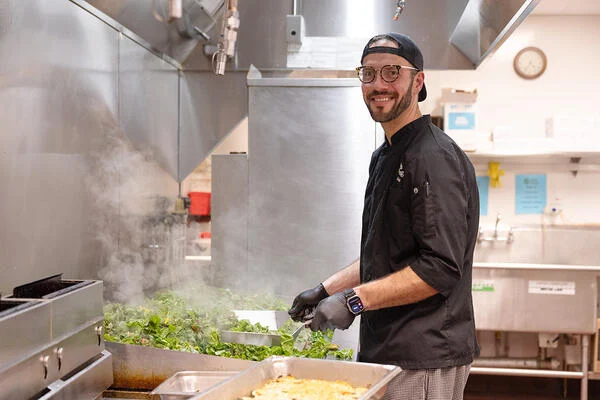
    A light-skinned man in a black chef's coat, backward baseball cap and black gloves stands in front of a large flattop cooking surface stirring a pile of greens.

    Chef Adam Dubois sauteing local greens at Smith College.

    Jessica Scranton/Smith College

    “We’re showing students that it’s not about the words ‘vegetarian’ or ‘vegan’—it’s about good food. It doesn’t have to have meat to be good,” said German Alvarado, director of culinary services at Smith. “With all of the technology that’s available, students are seeing all the variety of food out there and they want to see it in front of them. What’s trending is variety and healthy choices.”

    In 2015, the college pledged to reduce meat consumption by 5 percent each year, aiming to make 55 percent of its entrées plant-based by 2025. As of December, it was around 51.5 percent, according to Alvarado.

    “We’re not that far off,” he said, adding that the college just needs to add a handful of additional menu items to reach its goal. “We don’t want to do this for the sake of doing it. We want to make sure students are enjoying it and we’re creating good recipes.”

    Choice Is Key

    But Smith, UC Riverside and many other colleges have no plans to stop serving meat entirely. A dustup in the opinion pages of the Williams College student newspaper already showed limited appetite for that: In November, a student wrote an op-ed suggesting the college go vegan to mitigate animal cruelty, prompting blowback.

    “When accepting the invitation to attend the College, students did not sign up for a vegan menu,” Ella Goodman, a freshman at Williams, wrote in response. “Suddenly restricting our meal offerings would be unfair to students for whom a vegan menu could have been a dealbreaker in choosing between colleges.”

    Preserving personal choice is key for institutions undertaking plant-based dining initiatives, said Egan, the co-director of Menus of Change.

    “The word ‘meatless’ really backfires. People tend to not like being told they can’t have something,” she said. “The behavioral science is very clear: Having something taken away or restricting choice is a very good way to make people not excited about what’s left. Plant-forward is really about celebrating what’s in a dish.”

    And those initiatives at campus dining halls can also shape student relationships with food, which has implications that stretch far beyond the campus.

    “A person’s college years are a particular formative time for developing food identity, food preferences and making decisions about food,” Egan said. “Showing students that healthy, sustainable, plant-forward ways of eating can be delicious, comforting, satisfying and help them perform well in sports, academics and their different pursuits—those preferences stay with them long after their college years.”

    Source link

  • Doing the “Data Work” in Student Success

    Doing the “Data Work” in Student Success

    The latest episode of The Key, Inside Higher Ed’s news and analysis podcast, features a discussion between higher ed leaders and IHE editor in chief Sara Custer on how colleges can harness data to better support students. 

    Speaking at the Student Success 2025 event in November, Courtney Brown, vice president of strategic impact and planning at the Lumina Foundation; Elliot Felix, higher education advisory practice lead at Buro Happold; and Mark Milliron, president of National University, offered unique perspectives to the question of how institutions can be data-driven and student-centered.

    “You are not going to serve a student population well unless you do your data work,” said Milliron. The “data work” includes establishing good data governance and data mapping, building a data warehouse, and facilitating data integration across support platforms such as a learning management system and student information systems, he said. 

    Putting processes and best practice in place is what allowed National to expand its capacity, he said. “I don’t think we could’ve scaled some of the strategies we’ve done unless we did the plumbing work upfront.”

    On the question of scale, Felix encouraged institutions to combine their resources to serve more students. “How many institutions are creating their own, bespoke AI policy when they can do [it] as a group or borrow from Educause? There are so many ways to work together to go farther, to go faster.”

    While colleges might be teeming with data, Felix encouraged institutions to look at external sources to gain a clearer picture of students’ learning journeys. “I do think more data beyond the walls—employer data, labor market data, employment outcomes—would be really helpful.”

    Meanwhile, Brown argued that the needs of the modern-day student are varied and institutions must adapt to their students, rather than students adapting to colleges. Institutions that use data to understand whom today’s students are will be better placed to support their success, she said. “[Students] are parents, they are working, they are financially independent from their own parents. But most policymakers and others don’t think about that. So we need to understand who they are and then transform the system to better serve [them].”

    Listen to the full episode here

    Source link

  • Austin Peay Reinstates Professor Fired Over Kirk Headline

    Austin Peay Reinstates Professor Fired Over Kirk Headline

    csfotoimages/iStock/Getty Images

    Nearly four months after he was terminated for reposting a news headline that quoted the late conservative commentator Charlie Kirk’s position on gun rights, Darren Michael has been reinstated as a professor of theater at Austin Peay State University, Clarksville Now reported

    Michael returned to the classroom in late December. The university will also pay him $500,000 and reimburse therapeutic counseling services as part of the settlement.

    “APSU agrees to issue a statement acknowledging regret for not following the tenure termination process in connection with the Dispute,” the settlement agreement reads in part. “The statement will be distributed via email through APSU’s reasonable communication channels to faculty, staff, and students.”

    Shortly after Kirk was shot and killed at a campus event in September, Michael shared a screenshot of a 2023 Newsweek headline on his personal social media account that read, “Charlie Kirk Says Gun Deaths ‘Unfortunately’ Worth it to Keep 2nd Amendment.” His repost was picked up by conservative social media accounts, and his personally identifying information was distributed. It also caught the attention of Tennessee Sen. Marsha Blackburn, who shared Michael’s post alongside his headshot and bio with the line “What do you say, @austinpeay?” Michael was terminated Sept. 12. 

    Michael did not respond to a request for comment Wednesday. A spokesperson for Austin Peay State declined to comment.

    Source link

  • Oregon Higher Ed Body Endorses “Integration,” Up to Mergers

    Oregon Higher Ed Body Endorses “Integration,” Up to Mergers

    Oregon’s Higher Education Coordinating Commission is recommending that the state’s public colleges and universities pursue “institutional integration”—everything from sharing services and programs to full mergers. It is also seeking the power to renew, or terminate, academic programs.

    The commissioners approved a document Tuesday with five recommendations, and integration and program review were listed first. Ben Cannon, the commission’s executive director, said the vote was 13 to 2.

    The report says public universities will run out of money in a few years if they don’t continue to reduce costs. It cites “slowing growth forecasts for state revenue” and insufficient expected enrollment growth, adding that “especially given Oregon universities’ unusually high dependence on tuition for revenue, this creates an unsustainable dynamic.”

    “On the current path universities will be forced to continue to make substantial cuts annually or, in aggregate, fund balances will be completely exhausted within an estimated three to five years,” the report says.

    While the report doesn’t recommend recreating a statewide university system, it endorses “increasing systemness,” saying, “Only a few high-growth states can still afford a system of higher education built on the ‘every campus for itself’ model.”

    The commission’s integration recommendation goes beyond just the universities—it says the State Legislature should direct the commission, “in consultation with all of Oregon’s public higher education institutions, including community colleges,” to come up with one or more proposals for integration by next January. It suggests, in one non–full merger example, “combining services provided to the same region by a community college and a public university.”

    The commission also said lawmakers should require it to periodically review and renew universities’ degree programs, adding that the law could require programs to “demonstrate that they produce value for students and communities, don’t unnecessarily duplicate other institutional offerings” and meet “financial sustainability requirements.” It said the review should consider “impacts on underrepresented students” and not “ideological preferences” or “strictly financial returns to the individual.”

    Oregon Public Broadcasting previously reported on the recommendations. It wrote that Southern Oregon University president Rick Bailey laid part of the blame for university cutbacks on stagnant state funding.

    “In four years, I’ve made decisions that have eliminated 25 percent of our workforce. Imagine that happening at any other state entity,” Bailey said, according to OPB. “Our colleagues are all doing similar painful work, and so we have to ask, how much more efficient should our seven universities be?”

    Source link

  • “Profound Political Change” Needed to Revive Venezuelan Higher Ed

    “Profound Political Change” Needed to Revive Venezuelan Higher Ed

    Venezuelan academics are pessimistic that a change in leadership will improve the fortunes of the country’s downtrodden universities, even after the shock ousting of leader Nicolás Maduro.

    Delcy Rodríguez has been sworn in as the country’s interim president following the dramatic seizure of Maduro by U.S. forces.  

    Despite Rodríguez’s past as a professor at the Central University of Venezuela, academics are doubtful that her ascension will be beneficial to the country’s higher education system and have warned that “profound” political change is needed if universities are to recover from years of attacks.

    Venezuelan universities suffered under Maduro’s reign, with economic decline leading to severe budget cuts. Hyperinflation means salaries have dipped to meager amounts, with reports suggesting that pay for professors averaged $15 per month in 2020, while student numbers have fallen dramatically.

    Meanwhile, the deposed leader’s administration was known for jailing scholars it saw as critical of the government and has been accused of installing those with pro-Maduro views in leadership positions at universities. 

    These attacks, combined with the economic crisis, have driven many scientists and academics out of the country. A 2020 study found that Venezuela has lost 16 percent of its scientific research workforce as a result of emigration.

    Benjamin Scharifker, emeritus professor at Simón Bolívar University in the capital, Caracas, said the country’s university system and scientific institutions “absolutely collapsed” under Maduro, with attacks on universities seen as a way to maintain power. 

    “If you collapse the universities, then you also collapse the possibility of students going to the street and protesting against the government,” he said. 

    While they might not be grieving Maduro’s departure, academics said Rodríguez, who has been vice president since 2018, was not seen as any better. “We are only changing a face,” said Scharifker, with many of those who ruled under Maduro remaining in power despite his departure.

    For example, Jorge Rodríguez, the interim leader’s brother, was reappointed president of Venezuela’s National Assembly days after the U.S. attack. He previously held academic posts at universities in the country and was a prominent student leader.

    But, despite their links with the higher education sector, the Rodríguez family is not thought to be interested in helping universities recover from years of damage.

    “I don’t think that somebody that in 25 years has done [nothing] for the university will start doing it now,” said Jaime Requena, a member of the Academy of Physical, Mathematical and Natural Sciences of Venezuela and a researcher on brain drain. “I would be extremely surprised.”

    “It is a tremendous task to rebuild,” he added.

    Although the U.S. might influence the country’s future policy direction, academics were doubtful that President Donald Trump would be interested in prioritizing the university sector. In the U.S., Trump’s second presidency has been characterized by a crackdown on higher education, including funding cuts.

    And while new ties with the U.S. could make travel into and out of the country easier after a period of international isolation, many academics are unlikely to return without economic and political reform, Requena said. “You cannot have a research system working in a place where there is no freedom.”

    He added that international cooperation and partnerships, including loans, will be crucial to the future recovery of the sector. 

    “If you don’t have political freedoms, then you cannot really be a university professor,” Scharifker agreed.

    “If we really want science to recover to … the level that we once had many years back, we need a profound political change in Venezuela—not only the change of who is sitting in the presidential palace, but really what are the policies, and I think that is not going on in Venezuela at the moment.”

    Source link

  • Transfer and Learning Mobility in 2026 and Beyond

    Transfer and Learning Mobility in 2026 and Beyond

    Nearly four in 10 adult Americans have tried to transfer credit toward a college degree or credential. Of those, 58 percent lost credits in the process. For some, the consequences were severe: using up financial aid and repeating classes they’d already passed. Sixteen percent reported giving up on higher education altogether because the transfer process was simply too difficult.

    These aren’t just statistics. They represent learners and workers who lost time, money and faith in a system that promised them opportunity.

    Many have been trying to address these issues, and great work is underway. But the effort to transform transfer and learning mobility still lacks a coordinated and sustained focus at scale. Transfer and learning mobility are still treated as niche issues affecting a small percentage of students, rather than an increasingly common reality for today’s learners that should compel higher education to evolve. We have not yet achieved the fundamental mindset shifts, or built the supportive infrastructure, that are needed to treat all learning fairly, but the pressure is on. And with pressure comes opportunity.

    Year 5 of Connecting With You on ‘Beyond Transfer’

    Welcome to year five of the “Beyond Transfer” column on Inside Higher Ed—a column that seeks to elevate the voices of expert practitioners, researchers, advocates, policymakers, students and others who are seeking to overhaul not just the transfer experience, but the entire ecosystem related to ensuring that all Americans benefit from their hard-earned and hard-learned skills and competencies and receive the economic mobility they deserve.

    Each year, we kick off the column with some reflections on what we’ve learned through listening to and collaborating with all of you. At Sova, we’ve had the privilege of working at multiple levels of the transfer and learning mobility ecosystem (hereafter “transfer”): facilitating national expert groups such as the Beyond Transfer Policy Advisory Board and the Learning Evaluation and Recognition for the Next Generation (LEARN) Commission (co-convened with the American Association of Collegiate Registrars and Admissions Officers); advancing state-level work from California’s AB 928 Associate Degree for Transfer Intersegmental Implementation Committee to the Texas Transfer Alliance led by Educate Texas; supporting institutional collaborations such as the Acceleration to Credits Working Group and the CCC-CSU Transfer Collaborative; leveraging AI to transform the learning mobility experience through the AI Transfer and Articulation Infrastructure Network (ATAIN); and elevating student voice through our social media platforms.

    As we look ahead, we are connecting the dots on some insights that, while not new, have been at the forefront of our minds over the last year.

    • Credit loss is prevalent, damaging and unfair. Matt Giani, Lauren Schudde and Tasneem Sultana present a rigorous analysis of credit loss in Texas and describe its damaging consequences. In their study of almost 29,000 community college–to–public university first-time transfers, 83 percent of transfers experienced some credit loss. Perhaps most alarming is that this credit loss was among those who followed the rules and transferred to a discipline-aligned program of study (i.e., maintained the same major after transfer).
    • Transfer of credit is a shared American experience. In these politically divisive times, it’s rare to find a topic where common ground is still possible, but transfer is an issue that resonates across party lines. As referenced earlier, a recent survey of adult Americans conducted by Public Agenda for Sova and the Beyond Transfer Policy Advisory Board illuminates both how prevalent transfer is and how Americans’ experiences with transfer shape their attitudes toward colleges and universities. Not only have four in 10 Americans sought to transfer credit, but it’s also the case that a large majority of Americans across the ideological spectrum agree that colleges and universities should be held accountable for honoring learning and accepting credits.
    • The lack of change in transfer and learning mobility is harming higher ed’s reputation. The survey found that those who tried to transfer credit were more likely to feel that higher education institutions care more about making money than about educating students. At a time of declining public trust in higher ed, this is a dangerous signal. In recent focus groups on public attitudes toward college affordability and value conducted by Sova with support from Lumina Foundation, problems with credit transfer have been raised spontaneously by participants in every focus group conducted thus far (12 focus groups across four states).

    Credit transfer is too often built upon unfair contradictions and expectations. Consider, for example:

    • Students are encouraged and even expected to explore their options and pursue a broad education, and yet they are simultaneously forced to choose a preparatory pathway aligned to a receiving institution’s requirements. Because they cannot know where they will be accepted for transfer, they are forced to bet their credits on a single guess.
    • Learners are expected to accept admissions offers before they know how their prior coursework and other learning experiences will be applied to completion.
    • Courses evaluated for transfer are reviewed to ensure they are equivalent to a receiving institution’s courses, without acknowledgment that a single receiving institution may also have multiple faculty (and graduate students) teaching similar courses in a variety of ways and preparation within the receiving institution is uneven as well.
    • Impressive reform efforts in transfer and learning mobility are underway in many settings, with state policy influencers playing important roles. There is much to celebrate, from the leadership of large transfer-sending institutions such as the Alamo Colleges District and Maricopa Community Colleges, to technology initiatives such as ATAIN and Transfer Explorer, to the individual champions who dedicate their personal time in spaces like Transfer Nation to create knowledge and community.

    The Texas Transfer Alliance, with the generous support of Ascendium Education Philanthropy, is leading statewide work focused on building a single, regional Target Pathway that provides all students—regardless of whether they started in high school dual credit or in community college—with clarity through a 60-credit pathway by program that meets requirements for high school graduation, associate degree and eligibility for transfer to multiple bachelor’s-granting institutions in the region. Texas policies related to funding (e.g., HB 8) and data transparency (e.g., SB 25 and SB 3039) are creating the conditions that urge institutions to initiate reforms such as these.

    • Accreditors are beginning to shift and evolve. Much as most Americans are calling for accountability for credit transfer, accreditors are also calling for change. Writing on behalf of the seven federally recognized accrediting commissions overseeing approximately 3,000 institutions, the Council of Regional Accrediting Commissions (C-RAC) stated:

    “Institutions should commit to a default in learning evaluation that credits are applied to program completion unless there is evidence that the required learning outcomes are not met. Decision-making should not be based upon anecdotes, assumptions about quality, locations where earned, or an unexamined history of ‘how things have always been done.’”

    While this may seem like common sense to a layperson, this represents a significant mindset shift. As the arbiters of quality and gatekeepers for federal financial aid, increased accreditor attention to transfer stands to motivate institutional behavior in meaningful ways.

    • And yet, reform efforts in transfer and learning mobility remain slow and episodic. The field has not yet launched a movement equal in scope and depth to the size of the problem we are facing. Higher ed was built to privilege some learners and types of learning over others. Confronting this bias head-on and committing to a new modus operandi is necessary for higher education to evolve and maintain its relevance with today’s learners.

    The Path Forward

    As we dive headlong into 2026, we’re placing our bets on a few fronts.

    The first front is changing assumptions and mindsets. There are a number of ways we are urging the field to shift the lens on transfer and learning mobility. For example, in vertical transfer, the large majority of students cannot know to which institution they will be accepted and able to transfer. That is how the system is designed. It is therefore no longer acceptable for each receiving institution to consider it fair to impose a slew of differing transfer requirements, as it makes it impossible for a student to choose a 60-credit preparatory pathway that works across potential transfer destinations. The Target Pathways work in Texas is designed to ensure students are eligible for transfer to multiple institutions. That needs to become the gold standard.

    Secondly, we need a mindset shift akin to the goal (not yet fully realized) of developmental education redesign. Traditional prerequisite remediation operates on the assumption that students are not “college-ready” unless they prove they are through placement tests. The corequisite approach—backed by solid evidence of greatly improved student outcomes—begins with the assumption, instead, that the large majority of students are ready to start in college-level courses and institutions have a responsibility to support the success of the students they admit through how they design and teach credit-bearing courses.

    In transfer and learning mobility today, the prevailing mindset sounds a lot like that of traditional prerequisite remediation: Students are assumed to not be “transfer-ready” unless they prove it through a process that interrogates their transfer coursework and other prior learning experiences—often including reviews of textbooks, assignments and other minutiae—to prove similarity to “equivalent” courses at the receiving institution. Similar to the goal of dev ed redesign and aligned to how accreditors are shifting their thinking, what would it look like to shift the mindset to: The large majority of learners have been prepared enough by the sum of their learning experiences to be ready for further education and all institutions have a responsibility to support their success after transfer?

    In addition to work on mindsets, we are focused in a few other key areas:

    • Use tech/AI to leapfrog. AI can’t solve all our problems and we know it comes with many new ones, but learning mobility will be transformed as technology finally allows us to move beyond slow, manual, course-to-course reviews that result in limited credit mobility and confusing and conflicting information for learners. Tech offers opportunities to identify equivalencies at a level that human review will never achieve and provide students with exciting navigation support, blowing open the gates that currently restrict credit transfer, as ATAIN seeks to do.
    • Demand transparency for credential applicability. A combination of policy innovation in states (e.g., SB 3039 in Texas) and advances in technology (e.g., the articulation coverage score) lead us to a moment where we can—and must—focus in on transparency about whether learners and workers are getting credit that accelerates them toward their goals.
    • Give learners real clarity and guarantees. Collaborate across partners to build one Target Pathway for a region (by program) and layer on guaranteed program-level admissions programs with targeted financial aid, dedicated advising and belonging initiatives that create a giant vacuum that pulls students through to completion.
    • Shift incentives through policy. So long as institutions continue to operate in a world that primarily incentivizes enrollment, nothing will change. Policymakers must step in and change the incentive structures that drive institutional behavior—both the financial and reputational incentives. What does it mean to recognize and reward institutions when they not only accept transfer students, but commit to the work of ensuring all credit for prior learning is counted toward credentials so that learners and workers are supported to complete in a timely manner? In its recent report, the LEARN Commission points to the opportunity for policymakers to enhance transparency and create new incentives that accelerate institutional change.

    The question isn’t whether the current transfer credit system is broken. The data makes that clear. The question is whether higher education has the courage to take on this challenge in a coordinated, sustained and scaled way. Too many learners are losing credits, losing money and losing hope. It’s time to do better.

    The authors are members of Sova’s Transfer and Learning Mobility team. Learn more about Beyond Transfer at sova.org/beyond-transfer or follow “Beyond Transfer” on Instagram @beyondtransfer and Transfer Nation California on LinkedIn or Instagram @transfernationca.

    Source link