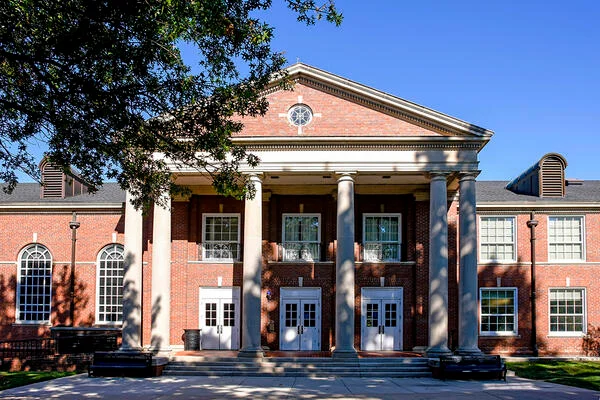
Michael was terminated by Austin Peay State University in September.
csfotoimages/iStock/Getty Images
Nearly four months after he was terminated for reposting a news headline that quoted the late conservative commentator Charlie Kirk’s position on gun rights, Darren Michael has been reinstated as a professor of theater at Austin Peay State University, Clarksville Now reported.
Michael returned to the classroom in late December. The university will also pay him $500,000 and reimburse therapeutic counseling services as part of the settlement.
“APSU agrees to issue a statement acknowledging regret for not following the tenure termination process in connection with the Dispute,” the settlement agreement reads in part. “The statement will be distributed via email through APSU’s reasonable communication channels to faculty, staff, and students.”
Shortly after Kirk was shot and killed at a campus event in September, Michael shared a screenshot of a 2023 Newsweek headline on his personal social media account that read, “Charlie Kirk Says Gun Deaths ‘Unfortunately’ Worth it to Keep 2nd Amendment.” His repost was picked up by conservative social media accounts, and his personally identifying information was distributed. It also caught the attention of Tennessee Sen. Marsha Blackburn, who shared Michael’s post alongside his headshot and bio with the line “What do you say, @austinpeay?” Michael was terminated Sept. 12.
Michael did not respond to a request for comment Wednesday. A spokesperson for Austin Peay State declined to comment.
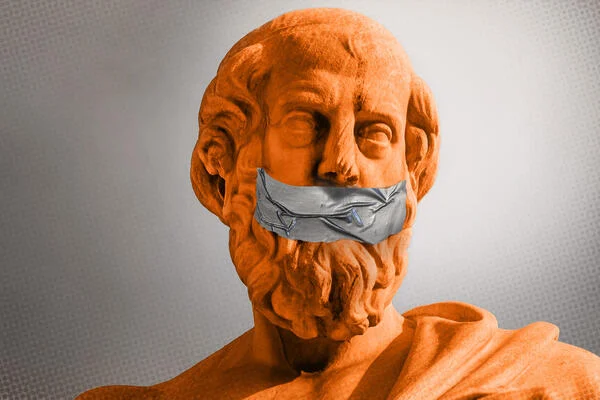
The censored Plato texts include passages from his Socratic dialogue Symposium that discuss patriarchy, masculinity, gender identity and the human condition.
Photo illustration by Justin Morrison/Inside Higher Ed | Nice_Media_PRO/iStock/Getty Images | rawpixel
At least 200 courses in the Texas A&M University College of Arts and Sciences have been flagged or canceled by university leaders for gender- or race-related content as the university undertakes its review of all course syllabi, faculty members told Inside Higher Ed.
This is just the beginning of the system board–mandated course-review process. Faculty were required to submit core-curriculum syllabi for review in December, and some faculty members have yet to receive feedback on their spring courses, scheduled to begin Monday.
So far, queer filmmakers, feminist writers and even ancient Western philosophers are on the chopping block. One faculty member—philosophy professor Martin Peterson, who is supposed to teach Contemporary Moral Problems this spring—was asked by university leadership to remove several passages by Plato from his syllabus.
In an email from department chair Kristi Sweet, Peterson was given two options: either remove “modules on race and gender ideology, and the Plato readings that may include these,” or be reassigned to teach a different philosophy course.
“Your decision to bar a philosophy professor from teaching Plato is unprecedented … You are making Texas A&M famous—but not for the right reasons,” Peterson said in his response to Sweet, which he shared with Inside Higher Ed. The Plato texts include passages from his Socratic dialogue Symposiumthat discuss patriarchy, masculinity, gender identity and the human condition. In one excerpt, the “Myth of the Androgyne,” the Greek playwright Aristophanes says, “First, you should learn the nature of humanity … for in the first place there were three kinds of human being and not two as nowadays, male and female. No, there was also a third kind, a combination of both genders.”
Peterson ultimately chose to revise his syllabus and replace the censored material with lectures on free speech and academic freedom. “I’m thinking of using this as a case study and [to] assign some of the texts written by journalists covering the story to discuss,” Peterson told Inside Higher Ed via text. “I want [students] to know what is being censored.”
Another censored class is Introduction to Race and Ethnicity. Students enrolled in the sociology course this spring were told via email Tuesday that the class was canceled because there was no way to bring it into compliance with the system policy. One professor, who wished to remain anonymous, was asked in the fall to remove content related to feminism and queer cinema from their History of Film class. The professor refused, and the dean resubmitted the syllabus as a noncore “special topics” class, which enrolled students were notified of Wednesday.
“I’m seeing the enrollment drops as we speak,” the professor said.
The enrollment declines could have the same result as the course review.
“The expectation is that a lot of those classes will ultimately be canceled, not because of content but because of underenrollment,” said another professor in the College of Arts and Sciences who wished to remain anonymous.
English faculty members received an email Tuesday from senior executive associate dean of the college Cynthia Werner telling them that literature with major plot lines that concern gay, lesbian or transgender identities should not be taught in core-curriculum classes.
In a follow-up email Wednesday, Werner said, “If a course includes eight books and only one has a main character who has an LGBTQ identity and the plot lines are not overly focused on sexual orientation (i.e. that is THE main plot line), I personally think it would be OK to keep the book in the course.” She also clarified that faculty may assign textbooks with chapters that cover transgender identity, so long as they do not talk about the material or include it on assignments or exam questions.
In November, the Texas A&M University System Board of Regents decided that courses that “advocate race or gender ideology, sexual orientation, or gender identity” would be subject to presidential approval and launched a systemwide, artificial intelligence–driven course-review process across all five campuses. Faculty members are still confused about who exactly is reviewing their syllabi.
“The university is doing different things in different departments and colleges. They’re interpreting these policies differently,” said Leonard Bright, a professor of government and public service at Texas A&M and president of the university’s American Association of University Professors chapter. “I’ve heard some say they were told that there are some committees [carrying out the review]. I’ve heard some say that it’s just the provost and his close affiliates. We really don’t have a real clear answer as to how these decisions are being made.”
It’s also unclear whether Texas A&M is violating a rule from the Texas Higher Education Coordinating Board that requires institutions to seek its approval before revising its core curriculum and “deleting courses.” A spokesperson for the university did not respond to Inside Higher Ed’s questions about the review Wednesday, including a question about how many total courses have been canceled so far.
The Texas A&M AAUP condemned the university’s decision to censor Plato in a statement Wednesday.
“At a public university, this action raises serious legal concerns, including viewpoint discrimination and violations of constitutionally protected academic freedom,” the AAUP chapter wrote. “Beyond the legal implications, the moral stakes are profound. Silencing 2,500-year-old ideas from one of the world’s most influential thinkers betrays the mission of higher education and denies students the opportunity to engage critically with the foundations of Western thought. A research university that censors Plato abandons its obligation to truth, inquiry, and the public trust—and should not be regarded as a serious institution of higher learning. We are deeply saddened to witness the decline of one of Texas’s great universities.”
The Foundation for Individual Rights and Expression also slammed the move.
“Texas A&M now believes Plato doesn’t belong in an introductory philosophy course,” Lindsie Rank, director of campus rights advocacy at FIRE, said in a statement. “This is what happens when the board of regents gives university bureaucrats veto power over academic content. The board didn’t just invite censorship, they unleashed it with immediate and predictable consequences. You don’t protect students by banning 2,400-year-old philosophy.”
Amherst College, where I teach, recently changed the designation of its senior administrators, who were formerly called “chiefs,” as in chief financial officer, to “vice presidents.” We now have 10 of them, as well as 15 other individuals who hold titles such as senior associate, associate or assistant vice president.
Not too long ago, in the time before they became chiefs, our VPs would have been called deans, directors or, in the case of our chief financial officer, treasurer. (Indeed, some retain a dean title along with their vice presidential one—the vice president of student affairs and dean of students, or the vice president and dean of admission and financial aid.) I respect and value the work that they do, regardless of their title. I know them and am aware of their dedication to the college and the well-being of its students, faculty and staff.
But, for a small, liberal arts college that has long been proud to go its own way in many things, including in its idiosyncratic administrative titles, that’s a lot of vice presidents and associate and assistant VPs.
For example, the title “dean of students” suggests a job that is student-facing, working closely with students to maximize their educational experience. The title of “vice president for student affairs” suggests something different, a role more institution-facing, dealing with policy, not people.
Mark J. Drozdowski, a commentator on higher education, put it this way more than a decade ago: “Higher ed, as the casual observer might divine, is awash in titles.” He observes that for faculty, “The longer the faculty title, the more clout it conveys … Yet among administrators, the opposite holds true: president beats vice president, which in turn beats assistant vice president, which thoroughly trounces assistant to the assistant vice president.”
“We’ve grown entitled to our titles,” Drozdowski continues. They “bring luster to our resumes and fill us with a sense of pride and purpose … Titles confer worth, or perhaps validate it. They have become a form of currency. They define our existence.”
What was true when Drozdowski wrote it is even more true today. Administrative titles may “confer worth” on the individuals who hold them, but higher ed will not prosper if administrative titles define its worth.
The multiplication of vice presidents and title inflation mark an embrace of hierarchy on the campuses where it happens. They may also signify and propel a division between those who see themselves as responsible for the fate of an institution and those who do the day-to-day work of teaching and learning.
What was once designated a “two cultures” problem to explain the divide between humanists and scientists now may describe a divide between the cadre of vice presidents and the faculty, staff and students on college campuses.
Having someone serve in the position of vice president at a college or university is not new, although the growth in the number of vice presidents at individual colleges and universities is. In fact, the role can be traced back to the late 18th century, when Princeton’s Samuel Stanhope Smith (son-in-law of the university president) became what the historian Alexander Leitch calls “the first vice president in the usual sense.” His primary duty was to step in when the president was unavailable. Yet, as Jana Nidiffer and Timothy Reese Cain note in their study of early vice presidencies, the position was not “continuously filled” at Princeton after that: After 1854, they write, “the role remained unfilled for almost thirty years and the title disappeared for more than a half-century.”
Today, having a single vice president—or having none at all—seems almost unimaginable across the landscape of higher ed. Harvard University, for example, now lists 14 people as vice presidents in addition to the 15 deans of its schools and institutes. The University of Southern California has 13 vice presidents on its senior leadership team. Yale University lists nine vice presidents, as does Ohio State University. Emory University lists eight, and Rutgers University seven.
The number of vice presidents at liberal arts colleges also varies significantly. Middlebury College has eleven. Dickinson College has nine, Kenyon College seven, Whitman College six, Goucher College six, Williams College three.
And don’t forget Amherst’s 10 VPs.
Those figures suggest that the number of vice presidents a place has is not simply a function of its size or complexity. The proliferation of vice presidents is driven, in part, by the desire of colleges and universities to make their governance structures legible to the outside world, and especially the business world, where having multiple vice presidents on the organization chart is standard operating procedure.
And once one institution of higher education adopts the title of vice president for its administrative officers, others are drawn to follow suit, wanting to ensure that their leadership structures are mutually legible. The growth of vice presidencies may also help propel career mobility. How can a mere dean compete with vice presidents for a college presidency?
More than a century ago, the distinguished economist and sociologist Thorstein Veblen warned that “standards of organization, control and achievement, that have been accepted as an habitual matter of course in the conduct of business will, by force of habit, in good part reassert themselves as indispensable and conclusive in the conduct of the affairs of learning.” His response was to argue that “as seen from the point of view of the higher learning, the academic executive and all his works are anathema, and should be discontinued by the simple expedient of wiping him off the slate.”
That is not my view. However, we have a lot to learn from Veblen.
It would be a mistake for faculty and others who may be accustomed to the way things are done in banking or in other businesses to overlook the impact of the proliferation of academic executives on campus culture. It will take hard work and vigilance to make sure that the cadres of vice presidents on campuses govern modestly and that vice presidents don’t become local potentates.
To achieve this, colleges must insist that their VPs stay close to the academic mission of the places where they work. This requires that we not allow our vice presidents to accrue privileges foreign to the people they lead and not escape from the daily frustrations that faculty and staff experience working in places where emails are not answered and nothing can get done without filling out a Google form.
It may be helpful if our vice presidents leave their offices and interact with faculty and students on a regular basis. They should sit in on classes, visit labs and studios, and occasionally answer their own phones.
Ultimately, even places like Amherst may be able to live with our own vice presidentialization—so long as those who have the title don’t take it too seriously and never forget that the business of education is not a business.
Austin Sarat is the William Nelson Cromwell Professor of Jurisprudence and Political Science at Amherst College.
The sectorwide concern about the future of many colleges and universities stays top of mind in 2026. The struggle to keep institutions open sometimes plays out publicly through rallies to alumni for contributions (Limestone University), pleas to government entities for a bailout (Birmingham Southern College), negotiations over mergers and closures (Pennsylvania State System), or the sale of an art collection (Randolph College). Other times, the signs stay hidden to most and closure comes as a swift, shockingly coldcock to the face for constituents (University of the Arts). All instances raise the question “How does one know if a shutdown or merger is imminent?”
The following checklist with 11 categories and 58 signs represents possible warnings that closure may be on the horizon. Words of caution: It really isn’t one or even several things from this list that predict a closure. It is the number, gravity and severity of the issues, along with whether the measures save enough money and whether revenue-generation measures have been enacted simultaneously. For example, are costs cut or assets liquidated to pay monthly operational costs, or are funds used to invest in revenue generation? Are actions ethical, legal and standard best practices, or do they cross the line? Do actions lead to reputational loss or lack of constituent (internal and external) and government and lender/investor confidence?
‘They Aren’t Buying What You’re Selling’ (Revenue Generation)
Indicators: Can’t attract and keep students. Apathetic alumni. Donor disinterest. Auxiliary revenue generators are failing.
‘Throwing Out the Baby with the Bathwater’ (Personnel: Part 1)
Indicator: Trying hard not to let people go.
Hiring freezes
Furloughs
Lack of annual raises
Lack of retirement plans
Increased costs to employees for health care
Not filling open positions
Elimination of tenure
‘Not With a 10-Foot Pole’ (Personnel: Part 2)
Indicator: Numerous employees with behind-the-scenes knowledge leave the institution because they see the writing on the wall. The institution can’t find or adequately compensate qualified employees.
Increased administrative turnover
Increased internal promotions for unqualified staff
Six to 12 months or more to fill a position
‘The Fire Sale’ (Assets)
Indicator: Liquidating or trying to monetize noncash assets. Selling donated or purchased personal property (art, rare books, vehicles, equipment); real property (buildings, land); intellectual property (copyrights to music, books, art and patents); and debt.
Auctioning off art collection (whole or part)
Selling real estate
Making deals with land developers
Selling debt to debt collectors
‘Desperate Times Call for Desperate Measures’ (Endowment Management)
Indicators: Changing policies, endowment value decreases significantly, hiring estate/trust attorneys to find loopholes in agreements, opaque actions with endowment funds, asking donors or the state attorney general’s office to change or negate gift agreements, and dissolving individual endowments.
Significant decreased fair-market value
Increasing percentage spent from investment earnings (above 5 percent best practice)
Spending corpus
Releasing funds from quasi-endowment
Sweeping or reallocating available earnings at end of fiscal year
Using restricted funds for unrestricted purposes
‘The Neighborhood Went to Hell’ (Deferred Maintenance)
Indicator: Unable to maintain or improve physical plant.
Not budgeting for deferred maintenance
Unclean buildings
Broken equipment or fixtures
Waiting “until next fiscal year” to fix equipment
Taking buildings off-line
Long periods between trash removal, mowing, panting, pruning, etc.
‘The Moral Compass Doesn’t Point North’ (External Audits and Legal Action)
Indicators: Questions arise about financial controls, noncompliance with accounting practices and other actionable legal issues.
Audit findings
Lawsuits increase
‘Bad Financial Risk’ (Financial Ratings and Rankings)
Indicators: External monitoring agencies (such as accreditors, professional and affiliate organizations, lenders, credit rating agencies, Department of Education) raise red flags. National rankings decline.
Accreditation warning, probation or loss
High debt ratios
Deficit budgets over multiple years
Can’t secure loans
Loans called by creditors
Less than 60 days’ cash on hand
No cash reserves
National rankings falling
‘The Smell of Fear’ (Board of Trustees’ Behaviors)
Indicators: Major changes in board behavior signaling dissatisfaction, alarm and crossing the lines between governance and management of the institution.
Board giving declines
Board members making major contributions to other institutions
Board members serving as president or senior administrators
Increased conflicts of interest
Making management decisions
Board member resignations
Board members making decisions based on political affiliations
This list offers a broad brushstroke on the matter of closures, and some categories and indicators are more telling and serious than others. Ultimately, and perhaps somewhat obviously, whether a closure happens boils down to several basic questions to be answered:
Is there enough revenue to meet expenses? Is revenue growing to meet increases in the cost to do business? Are forecast models accurate?
Is there enough cash on hand to address emergencies, revenue shortfalls and/or times of the year when revenue lags expenses?
Is the institution managing finances, funds and resources ethically, legally and according to national standards?
Are there action-oriented, realistic plans to stay relevant in the future? Are administrative decisions reactive or proactive?
Kathy Johnson Bowles is the founder and CEO of Gordian Knot Consulting.
Colleges and universities are deep in the first admissions cycle since the Trump administration dramatically disrupted the landscape for international students in the United States, and experts say that the past year has altered how they’re recruiting this year—and perhaps beyond.
Amid uncertainty about what the future may bring for international higher education, institutions are investing in new recruitment strategies or looking at new ways to reach international students, according to international education experts. That may involve recruiting more from countries that weren’t as affected by visa delays, forging new partnerships with international recruiting agencies or launching new branch campuses to reach international students in their home countries.
Anthony C. Ogden, founder and managing director at Gateway International Group, an international higher education firm, said he’s heard from a swath of institutions in recent months that are considering shaking up their international recruitment strategies as a result of the tumult of the past year.
“And that’s not unique to a certain section of higher ed,” he said. “It’s from the Big Tens to smaller institutions. Everybody’s considering different partners.”
In the year since President Donald Trump took office, his administration has, among other things, revoked students’ SEVIS records, implemented travel bans, advocated for institutions to cap the number of international students they admit, attempted to disallow Harvard University from hosting international students and frozen visa interviews for about three weeks, creating a backlog that has made it incredibly difficult to secure an appointment in many countries once interviews resumed. Further restrictions are expected on how long international students can stay in the United States and on Optional Practical Training, which allows international students to work in the country for up to three years after completing their schooling.
The number of new international students enrolled college in the U.S. this past fall dipped 17 percent as compared to the year before. Although surveys show international students still want to study in the U.S., they worry that they could have their visas revoked or face discrimination here.
Those fears, as well as concerns about securing a visa, have also influenced how students and their families are approaching the admissions process this year, international education leaders say. Many are still applying to U.S. universities, but an increasing number of students and families are developing backup plans, applying to institutions in other countries like the United Kingdom or Australia, said Samira Pardanani, associate vice president for international education and global engagement at Shoreline Community College.
“I think students are interested in more flexibility, and universities that used to not be very flexible, I’m seeing more flexibility,” she said. “What we’re seeing is students are looking for that low-risk start.”
International Innovations
But this precariousness and demand for flexibility could lead to new innovations in how institutions engage with international students, Ogden said.
“If we can’t bring students here, should we go to them, either on-site in-country or remotely in some ways? I think there’s some optimism there and when new modalities and new approaches—what we saw in the pandemic—comes out, some of that moves from the periphery to the mainstream,” he said. “Is that a Pollyannaish way of looking into January 2026?”
The University of Cincinnati, for one, is leaning in to new strategies to attract international students to its campus, according to Jack Miner, UC’s vice provost for enrollment management. The institution is exploring partnerships with schools in other nations—both high schools, which can funnel applicants to UC, and colleges where students can start a degree before transferring to the Ohio university.
Partnering with institutions rather than recruiting broadly across an entire country, Miner said, gives UC access to students who are already aware of and interested in studying in the U.S., removing a hurdle in the recruitment process. UC already has such partnerships in China and Vietnam but is planning to expand.
“What these partnerships has done for us is essentially streamline those conversations, because the students always end up knowing peers who have come to the U.S. or come to the University of Cincinnati. You know 20 students in the grade before you … or you have an older brother or sister that came to the university,” he said. “So that conversation about what it’s like to study in the United States, what it’s like to be at the University of Cincinnati, is a much easier conversation because it’s in context.”
It’s not just the Trump administration that has changed the international education landscape, said Liz Nino, executive director of international enrollment at Augustana College, a private Lutheran college in Illinois that began recruiting large numbers of international students in 2013. She said that visa appointment delays this year did seem to impact Augustana—the college’s first-year international cohort declined about 16 percent this fall from fall 2024—but that problems with visa interviews stretch back to COVID-19.
In recent years, she said, the “flood” of students who are interested in studying in the U.S. is more than U.S. embassies can handle, leading to interview wait times as long as a year and a half in certain countries. Currently, she said, she’s working with about 10 students from Ghana who were hoping to enroll in fall 2025 but had to defer to spring 2026; now it appears they may not be able to secure visas until October.
Such issues have influenced how Augustana recruits international students.
“This has been a huge challenge for U.S. universities because, as you can imagine, we’ve invested so much. I used to travel to Ghana once, sometimes twice a year, and now we’ve had to pull back because we cannot be putting so many resources into a market where we know that students simply cannot enroll,” Nino said.
The unpredictability can also be reflected in university budgets, said George F. Kacenga, vice president for enrollment management at William Paterson University in New Jersey.
“One of the most important things we can do, as enrollment managers, from my perspective, is give a forecast that is reliable so that a sound budget can be built,” Kacenga said. “In certain times, I might be aspirational about what I think that incoming number [of international students] looks like or share certain stretch goals. But right now, at least for myself and I think most of my colleagues, we are being very conservative in those international enrollment numbers.”
Deferred Students
The ultimate fates of students who were unable to secure visas in time for the fall 2025 semester appear to vary by institution.
Cornell University ended up having only a small number of students—primarily in graduate programs—who weren’t able to make it for the fall. Of that number, almost all will arrive for the spring semester.
“We feel like students were able to get to campus and were really relieved about the visa pressures not being as bad as we thought,” said Wendy Wolford, vice provost for international affairs at Cornell.
William Paterson had dozens of deferrals from fall 2025 to spring 2026 due to visa issues, Kacenga said. It’s not yet clear how many of those students will make it by the start of classes later this month, he said, but there has been “a lot of continued interest from those students.”
William Paterson also offered those students the opportunity to begin their coursework online until they’re able to secure visas, but Kacenga said students were generally uninterested in that option.
“There was too much uncertainty about actually being able to get here for the spring that people didn’t want to have a lost semester or an investment, and I’ve heard that story from institution types located all over the country,” he said. “So, a valiant effort to rally and support the students, but because of the uncertainty principle, it just wasn’t a smart choice for many folks.”
Fanta Aw, CEO and executive director of NAFSA, said in an email to Inside Higher Ed that visa delays have persisted, especially in China and India, the two largest suppliers of international students in the U.S. As a result, she wrote, it’s likely that most students who didn’t get visas in time to come in the fall opted to begin their studies elsewhere.
“The losses seen this past fall will continue to be felt for the foreseeable future as a decline in enrollments is not a one-term issue, but will have a compounding effect,” she wrote. “It is vitally important for the administration to reverse course if it wishes for a stronger, safer and more prosperous America.”
Aw and other experts expect visa delays to continue, but they say that, because there is so little new enrollment in the spring semester, those numbers won’t indicate much about the state of visa processing. Instead, the fall 2026 numbers will offer more insights into whether these delays were just a blip or if they’ll have a longer-term impact on international higher education.
As institutions begin to dole out acceptances this year, Kacenga said, he has been emphasizing to prospective and admitted students the importance of starting the college application and visa processes early.
“We’re helping students understand the urgency to complete your process to get admitted early—it’s not just about getting your class selection that you want or the housing arrangements that you’re most interested in,” he said. “It’s about doing it early so that you have the runway that you need for the immigration process.”
Last January, Alana Lewis felt an all-too-familiar dread as the Santa Ana winds tore through the tents above the playground at her home-based day care.
Little did she know, those winds weren’t just a harbinger of fire—they marked the beginning of a crisis that would leave lasting scars on her Altadena community.
She watched in disbelief as the Eaton Fire raged through California’s San Gabriel Mountains, creeping close to the outdoor slide and toys in her yard, which she would later find melted into the artificial grass.
As fire sirens blared and acrid smoke filled her home, Lewis evacuated, helplessly watching nearby homes and child-care sites like hers go up in flames.
“I hate that it happened, but I thank God that it wasn’t in the daytime,” said Lewis, founder of Auntie Lana’s Daycare. “I thank God that when the fire did hit, it was at night when the children were already home safe.”
Today, on the one-year anniversary of the blaze, it’s clear the fire wasn’t just an environmental disaster; it upended the everyday rhythms of life for Lewis and many other child-care providers across Los Angeles.
Nearly 60 percent of licensed child-care sites in Altadena were damaged or destroyed, according to data from the Pasadena Community Foundation.
“Everything outside was completely destroyed, demolished and unrecognizable,” said Lewis, adding that the condition inside her home was no better. “The soot from the fire was so thick that when you walked on the carpet, it would get underneath and inside your tennis shoes.”
Lewis spent months living in hotels and with family as she repaired her home, discarding furniture and salvaging what little remained from a shed that once housed art materials, bikes, toys and other equipment for her day-care charges.
Although initial emergency subsidies helped Lewis and other child-care providers for 30 days after the fire, she says she felt abandoned and neglected as she continued to face mounting out-of-pocket costs.
Relief came when Lewis received a $45,000 grant from Pacific Oaks College, allowing her to reopen her day care in early July.
The Pasadena-based college, in partnership with the Pasadena Community Foundation and Save the Children, distributed about $2 million to 43 child-care sites affected by the Eaton Fire. Grants ranged from $900 to $45,000, helping providers like Lewis rebuild and continue serving families.
“It helped a lot of providers who were stressed out,” Lewis said, noting that the loss of income prevented many from paying rent and that some were denied small business loans.
Breeda McGrath, president of Pacific Oaks College, said she recognized early on that child-care providers were suffering and mobilized to find donors.
McGrath said the decision to support them came naturally, given the college’s roots as a preschool in the 1940s and its evolution by the late 1950s into a four-year institution known for its work in early childhood education and teacher training.
“The identity of Pacific Oaks College over the years … has been focused on social justice, equity and diversity,” McGrath said. “So if we are not at the table to help rebuild and sustain early childhood education in our area, then we’re forgetting who we are.”
She sent a formal proposal to the Pasadena Community Foundation requesting $1.3 million to help child-care providers rebuild or secure new leases, pay staff, replace lost materials, and provide tuition support for families.
Within two days, the philanthropic organization that funds nonprofits and community initiatives in the greater Pasadena area agreed to support the effort.
McGrath later secured an additional $800,000 from Save the Children, a nonprofit that provides health, education and emergency aid to support children’s rights and well-being.
“This is our responsibility as a true community leader,” she said. “If we believe in teacher preparation, if we believe in supporting children, this is part of what you do.”
Pacific Oaks Steps In: In the immediate aftermath of the fire, Pacific Oaks College served as a hub for local child-care providers seeking air purifiers, diapers and other essentials.
McGrath said this was critical because, although the Pasadena Convention Center operated as the main coordination and distribution site, it proved difficult for some child-care providers to access the specific supplies they needed.
Breeda McGrath (first photo, left) joins Pacific Oaks College staff and student workers in helping child-care providers stock up on critical items.
She said Pacific Oaks College not only served as a hub, but also provided the “human power” of its staff and students—many of whom are training to become early childhood educators themselves.
McGrath said higher education institutions play a unique role in disaster recovery, particularly in supporting and preparing the next generation of educators.
“I believe in the long-term investment that higher education makes in a community,” McGrath said, noting that many child-care providers in the area studied at Pacific Oaks College.
“So educating early childhood providers about the best ways to build strong community relationships, run their businesses, care for children and access opportunities for continued learning—that’s where we can contribute our knowledge,” she said.
One year later, McGrath said long-term recovery is top of mind as the community works to rebuild its child-care system and support students training to become early childhood educators.
“If you look at the destruction, the rebuilding process takes a lot of time, effort and energy,” McGrath said. “Not just in terms of the insurance process, but also how long it takes to decide what it means to return—or what it means not to return.”
Auntie Lana’s Daycare: For more than 13 years, Lewis has run her Altadena-based day care for children from infancy through age 12, many of whom are enrolled in Pasadena Unified elementary schools.
The district serves about 15,000 students, the majority Black and Latino, with more than 70 percent socioeconomically disadvantaged. During the Eaton Fire, five schools were destroyed or severely damaged, including Eliot Arts Magnet, Edison Elementary, Loma Alta Elementary, Noyes Elementary and Franklin Elementary.
Lewis on a field trip with children from her Altadena-based day care.
Lewis said most of the children she cares for are Black and Latino, come from low-income families, and were directly affected by the fire, including three who lost their homes.
She added that some of the children had attended elementary schools destroyed by the fire and were displaced to other schools in Pasadena. That grief only deepened when they returned to their beloved day care and saw what had been lost.
“When the kids came back and saw that the things they played with were gone, you could see the look in their eyes—the disbelief,” Lewis said. “This will be with them forever.”
Some of Lewis’s charges work on a group project in her indoor play area.
McGrath said Altadena’s diverse history makes the loss of child-care providers especially profound.
“Over the years, families in Altadena have built strength and, across generations, a deep history in the community,” McGrath said. “A history of moving toward justice—a history of being a community that recognizes everyone’s desire to succeed and everyone’s right to earn a living wage.”
She said child-care providers are deeply woven into that history, often serving multiple generations of the same families and anchoring stability for working parents. That stability, McGrath added, is critical for college students—particularly student parents, who rely on child care to stay enrolled.
“To lose your day-care provider when you’re in those very vulnerable, sensitive stages of life is really destabilizing,” McGrath said. “That was a powerful loss—not just to families, but to long-held homes and to generational wealth that was deeply affected and destroyed.”
Lewis agreed, adding that child-care providers are often overlooked in conversations about disaster recovery and economic stability.
“As child-care providers, the role we play in the economy is extremely important,” Lewis said. “We help people go to work. We help mothers and fathers who are still in school. We have parents and grandparents who need their children cared for in a safe, quality learning environment.”
Lewis said her experience after the fire underscored just how essential—and vulnerable—the child-care sector is during times of crisis.
“We’re providing care to children who will run our economy someday,” Lewis said. “If we can come to the table and find a better solution, that would be awesome.”
Get more content like this directly to your inbox. Subscribe here.
In a very active and highly competitive environment, AI has grown at breakneck speed. As with so many technologies, business and industry have moved far faster than academe to embrace the cost savings, capability expanding and wholly innovative aspects of AI. Fraught with our own industry-specific challenges such as enrollment downturns, sharp drops in perceived value, the striking “math cliff” in higher ed and a rapidly changing regulatory policy shift in state and federal administration, our field has been cast into a sea of pressing priorities for changes.
This year is likely to be the one where we begin to implement institutionwide AI-powered solutions to help us move forward with agility and effectiveness in adapting to the changing environment. As Aviva Legatt writes in Forbes’ “7 Decisions That Will Define AI in Higher Education in 2026”,
“Over the past year, the shift from AI as a tool to AI as institutional infrastructure has become unmistakable. Students have already integrated AI into daily academic workflows, vendors are pushing enterprise deployments, federal and accreditation expectations are rising and labor-market volatility is forcing colleges to rethink how learning connects to opportunity. At the same time, agentic AI is moving from experimentation to execution, reshaping how advising, enrollment, learning support and operations can be delivered. In 2026, these threads converge: institutions that operationalize AI will widen their performance gap, while those that don’t will inherit a shadow system they can’t control.”
Most Popular
Yet, where these changes will take place within the field, how these changes will impact our higher education workforce and the extent to which we can change in time to meet our market demand by producing knowledgeable and skilled employees for the economy at large remains in question. For those of us in early and midcareer positions, pressing questions arise: “Will I still have a job? How will my position description change? Will I be prepared? What should I do now to ensure I remain a valuable asset to my university?” It is my purpose in this brief column to identify some of the areas in which changes seem most likely to take place in this new year.
To date, we have made significant progress in developing chatbot-hosted, transactional generative AI in which the user inputs questions and answers to the bot. One of the many high-quality examples is the Khan Academy’s Khanmigo. These have been effective in hosting tutors, study apps, curricular design and much more.
The use of generative AI continues to expand in new ways. Meanwhile, the development of AI agents is driving the expansion and efficiency of AI. In the agentic AI models, we have tools that are capable of reasoned assessment of what is needed to accomplish a goal, aligning a series of stacked tasks and completing those tasks without direct supervision in an efficient way, much like a human assistant would perform a series of tasks to achieve desired outcomes. For example, this often includes data collection, analysis of the data, identifying and implementing ways in which to accomplish the goals, documenting the findings, and finding better ways to accomplish the outcomes.
This opens the possibility that portions of individual position descriptions can be offloaded from humans and integrated into agentic AI duties. This results in fewer overall employees; lower indirect costs such as insurance, vacation and sick leave; and a more cost-efficient operation. Beginning now, institutions are moving from scattered pilots to governed, agentic workflows that will define the next decade of ensuring student success and operational efficiency.
I asked my virtual digital assistant, Gemini 3 Deep Research, on Dec. 28 to suggest some of the implementations we will most likely see broadly implemented to address the student lifecycle. Gemini suggested that the work will be “personalized, proactive and persistent.” Gemini 3 Thinking mode predicted we will see a wide range of implementations in 2026, including:
The 24/7 Digital Concierge (Recruitment): Beyond simple FAQs, agents now manage the entire “nurturing funnel,” handling complex credit transfer evaluations and scheduling campus tours via multichannel SMS and web interfaces. Source: 2026 Higher Education Digital Marketing Trends (EducationDynamics)
Socratic Tutors for Every Learner: AI tutors that don’t just give answers but engage in Socratic dialogue, scaffolding difficult concepts and generating infinite practice problems based on real-time course performance. Source: AI Tutors and the Human Data Workforce 2026 Guide (HeroHunt)
Predictive Intervention for Gatekeeper Courses: Using “behavioral trace data” from LMS platforms to identify students struggling in high-risk introductory courses (e.g., College Algebra, Gen Chem) before the first midterm. Source: Predictive Analytics in Higher Ed: Promises and Challenges (AIR)
Admissions Document Verification Agents: Autonomous systems that verify international credentials, flag missing forms and check for eligibility in milliseconds, reducing the time to decision from weeks to minutes. Source: AI Agents for Universities: Automating Admissions (Supervity)
Gemini 3 Thinking mode continued with examples of back-office efficiencies that AI will provide to universities that are early adopters of an agentic AI approach:
Automated University Accounting: AI agents that handle invoice processing, general ledger coding and “smart” expense management, ensuring policy compliance without manual entry. Source: 5 Use Cases for AI Agents in Finance (Centric Consulting)
Grant Management and Writing Assistants: Agents that scan federal databases (Grants.gov) to match faculty research with funding, draft initial narratives and manage postaward financial reporting. Source: AI Grant Management: Driving Efficiency (Fluxx AI)
Dynamic Enrollment Marketing Agents: “Search everywhere optimization” (GEO/AEO) tools that ensure the university appears in AI-generated best-of lists and voice-search results on platforms like TikTok and Reddit. Source: Transitioning to the Agentic University 2026–27 (UPCEA)
Procurement and Spend Analysis: Agents that continuously monitor contract compliance and supplier health, identifying hidden savings that can be reallocated to student scholarships. Source: How AI Agents Change Procurement Work in 2026 (Suplari)
HR and Benefits Support: 24/7 staff-facing agents that answer complex questions about leave policies, payroll and benefits, freeing HR staff for strategic culture-building work. Source: Agentic AI: Top Tech Trend of 2025/2026 (Gartner/EAB)
The “AI-First” Curriculum Redesign: Moving beyond academic integrity to “AI fluency” as a graduation standard, where agents help faculty redesign assessments to focus on process rather than product. Source: 2026 Predictions for AI in Higher Education (Packback)
Of course, there will be many comparable efficiencies implemented in other areas of universities. These are examples that demonstrate the cost and time efficiencies that can be realized through thoughtful implementation of agentic AI. In the Nov. 12 issue of this column, “Transitioning to the Agentic University 2026–27,” I detail an approach to begin the administrative agentic AI transition.
Although there is less mention publicly about direct instruction by AI, this is inevitable in coming years. Most likely AI-led instruction will begin in noncredit offerings, but ultimately no teaching task will be out of reach. It will come at a significantly lower cost, greater personalization and instant updating with every new development in the field as it happens. How can we best prepare our colleagues in higher education for the changes that are coming this year and each successive year?
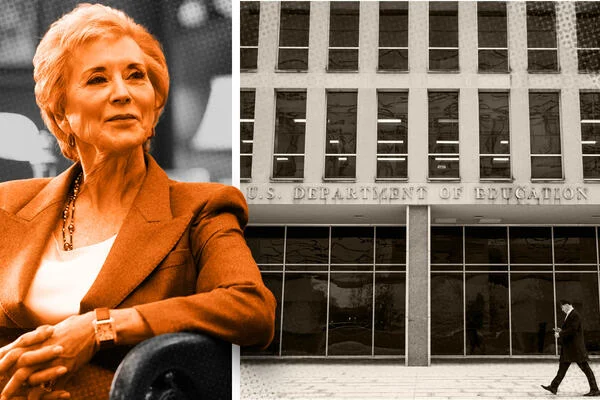
The Education Department said late last year that the grant program, which has funded student success initiatives, would support projects related to accreditation reform, civil discourse, artificial intelligence and workforce training.
Photo illustration by Justin Morrison/Inside Higher Ed | Anna Moneymaker/Getty Images | Pete Kiehart for The Washington Post via Getty Images
More than 70 colleges, universities, nonprofits and other organizations are sharing $169 million to advance a number of the Trump administration’s priorities.
Those include accreditation reform, promoting civil discourse, short-term workforce training programs and advancing the use of artificial intelligence in higher education. The Education Department announced the grant competition in November and said Monday that it had awarded the funds, which have historically gone to programs that support student success.
Colleges received funding to switch accreditors, start short-term programs that will be eligible for the new Workforce Pell program, hold workshops on constructive dialogue and support peer-to-peer engagement in civil dialogue.
Just over $50 million apiece went to the AI, civil discourse and Workforce Pell priorities, while projects related to accreditation received nearly $15 million, according to an Inside Higher Ed analysis of department data. All the grants in this tranche are for four years.
Two new accreditors planning to seek federal recognition—the Postsecondary Commission and the Commission for Public Higher Education Inc.—each received $1 million. The department also awarded $1 million to the University of Rochester for its plans to establish an accreditor focused on higher education certificate programs that serve students with intellectual disabilities, and another $1 million to Valley Forge Military College, which wants to create a new hybrid accrediting agency for military-aligned associate and certificate programs. (Valley Forge Military College is one of several institutions that have indicated interest in the Trump administration’s compact for higher education.)
Meanwhile, Davidson College’s Institute for Public Good is getting nearly $4 million to create the Deliberative Citizenship Network across 100 colleges and universities, according to a news release. Among other goals, the network aims to train faculty and staff on how to facilitate forums on difficult topics and create teaching resources that can be widely shared.
“With this funding, we will reach thousands of students and educators nationwide,” Chris Marsicano, executive director of the institute, said in a statement. “Davidson’s Institute for Public Good will serve as a national hub that connects research, teaching and public engagement around respectful inclusion across political viewpoints—no matter how unpopular on campus—as well as participating in community efforts to examine, talk through and solve big problems.”
The department’s initial announcement about the awards didn’t provide specific information about the funded projects, but the agency briefly posteddocuments Monday afternoon outlining which institutions received awards and for how much. Inside Higher Ed captured some of that information before the documents were taken down and compiled the details into a searchable database below. A department spokesperson said the final documents should be posted next week.
In the meantime, Inside Higher Ed reached out to the identified institutions for more information about how they plan to use the grant funding. The database will be updated as they respond.
The grant money comes from the Fund for Improvement of Postsecondary Education, which has historically supported programs related to student success. Those include the Basic Needs, Veteran Student Success and Postsecondary Student Success programs. But in November, the Education Department announced plans to send the funds to a different special projects program—a move that Democrats and advocates criticized. Department officials say this round of funding, for which they “received a historic number of applications,” will help to support students through their academic journeys.
“This historic investment will realign workforce programs with the labor market, break up the accreditation cartel and support institutions who want to change accreditors, and strengthen responsible use of AI in the classroom,” said Ellen Keast, a department spokesperson, in a statement. “These investments will open new, affordable higher education alternatives to American families, and we are very excited to see federal dollars driving change in the sector that is long overdue.”
Some critics have raised concerns about the truncated grant-review process. Typically, the FIPSE grant competition opens in the spring and awards go out by Dec. 31, one former department official said. They also question who will administer the program moving forward. Like other higher ed grant programs, FIPSE is slated to move to the Labor Department under agreements announced late last year.
One might expect to hear such exclamations from exultant college students, relieved or ready to rejoice upon polishing off their latest essay assignment. Instead, these are the words I hear with increasing frequency from fellow professors who have come to think that the out-of-class essay itself is now done. It’s an antiquated assignment, some say. An outmoded form of pedagogy. A forlorn fossil of the Writing Age, a new coinage that seems all too ready to consign writing instruction to extinction.
As a new director of my college’s faculty development office, I’m privy to ongoing conversations about the teaching of writing, many of which are marked by frustration, perplexity and pessimism. “I don’t want to read a machine’s writing,” one professor laments. “I don’t want to police student essay writing for AI use,” another asserts.
Kevin Roose, a tech writer for The New York Times, who recently visited my campus, has suggested that the take-home essay is obsolete, asking, “Why would you assign a take-home exam, or an essay on Jane Eyre, if everyone in class—except, perhaps, the most strait-laced rule followers—will use A.I. to finish it?”
Whether this situation is entirely new is arguable. For decades, we’ve had online resources that might make independent student reading unnecessary, yet we haven’t stopped assigning out-of-class reading. If I assign a rigorous novel like Charles Dickens’s Bleak House, I’ve long known that students can access an assortment of chapter summaries online—CliffsNotes, SparkNotes, LitCharts and others, all of which might make unnecessary the intellectual work of deciphering Dickens’s 19th-century sentences or wading into the deep waters of his sometimes murky prose. Maybe, as a recent New York Times piece about Harvard University students not doing their reading suggests, students aren’t doing that kind of homework, either.
Still, being able to create sentences, paragraphs, essays and research papers with a single prompt—or now, having “agentic AI” engineer an entire research process in a matter of minutes—seems different from googling the plot summary for the first chapter of Bleak House.
Maybe writing via LLMs is different because it’s not just about summarizing someone’s else’s idea; it’s about asking a machine to take the glimmer of one’s own half-hatched idea and turn it into a flawless, finished product. Somehow that process seems a little more magical, like being able to create a novel or a dissertation with a Bewitched-like twitch of the nose.
Further, the problems with out-of-class writing are different from those linked to out-of-class reading because of how embedded AI has become within the most basic writing tools—from Microsoft’s Copilot to Grammarly. With tools that blur the boundaries between the student and their “copilot,” students will increasingly have difficulty discerning what’s them and what’s the machine—to the chagrin of those who do want to develop autonomous intellectual skills. As high school senior Ashanty Rosario complained in an essay in The Atlantic about how AI is “demolishing my education,” AI tools have become “inescapable” and inescapably seductive, with shortcuts to learning becoming “normalized.”
In this world of ubiquitous AI shortcuts, how do we encourage students to take the scenic route? How do we help them see, as John Warner reminds us in More Than Words: How To Think About Writing in the Age of AI (Basic Books, 2025), that writing is an act of embodied thinking and a tool for forging human community, linking one human being to another? How do we encourage them, to use the language of Chad Hanson, to see their written assignments as “investments, not just in the creation of something to turn in on a deadline, but rather, investments in your humanity”? In an Inside Higher Ed essay, Hanson describes how he tells students, “When you give yourself time to use your faculties, you end up changing the dimensions of your mind.”
But there’s the rub. Writing takes time. Teaching writing takes time. The practice of writing takes even more time. If there is still value in the time invested in developing human writing skills, where is the time to be found within the constraints of traditional writing courses? Writing practice used to take place primarily at home, on student PCs and notepads, over hours, days and weeks. Now that student writing is being chronically offloaded to a magical deus ex machina, Roose asks why teachers wouldn’t simply “switch to proctored exams, blue-book essays, and in-class group work”?
As a writing professor, my answer is: There isn’t time.
Shifting writing practice from a largely out-of-class endeavor to an in-class one doesn’t provide students with the time needed to develop writerly skills or to use writing as a mode of deep thinking. Nor does it allow for both instruction and sufficient hands-on practice. At my college, courses typically run either three days per week for a short 50 minutes per class or two days per week for 80 minutes. Even in a “pure” writing course, such time periods don’t allow for students to have the sustained practice they would need to develop skill as writers. The problem is even worse in writing-intensive courses for which a significant amount of class time is needed for discussing literary history, philosophy, political theory, religion, art history or sundry other topics.
The solution I propose is to invest more rather than less in writing instruction: Just as we require labs for science lecture courses, we should provide required “writing labs” as adjuncts to writing classes. Here I don’t mean a writing lab in the sense of a writing center where students can opt to go for peer assistance. By writing lab, I mean a multihour, credit-bearing, required time during which students practice writing on a weekly basis under the supervision of the course’s instructor or another experienced writing teacher. Such labs would be time in which students develop their autonomous critical thinking skills, tackling assignments from conception to completion, “cloister[ed]” away, as Niall Ferguson puts it, from dependency on AI machines. And if writing “lab” sounds unduly scientific for the teaching of a human art, call it a weekly workshop or practicum. (Yet, even the word “laboratory” derives, via medieval Latin, from laborare, which simply means “to work or labor.”) Whatever the name, the need is real: Writing cannot be taught without student labor.
The problem I am addressing is a critical one, with too few alarms being sounded in higher education circles, despite the plethora of articles about education and AI. Even as colleges tout writing skill as a major outcome of college education, I fear that writing education may quickly fall between the cracks, with out-of-class writing being abandoned out of frustration or despair and insufficient in-class time available for the deep learning writing requires. Quiet quitting, let’s call it, of a long-standing writing pedagogy.
If colleges still wish to claim writing skill as an important learning outcome, they need to become more deliberate about what it means to educate student writers in the age of AI. Toward that end, colleges must first reassert the importance of learning to write and articulate its abiding value as a human endeavor. Second, colleges must devote professional development resources to prepare faculty to teach writing in the age of AI. And finally—here’s the pith of my argument—colleges need to restructure traditional models of writing instruction so that students have ample time to practice writing in the classroom, with a community of human peers and under the supervision of a writing guide. Only in, with and under those circumstances will students be able to rediscover writing as a true labor of love.
Carla Arnell is associate dean of the faculty, director of the Office of Faculty Development and professor of English at Lake Forest College.
The last month of 2025 brought more campus job cuts, capping off a tumultuous year for higher education.
While December yielded roughly 300 reported job cuts across the sector, that total reflects only a fraction of the jobs lost in higher education in 2025. Inside Higher Ed tracked more than 9,000 job cuts and buyouts last year—which is undoubtedly an undercount due to unreported personnel actions.
Rising operating costs and an uncertain federal policy environment drove cuts at even the wealthiest institutions last year as universities with multibillion-dollar endowments shed hundreds of jobs after President Donald Trump restricted federal research funds, sought to limit international student enrollment and clashed with multiple universities over alleged civil rights infractions. While many of December’s job cuts were not attributable to Trump, others seemed directly connected, including the loss of hundreds of international students at DePaul University, which undercut tuition revenues, prompting layoffs.
Here’s a look at layoffs, buyouts and program cuts announced in December.
DePaul University
The private Catholic university in Chicago cut 114 staff jobs last month, officials announced.
“These decisions were extraordinarily difficult and leaders across the university did not make them lightly. Each person affected contributed to the life of this university in meaningful ways,” officials wrote in a Dec. 15 message announcing the layoffs and assistance for employees, which included severance packages based on years of service, career counseling and more.
Staffing reductions at DePaul are part of a broader effort to reduce spending by $27.4 million as the university grapples with a budget deficit and aims to achieve a 2.5 percent operating margin. DePaul has also been hit with a staggering loss of international students amid the Trump administration’s crackdown on immigration, which has made it harder for some foreign nationals to obtain visas and deterred others. International enrollment at DePaul plunged by 755 students compared to the previous fall, a decline of nearly 62 percent, officials said in September.
University of Nebraska–Lincoln
Regents voted last month to close four programs at the flagship campus following months of consternation over the plan, which will see dozens of faculty positions eliminated.
Programs approved for closure are statistics, earth and atmospheric sciences, educational administration and textiles, merchandising and fashion design. The plan includes cutting 51 jobs, mostly from the faculty ranks, The Nebraska Examiner reported.
Program closures and job cuts are expected to save the university almost $7 million.
The December vote ended a bitter fight over the program cuts that prompted a faculty no-confidence vote in Chancellor Rodney Bennett. Faculty members have questioned the evaluation process and the timeline for the cuts; they also conducted their own financial assessment, which pushed back on the need for instructional cuts amid growing administrative expenses.
Bennett, who championed the program cuts, announced Monday that he plans to resign by Jan. 12. His sudden resignation ends an almost three-year stint as head of the flagship.
Martin University
Indiana’s only predominantly Black institution terminated all employees last month, a sign that points to an almost certain closure, though the Board of Trustees has not yet made it official. The move came shortly after the private university announced it would “pause” operations.
While the number of jobs lost is unclear, Martin—where enrollment has hovered around 200 students in recent years—employed 42 staff and faculty members in fall 2023, according to federal data.
Interim president Felicia Brokaw reportedly told employees the university was laying them off because it could not afford to pay them, according to an audio recording obtained by Mirror Indy. Brokaw also told staff she did not know when they would be paid for work already performed.
Martin officials have encouraged students to transfer elsewhere.
Western Wyoming Community College
Citing a need to balance its budget and avoid dipping into reserves, the community college in Rock Springs axed 33 jobs and reorganized 30 others, The Rocket Miner reported.
Last month’s cuts included eight full-time faculty jobs.
The newspaper reported that more layoffs could be on the horizon depending on what happens in the coming legislative session. State lawmakers are reportedly weighing a plan to cut property taxes by 25 percent (following a similar move last year), which would have a major effect on WWCC, given that its budget heavily relies on state appropriations and local property taxes.
University of Kansas
Nearly three dozen faculty members have opted to take buyouts offered by the public research university.
In all, 34 tenured faculty members applied to participate in an early-retirement incentive program at KU, The Lawrence Journal-World reported. University officials announced the launch of the early-retirement program in October, citing budget challenges. KU is currently seeking $32 million in cost reductions by July 1, when the next fiscal year begins.
Christian Brothers University
The private Catholic university in Memphis, Tenn., is cutting 16 faculty jobs, a move Interim President Chris Englert said was “designed to balance our operating budget and position CBU for transformation as we work to meet the needs of today’s students and today’s workforce.”
The Oklahoma Board of Regents for Higher Education voted to eliminate 41 degree programs and suspend 21 others across the state system due to underenrollment, NPR affiliate KOSU reported.
The flagship was hit the hardest, with 14 programs eliminated. No other state institution had more than three degree programs cut. Of the 14 at OU, eight were at the undergraduate level and six were graduate degrees. Cuts at OU include a mix of language programs—such as Arabic, Chinese, French and German—alongside geography, plant biology and others.
New Jersey City University
As part of a planned merger with nearby Kean University, the public institution is shedding nine degree programs alongside multiple minors and certifications, The Jersey City Times reported.
Undergraduate programs to be discontinued at NJCU are business information systems, chemistry, philosophy, women’s and gender studies, and a music performance degree. Graduate programs on the chopping block are business information systems, criminal justice, educational psychology and a music performance degree. An internal memo obtained by the newspaper noted that many programs have similar offerings at Kean that will continue unabated.
College of Idaho
The liberal arts college in Caldwell is cutting three majors but adding six new programs, a change that will see 10 employees laid off, including five professors, Idaho Ed News reported.
College officials said the eliminated majors—theater, communication arts and philosophy—were all underenrolled. New programs to be added are biochemistry, finance and criminology, at the undergraduate level, plus master’s degrees in data analytics, exercise science and accountancy.
Boston University
Facing a $30 million budget gap driven by low graduate enrollment numbers and other factors, the private university is offering buyouts to eligible faculty members, The Boston Globe reported.
Buyouts mark the latest effort by the research university to constrain costs. In early 2025, officials announced BU was laying off 120 workers and closing 120 vacant positions.
San Francisco State University
The public university is rolling out an early-retirement program to help close a budget deficit, Golden Gate Express reported.
SFSU officials announced the buyout program last month and reportedly expect between 60 and 75 faculty members to sign on. However, professors in some departments are not eligible, an exclusion officials told the news outlet was partly due to the need “to maintain business continuity.”