New research from Wake Forest University shows that boosting a student’s sense of belonging in college can significantly increase their likelihood of earning a degree.
The findings draw on nationally representative survey data from more than 21,000 undergraduates enrolled in two- and four-year colleges across the country.
The survey measured belonging by asking students to rate their agreement with the statement “I feel that I am a part of [school]” on a five-point scale, where 1 means strongly disagree and 5 means strongly agree.
Students who rated their sense of belonging in their second year one step higher on the five-point scale than they did in their first year—such as moving from neutral to agree—were 3.4 percentage points more likely to graduate within four years.
That pattern held over time: Each one-step increase in a student’s reported sense of belonging was linked to a 2.7-percentage-point higher likelihood of earning a degree within six years.
“What stood out to me was just how consistent the findings were,” said Shannon Brady, a Wake Forest University psychology professor and the study’s author. “We’re seeing this relationship hold across different kinds of students and institutions.”
Students in the study began college during the 2011–12 academic year, and their graduation outcomes were measured four and six years later. That’s the most recent nationally representative data available, Brady explained.
She said the findings send a clear message that fostering a sense of belonging is vital on campus, and that its impact on persistence and graduation rivals the effect of thousands of dollars in additional financial aid.
“One of the things that’s nice about belonging is that it doesn’t have to cost a lot,” Brady said, adding that intentional support—such as structuring first-year seminars or addressing hurdles in registering for classes—can make a meaningful difference in creating a sense of belonging with relatively few resources.
“It takes attention, and it takes people doing the work to make it happen,” she said.
The findings: The study identified two statistically significant differences in how belonging related to graduation outcomes for specific student groups.
The link between belonging and four-year graduation rates was stronger for students whose parents had attended college than for first-generation students. The report suggests this gap may be due to first-generation students being more likely to “face structural and psychological challenges that may, at times, weaken the benefits of belonging.”
“These challenges can take many forms,” the report said, including limited guidance in navigating college systems, financial pressures that compete with academic engagement and systemic cultural mismatches between institutional and home environments.
Belonging also had a weaker connection to six-year graduation rates for Asian students compared to non-Asian students. The report attributes this, in part, to the fact that Asian students are more likely to have “alternative supports that promote academic persistence.”
Those supports can include family expectations that emphasize educational achievement, peer networks with strong academic norms and cultural orientations that prioritize sustained effort over socio-emotional connection to an institution.
The authors caution that the broad “Asian” category includes considerable diversity across countries and regions of origin, generation status, and socioeconomic background; such diversity shapes both students’ access to support and their experiences of belonging and credential attainment.
The implications: Brady pointed to the City University of New York’s Accelerated Study in Associate Programs as a “fantastic” model for fostering student belonging.
The ASAP program works to remove everyday barriers, such as transportation costs, complicated scheduling and limited advising, and has been shown to improve graduation rates while also helping students feel connected to their campus.
“If you can’t get the classes you need, it’s hard to feel connected to school,” Brady said. “And if transportation is complicated—if you’re dependent on buses or rides from friends because you can’t afford a bus pass—it’s hard to build the relationships you want.”
Beyond individual programs, Brady recommended institutions adopt a standardized measure of student belonging across campuses.
“Almost no cross-institution conversation happens on this because the measures that schools are using are different,” she said. “You can’t aggregate knowledge as well as we might if we had a more standardized measure.”
Ultimately, Brady said, colleges have a responsibility to create environments where students feel they belong.
“I don’t want to suggest that belonging is always inherently a good thing, but we want to create institutions where it is reasonable and positive to build a connection to them,” she said.
Get more content like this directly to your inbox. Subscribe here.
Education Secretary Linda McMahon told a conservative news outlet she wants to focus less on higher ed this year. The comment comes after the Trump administration’s yearlong use of multiple federal departments to pressure universities and their employees and students to conform to the White House’s desires.
McMahon discussed her 2026 priorities in an interview with Breitbart before Christmas. As the outlet put it, “McMahon said the new year is a chance to shift a little bit away from higher education and focus on elementary and secondary.” (Education Department spokespeople didn’t respond Monday to Inside Higher Ed’s requests for further information on what she meant.)
On social media, McMahon posted, “In 2026 we will empower parents, strengthen families, and end Washington’s grip on education by returning it to the states.” She also shared a video touting what she sees as the administration’s many wins. Those included cutting deals with several universities to restore funding the administration froze, changes to the federal student aid application and steps toward dismantling the Education Department.
She told Breitbart her top three priorities will be literacy, noting poor scores on a national K–12 test; school choice, which usually refers to providing public money for parents to send their children to K–12 charter or private schools or to homeschool them; and “returning education to the states.”
Regarding that last priority, McMahon told the outlet, “That’s what we’re really going to be working on, and that falls in line with the president’s directive to eventually totally move education to the states and to make sure that the bureaucracy of the Department of Education doesn’t exist in Washington anymore.”
It remains unclear what “returning education to the states” would look like, even if Congress agrees to sign off on the Trump administration’s push to close the Education Department. Other laws Congress has passed over the decades would still continue to require a significant federal role in education.
McMahon also touted what Breitbart called her “victories,” with the outlet writing that “one of her favorite accomplishments is the department’s Title IX work protecting women’s sports.” It wrote that McMahon “specifically pointed to an agreement reached with the University of Pennsylvania ordering awards to be taken” from transgender former swimmer Lia Thomas “and given to the [cisgender] female athletes who really deserved them.”
In April, the department’s Office for Civil Rights found that Penn violated Title IX by allowing a trans woman to compete on a women’s sports team—presumably referring to Thomas, who last competed on the swim team in 2022, in accord with NCAA policies at that time.
Q: Where do CTLs come into the AI higher ed story? What has been going on with AI at CELT and UK, and what are you seeing nationally?
A: For some, CTLs might not be the first space that comes to mind when crafting vision and strategy or enhancing knowledge and skill about AI. Yet, for my money, regardless of where you are, you’ll be hard-pressed to find people who are more embedded in the discourse about AI in education, who are more knowledgeable about it in multidimensional ways, who experiment with and use AI tools daily, and who are more expert in both the scholarship and day-to-day realities of education across the institution. Teaching center staff are polymaths; they are scholars, practitioners, educators and curious minds that, every day, have to inhabit a dizzying range of epistemic grounds.
In response to the question, I’d venture that CTLs come into the story about AI in higher education before ChatGPT altogether. For years, we’ve engaged in critical and scholarly approaches to technology beyond how-to and best practices towards larger inquiries about how digital tools, platforms and infrastructures affect our capacity to learn, grow, connect and act in the world. Those are the waters in which we swim. From that history, CTLs were able to engage generative AI with nuance from the outset.
At the University of Kentucky, CELT began hosting information sessions, focused workshops, discussion forums and even play sessions starting in the first week of 2023. We were the main central unit to do so at that time, and we quickly became the go-to, trusted hub for faculty, staff and graduate students to make sense of AI as it might impact their scholarly work, student learning and our overall purpose.
As we begin 2026, CELT continues to make AI a central part of our work. We’ve led 200 AI-related events for thousands of participants and are working with the second faculty cohort of our Teaching Innovation Institute to focus on AI. In partnership with our Center for Computational Sciences, we’ve hosted education tracks for regionalsummits and an NSF ACCESS regional workshop. We’ve produced resources such as an AI use scale, which has proven popular among instructors and will soon release a comprehensive starter course on AI literacy for faculty, academic staff and graduate students.
Our work has informed the university advisory group on AI. I co-chair this group, which maintains guidelines on AI in educational, research, clinical and professional contexts. Colleagues have indicated that it has been meaningful for CTL leadership to play a significant role in composing institution-level guidance and contributing to a “post-AI” vision for education, scholarship and service.
Nationally, I’ve seen some variety in how CTLs are engaging with AI, though many are pursuing a version of what I’ve outlined here. CTLs are remarkably diverse in size, specialties, org charts, cultures and goals. Across higher education, though, I see an opportunity to further capitalize on CTLs in light of recent developments around institution-level requirements, curricular integration, industry partnerships and infrastructure.
If the first step is recognizing that CTLs are effective partners in making sense of AI as a disruption, the next step is including CTLs in these larger initiatives for implementation as well as assessment. There is a good deal of discussion about how to convincingly assess the impact of AI on student learning, scholarly activity and institutional success. This involves questions that often are oversimplified or shortchanged. What is learning? Where and how does it happen and for whom? What counts as evidence? How do we know that our data means what we say it means? What are the relevant scholarly precedents? What do we need to know about AI? CTLs stand to add a great deal of integrity and insight to these projects.
Q: You make the case for CTLs being an indispensable resource as universities navigate the AI tsunami. And yet, across the country, CTL budgets, staffing and sometimes even existence are under attack. How can CTL leaders better position their centers for institutional resiliency?
A: CTLs rarely operate with large budgets outside salary lines, which is to say that we traditionally have strategized for impact with this reality in mind. I don’t mean to dismiss the precarity that some CTLs may be feeling, but I do think there are ways to show our value and build resiliency, especially in the context of AI and when additional resources may not be available.
Christopher Hakala and Kevin Gannon have offered some great advice on that front. For me, the first step is about aligning CTL work with institutional priorities. Obviously, teaching excellence and student learning are a stated priority for any institution, but there are different ways that those goals resonate locally. Especially if we notice a gap, CTLs are well positioned to jump in and address it. A big part of resiliency is being imagined as a solution when the community is faced with a challenge.
AI offers a great example of an institutional exigency in CELT’s case, and we’ve contributed proactively to other priorities such as our quality enhancement plan, our state’s graduate profile and digital accessibility. But we should also make sure to prioritize the academic units within our institution. I regularly collaborate with our colleges and departments. Those leaders and their colleagues often are the most persuasive agents for communicating our value.
Resiliency is also built through partnerships that lend the CTL’s expertise, imprimatur and labor. AI is precisely the kind of catalyst that normalizes these exchanges even if they’re not typical. Other units may be able to assist with travel funding for a joint project, for example. In some cases, a unit might fund an initiative so long as the CTL coordinates it; our SoTL community is a good example of this. Bandwidth permitting, CTL staff can participate on funded grants that generate income through labor costs.
Despite the persistent urgency to expand, resiliency also means not losing sight of core services. At CELT, midsemester student feedback has become so popular that I have to shut off our request form early in the semester. Along with support for faculty dossiers and teaching portfolios, this work makes a clear case for our impact on career advancement as well as capitalizing on local data for student success.
When bandwidth seems scarce, light-lift activities can still offer a high yield. Communities of practice, reading groups, teaching triangles, drop-in hours and other programming that leverages the CTL as a community center can raise visibility and value while leaving gas in the tank. Faculty partners or affiliates allow for more sustainable reach and programming while increasing buy-in.
All of this, though—alignment, initiative, partnerships, services, reach—rely on relationships and recognition that CTL leadership needs to cultivate and work daily to affirm. We are, fundamentally, a relational enterprise. Our resiliency lies in our relationships.
Q: What was the career journey that brought you into a CTL and institutional leadership role, and what advice do you have for early or midcareer academics who might want to follow a similar professional path?
A: Ironically, I never interacted with the CTL at my doctoral institution. I did, however, begin to work in instructional development through unique graduate assistantships that friends had held and encouraged me to pursue. It was also critical that I used teaching assignments as opportunities to experiment and explore broader issues in higher education. Those projects ultimately determined the direction of my graduate work as a whole.
As I looked beyond my program, I wanted that work to continue as a career. It meant moving away from the traditional faculty role I’d imagined toward a version of what Donna M. Bickford and Anne Mitchell Whisnant have described as the administrator-scholar. Of course, I discovered most of what I know about this sort of work and about higher education on the job. My goal—my backward design—was (and still is) to elevate scholarly teaching, meaningful learning and the significance of a college education.
To be clear, I don’t mean to imply any sort of self-made myth; I can’t stress enough how much my mentors and colleagues have enabled my career every step of the way. Like many paths, CTL work is collaborative by nature. It’s not a stage for solo acts.
I’m still learning a lot about leadership. I worked as an educational developer at my CTL before stepping into the associate director and, later, director and assistant provost roles. Looking back, I see some thematic coherence despite the usual noise of life. Those transitional moments typically involved acting upon an opportunity to make our projects, organization or people more successful at a particular inflection point of pressure or change. I’ve also prioritized becoming as familiar as possible with the full complexity of the university and its communities well beyond the immediate operations of the CTL.
For the curious, I’d recommend getting to know your local CTL if you haven’t already. Attend their events, participate in a program or just set up a time to learn more about the center. Whether you’re in a staff or faculty role, you might discover an opportunity to support or collaborate with the CTL, even in just small ways. I’d also recommend getting to know what it’s like to teach in different disciplines and under different conditions than you normally experience. Getting to know the landscape of CTLs and higher education more broadly helps significantly with clarifying your why as well as what you’d want to see in a new position.
There are some helpful organizations and resources to get a sense of educational development as a field of work. This is especially helpful if a CTL is not easily accessible. The POD Network is a good place to start, though there are other organizations as well as surveys of the field. If you’re a podcast listener, there’s never been a better time for higher education podcasts: Teaching in Higher Ed, Tea for Teaching, Intentional Teaching, Centering Centers and so on. Becoming conversant about the work and the issues is at least half of the journey.
Keep in mind that there are many career paths in educational development: some with CTLs, some with other kinds of administrative offices and some outside higher education altogether in both public and private sectors. Depending on your interests and skills, you can go into a variety of meaningful roles.
It has been just over four months since I last wrote for my “Resident Scholar” column. There are two explanations for this. First, I am on a magnificent, hard-earned sabbatical that I delayed multiple times. My last one was 12 years ago. I have protected this sacred time for reflection and renewal.
Second, the political intensity of 2025 necessitated a break. I am not usually a break-taking kinda guy, but 2025 most certainly was not a usual year. It was disorienting, stressful, devastating and overwhelming. Consequently, I decided to take a much-needed break.
In 2024, the Inside Higher Ed editors and I chose to name my column “Resident Scholar” because I proudly live among the people—meaning, I try my hardest to not be an out-of-touch, ivory tower academician. I aim to write about realities that are relevant, timely and at times taboo. I know the enormous challenges that confront presidents, provosts, student affairs vice presidents, chief diversity officers, academic deans and other higher education leaders, because I talk with several of them every week.
I know what is happening on campuses because I spend time on dozens beyond my own year after year. I talk to students to hear and understand their experiences, expectations and appraisals. It feels like I live among policymakers because I often hear their considerations firsthand. Parents and family members of Black prospective and current students tell me what is on their minds. I do not have to guess what is happening at historically Black colleges and universities because informants on those campuses let me know.
The people told me that 2025 was disorienting, stressful, devastating and overwhelming for them. Consequently, to the greatest possible extent, many of them chose to take breaks.
At first, I did not think that doing so was an option for me. The vicious attacks on U.S. higher education and the dismantling of diversity, equity and inclusion efforts across all industries (including ours) demanded a fight-like-hell response, I thought.
I launched the National DEI Defense Coalition. Also, I dropped everything last spring to travel the country to interview students, faculty and staff for a forthcoming documentary film about the impact of the elimination of DEI programs and positions. I testified twice to Congress last summer; one hearing was specifically about DEI in higher education. I felt then and continue to feel a strong sense of urgency.
But many colleagues with whom I reside at the University of Southern California and elsewhere throughout American higher education modeled something different. Specifically, they showed me how taking breaks is essential to self-care. This break has afforded me space and opportunities to breathe, grieve, process, connect with affected others, consider conservative viewpoints, strategize and reflect on why higher education and our democracy were so easily disrupted in 2025 and the years leading up to it.
It allowed me to reside with my people and do what many of them wisely elected for themselves: pause, take a break. I now feel ready to resume the fight for our democracy, while savoring the seven months that remain in my sabbatical. I acknowledge that elective break-taking is not a privilege that is available to everyone in U.S. higher education.
I genuinely appreciate this “Resident Scholar” platform, mostly because it is an outlet that enables me to represent and weigh in on topics that are on the hearts and minds of actual people on the actual campuses at which I do research and climate assessments, strategy advising, keynote addresses, professional learning activities, and consultations. Those places and the people who live, learn and work at them gave me permission to take a much-needed break in the final months of 2025. I am grateful for this and ready to resume my important role as our field’s resident scholar in 2026 and beyond.
Shaun Harper is University Professor and Provost Professor of Education, Business and Public Policy at the University of Southern California, where he holds the Clifford and Betty Allen Chair in Urban Leadership. His most recent book is titled Let’s Talk About DEI: Productive Disagreements About America’s Most Polarizing Topics.
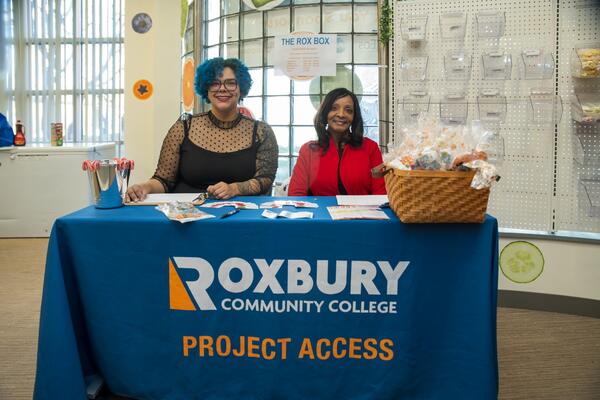
With rising food costs and uncertain federal food-assistance benefits wreaking havoc on families nationwide, Alicia Wright has found relief in an unlikely place: her community college’s food pantry.
Wright, a student at Roxbury Community College, said her campus food pantry has been lifesaving, especially as she juggles classes while raising her 6-year-old daughter, Olivia.
“I was like, ‘Oh snap—I don’t have to trek around Boston to find food from other local pantries,’” said Wright, a theater major who is scheduled to graduate in 2027. “Having it right there really changed the game for me.”
Wright is one of more than 1,500 students who have relied on the pantry, better known as the Rox Box, since its launch in October 2023, according to Nancy Santos, RCC’s Project Access director.
Roxbury Community College students shop for food and personal care essentials at the Rox Box.
Roxbury Community College
Designed to mirror a neighborhood grocery store, the pantry carries items such as food, diapers and personal care essentials and is funded entirely by the community.
“If I find myself going to class thinking about how I didn’t go grocery shopping this weekend, I know I can pick up something from the Rox Box,” Wright said, adding that students receive 30 points each month to redeem for items they need.
“That lets me be more present in class … [and] really does allow peace of mind,” Wright said.
Like Wright, nearly 60 percent of college students nationwide have experienced at least one form of basic needs insecurity in the past year, according to a recent Hope Center survey.
According to Swipe Out Hunger, a nonprofit dedicated to ending college student hunger, student visits to campus food pantries have increased by 30 to 50 percent over the past year across its more than 900 campus partners nationwide.
Origin story: The Rox Box started as an extension of Project Access, an initiative designed to address the nonacademic issues that can prevent degree completion at the Boston-area college.
Santos said the Rox Box has met a strong need, serving more than 300 students each month.
“It’s really taken off,” Santos said. “We see the athletes and everyone walking around with their little bags that say ‘Rox Box,’ and they’re proud that they’re going.”
Roxbury Community College Project Access director Nancy Santos (right) sitting with a student worker at the Rox Box.
Roxbury Community College
She noted that demand continues to rise, with more than 1,700 visits from over 1,500 students between September and December 2025.
“We know the need is out there, because 1,700 visits on our campus is a large number when we only have 2,400 students enrolled,” Santos said, noting that RCC’s student body is predominantly Black, Latino and Pell Grant eligible.
Santos said she regularly surveys students who rely on the Rox Box and has found that nearly 40 percent worry their food won’t stretch until the next time they can afford to buy more, while nearly 30 percent have changed their eating habits to make the provisions last longer.
She underscored how the federal government shutdown last fall contributed to growing “uneasiness” and “insecurity” around RCC students’ food needs.
This comes as nearly 40 percent of public college students in Massachusetts experienced food insecurity last year.
“The numbers are alarming to us,” Santos said. “Our faculty have even shared that they can sometimes see students are distracted or they don’t come to school if they’re hungry … [and] it really does affect their grades.”
To ensure the Rox Box runs smoothly, Santos said, they hired a coordinator who is an RCC alum and had previously relied on the pantry.
“She started as a work-study, so she worked in the pantry with us, and when she graduated we hired her back,” Santos said. “In doing so, the students identify with her and they see there’s a path. They see where they are isn’t where they’ll always be.”
Santos said the pantry helps students feel supported and actively works to reduce the shame around needing help.
“I often say that the shame is not that you are food insecure, the shame is that [food insecurity] exists,” Santos said. “Don’t pretend it isn’t happening. Address it and embrace it and let’s figure out a way to wipe it out.”
What’s next: Santos said starting a campus food pantry is a “big undertaking” but worthwhile for other institutions looking to create their own.
“We are a small college, but we care for our students,” Santos said. “When students are fed and when they’re able to concentrate and really study, it helps them go across the finish line.”
Wright agreed, adding that actively listening to students’ needs and implementing those changes really fosters a sense of trust and community.
“We tell them our views and what we need and everything, and then we see things being done about it,” Wright said. “It really allows us to feel seen, heard and supported.”
Ultimately, Wright said, RCC really gets it right about seeing students “holistically.”
“We’re not just students—we’re entrepreneurs, we’re parents, we’re our parents’ caregivers,” Wright said. “A lot of us are already full-grown people who have lived life and know how to survive, [but] we just need a bit more support that shows [the college is] here for your success.”
Want to help students battling food insecurity? You can support The Rox Box here.
Get more content like this directly to your inbox. Subscribe here.
As we enter the new year, I want to share some thoughts about what higher education needs to accomplish as a sector in 2026. I view these as resolutions: tough challenges we need to tackle with courage and determination. Are you ready?
Fix Accreditation
I have participated in accreditation as a college president, a law school faculty member and as a board member of the NWCCU, the Northwest’s regional accreditor, and so I say this from experience: Our accreditation system is horrible. It wastes massive amounts of time and accomplishes almost nothing to guarantee students a good education. We need to scrap it and start over. Instead of multiyear cycles, we should review schools every five years, in a process that takes no more than six months. It should focus on just three things: student outcomes, responsible financial management and academic freedom. Schools that do not meet strong, clear, objective standards in these areas should be placed on probation and, ultimately, decertified if they fail to improve. We have to stop rubber-stamping failure.
Discuss Creating a True National Higher Ed System
If I use the phrase “American higher education system” with colleagues from Europe and Asia, they laugh. “System? You don’t have a system! You have a giant collection of unregulated institutions that perform very inconsistently, many of them for-profit scams.”
There is so much truth in this reaction. The venerable Higher Education Act of 1965 no long meets our national needs. We need to start a rational discussion about reform of the higher education regulatory landscape. We need a smaller number of higher-performing universities, we need to eliminate institutions with poor outcomes that provide limited or no real return on investment, we need to provide truly affordable undergraduate programs in every state, we need to cut regulations and legal rules that drive up the cost of compliance, and we need to limit student debt. This is not the year for reform—Congress is a divided mess. But we need to start discussing the future.
Focus on Community Colleges
The foundation of American higher education is the part of the sector we talk about least: our community colleges. Community college is the best place to provide four vital services our students and our country desperately need: remedial education to make up for poor K–12 schools, valuable job training in skills and trades to help students prepare for the workplace, ESL classes to help nonnative English speakers thrive, and low-cost general education to help students determine whether they want to proceed to a four year degree.
Community college quality is inconsistent across the United States: excellent in some states, poor in others. As a result, there is no one-size-fits-all set of reforms we need to enact. Every state government needs to have a serious, honest conversation led by the governor on how to strengthen and improve this vital sector.
College costs too much. Instead of pretending this is not true, we need to develop new low-cost, high-quality models. We cannot rely on new institutions to do this: The entry costs and accreditation barriers are too high.
Here’s a place to start.
The eight (relatively wealthy) Ivy League universities should jointly create Ivy College, a low-cost undergraduate lab school in a place they currently don’t serve, like Los Angeles. They should cut everything ancillary to great undergraduate education that drives up costs. That means no research, no sports and recreation, no subsidized activities, no alumni association, no communications department, no health and counseling, no permanent campus (just rented office space). They should reduce the number of majors and the number of electives. Simplify admission, with a lottery for every student scoring 1100 or above on the SAT. Get federal regulatory waivers for compliance cost drivers.
If we tried this for four years, we would learn so much! Then, the Big Ten schools should follow suit.
Advertise on Television
A recent Pew poll found that 70 percent of Americans think higher education is headed in the wrong direction. How do we improve public trust in higher education? Reform will help, yes, but we also need a more effective approach to public relations. When other industries run into trouble, they don’t rely on heartfelt op-eds and books published by university presses to make their case. They launch proactive television and a social media ad campaigns.
ACE should enlist the top 100 universities to bankroll ads that explain the ROI of higher education and the value of university research to national security, health and the economy. Trusted figures should explain why college matters. Celebrities should explain why they benefited from college. And we should remind people that American research universities helped win the Second World War.
John Kroger served as president of Reed College, attorney general of Oregon, chief learning officer of the U.S. Navy and a visiting faculty member at Harvard and Yale Universities and Lewis and Clark College.
Lowering college costs, boosting accountability and reforming accreditation will likely be at the top of congressional Republicans’ to-do list for 2026. But as public approval ratings for President Trump continue to decline and midterm elections loom, higher education policy experts across the political spectrum say congressional conservatives could be running out of time.
The push for more affordable higher education has been gaining momentum for years, and while it was a common refrain at the committee level in 2025, complex and sweeping debates over tax dollars soaked up much of lawmakers’ attention.
First, the Republicans passed their signature piece of legislation, the One Big Beautiful Bill Act, which cut taxes for wealthy individuals, increased them for elite universities and overhauled the student loan system. Then, they turned their attention to disagreements on the federal budget—an impasse that led to the record 43-day government shutdown.
But in the few cases where members of the GOP did get to home in on college cost issues, whether via legislation or hearings, an underlying theme emerged—holding colleges accountable for their students’ return on investment.
Higher education experts have no doubt that concern will continue in 2026, but Congress won’t have the time or the oxygen needed to nail down real changes unless they figure out how to fund the government, which runs out of money again Jan. 31.
“The Republican majority is very conscious that it may be on the clock, and this would argue for trying to move rapidly and get things done,” said Rick Hess, a senior fellow and director of education policy studies at the American Enterprise Institute, a right-leaning think tank. “But with the narrow and fractious House majority, the way the budget is going to chew up time going into January and the pressure on the Senate to get judges confirmed, it’s just going to be a challenge for them to find much time to move further higher ed–related legislation.”
Legislative Actions
Republicans spent much of 2025 using their control of Congress and the White House to pass what many industry leaders have described as the largest overhaul to higher education policy in more than a decade—the One Big Beautiful Bill Act. And while policy experts were initially skeptical that this multi-issue package could pass given the complex, restrictive nature of a legislative process called reconciliation, the GOP found a way.
The final bill, signed into law July 4, served as a major win for the GOP, expanding federal aid for low-income students to include nontraditional short-term training programs, limiting loans for graduate students, consolidating the number of repayment plans and increasing taxes on wealthy colleges, among other provisions.
Conservative policy experts like Hess praised the overhaul as “a much-needed and positive set of changes.”
“There’s certainly more that can be done, but I think it moved us in a substantially better direction than we’ve been,” he added.
But aside from OBBBA, little legislation concerning colleges and universities advanced. Only one bill tracked by Inside Higher Ed, the Laken Riley Act, reached the president’s desk. That law gave state attorneys general increased power over visas that could affect some international students and scholars. Others, including the Protection of Women and Girls in Sports Act, a bill that forbids trans women from participating in women’s sports, and the DETERRENT Act, a bill designed to restrict foreign academic partnerships, made it out of the House in a matter of weeks but then got stuck in the Senate.
The story of 2025 in higher ed is a big, dramatic one, but it’s almost entirely one of executive branch activity.”
—Rick Hess, AEI
So when asked what congressional accomplishments stood out from 2025, progressive policy experts told Inside Higher Ed they didn’t see much. The things that did happen, they added, hurt students and institutions more than they helped.
“‘Accomplishments’ is not really the word I would use considering the challenges that higher education faced this year,” said Jared Bass, senior vice president of education at the Center for American Progress. “I don’t think that Congress actually met the moment for affordability or defending and preserving higher education.”
Instead, he said, legislators placed the burden of cost on the backs of students.
“The Republican argument is by cutting access to these loans they’ll actually drive down costs. But we’ll have to wait and see if that happens,” he explained. “But I would say it didn’t actually make college more affordable. It just made resources less available.”
Although the House Committee on Education and Workforce hosted a greater number of higher ed hearings, some of the more notable panels came from the Senate Health, Education, Labor and Pensions Committee.
“They actually wanted to put the ‘E’ back in HELP and focus on education issues,” said Emmanual Guillory, senior director of government relations at the American Council on Education, a leading higher ed lobbying group. “That wasn’t really the case under prior leadership. So that was good.”
Chairman Bill Cassidy, a Republican from Louisiana, right, and ranking member Sen. Bernie Sanders, Independent of Vermont, lead the Senate Health, Education, Labor and Pensions Committee.
Tom Williams/CQ–Roll Call Inc./Getty Images
Much of the shift in interest, Guillory added, was likely tied to new leadership. This was the first year that Sen. Bill Cassidy, a Louisiana Republican, held the gavel. In the last Congress, Cassidy had served as ranking member.
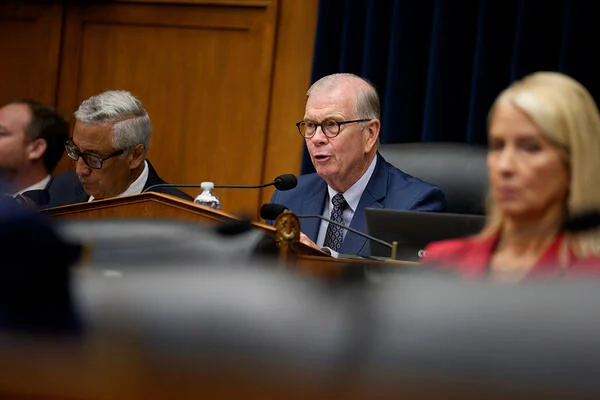
The House Committee on Education and Workforce also had new leadership, as Rep. Virginia Foxx of North Carolina handed the baton to Rep. Tim Walberg from Michigan. But it was the Senate’s tactics that led to more meaningful legislative progress in ACE’s view.
“Mr. Walberg may have pushed a slightly more aggressive agenda. The House definitely had more hearings in the higher ed space and tackled more hard-punching issues, but in the Senate they took a different approach,” Guillory said. “When it came to those difficult issues and conversations, the Senate chose to discuss those a bit more quietly and really work on solutions with stakeholder groups and ask, ‘How can we be influential with actual legislation?’”
Chairman Tim Walberg took over the House Education and Workforce Committee in 2025.
Andrew Harnik/Getty Images
When asked for their reflections on the year, Cassidy and Walberg pointed to OBBBA, which they touted as a historic reform to drive down college costs and limit students from taking on insurmountable debt. But while Walberg then looked back to the ongoing antisemitism discussions and concerns about “hostile learning environments,” Cassidy touted his legislation aimed at helping students better understand the cost of college.
“College is one of the largest financial investments many Americans make, but there is little information to ensure students make the right decision,” he said. “That is why I introduced the College Transparency Act to empower families with better information so they can decide which schools and programs of study are best suited to fit their unique needs and desired outcomes.”
Democrats Fight Back
Meanwhile, Democrats in both chambers said they were forced to spend much of their time and attention maintaining the Department of Education, an agency they say is needed to do much of the work to fulfill Republicans’ priorities, be it addressing antisemitism and other civil rights issues or driving down college costs.
From his early days on the campaign trail in 2024, Trump has promised to dismantle the department, and starting in March of 2025, he began doing so—all without congressional approval.
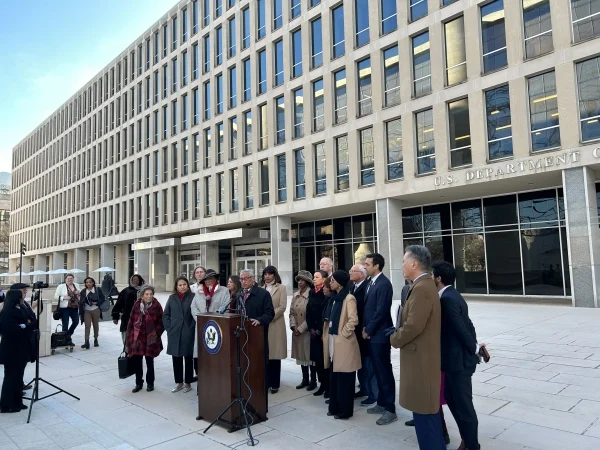
Through it all, the Democrats repeatedly decried his “attack” on higher ed. They used statements, town halls and demonstrations outside the department to draw attention to decisions they said would be “detrimental” to “students, teachers and educators.”
Lawmakers tried to access the Education Department in February but were denied entry.
Katherine Knott/Inside Higher Ed
Rep. Bobby Scott, a Virginia Democrat and ranking member of the House education committee, said he has spent much of his year in defense mode, pushing back against each of these actions.
“The administration has been dismantling the Department of Education, making access to education much less available,” he said. “And we’ve been trying to keep it together.”
But both Scott and Sen. Patty Murray, a Washington Democrat and former educator, acknowledged that as members of the minority, they can only do so much. A few Republicans have joined them in voicing concern about specific issues, but not enough, they say.
“We’ve had some successes—forcing some funding to be restored and rejecting, for example, President Trump’s push to slash Pell Grants by half in our draft funding bill for the coming year—but ultimately, we need a whole lot more bipartisan outrage and pushback from Republicans to truly start to undo the sweeping damage Trump has already caused,” Murray said.
And it wasn’t just Democrats who raised concerns.
“Congress has done very little to ask important questions, to ask the executive branch to justify some of the actions it is taking,” said Hess from AEI. “Hill Republicans are very much marching in lockstep to what the White House asks. The story of 2025 in higher ed is a big, dramatic one, but it’s almost entirely one of executive branch activity.”
What’s Ahead in 2026?
Now that congressional Republicans have completed a number of the tasks they set for themselves back in January 2025, most experts say two remaining items—college cost and accreditation reform—will be top priorities in 2026.
Most sources Inside Higher Ed spoke with anticipated that college cost reduction and transparency would be addressed first, largely because related bills made it out of a House committee in December and senators held a hearing on the topic. The bills, which would standardize financial aid offers and create a universal net price calculator, have already gained some significant bipartisan support.
Meanwhile, many remain skeptical of Republicans’ proposals for accreditation. Although no exact legislative language has been released, GOP lawmakers and Trump officials at the Department of Education have called for a major overhaul to not only ensure better student outcomes but also to deconstruct a what they see as a systemic liberal bias.
“I would hope to see a focus on accreditors taking an active role and not just sort of a check-the-box approach to quality assurance,” said Carolyn Fast, director of higher education policy at the Century Foundation, a left-leaning think tank. “What I’m concerned about is some of the efforts to reform accreditation don’t seem necessarily as concerned about making sure that the system is working in terms of their role as gatekeepers of federal funds … but more about political and cultural war issues.”
Bass from CAP said that he will be keeping a close eye on the midterm election campaign trail for a pulse on higher ed policy in general this year, as it gives the public a chance to speak up and direct change.
“I’m curious to see how conversations about affordability play out, not just for higher education or education over all, but just for the country,” he said. “There are going to be over 30 gubernatorial races next year, and the debate gets shaped over key issues like higher education, like college costs, like affordability. So it will be very interesting to see how both parties are going to show up.”
The autonomy of states in setting their own higher education policies creates a series of natural experiments across the United States, offering insights into what approaches work best in particular contexts. Given the importance of local considerations, there are few universal policy prescriptions that can be recommended with confidence. Sadly, this complexity was overlooked in Saul Geiser’s recent Inside Higher Ed essay entitled “Why the SAT Is a Poor Fit for Public Universities.”
My position is not that all, or even any, public universities should require standardized test scores. In fact, I share Geiser’s view that a university’s “mission shapes admission policy.” However, it is because of this principle that I contend that the SAT cannot be dismissed as a poor fit for public universities without considering how institutions operationalize their missions and define their institutional priorities.
Vertical Stratification Within a Public University System
In my view, Geiser’s argument is fundamentally flawed in his comparison of elite private institutions to public university systems, which often include an elite flagship campus alongside a broader range of institutions. Geiser’s comparison is particularly surprising given his long-standing association with the University of California system.
The California Master Plan for Higher Education has long been studied and celebrated for establishing a public postsecondary education system consisting of institutions with differentiated missions and admission processes. Under its original design, the community colleges provided open access to all high school graduates and adult learners, offering a stepping-stone to the four-year institutions. The California State University institutions admitted the top third of high school graduates, focusing on undergraduate education and teacher preparation. The University of California institutions were reserved for the top eighth of high school graduates and emphasized research and doctoral education.
By using high school class rank to sort students into the different tiers of the system, the Master Plan established a baseline for admissions to both UC and CSU institutions. This framework enabled the emergence of two elite public flagship campuses in Berkeley and Los Angeles that prioritized academic excellence alongside accessible undergraduate institutions in the CSU system that served as drivers of economic development and social mobility.
Reorienting the analysis to a comparison between elite public and private institutions would have provided a stronger basis for discussing selective admissions, as both of these institutional types receive far more applications than available spaces in their first-year cohorts. In these circumstances, institutions must make choices about how to differentiate among a pool of qualified applicants.
It is common to start with assessing an applicant’s academic achievement. In a competitive pool, this assessment is less about whether the applicant meets minimum academic standards of the university and more about how the applicant has achieved above and beyond other applicants to the same program or institution. In a competitive admission pool, academic excellence is often an important distinction, but it can be defined in different ways.
Assessing Academic Excellence
Many researchers agree that the use of both high school GPA and standardized test scores yields the most accurate assessment of academic potential, rather than relying on either measure alone. Geiser’s own research from 2002 shows that combining both high school GPA and test scores better predicted UC students’ first-year grades than just high school GPA alone. Therefore, I was surprised that he presented the use of GPAs and test scores in admission policies as mutually exclusive alternatives.
Although somewhat dated, a compelling finding from his 2002 analysis was that the combination of SAT Subject Test scores (discontinued in 2021) and high school GPA accounted for a greater proportion of variance in UC students’ first-year GPA than the combination of GPA and SAT scores. This finding suggests that precollege, discipline-specific achievement is important.
This should come as no surprise, as college curricula for artists, anthropologists and aeronautical engineers differ substantially. It is reasonable to expect that the predictors of success in these programs would also differ. As such, academic programs within universities may be well served by setting admission standards calibrated to the specific competencies of their respective disciplines—a portfolio for the artist, an academic paper for the anthropologist and a math exam for the engineer.
Although Geiser maintains that “academic standards haven’t slipped” at the UCs since they went test-free four years ago, a recent Academic Senate report from the University of California, San Diego, revealed that about one in eight first-year students this fall did not meet high school math standards on placement exams despite having strong high school math grades—a nearly 30-fold increase since 2020—and about one in 12 did not even meet middle school standards. This mismatch between GPAs and scores on course placement exams underscores critics’ concerns about inflation of high school GPAs and undermines the reliability of GPAs as a sole marker of academic achievement. The authors of the report called for an investigation of grading standards across California high schools and recommended the UC system re-examine its standardized testing requirements.
It is understandable that faculty in quantitative disciplines, such as engineering and finance, would want to better gauge the readiness of applicants for their programs by considering test scores, if only the results from the SAT or ACT math sections, in light of these findings. However, if one in 12 students are not meeting middle school math standards, then the greater concern is that these students, regardless of major, will require remediation, creating longer, more expensive and more difficult paths to graduation.
Variation in Standardized Testing Requirements Across States
I was surprised Geiser did not acknowledge this report, instead arguing that the reinstatement of standardized test requirements at Ivy League institutions “provided intellectual cover for the SAT’s possible revival” nationwide. This characterization overlooks the fact that some public institutions in at least 11 states—Alabama, Arkansas, Florida, Georgia, Indiana, Louisiana, Mississippi, Ohio, Tennessee, Texas and West Virginia —already require standardized test scores in admission, according to the College Board. Notably, Florida public universities never suspended their test requirements during the COVID pandemic when all of the Ivies did.
In some states, public institutions, including Southern Arkansas University, Fairmont State University in West Virginia and Alcorn State University, a historically Black institution in Mississippi, waive test requirements for students with higher GPAs. In practice, this approach prioritizes performance in the classroom but offers low-performing high school students a second chance to demonstrate their proficiency and potential.
These examples show how variations in admission practices across institutions enable public systems to pursue their missions and diverse sets of state goals that may not be possible for any single institution within their system. These systems can offer broad access to four-year programs while also upholding academic standards and pursuing academic excellence. Whether that means all, some or none of the institutions in a public system require the SAT or ACT depends on the goals and strategies of each of the states.
While most public institutions adopted test-optional admissions during the pandemic, California implemented a test-blind policy that prohibited the consideration of test scores. Based on my experience as an admission officer, I applaud this decision. Test-optional admission is an easy policy decision, but I have seen how test-optional policies can create two different admission processes, where test scores are essentially required for some groups of students and not for others. Test-optional policies muddy the waters, offering less transparency in an already complicated process. The UC and CSU systems avoided this mistake by establishing equal grounds for evaluating applicants, but this does not mean that other public institutions need to do the same.
Aligning Admissions With Mission
Public universities are facing numerous enrollment pressures. Shifting state and regional demographics continue to force admission leaders to adjust their recruitment strategies and admission policies. The growing prominence of artificial intelligence appears apt to redefine the academic experience and admission processes, but exactly when and how are unknown. Meanwhile, the expected increase in states’ financial obligations in relation to Medicaid is likely to increase reliance on tuition revenue, which will ultimately shape the budgets and enrollments of higher education institutions.
A uniform, one-size-fits-all approach to admissions policy, such as test-blind admissions for all public universities, does not respect the autonomy of states and institutions and does not serve the diversity of institutional contexts. Public universities should continue to tailor admissions policies to their specific needs, which may include variation across campuses within a public system or even among programs within the same institution. What matters most is that admission policies remain transparent, are applied consistently to all applicants within a program and closely align with the institution’s mission and public purpose.
Ryan Creps is an assistant professor in the Graduate School of Education at the State University of New York at Buffalo and was previously an admission officer at Brown University. His research focuses on college admission practices and postsecondary enrollment trends.
Under Attorney General Pam Bondi, the Justice Department has sued seven states to challenge their tuition policies for undocumented students.
Andrew Harnik/Getty Images News/Getty Images
With just over two weeks left in office, Republican Virginia attorney general Jason Miyares agreed with the federal Justice Department that a 2020 law granting in-state tuition to undocumented students is unconstitutional.
In a joint court filing, Miyares and lawyers for the Justice Department asked a federal judge to declare the Virginia Dream Act invalid and bar state authorities from enforcing it. If approved, the joint consent decree order would make Virginia the fourth state to scrap its policies that allow eligible undocumented students to pay the lower in-state tuition rate. The joint agreement came just one day after the Trump administration sued Virginia over its in-state tuition policies—the seventh such lawsuit.
In response to these challenges, some states have fought the Justice Department, while several Republican-led states quickly agreed to stop offering undocumented students in-state tuition. The rapid change in policies spurred confusion and chaos for students as they scrambled to find ways to pay for their education. Some advocacy groups have sought to join the lawsuits to challenge the Justice Department.
Miyares, who lost his re-election bid to Democrat Jay Jones in November, wrote on social media that it’s clear that the 2020 statute “is preempted by federal law.”
“Illegal immigrants cannot be given benefits that are not available to American citizens,” he wrote. “Rewarding noncitizens with the privilege of in-state tuition is wrong and only further incentivizes illegal immigration. I have always said I will call balls and strikes, and I am proud to play a part in ending this unlawful program.”
Trump lawyers argued in the Virginia lawsuit and elsewhere that such policies discriminate against U.S. citizens because out-of-state students aren’t eligible for in-state tuition. In Virginia, undocumented students can qualify for the reduced rate if they graduated from a state high school and if they or their parents filed Virginia income tax returns for at least two years before they enroll at a postsecondary institution.
Jones, the incoming Democratic attorney general, criticized the administration’s lawsuit as “an attack on our students and a deliberate attempt to beat the clock to prevent a new administration from defending them.” He added that his team is reviewing their legal options.
In the meantime, the Dream Project, a Virginia nonprofit that supports undocumented students, is seeking to intervene in the lawsuit and has asked the court to delay its consideration of the proposed order. An estimated 13,000 undocumented students were enrolled in Virginia colleges and universities in 2018, according to the filing.
The Dream Project argued in its filing that it and the students it serves would be harmed if the Virginia Dream Act is overturned and that the court should hear a defense of the law.
“The motion by the Trump administration was deliberately filed over a holiday in the dead of night without briefing, without public scrutiny, and without hearing from our scholars and families who would be impacted by this judgment,” Dream Project executive director Zuraya Tapia-Hadley said in a news release. “The state and federal administrations are attempting to re-legislate and set aside the will of the people. If we don’t intervene, that essentially opens the door for settled law to be thrown out with the wave of a pen via a judgment.”
Carl Tobias, a law professor at the University of Richmond, said he’s hopeful that the judge, Robert Payne, will grant the motion for intervention, noting that he “is a stickler for proper procedures.”
“There’s a basic premise that there should be two sides to every litigation, and there aren’t two sides in this litigation,” he said, adding that if the judge does approve the consent decree, the General Assembly could always put a law similar to the Virginia Dream Act back in place.
To Tobias, the legislation is constitutional and should withstand a legal challenge.
“This administration has a very different view of what the Constitution requires, so they can make their arguments,” he said. “But they shouldn’t be making them in a vacuum without hearing the other side.”
The National Institutes of Health is deciding, per court agreements, whether to award or deny droves of grant applications that the agency previously either rejected or shelved. This funding was stalled last year amid the Trump administration’s blunt moves to restrict research into certain disfavored topics, such as diversity, equity and inclusion—though researchers and state attorneys general said officials shot down a greater range of projects, including ones that could save lives.
The NIH’s agreements, laid out in court filings in two ongoing lawsuits, are already bearing fruit. A spokesperson for the Massachusetts attorney general’s office, which is leading one of the cases, said the agreement in that suit promises decisions on more than 5,000 grants nationally. On Dec. 29, the date of the agreement, the NIH issued 528 grant decisions, 499 of which were approvals, the spokesperson said.
A spokesperson for the American Civil Liberties Union, which is leading the other case, said the agreement in that case involves about 400 grants. He said the NIH awarded at least 135 out of 146 applications in a batch of decisions on Dec. 29.
The filings set a series of dates by which the NIH agreed to decide on awarding or denying other types of grants. The last deadline is July 31.
The agreements are another example of the Trump administration reversing many of its sweeping cuts to research funding in response to litigation. Researchers and organizations filed suit after suit last year after the NIH and other federal funding agencies abruptly terminated previously awarded grants and sat on applications for new ones.
In a news release, the ACLU said the grants that the NIH will now decide on “address urgent public health issues, including HIV prevention, Alzheimer’s disease, LGBTQ+ health, and sexual violence.” ACLU of Massachusetts legal director Jessie Rossman said in the release that the NIH’s “unprecedented” and “unlawful” actions put “many scientists’ careers in limbo, including hundreds of members of the American Public Health Association and the UAW union.”
ACLU lawyers are among the attorneys representing those groups, Ibis Reproductive Health and individual researchers in a suit they filed in April against the NIH and the larger Health and Human Services Department for stalling and rejecting grant funding. Democratic state attorneys general filed a similar suit in the same court, the U.S. District Court of Massachusetts.
The agencies agreed to decide these grant applications in exchange for the plaintiffs dismissing some of their claims. The agencies didn’t admit wrongdoing.
In a news release, the Massachusetts attorney general’s office said the Trump administration “indefinitely withheld issuing final decisions on applications that had already received approval from the relevant review panels,” leaving the states that sued “awaiting decisions on billions of dollars.”
The release said that, for example, when the suit was filed in April, the University of Massachusetts “had 353 applications for NIH funding whose review had been delayed, signifying millions in potential grant funding that would aid in lifesaving medical research.” Massachusetts attorney general Andrea Joy Campbell said in a statement that “lifesaving studies related to Alzheimer’s disease, cancer, and other devastating illnesses were frozen indefinitely—stealing hope from countless families across the country and putting lives at risk.”
It’s unclear how much money the NIH may dole out in total. An HHS spokesperson told Inside Higher Ed that the “NIH cannot comment on the status of individual grant applications or deliberations.”
“The agency remains committed to supporting rigorous, evidence-based research that advances the health of all Americans,” the spokesperson said. HHS and the NIH didn’t provide interviews or further comment.
Meanwhile, a legal fight continues over grants that the NIH previously approved but later canceled.
Lingering Questions
In June, in these same two cases, U.S. District Judge William Young ordered the NIH to restore grants the agency had awarded but then—after Trump retook the White House—terminated midgrant.
Young, a Reagan appointee, criticized the federal government for not formally defining DEI, despite using that term to justify terminating grants. He said at a hearing that he’d “never seen racial discrimination by the government like this” during his four decades as a federal judge.
But, two months later, the U.S. Supreme Court, in a 5-to-4 preliminary decision, stayed Young’s ruling ordering restoration of the grants. Justice Amy Coney Barrett, a Trump appointee, wrote for the majority that Young “likely lacked jurisdiction to hear challenges to the grant terminations, which belong in the Court of Federal Claims.” However, STAT reported that the NIH had restored more than 2,000 terminated grants following Young’s ruling, and it didn’t reverse course after the Supreme Court decision.
That question of whether researchers with canceled grants must ultimately try their luck before the Court of Federal Claims is now before the U.S. First Circuit Court of Appeals. There’s a hearing Tuesday in that matter.
Questions linger about when the grant fight will really end. In a video interview with journalist Paul Thacker—released Wednesday and previously reported on by STAT—NIH director Jay Bhattacharya said that, despite the grant restorations, any grants dealing with DEI that come up for renewal this year won’t be funded. Bhattacharya distinguished between cutting a grant and not renewing it.
He said that, “as best I can understand the legal aspects,” the courts have said his agency can’t cut restored grants. “But, when it comes to renewal, those grants no longer meet NIH priorities … so when they come up for renewal over the course of the year, we won’t renew them,” he said.
Bhattacharya said the NIH’s DEI-related work “did not actually have any chance of improving the health of minority populations.” He said, “I think that the shift away from DEI is of a piece with the rest of what we’re trying to do at the NIH, which is to do research that actually makes the lives of people better.”