Bunker Hill Community College is canceling its summer study abroad programs in response to Trump administration immigration policies, WBUR reported.
“Our first priority in any Study Abroad experience is the safety of our students and staff,” read a statement from the community college to WBUR. “With the changes in national immigration policy and enforcement that have emerged over the last several weeks, including the prospect of renewed travel restrictions, the College will redirect this year’s exploration and learning to U.S.-based sites.”
The community college planned to send about 60 students to Costa Rica, Ghana, Japan, Kenya and Panama for two-week educational programs between May and July. The decision to cancel the trips came after news reports that the Trump administration is considering a travel ban on dozens of countries.
Biology professor Scott Benjamin, who’s led the Costa Rica trip since 2002, told WBUR that college leaders were concerned for international students who planned to go on these trips. International students make up 7 percent of the college’s student body.
“The school was just very worried about the probably remote, but still potential possibility that we could go away and come back, and a student couldn’t come back into the country,” Benjamin told the news outlet.
The women’s tournament officially kicks off Friday.
Tyler Schank/NCAA Photos/Getty Images
Women’s basketball has experienced a surge in popularity of late, and this year is no different. The Athletic reported that regular season viewing of women’s college basketball was up 3 percent on ESPN—even if this year’s Big Ten championship didn’t quite hit the record-breaking viewership of 2024’s, fueled by fans of then–University of Iowa point guard Caitlin Clark.
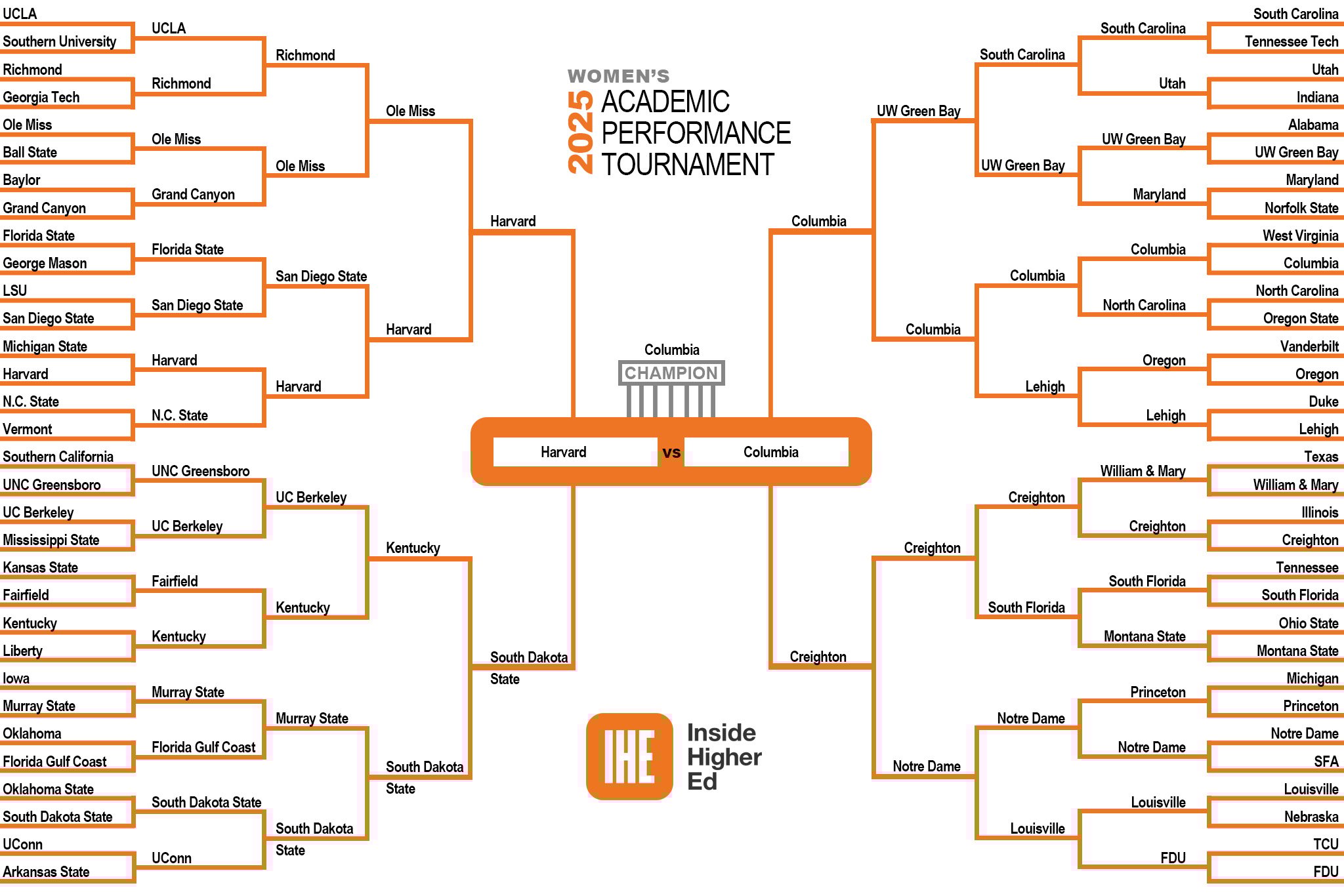
Here at Inside Higher Ed, though, we celebrate the start of March Madness a little differently from the 1.44 million people who tuned in earlier this month to this year’s Big Ten championship face-off between the University of Southern California and the University of California, Los Angeles. For every tournament since 2006, we’ve created a bracket of who would take home the trophy if the winners were selected based on academic, rather than athletic, achievement.
If you’re new here (or you didn’t see the men’s bracket from yesterday), here’s how it works: Matchups are decided by which team had the higher academic progress rate—the NCAA’s own metric for measuring academic performance—based on the most recent data available, from 2022–23. The academic progress rate measures student athlete retention and academic eligibility, though some outside experts have criticized the metric for painting an incomplete picture of a team’s academic achievement.
There are, inevitably, at least a handful of ties every year. In those cases, we used several different graduation metrics to select winners. First, we used the team’s 2023–24 graduation success rate, which shows whether athletes graduated within six years of entering an institution. If teams tied again, we then turned to the teams’ federal graduation rates, which are more inclusive than the NCAA’s metric. Finally, when teams were matched up on all three of those measures, we turned to the institution’s overall GSR across their athletics programs.
It’s worth noting that federal graduation rate data is not available for Ivy League teams, so for GSR ties involving Ivies, we skipped right to the overall GSR metric. That caused some chaos in a bracket that ended up seeing a total of seven ties featuring Ivy League institutions.
Another note on methodology: Although two of the First Four games were decided before publication, we used academic metrics to select the winners of those matchups as well.
This tournament was intense. There were not two, not three, but four matchups in the second round in which both teams had perfect APRs of 1,000. Kudos to those teams!
The championship matchup was between two Ivies, Harvard University and Columbia University, both of which had perfect APRs and GSRs and whose overall GSRs were perfectly matched at 99. We’ve never seen this before in Inside Higher Ed’s 19 years of academic March Madness, so, although not ideal, we had to resort to a (virtual) coin flip. Naturally, Harvard was heads, because both start with “H.”
But, in the end, we got tails. Congratulations to the Columbia Lions—who have now won Inside Higher Ed’s academic tournament two years in a row!
Over two-thirds of adult Americans who have attempted to transfer academic credit report having at least one negative experience, according to a recently released survey from Public Agenda. Student mobility is increasing, as is student access to college-level learning from multiple sources. But as evidenced by the Public Agenda survey and slow progress toward improving outcomes for transfer students, higher education institutions are still struggling to improve the transfer experience.
Part of this continued struggle is the siloed and opaque nature of information about how prior learning will be accepted and applied toward a credential upon transfer to a new institution. With 1.2 million students transferring between institutions in 2024—a 4.4 percent increase from 2023—it is more critical than ever to overcome the barriers students face moving academic credit to and between institutions to earn a degree.
To help address these complex and longstanding challenges, ourteams at not-for-profit Ithaka have launched a new, public, national credit mobility website, Transfer Explorer. Currently in its beta release, Transfer Explorer will expand in 2025 to contain data from a growing number of institutions across four states, thanks to collaborations with the Connecticut State Colleges and Universities system, the City University of New York, the South Carolina Commission on Higher Education, and the Washington Student Achievement Council.
To break down transfer data silos, Transfer Explorer member schools establish an automated data feed of evaluated course equivalencies, course catalog information and program requirements directly from their institutions’ student information and degree audit systems. This enables Transfer Explorer to create exploration tools with the most accurate and up-to-date information and allows institutions to easily maintain accurate information on the website simply by maintaining data within their existing systems. Data integration from member college source systems is powered by CampusAPI Requisite and Equivalency services from the nonprofit DXtera Institute.
Students can use Transfer Explorer beta to:
Create a personal wallet of courses they have taken or plan to take at one or more schools
Explore how courses in that wallet transfer and apply to degree requirements at Transfer Explorer member schools
Create multiple explorations and research different schools and degrees
Save and share explorations by creating a personal, unique, and editable hyperlink
Discover information about Transfer Explorer member schools
Three schools in South Carolina are the first to be featured as destination schools on Transfer Explorer: Aiken Technical College, Coastal Carolina University and Lander University. These represent three different source systems (Colleague, Banner and DegreeWorks), but their data are normalized for a consistent exploration experience in Transfer Explorer.
Lander University was the first institution to launch Transfer Explorer in February 2025.
“At Lander University, we have made major changes over the past five years to make our institution more transfer friendly: We have streamlined our general education curriculum, modified the maximum number of credit hours we will accept and added staff to enhance the transfer student onboarding experience,” said Lloyd Willis, dean of the College of Graduate and Online Studies.
“We view Transfer Explorer as the next step of this evolution. We love the tool’s user interface, the level of data it contains and the functionalities it contains that empower students to engage in course articulation and transfer conversations with their academic advisers.”
Community and technical colleges play a critical role in student mobility both as preparers of students for transfer and careers, as well as receivers of transfer students from all sectors of higher education. Aiken Technical College is planning to use Transfer Explorer in its recruitment and admission activities for new students, as well as to support students planning to transfer to a university.
“Aiken Technical College is excited to be a part of the Transfer Explorer project. The website is very user-friendly for students and advisors and will go a long way in avoiding lost college credits for students upon transfer,” said Chad Crumbaker, vice president of academic affairs and workforce innovation at Aiken Technical College.
Crumbaker is also eager to see how Transfer Explorer can help Aiken improve transfer processes and rules: “It also will help us identify additional opportunities to analyze course equivalencies to ensure that students get credit towards their programs for the courses they have already taken and to confirm that our transfer agreements are in practice in our transfer process.”
Transfer Explorer will continue to expand and grow in 2025 and beyond. Upcoming additions to the site include enabling users to add credit for prior learning experiences (e.g., exams, military training) to their explorations, improving the interoperability of school data by allowing comparisons across destinations and enhancing the user experience in collaboration with member schools and systems.
Transfer Explorer is inspired by and builds upon the groundbreaking CUNY Transfer Explorer (T-Rex) created by the City University of New York and Ithaka S+R in 2020, which has helped hundreds of thousands of people explore, discover and use the over 1.6 million credit transfer rules for the CUNY system’s 20 undergraduate colleges.
Transfer Explorer and the broader Articulation of Credit Transfer Project have been generously funded by Ascendium Education Group, the Gates Foundation, the Carroll and Milton Petrie Foundation, ECMC Foundation, the Heckscher Foundation for Children, and the Ichigo Foundation.
Chris Buonocore is product manager for Transfer Explorer at Ithaka and founding member of the CUNY Transfer Explorer platform.
Alex Humphreys is vice president for innovation at Ithaka, where he leads a team that scouts and develops the future of research and education through projects, partnerships and investments.
Martin Kurzweil is vice president for educational transformation at Ithaka S+R and principal investigator of the ACT project.
Emily Tichenor is a senior program manager at Ithaka S+R leading initiatives and research focused on credit mobility, including Transfer Explorer.
Philanthropic giving to higher ed institutions increased 3 percent when adjusted for inflation—for a total of $61.5 billion—between 2023 and 2024, according to a new report from the Council for Advancement and Support of Education.
Philanthropy from foundations, higher ed’s biggest supporter, increased 13.3 percent over that period, while alumni giving, the second-largest source of support, increased 7.5 percent; giving from nonalumni donors increased 4.7 percent. Giving from corporations, however, dropped 7.3 percent.
Donors’ priorities have also shifted somewhat. Gifts supporting current operations increased 2.3 percent, while those earmarked for capital purposes—like endowments, property, buildings or equipment—grew 11.7 percent.
Nearly half of endowment gifts, 48.3 percent, were designated for student financial aid. Almost 16 percent of endowment gifts went toward faculty and staff compensation, 23 percent funded academic divisions, and 8.8 percent supported research. Smaller shares supported athletics and student life, 2.4 percent and 1.6 percent respectively.
Gifts toward current operations represented 58.2 percent of gifts to higher ed in 2024. Research dominated, receiving 43.6 percent of those funds. A little over 28 percent of those gifts went toward academic divisions, 12.8 percent supported athletics and 12 percent funded student financial aid; 2.2 percent was designated for faculty and staff compensation, and 1.3 percent supported student life.
“Philanthropy remains essential to the success and sustainability of higher education,” Sue Cunningham, president and CEO of CASE, wrote in the report. “The consistent generosity of donors reflects a collective belief in the transformative power of education and its ability to create a more prosperous society.”
The Trump administration has sent questionnaires to U.S.-funded Canadian and Australian researchers asking whether their research is a “DEI project,” whether it defends against “gender ideology” and whether it reinforces “U.S. sovereignty,” according to organizations in those countries.
The Canadian Association of University Teachers, a federation that says it represents 72,000 employees, provided Inside Higher Ed a copy of one of these surveys. One question asked, “Can you confirm that your organization does not work with entities associated with communist, socialist, or totalitarian parties, or any party that espouses anti-American beliefs?” Another asked, “Does this project reinforce U.S. sovereignty by limiting reliance on international organizations or global governance structures (e.g., UN, WHO)?”
David Robinson, executive director of the Canadian association, said his organization was informed of the questionnaires by U.S. Department of Agriculture–funded researchers who received them. The White House didn’t return Inside Higher Ed’s request for comment Wednesday.
“It’s just unbelievable,” Robinson said. He said the U.S. government is trying to “impose a certain ideological viewpoint on research.”
Robinson also provided a survey that he said Australian researchers received. It contains the same questions and more, including, “What impact does this project have on protecting religious minorities, promoting religious freedom, and combatting Christian prosecution [sic]?”
Both surveys say “OMB”—standing for Office of Management and Budget—at the top. Chennupati Jagadish, president of the Australian Academy of Science, said in a statement Monday that “Australian scientists have been surveyed to disclose their institution’s compatibility with United States (US) foreign and domestic policy.”
“Any reasonable assessment of the survey indicates that US Government funded research in Australia could be terminated because an Australian institution—not the research project—has links with several named countries, or links with the United Nations and its agencies, or impacts the protection and promotion of specific religions,” Jagadish said.
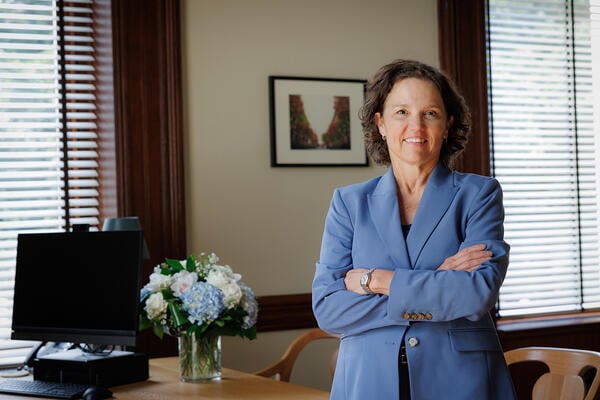
Columbia University interim president Katrina Armstrong is no stranger to crisis.
During her time in medical school and residency in Baltimore in the early 1990s, Armstrong treated patients with AIDS as the epidemic claimed tens of thousands of lives with no cure in sight.
Then, on Armstrong’s first day as physician in chief and chair of the department of medicine at Harvard University’s Massachusetts General Hospital in 2013, terrorists set off bombs near the finish line of the Boston Marathon, killing three people and injuring nearly 300 others. Staff at Mass General responded immediately, activating emergency protocols and mobilizing trauma teams and other resources to treat the victims.
But in recent months, Armstrong has navigated a crisis that no medical training could prepare her for, one that threatens the financial health and public standing of Columbia.
She was thrust into the spotlight eight months ago, elevated from CEO of Columbia’s Irving Medical Center to the Ivy League institution’s top job after then-president Minouche Shafik stepped down following a difficult year of protests and congressional scrutiny. Now, months after her ascent, the Trump administration has Columbia squarely in its crosshairs for, it claims, failing to address antisemitism in the wake of the pro-Palestinian protests that roiled the campus last spring and spread nationwide.
Already Trump officials have stripped Columbia of $400 million in federal grants and leveled a series of sweeping and legally dubious demands to overhaul student disciplinary policies, reform admissions and clamp down on an academic department—moves experts have cast as an autocratic attack on higher education. They come even though the Education Department’s Office for Civil Rights has not yet completed a Title IV investigation into reports of antisemitism on campus.
Columbia law professors and conservative legal scholars have questioned the legality of Trump’s actions. But whether they are lawful or not, Columbia is facing an unprecedented threat to its finances and autonomy with a first-time president at the helm.
Soon enough, the university will find out if she’s up to the challenge.
The Leader
Originally from Alabama, Armstrong earned a bachelor of arts in architecture from Yale University in 1986 and added a medical degree from Johns Hopkins University in 1991. She joined the medical school faculty at the University of Pennsylvania in 1996, where she stayed until 2013, when she was hired as a professor at Harvard University and its affiliate, Massachusetts General Hospital.
Over the course of her academic career, Armstrong has churned out more than 300 publications. Her body of work includes research on “cancer risk and prevention in Black and Latino patients; racial inequities in genetic testing and neonatal care; and the impact of segregation, discrimination, and patient distrust on the health of marginalized populations,” according to Columbia Magazine. Many of those topics have drawn scrutiny from the Trump administration in recent months, raising the question of whether such projects would receive federal funding now.
(Columbia did not make Armstrong available for an interview.)
To her supporters, Armstrong is a brilliant researcher with a celebrated career in medicine and academia, someone they describe as charismatic and magnetic with a strong moral compass.
But to her detractors, Armstrong is someone who has capitulated to the Trump administration and failed to defend the institution from politically motivated and possibly unlawful broadsides.
Roy Vagelos is firmly in the supporters’ camp.
Now 95, Vagelos earned a medical degree from Columbia in 1954 and went on to a career in academia and medical science, serving as chief executive officer of the pharmaceutical giant Merck. In August, amid ongoing antiwar protests, Vagelos and his wife, Diana Vagelos (whom he met on campus in 1951), donated $400 million to Columbia’s medical school.
That gift, he told Inside Higher Ed, reflects his confidence in Armstrong, whom he praised for having a nonstop work ethic and developing a clear vision for the medical school.
“Katrina is different from other academic leaders in that she wants to impact society beyond just education,” Vagelos said. “She is a doctor, she wants to cure disease, she wants to improve lives throughout the world by improving health. I had a different kind of career, but our objectives are the same.”
Claire Shipman, vice chair of the Columbia Board of Trustees, complimented Armstrong as an authentic and “exceptional leader” who “came in to help us heal and get our campus in order.” She added that Armstrong is cool under pressure despite the enormity of the current threats.
“Columbia is the epicenter of the political struggle somehow, and she’s getting a crash course in politics,” Shipman said. “Maybe it’s because she’s a doctor, but she’s definitely used to working in crisis conditions, and she just gets into the zone and handles it.”
(Shipman declined to discuss board deliberations on the Trump administration’s demand letter ahead of today’s deadline for a response.)
Columbia students protest on campus, Nov. 14, 2023.
Andrew Lichtenstein/Corbis/Getty Images
James McKiernan, who holds several roles at Columbia, including interim dean of the Vagelos College of Physicians and Surgeons, argued that Armstrong is making the most of a tough situation, balancing legal compliance with a continued commitment to student free speech.
“I think she inherited a situation where the boundaries had not been established, particularly physical boundaries on time, manner, and place for demonstrations,” McKiernan said.
Colleagues from other phases of Armstrong’s career also spoke effusively about her.
David Asch, a professor and senior vice president for strategic initiatives at the University of Pennsylvania who worked with Armstrong years ago, called her “completely electric in the classroom.” He added that he was unsurprised she ascended to the top job at Columbia.
“She had ‘university president’ written all over her,” Asch said.
Johns Hopkins Medicine International president Charles Wiener, who also worked with Armstrong in the 1990s, said she had a good personal touch with patients and their families and was motivated by a “relentless drive to take care of people.”
Even critics looking for her to take a stronger stand against Trump had positive things to say about Armstrong.
Michael Thaddeus, a math professor and vice president of the Columbia chapter of the American Association of University Professors, described her as the most open and accessible leader he’s seen in his 27 years at the university.
“When I was in her office, I mentioned that AAUP was having a happy hour at a nearby bar that evening,” Thaddeus said. “She and her husband showed up at the happy hour and stayed for 90 minutes. That’s just something inconceivable that any previous president wouldn’t have dreamed of doing.”
Still, he voiced concerns about her leadership, including that the campus remains closed to the public and that she has yet to clearly articulate a response to Trump. Thaddeus noted that the university has been in a “holding pattern” since the “turbulent reign” of Shafik, and that Armstrong has largely focused on calming campus tensions. But now that the federal government has brought the fight to Columbia, he wants to see her step it up.
“She’s in a very difficult position now, and what she’s done in the last seven or eight months is not going to work anymore,” Thaddeus said. “She needs to commit to some course of action.”
Others argue that Armstrong is in fact crumbling in the face of threats from the federal government.
Last week AAUP president Todd Wolfson blasted Columbia in a statement that accused campus leaders of surrendering to authoritarianism and sacrificing students to appease Trump.
“The subjugation of universities to state power is a hallmark of autocracy. Columbia University’s immediate submission and betrayal of the core mission of higher education reflects cowardice and capitulation to a government that seems intent on destroying US higher education,” Wolfson wrote.
The Response
The largest decision of Armstrong’s short tenure as president is looming.
Columbia faces a deadline today to respond to a demand letter from the Trump administration, which called on leadership to make sweeping changes, including expelling or suspending student protesters, overhauling disciplinary procedures, banning masks on campus, and reforming admissions. Arguably the most onerous demand is placing the Middle East, South Asian and African Studies Department into “academic receivership” for a minimum of five years, though Trump officials did not specify what that should entail.
A Wall Street Journal article published Wednesday indicated the university is likely to yield to Trump’s demands. Armstrong’s public statements have offered few clues as to what Columbia will do. But on March 13, Columbia punished student protesters who occupied Hamilton Hall last spring—months after Armstrong apologized for the “hurt” their arrests caused on campus. Sanctions included multiyear suspensions, expulsions and temporary degree revocations. Though the punishments were announced the same day the Trump administration sent the demand letter, Columbia officials said the decisions were the result of lengthy investigations.
Experts have mixed views of Armstrong’s communiqués.
Lisa Corrigan, a communications professor at the University of Arkansas and an expert on rhetoric and political communication, believes the president is scapegoating protesters and taking a tepid stance.
After analyzing her statements, Corrigan told Inside Higher Ed by email that she thinks Armstrong is “trying to walk the line between the larger national higher ed community and the donors/Trump administration.” Her statements seem to accept “the administration’s rationale for financial sanctions,” Corrigan said, which “only paves the way for further funding and speech assaults at Columbia and elsewhere using the antisemitism canard. Given the speedy exit of her immediate predecessor, Minouche Shafik, after her catastrophic testimony in congressional hearings in April 2024 on antisemitism on Columbia’s campus, Armstrong’s remarks clearly paint her as more amenable to the administration’s increasing control over the future of the institution.”
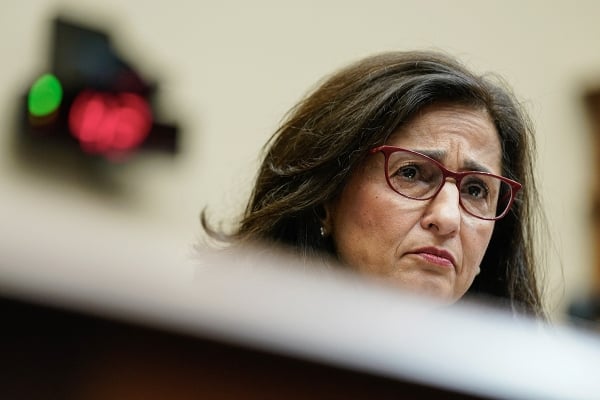
Former Columbia president Minouche Shafik testifies before Congress in April 2024. She resigned from the post last August.
Drew Angerer/Getty Images
Larry Ladd, a subject matter specialist at AGB Consulting, emphasized that Armstrong is navigating an unprecedented moment, treading carefully as she tries simultaneously to listen to the concerns of the campus community and to respond to threats from the federal government.
He likened the situation at Columbia to the ongoing trade war between the U.S. and its neighbors.
“The president of Columbia has the same challenge the president of Mexico or the prime minister of Canada has: how to create constructive conversation with the federal government. She is doing the best she can to engage in that conversation, because the government has power to help or harm the university, and she is trying to protect the university and its values,” Ladd said. “She has to be careful to defend its values without causing harm to the university.”
The Trump administration is pausing $175 million in federal funding to the University of Pennsylvania, apparently because the college allowed a transgender woman to compete in women’s sports three years ago.
The funding pause, announced Wednesday via a White House social media post, is not related to any investigation. Instead, the Departments of Defense and Health and Human Services stopped the $175 million as part of an “immediate proactive action to review discretionary funding streams,” a senior White House official said in a statement. The legality of the move isn’t clear, and officials didn’t specify what the paused funding was intended to be used for.
The official did note that the university “infamously permitted a male to compete on its women’s swimming team.”
The University of Pennsylvania became a target for Republicans and conservatives after swimmer Lia Thomas, who initially competed on the men’s swimming team, transitioned and then swam for the women’s team during the 2021–22 season—in compliance with the NCAA policies at the time. Thomas went on to win the NCAA championship in the 500-yard freestyle, although her time was not an NCAA record.
President Donald Trump campaigned in part on getting “men out of women’s sports,” and signed an executive order in early February specifically banning transgender women from competing in women’s sports. The order is part of a broader rollback of trans rights, and Trump has gone so far as to deny the existence of trans and gender-nonconforming people, declaring that there are only two sexes, male and female.
Shortly after the order was signed, the Education Department’s Office for Civil Rights opened a Title IX investigation into transgender athletes participating in college sports at the University of Pennsylvania. The Education Department also urged the NCAA to rescind all “records, titles, awards, and recognitions” given to trans women and girls. Since Trump’s order, the NCAA and Penn have acceded and revised policies to prevent trans women from competing in women’s sports.
A senior Trump administration official told Fox Business that the pause was a “proactive punishment” and that the university is at risk of losing all federal funding as part of the ongoing Title IX investigation.
“This is just a taste of what could be coming down the pipe for Penn,” the official told Fox Business, which first reported on the pause.
A University of Pennsylvania spokesperson said Wednesday afternoon that the institution had yet to receive any official notification or any details about the pause. The spokesperson noted that Penn follows NCAA and Ivy League policies regarding student participation on athletic teams.
“We have been in the past, and remain today, in full compliance with the regulations that apply to not only Penn, but all of our NCAA and Ivy League peer institutions,” the spokesperson said.
Columbia, Penn and other universities are facing great uncertainty when it comes to federal funding as Trump looks to cut spending and crack down on programs that don’t align with his priorities. Penn recently paused hiring and took other steps to curb spending.
Pausing Penn’s funding without any formal investigation and outside the typical processes for such a punishment is just the latest salvo in Trump’s attacks on wealthy universities. Earlier this month, the administration cut $400 million in grants and contracts from Columbia University, accusing the institution of “continued inaction in the face of persistent harassment of Jewish students”—an unprecedented move that alarmed experts and higher education advocates. Trump officials then ratcheted up the pressure by demanding sweeping changes at Columbia as a precondition to formal negotiations. Columbia has until Thursday, March 20, to respond.
Jon Fansmith, senior vice president of government relations at the American Council on Education, said the administration is punishing conduct they disagree with, adding that he found the Penn pause “more troubling” because of the lack of explanation or rationale.
“It’s one thing to say we think there’s a big problem,” he said. “It’s a much bigger deal to say we’re arbitrarily suspending funding without a reason … You should at least have a reason for taking serious action.”
He noted that the current regulations governing Title IX don’t specifically bar transgender students from participating in women’s sports, and that Penn is in compliance with the policies. So he’s not sure what Penn could offer the Trump administration to restore the funding.
Blake Emerson, a professor of law and political science at the University of California, Los Angeles, said the funding pause is illegal since the administration didn’t follow the processes under Title IX to pull funding. That process includes a formal hearing and a report to Congress.
“There is no freestanding executive power to cut off money without legal authority,” he said. “It’s another instance in this pattern of the Trump administration not just aggressively using the law to target political opponents and universities, but flouting the law and not even showing casual regard for the legal process.”
Emerson noted that executive orders aren’t laws, and that if the Trump administration wants to change the existing interpretations of Title IX, it has to go through the rule-making process.
He urged Penn and Columbia to fight the cuts, as he doesn’t think “acquiescence is likely to appease” the Trump administration.
“Universities have a strong case to make that the funds being cut off are really necessary to provide essential public services the universities provide,” he said. “We’re losing scientific research because of these illegal steps, and universities are failing to make the case for their own programs when the actions being taken against them are clearly illegal. To my mind, acquiescence is a major blunder.”
Meanwhile, conservative activists who have railed against trans athletes praised the move.
Riley Gaines, who competed against Thomas, called the timing of the announcement “serendipitous” in a social media post. Three years ago Wednesday, she tied with Thomas for fifth place in the 200-yard freestyle at the 2022 NCAA championships.
Beth Parlato, senior legal adviser for the Independent Women’s Law Center, said in a statement that the message from the funding pause was clear: comply or suffer the consequences.
“President Trump means business and he’s not going to tolerate any school willfully violating the law,” Parlato said. “It is so encouraging to see an administration actually follow through with promises made to the American people, and I’m looking forward to watching each and every school that fails to protect women and girls be held accountable.”
The American Association of University Professors chapter at Columbia University is urging officials there to reject the Trump administration’s demands, which include putting an academic department under receivership, abolishing the University Judicial Board and giving security employees arrest authority.
“Compliance would make Columbia complicit in its own destruction, stripping shared control of academic and student affairs from the faculty and administration and replacing the deliberative practices and structures of the university with peremptory fiats from outside the institution,” the AAUP chapter said in a statement Tuesday. “We see no evidence that compliance would assuage the hostility of the White House.”
The Trump administration announced March 7 it was canceling about $400 million in federal grants and contracts for Columbia due to what it claims is the university’s “continued inaction in the face of persistent harassment of Jewish students.” Then, in a letter last week, federal officials listed “next steps that we regard as a precondition for formal negotiations regarding Columbia University’s continued financial relationship with the United States government.” They set a March 20 deadline for complying with the demands, which also include a mask ban, a plan for changing admissions and more.
The Columbia AAUP’s statement said, “The government’s demands read like a ransom letter, dictating to the university what principles it must sacrifice and what ideological positions it must adopt to restore research funding.” As for the justification of fighting antisemitism, the AAUP chapter said the university took “many actions over the last year to accommodate its Jewish students, sometimes at the expense of the grievances of other campus groups.”
The AAUP chapter said this “assault on Columbia will serve as a model for attacks on other universities across the nation” and urged colleagues to speak out and “march in the streets.”
The White House didn’t return a request for comment Tuesday.
Moody’s Ratings on Tuesday downgraded its outlook for the higher education sector from stable to negative due to recent and potential federal policy changes.
The revised outlook comes as the Trump administration has gutted the Education Department via mass layoffs and sought to aggressively overhaul higher education with a flurry of executive orders that have destabilized certain funding streams.
“Actions and potential changes include cuts to research funding, enforcement actions against diversity programs, staff reductions at the US Department of Education, uncertainty over federal student aid, and possible expanded taxes on endowments,” Moody’s analysts wrote in the report released Tuesday. “These factors are causing institutions to pause capital investments, freeze hiring, and cut spending.”
In December, Moody’s projected a stable 2025 with anticipated revenue growth of 4 percent—the most optimistic outlooks for the sector among a trio of predictions from key financial organizations. Now the ratings agency notes federal policy changes could prompt revenue shortfalls, particularly at research universities, due to a proposed cap on National Institutes of Health reimbursements for research-related costs. That cap, which is currently blocked by a court order, would mean about $100 million in cuts annually for research universities that spend at least $50 million on research and award 70 research doctorates a year, according to Moody’s.
In addition to the NIH rate cut, an increase to the endowment tax would hit wealthy, private universities and likely drive cuts to financial aid or in other spending categories, the report found. The current endowment tax is 1.4 percent for institutions with at least 500 students and $500,000 in assets per student, but recent Republican proposals have floated raising that tax significantly. One proposal has called for a 10 percent tax and changing the per-student endowment threshold from $500,000 to $200,000. Another GOP proposal would set the tax at 21 percent.
Potential disruptions to federal financial aid disbursement, however, would impact all colleges and universities. Moody’s noted that “only a select group of wealthy institutions have the financial flexibility to manage such a scenario without likely seeing steep enrollment decline.” Given steep cuts to the Education Department, Moody’s expressed concern that the Federal Student Aid office could be affected, particularly after last year’s overhaul of the Free Application for Federal Student Aid, which was beset by multiple technical challenges.
“The administration has said the reductions will not affect the department’s statutorily mandated functions such as administering Title IV financial aid and providing assistance to federal student loan borrowers, but the extent to which that will be the case is uncertain,” the report noted.
Federal enforcement actions against diversity, equity and inclusion initiatives—which the Trump administration has targeted—also pose a financial risk to the sector, according to Moody’s. The report cited the potential for “a wide array of funding cuts, including Title IV funding suspension, if [universities] do not comply” with Trump’s executive orders clamping down on DEI offerings.
Moody’s also flagged potential losses due to the possible reduction in visas for foreign students. Colleges and universities that would be hit the hardest, according to the report, are those that are “reliant on STEM master’s programs, or more niche offerings like art and design programs.”
The report concluded that the outlook could revert to stable “if many of the federal policies and proposals are reversed or halted by judicial intervention or do not come to pass. Stronger-than-expected investment market returns and operating revenue growth could also lead to a revision of the outlook to stable.”
A federal judge in Maryland this week ordered the U.S. Department of Education to reinstate numerous grants that support teacher-preparation programs.
The department canceled the $600 million in grants last month as part of a wider effort to slash federal funding and eliminate programs that promote diversity, equity and inclusion. In response, the American Association of Colleges for Teacher Education, the National Center for Teacher Residencies and the Maryland Association of Colleges for Teacher Education challenged the cuts, arguing in a lawsuit that the grant terminations were illegal.
On Monday, U.S District Judge Julie Rubin ordered the department to restore funding for the Supporting Effective Educator Development program, the Teacher Quality Partnership program and the Teacher and School Leader incentive program within five business days. That order comes after a federal judge last week directed the department to reinstate canceled grants in eight states.
“We are thrilled that the court has ruled in favor of preserving funding for TQP, SEED, and TSL grants, which have a transformative impact on our nation’s education system,” AACTE president and CEO Cheryl Holcomb-McCoy said in a news release.
The order also blocks the department from terminating any other TQP, SEED or TSL grant awards “in a manner this court has determined is likely unlawful as violative of the Administrative Procedure Act,” which instructs courts to “hold unlawful and set aside final agency actions” deemed “arbitrary, capricious, an abuse of discretion, or otherwise not in accordance with law.”
The judge asked both the department and the plaintiffs to file a status report within seven business days showing compliance with the order.