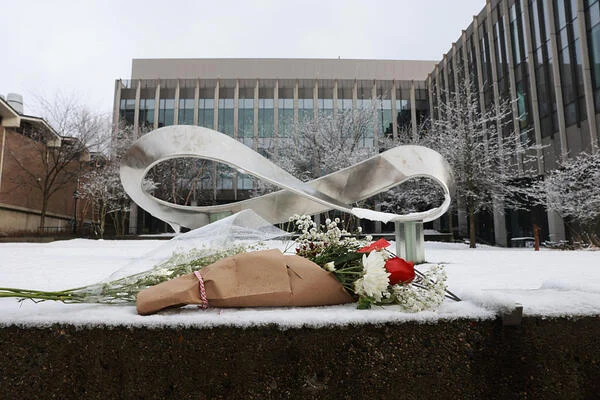
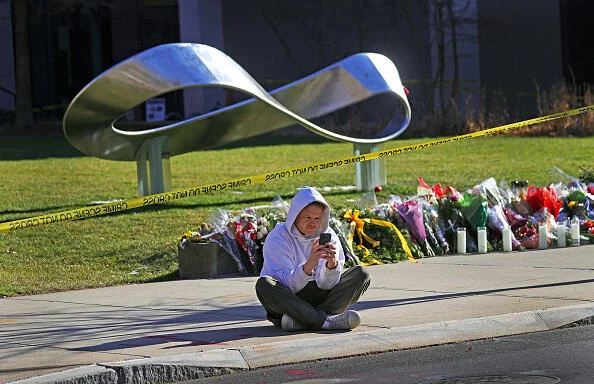
The Department of Education is investigating whether Brown University violated the Clery Act in relation to a campus shooting earlier this month that left two students dead.
“After two students were horrifically murdered at Brown University when a shooter opened fire in a campus building, the department is initiating a review of Brown to determine if it has upheld its obligation under the law to vigilantly maintain campus security,” U.S. Secretary of Education Linda McMahon said in a Monday news release announcing the investigation.
The release also questioned whether Brown’s video surveillance system was “up to appropriate standards” and accused the university of being “unable to provide helpful information about the profile of the alleged assassin” in the aftermath of the shooting.
The suspected shooter, Claudio Manuel Neves Valente, a former Brown student, evaded capture and was found dead from a self-inflicted gunshot wound following a five-day manhunt. While some observers accused Brown of substandard security practices, which critics say delayed the capture of the suspected shooter, others allege the FBI bungled the search.
ED is also probing whether Brown’s emergency notifications about the shooting were delayed.
The department requested various records to aid in the investigation, including copies of annual security reports; crime logs; student and employee disciplinary referrals “related to the illegal possession, use, and/or distribution of weapons, drugs, or liquor”; and copies of all Brown policies and procedures, among other campus safety documents.
The same day that ED announced the investigation into Brown, the private university in Rhode Island placed its top campus safety official, Rodney Chatman, on administrative leave as it reviews the shooting. Hugh T. Clements, the former chief of police of the Providence Police Department, will take on the top public safety job as Brown conducts a security assessment.
Brown officials did not respond to a request for comment from Inside Higher Ed.
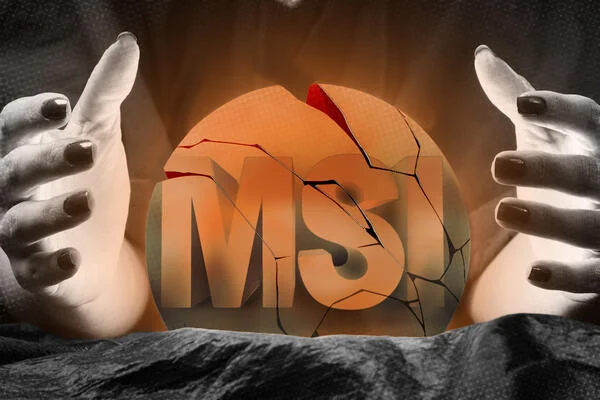
A DOJ report is the latest in the Trump administration’s attempts to dismantle minority-serving programs.
Photo illustration by Justin Morrison/Inside Higher Ed | d1sk and nullplus/iStock/Getty Images
The Department of Justice has declared a slew of Department of Education programs and grants unconstitutional based on the Supreme Court’s decision in Students for Fair Admissions v. Harvard and the University of North Carolina.
According to a report by the DOJ’s Office of Legal Counsel (OLC), minority-serving institution (MSI) programs are unlawful because they award money to colleges and universities based on the percentage of students of a certain race. The report said such programs “effectively [employ] a racial quota by limiting institutional eligibility to schools with a certain racial composition” and should no longer be funded.
The report also deemed it unconstitutional that two scholarship providers, the United Negro College Fund and the Hispanic Scholarship Fund, both of which award scholarships to students of a specific race, are given access to Free Application for Federal Student Aid data.
In a statement from the education department, Secretary Linda McMahon said that the report is “another concrete step from the Trump Administration to put a stop to DEI in government and ensure taxpayer dollars support programs that advance merit and fairness in all aspects of Americans lives. The Department of Education looks forward to working with Congress to reform these programs.”
The statement noted that the department is “currently evaluating the full impact of the OLC opinion on affected programs.”
The OLC also evaluated the constitutionality of two TRIO programs, the Ronald E. McNair Postbaccalaureate Achievement Program, a scholarship that helps students from underrepresented backgrounds work towards Ph.D.s, and Student Support Services, which provides grants for institutions to develop academic support infrastructure. It ultimately concludes that those programs are constitutional and may continue to be funded.
Nevertheless, in ED’s announcement of the DOJ decision, those TRIO programs were included in a list of “affected programs.”
The Trump administration’s attack on MSI programs began in July, when the U.S. Solicitor General declined to defend against a lawsuit challenging the definition of a Hispanic-serving institution (HSI) as one that enrolls a student body with at least 25 percent Hispanic students. In September, ED officially announced its plans to end these programs, terminating the majority of MSI grants for FY2025.
Supporters of MSI programs strongly criticized the OLC’s report.
“Today’s baseless opinion from the Justice Department is wrong, plain and simple. Donald Trump and his Administration are once again attacking the institutions that expand opportunity for millions of aspiring students of all backgrounds. The opinion ignores federal law, including Congress’ bipartisan support for our nation’s Hispanic-Serving Institutions and Minority-Serving Institutions, including more than 100 MSIs in California alone,” Senator Alex Padilla, a California Democrat who chairs the Senate HSI Caucus, wrote in a statement. “Every student deserves access to the American Dream. This unconscionable move by this Administration will harm millions of students who deserve better.”
Presidents of institutions that could be impacted by the legal decision are also speaking out. Wendy F. Hensel, president of the University of Hawai’i, called the news “disappointing” in a statement to the campus community. UH is an Alaskan Native and Native Hawaiian-serving institution, an Asian American and Native American Pacific Islander-serving institution, and a Native Hawaiian Career and Technical Education grantee; Hensel said these programs are “vital” to UH and the state of Hawai’i.
She wrote that the university’s general counsel is examining the full report and that campus leadership is currently “evaluating the full scope of the impact on our campuses and programs and implementing contingency plans for the loss of funding.”
“We recognize that this news creates uncertainty and anxiety for the students, faculty and staff whose work and educational pathways are supported by these funds. We are actively assessing how best to support the people and programs affected as we navigate this evolving legal landscape,” she wrote.
Trump’s allies, however, applauded the report and ED’s efforts to end MSI programs.
“Today’s announcement is a strong step by the Trump administration to end racial discrimination in our higher education system. These programs determine funding eligibility through arbitrary, race-based quotas which unfairly assume a student’s background determines his or her educational destiny,” Education and Workforce Committee Chairman Tim Walberg, a Republican representative from Michigan, wrote in a statement. “America was founded on the principles of freedom and equality, and that every citizen can chase the American Dream. In Congress, we are working with the Trump administration to create a fairer higher education system so every student has a strong chance at success.”
California State University, Fullerton, (above) is one of the 22 campuses where teamsters are prepared to strike.
David McNew/Getty Images
Members of Teamsters Local 2010, a union representing 1,100 skilled trade employees at the California State University system, voted Monday to authorize a strike across all 22 campuses.
CSU refused to pay contractually guaranteed five percent raises and salary step increases in July, and the union has filed several unfair labor practice complaints against the university system, union representatives said in a news release. Teamsters members are not striking yet, but are prepared to do so “if CSU continues to break the law, ignore their contract, and refuse to pay the raises that its skilled workforce is owed,” the release stated.
“CSU is steering itself into a completely avoidable battle with the Teamsters Union. Our members will not stand by while the University commits unfair practices, misuses state funds, breaks its promises, and enriches executives at the expense of the workers who keep its campuses running,” Jason Rabinowitz, secretary-treasurer of Teamsters Local 2010, said in the release. “CSU’s greed, dishonesty and disrespect for its workforce are indefensible. This vote makes clear that we are ready to strike if CSU continues to rip us off while lining their own pockets.”
In a statement, a spokesperson for the CSU Chancellor’s office said the vote is procedural and that a strike is not necessarily “imminent.”
“The result of the strike authorization vote is disappointing, as the current labor agreement, negotiated and ratified through the collaborative collective bargaining process, contained clear contingency provisions language that tied certain salary increases to the receipt of new, unallocated, ongoing state funding. Those contingencies were not met, leading to the current reopener negotiations on salary terms,” the spokesperson said. “We believe the time and resources of all parties would be more productively devoted to the bargaining table, where meaningful progress can be made, rather than toward preparing for a strike.”
Christian Brothers University plans to cut 16 full-time faculty positions at the end of its spring semester as it tries to balance its “operating budget and position CBU for transformation,” Interim President Chris Englert said in a public message this week.
Englert specifically noted the Catholic nonprofit was not eliminating any academic programs and “students will be able to complete their declared majors with minimal disruption.”
Earlier this month, the Tennessee university announced that its accreditor had lifted its probationary status after two years after it made major cuts to reduce its deficit.
Dive Insight:
Christian Brothers has undergone a long and at times painful restructuring as it tries to right its finances.
In fall 2023 — as it faced as much as a $7 million deficit — the institution declared financial exigency, a process that distressed colleges invoke that allows them to lay off tenured professors and wind down programs.
In doing so, the university cited a “consistent decline” in undergraduate enrollment since the 2018-19 academic year and a failure to meet its first-time freshman goals for fall 2023. Between 2018 and 2023, undergraduate fall enrollment declined by just over 30% to 1,204 students, according to federal data.
In October 2023, the university cut several high level-administration positions to reduce its deficit by $1 million.
By December 2023, the Southern Association of Colleges and Schools Commission on Colleges put Christian Brothers on probation over concerns about its financial stability and governing board practices. Later the same week, the university eliminated 28 faculty positions through both layoffs and cutting vacant roles.It also nixed a dozen programs with low enrollment, including English, history, ecology and engineering physics.
By last fall, the university sounded a more optimistic note. Leaders said it was poised to come off probation with SACSCOC after increasing its first-year student enrollment and reducing its budget deficit by nearly half to $2.5 million in May 2024.
It took another year for Christian Brothers to officially come off probation. In a Dec. 9 message, Englert described the event as an “important milestone for our institution and a direct reflection of the dedication, hard work, and integrity demonstrated by our faculty, staff, and trustees.” At the same time, he noted the university would have to remain academically and financially strong to stay in compliance.
Englert repeated that sentiment this week when announcing the further faculty reduction. He also framed the cuts as a step toward a faculty-to-student ratio target of 12-to-1, as well geared toward long-term financial stability and “ongoing academic alignment efforts and in response to shifting enrollment patterns.”
The university is still struggling with maintaining its enrollment, with its student body falling by roughly a third from 2024 to 2025, according to the Daily Memphian.
The department says Palantir was involved in a portal tracking universities’ foreign gifts and contracts.
The American Association of University Professors (AAUP) is publicly expressing concern about the Education Department working with Palantir, a controversial artificial intelligence and data analysis company that serves the U.S. military and Immigration and Customs Enforcement.
The AAUP says it learned of the partnership when FedScoop reported that it noticed a message referencing Palantir on the website foreignfundinghighered.gov Dec. 4. An hour later, the website showed “a login page with the Palantir logo,” and, a couple of hours after that, “the Palantir logo was replaced with an Education Department logo,” the outlet wrote.
Foreignfundinghighered.gov tracks foreign gifts and contracts data for higher ed institutions. If a foreign source provides a college or university more than $250,000 in a year, Section 117 of the Higher Education Act of 1965 requires the institution to report the payment to the federal government.
In an email to Inside Higher Ed, the Education Department described Palantir’s involvement in the past tense. It said Palantir was involved with the foreign funding portal as a subcontractor for Monkton, a company that has long handled privacy and data issues for the Departments of Defense and Homeland Security.
“After soliciting feedback from institutions of higher education, the Trump Administration has upgraded the portal to make it easier for colleges and universities to report their foreign gifts and contracts as required,” Julie Hartman, the Education Department’s press secretary for legal affairs, said in a statement.
The AAUP held a news conference Wednesday raising concern about Palantir’s past work and about critical statements that Palantir leaders Alex Karp and Peter Thiel had made about higher ed.
“We want transparency,” AAUP president Todd Wolfson told reporters. “We want to know what Palantir is doing on this contract and we want to know how much they stand to make.” He said it “seems to be yet another front aimed at surveilling and criminalizing our colleges and universities,” and could indicate a “shift toward treating higher education not as a public good, but as a security threat to be monitored.”
The department didn’t tell Inside Higher Ed how much Palantir is being paid. Hartman said “universities’ clear disclosure and public transparency requirements have been in statute for decades,” adding that the AAUP’s “baseless assertion that the portal is a ‘politicized punitive action’ demonstrates their utter disregard for the rule of law.”
She said, “the Trump Administration is ending the secrecy surrounding foreign dollars and influence on American campuses.” Palantir spokespeople didn’t return Inside Higher Ed’s requests for comment.
AFT President Randi Weingarten has been a loud advocate for protecting borrowers’ rights to loan repayment programs.
Chip Somodevilla/Getty Images
The Department of Education has accumulated a backlog of more than 800,000 applications for income-driven loan repayments (IDR) as of Dec. 15, according to the most recent status report in a lawsuit filed by the American Federation of Teachers (AFT).
The union originally sued the department in March for pausing all applications to IDR plans, loan consolidation and the Public Service Loan Forgiveness program, but the case was quickly settled as the department reopened the application portal and committed to providing regular status updates.
For five months, the status reports carried on and the case remained quiet. But then, in September, AFT filed an amended class action complaint and motion for preliminary injunction, arguing that just because the portal is open doesn’t mean it is working properly. Tens of thousands of applications were going untouched, violating the rights of the borrowers who submitted them.
In October, the department again reached a settlement with the plaintiffs, committing to process applications, and the motion was stayed. But now, with the latest status report released, AFT argues that the department isn’t holding up its end of the deal.
“The problem is they don’t appear to have kept their word,” Randi Weingarten said in a news release Wednesday. “The borrower backlog remains eye-popping, and Education Secretary Linda McMahon clearly has no idea how to manage this process.”
In addition to the backlog of pending loan repayment applications, the report shows that only 170 borrowers at the end of their IDR plan and 280 borrowers who have completed their PSLF payments have received their rightful loan forgiveness.
Weingarten suggested that in addition to loan forgiveness being low on the Trump administration’s list of political priorities, much of the backlog is due to major staffing cuts.
“Perhaps [Secretary McMahon] shouldn’t have sold the Department of Education off for parts,” the union president said. “President Donald Trump and Vice President JD Vance may believe affordability is a hoax, but hundreds of thousands of Americans just trying to get ahead are bleeding—and the administration’s lack of action is rubbing salt into the wound.”
So, until the department “follows the law and processes every single outstanding application,” she added, AFT will not stop fighting its case.
We’re approaching the end of a year that was at various times frightening, difficult and downright ridiculous. We hope that, despite the struggles higher education faced this year, you can still find something to be thankful for this holiday season, whether it’s generous donors making big differences for small campuses, colleges striving to improve cost transparency, or institutions supporting their communities through tough times.
If not, maybe you can take some inspiration from the videos below.
Here are Inside Higher Ed’s favorite holiday greetings, from the wacky to the artsy to the classy, showcasing the talents and holiday spirit of students, staff and faculty across the country.
Quinnipiac University, Hamden, Conn.
This slapstick sketch depicts Quinnipiac’s mascot, Boomer the Bobcat, messily preparing to welcome community members to his abode for Christmas dinner. Despite mishaps like spilling a bowl of assorted vegetables all over the floor and whisking what looks like mashed potatoes so feverishly they go flying, Boomer ends up putting out a beautiful spread—roast turkey, green beans, deviled eggs and more—for his delighted guests.
University of Louisiana at Monroe
The ULM Chamber Singers bring us a stirring adaptation of the 12 Days of Christmas entitled, no surprise, the 12 Days of Finals. Among the listed gifts is “ten paddlers paddling,” referring to the campus’s unique access to Bayou DeSiard, where students can borrow a kayak for free and paddle around to their heart’s delight.
Salt Lake Community College, Salt Lake City, Utah
Salt Lake Community College brings us another musical video, this time in the form of a tribute to Mister Rogers’ Neighborhood. President Greg Peterson takes on the titular role, singing: “We’ve made the most of this beautiful year, full of big hopes and holiday cheer. It’s education for you—it’s SLCC.edu. Will you join us next year?” Fuzzy video filters take the viewer back to old-school PBS, making the homage all the more nostalgic.
The University of Texas, Dallas’s Harry W. Bass Jr. School of Arts, Humanities, and Technology
This video highlights an annual tradition in an animation business development course at UT Dallas. The students are asked to design a holiday card and their peers then vote on the 10 best cards in the class. The winners’ cards are then printed and sold to fundraise for the school’s Student Emergency Fund. “I’m glad that our class is helping people have the reassurance that they need that they’re safe on campus and that somebody’s looking out for them if something does happen,” one of this year’s participants said.
Gonzaga University, Spokane, Wash.
College holiday greetings love to get a little bit meta. In this greeting, Gonzaga president Katia Passerini realizes she has forgotten to write a poem for this year’s holiday video. Luckily, student Alexis Sandoval just so happens to have a Christmas poem prepared, saving the day. Different members from the campus community, from a security leader to the university chaplain, recite the poem, bidding viewers to “rejoice in faith, carry peace and love into a happy New Year.”
Moraine Valley Community College, Palos Hills, Ill.
In this feel-good sketch, President Pamela Haney tries to bake a sweet treat for the college’s leadership team, but is missing a few key ingredients, including kindness and dedication. Luckily, teams from across the campus come to the rescue, bringing Haney everything she needs to finish making the cake. As one administrator says, “it’s amazing what we can do when we all work together.”
Wellesley College, Wellesley, Mass.
This year, the women’s liberal arts college celebrated 150 years since it welcomed its first class in 1875. As part of that celebration, the holiday video this year compiled archival footage and images submitted by alumni of winters on campus over the past century-and-a-half. The video, which features students sledding, ice skating, skiing and playing in the snow, is set over a song composed for the Class of 1948’s junior class show, which bemoans leaving Wellesley’s campus behind.
Community College of Philadelphia
“My Favorite Things” from The Sound of Music is everyone’s favorite non-Christmas Christmas song. Why has it entered the holiday songs zeitgeist? Who can say for sure, but I think we’re all glad it has. This particular rendition by CCP students and faculty sets the classic tune against a hip-hop beat and features a sick guitar solo.
University of Alabama, Tuscaloosa, Ala.
Uh-oh—President Peter Mohler is supposed to be helping write Christmas cards, but he’s nowhere to be found! This cheeky sketch shows that he’s shirking his responsibilities to do much cooler and more fun things, like play video games with students or shoot hoops with Big Al, the institution’s elephant mascot. Luckily, when his colleagues finally find him, he’s already finished the holiday cards. Crisis averted!
Tulane University, New Orleans, Louisiana
“What’s one Tulane memory you hope never melts away?” this video asks a gaggle of sweater-clad Tulane students. More than one note a once-in-a-lifetime Gulf Coast blizzard that shocked and delighted Tulane students this past January, with one saying it was “like a dream.” Others mention friends, sports championships and exploring the city of New Orleans.
Ask just about any federally funded researcher to describe 2025, and they use words like chaotic, demoralizing, confusing, destabilizing and transformational.
“It’s been a very destabilizing year [that’s made] people question the nation’s commitment to research,” Heather Pierce, senior director for science policy at the Association of American Medical Colleges, told Inside Higher Ed.
She expects 2026 to be a year of rebuilding and standard setting.
Speaking of the National Institutes of Health, which calls itself the world’s largest public biomedical research funder, Pierce said the research community is expecting more major regulation and written policy changes in 2026, which will shed more light on how grants will be funded, how much the federal government will invest in the research enterprise and what priorities will emerge from this administration.
If the administration’s attacks on federally funded research in 2025 are any indication, the federal government of 2026 will likely be just as willing to advance its conservative ideological agenda by controlling universities through the nation’s research enterprise. And while the administration may not let up in the new year, courts stymied some of its most sweeping changes in 2025 and may continue to be an obstacle in the new year.
Soon after President Donald Trump started his second term in January, the National Institutes of Health, National Science Foundation, Department of Education and numerous other federal agencies that collectively send billions in research dollars to universities, began freezing and terminating hundreds of grants. Many of the targeted grants—including projects focused on vaccines, climate change, and health and education disparities among women, LGBTQ+ and minority communities—were caught in the crossfire of Trump’s war against diversity, equity and inclusion initiatives and so-called woke gender ideology.
Not only would the terminations lead to the loss of jobs, staff and income, a lawsuit filed by a group of NIH-funded researchers in April predicted that “scientific advancement will be delayed, treatments will go undiscovered, human health will be compromised, and lives will be lost.”
The true damage comes from the betrayal, the sense of uncertainty and the loss of trust researchers have—or had—vis-à-vis with the federal government. That’s really hard to quantify.”
Scott Delaney, cofounder of Grant Witness
Terminated federal grants encompassed a wide range of research projects. Some of the casualties included funding to study the erosion of democracy, the effectiveness of work study, dementia, COVID-19, cancer and misinformation. Others supported teacher-training programs and initiatives designed to attract more underrepresented students into STEM fields.
“The premise of this award is incompatible with agency priorities,” read a letter the NIH sent to numerous researchers back in March, terminating their active grants. “[R]esearch programs based primarily on artificial and nonscientific categories, including amorphous equity objectives, are antithetical to the scientific inquiry, do nothing to expand our knowledge of living systems, provide low returns on investment, and ultimately do not enhance health, lengthen life, or reduce illness.”
But it didn’t stop there.
The Trump administration also temporarily froze billions more dollars in federal research grants at a handful of the nation’s wealthiest, most selective institutions, including Harvard University, Columbia University and the University of California at Los Angeles, for allegedly failing to address antisemitism on campus and ignoring the Supreme Court’s ban on affirmative action, among other allegations. (Most of the universities got their money back after cutting deals with the administration or via court orders.)
Faculty in the University of California system successfully fought the administration’s funding cuts, winning court orders to restore the money.
Justin Sullivan/AFP/Getty Images
And because the NIH, NSF, ED and several other federal agencies also laid off thousands of workers, researchers with questions had far fewer resources to help them navigate changes to application and award processes.
By some estimates, the government disrupted upward of $17 billion in NIH grants alone this year, according to Scott Delaney, a former lawyer and Harvard University epidemiologist who the university laid off as a result of grant terminations.
Earlier this year, he cofounded Grant Witness, a website that has been tracking grant cancellations at the NIH, NSF and the Environmental Protection Agency. While both the NIH and NSF have since restored thousands of grants, Delaney said those and other restorations won’t be enough to repair the now-fractured relationship between faculty and federal funding agencies.
“The true damage comes from the betrayal, the sense of uncertainty and the loss of trust researchers have—or had—vis-à-vis with the federal government. That’s really hard to quantify,” he told Inside Higher Ed this month. “In the years ahead, there will be folks who don’t want to plan long-term research projects because they don’t know if their funds are going to get summarily yanked out from underneath them; folks who don’t want to continue their careers in academic research or train in academic research; trainees who would have had training grant support who don’t now and go do something else. And some researchers will just leave the country.”
In addition, some of the Trump administration’s research funding proposals have stoked worry this year about the long-term sustainability of the nation’s academic research enterprise.
Numerous agencies—including NIH, NSF and Department of Energy—have attempted to cut university reimbursement rates for indirect research costs. Higher education and science advocates characterized such policies as “shortsighted and dangerous,” and said it would hamper university budgets, hurt the economy and stymie scientific progress. Although federal courts have since blocked the rate caps, the mere anticipation of such policy changes led some universities—including the Massachusetts Institute of Technology and Northwestern University—to freeze hiring and, in some cases, graduate admissions.
But by September, the NIH said it was on track to spend its full $47 billion budget by the end of the fiscal year that month.
However, the NIH awarded 3,500 fewer competitive grants this year with the biggest declines at the Institutes of minority health, nursing, human genome, alcohol abuse and alcoholism and mental health, according to The New York Times. Those changes are part of the White House’s plan to streamline scientific funding by eliminating wasteful spending and cutting “woke programs” that “poison the minds of Americans.”
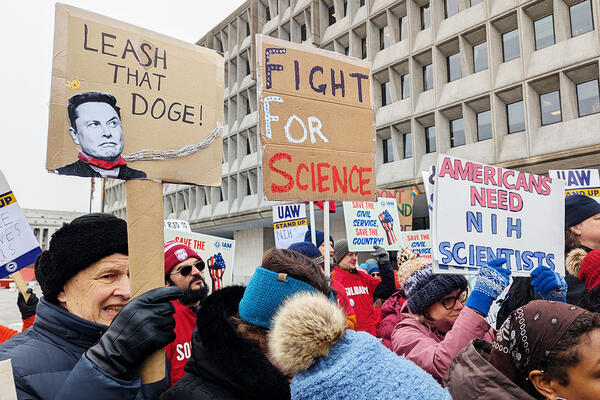
The cuts to federal agencies and research spurred protests in the spring.
As 2025 fades into 2026, the federal research funding picture isn’t looking as bleak—at least not on the surface.
A flurry of litigation from universities, individual researchers, trade associations and labor unions prompted several federal agencies to reinstate some research grants.
All things considered, 2025 “could have been worse, but it was still awful,” Delaney said, noting that there are still thousands of grants in limbo at the NSF, DOE and numerous other agencies beyond the NIH.
“So many people fought so hard—some of them sacrificed their jobs inside these federal agencies—and they succeeded in many ways. To tell a story that doesn’t include both their sacrifice and their success discredits what was a Herculean and heroic effort for scientists, many who have never spoken up in a political way before this year,” he added. “But it’s also important to emphasize that this fight isn’t over, and we need to keep fighting. It can get worse.”
‘Not Insulated From Politics’
Katie Edwards, a social work professor at the University of Michigan, is one of the researchers who sued the NIH. In March, the agency canceled six grants she was using to research mental health and violence prevention among marginalized young people, including Indigenous and LGBTQ+ youth. Valued at $10 million, the grants supported roughly 50 staff, community collaborators and trainees and put them all at risk of losing their jobs.
“For many trainees—especially those who are LGBTQ+ or people of color—the message they internalized was painful: that research on their communities is ‘ideological’ or expendable,” Edwards wrote in an email to Inside Higher Ed. “The emotional toll of fighting for and protecting staff, reassuring community partners, and trying to navigate a constantly shifting federal landscape has been immense.”
Fighting for Public Health Research
April: A group of NIH researchers, a public health advocacy organization and a union representing more than 120,000 higher education workers sued the NIH for terminating more than $2.4 billion in grants.
August: The U.S. Supreme Court ruled by a vote of 5 to 4 that any legal challenges to the grant terminations should be litigated in the Court of Federal Claims, not the federal district court system they’ve been moving through for months.
Edwards
University of Michigan
Although her grants have since been reinstated—albeit some with reduced dollar amounts, administrative delays and anti-DEI language in the notice of award—and her team has resumed their work, this year has forever changed her perspective on research.
“This year made clear that science is not insulated from politics—and that researchers must be prepared to defend not only their projects, but the people those projects exist to serve,” Edwards said. “Federally funded research with marginalized communities requires constant vigilance, strong partnerships, and collective resistance. We cannot simply adjust our science to political winds when real communities rely on this work.”
But not every researcher who appealed a grant termination got their money back.
In March, the Education Department informed Judith Scott-Clayton, a professor of economics and education at Teachers College, Columbia University, that it was cancelling her six-year grant to examine the impact of receiving federal work-study funding on enrollment and persistence among low-income students four and a half years into the grant.
Teachers College appealed the decision in April, but the government rejected it in September, stating that Education Department grants were specifically excluded from Columbia University’s settlement with the Trump administration. Support from a private foundation allowed Scott-Clayton and her team to resume their research this November, but she told Inside Higher Ed that the disruptions to research have been “extremely unsettling and demoralizing.”
And she’s not certain that 2026 will be any better.
“Even though I believe in the value of what I do, self-doubt can flare up when an authority as significant as the federal government formally declares your work to be a waste of resources,” she said. “I am not sure what the future of our field looks like if our federal government no longer values research evidence. And I am not sure what our society looks like if the federal government can make decisions so arbitrarily without any consequences or constraints.”
New Year, Old Concerns
This year is ending with unresolved questions about what the Trump administration’s research policies will ultimately be, and how much the federal government will fund research. Pierce at the Association of American Medical Colleges said she expects next year will provide answers.
Joanne Padrón Carney, chief government relations officer for the American Association for the Advancement of Science (AAAS), said “I think the [the Energy Department’s] Genesis mission and the prioritization of artificial intelligence and emerging technologies is going to be a key driver in—I guess you could say—filling in the cracks of the foundation of the research enterprise that has been kind of hit by this earthquake in the past year.”
The National Institutes of Health has cut staff and is eyeing other changes to how it funds research.
Wesley Lapointe/The Washington Post via Getty Images
The continuing resolution that ended the historically long federal government shutdown in November expires Jan. 30, and Congress is leaving town for the holidays without passing funding bills for some major science funding agencies, including the NIH, NSF and Energy.
Trump proposed slashing about $5.2 billion from the NSF. But House appropriators have suggested cutting $2.1 billion, while senators only put forth axing $60 million, according to an appropriations debate tracker from the AAAS. And while the president proposed cutting nearly 40 percent from the NIH—$18.1 billion—the House and Senate have instead suggested increasing its funding by roughly $1 billion, the tracker shows. That pushback from Congress is promising, advocates say.
And colleges and universities are still waiting for federal research funding agencies to set indirect cost reimbursement caps, after litigation blocked their plans to set the limit at 15 percent. The forthcoming OMB guidance setting those caps is also supposed to help agencies implement Trump’s controversial August executive order directing “senior appointees” to take charge of awarding, denying, reviewing and terminating new and already awarded grants. Among other changes, that order also said grants can’t “promote” racial preferences or “the notion that sex is a chosen or mutable characteristic,” and that they “should be given to a broad range of recipients rather than to a select group of repeat players.”
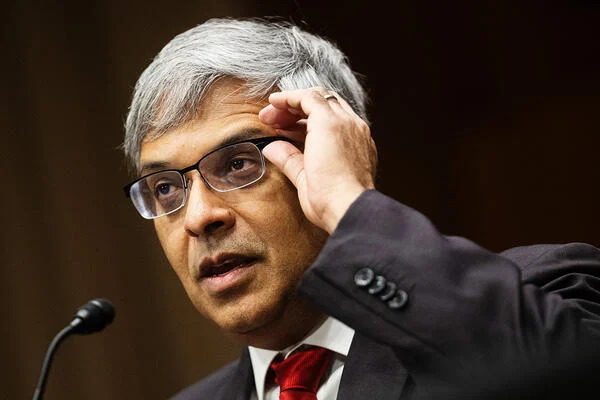
Dr. Jayanta Bhattacharya took over the National Institutes of Health and has pledged to support what the administration calls “gold standard science.” He’s become a vocal supporter of the Make America Healthy Again agenda, which focuses more on chronic diseases.
Jim Watson/AFP/Getty Images
Further, the NIH is eyeing ways to reduce how much of its grant dollars researchers can use to pay scientific journals to publish their work. The proposed options ranged from limiting how much could be spent per publication or capping the percentage of a grant that can go toward publishing fees overall, to no longer funding publication costs whatsoever. The NIH said in the summer that it planned to make whatever policy it chose effective early next year, but it only recently released the public comments, and an agency spokesperson said he couldn’t provide a definitive implementation timeline.
Just this week, Science published a memo showing that NSF is scaling back its reviews of grant proposals, citing its “significantly reduced” workforce and a need to expedite approvals and denials to address a “significant backlog of unreviewed proposals and canceled review panels” from the government shutdown. The memo also said NSF program officers are “expected to maximize their use of available automated merit review tools, especially tools that identify proposals that should be returned without review.”
And the NIH ordered staff last Friday to start using a “computational text analysis tool” to scan current and new grants for words and phrases that may mean they’re misaligned with NIH priorities. Staff were told to look out for terms such as “health equity” and “structural racism.” How this and the NSF policy changes will work in practice remains to be seen.
The educational improvement research field also awaits word on the future of the congressionally required Institute of Education Sciences (IES), which the administration gutted early this year amid its ongoing push to dismantle the larger Education Department. IES is the federal government’s central education data collection and research funding agency. Education secretary Linda McMahon hired a special adviser to “re-envision” it, but the plan hasn’t been released.
Overall, Pierce said 2026 “will continue to be a challenging year, especially for those researchers, institutions and trainees that have seen their grants terminated.” But she noted medical research is marked by passion for improving the nation’s health.
The suspect wanted in connection to a mass shooting at Brown University that killed two students and injured nine was found dead in a storage unit in Salem, N.H., authorities said at a news conference Thursday night.
They identified Claudio Manuel Neves Valente, 48, a former Brown student and Portuguese national, as the man they say barged into an engineering classroom at Brown last Saturday and opened fire on students attending a review session. Valente died from a self-inflicted gunshot wound.
“We are 100 percent confident that this is our target and that this case is closed from a perspective of pursuing people involved,” Rhode Island attorney general Peter Nerhona said.
Officials said they believed Valente was also connected to the murder of MIT nuclear physicist Nuno Loureiro earlier in the week. The same rental car had been spotted near Brown and outside Loureiro’s home, authorities said.
Loureiro was shot at his home Monday night and died at the hospital the next day. His home in Brookline, Mass., is about 50 miles from Brown. Authorities said that in the 1990s, Valente had attended the same university in Lisbon as Loureiro.
Brown President Christina Paxson said at the press conference that Valente had been a student at Brown in the early 2000s but withdrew. She noted that he was a physics student and had likely spent a lot of time in the Barus and Holley science building, where Saturday’s shooting took place.
Paxson wrote in an update Friday that the students injured Saturday were all improving; three had been released from the hospital and six remained in stable condition.
Officials said Valente entered the U.S. in 2000 on a student visa; he became a lawful permanent resident in 2017.
On Friday, the Trump administration announced it was suspending the green card lottery program through which Valente entered the country in 2017. The Diversity Immigrant Visa program, or DV1, allows some 50,000 people a year from low-immigration countries to participate in a random selection process for entry to the U.S.
Valente “entered the United States through the diversity lottery immigrant visa program (DV1) in 2017 and was granted a green card,” Secretary of Homeland Security Kristi Noem wrote on X. “This heinous individual should never have been allowed in our country. … At President Trump’s direction, I am immediately directing [United States Citizenship and Immigration Services] to pause the DV1 program to ensure no more Americans are harmed by this disastrous program.”
This story was updated 12/19 with news about the condition of the injured Brown students and the Trump administration’s pause on a visa lottery program.
For nine years, Inside Higher Ed published an annual list of predictions known as the In-and-Out List, before taking a four-year hiatus. That ends now. In the last edition, IHE staff called 2020 “a year from hell” and a “rough year for higher ed.”
As another year looms, colleges and universities are bracing for yet more upheavals as they try to navigate the new normal. Time—and 2026—will tell whether the sector is resilient enough to do so.
Below, we look at the rollercoaster that was 2025 and offer our own very loose predictions for what may lie ahead. Happy 2026.