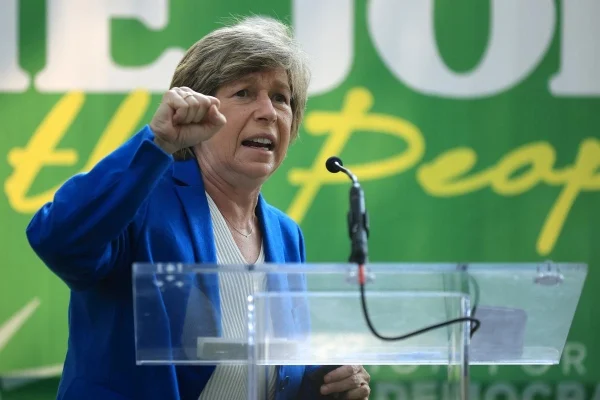
AFT President Randi Weingarten has been a loud advocate for protecting borrowers’ rights to loan repayment programs.
Chip Somodevilla/Getty Images
The Department of Education has accumulated a backlog of more than 800,000 applications for income-driven loan repayments (IDR) as of Dec. 15, according to the most recent status report in a lawsuit filed by the American Federation of Teachers (AFT).
The union originally sued the department in March for pausing all applications to IDR plans, loan consolidation and the Public Service Loan Forgiveness program, but the case was quickly settled as the department reopened the application portal and committed to providing regular status updates.
For five months, the status reports carried on and the case remained quiet. But then, in September, AFT filed an amended class action complaint and motion for preliminary injunction, arguing that just because the portal is open doesn’t mean it is working properly. Tens of thousands of applications were going untouched, violating the rights of the borrowers who submitted them.
In October, the department again reached a settlement with the plaintiffs, committing to process applications, and the motion was stayed. But now, with the latest status report released, AFT argues that the department isn’t holding up its end of the deal.
“The problem is they don’t appear to have kept their word,” Randi Weingarten said in a news release Wednesday. “The borrower backlog remains eye-popping, and Education Secretary Linda McMahon clearly has no idea how to manage this process.”
In addition to the backlog of pending loan repayment applications, the report shows that only 170 borrowers at the end of their IDR plan and 280 borrowers who have completed their PSLF payments have received their rightful loan forgiveness.
Weingarten suggested that in addition to loan forgiveness being low on the Trump administration’s list of political priorities, much of the backlog is due to major staffing cuts.
“Perhaps [Secretary McMahon] shouldn’t have sold the Department of Education off for parts,” the union president said. “President Donald Trump and Vice President JD Vance may believe affordability is a hoax, but hundreds of thousands of Americans just trying to get ahead are bleeding—and the administration’s lack of action is rubbing salt into the wound.”
So, until the department “follows the law and processes every single outstanding application,” she added, AFT will not stop fighting its case.
We’re approaching the end of a year that was at various times frightening, difficult and downright ridiculous. We hope that, despite the struggles higher education faced this year, you can still find something to be thankful for this holiday season, whether it’s generous donors making big differences for small campuses, colleges striving to improve cost transparency, or institutions supporting their communities through tough times.
If not, maybe you can take some inspiration from the videos below.
Here are Inside Higher Ed’s favorite holiday greetings, from the wacky to the artsy to the classy, showcasing the talents and holiday spirit of students, staff and faculty across the country.
Quinnipiac University, Hamden, Conn.
This slapstick sketch depicts Quinnipiac’s mascot, Boomer the Bobcat, messily preparing to welcome community members to his abode for Christmas dinner. Despite mishaps like spilling a bowl of assorted vegetables all over the floor and whisking what looks like mashed potatoes so feverishly they go flying, Boomer ends up putting out a beautiful spread—roast turkey, green beans, deviled eggs and more—for his delighted guests.
University of Louisiana at Monroe
The ULM Chamber Singers bring us a stirring adaptation of the 12 Days of Christmas entitled, no surprise, the 12 Days of Finals. Among the listed gifts is “ten paddlers paddling,” referring to the campus’s unique access to Bayou DeSiard, where students can borrow a kayak for free and paddle around to their heart’s delight.
Salt Lake Community College, Salt Lake City, Utah
Salt Lake Community College brings us another musical video, this time in the form of a tribute to Mister Rogers’ Neighborhood. President Greg Peterson takes on the titular role, singing: “We’ve made the most of this beautiful year, full of big hopes and holiday cheer. It’s education for you—it’s SLCC.edu. Will you join us next year?” Fuzzy video filters take the viewer back to old-school PBS, making the homage all the more nostalgic.
The University of Texas, Dallas’s Harry W. Bass Jr. School of Arts, Humanities, and Technology
This video highlights an annual tradition in an animation business development course at UT Dallas. The students are asked to design a holiday card and their peers then vote on the 10 best cards in the class. The winners’ cards are then printed and sold to fundraise for the school’s Student Emergency Fund. “I’m glad that our class is helping people have the reassurance that they need that they’re safe on campus and that somebody’s looking out for them if something does happen,” one of this year’s participants said.
Gonzaga University, Spokane, Wash.
College holiday greetings love to get a little bit meta. In this greeting, Gonzaga president Katia Passerini realizes she has forgotten to write a poem for this year’s holiday video. Luckily, student Alexis Sandoval just so happens to have a Christmas poem prepared, saving the day. Different members from the campus community, from a security leader to the university chaplain, recite the poem, bidding viewers to “rejoice in faith, carry peace and love into a happy New Year.”
Moraine Valley Community College, Palos Hills, Ill.
In this feel-good sketch, President Pamela Haney tries to bake a sweet treat for the college’s leadership team, but is missing a few key ingredients, including kindness and dedication. Luckily, teams from across the campus come to the rescue, bringing Haney everything she needs to finish making the cake. As one administrator says, “it’s amazing what we can do when we all work together.”
Wellesley College, Wellesley, Mass.
This year, the women’s liberal arts college celebrated 150 years since it welcomed its first class in 1875. As part of that celebration, the holiday video this year compiled archival footage and images submitted by alumni of winters on campus over the past century-and-a-half. The video, which features students sledding, ice skating, skiing and playing in the snow, is set over a song composed for the Class of 1948’s junior class show, which bemoans leaving Wellesley’s campus behind.
Community College of Philadelphia
“My Favorite Things” from The Sound of Music is everyone’s favorite non-Christmas Christmas song. Why has it entered the holiday songs zeitgeist? Who can say for sure, but I think we’re all glad it has. This particular rendition by CCP students and faculty sets the classic tune against a hip-hop beat and features a sick guitar solo.
University of Alabama, Tuscaloosa, Ala.
Uh-oh—President Peter Mohler is supposed to be helping write Christmas cards, but he’s nowhere to be found! This cheeky sketch shows that he’s shirking his responsibilities to do much cooler and more fun things, like play video games with students or shoot hoops with Big Al, the institution’s elephant mascot. Luckily, when his colleagues finally find him, he’s already finished the holiday cards. Crisis averted!
Tulane University, New Orleans, Louisiana
“What’s one Tulane memory you hope never melts away?” this video asks a gaggle of sweater-clad Tulane students. More than one note a once-in-a-lifetime Gulf Coast blizzard that shocked and delighted Tulane students this past January, with one saying it was “like a dream.” Others mention friends, sports championships and exploring the city of New Orleans.
Ask just about any federally funded researcher to describe 2025, and they use words like chaotic, demoralizing, confusing, destabilizing and transformational.
“It’s been a very destabilizing year [that’s made] people question the nation’s commitment to research,” Heather Pierce, senior director for science policy at the Association of American Medical Colleges, told Inside Higher Ed.
She expects 2026 to be a year of rebuilding and standard setting.
Speaking of the National Institutes of Health, which calls itself the world’s largest public biomedical research funder, Pierce said the research community is expecting more major regulation and written policy changes in 2026, which will shed more light on how grants will be funded, how much the federal government will invest in the research enterprise and what priorities will emerge from this administration.
If the administration’s attacks on federally funded research in 2025 are any indication, the federal government of 2026 will likely be just as willing to advance its conservative ideological agenda by controlling universities through the nation’s research enterprise. And while the administration may not let up in the new year, courts stymied some of its most sweeping changes in 2025 and may continue to be an obstacle in the new year.
Soon after President Donald Trump started his second term in January, the National Institutes of Health, National Science Foundation, Department of Education and numerous other federal agencies that collectively send billions in research dollars to universities, began freezing and terminating hundreds of grants. Many of the targeted grants—including projects focused on vaccines, climate change, and health and education disparities among women, LGBTQ+ and minority communities—were caught in the crossfire of Trump’s war against diversity, equity and inclusion initiatives and so-called woke gender ideology.
Not only would the terminations lead to the loss of jobs, staff and income, a lawsuit filed by a group of NIH-funded researchers in April predicted that “scientific advancement will be delayed, treatments will go undiscovered, human health will be compromised, and lives will be lost.”
The true damage comes from the betrayal, the sense of uncertainty and the loss of trust researchers have—or had—vis-à-vis with the federal government. That’s really hard to quantify.”
Scott Delaney, cofounder of Grant Witness
Terminated federal grants encompassed a wide range of research projects. Some of the casualties included funding to study the erosion of democracy, the effectiveness of work study, dementia, COVID-19, cancer and misinformation. Others supported teacher-training programs and initiatives designed to attract more underrepresented students into STEM fields.
“The premise of this award is incompatible with agency priorities,” read a letter the NIH sent to numerous researchers back in March, terminating their active grants. “[R]esearch programs based primarily on artificial and nonscientific categories, including amorphous equity objectives, are antithetical to the scientific inquiry, do nothing to expand our knowledge of living systems, provide low returns on investment, and ultimately do not enhance health, lengthen life, or reduce illness.”
But it didn’t stop there.
The Trump administration also temporarily froze billions more dollars in federal research grants at a handful of the nation’s wealthiest, most selective institutions, including Harvard University, Columbia University and the University of California at Los Angeles, for allegedly failing to address antisemitism on campus and ignoring the Supreme Court’s ban on affirmative action, among other allegations. (Most of the universities got their money back after cutting deals with the administration or via court orders.)
Faculty in the University of California system successfully fought the administration’s funding cuts, winning court orders to restore the money.
Justin Sullivan/AFP/Getty Images
And because the NIH, NSF, ED and several other federal agencies also laid off thousands of workers, researchers with questions had far fewer resources to help them navigate changes to application and award processes.
By some estimates, the government disrupted upward of $17 billion in NIH grants alone this year, according to Scott Delaney, a former lawyer and Harvard University epidemiologist who the university laid off as a result of grant terminations.
Earlier this year, he cofounded Grant Witness, a website that has been tracking grant cancellations at the NIH, NSF and the Environmental Protection Agency. While both the NIH and NSF have since restored thousands of grants, Delaney said those and other restorations won’t be enough to repair the now-fractured relationship between faculty and federal funding agencies.
“The true damage comes from the betrayal, the sense of uncertainty and the loss of trust researchers have—or had—vis-à-vis with the federal government. That’s really hard to quantify,” he told Inside Higher Ed this month. “In the years ahead, there will be folks who don’t want to plan long-term research projects because they don’t know if their funds are going to get summarily yanked out from underneath them; folks who don’t want to continue their careers in academic research or train in academic research; trainees who would have had training grant support who don’t now and go do something else. And some researchers will just leave the country.”
In addition, some of the Trump administration’s research funding proposals have stoked worry this year about the long-term sustainability of the nation’s academic research enterprise.
Numerous agencies—including NIH, NSF and Department of Energy—have attempted to cut university reimbursement rates for indirect research costs. Higher education and science advocates characterized such policies as “shortsighted and dangerous,” and said it would hamper university budgets, hurt the economy and stymie scientific progress. Although federal courts have since blocked the rate caps, the mere anticipation of such policy changes led some universities—including the Massachusetts Institute of Technology and Northwestern University—to freeze hiring and, in some cases, graduate admissions.
But by September, the NIH said it was on track to spend its full $47 billion budget by the end of the fiscal year that month.
However, the NIH awarded 3,500 fewer competitive grants this year with the biggest declines at the Institutes of minority health, nursing, human genome, alcohol abuse and alcoholism and mental health, according to The New York Times. Those changes are part of the White House’s plan to streamline scientific funding by eliminating wasteful spending and cutting “woke programs” that “poison the minds of Americans.”
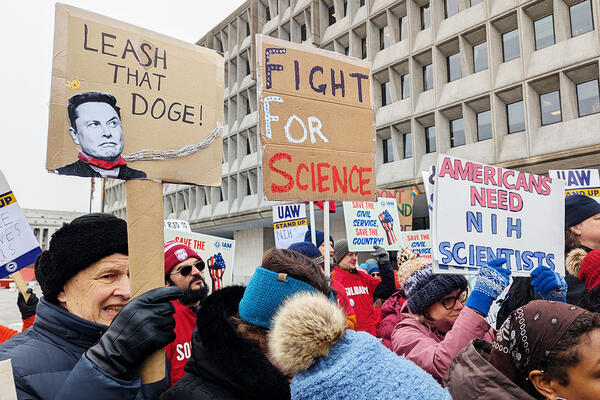
The cuts to federal agencies and research spurred protests in the spring.
As 2025 fades into 2026, the federal research funding picture isn’t looking as bleak—at least not on the surface.
A flurry of litigation from universities, individual researchers, trade associations and labor unions prompted several federal agencies to reinstate some research grants.
All things considered, 2025 “could have been worse, but it was still awful,” Delaney said, noting that there are still thousands of grants in limbo at the NSF, DOE and numerous other agencies beyond the NIH.
“So many people fought so hard—some of them sacrificed their jobs inside these federal agencies—and they succeeded in many ways. To tell a story that doesn’t include both their sacrifice and their success discredits what was a Herculean and heroic effort for scientists, many who have never spoken up in a political way before this year,” he added. “But it’s also important to emphasize that this fight isn’t over, and we need to keep fighting. It can get worse.”
‘Not Insulated From Politics’
Katie Edwards, a social work professor at the University of Michigan, is one of the researchers who sued the NIH. In March, the agency canceled six grants she was using to research mental health and violence prevention among marginalized young people, including Indigenous and LGBTQ+ youth. Valued at $10 million, the grants supported roughly 50 staff, community collaborators and trainees and put them all at risk of losing their jobs.
“For many trainees—especially those who are LGBTQ+ or people of color—the message they internalized was painful: that research on their communities is ‘ideological’ or expendable,” Edwards wrote in an email to Inside Higher Ed. “The emotional toll of fighting for and protecting staff, reassuring community partners, and trying to navigate a constantly shifting federal landscape has been immense.”
Fighting for Public Health Research
April: A group of NIH researchers, a public health advocacy organization and a union representing more than 120,000 higher education workers sued the NIH for terminating more than $2.4 billion in grants.
August: The U.S. Supreme Court ruled by a vote of 5 to 4 that any legal challenges to the grant terminations should be litigated in the Court of Federal Claims, not the federal district court system they’ve been moving through for months.
Edwards
University of Michigan
Although her grants have since been reinstated—albeit some with reduced dollar amounts, administrative delays and anti-DEI language in the notice of award—and her team has resumed their work, this year has forever changed her perspective on research.
“This year made clear that science is not insulated from politics—and that researchers must be prepared to defend not only their projects, but the people those projects exist to serve,” Edwards said. “Federally funded research with marginalized communities requires constant vigilance, strong partnerships, and collective resistance. We cannot simply adjust our science to political winds when real communities rely on this work.”
But not every researcher who appealed a grant termination got their money back.
In March, the Education Department informed Judith Scott-Clayton, a professor of economics and education at Teachers College, Columbia University, that it was cancelling her six-year grant to examine the impact of receiving federal work-study funding on enrollment and persistence among low-income students four and a half years into the grant.
Teachers College appealed the decision in April, but the government rejected it in September, stating that Education Department grants were specifically excluded from Columbia University’s settlement with the Trump administration. Support from a private foundation allowed Scott-Clayton and her team to resume their research this November, but she told Inside Higher Ed that the disruptions to research have been “extremely unsettling and demoralizing.”
And she’s not certain that 2026 will be any better.
“Even though I believe in the value of what I do, self-doubt can flare up when an authority as significant as the federal government formally declares your work to be a waste of resources,” she said. “I am not sure what the future of our field looks like if our federal government no longer values research evidence. And I am not sure what our society looks like if the federal government can make decisions so arbitrarily without any consequences or constraints.”
New Year, Old Concerns
This year is ending with unresolved questions about what the Trump administration’s research policies will ultimately be, and how much the federal government will fund research. Pierce at the Association of American Medical Colleges said she expects next year will provide answers.
Joanne Padrón Carney, chief government relations officer for the American Association for the Advancement of Science (AAAS), said “I think the [the Energy Department’s] Genesis mission and the prioritization of artificial intelligence and emerging technologies is going to be a key driver in—I guess you could say—filling in the cracks of the foundation of the research enterprise that has been kind of hit by this earthquake in the past year.”
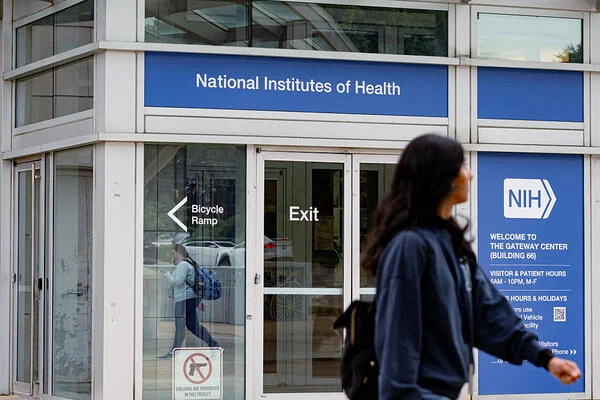
The National Institutes of Health has cut staff and is eyeing other changes to how it funds research.
Wesley Lapointe/The Washington Post via Getty Images
The continuing resolution that ended the historically long federal government shutdown in November expires Jan. 30, and Congress is leaving town for the holidays without passing funding bills for some major science funding agencies, including the NIH, NSF and Energy.
Trump proposed slashing about $5.2 billion from the NSF. But House appropriators have suggested cutting $2.1 billion, while senators only put forth axing $60 million, according to an appropriations debate tracker from the AAAS. And while the president proposed cutting nearly 40 percent from the NIH—$18.1 billion—the House and Senate have instead suggested increasing its funding by roughly $1 billion, the tracker shows. That pushback from Congress is promising, advocates say.
And colleges and universities are still waiting for federal research funding agencies to set indirect cost reimbursement caps, after litigation blocked their plans to set the limit at 15 percent. The forthcoming OMB guidance setting those caps is also supposed to help agencies implement Trump’s controversial August executive order directing “senior appointees” to take charge of awarding, denying, reviewing and terminating new and already awarded grants. Among other changes, that order also said grants can’t “promote” racial preferences or “the notion that sex is a chosen or mutable characteristic,” and that they “should be given to a broad range of recipients rather than to a select group of repeat players.”
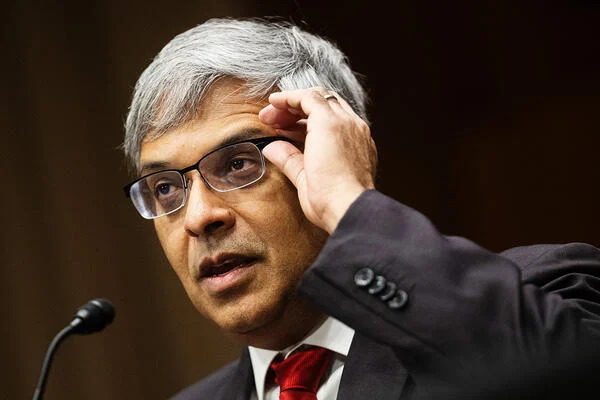
Dr. Jayanta Bhattacharya took over the National Institutes of Health and has pledged to support what the administration calls “gold standard science.” He’s become a vocal supporter of the Make America Healthy Again agenda, which focuses more on chronic diseases.
Jim Watson/AFP/Getty Images
Further, the NIH is eyeing ways to reduce how much of its grant dollars researchers can use to pay scientific journals to publish their work. The proposed options ranged from limiting how much could be spent per publication or capping the percentage of a grant that can go toward publishing fees overall, to no longer funding publication costs whatsoever. The NIH said in the summer that it planned to make whatever policy it chose effective early next year, but it only recently released the public comments, and an agency spokesperson said he couldn’t provide a definitive implementation timeline.
Just this week, Science published a memo showing that NSF is scaling back its reviews of grant proposals, citing its “significantly reduced” workforce and a need to expedite approvals and denials to address a “significant backlog of unreviewed proposals and canceled review panels” from the government shutdown. The memo also said NSF program officers are “expected to maximize their use of available automated merit review tools, especially tools that identify proposals that should be returned without review.”
And the NIH ordered staff last Friday to start using a “computational text analysis tool” to scan current and new grants for words and phrases that may mean they’re misaligned with NIH priorities. Staff were told to look out for terms such as “health equity” and “structural racism.” How this and the NSF policy changes will work in practice remains to be seen.
The educational improvement research field also awaits word on the future of the congressionally required Institute of Education Sciences (IES), which the administration gutted early this year amid its ongoing push to dismantle the larger Education Department. IES is the federal government’s central education data collection and research funding agency. Education secretary Linda McMahon hired a special adviser to “re-envision” it, but the plan hasn’t been released.
Overall, Pierce said 2026 “will continue to be a challenging year, especially for those researchers, institutions and trainees that have seen their grants terminated.” But she noted medical research is marked by passion for improving the nation’s health.
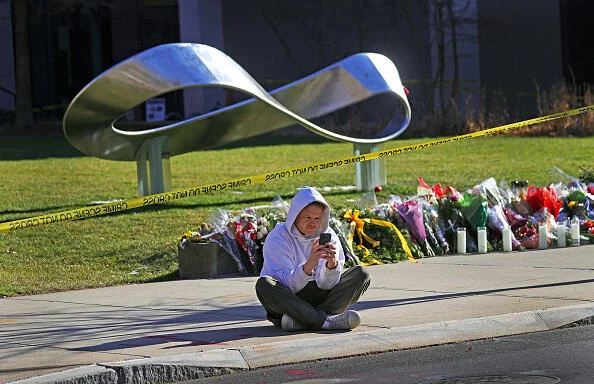
The suspect wanted in connection to a mass shooting at Brown University that killed two students and injured nine was found dead in a storage unit in Salem, N.H., authorities said at a news conference Thursday night.
They identified Claudio Manuel Neves Valente, 48, a former Brown student and Portuguese national, as the man they say barged into an engineering classroom at Brown last Saturday and opened fire on students attending a review session. Valente died from a self-inflicted gunshot wound.
“We are 100 percent confident that this is our target and that this case is closed from a perspective of pursuing people involved,” Rhode Island attorney general Peter Nerhona said.
Officials said they believed Valente was also connected to the murder of MIT nuclear physicist Nuno Loureiro earlier in the week. The same rental car had been spotted near Brown and outside Loureiro’s home, authorities said.
Loureiro was shot at his home Monday night and died at the hospital the next day. His home in Brookline, Mass., is about 50 miles from Brown. Authorities said that in the 1990s, Valente had attended the same university in Lisbon as Loureiro.
Brown President Christina Paxson said at the press conference that Valente had been a student at Brown in the early 2000s but withdrew. She noted that he was a physics student and had likely spent a lot of time in the Barus and Holley science building, where Saturday’s shooting took place.
Paxson wrote in an update Friday that the students injured Saturday were all improving; three had been released from the hospital and six remained in stable condition.
Officials said Valente entered the U.S. in 2000 on a student visa; he became a lawful permanent resident in 2017.
On Friday, the Trump administration announced it was suspending the green card lottery program through which Valente entered the country in 2017. The Diversity Immigrant Visa program, or DV1, allows some 50,000 people a year from low-immigration countries to participate in a random selection process for entry to the U.S.
Valente “entered the United States through the diversity lottery immigrant visa program (DV1) in 2017 and was granted a green card,” Secretary of Homeland Security Kristi Noem wrote on X. “This heinous individual should never have been allowed in our country. … At President Trump’s direction, I am immediately directing [United States Citizenship and Immigration Services] to pause the DV1 program to ensure no more Americans are harmed by this disastrous program.”
This story was updated 12/19 with news about the condition of the injured Brown students and the Trump administration’s pause on a visa lottery program.
We are grateful to Inside Higher Ed editor in chief Sara Custer in her recent column “Higher Ed Faces Competing Visions for Its Future” (Dec. 18, 2025) for mentioning Advancing Public Trust in Higher Education, the initiative we co-direct at the American Association of Colleges and Universities. We write to expand upon Custer’s review of the emerging responses to the trust problem and to clarify what our initiative is advocating and doing to invigorate public trust.
Higher ed cannot restore public trust in colleges and universities unless the sector reckons in a clear-eyed fashion with the causes of the current crisis. Simply put, the fundamental problem is that when the sector or its individual institutions draw public criticism, we are unable either to make quick changes in response, to explain compellingly why we should not do so, or to redirect public attention effectively toward the overall value and purpose of our work. Under increased scrutiny from the public and government alike, that paralysis is a recipe for a disastrous decline in public trust.
Solving this crisis will require a multipronged approach that balances internal reform—although not along the lines of the administration’s ill-fated Compact—with better communication and collective defense strategies. Higher education must become better and nimbler at making changes that already have wide support but are held back by parochial interests; better at relentlessly prioritizing engagement with local communities; and better at offering a meaningful welcome to all students, including those with conservative views and others who feel alienated from our institutions. We also need to be better at mounting a vigorous and coordinated sectorwide defense when we are in the right, and at communicating our value and purpose clearly and effectively so that the public can put things into context when we inevitably make mistakes.
Our view is that internal reform, improved communication, and better defense are inseparable parts of a whole; higher education will not regain public trust, or reestablish productive partnerships with the government and our communities, unless we pursue all three goals simultaneously. Our vision is of a sector that is agile, responsive, invitational, humble and trusted to generate new knowledge and transform students’ lives. If colleges and universities act smartly and collectively, we believe that vision is within reach.
We look forward to sharing more specifics about our approach with Inside Higher Ed’s readers over the coming months.
Jeremy C. Young is Senior Advisor for Strategic Initiatives, and Kathryn Enke is Vice President for Leadership and Strategy, at the American Association of Colleges and Universities
Coursera and Udemy both launched during the MOOC boom of the early 2010s.
Allison Shelley/Complete College Photo Library
To keep pace with advances in generative artificial intelligence technology, two big online learning companies are planning to merge in a deal valued at $2.5 billion.
Coursera announced its plans to absorb Udemy in a news release Wednesday; both companies launched during the massive open online course provider boom of the early 2010s. Coursera, which offers a variety of courses, certifications and degrees, expects the all-stock merger to be finalized by the second half of 2026 and to generate more than $1.5 billion in annual revenue.
Combining the two companies is also estimated to save $115 million in operating costs over the next two years and allow for sustained investment in “AI-driven platform innovation, rapid product development, and durable growth initiatives,” according to Coursera’s statement.
Since Open AI launched ChatGPT three years ago, nearly every industry has moved to incorporate generative AI into its operations, and higher education is no exception. Although still contentious, students and faculty are increasingly using generative AI to help with research, writing and studying; a number of universities have launched campuswide AI partnerships with technology companies. In addition, learning management systems are touting their new AI capabilities, and employers say they want AI-ready graduates.
Greg Hart, CEO of Coursera, said the companies are merging to better help learners, instructors, and enterprise, university and government customers keep up with the changes.
“We’re at a pivotal moment in which AI is rapidly redefining the skills required for every job across every industry. Organizations and individuals around the world need a platform that is as agile as the new and emerging skills learners must master,” he said in the release. “By combining the highly complementary strengths of Coursera and Udemy, we will be in an even stronger position to address the global talent transformation opportunity, unlock a faster pace of innovation, and deliver valuable experiences and outcomes for our learners and customers.”
For humanities faculty, the past five years have felt like a relentless assault on our ability to do our jobs. We have endured COVID, generative AI, budget cuts, and bitter fights over the Oct. 7 Hamas attack and Israel’s war on Gaza. At times it has been a challenge to remain human, let alone humanistic: to calm the nervous system enough to read a book, refine an argument, or show up for our colleagues and our increasingly fragile students. Now we are facing the Trump administration’s effort to gut-renovate our universities under the pretext of “combatting antisemitism.” With local enablers paving the way, that destruction may yet succeed.
In February of this year, a few colleagues and I co-founded a group called Concerned Jewish Faculty & Staff (CJFS), which now has more than 200 members on more than two dozen campuses. Our group, which is predominantly made up of academics at Massachusetts colleges and universities but includes members from across New England, is one of several such efforts nationwide that have coalesced into a new National Campus Jewish Alliance. We recognize that Jewish safety is inseparable from the safety of all people, and we work to foster academic environments that reduce antisemitism by treating educators as partners, not as suspects. I’d like to share a few examples of what this looks like in practice.
Fearmongering Versus Tea
As a Jewish professor of Arabic at Boston University, I mentor students with many different identities: Arab, Jewish, both or neither. After Oct. 7, 2023, I watched them struggle to metabolize the horrors in Israel and Gaza. They identified with various “sides” of the Palestinian-Israeli conflict; what they shared was a sense of helplessness and a hunger for facts and insights beyond those found on Instagram. They needed contact with solid reading material, with trusted adults and, above all, with each other. My colleagues and I were in pain too. By mid-October, a few of us began meeting to discuss how to nurture a respectful and humane campus climate for ourselves and our students.
As we looked around for helpful approaches, we noticed one very unhelpful one: Keep people constantly triggered so their brains can’t process new information or perspectives.
Instead of trying to lower the temperature after Oct. 7, one influential institution on our campus immediately began stoking fear of antisemitism. On Oct. 18, they sent out an email telling students to record and report all instances of “antisemitism and anti-Zionism.” They encouraged students to submit videos and screenshots of their classmates. They conflated antisemitism and anti-Zionism, strongly implying that criticism of Israel’s government threatened the identity and even the safety of Jewish students at BU. They ignored the inconvenient facts that a great proportion of anti-Zionists at BU are Jewish and that nationwide, plenty of Israel supporters are antisemitic. Even worse than this bad-faith conceptual stew was the subtext. We know you’re scared. We know you feel everyone hates you. Although this university has 4,000 Jewish undergraduates, you’re basically alone and unsafe here. But don’t worry; we have your back. This gaslighting maneuver only stoked the anxieties it purported to calm.
What my colleagues and I did instead was much smaller in scale. Four tenured humanities professors (all moms, as it happened) started gathering students for tea. We chose to work together because we did not agree about what was happening or should happen in the Middle East, but we respected and liked each other. Each of us personally invited a few students, for a total of about 12 per gathering. This was not an advertised event but a series of private teas. My colleagues brought concerned Muslim and Arab students, liberal Zionist students, and eventually some leaders of BU Students for Israel and the Hillel. I invited Arabic learners from various backgrounds and some pro-Palestinian students I knew, including some leaders of Students for Justice in Palestine. (Others, who had been doxxed, were scared to come.) We brought substantial and slightly awkward snacks, things like pistachios, clementines and pomegranates to keep people’s hands busy. We sat around in armchairs, more conversation circle than summit meeting. And we made one ground rule: For these 90 minutes you can’t talk about the region, which we can’t fix, but only the BU campus, which we share.
When we passed a timer around the room, giving every student and faculty member 60 seconds to say what was on their minds, everyone heard at least one thing they didn’t expect. One male Jewish student who sometimes wore a kippah and sometimes didn’t told of how differently people looked at him in those two situations. The Muslim women—hijab-wearing or not—understood. As trust grew, students felt comfortable asking each other questions like, “Why do people tear down posters of Israeli hostages?” or “Why did your group blast disco music over our die-in?”
The last tea occasioned two tiny breakthroughs. One student suggested BU’s “Jewish trustees and donors” were blocking the student movement to divest from Israel. Really? Together we checked the website: In fact, two of our most senior trustees are Arab. The student was taken aback, changing her view without ever being accused of antisemitic bias; everyone learned something. Later, a Palestinian student asked a pro-Israel Jewish student what the word “Zionism” meant to him. He began defining it, starting with “the right of the Jews to have self-determination in their ancestral homeland, Eretz Yisrael.” As she looked confused, he blushed and stammered, using more Hebrew words she didn’t understand. Finally he stopped: “I’m sorry, I’ve never had to explain this before. I’ve always been in Jewish schools or camps or Hillel or places where everyone just understood what Zionism means.” The conversation moved on. The next day he and his roommate came to my office to worry that he had not “represented his side” well enough; we talked for an hour; I assured him that he represented only himself, a student trying to learn and figure out what he believed. I doubt his politics changed, but the moment of aporia made everyone more human. When CJFS organized a Freedom Seder the next April, both he and his roommate came.
Administrators have asked us how to scale up this effort. My long-term hope is to train students and colleagues to be peer educators in their own networks. But it would need to start small, with faculty and staff who trust each other. There are no shortcuts.
Policing Versus Conversing
Such efforts may soon be complicated by a harmful state-level effort by the politicians and legacy Jewish groups who make up the Massachusetts Special Commission on Combatting Antisemitism, which was established by the state legislature in 2024 and has been touted as a model for other states.
The Commission furthers a nationwide plan to advance a program of what is fair to describe as “Don’t Say Palestine” policies. It aligns with the Anti-Defamation League’s (ADL) state-by-state Jewish Policy Index, which calls for such commissions, and follows the exact playbook of the Israel advocacy group ICAN (the Israeli-American Civic Action Network), which aims to bring hyperlocal pro-Israel advocacy to cities, towns and school boards, especially in blue states. A Massachusetts state senator has praised ADL CEO Jonathan Greenblatt for encouraging the establishment of the commission; ICAN has boasted of its influence on the process.
One reason our group, Concerned Jewish Faculty & Staff, has grown so fast is that everyone can see the Trump administration weaponizing antisemitism to attack universities and degrade civil rights. But another reason is anger at this state-level commission right here in our beloved Massachusetts, which has taken its eye off actual antisemitism and focused instead on policing discourse about Israel.
The Commission conflates Jewishness with Zionism, pushing the incoherent and dangerously vague International Holocaust Remembrance Alliance (IHRA) definition of antisemitism and other sloppy ideas. But a deeper problem is its punitive approach, which focuses on policing a boundary of what is and isn’t antisemitic. In its 13 months of hearings, the Commission has modeled the punitive approach by attacking educators, publicly haranguing the (Jewish) president of the Massachusetts Teachers Association (MTA) for two hours last February over some materials on an MTA website. In its final report, released in November, the Commission aims to institutionalize the punitive approach by creating a mechanism through which members of the public can report “problematic curriculum” in K-12 schools, as well as an anonymous reporting system for suspected acts of bias in K-12 schools “which may not rise to the level of a hate crime.” If adopted in any city or town, these measures will create an unpedagogical climate where teachers are afraid to teach and students hesitate to speak up in class: No one wants to be reported as an antisemite, even if the charge is disproven later. At best, such a climate will only drive anti-Jewish bias underground; at worst, because schoolchildren and college students are sensitive to hypocrisy, it will spark resentment and feed an anti-Jewish backlash. Several Concerned Jewish colleagues have written movingly on this commission’s dangers; CJFS has released a Shadow Report detailing its faulty assumptions and missteps.
The question is what to do instead. What is a humane, pedagogical response to rising tensions and the ambient normalization of bigotry in all forms? Again, learning can happen only in an environment of respect and trust.
Let’s take an example of casual classroom antisemitism. In March 2024, my Core Curriculum class was reading Foucault and discussing the Panopticon surveillance regime. When the talk turned to Internet culture and public discomfort with social media, one normally tuned-out student suddenly piped up: “The Jews want to ban TikTok. They’re against its pro-Palestine content.” The Jews. Because we all automatically love Israel and hate free speech? Luckily, I was the teacher; I could explain why it was incorrect to say some entity called “the Jews” either wanted or were able to control social media. I could cite a 2020 Pew research poll saying 41 percent of Jewish Americans are emotionally unattached or weakly attached to Israel. (Among secular Jews, that figure is 67 percent.) I could point out that the great majority of Israel’s U.S. supporters are not Jewish at all: One Evangelical lobby group, Christians United for Israel, claimsten million members, 2.5 million more than the total number of Jews in America. If this discussion happened today, I could cite a survey from The Washington Post finding that about 4 in 10 American Jews believe Israel has committed genocide in Gaza. And because I feel safe in my classroom—because my university does not endorse the conflation of Jewishness with Zionism—I could personally vouch that many Jewish people disavow nationalism altogether.
Now, let me share an example of misperceived classroom antisemitism from my 40-person general education course, War in Arabic Literature and Film. The course confronts some difficult material set in Iraq, Syria, Lebanon and Israel-Palestine. We learn how war can harden sectarian identifications and gender roles. We read some American and Israeli authors as sidelights. We do a lot of social-emotional scaffolding and role-taking; students sit in small discussion groups, and I collect exit notes.
One student, a self-described “proud Zionist,” was a wonderful presence in the course’s fall 2024 first run. But one day she was crying after class, and her exit note said: “I loved this course and was about to recommend it to all my Jewish friends, but now I can’t, because I feel today’s discussion was antisemitic.” That day’s session had focused on Ari Folman’s Waltz with Bashir, a stunning Israeli film about Israel’s 1982 invasion of Lebanon, paired with a student presentation on Edward Said’s classic essay, “Permission to Narrate.” (Incidentally, Waltz violates the IHRA definition of antisemitism, comparing the Sabra and Shatila massacre to Auschwitz.)
I caught up with my student and we talked for an hour in the street and in my office. Raised to sincerely experience criticism of Israel as antisemitic, she felt hurt by the student presentation. I did not try to tell her about Edward Said’s humanistic outlook, deep empathy for Jewish victims of the Holocaust, or anything else. Instead, trusting her seriousness and troubled by her distress, I suggested: What if she was upset not by the reading material, but by the frame? Would she have preferred me to assign the Said essay as a primary source to analyze rather than an authoritative secondary source for a presentation? She said yes, that would be different. I offered to revisit that part of my syllabus the following year, empowering students to talk back to Said if they wished. She contributed enthusiastically to class for the rest of the semester.
I am so grateful that this brave young woman shared her concerns with me rather than running to a dean, a “problematic curriculum” hotline, or a politico-religious organization, as students are being urged to do. By talking to each other honestly like intelligent adults, we both learned something.
These experiences have convinced me that policing “antisemitic” speech about Israel is not only unjust but deeply counterproductive: it breeds suspicion between well-meaning people, making it harder for us to unite when genuine neo-Nazism rears its head. You can’t stamp out antisemitism, fear of Palestinians, or any other prejudice; only slow heart-changing conversations can melt it away. So, to foster a campus climate of real inclusion, we need to convene and converse, not record and report. The details are tricky, but teachers and students can figure them out together. Our administrations and governments just have to give us the respect, job security and academic freedom to do so.
Margaret Litvin is an associate professor of Arabic and comparative literature at Boston University and a co-founder of Concerned Jewish Faculty & Staff.
In 2018, the Supreme Court struck down a ban on state-authorized sports betting, opening the floodgates to an industry that dumps billions of dollars into state budgets. According to the American Gaming Association, Americans wagered $119.84 billion on sports events in 2023, up 27.5 percent from the previous year. Professional leagues attract the highest betting volumes, but gambling in college sports is growing, according to Jim Borchers, president and CEO of the U.S. Council on Athletes’ Health (USCAH) and chief medical officer for the Big 10 Conference.
Digital platforms, gamification and prop betting are driving this boom, he says. A former Ohio State football player, Borchers argues the influx in gambling threatens the integrity of college sports and risks athletes’ mental and emotional health. Name, image and likeness payments, combined with media revenue-sharing, contribute to a new reality for college sports that is more transactional than ever, with huge sums of money flowing in and out.
To help students and institutions respond to the new environment, USCAH developed an accreditation process mapped to the National Collegiate Athletics Association’s best practices and standards of care. USCAH launched the program in September and is already working with 40 institutions at every level of college athletics from the power four conferences (the Big 10, SEC, Big 12 and ACC) to Division III institutions.
Gambling is now an integral part of college athletics, Borchers acknowledges, but he is hopeful the new accreditation system will guarantee that student athletes’ health isn’t lost along the way.
This interview has been edited for length and clarity.
Q: In 2018, the Supreme Court ended the federal ban on sports gambling. From your vantage point, how has that changed gambling in college athletics?
A: It’s been in the back rooms and dark corners, but I think gambling always existed, and there was always a concern around integrity in sport. But in the last five to seven years, gambling has exploded, and it’s really become part of the fabric of sport, so much so that many people consider it like a video game. It’s so easy make a wager on so many different things in sport. And it seems like it’s just a normal part of what goes on. So the technology piece of it—the predictive markets, the prop bets, the things that go beyond “is Team A going to beat Team B by a certain number of points?”—have a huge effect on the individual and that’s something that we have to take into account when we think about how this affects sport.
Jim Borchers, president and CEO of the U.S. Council on Athletes’ Health and chief medical officer for the Big 10 Conference
Q: Prop betting is where gambling gets more sophisticated, but also a bit wacky. How does prop betting, in particular, affect athletes?
A: It gets really wacky because you’re betting on things that individuals may or may not do, or things that you would expect them to do in real time during the course of a game. I’ve explained it to people as: If you play a team sport and the overall objective is to play well and have your team win, you can have a good outcome. You and your coach could feel like you played pretty well. But if you didn’t meet these prop bets, all of a sudden you start seeing negativity around the way you performed, and you start thinking, “Wait, am I really doing what I should be doing?”
How does that affect someone who’s 18 or 20 years old? It creates a whole outside amount of stress that obviously can become pretty specific for the individual. It can be very harassing. It can be malignant. It can be damaging. And I think that’s where you’ve seen a lot of the movement to try to get prop bets and predictive markets out of the sport betting market. But I just don’t think that’s realistic. The train has left the station, and we need to think of different ways to address it.
Q: Especially because these betting companies buy TV ads during the games. Gambling is totally integrated in the college sport business. There’s just no way that you can separate them.
A: And their number one market is males, ages 18 to 24. They give you free bets. They’re trying to create habits. Gambling, in and of itself, can be a very addictive and malignant behavior and lead to all sorts of health issues and personal issues. But there are a lot of people who don’t think anything of, “Yeah, I’ll take 20 bucks and make a few bets and see if I can hit something this weekend.” I think they see that as part of the fun of sport, rather than being invested in the sport or the game itself.
Q: Give me some examples of the impact you’ve seen gambling have on student athletes.
A: This whole financial marketplace now exists in college athletics—even high school athletics now has NIL payments—and so sport as a financial vehicle is growing, and these markets are growing, and that causes them stress. Young athletes are developing physically and mentally. Do we expect them to have a skill set to manage that financial stress like an adult, or the experiences and the ability to develop that skill set? I think it is misguided.
You add into that the pressure of outside influences who now have their own financial market where they’re making these bets and providing those bets. And they can make comments to that person directly either on social media or direct messaging. It’s easy for me as a 55-year-old to say, “I’ll just turn my phone off,” but that’s not how these folks operate. It impacts their mental and emotional health, and that impacts their performance. We know athletes have to be physically, mentally and emotionally well to perform at their best.
Q: You mentioned that these betting agencies are focusing on 18- to 24-year-old men, and I would take a guess that most of the games they’re betting on are football and men’s basketball. Is there enough discussion about this being an issue for males in particular?
A: I don’t think there’s enough discussion at all, because the focus gets drawn away from the actual event. The other piece of it is, oftentimes, it’s peer groups that are engaging in these behaviors. It’s people that athletes see on campus or in their classes. It’s led to more isolation and more silos. College athletes feel like they have to wall themselves off from all of those parts of the college experience that are important to the overall development of a young adult.
Look, higher education serves a lot of roles. There’s a knowledge base and building a foundation in a field of study. But there’s developing as a young adult through social interactions—being on your own for the first time and learning to engage in the community and interact with people with similar beliefs or maybe different beliefs. I think you’re seeing athletes become more isolated and unable to participate in that. In some way it’s stunting their development, and they leave college then, as young adults, without having had a lot of those experiences.
Q: Division I sports and the big four conferences are where we see big sums of NIL payments and revenue sharing. Is gambling concentrated in those areas of college sport too?
A: Gambling is universal. There’s a marketplace for everything. With the recent NCAA basketball issue you saw how it seeps down into schools, where people would have thought, wow, really, people are betting on these events? It’s misguided to think this is only happening at the highest level of sport. And I think it’s misguided to think that athletes themselves aren’t invested in it and doing it.
Q: I even read a story about a bus driver who saw an athlete was limping and then capitalized on that.
A: Yeah, information and the ability to gain information is key. You’re seeing people go to all sorts of lengths to try to find out information. And that introduces a whole different set of malignant consequences to that part of this industry. They’re trying to find out information from the individuals: people that are working with the medical staffs, as you mentioned, a bus driver. Are you a food services person? Are you doing something with athletes where you’re able to garner some information and pass that information off? And then there are the athletes themselves. If they are being approached for information and maybe think, “Well, I’m just giving an injury update on someone,” but they don’t realize the effect that’s having in the larger environment around wagering and sport.
Q: To your point about integrity earlier, the amount of money in college athletics points to a greater question around the integrity of college athletics as a whole. Where is this all going?
A: To me, it’s asking, “What is the purpose of sport?” Is sport, and your ability to participate in a sport and be good in sport, a financial vehicle? And if it is, what role does it play in education-based athletics? In the United States, sport is so much a part of what the community is and how people identify with an institution. But the financial markets are creating a transactional nature to it. I think most college athletes just want sport to continue to be part of their college experience, because it’s what they’ve known. They want to go to school, have a peer group and play a sport they enjoy. When it becomes a financial vehicle, there’s a whole different aspect to sport because now your efforts and what you’re doing in sport are objectively equated with a dollar amount.
And how do we reconcile those two? It’s really challenging. Now that you have athletes in college making seven figures, they’re probably the financial engine for their families. Their purpose and why they’re there has changed. Not that sport hasn’t always been a big part of the collegiate experience, but if you’re paying somebody a million dollars or $500,000 to participate in sport, I don’t think they’re going to have much focus on any of the other reasons why they’re in college.
Q: From my conversations with university leaders, it’s clear they’re not happy about how much money is flowing through athletics. But here we are. What can colleges do?
A: Our most recent initiative is accreditation for athletic departments on health, safety and well-being. The other reality is I don’t know that athletic departments are complex enough to handle those and all the issues around the financial part of the business. Now there’s a whole different risk profile to sport when people are making this kind of money. I think you’re going to see more lawsuits because there’s going to be lost wages or an inability to earn income.
We have to acknowledge that and then be very transparent about what the expectations are when people come to sport. As much as we want to say college athletics is still a relationship-driven industry where parents and their kids made an investment in going to school to play sport because they built great relationships with coaches or felt great about the institution, we’ve now allowed this transactional nature to take place. There are representatives, agents and other influences in college athletics. We have to allow it to be part of what we’re talking about every day, and thinking about as an athletic department or an institution. Unless you think of it that way, you’ll have outcomes that you’re just not prepared for.
Q: Where did the accreditation standards come from?
A: A group of higher education leaders asked the U.S. Council for Athletes’ Health about 18 months ago to develop an accreditation program that shows institutions are meeting best practices and standards of care based on the NCAA roadmap. We met with legal and education experts and have developed a program that focuses on ongoing self-study and assessment and education. It’s a four-year process. We’ve met with the NCAA and they acknowledge that it meets their best practice standards. We feel like accreditation is a step in the right direction because it’s something people in education understand—this is a four-year cycle, we educate people every year on these topics, we do a self-study every year, and once every four years, we do a more comprehensive self-study with an audit or an evaluation from the accrediting body, where we share our information and get feedback.
Q: For academic accreditation, you either get access to Title IV funding or you don’t. Is there an incentive for what you’re talking about here?
A: The incentive, in my opinion, is the risk and liability that exists if you’re not doing this. Because as somebody who sits in as an expert in cases, when there are unwanted outcomes, it’s the system failure that is the biggest issue. And it’s a reputational harm. I tell people all the time—you drop your child off at a daycare for eight hours a day. Would you drop your child off with coaches or with other people that aren’t going to meet best practices? It’s a process that you should be invested in and, if you choose not to be invested in it, that says something about what you’re doing.
Many of today’s college students are digital natives, having grown up in a world dominated by cellphones, the internet, social media and rapid technological advancements.
As a result, more primary and secondary schools are introducing phone-free policies to improve children’s interpersonal skills and mitigate the harms of social media on their developing brains.
At some colleges and universities, students, faculty and administrators have identified opportunities to encourage healthy device habits and promote student success.
By the numbers: Students, in large part, are aware of their heavy device use and its potential link to poor academic outcomes.
A fall 2025 survey by Echelon Insights found that 54 percent of U.S. students say they spend five hours or more on recreational screen time, including scrolling social media, streaming or gaming. Of those students, 18 percent say they spend over six hours on their devices doing non–coursework-related tasks.
Another 2025 study of smartphone use surveyed students in the U.K. and found that among young adults aged 18 to 22, 73 percent spend more than four hours on their phone each day. Over three in four students also believe their smartphone negatively impacts their academic performance.
Finding ways to unplug, however, is difficult.
One research study from San Jose State University found that students who logged daily social media use reported a slight decrease in overall screen time over the course of a month, but simply monitoring screen time didn’t change the students’ high internet use. A Northwestern study of Americans who deactivated their Facebook account found leaving the platform did improve their mental health, but many just spent their time on other platforms rather than go offline entirely.
DIY: A 2023 survey of college students found that over 80 percent of respondents believe colleges and universities should do more to support breaks from technology. For practitioners looking to support students who are glued to their phones, other institutions and experts offer interventions that can encourage them to disconnect from devices.
Encourage sleep. Excessive screen time is linked to poor health outcomes; it has been shown to disrupt students’ sleep and energy levels as well as their emotional health and cognition. First-year seminar instructors at the New York Film Academy require incoming students to complete a sleep log. Students track how many hours they sleep in a week, and the log provides a space for reflection and links healthy habits to academic and personal performance.
Provide tech breaks. Fluid Focus’s survey of U.K. students found that 67 percent of students struggle to disconnect while they’re at home studying; an additional 16 percent said they have trouble disconnecting “during class.” Faculty and staff can help make it possible by assigning classroom activities that don’t require a device or creating phone-free class sessions.
Establish phone-free environments. New York University’s president announced this fall that the university would implement device-free spaces, classes and events at campuses in New York, Shanghai and Abu Dhabi. Wyoming Catholic bans phones outright on campus; it also limits students’ internet access in the dorms to college emails and selected websites for class. Students leave their phones at the student life center and can check them out before they leave town.
Support student leadership. The fear of missing out can also hinder students from spending less time on their smartphones, according to U.K. survey respondents. Some colleges and universities house student clubs that promote device-free engagement.
Provide incentives.Researchers from Rensselaer Polytechnic Institute, the University of Pittsburgh and the University of Texas at Austin evaluated how an app that rewards students for staying off their phone during class could change behaviors. They found that app users were more likely to be focused, attend class and be satisfied with their academics, but weren’t necessarily more likely to study using the time saved by staying off their phone.
Do you have a wellness intervention that might help others promote student success? Tell us about it.
Last November, I wrote in Inside Higher Ed about the expanding opportunities for scholars and mission-driven organizations to embrace audio. According to eMarketer, U.S. adults spend about 21 percent of their media time with audio, yet brands devote only about four percent of ad budgets to it. That gap is a missed opportunity and a signal to communicators and institutions ready to build real loyalty through sound.
And since that article was published, I haveseen more teams start to recognize and implement audio as an essential channel for embedding important ideas into the culture. University centers, institutes and nonprofits are launching shows, and some are even building podcast “networks.” HigherEdPods, a community for higher ed podcasters, already counts 133 members, and its directory lists 1,205 podcasts from 210 colleges and universities. This is good, and it should definitely be happening.
But the boom in podcasting has also created a new problem: It’s increasingly a one-percenter’s game. A small slice of shows capture most of the listening, and everyone else is left fighting over whatever attention remains. You can see this in higher ed’s own backyard. Click over to the “Podcasts by popularity” tab on HigherEdPods and you’re greeted mostly by celebrity science and psychology shows—Huberman Lab, The Happiness Lab, WorkLife with Adam Grant, No Stupid Questions—and by the usual institutional suspects, the Ivies, Stanford, MIT, and other major brands, at the top. (One delightful outlier in the top 20 is History That Doesn’t Suck, run by a fellow in Integrated Studies at Utah Valley University, a regional public school in my home state of Utah.)
And this pattern isn’t unique to higher ed. As Axios’s 2025 Media Trends report notes, top creators across formats are capturing a disproportionate share of engagement.
The legacy advice to build a podcast audience is to “stick it out”—to publish weekly or in seasons, and to expect it to take 50 to 100 episodes before an audience begins to form. That might be fine advice for an independent creator whose main product is the show.
For institutions, it’s terrible advice. Most don’t have the mandate, appetite, budget or capacity to grind out 100 episodes and hope. A few marquee institutions can launch a weekly interview show and pull in listeners on brand name alone, for a while. But keeping them is another story. For other institutions and centers still building their reputations and networks, asking an audience to commit to an endless series is an even taller order. The appetite for podcasts is still strong; people simply have more, and more polished, choices than ever.
When podcasting got easy, formats got generic.
Part of how we got here is that podcasting became easy, in all the best and worst ways. The tools improved, the price of decent audio gear plummeted, and platforms made it almost frictionless to publish. That lowered barrier is great for access and experimentation. It also means “we should have a podcast” is now a default instinct, not a strategic decision.
The result is a glut of weekly interview shows that all feel vaguely the same: a host, a guest, 45 minutes of conversation and a title that reads like a panel description. When these shows fall flat, they usually fail in one of two ways. They sound like a lecture (overstructured, dense, information-first) or a meeting (under-edited, meandering, inside baseball). Both signal the same problem: no designed listener experience.
What’s been lost in the rush is not enthusiasm or expertise, but form.
Weekly shows encourage institutions to think in terms of slots to be filled rather than journeys to be designed. The question becomes “Who do we put on the podcast next?” instead of “What story are we telling, and who actually needs to hear it?”
There’s a better fit for how institutions work and how people listen: the limited series.
From Endless Feed to Bingeable Arc
A limited series treats audio not as an endless stream but as a complete experience. Instead of promising listeners “new episodes every Tuesday,” you promise them something like:
“Five episodes that will change the way you think about X.”
That simple shift does three important things.
First, it aligns with how people actually listen. A recent Podcast Trends Report found that about 60 percent of listeners say mini-series or seasonal podcasts are easier to complete than ongoing shows. And SiriusXM notes that among binge listeners, roughly 60 percent say they finish an entire series within the first week of its release, and nearly 9 in 10 say they’re happy to listen to episodes that are several months old. In other words, a well-crafted limited series can pull people through quickly and keep working long after launch.
Second, it matches how institutions actually operate. Universities and mission-driven organizations already think in projects and initiatives: a new center launch, a major report, a grant, a campaign, an anniversary. A three- to 10-episode arc maps cleanly onto that reality. It becomes a narrative companion to the work and a way to walk a specific audience through the why, the how and the stakes.
Third, it forces craft. When you only have a few episodes, you can’t afford to wander. You have to choose a central question, decide whose voices matter most and design an arc that gives each episode a clear job to do. You’re not filling airtime; you’re building a story people can binge and remember.
We’re already seeing this in higher education. Stanford’s Haas Center for Public Service recently produced Mosaic: 40 Years of the Haas Center, a three-episode limited series on the past, present and future of public service at Stanford, all organized around the question of why service learning is an essential part of student life and how its impact extends beyond the university.
And this isn’t an either/or choice. Limited series can live inside an existing weekly show as clearly branded “special seasons,” giving loyal listeners something to sink their teeth into while also creating a front door for new audiences who want a finite, bingeable story before they decide whether to subscribe. They can also be packaged and repurposed long after the initial release as a project you can point to in syllabi, campaigns, grant reports and fundraising campaigns.
The AI, Unscripted podcast from the University of Maryland shows what this kind of nested limited series can look like. This seven-part arc, designed to guide faculty from AI-curious to AI-confident, lives within the broader Moving the Needle teaching-and-learning podcast. It opens with a “host handover” episode between Moving the Needle host Scott Riley and the AI, Unscripted co-hosts—Mary Crowley-Farrell, Michael Mills and Jennifer Potter—and then rotates those co-hosts through episodes on AI in business, journalism, nursing, psychology, English and graduate education. The episodes are published in the same Moving the Needle feed and clearly tagged as a “Special Edition,” making the series easy to find while still drawing traffic to the main show.
For institutional podcasters, that’s the big opportunity in this crowded, one-percenter landscape. You don’t need to win the “most episodes” game. You need to make a small number of episodes so compelling, so clearly scoped and so bingeable that the right people choose to press play, and then keep going.
Danielle LeCourt is the founder and principal of De LeCourt, a strategic communications studio that helps universities, research institutes and mission-driven organizations turn complex ideas into stories that people care about. A longtime strategist and podcaster, she has worked with institutions such as Harvard, Southern Methodist University, the University of Delaware, and Genentech to elevate the visibility and impact of their work through storytelling and sound.