Tag: Jobs

  • Thoughts on 20 years of college teaching (opinion)

    Thoughts on 20 years of college teaching (opinion)

    I have now been teaching at Duke University for 20 years. I have been through all kinds of teaching fads—active learning, team-based learning, alternative grading, service learning, etc. You might assume that I have become a better teacher over these many years. Yet I am noticing a curious trend in my course evaluations: Some of my students like me and my courses less and less.

    As a teaching faculty member, this matters greatly to my own career trajectory, and so I’ve wondered and worried about what to do. Why am I struggling to teach well and why are my students struggling to learn?

    Looking back on the past two decades of my teaching and reaching further back into my own college experience, I see six clear differences between now and then.

    Difference No. 1: Access to Information

    When I took my first college environmental science class, way back in 1992, I was mesmerized. This was before the days of Advanced Placement Environmental Science, so I came into the class knowing almost nothing about the topic, motivated by my naïve idea to be part of “saving the world.” To learn, I had a textbook (that I still have, all highlighted and marked up) and the lectures (for which I still have my notes). Sure, I could go to the library and find books and articles to learn more, but mostly I stuck to my textbook and my notes. I showed up to the lecture-based class to learn, to listen, to ask questions.

    Today, my students show up in my course often having taken AP Environmental Science, with access to unlimited information about the course topics, and with AI assistants that will help them organize their notes, write their essays and prepare for exams. I have had to shift from expert to curator, spending hours sifting through online articles, podcasts (SO many podcasts) and videos, instead of relying on a single textbook. I look for content that will engage students, knowing that some may also spend their class period fact-checking my lectures, which brings me to …

    Difference No. 2: Attention

    When I lecture, I look out to a sea of stickered laptops, with students shifting their attention between me, my slides and their screens. I remind them that I can tell when they are watching TikTok or texting, because the class material probably isn’t causing their amused facial expressions.

    Honestly, I am finding myself more distracted, too. While lecturing I am not only thinking about the lecture material and what’s on the next slide—I am also wondering how I can get my students’ attention. I often default to telling a personal anecdote, but even as they briefly look up to laugh, they just as quickly return their eyes to their screens.

    The obvious advice would be to have more engaging activities than lecturing but …

    Difference No. 3: More Lectures, Please

    After 2020, one comment showed up over and over on my course evaluations: lecture more. My students seemed not to see the value of small-group activities, gallery walks, interactive data exercises and discussions. They felt that they were not learning as much, and some of them assumed that meant that I didn’t know as much, which leads me to …

    Difference No. 4: Sense of Entitlement

    While I teach at a private elite university, my colleagues across a range of institutions have backed this up: Some students seem to not have much respect for faculty. The most common way this shows up is at the end of the semester, when students send me emails about why my course policies resulted in a grade they think is unfair, or after an exam, when they argue that I did not grade them fairly, which leads me to …

    Difference No. 5: Assessment Confusion

    When I was in college, I took midterms and finals. I rewrote my notes, made flash cards, created potential exam questions, asked friends for old exams and studied a lot. I took multiple-choice exams and essay exams, in-class exams and take-home exams. When I first started teaching my lecture-based class, I assigned two midterms and a final. I took the business of writing exams seriously, often using short-answer and essay exams that took a whole lot of time to grade. I wanted the experience of taking the exam to help students feel like they had learned something, and the experience of studying to actually entice them to learn.

    Then, two things happened. We faculty got all excited about alternative assessments, trying to make our classes more inclusive for more learning styles. And the students started rebelling about their exam grades, nitpicking our grading for a point here and there, angry that, as one student put it, I was “ruthless” in my grading. Students didn’t show up at my office hours eager to understand the concepts—they wanted more points.

    So, I threw out exams in favor of shorter papers, discussions and activities. In fall 2024, I had 74 students and I gave a whopping 67 of them A’s. To do well in my class now, you don’t really have to learn anything. You just need to show up. Except the problem with grading for attendance is …

    Difference No. 6: Our Students Are Struggling

    We all know that our students are struggling with more mental and emotional health issues, perhaps due to COVID-related learning loss, the state of the world and so many other things. Many of us include mental health resources in our syllabus, but we know that’s not enough. Students are much more open about their struggles with us, but we aren’t trained therapists and often don’t know the right thing to say. Who am I to determine whether or not one student’s excuse for missing a class is valid while another’s is not? How can I keep extending the deadlines for a struggling student while keeping the deadline firm for the rest? Sure, there are suggestions for this (e.g., offer everyone a “late assignment” ticket to use), but I still spend a lot of time sifting through student email requests for extensions and understanding. How can we be fair to all of our students while maintaining the rhythm of course expectations?

    Usually, one acknowledges the differences between students now and “back then” at retirement, reflecting on the long arc of a teaching career. But I am not at the end—I have a long way to go (hopefully). I am expected to be good at this in order to get reappointed to my teaching faculty position.

    Teaching requires much more agility now as we attempt to adapt to the ever-expanding information sphere, our students’ needs, and the state of the community and world beyond our classrooms. Instead of jumping to solutions (more active learning!), I think it’s reasonable to step back and acknowledge that there is no one change we need to make to be more effective educators in 2025. We also can acknowledge that some of the strategies we are using to make our classes more engaging and inclusive might backfire, and that there still is a time and place for really good, engaging lectures and really hard, useful exams.

    There are fads in teaching, and over the past 20 years, I have seen and tried plenty of them. We prize teaching innovation, highlighting new techniques as smashing successes. But sometimes we learn that our best-laid plans don’t work out, that what students really want is to hear from an expert, someone who can help them sort through the overwhelming crush of information to find a narrative that is relevant and meaningful.

    The students in our classrooms are not the same students we were, but maybe there is still a way to spark their enthusiasm for our subjects by simply asking them to be present. As debates about the value of higher education swirl around us, maybe caring about our students and their learning means asking them to put away their screens, take out a notebook and be present for our lectures, discussions and occasional gallery walk. For my part, I’m reminding myself that some students aren’t all that different than I was—curious, excited, eager to learn—and that I owe it to them to keep showing up committed to their learning and, maybe, prepared with a few more light-on-text lecture slides.

    Rebecca Vidra is a senior lecturer at the Nicholas School of the Environment at Duke University.

    Source link

  • The King’s College aims to reopen

    The King’s College aims to reopen

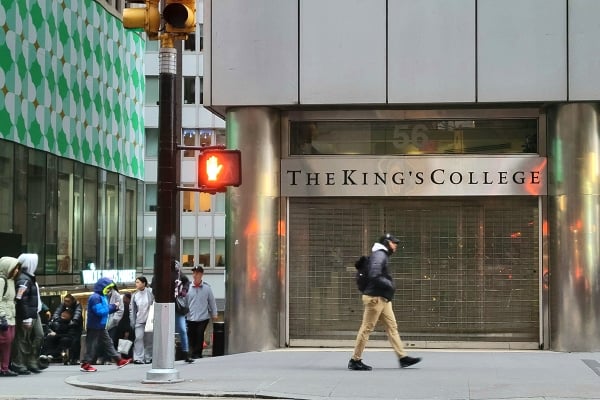
    When the King’s College in New York shut down in summer 2023, its leadership said the cancellation of fall classes and termination of faculty and staff did not mean permanent closure. Now its Board of Trustees is seeking to revive the evangelical institution, according to a report from Religion Unplugged.

    The news outlet obtained a document that detailed a plan “to gift the college, including its charter and intellectual property … to likeminded evangelical Christians who propose the most compelling vision to resume the operations of the college.” The document—reportedly a request for proposals—listed a deadline of Feb. 7 for potential partners.

    TKC officials did not respond to a request for comment from Inside Higher Ed.

    The King’s College shut down in July 2023 amid severe financial pressures and a failed $2.6 million fundraising effort earlier that year that officials said was necessary to meet immediate needs. However, the emergency fundraising effort only brought in $178,000 by its initial deadline.

    The college, which enrolled a few hundred students a year, had faced declining enrollment in its final years and the loss of generous donors who had long buoyed TKC. Richard DeVos—the co-founder of Amway and father-in-law of former education secretary Betsy DeVos—donated millions of dollars to the college before his death in 2018. Another major donor, Bill Hwang, also contributed several million before he was arrested in 2022 on fraud charges.

    Facing financial pressures in 2021, the college put its faith in another wealthy entrepreneur, striking a deal with Canadian investment company Primacorp Ventures, owned by Peter Chung, a for-profit education mogul who had also loaned the college $2 million in early 2023. Acting as an online program manager, Primacorp Ventures promised to enroll 10,000 students over three years, sources previously told Inside Higher Ed. The catch, according to one source, was that Primacorp would collect 95 percent of the revenue generated from online enrollment, a deal that struck experts as predatory. The online program—which cost TKC at least $470,00 to launch, according to tax documents—delivered around 150 students its first year and soon folded.

    The college had previously tried and failed to find a partner to keep it open in 2023. If it finds one this time, the board will submit a “go-forward plan” to the New York State Education Department by mid-July, according to the RFP obtained by Religion Unplugged.

    The King’s College will face a series of obstacles in its reopening effort, including accreditation. The Middle States Commission on Higher Education stripped TKC’s accreditation in May 2023, noting a failure “to demonstrate that it can sustain itself in the short or long term.”

    If the King’s College manages to reopen, it would be history repeating itself. Founded in New Jersey in 1941, TKC closed in 1994, only to be revived in 1997 and re-established in New York City.

    Source link

  • Biology syllabi lack learner-centered principles

    Biology syllabi lack learner-centered principles

    A course syllabus serves as a road map for navigating the upcoming term and content that will be covered, but researchers believe it could support students’ self-directed learning as well.

    A November study published in the Journal of Research in Science Teaching, authored by a team of faculty from Auburn University and the University of Alabama at Birmingham, shows few introductory biology syllabi engage students in effective study habits or encourage help-seeking behaviors, instead favoring content.

    The research highlights opportunities to address the hidden curriculum of higher education and support success for historically marginalized students.

    What’s the need: Some college students lack effective study habits, and these gaps are often a piece of larger equity concerns for marginalized groups, highlighting limited opportunities or resources for underprivileged communities.

    Introductory science, technology, engineering and mathematics courses, in particular, often serve as gatekeepers, limiting which students can pursue these degree programs and resulting in less diverse STEM degree attainment.

    Today’s college students also demonstrate less college readiness in their academic skills, due in part to remote instruction as a result of the COVID-19 pandemic.

    Often, colleges or universities will create co-curricular interventions such as workshops to teach these skills or introduce best practices in a first-year seminar course. While these can be effective, institutions may lack the resources or time to deliver the interventions, which researchers say underscores a need for alternative strategies that reach students.

    Researchers theorized that embedding within the syllabus explicit instruction to promote three skills—study behaviors, metacognitive evaluation or academic help-seeking—could impact student success.

    Methodology: Researchers evaluated 115 introductory biology syllabi from 94 unique institutions, including 48 percent research-intensive institutions, 29 percent minority-serving institutions, 72 percent publics and 61 percent with enrollment over 10,000 students.

    A Deeper Look at STEM Syllabi

    A Worcester Polytechnic Institute study found instructors could help create a more inclusive learning environment in STEM courses through tailoring their syllabus to feature elements like materials from diverse scholars and accessibility statements. Read more here.

    One engineering professor at the University of Massachusetts at Amherst redesigned her syllabus as a zine, or miniature magazine, to promote student engagement and build community in the classroom.

    Syllabi were categorized by having the presence of study behaviors, academic help-seeking and metacognition suggestions; the type of suggestions of those three factors; and the quality of these recommendations (effective or ineffective).

    Further syllabus analysis covered four factors to gauge how learner-centered they were, including having clear and appropriate learning goals and objectives, aligned and define assessment activities, a logically sequenced course schedule, and a positive and organized learning environment. Each syllabus was awarded between zero and 48 points, with higher scores indicating they were more learner-centered.

    The findings: Among the 115 syllabi evaluated, only 14 percent earned a score of at least 31 to be considered learner-centered. Around three in 10 syllabi were considered “content-centered,” earning a score of 16 or less. Researchers theorized faculty may lack time or interest when creating their own syllabi, instead relying on templates from the institution or previously generated documents.

    Design by Ashley Mowreader

    Only 3.5 percent of syllabi showed evidence of reducing opportunity gaps in STEM courses, which researchers defined as de-emphasizing course rules, encouraging the use of external resources for continued learning outside the classroom and emphasizing the role of students in their own learning.

    “Most of the syllabi in our sample provided learning resources but focused primarily on course policies and did not address students as engaged learners,” according to the study.

    A majority of syllabi did offer suggestions for study behaviors, metacognition or approaches for academic help-seeking (61 percent), although the greatest share of these only addressed help-seeking (45 percent). When the syllabus did share advice to seek help, many just provided a list of resources, and fewer encouraged students to utilize them.

    “Only 17.9 percent of syllabi provided a listing of academic help-seeking resources, encouragement to use those resources, and an explanation on how to use those resources,” researchers wrote, with the explanation piece critical for addressing equity gaps and the hidden curriculum of higher education.

    Of the syllabi that provided recommendations for students’ study behaviors, a significant number gave students unhelpful advice or shared practices that are not affirmed with research.

    “We found that most biology syllabi endorsed effective study strategies such as self-testing and spacing,” researchers wrote. “However, we also found that syllabi recommended strategies that have been described as ineffective for long-term learning (e.g., re-reading textbooks and re-writing notes).”

    Twenty-nine percent of syllabi recommended only effective, evidence-based study habits. A greater share (42 percent) offered both effective and ineffective techniques, and 24 percent only offered ineffective behaviors.

    Just because the syllabus was lacking details on how to study or practice metacognition doesn’t mean it was absent from the class entirely, researchers noted, as instructors may discuss these topics in class or provide additional resources with this information. This presents an opportunity for instructors to make themselves more aware of evidence-based practices to close equity gaps and bring the syllabus into better alignment with their pedagogy, according to the study.

    Do you have an academic intervention that might help others improve student success? Tell us about it.

    Source link

  • Did the Ivy League really break America? (opinion)

    Did the Ivy League really break America? (opinion)

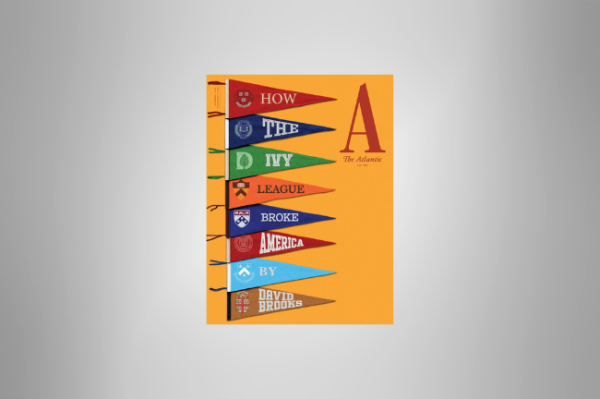
    Are many of the ills that plague American society caused by Ivy League admission policies?

    That is the premise of David Brooks’s cover story for the December issue of The Atlantic, “How the Ivy League Broke America.” Brooks blames the Ivies and “meritocracy” for a host of societal problems, including:

    • Overbearing parenting
    • Less time for recess (as well as art and shop) in schools
    • An economy that doesn’t provide opportunities for those without a college degree
    • The death of civic organizations like Elks Lodge and Kiwanis Club
    • The high percentage of Ivy League graduates who choose careers in finance and consulting
    • The rise of populism based on “crude exaggerations, gross generalizations, and bald-faced lies.”

    Brooks somehow left the decline of small-town mom-and-pop businesses and the popularity of reality television off his laundry list.

    You may be wondering how the Ivies contributed to or caused all these problems. The essence of Brooks’s argument is that “every coherent society has a social ideal—an image of what the superior person looks like.” His hypothesis is that America’s social ideals reflect and are determined by the qualities that Ivy League universities value in admission.

    One hundred years ago, the Ivy League social ideal was what Brooks terms the “Well-Bred Man”—white, male, aristocratic and preppy, athletic, good-looking, and personable. What was not part of the ideal was intellectual brilliance or academic prowess, and in fact those who cared about studying were social outcasts. Applying to the Ivies resembled applying for membership to elite social clubs.

    That changed starting in the 1930s when a group of educational leaders, the most prominent being Harvard president James Conant, worried that the United States was not producing leaders capable of dealing with the problems it would face in the future. Their solution was to move to an admission process that rewarded intelligence rather than family lineage. They believed that intelligence was the highest human trait, one that is innate and distributed randomly throughout the population. Conant and his peers believed the change would lead to a nation with greater opportunities for social mobility.

    Brooks seems far from sure that the change was positive for America. He acknowledges that “the amount of bigotry—against women, Black people, the LGBTQ community—has declined” (that might be debatable given the current political climate), but observes that the previous ideal produced the New Deal, victory in World War II, NATO and the postwar world led by America, while the products of the ideal pushed by Conant have produced “quagmires in Vietnam and Afghanistan, needless carnage in Iraq, the 2008 financial crisis, the toxic rise of social media, and our current age of political dysfunction.” Those examples seem cherry-picked.

    In the essay, Brooks cites a number of troubling societal problems and trends, all supported with extensive research, but the weakness of his argument is that he tries to find a single cause to explain all of them. That common denominator is what he calls “meritocracy.”

    Meritocracy, a society with opportunities based on merit, is an appealing concept in theory, but defining merit is where things get sticky. Merit may be similar to Supreme Court justice Potter Stewart’s description of pornography, in that you know it when you see it. Does merit consist of talent alone? Talent combined with work ethic? Talent, work ethic and character?

    Merit is in the eye of the beholder. If I was admitted to an Ivy League university, it was obviously because I had merit. If someone else, especially someone from an underrepresented population, got the acceptance instead of me, factors other than merit must have been at play. If two candidates have identical transcripts but different SAT scores, which one possesses more merit? Complicating the discussion is the fact that many things cited as measures of merit are in fact measures of privilege.

    For Brooks, Ivy League meritocracy involves an overreliance on intelligence and academic achievement, to the detriment of noncognitive skills that are more central to success and happiness in life. He argues that “success in school is not the same thing as success in life,” with success in school primarily being individual while success in life is team-based. He quotes Adam Grant’s argument that academic excellence is not a strong predictor of career excellence.

    Ultimately, he argues that “meritocracy” has spurred the creation of “an American caste system,” one in which “a chasm divides the educated from the less well-educated,” triggering “a populist backlash that is tearing society apart.” Yet Brooks’s beef is not so much with meritocracy as it is with a mindset that he attributes to Conant and his brethren. He equates meritocracy with a belief in rationalism and social engineering that assumes that anything of value can be measured and counted. What he is criticizing is something different from meritocracy, or at least reflects a narrow definition of meritocracy.

    Even if we don’t agree with Brooks’s definitions, or the implication that Ivy League admission policies are responsible for the ills of society, his article raises a number of important questions about the college admission process at elite colleges and universities.

    First, is the worship of standardized testing misplaced? The SAT became prominent in college admission at around the same time that Conant and others were changing the Ivy League admission paradigm. They believed that intelligence could be measured and latched onto the SAT as a “pure,” objective measure of aptitude. Today, of course, we recognize that test scores are correlated with family income and that scores can be manipulated through test preparation. And the “A” in SAT no longer stands for aptitude.

    Do we measure what we value or do we value what we can measure? Brooks criticizes the Ivies for focusing on academic achievement in school at the expense of “noncognitive skills” that might be more important to success in life after college, things like curiosity, relationship-building skills and work ethic. He’s right, but there are two reasons for the current emphasis. One is that going to college is going to school, so an admission process focused on scholastic academic achievement is defensible. The other is that we haven’t developed a good mechanism for measuring noncognitive skills.

    That raises a larger question. What do we want the admission process to accomplish? The SAT is intended to predict freshman year college GPA (in conjunction with high school grades). Is that a satisfactory goal? Shouldn’t we have a larger lens, aiming to identify those who will be most successful at the end of college, or after college? Should we admit those with the greatest potential, those who will grow the most from the college experience, or those who will make the greatest contribution to society after college?

    Brooks questions elite colleges’ preferences for “spiky” students over those who are well-rounded. Is a student body full of spiky students really better? An even more important question arises from a distinction Brooks made some years ago between “résumé virtues” and “eulogy virtues.”

    Does the elite college admission process as currently constituted reward and encourage students who are good at building résumés? A former student attending an elite university commented that almost every classmate had done independent academic research and started a nonprofit. Do students aspiring to the Ivies choose activities because they really care about them or because they think they will impress admission officers, and can admission officers tell the difference? What is the consequence of having a student body full of those who are good at playing the résumé-building game?

    There is one other issue raised by Brooks that I find particularly important. He argues that those who are successful in the elite admission process end up possessing greater “hubris,” in that they believe their success is the product of their talent and hard work rather than privilege and luck. Rather than appreciating their good fortune, they may believe they are entitled to it. That misconception may also fuel the populist backlash to elites that has increased the division within our country.

    I don’t buy Brooks’s definition of meritocracy or his contention that the Ivy League “broke” America, but his article nevertheless merits reading and discussion.

    Jim Jump recently retired after 33 years as the academic dean and director of college counseling at St. Christopher’s School in Richmond, Va. He previously served as an admissions officer, philosophy instructor and women’s basketball coach at the college level and is a past president of the National Association for College Admission Counseling. He is the 2024 recipient of NACAC’s John B. Muir Excellence in Media Award.

    Source link

  • Rutgers cancels HBCU event to align with Trump DEI orders

    Rutgers cancels HBCU event to align with Trump DEI orders

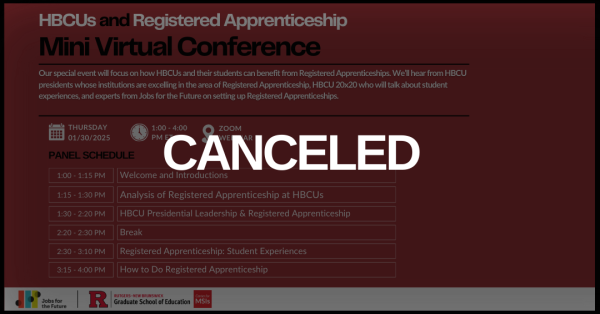
    The virtual mini-conference sponsored by Jobs for the Future was scheduled for Jan. 30.

    The Rutgers University Center for Minority Serving Institutions announced Thursday that it has canceled an upcoming virtual conference about registered apprenticeship programs as a result of President Trump’s executive orders targeting diversity, equity and inclusion initiatives.

    “We were very excited to bring the HBCUs and Registered Apprenticeship Mini-Conference to you next week,” said the email sent to registered attendees. “Unfortunately, due to President Trump’s Executive Orders … we have been asked to cease all work under the auspices of the Diversity, Equity, Inclusion, and Accessibility HUB at Jobs for the Future, which the U.S. Department of Labor funds.”

    Jobs for the Future, an organization focused on helping college and workforce leaders create equitable economic outcomes for students, runs a national innovation hub focused on improving access to registered apprenticeships for women, people of color and other underrepresented groups.

    Located in New Jersey, a blue state for more the 30 years, Rutgers has not faced pressure from state legislators to dismantle DEI. But the cancellation demonstrates the leverage and power the federal government can hold over colleges and universities by threatening to pull funding from programs that don’t comply with the president’s demands.

    It’s just the kind of reaction higher ed policy experts and DEI advocates predicted as a result of the Republican agenda.

    “That wariness and sort of pre-emptive compliance, even absent direct threats from the federal or state government, might be somewhat universal,” Brendan Cantwell, a professor of education at Michigan State University, told Inside Higher Ed.

    “These leaders will be worried about losing their federal funding, which is exactly what DEI opponents want,” added Shaun Harper, a professor of education, business and public policy; the founder of the University of Southern California’s Race and Equity Center; and an Inside Higher Ed opinion contributor.

    More cancellations are anticipated in the weeks and months to come as the Trump administration continues to issue executive orders. For instance, Trump’s growing team at the Department of Education announced a series of actions Thursday related to eliminating DEI.

    “The Department removed or archived hundreds of guidance documents, reports, and training materials that include mentions of DEI from its outward facing communication channels [and] put employees charged with leading DEI initiatives on paid administrative leave,” agency officials said in a news release. “These actions are in line with President Trump’s ongoing commitment to end illegal discrimination and wasteful spending across the federal government. They are the first step in reorienting the agency toward prioritizing meaningful learning ahead of divisive ideology in our schools.”

    Other actions the department has taken include:

    • Dissolving the department’s Diversity and Inclusion Council.
    • Terminating the Employee Engagement Diversity Equity Inclusion Accessibility Council within the Office for Civil Rights.
    • Canceling ongoing DEI training and service contracts that total over $2.6 million.
    • Withdrawing the department’s Equity Action Plan, which was released in 2023 to align with former president Joe Biden’s executive order to advance racial equity and support for underserved communities.

    Source link

  • Scientists worried after Trump halts NIH grant reviews

    Scientists worried after Trump halts NIH grant reviews

    Orders to freeze travel, meetings, communications and hiring at the National Institutes of Health—and all other agencies within the Department of Health and Human Services—has some federally funded researchers on edge just days into President Donald Trump’s second term.

    Scholars say they’ve received emails canceling key meetings that determine which research projects to fund and they’re worried about how those and other disruptions could stall the billions of dollars in NIH-funded projects universities oversee.

    “I suspect that folks outside the sciences don’t understand just how disruptive even a short delay in funding decisions can be,” Adam Forte, an associate professor of geology at Louisiana State University who runs his own lab, posted on BlueSky Thursday alongside numerous other concerned scholars. “This is how we lose huge amounts of scientific capacity, scientific capacity we as a collective have already invested huge amounts of time and money in, just lighting it on fire to watch the flames.”

    If they leave, it’s not like there is much chance they’re coming back to that, or a similar position. That expertise is just gone as they are forced to move onto something else to pay the bills. A spectacular waste from a “short” delay in the machinery that funds science. 5/6

    Adam Forte (@topoismyforte.bsky.social) 2025-01-23T12:23:24.069Z

    Some research policy experts say a pause is typical for the initial days of a new administration and that it’s too soon to tell whether this week’s order is a cause for concern. Others, however, are interpreting it as part of a larger message from Trump, who has repeatedly undermined scientific findings about COVID-19 and climate change and nominated Robert F. Kennedy Jr., who falsely claims there are no safe or effective vaccines, to lead the HHS.

    While Kennedy, who previously vowed to enact mass layoffs at the NIH, and Trump’s other cabinet nominees await Senate confirmation, Trump has already issued a blitz of executive orders—including some that roll back diversity and environmental justice initiatives, as well as protections for federal workers and immigrants—since retaking the White House Monday. (In addition to those in HHS, all federal agencies are also under a hiring freeze.)

    “It’s not unheard-of to see some things paused when a new administration takes over, but when we look at the whole package of language and executive orders that have come out this week, they’re all tied up together,” said Jennifer Jones, director of the Center for Science and Democracy at the Union of Concerned Scientists. “The goal is to intimidate, chill and create this exact sort of fear.”

    A Communications Freeze

    That fear for NIH-affiliated researchers came after Dorothy Fink, acting secretary of HHS, sent a memo Tuesday to all HHS division heads, including the directors of the NIH, the Centers for Disease Control and Prevention, and the Food and Drug Administration.

    “As the new administration considers its plan for managing the federal policy and public communications processes, it is important that the President’s appointees and designees have the opportunity to review and approve any regulations, guidance, documents, and other public documents and communications (including social media),” explained the memo, which instructed agency employees to refrain from numerous forms of communications, including issuing grant award announcements and public speaking, until a presidential appointee can review them. The memo is in effect until Feb. 1.

    An NIH spokesperson clarified to Inside Higher Ed via email that the restrictions apply to communication “not directly related to emergencies or critical to preserving health,” and that any “exceptions for announcements that HHS divisions believe are mission critical” will be made “on a case-by-case basis.”

    On Wednesday, Glenda Conroy, a senior travel official for NIH, emailed NIH employees notifying them that all sponsored travel for HHS employees is also suspended until further notice.

    Disruptions to Research

    As of right now, all these restrictions mean that scheduled meetings have been canceled or postponed, including NIH study sections, which convene scientific experts to decide which projects to fund.

    And university-affiliated researchers make up a sizable portion of the grant application pool. The $44 billion NIH is the largest federal research funding source for colleges and universities, which receive billions in NIH grants each year to support medical and other scientific research projects, including those that have advanced treatments for common diseases such as cancer and Alzheimer’s.

    Chrystal Starbird, an assistant professor of biology and a cancer researcher at the University of North Carolina at Chapel Hill’s School of Medicine, had been planning for months to attend a study section next week where nearly 60 grants were set to be reviewed, but she got word a couple of days ago that it was canceled.

    “Ultimately, the NIH will continue to function, so maybe it’s not a huge issue, but for the people being reviewed now it is,” she said. “None of those grants will be reviewed on time. The question is: How are they going to get all of us together again to review the grant?”

    And rescheduling the study sections for weeks or months after the communication restrictions lift may disrupt certain ongoing projects.

    “Some people may be using this funding to do research that may have more time pressure,” Starbird said, noting that clinical research typically adheres to strict patient-monitoring timelines. “We have to acknowledge that there’s already a significant impact from this pause.”

    ‘Too Soon to Assume’ Worst-Case Scenario?

    Carrie Wolinetz, a science and health policy consultant who worked for the NIH between 2015 and 2023, said in an email that the communications freeze is similar to memos from previous transitions. Although she acknowledged that pausing study section meetings seems broader than previous transitions, it doesn’t strike her “as tremendously outside the norm of activities that might be paused while a new team is transitioning.”

    And though it’s understandable that all of these restrictions are “causing anxiety,” she said it’s “too soon to assume that worst case scenario.”

    “It becomes a concern if there is a long cessation of activity, of the sort you might experience if there was an extended government shutdown,” she said. “There is likely to be minimal impact in the short term—other than for folks who hopped on flights only to discover their meeting was cancelled, which I imagine was pretty irritating.”

    But others caution that having such restrictions in place for even a short time could force people out of their jobs, create a talent void and potentially stall innovation.

    “Even if this is short-lived bumpiness, the uncertainty in funding can have career-altering implications, especially for young scientists,” Erica Goldman, a former academic and director of policy entrepreneurship for the Federation of American Scientists, said in an email.

    “If conferences or travel are canceled, for example, the inability to present new ideas and network with senior colleagues can have cascading effects,” she continued. “I’m reminded of the experiments, data, and professionals who left the field during COVID-19. Even temporary pauses can have lasting consequences.”

    Source link

  • Should universities cash in on cryptocurrency donations?

    Should universities cash in on cryptocurrency donations?

    In 2023, Korean video game company WeMade pledged to donate the equivalent of one billion Korean won ($695,988) in Wemix tokens—a cryptocurrency linked to the blockchain platform of the same name—to Seoul National University.

    What seemed like a moment for celebration quickly descended into controversy, with the university eventually ceasing to accept cryptocurrency donations altogether.

    So, what happened? Shortly after the donation was made, WeMade reportedly liquidated a large share of its coins, causing a significant currency devaluation and meaning SNU’s donation was no longer worth so much—a problem given that the funds had been earmarked for a specific project.

    That wasn’t the only barrier. Under South Korean financial regulations, the university was also unable to open a corporate account for virtual asset exchange. With calls to change the law unanswered, the university was left holding a volatile currency it was unable to convert to cash.

    Now Korean regulators are reportedly considering allowing the country’s universities to convert cryptocurrency for the first time—potentially opening a significant new fundraising stream for the country’s financially ailing sector.

    Elsewhere, universities are already cashing in on the crypto craze, most notably in the U.S. In 2021, the University of Pennsylvania received $5 million in Bitcoin from an unnamed donor. A year later, Vitalik Buterin, co-founder of Ethereum, a leading blockchain, donated the equivalent of $9.4 million in USDC coin to the University of Maryland to fund public health research in the wake of the pandemic.

    The Giving Block, a U.S.-based platform that facilitates cryptocurrency donations to nonprofit organizations, said that the higher education sector has been one of its “biggest growth areas” over the past two years, with Washington State University and Northeastern University among the company’s clients.

    “There are several things driving this, like the booming crypto market and broader mainstream adoption, but the biggest driver for schools is simply following the money,” said Pat Duffy, its co-founder.

    With analysts suggesting popular currencies like Bitcoin will continue to grow in value this year, spurred on by newly inaugurated Donald Trump’s crypto-friendly rhetoric, universities could be set to benefit—if they are prepared to manage the risks that come with the volatile landscape.

    “For donors in the U.S., the biggest driver is the tax incentive,” said Duffy. “You can skip capital gains taxes on appreciated assets and still get a deduction for the full market value.

    “The donor pays no taxes on their appreciated crypto, and neither does the school. Donors across the country are eliminating tens of millions of dollars in tax liability by choosing to give with crypto, and giving larger gifts … as a result.”

    For universities, accepting cryptocurrency may also allow them to target their fundraising at a younger, tech-savvy market. “They can attract more people if they accept crypto payments,” said Nir Kshetri, professor of management at the University of North Carolina at Greensboro.

    It’s not just donations where universities are capitalizing. Some, like Bentley University, have begun accepting tuition fees in cryptocurrency, with significant implications for international students.

    In Nigeria, for example, converting the naira to the U.S. dollar to make fee payments can be a complicated process. For some, paying in decentralized cryptocurrency is simpler and faster, according to Kshetri.

    However, a key risk for universities is the unpredictability of cryptocurrency markets, with fears compounded by the volatility of Bitcoin in recent years. While the market is recovering, crashes such as the one experienced in 2022 have left a lasting impact and made some universities wary.

    “Right now it’s at a peak, but who’s to say we won’t see a return to what we saw two years ago when the bottom fell out?” cautioned Bill Stanczykiewicz, director of the Fund Raising School at Indiana University Indianapolis’s Lilly Family School of Philanthropy.

    According to Stanczykiewicz, best practice is to avoid holding on to cryptocurrency, even if it is predicted to increase in value. “What we say to fundraisers is if you get crypto, turn it into your national currency as quickly as you can,” he said, or use a platform like the Giving Block, which does this for you.

    However, this approach isn’t universal. In Paraguay, Universidad Americana is less risk-averse than some, evaluating the market before converting any cryptocurrency payments.

    Universities considering going down this avenue also need to consider the ethical aspects, said Stanczykiewicz, and whether such donations adhere to their institution’s values.

    Specifically, the environmental impact of currencies like Bitcoin is a concern for some. However, Kshetri argued, the coin has already been mined prior to the donation—that is, the damage has already been done. “Just to transfer that Bitcoin from you to me consumes very little … electricity,” he said.

    Whatever your ethical view, those interviewed for this article agreed on this: Cryptocurrency is here to stay and, for universities, it’s simply a question of how quickly they embrace it.

    “Historically, it was regulatory uncertainty that made universities nervous about crypto acceptance and investing,” said Duffy. Today, he continued, in the U.S., “regulatory clarity and the political support we see on both sides of the aisle have cleared up those concerns.”

    With countries like South Korea set to provide a regulatory green light, too, it may not be long before institutions around the globe follow in the footsteps of their U.S. counterparts.

    Source link

  • Four ways to help students return from a leave of absence

    Four ways to help students return from a leave of absence

    Some students may need to take a leave of absence for their mental health before returning to an institution. Here’s how the institution can help.

    Brothers91/E+/Getty Images

    In the past few years, more students have shared the toll their mental health can take on their academic pursuits. Recent surveys of students who left higher education prior to completing a credential or degree reveal that mental health challenges or stress are primary reasons why they discontinue their education.

    Some learners opt to take a pause, withdrawing from the university for a semester or longer to prioritize their health and wellness.

    To promote student completion and success, institutions can consider formal procedures and initiatives targeted toward easing the transition of re-enrollment after a voluntary mental health leave of absence.

    The background: Colleges have historically offered students the opportunity to temporarily unenroll to address health conditions, but only more recently has that definition expanded to include students’ mental health.

    At some institutions, students who withdrew found it difficult to return. Other institutions prioritized risk mitigation versus student success and pushed learners to withdraw rather than providing solutions.

    “Such policies and practices actually discourage students—not just the student with a mental health condition, but all others—from seeking help,” according to a 2021 report from Boston University and the Ruderman Family Foundation.

    A recent survey from the Princeton Review found 43 percent of colleges and universities now have an official support program in place for students returning from mental health leave of absence.

    However, there is little consistency in policies and practices regarding medical or psychiatric leaves of absence, according to the BU report: “Students are often left to confusing, conflicting information and sometimes, discriminatory policies and practices that make a return to higher education difficult.”

    State policymakers have worked to expand the conditions included in leave-of-absence policies at institutions to recognize mental health difficulties.

    In May 2024, Maryland passed legislation that expanded formal health withdrawal policies at public institutions to include mental health. The legislation also requires institutions to provide partial refunds for students who withdraw for physical or mental health reasons in the middle of the term.

    A 2022 bill introduced to the New York State Legislature would require university systems to review enrollment and re-enrollment policies for students who take extended mental health leaves.

    Students Taking Action

    Active Minds, a youth-led mental health advocacy group, developed a guide for students who are advocating for improved leave-of-absence policies at their institution.

    How to help: Some of the ways institutions assist learners are through:

    • Outlining the return process. The University of Southern California offers a step-by-step outline of the different offices a student must contact to re-enroll. Stanford University also created a Returning to Stanford booklet to answer frequently asked questions.
    • Consolidating resources. Many learners are unaware of the full scope of resources available at the institution. A centralized website, such as this one at Cornell University, can help students during their transition back to campus.
    • Providing coaching services for returners. Institutions, themselves or in partnership with outside organizations, can deliver intentional coaching for skill development and resource coordination to re-enroll learners.
    • Connecting students with peers. Supportive communities can help reconnect students to the institution and affirm their commitments to healthy habits, like engaging in social activities or demonstrating good study behaviors. Georgetown University offers a special support group, Back on the Hilltop, for learners who are returning from a leave of absence or who have recently transferred.

    Do you know of a wellness intervention that might help others encourage student success? Tell us about it.

    Source link

  • Trump announces 10 new Education Department appointees

    Trump announces 10 new Education Department appointees

    The Trump administration named 10 new Education Department appointees Thursday, four of whom have previously worked with the America First Policy Institute, a pro-Trump think tank formed in 2021 as the president ended his first term in office. 

    Education secretary nominee Linda McMahon was a co-founder of AFPI and served as the group’s president and CEO until she was selected to head the department.

    Thursday’s announcement offers more insight into who will help carry out Trump’s education agenda. Until McMahon and Deputy Secretary–designate Penny Schwinn are confirmed by the Senate, a veteran agency official, Denise Carter, will serve as acting secretary.  

    The newest cohort of appointees includes:

    • Rachel Oglesby, a former AFPI chief state action officer, as chief of staff.
    • Jonathan Pidluzny, AFPI’s former director of higher education reform, as deputy chief of staff for policy and programs.
    • Virginia “Chase” Forrester, former AFPI chief events officer, as deputy chief of staff for operations.
    • Craig Trainor, a former congressional senior special counsel and AFPI senior litigation counsel, as deputy assistant secretary for policy in the Office for Civil Rights. (During his time at AFPI, Trainor worked under Pam Bondi, whom Trump has nominated as his attorney general.)
    • Steve Warzoha as White House liaison.
    • Tom Wheeler as principal deputy general counsel.
    • Madi Biedermann as deputy assistant secretary for the Office of Communications and Outreach.
    • Candice Jackson, who served in the first Trump administration, as deputy general counsel.
    • Joshua Kleinfeld as deputy general counsel.
    • Hannah Ruth Earl as director of the Center for Faith-Based and Neighborhood Partnerships.    

    Source link