Texas State Technical College is striving to fill the state’s workforce gaps, but college leaders say the institution has been hampered by out-of-date facilities and a lack of funding to expand.
The technical college has historically been entirely reliant on state funding, which can fluctuate. Unlike the state’s community colleges, it’s not allowed to levy taxes or issue bonds. And yet, the institution is bursting at the seams with 45 out of its 127 programs at capacity this semester across its 11 campuses. Enrollment at the institution has risen steadily over the last few years, jumping up to 13,682 students this year from 12,518 last year.
But this past election cycle, Texas voters gave the institution a rare gift for a technical college—an $850 million endowment.
In November, almost 70 percent of Texans backed a constitutional amendment to create an endowment for TSTC out of the state’s general revenue fund, which will include annual disbursements for capital improvements. College leaders expect up to $50 million from the endowment each year, said Joe Arnold, the college’s deputy vice chancellor of government relations.
He called the endowment “transformational for the institution and for the state of Texas.”
“Texas has grown and grown and grown in businesses and population over the last 20 years, and it’s going to continue to grow,” Arnold said. “You’re going to have to have the workforce to meet the demand, and this is going to help us do that.”
This is the second time TSTC has sought to get an endowment on the ballot. In 2023, an attempt to establish a $1 billion endowment for the college died in conference committee, The Texas Tribune reported.
An Unusual Advantage
Endowments at two-year institutions are rare compared to their four-year counterparts, but they aren’t unheard of. Southwest Wisconsin Technical College, for example, recently used its $700,000 Aspen Prize for a student success plan endowment run by its foundation. Ivy Tech Community College’s foundation also raises money for endowments to pay for student scholarships and other needs.
Some states have also provided such funds for their public higher ed institutions. Alabama, for example, has an education trust fund for its institutions, including two-year and four-year colleges. Tennessee also put lottery reserves in an endowment to sustain Tennessee Promise, its free community college program. Texas’s Permanent University Fund also allows the University of Texas and Texas A&M systems to generate money from land leased by oil and gas companies.
But still, “most public institutions don’t have state-provided endowments like that,” said Robert Kelchen, head of the Department of Educational Leadership and Policy Studies at the University of Tennessee at Knoxville. The advantage of an endowment is college leaders “know that the funds are going to be there and they have some level of control over how it gets drawn down.” But it’s a hard model for other states to replicate unless they have “a windfall [of] one-time funds” they’re willing to devote, without pulling back on state appropriations.
“Because of a lot of the politically conservative legislation coming out of Texas, I think the perception is that Texas doesn’t financially support higher ed, but they do, and they’ve done some pretty innovative things in finance,” Kelchen added.
Arnold said it makes a real difference knowing the institution has a set amount of money coming in each year.
“We can plan for growth” and “plan ahead,” Arnold said.
Support and Opposition
Plans for the endowment had the backing of a wide range of employer groups, including the Texas Association of Manufacturers, the Texas Association of Builders and the Texas Economic Development Council, among others.
It also drew opponents, including the Libertarian Party of Texas and a few other groups that support limited government. These organizations raised concerns that creating a separate tranche of long-term funding for TSTC could get in the way of its fiscal oversight.
For example, Texas Policy Research, a research organization that seeks “liberty-based solutions” to improve Texas governance, recommended Texans vote no—arguing that “locking funding mechanisms into the Constitution erodes transparency and limited government” and that “programs should be funded through the regular budget process, where lawmakers justify spending every two years.”
But Arnold stressed that the money can only be used for specific purposes, such as renovations, infrastructure improvements and buying new land, buildings and equipment for programs.
Those types of funds are sorely needed, Arnold said. TSTC was founded 60 years ago and its flagship campus is on an old U.S. Air Force base. The funding will allow the college to update its “rather old facilities” and move forward with plans to add new campuses in three additional counties.
Defenders of the proposition also argue TSTC’s funding model holds it accountable. The state tracks graduates’ wages five years after they leave TSTC, and state money is doled out to the college based on their wage gains. Select programs also refund students’ out-of-pocket tuition costs if they don’t get a job interview in their field of study within six months.
The college’s funding depends on “graduates securing good jobs,” Meagan McCoy Jones, president and CEO of McCoy’s Building Supply, wrote in an op-ed in The Austin American-Statesmandefending the endowment proposal. “That ensures accountability to students, taxpayers and employers alike.” She told voters the endowment would “strengthen our economy, support families with life-changing education and keep our state on a path of growth and innovation.”
Since the funding formula was implemented in 2013, the college has discontinued programs that didn’t lead to well-paying or in-demand jobs.
“It made us really work hard with our employers to understand what the needs were,” Arnold said.
He believes the endowment is the next step in continuing to improve the institution.
“We’re excited to be able to increase our capacity and put more people to work in Texas,” he said. “That’s kind of our thing.”
More colleges and universities are seeking ways to embed work-based learning into the student experience, ensuring graduates are prepared to tackle their first job.
The University of Delaware’s Lerner College of Business and Economics received a grant in January from the Delaware Workforce Development Board to create yearlong employment opportunities for current students, connecting them with businesses across the state that are interested in hiring local talent. Program leaders say the goal is to provide deeper learning opportunities for students and create a talent pipeline for the region.
“We want to keep homegrown talent here in Delaware after they graduate,” said Scott Malfitano, chair of the Delaware Workforce Development Board, in a press release. “We also want to keep those students who come from out of state to Delaware here when they see the wonderful opportunities that are available.”
Part of the challenge is that companies in Delaware compete for talent with employers in nearby regions including Washington, D.C.; Philadelphia; and New York, Malfitano said. “We want [students] to see the opportunities that are here, and they’ll find out that businesses are hungry and they want to keep the talent here.”
How it works: The Lerner Co-Op program launched in January. The university’s career center solicited businesses in the region to host co-op participants and opened a form for students to apply. In the spring, companies provided job descriptions, and students submitted applications before being selected for interviews by the employers.
The co-op officially started in June, when students began their full-time summer internships, working 40 hours per week. Since classes started back up in the fall, students continue to work up to 20 hours per week, which they will do until next spring.
“A lot of our students tend to intern in the summer for eight to 10 weeks, which is great, but we wanted for them to have a much longer experience to build their résumé, build their networks and make money,” Jill Panté, director of Lerner career services, said in a January press release.
Grant funding was used to hire a program coordinator to oversee the co-op, including posting positions, scheduling interviews and assisting with the offer process, Panté said.
The impact: For the initial cohort, 25 students were placed with 21 employers, including WSFS Bank, JPMorgan Chase, 2L Race Services, the Siegfried Group and DuPont. Student roles include business operations, event coordination and data product solutions.
Feedback from participants, collected in surveys and blog posts, showed that continuing the work beyond the summer has been productive for both students and employers. Employers get more work done, and students expand their learning experiences and benefit from longer-term mentors who provide career advice and support during the program.
Looking ahead, the university hopes to grow the program to 50 companies in the next year, allowing additional students to participate.
Does your college or university provide paid work experiences for students during the academic year? Tell us more here.
As a PR professional, you can equip students on your campus with the skills and confidence to excel in interviews. Here are four reasons why you should invest the time and resources in media training your students.
It makes your life easier. When a reporter contacts you and asks for a student to weigh in on the news of the day or your institution’s latest initiative, you will have a pool of students to pick from at the ready rather than reaching out to deans or faculty to find a student and vet them that day.
While it will make your life easier in the long run, it does require you to put in the time up front. Meet students on their timelines. Most student group meetings are outside of class time, so it might mean you are attending a student government association meeting at 8 p.m. or doing a Zoom training with the College Democrats or Republicans on your lunch break.
It helps students and the community navigate crisis situations. With protests becoming regular occurrences on our campuses and in our communities, media training students will help them remain calm under pressure. When a reporter is looking for a comment, students won’t just say the first thing that pops into their mind. They will know how to get their key messages across to the audiences they are trying to reach.
It’s not just national and local media students need to respond to; student reporters are often the first to approach peers for quotes. All student newspapers are online, can be accessed by anyone and are an extension of your institution and its values. Engaging with student media isn’t just a learning opportunity—it shows how students will represent themselves, which in turn has a direct impact on the reputation of your institution.
Many students don’t know they can choose to not talk to the media or say no to interview requests. We’ve all seen the videos of reporters knocking on students’ doors and the students saying something unfavorable rather than just not opening the door in the first place, or of students having a microphone put in their face as they are walking to class to weigh in on a subject they don’t know about instead of saying, “I don’t know.” Media training can help students realize they have the option to respectfully decline interviews and interactions, which can help alleviate the pressure they might feel to respond in the moment.
Students build career-ready competencies. Whether it’s an internship or job interview, being able to succinctly articulate their points will help students for the rest of their lives. From public speaking to leadership roles to internships, media training gives students skills for their future.
We want our students to be able to weigh in on important issues, and media outlets are always looking for a student perspective. For example, my team was recently on campus for faculty and staff media and op-ed training when a professor asked if his students could sit in. Afterward, one student drafted an op-ed that she successfully placed. I’ve also provided op-ed writing training to seminar classes in which students learn the nuts and bolts of writing an op-ed and how to get published as an undergrad.
Name, image and likeness (NIL) has changed the game for student athletes. It takes students out of the arena and into the public eye where their reputation will be on the line. If you are at a larger school, some of your student athletes may have their own publicist, but if you are not at school where the NIL money is flowing, media training helps prepare student athletes for local commercials, being the face of the pizza shop down the street or even a postgame interview.
When a scandal occurs—a coach is fired, or student athletes are gambling or being hazed—you want students to know they can come to you for advice and guidance when reporters descend on campus.
Students are the most prominent ambassadors of your institution. Media training isn’t about making them a professional correspondent; it’s about making them feel prepared when they are in the spotlight. Whether they are engaging in a protest, talking with a peer reporter at the school newspaper or navigating a postgame interview, media training can serve them in the moment and long term. It’s worth your time to engage with your best spokespeople.
Cristal Steuer is associate vice president at TVP Communications, a national public relations and crisis communications agency solely focused on higher education.
DHS said ICE arrested Sumith Gunasekera on Nov. 12.
Lawrey/iStock/Getty Images Plus
Immigration and Customs Enforcement has detained a Ferris State University professor, according to a Department of Homeland Security news release that calls him “a criminal illegal alien sex offender from Sri Lanka.”
ICE arrested Sumith Gunasekera in Detroit on Nov. 12, DHS announced in its Nov. 25 release. That’s the date Ferris State “became aware of accusations regarding” Gunasekera, university spokesperson David Murray said in an emailed statement. Murray didn’t answer further questions from Inside Higher Ed Monday, including whether the university performed a background check on Gunasekera before hiring him.
“He has been placed on administrative leave while the university gathers more information,” Murray wrote. “This is a personnel issue and it would be inappropriate for the university to further discuss the matter.”
The university’s website lists Gunasekera as director of its Data Analytics Consulting and Research Center. A Sumi Gunasekera is also listed as an assistant professor of marketing.
As of last week’s news release, DHS said Gunasekera “remains in ICE custody pending further immigration proceedings.” DHS spokespeople didn’t respond to Inside Higher Ed’s questions Monday about whether he’s still being held and where.
The DHS release says that, in 1998, “a criminal court in Brampton, Ontario convicted Gunasekera for utter threat to cause death or bodily harm and sexual interference and sentenced him to 1 month of incarceration and 1 year of probation.” Anita Sharma, group leader at the Ontario Court of Justice in Brampton, told Inside Higher Ed the case has been archived, so she couldn’t provide further details Monday.
DHS’s release says “the convictions in Canada” rendered Gunasekera “ineligible for legal status in the United States.” Tricia McLaughlin, a DHS spokesperson, said in the release that “it’s sickening that a sex offender was working as a professor on an American college campus and was given access to vulnerable students to potentially victimize them. Thanks to the brave ICE law enforcement officers, this sicko is behind bars and no longer able to prey on Americans.”
Inside Higher Ed was unable to reach Gunasekera for comment.
Colleges can support military-affiliated students through peer connections and community.
SDI Productions/Getty Images
Approximately 5 percent of all undergraduate learners are active-duty military, reservists, National Guard or veterans, but many systems within colleges aren’t set up to accommodate their needs.
A November research brief from the Center for Higher Education Policy and Practice outlines some of the barriers to military students’ success while they’re enrolled and offers strategies to improve their college experiences. The report draws on interviews with students, recent graduates, higher education faculty and staff, policy experts, and past research.
Clearly outline program costs and the support services available to military-connected learners. Colleges should also share data on military student enrollment, completion and job outcomes, such as on a dedicated military-student web page.
Streamline credit transfer policies using the American Council on Education’s Military Guide as a starting point for military experience. Providing quality transfer advising can also ensure maximum allowable credits are awarded for prior service and can explain how a major program may increase or decrease transferred credits.
Provide financial aid counseling for military-connected students so they know the benefits available for them at federal, state and institutional levels. The college should also allocate dollars in the case of benefit delays or work with appropriate offices to expedite funds.
Create peer mentorship programs to connect incoming students with currently enrolled military learners who have similar lived experiences. Affinity groups on campus, such as the Student Veterans of America, can also instill a sense of belonging.
Offer professional development training for faculty and staff to be culturally competent about military-specific needs. Green Zone Ally Training is one example that helps higher education professionals support veterans on campus.
Offer flexible courses that accommodate active-duty service members and their families, who may be navigating deployments or relocations. These could include online classes or competency-based education.
Establish policies for service-related disruptions including deadline extensions, rescheduling exams or alternative-format course materials to mitigate disruptions to students’ academic timelines.
Provide accessibility across systems so veterans with disabilities gain equitable access to resources. In instances when accommodations are needed, creating a streamlined process to qualify for accommodations through the disability services office ensures veterans can access all resources.
Create partnerships with external agencies who also support military-connected individuals, such as Veterans Service Organizations and the local Veterans Affairs office.
Connect students with career coaches who can translate their military experience and training into the civilian workforce as well as liaise between veteran-friendly employers and students. Some military-connected students may need additional advice on how professional demeanor and formality expectations vary in the civilian workforce, the report noted.
Expand access to co-op programs and internships that are tailored to military learners and career exploration opportunities. Military-focused career events can make the match between veteran-friendly organizations and future employees.
Track career outcomes for military-affiliated students and align offerings with labor market opportunities.
How does your college or university provide specialized resources to military-affiliated students? Tell us more here.
Valerie Johnson has watched—and fought against—political attacks on academic freedom for years. A political scientist and associate provost of diversity, equity and inclusion at the Catholic DePaul University, Johnson understands well the political incentives for conservatives to bring universities to heel.
This year brought an avalanche of new and continuing attacks on what professors can teach, speak about and research at American colleges and universities, led by the Trump administration and exacerbated in states like Florida and Texas, where Johnson describes these changes as swift and effective.
Together with co-authors and editors Jennifer Ruth, a film professor at Portland State University, and Ellen Schrecker, a professor emerita of American history at Yeshiva University, Johnson wrote The Right to Learn: Resisting the Right-Wing Attack on Academic Freedom (Beacon Press, 2024). In October, the book was granted the American Association of Colleges and Universities’ Frederic W. Ness Book Award, an annual honor that highlights the “book that best illuminates the goals and practices of a contemporary liberal education.”
Johnson spoke with Inside Higher Ed over Zoom about the impetus for the book and how she interprets the escalating attack on academic freedom today.
The interview has been edited for length and clarity.
Q: What prompted you to write this book? Was there a specific moment when the scope of this campaign against academic freedom that you describe became unmistakable for you?
A: Yes, it was the summer of 2021. A friend of mine was working with the African American Policy Forum, and they wanted to sound the alert that we were seeing a rollback of rights. And so they had asked Jennifer Ruth, my co-author and co-editor of the book, to work on what they called the Faculty Senate campaign. Twenty twenty was a momentous year. We began to see gag orders about what could be taught. So Jennifer and I … wanted to alert all faculty senates across the United States that we were seeing this erosion of academic freedom and that they should pay attention. We asked them to write resolutions asking their administrations to reaffirm academic freedom.
Q: How have faculty senates or governing bodies adapted—or failed to adapt—to the current legislative landscape?
A: Well, I would like to say I’ve seen quite a bit of resistance, but unfortunately people have a way of conceding when their livelihoods are at stake. And how you answer that question is also determined by where you are in the country. If you’re in a red state—like Florida, like Texas—where there are prohibitions like, “Hey, you cannot teach on this, this, this and this,” then either you stay there and withstand some degree of punishment, or you leave. A lot of faculty are leaving red states for bluer states.
It’s actually been very surprising to me. This period in American history has really caused me to rethink what I originally believed about human nature. It is very surprising how cowardly people are … I am a political scientist by training, and I [know] only about 4 to 5 percent of people will protest anything. And we have seen various rallies, protests, etc., but it hasn’t been as engaging as I would like to see.
Q: One of the things that the book addresses is that efforts on the right to degrade academic freedom are strategic rather than reactive. What evidence convinced you that this was an organized, long-term project?
A: There’s always been attempts to erase history. Frederick Douglass said a long time ago that America is false to its past. It’s false to its present, and it resigns itself to be false to the future.
America has always created a story that it is something it is not, and I think the values that we have are largely aspirational. When universities talk about their mission statements, they’re not saying it’s [complete], they are saying, “This is who we’d like to be.” There has always been a concerted effort to blame the victim when it comes to people who have marginalized identities and to ensure that, largely, their stories are not told. And so through education, if you could limit discussions of race and social equality, then people aren’t thinking about it. They’re not thinking about passing legislation that pursues those goals. And you could make people believe that, “Hey, all the problems of the past have been resolved,” when, in fact, if you look empirically, they haven’t.
Q: When you were doing your research, were there any state-level policies or actors that really surprised you, either in their influence or how quickly they spread?
A: Yeah, I would say Florida and Texas. It was very quick. [Governor Ron] DeSantis definitely took over the university system very quickly [with] Don’t Say Gay and Anti-Woke. I mean, it’s amazing, but it’s an easy setup. For the average citizen, it’s a part of the culture wars where they see LGBTQIA rights, for example, or women’s rights, and they’re alarmed by them … It is “me against them,” and particularly in red states and the Bible Belt, it has been a pretty easy sell to the citizenry because it aligns with some of their well-cherished values, but it doesn’t promote human rights. It doesn’t promote a country or a world where people are seen not by any sort of cultural or identity markers, but by their membership in the human race.
Q: Are there any aspects of the current debate that you think are most misunderstood, either by the media or the public or folks in higher ed?
A: Yes, I think there are a couple of things that are really misunderstood. One is structural inequality, or when you look at, for example, inequality by race. I think most people think that the civil rights movement resolved any social economic inequality when, in fact, it did not. I always use the metaphor of a Monopoly game gone wrong—just because you change the policy doesn’t mean you change the conditions. So let’s say you and I are playing a game of Monopoly, and halfway through the game, I realize you’ve been cheating all along. So I call you out on it, and your response to that is, “OK, let’s change the policy. No more cheating.” And then you say, “Let’s resume the game.” The problem with that is you have already amassed the red hotels, the green houses. Generation by generation, those people who benefited from slavery or land appropriation of the Native Americans and Mexicans, or Jim Crow and residential segregation, that’s a cumulative advantage. For those people who were disadvantaged, there’s a cumulative disadvantage that moves forward from generation to generation. Existing racial inequality—I don’t think people actually understand it. They saw shows like The Cosby Show, and they are like, “Oh, wow, all people from minoritized backgrounds, they’ve made it.” In fact, it’s really a myth.
To that extent, if you say that you want to provide opportunities that create inclusion on college campuses, they’re looking at that like, “Well, wait a minute. They’ve made it. So this is unfair to me.” Then you have this disdain for DEI. Of course, for people between the ages of zero and 18 in America, the majority of them are nonwhite. So every single year, campus enrollment is becoming less white … and American universities and colleges that are going to have to depend on American students for their enrollment will increasingly have to court and recruit students who are nonwhite because of the demographic shift.
Q: How should universities communicate with the public about academic freedom without reinforcing the right wing framing that expertise equals elitism?
A: One thing that is constantly on my mind is: How do you talk about something as heavy as academic freedom? In a way, I wish we would have retitled the book something like “The Right to Learn: Resisting the Attack on What You Can Learn,” or something like that. When you put “academic freedom,” people ask, what is academic freedom? People know about free speech, but people don’t know about academic freedom. That is why you have an increasing number of students who come to college campuses believing that they should get a tailor-made curriculum.
So, what can universities do? I believe in community education. I love it when community groups and politicians ask me to come and speak to regular community folk. We have to see our enterprise as not only teaching in the university, but outside of the university, and that could be done with op-ed pieces or just going where people are—churches, community institutions … I think that’s the only way it’s going to happen. We have to get out of the ivory tower.
Northeast Technical College fired its president last week, reversing course on a resignation agreement accepted by the board just two weeks earlier that would have reportedly kept him in the job until June.
Kyle Wagner, president of the public college in South Carolina since 2016, submitted his resignation Nov. 11 and then went on medical leave, according to Queen City News. But two weeks later, NETC’s governing board rescinded the agreement and fired the longtime president with little explanation, the local news outlet reported. The decision was effective immediately.
The board also voted to immediately begin a search for the college’s next president.
Wagner’s firing comes after a tumultuous year for the college and the president. Last December, Northeastern Technical College was sanctioned by its accreditor, the Southern Association of Colleges and Schools Commission on Colleges, for compliance concerns that included not employing adequate numbers of full-time faculty members, among other issues cited in a report.
That same month, the South Carolina Office of the State Inspector General determined that Northeastern Tech had placed some high school students in a dual-enrollment program in additional classes, unbeknownst to them, which resulted in unexpected bills from the college.
College employees, including Wagner, benefited financially from the mistake, according to the OIG’s office.
“NETC failed one or more invisible students, transforming them, via a flawed fast track scheme, into ghost students—haunting the reliability of NETC’s enrollment numbers. Inflated enrollment numbers provided additional funding to NETC which served select faculty and staff justifying salary increases and/or bonuses,” Inspector General Brian Lamkin wrote in his report. “Due to the inadequacies of NETC staff, some students were left with grade discrepancies, issues with financial aid eligibility at future institutions, and unreconciled student account balances.”
Local politicians called for Wagner to resign late last year, citing the accreditation and dual-enrollment issues. Despite lawmakers’ concerns, then–board chairman Dan Bozard said in January that they backed Wagner “without reservation.” But some 11 months later, that support has evidently diminished.
Contacted by LinkedIn, Wagner did not respond to a request for comment from Inside Higher Ed. College officials also did not respond to a media inquiry about Wagner’s reported firing.
Two decades ago, Uncle Sam offered a helping hand for college graduates who desired careers that required advanced degrees by establishing a loan program known as Grad PLUS. That hand has now been withdrawn. Also known as Direct PLUS loans, this program allowed students to borrow beyond the $20,500 limit available through direct unsubsidized loans to cover their full cost of attendance. With the One Big Beautiful Bill Act signed into law last summer, Grad PLUS loans will no longer be an option for prospective graduate students after July 2026.
The question of whether colleges and universities raise their tuition prices as the availability of federal aid increases has been a hotly debated topic for more than four decades, with contradictory findings. One recent study found that institutions increased their tuition prices after the creation of Grad PLUS, and determined that the funds did not increase access (or completion) for graduate education in general or for underrepresented groups in particular. These findings echo previous studies that also support a positive relationship between government aid and college prices. In contrast, other studies and analyses at the undergraduate level, as well as for graduate business, medical and law programs, have found little evidence of nonprofit institutions increasing tuition in relation to government subsidies. (The for-profit sector is another story.)
In any case, the elimination of Grad PLUS is a new reality that incoming graduate students will have to face. Now, students in master’s and doctoral programs will only be able to borrow up to $20,500 annually (with a maximum of $100,000). Students in professional degree programs, like law and medicine, will have a higher cap of $50,000 annually (up to $200,000 total). Additionally, the maximum amount students can borrow from the federal government for their undergraduate and graduate studies combined is $257,500. Students who borrow beyond any of these limits annually will have to turn to private loans to finance the remaining costs, which are less accessible for low-income students (who have less credit) and often come with higher interest rates.
The specific impact of these new limits on students is not yet known, but if we look at data for borrowers from previous years, we see potential impacts. In 2019–20, approximately 38 percent of all graduate borrowers borrowed beyond these caps, according to an analysis by Jobs for the Future. When disaggregated by degree type, 41 percent of graduate borrowers pursuing master’s degrees, 37 percent pursuing Ph.D. degrees and 25 percent pursuing professional degrees borrowed beyond the loan caps set by OBBBA.
A recent analysis published by American University’s Postsecondary Education & Economics Research Center shows potential impacts not just by graduate degree type but also by specific field of study. For professional degrees (with the higher loan cap), more than half of borrowers for chiropractic, medicine, osteopathy and dentistry programs borrowed more than $200,000 for their degrees in recent years. Among the master’s programs reviewed, half or more of borrowers in programs including audiology/speech pathology, public health, nursing and school and mental health counseling, to name a few, borrowed beyond the new limits.
Based on these analyses, it is clear that many prospective graduate students will be impacted by the new loan caps, at least in the short term. The rationale for these loan caps is that graduate programs will lower their costs to make graduate education more affordable, although it is doubtful that colleges will decrease the costs of graduate programs within just a year. It should be noted that many students do not borrow at all to obtain their degrees. In 2019–20, approximately 40 percent of full-time domestic students enrolled in master’s degrees did not borrow.
For programs that attract students from high-income backgrounds (usually selective elite institutions), what incentive is there to decrease costs if enough students can pay out of pocket? For instance, between 2014 and 2019, medical school matriculants from high-income backgrounds (over $200,000) increased substantially. The number of students attending law schools from wealthy backgrounds has also increased in the past couple of decades, particularly at selective elite institutions. Graduate education, at least at elite schools, has become less accessible for many low-income students.
Without financial support, options for low-income students will become even more limited. These students will largely be relegated to less selective public universities, and the more elite private schools will become even less economically diverse than they already are. Financial aid offices will become the de facto second admissions office. Using Massachusetts as an example, our analysis found that the annual cost of attendance exceeded the annual loan limit of $50,000 in the case of every accredited law and medical school in the state, with the gap between the cost of attendance and the limit ranging from about $5,600 in the case of the lone public law school (the University of Massachusetts at Dartmouth), and $33,000 in the case of the only public medical school option (University of Massachusetts Chan), to as high as $71,000 for Harvard Law School and $64,000 for Harvard Medical School.
Amounts calculated based on current advertised rates for first-time (entering), full-time students enrolled in daytime, nine-month and on-campus programs.
Amounts calculated based on advertised rates for first-time (entering), full-time students enrolled in daytime, 10-month and on-campus programs.
This simple analysis, of course, does not take into account any institutional grants or scholarships students may be awarded, but those funds vary by institutional budgets.
What happens when a deserving medical school applicant gains admission and a financial aid offer, only to realize that they still have a balance of $40,000 after institutional and federal aid is applied? For students to turn to private lenders, they will likely need either good credit and a substantial income or a cosigner, which may not be an option for many students from underresourced backgrounds. Almost 93 percent of private student loans given last year had a cosigner. Almost 51 percent of individuals from low/moderate incomes have limited or poor to fair credit. Even if they are lucky to be offered loans, the interest rates will likely be much higher.
With Washington Out, States May Have to Intervene
With the recent federal cuts to Medicaid likely to lead to decreases in state funding for postsecondary education, states may be hesitant to award funds to support students pursuing graduate education—but there are frameworks to help states determine which graduate programs deserve state funding and which type of funding to provide students. Third Way recently produced a framework that categorizes programs by personal return on investment and social value. One possible solution would be to offer accessible loans and state subsidies based on how a state places certain programs in this model.
For programs that lead to high ROI and social value—for example, dentistry—states that are facing a shortage of dentists could offer accessible (and lower than market rate) loans in exchange for working in certain geographic areas in that state. Providing low-interest loans instead of grants would make sense for this category because dentists are more likely to have high enough earnings (postresidency) that they can repay their loans. Certain localities have set up zero-interest loans for students pursuing specific industries, such as a San Diego County program for aspiring behavioral health professionals (a type of pay-it-forward program).
Some states, such as Pennsylvania, do have loan repayment programs for certain health occupations in exchange for working in specific areas of their states. Offering this solution without providing accessible loans will only benefit students who come from wealthier families, as they are more likely to have good enough credit or relationships with creditworthy cosigners to access private loans in the first place.
For programs that are high in social value but low in personal ROI, such as teaching or social work, if a state determines this is an area of need, they can offer grants to lower the cost of attending these programs and minimize the amount of loans students will have to take out, in exchange for service in these fields for a specific period of time. Offering accessible, low-interest loans to students pursuing these careers could still be an option, but should be secondary, or supplemental to, grants.
In line with recommendations from a jointly authored report from the American Enterprise Institute, EducationCounsel and the Century Foundation, states can offer grants to graduate students who demonstrate financial need, in addition to targeted grant aid for certain programs. Already, certain states, such as Maryland, New Mexico, Virginia and Washington, offer grant aid to graduate students in specific fields or based on financial need. Massachusetts also offers a tuition waiver to incentivize students to enroll in graduate programs at its public universities.
Unfortunately, I was unable to find a single repository of state aid specifically for graduate students from various states. The closest I could find was a report released by the National Association of State Student Grant and Aid Programs for the 2023–24 academic year with data on state-funded expenditures for both undergraduate and graduate student aid. The report shows that only a handful of states allocated more than a million dollars to need-based graduate aid (Arizona, Colorado, Maryland, Minnesota, New Jersey, Texas and Virginia), but does not specify for which programs, nor does it detail how aid is awarded and to which institutions.
The Education Finance Council also maintains a list of nonprofit loan providers in different states that offer lower-interest or more accessible loans, many of which are state-administered, such as the Massachusetts Educational Financing Authority. States that already administer conditional loans, scholarships, grants or loan forgiveness programs at the undergraduate level should consider expanding these programs to high- demand industries that require postbaccalaureate credentials if they have not already.
What Can Institutions Do?
Institutions are the closest to students, and they can play a role as well. Beyond offering need-based grants/scholarships to lower the cost of attendance, institutions can also guide students in the lending process, such as by publishing preferred lenders on financial aid websites. These lenders should have a good reputation with borrowers and offer low interest rates. Examples of institutions that advertise preferred lenders include Baylor University, the University of Iowa and the University of Central Missouri.
Institutions with more financial resources can either directly partner with lenders to offer lower fixed interest rates through risk sharing or provide loans themselves. Harvard Law School makes loans available to graduate students through a partnership with the Harvard Federal Credit Union. Some private loan providers looking to get into the graduate lending space are now in conversations with institutions about developing new risk-sharing models.
Many occupations that typically require graduate degrees, such as teaching, nursing and medicine, will face steep shortages in the coming years. States should align aid programs with current and future workforce shortages, determine which graduate programs will exceed federal loan caps and by how much, offer targeted grants for high-social-value but low-earning fields where costs exceed caps, and provide below-market or zero-interest (and accessible) loans for high-social-value, high-earning fields.
Institutions must act urgently by partnering with accessible, ethical lenders; increasing need-based aid for students who need it most; and protecting students from predatory options. At the very least, institutions can advertise the upcoming student loan changes on their websites. With OBBBA loan caps, Washington is stepping back. Will states and institutions be able to step forward and lead the way in preserving access and promoting economic mobility? Only 2026 will tell.
Josh Farris is research and policy specialist and Derrick Young Jr. is cofounder and executive director at Leadership Brainery, a nonprofit organization focused on improving access to graduate education for students from limited-access backgrounds.
Between 1997 and 2025, the proportion of women serving on community college boards grew from 33 percent to 47 percent.
Maricopa County Community College District
New data shows that community college trustees have become more reflective of the diverse student bodies they serve over the past three decades.
That’s one of the big takeaways from a report the Association of Community College Trustees published last week in partnership with the Center for the Study of Community Colleges, which shows that the proportion of women serving on community college boards is on the rise. Between 1997 and 2025, female representation on the boards grew from 33 percent to 47 percent, with the biggest increases coming in the past seven years. During the same time frame, the proportion of nonwhite trustees grew from roughly 12 percent to 27 percent.
Association of Community College Trustees/Center for the Study of Community Colleges
While disparities remain, that breakdown is now closer to mirroring the diversity of community college students. In 2025, 57 percent of students were women and 58 percent identified as people of color, according to data from the American Association of Community Colleges.
The report, “Community College Trusteeship in 2025: A Commitment to Serve,” draws on surveys of more than 2,000 community college trustees and 40 qualitative interviews with trustees, building on similar reports from 1997 and 2018. The study demonstrates that trustees “have a pulse on their communities’ needs, a deep commitment to the community college mission of open access to high-quality higher education for all people, and the kind of visionary thinking needed to keep their institutions thriving,” ACCT president and CEO Jee Hang Lee said in a news release.
That’s in part because community college governing boards are also more likely now to have members who attended a community college.
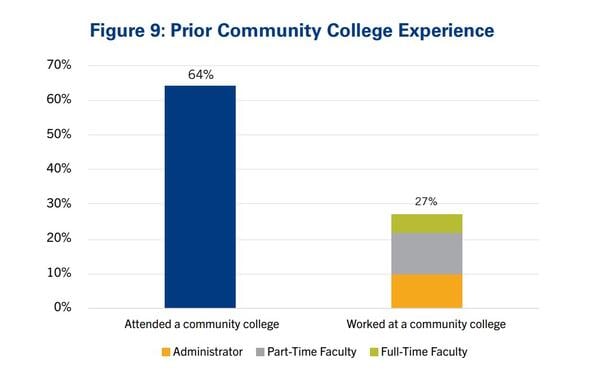
In 2025, 64 percent of trustees attended a community college and 27 percent previously worked at one, according to the report. In 1997, only 51 percent of trustees had been community college students and 22 percent had been employees. Today’s trustees also are also showcasing the earning potential of community college graduates: 71 percent of trustees who attended a two-year college made at least $100,000 a year in 2025, while 31 percent made close to $200,000, according to the report.
Association of Community College Trustees/Center for the Study of Community Colleges
In an interview, one such trustee said that attending a community college first allowed them to continue on to a university “to get my education at a reasonable cost and also to improve my life and my business.”
For many trustees, those firsthand experiences with the community college system have also translated into enthusiasm for higher education governance work. “I was a nontraditional college student,” one said in an interview for the report. “I went back to school with three kids in tow and got my bachelor’s and my master’s, and it’s just something that I believe in.”
That’s a common trajectory for community college trustees.
Among trustees who were once community college students, 83 percent have a bachelor’s or higher degree, and 54 percent have a graduate or professional degree. And over all, trustees have become even more educated over the past 28 years. Although the vast majority of trustees have long held a college degree, the proportion with a bachelor’s degree rose from 84 percent to 86 percent between 1997 and 2025; the proportion with a graduate or professional degree rose from 50 percent to 59 percent.
But other aspects of community college governance haven’t changed as much since the 1990s, the report shows.
In 2025, trustees spent an average of five hours a week on board duties—hardly any change from 1997. Similarly, trustees identified funding, access and affordability as top challenges in 1997, 2018 and in 2025. This year, however, 63 percent of trustees also cited enrollment as a top issue, “likely stemming from the fact that most states have begun to experience the anticipated enrollment cliff,” the report noted.
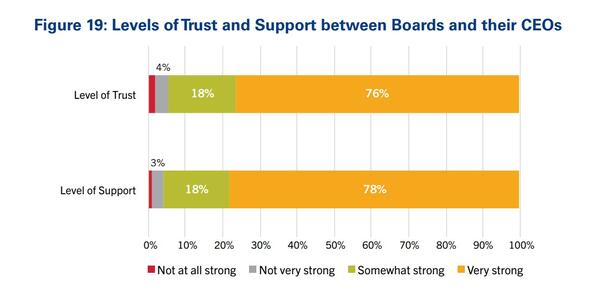
Community college trustees have also maintained high levels of trust in and support for their college leaders. In 2025, 94 percent of respondents indicated a “somewhat or very strong level of trust” between boards and presidents, while 96 reported somewhat or very strong levels of support—numbers that have hardly changed since 1997.
Association of Community College Trustees/Center for the Study of Community Colleges
And that’s an essential aspect of effective governance, one trustee said in an interview.
“The demands [on] a college president are huge, and [it’s a] difficult job, which is one reason [that] when you get somebody, you’ve got to support them,” they said. “You hire somebody and then you get out of their way and let them do what you hired them to do. That is so important.”
Northwestern University is the sixth to cut a deal with the administration.
pabradyphoto/Getty Images
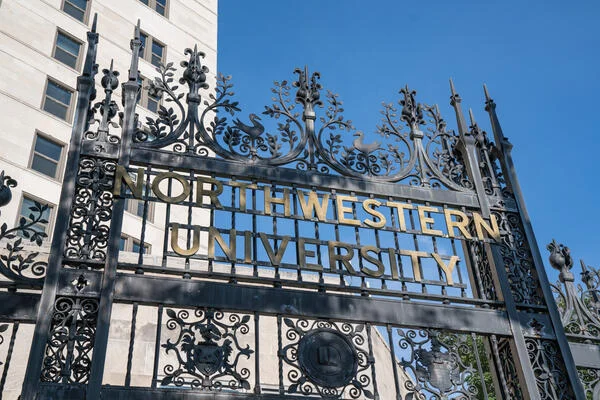
Northwestern University has reached an agreement with the Trump administration to restore federal research funding. The university will pay the federal government $75 million and enact various changes. In return, the federal government will lift a freeze on millions in research funding.
As part of the settlement, Northwestern agreed to adhere to federal antidiscrimination laws and to not give preferences in admissions, scholarships, hiring or promotion that are based on race, color or national origin; to maintain clear free speech policies; and to mandate antisemitism training for all students, faculty and staff. University officials will also reverse a 2024 deal made with pro-Palestinian student protesters in which Northwestern agreed to provide more support for Muslim, Middle Eastern and North African students and greater financial transparency.
The settlement also bars Northwestern’s Feinberg School of Medicine from performing “hormonal interventions and transgender surgeries” on minor patients, according to language in the agreement. However, university officials have said that does not reflect a change in practice. Instead the agreement merely codifies that Northwestern will not provide such services.
Northwestern is now the sixth university to strike a deal with the Trump administration, following settlements with the University of Pennsylvania, Columbia University, Brown University, the University of Virginia and Cornell University. Of those settlements, Northwestern has the second-highest financial payout at $75 million, trailing only Columbia, which agreed to pay $221 million. Unlike the Brown and Cornell settlements, all of the money will go directly to U.S. government.
A Path Forward
Northwestern leadership cast the settlement as a win, despite the $75 million payout.
“It was the best and most certain method to restore our federal funding both now and in the future,” interim president Henry Bienen said in a video message following the settlement.
The Trump administration froze $790 million in federal research funding earlier this year amid concerns about alleged antisemitism on campus following pro-Palestinian demonstrations in 2024. Last year, at the height of the protests, then-president Michael Schill struck a deal with pro-Palestinian students, known as the Dearing Meadow agreement, which has now been scuttled. That deal was heavily scrutinized by Congress when Schill testified in May 2024. (Schill would later resign, stepping down this fall amid the standoff over frozen federal research funding.)
Though Harvard University brought a successful lawsuit against the federal government, prompting a judge to rule in July that a similar funding freeze there was illegal, Northwestern aimed to avoid a costly and protracted legal battle in an effort to quickly restore research dollars.
Bienen argued in the video that “suing would have cost time and money that we believe the university could not risk” and the settlement was “the best path forward for us to be able to turn the page.” Despite an endowment valued at more than $14 billion, Bienen said, the university could not afford to sustain its research mission on its own. Had that freeze continued, Bienen said it would “gut our labs, drive away faculty, and set back entire fields of discovery.”
Northwestern, like other wealthy institutions hit with federal funding freezes, has made a number of cost-cutting moves as it navigated sudden financial challenges related to the research enterprise. Earlier this year Northwestern eliminated 425 jobs as part of overall budget reductions.
Now the federal funding spigot is set to be turned back on, though officials noted on the university website that “some terminated grants will not be reinstated, specifically those the federal government has cut” and that “these decisions were not specific to Northwestern.”
The university did not admit to any wrongdoing in the settlement.
Northwestern also answered a question that has been hanging over numerous other universities in its settlement communications, stating that it will not sign the Trump administration’s proposed “Compact for Academic Excellence in Higher Education.” Originally floated to only a few universities before it was opened to all, the compact would provide preferential treatment in federal funding in return for various changes, many of which experts warn would undermine academic freedom. So far, few institutions have expressed interest in the proposal.
A Landmark Deal
Federal officials also hailed the settlement with Northwestern as a win.
“Universities that receive federal funding have a responsibility to comply with the law, including protecting against racial discrimination and antisemitism,” Assistant Attorney General Harmeet K. Dhillon of the Justice Department’s Civil Rights Division said in a news release. “We appreciate the significant improvements Northwestern has made and are gratified to reach an agreement that safeguards of rights [sic] of all the university’s applicants, students, and employees.”
Education Secretary Linda McMahon called the settlement a landmark deal.
“The deal cements policy changes that ‘will protect students and other members of the campus from harassment and discrimination,’ and it recommits the school to merit-based hiring and admissions. The reforms reflect bold leadership at Northwestern, and they are a roadmap for institutional leaders around the country that will help rebuild public trust in our colleges and universities,” McMahon said in the DOJ news release that announced the settlement.