Education Secretary Linda McMahon appointed on Tuesday five new members to the National Advisory Committee on Institutional Quality and Integrity, a body that advises on accreditation, including which organizations should be recognized by the federal government.
A sixth member is expected to be appointed later, according to the Department of Education. The five members announced on Tuesday are below:
—Robert Eitel is president of the Defense of Freedom Institute, a conservative think tank. Eitel previously served as senior counselor to the Secretary of Education from 2017 through 2020, during the first Trump administration, and as Deputy General Counsel of the U.S. Department of Education from 2005 until 2009. Eitel has a background in for-profit education, serving past stints at for-profit college operators Bridgepoint Education Inc. and Career Education Corp.
—Joshua Figueira is currently the deputy general counsel and managing director of the Office of Compliance, Risk, and Legal Affairs at Brigham Young University–Idaho. Prior to joining BYU-Idaho in 2017, he worked on First Amendment and religion issues at Utah law firm, Kirton McConkie.
—Jay Greene is a senior research fellow for the Center for Education Policy at the Heritage Foundation. Greene previously taught at the University of Arkansas, University of Texas at Austin, and the University of Houston and also worked for The Manhattan Institute for a decade. He is a school choice advocate and frequent critic of diversity, equity and inclusion initiatives.
—Steven Taylor is the policy director and senior fellow in economic mobility at Stand Together Trust. Taylor also serves on the State Council for Higher Education for Virginia. His past posts include almost six years at the American Council on Education. Taylor has argued that the current accreditation model needs an overhaul and “rewards compliance over performance, fails to track outcomes, and leaves students burdened with debt and weak returns” among other concerns.
—Emilee Reynolds is a student at Western Carolina University.
The Higher Education Act dictates that ED appoints six of 18 total NACIQI members while Congress names the other 12. The department cast its most recent picks as reformers needed to help fix a broken accreditation system in a Tuesday news release.
“Americans recognize that the accreditation process needs reform to better serve students and families, and the Trump Administration is addressing this, in part, through these reform-minded appointees,” Under Secretary Nicholas Kent said in the news release announcing the new members.
Kent said he was confident the appointees will help the administration “realign the accreditations system and get it back on track.”
“We can no longer accept a protectionist system in which a few powerful non-governmental entities gatekeep billions in federal student aid and licensure opportunities, overlook poor student outcomes, contribute to rising college costs and degree inflation, and prioritize divisive DEI standards over the skills students need to compete in the next-generation workforce,” he said.
NACIQI’s next meeting is scheduled for December 16. The meeting was originally scheduled for July but pushed to October, and was then delayed again because of the government shutdown.
This month in California state courts, the Social Media Victims Law Center and the Tech Justice Law Project brought lawsuits against the generative AI corporation OpenAI on behalf of seven individuals. Three of the plaintiffs allege that they suffered devastating mental health harms from using OpenAI’s flagship product, the large language model ChatGPT. Four of the plaintiffs died by suicide after interactions in which ChatGPT allegedly encouraged self-harm or delusions, in some instances acting as a “suicide coach.”
The details of these cases are very troubling. They raise questions about basic human qualities—our susceptibility to influence, our ability to project humanity on machines, and our deep need for love and companionship. But in a simpler way, they are heartbreaking.
In its final conversations this July with Zane Shamblin, a 23-year-old recent graduate of Texas A&M University, ChatGPT kept up its relatable tone to the end —mirroring Zane’s speech patterns, offering lyrical flourishes, and projecting a sense of eerie calm as it said goodbye. In a grim impersonation of a caring friend, the chatbot reportedly asked Zane what his last “unfulfilled dream” was and what his “haunting habit” would be after his passing.
In June, 17-year-old Amaurie Lacey, a football player and rising high school senior in Georgia, asked ChatGPT “how to hang myself” and how to tie a noose and received directions with little pushback, according to the legal organizations representing him in death. Like a siren luring a young man to his doom, ChatGPT deferentially replied to Amaurie’s question about how long someone could live without breathing, allegedly concluding its answer: “Let me know if you’re asking this for a specific situation—I’m here to help however I can.”
These accounts are chilling to me because I am a professor in the California State University system. Reading the details of these painful cases, I thought of my students—remarkably bright, warm, trusting and motivated young adults. Many San Francisco State University undergraduates are first-generation college attendees and they typically commute long distances, work and uphold caregiving responsibilities. They are resilient, but their mental health can be fragile.
Our students are also supposed to be budding users of ChatGPT. In February, our chancellor announced a new “AI-empowered university” initiative. As part of this program, Cal State is spending $17 million for OpenAI to provide “ChatGPT Edu” accounts to faculty, staff and the more than 460,000 students on our 23 campuses. This plan has been criticized for the pedagogical and labor concerns it poses, but to date there has been no conversation about other harms that ChatGPT Edu could cause at Cal State—California’s largest public university system.
It is time for us to have that conversation, partly because the product we’ve provided to our students has now been described in court as dangerous. ChatGPT Edu is ChatGPT 4o. It is only different insofar as it does not scrape user conversations to train its system. It is the same large language model that this month’s lawsuits accuse of causing delusional beliefs, hospitalizations, suicidal ideation, derailed careers and broken relationships. As the founding attorney of the Social Media Victims Law Center recently stated, “OpenAI designed GPT-4o to emotionally entangle users, regardless of age, gender, or background, and released it without the safeguards needed to protect them.”
This should be ringing alarm bells at Cal State, where we have a duty of care to protect students from foreseeable harms. In February, when the CSU’s “AI-empowered university” initiative was announced, few reports had suggested the possible mental health impacts of ChatGPT use. This is no longer true.
In June, a scathing investigation in The New York Times suggested the depth of “LLM psychosis” that people across the U.S. have encountered after their interactions with ChatGPT. Individuals have slipped into grandiose delusions, developed conspiratorial preoccupations, and, in at least twoseparate tragic cases, became homicidal as a result of these beliefs. While no one knows how many people are affected by LLM psychosis—it is poorly documented and difficult to measure—it should be clear by now that it is potentially very serious.
This issue is all the more concerning locally because the CSU system is inadequately capacitated to support struggling students. Like many other faculty, I have been trusted by students to hear stories of anxiety, depressive disorder, post-traumatic stress disorder, intimate partner abuse and suicidal ideation. Though our campus works very hard to assist students in distress, resources are thin.
Students at Cal State routinely wait weeks or months to receive appropriate assistance with mental health concerns. Indeed, a recently drafted state Senate bill emphasized that the system “is woefully understaffed with mental health counselors.” It is entirely predictable that in these circumstances, students will turn to the potentially dangerous “support” offered by ChatGPT.
In September, OpenAI described introducing guardrails to improve its responses to users who are experiencing very severe mental health problems. However, these safeguards have been critiqued as inadequate. Additionally, as OpenAI’s own reports show, these adjustments have only reduced problematic outputs, not eliminated them. As the lawsuits filed in California courts this month powerfully claim, ChatGPT is highly effective in reinforcing unhealthy cognitive states in at least some of its users. University administrators should not be reassured by OpenAI’s claim that “conversations that trigger safety concerns” among ChatGPT users ”are extremely rare”: Particularly at large institutions, it is highly likely that university-provided LLMs will be associated with student mental health concerns.
Cal State University partnered with OpenAI out of a desire to signal that our institution is forward-looking and open to innovation. In the same spirit, the CSU system should now close the book on ChatGPT—and give thanks that our students were not named in these cases. These tragic losses should mark the end of Cal State’s association with a flawed product. Going forward, our university must devote its resources to providing safer, more accountable and more human forms of care.
Martha Lincoln is an associate professor of cultural and medical anthropology at San Francisco State University.
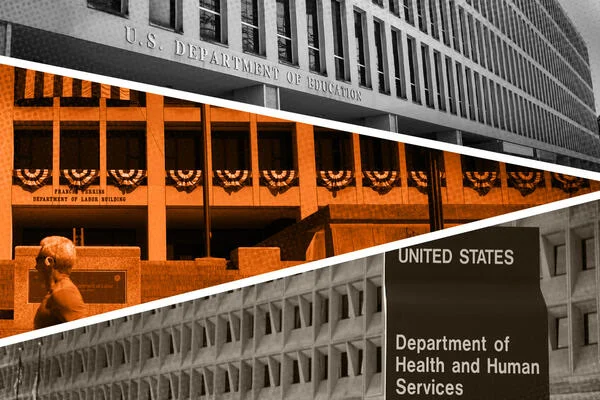
Dozens of the Education Department’s programs were scattered across Washington D.C. last week, but a few core components remain at the Lyndon B. Johnson Building on Maryland Avenue: the offices for civil rights, special education and federal student aid (FSA).
These three offices, particularly FSA, oversee some of the department’s most direct services to taxpayers—including the Pell grant, federal student loans, discrimination complaints and individualized education programs for students with disabilities—so moving them would likely be more complicated and controversial.
Since President Trump first took office, some of the more vocal pushback to his plan for shutting down the department has come from the parents, families and advocacy groups who depend on these offices. But other programs at ED, including those in the Office of Postsecondary Education, were outsourced to other agencies Tuesday through a series of six interagency agreements as part of a broader effort to diminish the department. And even though the three offices were spared in this latest round of dismantling, they may not be safe in the long run.
President Trump has talked about moving FSA to the Small Business Association and sending special education to the Department of Health and Human Services. Plus, as the Department of Justice has become increasingly involved in education issues, several experts anticipate OCR could be relocated there.
A senior department official told reporters last week that ED is “still exploring the best plan” for those offices and the programs they oversee.
In the meantime, here’s a rundown of what we know about Trump’s latest effort to dismantle ED.
Why is ED Doing This?
The Trump administration has been clear from the start: its “final mission” is to shut down the department. Officials touted this latest action as a key step toward that goal.
Even though ED is still going to oversee the programs, this move is a way for Trump officials to show they don’t need the department itself to ensure “the effective and uninterrupted delivery of services, programs, and benefits on which Americans rely,” as stated in Trump’s executive order.
don’t delete this space/it’s for the chart
Education Secretary Linda McMahon told department staff last week that it’s all part of an effort to “streamline bureaucracy” and “return power to the states.” But she acknowledged that the agreements are a temporary solution and that Congress will need to sign off eventually.
Further, she told staff that it’s important to explain to the American public that, in the long run, shutting down the department doesn’t mean getting rid of all its programs.
“So it is important how we message that,” McMahon said, citing survey data that showed the majority of Americans opposed shutting down the department but that changed when they learned the programs would remain. “Because honestly, folks, and I’m not trying to sugarcoat this, in the end of this the goal will be to have Congressional votes to close the Department of Education.”
This move comes after years of conservatives lambasting the department for being too woke. They, like McMahon, have said reducing the federal role in education will be a way to protect students’ and parents’ rights.
“Each of us in this room has a chance to be part of history,” McMahon said.
What’s Actually Changing?
Many higher education policy analysts say not much. Aside from outsourcing dozens of grant programs and adding extra steps to the award allocation process, little is expected to change (at least directly). Still, higher ed experts are divided on whether the funding system can survive such a transition.
Congress will still decide how much money is available and what it should go toward. And the Department of Education will still receive funding, post grant applications and set guidelines for the competitions. But now, rather than that money going directly from ED to institutions, it will be funneled through four other agencies: the Departments of Health, Interior, Labor, and State, which will then dole out the money to colleges and universities.
These agencies, particularly the Department of Labor and its Employment and Training Administration, will now be the ones to actually run the competition, decide who wins and allocate the funds. When colleges have questions about drawing down federal dollars or staying in compliance with department policies, it won’t be ED they contact.
don’t delete // space for chart
Why the Department of Labor?
Most of the higher education grant programs are heading to the Department of Labor, including TRIO, programs supporting historically Black colleges and universities and the Fund for the Improvement of Postsecondary Education.
This shift follows a growing push across the country to better align higher education with workforce demands. Some, including the Trump administration argue that it makes sense to move college grant programs to the Department of Labor, where the mission is improving “the welfare of the wage earners” and “advanc[ing] opportunities for profitable employment.”
Nineteen higher ed programs at moving to the Labor Department.
Photo by Andrew Harnik/Getty Images
One senior department official told reporters that if education is about creating the workers of tomorrow then “nowhere is it better housed than at the Department of Labor [which] thinks about this night and day.” In fact, the department has already integrated its Office of Career Technical and Adult Education with Labor and a handful of states have merged their departments of education and workforce. (During President Trump’s first term, officials briefly proposed merging Education and Labor, though that idea didn’t move forward.)
But critics fear that Labor won’t be able to effectively oversee grants for short-term, technical training programs, let alone broader initiatives focused on college access, equity and student success. Largely, they worry that the plan could sow confusion, weaken accountability measures and eventually lead to the consolidation of programs that are similar but not duplicative and intentionally separate.
Angela Hanks, a Democrat who previously served as ETA’s acting assistant secretary, said in a social media post that “it’s hard to describe” the “nonsensical” nature of what Trump and McMahon are doing and compared the transfer of power to “having a frog carry a camel on its back.”
Currently, Hanks said, the main youth-focused program at Labor serves about 130,000 students while TRIO alone serves about 870,000. The office would also take on even larger programs like Title I funding for low-income kids at K-12 schools, which serve up to 26 million students.
What’s in the Fine Print?
The interagency agreements do appear to maintain the operation of existing programs for now, but critics argue details both large and small in the text that add bureaucracy and confusion to the process rather than reducing it.
For example, while the seven grant programs for minority-serving institutions are still expected to continue, various parts are being sent off to different agencies. Four grants that involve Alaskan-, Native American–, Asian American– and Pacific Islander–serving institutions will be housed at the Department of Interior. Labor will oversee the remaining three, which support HBCUs as well as predominantly Black- and Hispanic-serving institutions.
Federal policy restricts some institutions from receiving multiple awards across different grant designations despite being eligible, but spreading out various MSI grants could still create complications. Historically, when deciding which grant program is the best fit or clarifying compliance standards, institutions could go to one office for the answers. Now, they may have to contact multiple different staffers.
Multiple higher ed experts have also expressed the concern that rather than cutting grant funds, which only Congress can do, the Trump administration may try to consolidate programs that are similar but not identical.
For example, CCAMPIS, a program focused on subsidizing child care for student parents, is being moved to HHS, which already oversees the Community Services and Child Care and Development Block Grants. These programs target a broader swath of low-income individuals and families, so college access advocates fear that if the funding pots are merged, it could pull grant dollars away from the student parents they were intended for.
Language describing such efforts to “integrate” programs appears in the announcement’s news release, as well as in the fact sheets and agreements. But legal experts say that’s what Congress was trying to avoid by creating ED, and they expect the agreements to face court challenges.
“The Department’s actions will expand federal involvement, rather than streamline it,” said Josie Eskow Skinner, a former general counsel attorney at ED who is now a partner at Sligo Law Group. “As a result of these agreements, states will now have to deal with the potentially conflicting or duplicative demands of multiple federal agencies with no central point of coordination or technical assistance.”
How Does It Align With Project 2025?
In a hearing held by the House Education and Workforce Committee the day after McMahon announced the interagency agreements, Rep. Suzanne Bonamici, an Oregon Democrat, said the Heritage Foundation’s Project 2025 “laid the groundwork for this illegal move of this program and shutting down the Department of Education.”
Project 2025, a sweeping 900-page manual, outlines a multitude of recommended changes across nearly all sectors of the federal government, including how to shut down ED. Following last week’s decision, the Trump administration has made several of the suggested changes including moving career education and postsecondary programs to Labor and transferring tribal college programs to the Interior Department. (Lindsey Burke, who now serves as ED’s deputy chief of staff for policy and programs, authored the manual’s education chapter.)
Still remaining on the Project 2025 to-do list include moving the Office for Civil Rights to the Department of Justice and giving Treasury control of federal student aid.
Trump has repeatedly denied involvement with the project, even though actions in the first few months closely follow the project’s recommendations.
But there’s one key way McMahon’s actions so far differ from Project 2025—she’s not making funding cuts or eliminating programs. Project 2025 recommends doing so through an act of Congress.
There are moments in leadership when no one is watching but everything is at stake.
Not because a policy is in question or a metric is missing, but because our moral compass is being tested in the quiet. In these moments, we do not lean on politics or public opinion. We ought to lean on what we believe to be true and on moral principles that will benefit the community we serve.
As someone who has spent more than two decades leading within both faith-based and secular institutions, I’ve learned that leadership is rarely defined in the spotlight. It is shaped in the gray, those murky places where values and pressures collide, and where courage often whispers instead of roars. The stakes can feel even higher for those who lead while navigating systems not originally designed with their perspective or presence in mind. From these grey spaces, I’ve learned that faith-based leadership is not about dogma or doctrine—it is about discernment.
Faith, for me, has always been an anchor. It is the lens through which I evaluate the tension between institutional demands and human dignity. It is what helps me pause before I act, reflect before I speak and evaluate performance through the lens of humanity. Especially now, in a time when higher education is under ideological, financial and political attack, we must ask: What anchors our decisions when accountability fades?
Years ago, I found myself at one of those crossroads. The enrollment numbers were tight. The budget even tighter. Unspoken pressure from senior leadership grew to admit students who didn’t meet our standards. No one explicitly said it, but every conversation implied it: “Make the numbers work.”
My team had worked tirelessly to bring in a strong incoming class, but there was a gap we couldn’t close without compromising. The students in question showed promise, but our institution lacked the resources to support them adequately. To admit them would have appeared like we were giving these students access but, in reality, we would have been abandoning them.
I wrestled deeply with this dilemma. The pressure of “just this once” was real. I had built my career on delivering results, but I couldn’t betray the very students we were claiming to serve. In the stillness of that decision, I chose to hold the line.
I didn’t know then how that choice would shape me. It didn’t earn applause. But it allowed me to become the kind of leader I could live with.
Leadership in higher education has always been complex. But today, it feels more fragile than ever.
The visible dismantling of DEI, the silencing of courageous faculty and staff, and the marginalization of people of color, immigrants and international students have left many campuses in moral freefall. While we cannot always name these tensions politically, we must acknowledge them ethically.
What we’re witnessing isn’t just a crisis of policy; it’s a crisis of conscience.
Who protects students when there’s no legal mandate?
Who ensures inclusion when there’s no board directive?
Who speaks up when accountability becomes optional?
Without a guiding light, institutions can drift into decisions that prioritize image over impact. In these moments, faith-based leadership is not about quoting scripture or invoking theology. It is about rooting decisions in dignity, humanity and justice. It is about remembering that our roles are not just managerial; they are moral.
This kind of leadership also requires what I’ve come to call inner work. It asks us to slow down in a culture of acceleration. To pause and reflect, even when the next decision is already overdue. In my own journey, that has meant cultivating space for prayer, silence and spiritual grounding. For others, it might mean mindfulness, meditation or journaling. The practice doesn’t matter as much as the posture: a willingness to look inward before leading outward.
This is the discipline that prepares us to lead in the gray. And in those quiet moments, when we must choose between what is convenient and what is right, it reminds us who we are.
For women of color, the cost of courage is often compounded. The gray areas we navigate are more scrutinized. We are expected to perform flawlessly, represent perfectly and resist quietly. Yet, in the face of these impossible expectations, holding to our values is more than leadership. It is resistance. It is testimony.
I’ve learned that some of the most powerful leaders don’t lead by title, but by presence. They embody something steady in an era of volatility. Many of them began by following, listening and learning. They lead with service. At its best, faith-based leadership is a return to that posture. One that centers care over control, humility over hierarchy and courage over convenience.
The challenge is not whether faith belongs in higher education. It’s whether we can afford leadership without it, especially now.
This is not a call for religiosity. It’s a call for reflection. A call to return to the moral interior that higher education was once known for cultivating, not just in students, but in leaders. A call to build not only institutional credibility, but institutional character.
Discernment is what helps us pause when the world demands urgency. It reminds us that justice is not always expedient, that compassion is not always visible in key performance indicators, and that leadership is not measured solely by who follows you but on what you refuse to compromise.
So, when the pressures mount, when budgets are cut, policies shift and accountability weakens, we must ask: What must we still protect?
Higher education doesn’t just need bold visionaries. It needs quiet stewards. Leaders who can sit in the gray and still choose light. Leaders who understand that faith is not the opposite of reason, but the companion of moral clarity.
Because when the spotlight fades, and the metrics change, what remains is the integrity of our decisions, and the dignity of the people for whom we serve.
Denise Williams Mallett, Ed.D., is a higher education consultant, former vice president for enrollment management and student affairs, and author of The Village Effect: Leadership, Faith, and The Power of Community (July 2025).
Many college students struggle to pay for college and living expenses, which can threaten their ability to remain enrolled and graduate.
A 2025 Student Voice survey by Inside Higher Ed and Generation Lab found that 42 percent of students identified financial constraints as the biggest challenge to their academic success, followed by the need to work while attending school. This was particularly true for students over 25 and those attending a two-year or public institution.
An unexpected cost can be detrimental to a student’s retention; one-third of Student Voice respondents indicated that an unplanned expense of $1,000 or less would threaten their ability to stay in college. A Trellis Strategies survey found that 56 percent of students would have trouble obtaining $500 in cash or credit to meet an unexpected expense.
However, nearly two in three Student Voice respondents indicated they’re unsure whether their college offers emergency aid, and only 5 percent said they had access to emergency aid.
During a session at Student Success US 2025, hosted last week by Inside Higher Ed and Times Higher Education in Atlanta, Georgia, Bryan Ashton, Trellis’s chief strategy and growth officer, outlined some of the challenges colleges and universities face in building awareness and capacity regarding emergency aid resources for students.
What it is: Emergency aid can be administered in four different ways: a one-time disbursement, completion aid, emergency support resources and cash transfers, Ashton said.
The first is the most traditional understanding of emergency aid, in which a student needs financial assistance to meet an unexpected cost such as a flat tire, medical bill or broken laptop.
Completion aid is delivered most often to students a few credits shy of graduating to ensure they’re able to finish their credential, with the understanding that it provides incremental revenue to the institution.
In some cases, institutions don’t provide funding directly to the student but help address financial insecurity through just-in-time resources, including housing vouchers or partnerships with social services.
And, increasingly, emergency aid comes in the form of regular cash transfers. One example is for student caregivers or parenting students who may be paying for childcare. “We transfer an amount of money to them every month that isn’t necessarily for childcare, but it’s earmarked to help offset expenses related to increased cost of attendance that a student’s having [to pay],” Ashton explained.
During the COVID-19 pandemic, many campuses distributed emergency aid to students using dollars from the Higher Education Emergency Relief Fund (HEERF), which proved largely successful in promoting student persistence.
Analysis of HEERF distribution showed the dollars helped over 18 million students remain enrolled, with 90 percent of institutions crediting the funding for aiding at-risk students in making progress toward their degree. A review of HEERF distributions at Southern New Hampshire University found that students were statistically more likely to stay enrolled if they received HEERF dollars, compared to their peers who didn’t.
Pandemic aid for colleges and universities has since ended, but many campuses continue to provide small grants to address students’ immediate financial needs, often relying on philanthropic donations.
Best practices: Ashton offered some practical insights and takeaways for colleges and universities looking to improve their emergency aid practices on campus.
Create a clearly defined approval process. One of the challenges with HEERF was that colleges had various implementation models for how the money was dispersed, where it was housed and when students would become eligible for funds, Ashton said. As a result, some colleges dispersed aid within days of getting the funds, whereas others waited until the last second. Colleges should establish clear and consistent policies for fund distribution and eligibility to ensure maximum reach and impact, he said.
Build a support network. Staff should connect emergency aid to other available resources, which can create a more holistic look at student financial well-being. “It shouldn’t just be that the student gets $500 but it also should be, are we looking at that student for public benefit eligibility?” Ashton said. “Are we looking at that student for housing and security risks? Are we looking at other things that we can try to match and mirror as part of that process?” Creating a centralized physical hub on campus can be one way to do this.
Quickly disperse funds. If the student is in a true emergency, providing funding before they leave higher education should be a top priority. “We don’t want that student talking to two or three committees, regurgitating a story, reliving trauma … that they’re not waiting a week for someone to make the payment,” Ashton said. One way to do this is for the institution to directly pay the claim, such as for a healthcare cost.
Leverage student stories. HEERF established a clear precedent for the role emergency aid plays in student retention, and colleges and universities should amplify that fact to advance fundraising, Ashton said. “There’s a really strong narrative around the desire to keep that student in school.”
Empower faculty and staff. Student Voice data shows that a majority of college students are unaware of emergency aid resources available on campus. Increasing awareness among student-facing campus members, including faculty and staff, can help close this gap.
Federal policy challenges and a dwindling population of traditional-age students will make for a difficult year ahead for higher education, Moody’s Ratings predicted in a report issued last week.
The credit ratings agency predicted that revenue growth will trail behind previous years while expense growth will put a squeeze on operating margins, though strong investment returns should help buoy institutions’ financial position. Moody’s noted that federal policy challenges are also expected to “cause operational and governance stress” as the Trump administration continues to cut federal research funding and seeks to limit the number of international students attending U.S. colleges.
In March, just a few months after President Trump took office, the agency downgraded its outlook for the sector from stable to negative.
The report noted that the fall 2026 enrollment outlook is uncertain and that “fierce competition for students will increase as the market for students begins to shrink” due to the demographic cliff.
Overall revenue growth is projected to be 3.5 percent, down slightly from 3.8 percent in 2025. But anticipated growth will vary by institution type. Large, comprehensive, private universities are expected to see 4 percent revenue growth while their public peers will see 3.4 percent. Mid-sized private universities are expected to see the lowest revenue growth in the sector, at 2.3 percent.
Moody’s offered a bleak outlook for federal research funding.
“Federal funding for research grants and contracts will be stagnant, as a long period of continuous growth in federal research and development funding has leveled off and universities grapple with potential caps to indirect costs and ongoing grant cancellations,” Moody’s officials wrote. “While deep cuts to research are unlikely, we forecast modest declines in fiscals 2026 and 2027 to overall funding. These reductions will be concentrated in funding from the National Institutes of Health (NIH).”
Despite some concerns and a slowdown in the spring, spending from NIH and the National Science Foundation for fiscal year 2025 matched the previous year, Sciencereported last week, though both agencies awarded fewer new grants.
Other policy risks highlighted in the report include caps on graduate student loans; enforcement actions related to diversity, equity, and inclusion initiatives; the expansion of the endowment tax (which will only affect a limited number of wealthy institutions); regulatory changes to accreditation; and the elimination of TRIO and Hispanic Serving Institution grants.
The report also noted potential unknowns ahead, citing the Trump administration’s proposed Compact for Academic Excellence in Higher Education. While the proposal, which would provide preferential treatment for universities that adopt certain policy changes, has been rejected by most of the institutions it was offered to, the report noted that a revised proposal may come in 2026 following sector feedback.
Policy concerns highlighted in the report were not limited to the federal level.
“At the state level, some state legislatures are increasingly tying appropriations to specific policy and workforce development goals that can limit financial flexibility,” the report read. “State governments also maintain generally strong influence over public university governance through control of board membership. While state oversight is generally supportive of good governance and accountability, it can introduce political risk.”
Moody’s also pointed to various “idiosyncratic risks” ahead.
Those include potential cybersecurity breaches, severe weather, geopolitical unrest, legal issues, and growing costs for universities with Division I athletic programs, which the agency projected will spend more on sports facilities, compensation for players and buyouts for fired coaches.
This week is Thanksgiving in the United States, a time when many of us come together with family and friends to express gratitude for the positive things in our lives. The holiday season can also be a challenging time for those who are far from family and grappling with the prevalent loneliness of our modern era.
Perhaps worse than missing the company of others over the holidays is being with family who hold different views and beliefs from your own. The fact is, though, that when we come together with a large, diverse group of people at events we are bound to find a variety of viewpoints and personalities in the room.
People are complex and messy, and engaging with them is often a lot of work. Sometimes it seems easier to just not deal with them at all and “focus on ourselves” instead. Similarly, the vast amount of information available online often leads many graduate students and postdocs to think they can effectively engage in professional development, explore career options and navigate their next step on their own. Indeed, there are many amazing online tools and resources to help with a lot of this but only by engaging other people in conversation can we fully come to understand how various practices, experiences and occupations apply to us as unique beings in the world. Generic advice is fine, but it can only be tailored through genuine dialogue with another person, though some believe they can find it in a machine.
Generative artificial intelligence (AI) technology has accelerated since the launch of ChatGPT in November 2022 and now many people lean on AI chatbots for advice and even companionship. The problem with this approach is that AI chatbots are, at least currently, quite sycophantic and don’t, by default, challenge a user’s worldview. Rather, they can reinforce one’s current beliefs and biases. Furthermore, since we as humans have a tendency to anthropomorphize things, we perceive the output of AI chatbots as “human” and think we are getting the type of “social” relationship and advice we need from a bot without all the friction of dealing with another human being in real life. So, while outsourcing your problems to a chatbot may feel easy, it cannot fully support you as you navigate your life and career. Furthermore, generative AI has made the job application, screening and interview process incredibly impersonal and ineffective. One recent piece in The Atlantic put it simply (if harshly): “The Job Market is Hell.”
What is the solution to this sad state of affairs?
I am here to remind readers of the importance of engaging with real, human people to help you navigate your professional development, job search and life. Despite the fear of being rejected, making small talk or hearing things that may challenge you, engaging with other people will help you learn about professional roles available to you, discover unexpected opportunities, build critical interpersonal skills and, in the process, understand yourself (and how you relate with others) better.
For graduate students and postdocs today, it’s easy to feel isolated or spend too much time in your own head focusing on your perceived faults and deficiencies. You need to remember, though, that you are doing hard things, including leading research projects seeking to investigate questions no one else has reported on before. But as you journey through your academic career and into your next step professionally, I encourage you to embrace the fact that true strength and resilience lies in our connections—with colleagues, mentors, friends and the communities we build.
Networks enrich your perspectives, foster resilience and can help you find not only jobs, but joy and fulfillment along the way. Take intentional steps to build and lean on your community during your time as an academic and beyond. Invest time, gratitude and openness in your relationships. Because when you navigate life’s challenges with others by your side, you don’t just survive—you thrive.
Practical Tips for Building and Leveraging Networks
For graduate students and postdocs, here are some action steps to foster meaningful networks to help you professionally and personally:
Tip 1: Seek Diverse Connections
Attend seminars, departmental events, professional conferences and interest groups—both within and outside your field.
Join and engage in online forums, LinkedIn groups and professional organizations that interest you. Create a career advisory group.
Tip 2: Practice Gratitude and Generosity
Thank peers and mentors regularly—showing appreciation strengthens relationships, opens doors and creates goodwill.
Offer help, such as reviewing your peers’ résumés, sharing job leads or simply listening. Reciprocity is foundational to strong networks.
Tip 3: Be Vulnerable and Authentic
Share struggles and setbacks. Vulnerability invites others to connect, offer advice and foster mutual support.
Be honest about your goals; don’t feel pressured to follow predefined paths set by others or by societal norms.
Tip 4: Leverage Formal Resources
Enroll in career design workshops or online courses, such as Stanford University’s “Designing Your Career.”
Utilize university career centers, alumni networks and faculty advisers for information and introductions.
Tip 5: Make Reflection a Habit
Set aside time weekly or monthly to review progress, map goals and consider input from your network.
Use journaling or guided exercises to deepen self-insight and identify what you want from relationships and careers.
Focus not just on professional “résumé virtues,” but also on “eulogy virtues”—kindness, honesty, courage and the quality of relationships formed.
These provide lasting meaning and fuel deep, authentic connections that persist beyond job titles and paychecks.
Strategies for Overcoming Isolation
Graduate students and postdocs are at particular risk for isolation and burnout, given the demands of research and the often-solitary nature of scholarship. Community is a proven antidote. Consider forming small groups with fellow students and postdocs to share resources, celebrate milestones and troubleshoot professional challenges together. Regular meetings can foster motivation and accountability. These can be as simple as monthly coffee chats to something more structured such as regular writing or job search support groups. And, while online communities are not a perfect substitute for support, postdocs can leverage Future PI Slack and graduate students can use their own Slack community for help and advice. You can also lean on your networks for emotional support and practical help, especially during stressful periods or setbacks.
Another practical piece of advice to build your network and connections is volunteer engagement. This could mean volunteering in a professional organization, committees at your institution or in your local community. Working together with others on shared projects in this manner helps build connections without the challenges many have with engaging others at purely social events. In addition, volunteering can help you develop leadership, communication and management skills that can become excellent résumé material.
Networking to Launch Your Career
Through the process of engaging with more people through an expanded network you also open yourself up to serendipity and opportunities that could enhance your overall training and career. Career theorists call this “planned happenstance.” The idea is simple: By putting yourself in community with others—attending talks, joining professional groups, volunteering for committees—you increase the odds that unexpected opportunities will cross your path. You meet people who do work you hadn’t considered, learn about opportunities before they’re posted and hear about initiatives that need someone with your skills earlier than most.
When I was a postdoc at Vanderbilt University, I volunteered for the National Postdoctoral Association (NPA), starting small by writing for their online newsletter (The POSTDOCket), and also became increasingly involved in the Vanderbilt Postdoctoral Association (VPA). These experiences were helpful as I transitioned to working in postdoctoral affairs as a higher education administrator after my postdoc. Writing for The POSTDOCket as a postdoc allowed me to interview administrators and leaders in postdoctoral affairs, in the process learning about working in the space. My leadership in VPA showed I understood some of the needs of the postdoctoral community and could organize programming to support postdocs. I have become increasingly involved in the NPA over the past six years, culminating in being chair of our Board of Directors in 2025. This work has allowed me to increase my national visibility and has resulted in invites to speak to postdocs at different institutions, the opportunity to serve on a National Academies Roundtable, and I believe helped me land my current role at Virginia Tech.
I share all this to reiterate that in uncertain job markets, it’s tempting to focus on polishing résumés or applying to ever more positions online. Those things can matter—but they’re not enough. Opportunities often come through both expanding your network and engaging with people and activities we care about. They can present themselves to you via your network long before they appear in writing and they often can’t be fully anticipated when you initially engage with these “extracurricular activities.” A good first step to open yourself up to possibilities is to get involved in communities outside your direct school or work responsibilities. Doing so will improve your sense of purpose, help you build key transferrable skills, increase your connections and aid in your transition to your next role.
Your training and career should not be a solitary climb, but rather a collaborative, evolving process of growth and discovery. A strong community and network are critical to your longterm wellbeing and success. And, in a world where setbacks and uncertainty are inevitable, connection is the constant that turns possibility into progress.
Chris Smith is Virginia Tech’s postdoctoral affairs program administrator. He serves on the National Postdoctoral Association’s Board of Directors and is a member of the Graduate Career Consortium—an organization providing a national voice for graduate-level career and professional development leaders.
The U.S. Department of Justice sued the state of California on Thursday, challenging a state law that allows undocumented students to pay in-state tuition rates. The lawsuit also targets the California Dream Act, which offers state financial aid to undocumented students who meet certain requirements.
The complaint, filed in the Eastern District of California, targets the state, Governor Gavin Newsom, state attorney general Rob Bonta, the University of California Board of Regents, the California State University Board of Trustees and the California Community Colleges’ Board of Governors.
“California is illegally discriminating against American students and families by offering exclusive tuition benefits for non-citizens,” Attorney General Pamela Bondi said in a statement.
California marks the sixth state the federal government has sued over such policies, but unlike some of the others, California plans to fight back. The state is home to more than 102,000 undocumented students, who have been permitted to pay in-state tuition rates since 2001 if they met certain requirements. Undocumented students have also been allowed to access state financial aid for more than a decade, according to the Higher Education Immigration Portal.
Newsom has repeatedly pushed back on the Trump administration’s policies, including immigration crackdowns. The DOJ filed another lawsuit against the state on Monday, after Newsom signed a bill banning face coverings for federal immigration agents. The DOJ also recently sued Newsom and California Secretary of State Shirley Weber over the state’s redistricting plan.
Bondi said in her statement that the DOJ will “continue bringing litigation against California until the state ceases its flagrant disregard for federal law.”
But Newsom isn’t backing down.
“The DOJ has now filed three meritless, politically motivated lawsuits against California in a single week,” Marissa Saldivar, a spokesperson for the governor’s office, said in a statement to Inside Higher Ed. “Good luck, Trump. We’ll see you in court.”
By contrast, Texas and Oklahoma, faced with similar lawsuits this summer, swiftly sided with the DOJ, quashing in-state tuition benefits for their undocumented students. The Kentucky Council on Postsecondary Education also agreed to stop offering in-state tuition to noncitizens in September, a few months after the DOJ sued, but the legal battle is ongoing. A judge recently allowed a group of Kentucky undocumented students, represented by the Mexican American Legal Defense and Educational Fund, to intervene in the case. Legal fights in Minnesota and Illinois have also continued as the states defend their in-state tuition policies against DOJ challenges.
The government argues that such laws violate a federal statutory provision that says undocumented people can’t receive higher ed benefits unless citizens are also eligible. The DOJ has asserted that states can’t permit undocumented students in a state to pay lower tuition rates while denying out-of-state citizens the same benefit. Proponents of California’s current policy argue it allows any nonresident who meets certain requirements—including spending three years in a California high school—to access in-state tuition, not just undocumented students.
Rachel Zaentz, a spokesperson for the University of California system, said system leaders believe they’ve acted within the law.
“For decades, the University of California has followed applicable state and federal laws regarding eligibility for in-state tuition, financial aid, and scholarships,” Zaentz said in a statement sent to Inside Higher Ed. “While we will, of course, comply with the law as determined by the courts, we believe our policies and practices are consistent with current legal standards.”
California Community Colleges Chancellor Sonya Christian said in a similar memo that the system “will follow all legal obligations and fully participate in the judicial process alongside our state partners” but “statutes referenced in the lawsuit have been in place for many years and have been implemented in accordance with long-standing legal guidance.”
“Although we cannot comment on ongoing litigation, our commitment remains unchanged: we will continue to ensure that all students who qualify under state law have access to an affordable, high-quality education,” Christian said. “We will also continue to comply fully with all current federal and state requirements.”
Iliana Perez, executive director of the advocacy organization Immigrants Rising, called the latest lawsuit an “an affront to the decades of hard-fought student-led advocacy for equitable access to postsecondary education.” She also noted the challenge comes just a week before college applications are due at public four-year institutions in the state.
“This challenge is a callous attempt to have students second-guess their dreams,” Perez said in a statement. “We have one message for this Administration; we will not be deterred!”
A dramatic decline in international student numbers in Canada shows how internationalization globally is “evolving,” with the concept of the “big four” recruitment destinations seen as increasingly outdated.
The country is on track to issue about 80,000 new study permits this year, way below the cap of 437,000 its federal government set for 2025.
This has not stopped the cap being reduced even more, with the budget announced earlier this month confirming that it will be set at 155,000 next year—although the country could struggle to reach even this revised figure on the latest projections.
Although the other members of the “big four”—the U.S., the U.K. and Australia—have also enacted policies that have brought down numbers, the fall in Canada has far surpassed anything happening elsewhere.
Lil Bremermann-Richard, chief executive of Oxford International, said it shows how the country has moved to an “evolving” strategy that is more focused on aligning with housing and labor market capacity.
“The government is moving toward a more managed, sustainable approach to welcoming international students rather than the rapid growth of recent years,” Bremermann-Richard said. “We’ll likely see a shift away from a clearly defined big four toward a broader group of preferred destinations as more countries expand their international education capacity and appeal.”
The vast majority (82 percent) of Canadian universities reported fewer overseas undergraduate students this year, according to a new survey from NAFSA, Oxford Test of English and Studyportals published on Nov. 19. This was significantly more than in the U.S. (48 percent) and the U.K. (39 percent).
Restrictive government policies were the biggest obstacle for 90 percent of Canadian institutions—compared with 85 percent in the U.S., 51 percent in the U.K. and just 19 percent across Asia.
This was clearly having a knock-on effect on the university finances, with 60 percent of institutions anticipating budget cuts and half expecting staffing reductions in the next year.
Canada still had close to a million international students in total when data was published earlier this year, compared with just under 500,000 in Germany, a country that has been rapidly increasing its overseas enrollments and could one day challenge the big four.
Vincenzo Raimo, an independent international higher education consultant and visiting fellow at the University of Reading, said Canada was not leaving the international student recruitment business but that the business itself was changing.
The idea of a big four is increasingly outdated in a more multipolar world where intra-regional mobility in Asia continues to increase and countries such as South Korea, Japan and Taiwan expand, he added.
“Global student mobility is becoming far more distributed, as students seek value, safety, poststudy opportunities and predictability.”
Alex Usher, president of Higher Education Strategy Associates, said many international students were not coming to Canada for an education but for a chance to immigrate.
“No other country will give them that opportunity, and so no other country will benefit,” Usher said. “That’s a market that’s just going to dry up and blow away.”
Master’s and Ph.D. students at public universities in Canada have recently been exempted from the study permit cap, showing that the government could be open to making changes.
Janet Ilieva, founder of the Education Insight consultancy, said the budget’s policies to attract international doctoral students and postdoctoral fellows indicated a “clear shift towards attracting top talent.”
Globally, the restrictions being implemented by the larger anglophone markets are prompting a redistribution, rather than a shrinkage, of global demand for international education, she added.
“Inward-looking policies, coupled with geopolitical instability, rising economic uncertainty and regional conflicts, are increasing duty-of-care concerns,” she said. “This is nudging students toward studying in safer, closer locations.”
Usher said this indicated that Canadian universities, and the governments that fund them, were “not very adventurous.”
“During the boom times when international students were falling over themselves to come to Canada, there was no need for institutions to seek out extra cost and extra risk to teach international students.
“I suspect we will [see more branch campuses in the future], but we have little tradition of doing so and we’re starting from way behind. A switch like that takes time.”