Tag: Jobs

  • Why Founder’s College Is the Answer to Declining College-Going

    Why Founder’s College Is the Answer to Declining College-Going

    In a recent Forbes column, Lumina Foundation president Jamie Merisotis reminded us that degrees must do more than certify coursework—they must create real value for students and employers. In Indiana, where Sagamore Institute’s 2040 workforce economy study and the Indiana Commission for Higher Education warn of falling college-going rates, this challenge is especially urgent.

    That is the backdrop for Butler University’s boldest experiment yet: Founder’s College, launched August 2025.

    Compressing Time, Expanding Values

    The Founder’s College model confronts a growing national conversation: does the U.S. need more pathways beyond the traditional four-year degree? Institutions across the country are piloting three-year bachelor’s options and embedded two-year credentials to align faster, more affordable education with urgent labor market shortages while maximizing current infrastructure to meet needs.

    Butler University has placed itself in this conversation with uncommon clarity. At Founder’s College, students complete a two-year associate degree in six structured semesters, front-loading the critical skills usually acquired in a student’s junior and senior years—career motivation, professional identity and workforce readiness. This compressed pathway is not cut-rate—it is deliberately sequenced with degree programs tied to Classification of Instructional Programs codes and O*NET occupational standards synced to NACE competencies, ensuring that every credential reflects real career demand in Indiana and beyond.

    Founder’s students walking down steps

    A Workforce-Aligned, Equity-Driven Blueprint

    The Indianapolis labor market, seeing a 3.1 percent GDP growth, underscores the need for this approach (Indiana University News, 2004). The monetary value of all that is produced in the state is outpacing state and national averages. At the same time, in-demand industries—especially health care, professional services, technology and advanced manufacturing—are confronting skill mismatches. Employers are offering jobs, yet Indiana’s college-going rate has slipped to historic lows, leaving pipelines partially empty (Indiana Business Research Center, 2024). The Indiana Department of Workforce Development reports wages are rising, up 4.1 percent in the metro area in 2025 according to InContext Indiana.

    Institutions like Butler University are not blind to the demographic challenges either. A declining birth rate, an aging workforce, admissions redesigns and disruptive technologies such as AI intensify the demand for midlevel, adaptable credentials to reskill workers quickly.

    Founder’s students walking a path on campus

    Here is where Founder’s College shifts the ground. It builds wraparound supports—career coaching, social workers, family inclusion and embedded apprenticeships—into the core of its structure rather than leaving them at the margins. By lowering tuition costs to nearly debt-free levels for students and building in work-integrated experiences, Founder’s College creates a system where opportunity is the design, not the exception.

    Global Research, Local Application

    Butler’s experiment does not arise in a vacuum. It mirrors and operationalizes the findings of major policy reports:

    A 2024 Organisation for Economic Co-operation and Development report recommends expanded investment in skills and high-quality education to combat slowing productivity growth coupled by aging, digitalization and climate changes. It stresses repeatedly that the U.S. is falling behind peer nations in connecting academic programs to workplace readiness, particularly in apprenticeships and microcredentials. The Founder’s College requirement that every student engage in structured, mentored, for-credit work experience directly addresses that gap.

    The America AI Action Plan 2025 highlights the accelerating impact of artificial intelligence on the skills profile of jobs. Handshake reports increase in generative AI usage too. While OECD 2025 reminds us that there is a changing landscape requiring adaptability, complex interdisciplinary problem-solving and liberal arts and professional academic digital fluency are no longer optional. At Founder’s College, technical writing studios, digital credentialing, industry certification and technology integration prepare students to thrive in an AI-mediated workplace.

    FutureEd research from 2023 emphasizes transparency in skills attainment and the use of short-term, stackable credentials as levers of equity. By awarding credentials midjourney and maximizing learning mobility, a call from the LEARN Commission—not just at degree completion—Founder’s College signals value to students, employers and families at every step.

    Taken together, these frameworks make Founder’s College not just a local response to Indiana’s challenges, but a globally informed model tuned to the future of work.

    Founder’s College directly widens the workforce pipeline—by lowering the cost barrier, embedding workforce credentials and signaling to families that college is not just accessible, but immediately useful.

    Founder’s students in student center

    A Case Study and a Challenge

    Across the United States, demographic and migration patterns are reshaping where and how higher education demand will grow. The U.S. South, with its younger, more racially and ethnically diverse populations and steady in-migration, stands poised to lead the nation in enrollment growth through 2035. In contrast, much of the Midwest faces different headwinds: smaller cohorts of college-age students, declining K–12 enrollments and out-migration of young families.

    Rather than a simple story of winners and losers, this shift underscores the divergent opportunities that regions face. In the South, higher education systems will need to expand capacity, affordability and culturally responsive pathways that meet the aspirations of new, more diverse learners. In the Midwest, the challenge is not only to stabilize enrollment but to re-engage adults with some college, no credential and to strengthen the link between education and regional economic renewal.

    Nationally, forecasts for the next decade suggest that the future of higher education will depend on how well institutions adapt to a shrinking pool of traditional-age learners while expanding access for new groups, including working adults and first-generation students. Recruitment, funding models and program design will need to evolve accordingly.

    Using the 2020 U.S. Census as a baseline, when 43 percent of Americans identified as people of color and more than half of minors identified as nonwhite, it’s clear that the next generation of university-bound students will be more multiracial and more globally connected than ever before. Their appetite for education will be shaped by digital fluency, early exposure to STEM and environmental learning, and a social consciousness steeped in sustainability, mental health and civic responsibility.

    For Indiana, where college-going rates are at historic lows, this is more than institutional innovation. Founder’s College is therefore both a case study and a challenge.

    • To other universities: Reimagine the traditional degree in ways that speak to today’s students and employers.
    • To states: Invest in models that don’t just get more students in the door, but get them to good jobs, faster.
    • And to students themselves: Butler is showing you that higher education is within reach, aligned with your life and positions you for thriving success.

    As Merisotis wrote, the future belongs to institutions that make degrees more valuable. Indiana may have just found its vanguard.

    Source link

  • Transparency Now or Regulation Later

    Transparency Now or Regulation Later

    Doctors predicted Wayne Frederick, the president of Howard University, wouldn’t live past 8. Now he’s 54. Frederick came to the U.S. from Trinidad and Tobago with a dream of finding a cure for his disease, sickle cell anemia, but detoured into higher ed administration.

    At an event hosted by the American Council on Education at Howard University this week, Frederick said CRISPR gene editing, a technology developed in academia, made his dream a reality. Finding cures to debilitating diseases is one of “the intangible things that higher ed does to change lives,” he said.

    Higher ed has changed lives in thousands of other ways; institutions are the largest employers in 10 states; colleges have helped regenerate many of America’s Rust Belt centers. Higher education is undeniably a public good. But as concerns grow about the affordability of college, do Americans care?

    In the ACE event’s discussion about the economic impact of higher ed, Alex Ricci, president of the National Council on Higher Education Resources, pointed out that despite college’s role in local and regional economies, the debate about the value of higher ed comes down to whether one thinks the benefit to the individual is greater than to society as a whole. “Many colleges and universities see themselves as a benefit shared broadly by society. Most Americans—especially those carrying thousands of dollars in student loan debt—see it as a transaction where the individual is the primary beneficiary or victim, depending on the student’s long-term outcomes,” he said.

    Regardless of whether you think higher ed is a public or private good, institutions are losing the value debate. In recorded remarks for the discussion, Representative Burgess Owens, a Utah Republican, chairman of the House subcommittee on higher education and workforce development, said, “Higher education should be about value, not just prestige.” He also presided over the “No More Surprises: Reforming College Pricing for Students and Families” hearing last month where lawmakers examined ways to make college costs more transparent.

    The lack of transparency on the cost of college can be life-altering for students and poses existential risks for colleges. Inside Higher Ed’s 2025 student survey found that three-fourths of the 5,000 respondents encountered some surprises in the cost of their education. These surprises can derail education journeys. One in five students said that an unexpected expense of $500 to $1,000 would threaten their ability to persist. Bad surprises also harm colleges: Students say that the lack of affordability is the biggest driver of declining public trust in higher education.

    College cost transparency has been a government priority since the Obama administration, but never has public trust in higher ed been so low or institutions so vulnerable to government overreach. Republican lawmakers have seized on the problem of college affordability and cost transparency and are looking for bipartisan solutions. In May, Senator Chuck Grassley, a Republican from Iowa, introduced the Understanding the True Cost of College Act 2025, which calls for standardization of financial aid offers so students understand in simple terms what the direct costs, indirect costs and net price of college will be. Last month the Senate Committee on Health, Education, Labor and Pensions formally requested information from the sector on ways to improve transparency, lower costs and ensure a college degree is valuable to students.

    Some colleges sense the urgency of the moment and are taking action on affordability. More are offering free tuition to households earning as much as $200,000 a year. Last month Whitworth University made a radical decision to stop tuition discounting and decrease its annual sticker price from $54,000 to $26,900. At the same time, a recent study found that tuition discounting is on the rise among public four-year institutions. But tuition discounts create more confusion around the true cost of college.

    A reasonable question to ask is: Why are only 730 colleges members of the College Cost Transparency Initiative? If higher ed stakeholders wanted to win the value debate, they would listen to lawmakers—and students and their families—and act on affordability and cost transparency. Otherwise, policymakers will do it for them. By demonstrating their impact for individual students, colleges can make a compelling case for their broader societal value.

    Source link

  • U.S. Continues Decline in THE World University Rankings

    U.S. Continues Decline in THE World University Rankings

    Photo illustration by Justin Morrison/Inside Higher Ed | bingdian, cbarnesphotography and DNY59/iStock/Getty Images

    Even before U.S. universities lost billions of dollars in federal research funding and international students struggled to obtain visas, America’s dominance in research impact and global reputation was waning. According to the latest rankings from Times Higher Education, the U.S. has continued to cede influence to universities in Asia.

    For several years, the rankings from Inside Higher Ed’s parent company have documented a steady decline in the U.S.’s leadership in global higher education. The 2026 World University Rankings reflect that ongoing trend: Just 102 universities from the United States cracked the top 500—the lowest figure on record, down from a high of 125 in 2018. (The rankings started in 2004.)

    The downward trend is less apparent in the overall top 10, where seven U.S. institutions appear. The Massachusetts Institute of Technology is the highest-ranking American institution, coming in at No. 2, just behind the top-ranked University of Oxford. According to THE, Princeton University recorded an institutional best score to tie for third.

    But institutions farther down the list have slipped. Twenty-five colleges logged their worst-ever scores while 62 dropped in the rankings, which uses 18 measures to judge institutions on five areas including teaching, research quality and international outlook.

    The 2026 rankings of more than 2,100 institutions are based on data collected from 2022 and 2023 and don’t reflect the Trump administration’s push to reshape American higher education. They don’t show what impact cuts to research funding and the crackdown on international students might have on U.S. institutions’ position on the global stage. Those changes could lead to a further decline for U.S. institutions in the rankings, though Ellie Bothwell, THE rankings editor, said what future rankings might show is hard to predict.

    “Any country that cuts research funding, that limits internationalization of higher education, would be in danger of declining in the ranking,” she said. “Those are key things that we measure. Those are important things that universities do. There’s always going to be a risk if you cut those. There’ll be a decline, but it’s all relative, so it does also depend what goes on elsewhere.”

    Looking at the overall 2026 rankings, Bothwell called the decline for the U.S. “striking,” adding that the drop reflects increased global competition. American institutions on average received lower scores on measures related to research, such as citation impact, as well as research strength and reputation.

    Meanwhile, Asian universities continue to climb the rankings. Five universities from China are now in the top 40, and 18 achieved their highest ranks ever, according to THE.

    THE’s chief global affairs officer, Phil Baty, said in a statement that the latest data suggests higher ed is moving toward a new world order with an Eastern center of gravity.

    “This year’s rankings highlight a dramatic and accelerating trend—the shift in the balance of power in research and higher education excellence from the long-established, dominant institutions of the West to rising stars of the East,” Baty said.

    He predicted that U.S. institutions and those in Western Europe would continue to lose ground to their East Asian counterparts in the rankings. “This clear trend is set to persist as research funding and international talent attraction continue to be stymied in the West,” he added.

    Source link

  • Texas Systems Review Course Descriptions, Syllabi

    Texas Systems Review Course Descriptions, Syllabi

    As conservative Texas politicians identify and target faculty who teach about gender identity, officials at six Texas public university systems have ordered reviews of curriculum, syllabi and course descriptions.

    The impetus is clear: Texas A&M University fired a professor, demoted two administrators and pushed out its president after conservative politicians lambasted the institution for a lesson on gender identity in a children’s literature class. Their criticism hinged on the fact that the topic was not reflected in the brief course catalog description for the class. Before he resigned, Texas A&M president Mark Welsh ordered an audit of all courses at the flagship campus, which the system Board of Regents quickly extended to all Texas A&M institutions.

    “The Board has called for immediate and decisive steps to ensure that what happened this week will not be repeated,” the regents wrote in a statement posted on X. “To that end, the Regents have asked the Chancellor to audit every course and ensure full compliance with applicable laws.”

    Other systems soon followed. On Sept. 29, University of North Texas system chancellor Michael Williams instructed the president of each institution to “conduct an expedited review of their academic courses and programs—including a complete syllabus review to ensure compliance with all current applicable state and federal laws, executive orders, and court orders,” he wrote in a letter. The review is due Jan. 1.

    The University of Texas system is reviewing all courses on gender identity to “ensure compliance and alignment with applicable law and state and federal guidance, and to make sure any courses that are taught on a U.T. campus are aligned with the direction and priorities of the Board of Regents,” according to a statement from the system. The review will be discussed at the Board of Regents meeting in November.

    System leaders at several public institutions have cited Texas House Bill 229, President Donald Trump’s Jan. 20 executive order and a Jan. 30 letter from Gov. Greg Abbott that said, “All Texas agencies must ensure that agency rules, internal policies, employment practices, and other actions comply with the law and the biological reality that there are only two sexes—male and female.” Yet no current federal or state laws prohibit public university professors from teaching about transgender identity.

    A University of Houston system spokesperson told The Texas Tribune that it is completing a review of general education courses in compliance with Texas Senate Bill 37, which took effect this fall. The law requires public universities to complete a curriculum review every five years, but the first reviews aren’t due until 2027. Texas Woman’s University is also conducting a review of all academic courses and programs, the Tribune reported.

    Texas Tech University ordered its faculty to ensure that course content complies with Texas and U.S. law, as well as the federal and gubernatorial executive orders that declare the existence of only two genders—male and female. The resulting oral policies—which officials are purposely not writing down—severely limit what faculty can teach about gender identity and effectively erase transgender people and topics from the curriculum.

    It’s unclear how each of the six university systems will respond after their reviews are complete, and whether courses will be censored or entirely removed from the catalog.

    “Faculty are highly trained experts in their fields of study. It harms education for faculty to be told what to teach by politicians,” Brian Evans, President of the Texas Conference of the American Association of University Professors, told Inside Higher Ed by email. “For example, it is impossible to teach about gender without recognizing that there are countless gender identities and gender expressions across the world, the ideology that there are only two genders being only one of those.”

    The conservative politicians who have gone after institutions and faculty for teaching about gender identity have found professors through syllabi and course information posted online. As the risk of doxing grows, faculty are working to keep their information private, but new technology and Texas law are adding complications.

    Hundreds of American colleges and universities are now requiring their faculty to upload syllabi to Simple Syllabus, a third-party platform that offers uniform syllabus templates and easy editing; it also allows faculty to embed syllabi into campus learning management systems. According to the company’s website, more than 500 colleges and universities currently use the platform. Institutions may limit who can view the syllabi—for example, Clemson University requires users to log in with university credentials.

    But other institutions—including the University of Houston, Texas A&M University and the University of Texas at Austin—allow the general public to view their Simple Syllabus pages. This may be in part due to Texas House Bill 2504, a 15-year-old law that requires public institutions to provide publicly accessible syllabi that include major assignments and exams, required or recommended readings, and a general description of lecture or discussion topics.

    Andrew Joseph Pegoda, a lecturer in the Women’s, Gender and Sexuality Studies Department at the University of Houston, experienced the risks of this public access firsthand. In August, a conservative news site published a piece targeting Pegoda for teaching two courses that include queer theory in the curriculum and that, according to the news site, exemplify “indoctrination in women’s and gender studies departments.”

    “I realized that they got their information from Simple Syllabus,” Pegoda said. The platform allows users to search posted syllabi at an institution using keywords—for example, searching the word “queer” on the Simple Syllabus page for one Texas university returned four different syllabi that included the term.

    The spotlight on Pegoda came and passed quickly, largely because his name wasn’t included in the article’s headline. “I’m glad it wasn’t worse than it was. It could have been more direct or more vicious,” he said.

    Simple Syllabus spokesperson Matthew Compton-Clark said the company has not received any reports of targeting via the platform. “We take data privacy extremely seriously, and are a faculty-first organization,” he wrote in a statement to Inside Higher Ed. “We provide multiple privacy features, giving faculty the ability to set not just their entire syllabus private, but individual components as well. This same feature also exists for the institution, allowing the school to set the visibility of the entire syllabus, or individual parts of the document based on their state-specific legislation.”

    The Texas law does not require the public syllabi to include class meeting times or locations, though many professors don’t amend the public versions of their materials to exclude that information. Pegoda said he’s been advised to “put minimum detail in the public Simple Syllabus and then to provide a more regular syllabus to students,” he said.

    But, in the wake of the incident at Texas A&M, that may not work, he said. “Now professors are being encouraged to very specifically detail everything in the syllabus so as to not potentially get fired or have student complaints.”

    Source link

  • Coppin State’s Tuition Program Led to Enrollment Boom

    Coppin State’s Tuition Program Led to Enrollment Boom

    A historically Black university in Maryland says efforts to boost enrollment and up its name recognition are paying dividends, allowing it to more than quadruple out-of-state student enrollment over the past two years.

    Coppin State University in Baltimore announced in 2023 that it would begin offering in-state tuition to any student who lived in one of the 41 U.S. states and territories without an HBCU—as well as the District of Columbia, which has two HBCUs—through a program called Expand Eagle Nation. In 2024, the first year of the program, the institution more than doubled the number of students from qualifying states to 195—up from 81 the previous fall. (Coppin’s in-state annual cost of attendance is $27,410, versus $34,474 for out-of-state students.)

    This fall, the numbers increased even more dramatically: 416 of Coppin’s incoming class of 1,000—its largest freshman class in 25 years—come from the qualifying states. Overall, Coppin’s enrollment is up 26 percent this year, including growth on the in-state side, as well. In fact, James Stewart, associate vice president for student development and achievement, said the attention Coppin has received for its Expand Eagle Nation program has raised the university’s profile among local students.

    Still, it’s been a major shift for the institution, which used to attract students primarily from within a 50-mile radius.

    “I think our students enjoy the diversity of thought from so many different regions,” said Jinawa McNeil, the university’s director of admissions. “This is really giving opportunity to students, but it’s [also] making Coppin a different environment, where you traditionally were with students that you might have went to high school with, or maybe a high school not far from you, but now you’re talking to students who are literally from states that you’ve never been to.”

    Coppin’s growth comes at a time when many institutions across the country are working to attract new populations of students ahead of the impending demographic cliff—the decline in high school graduates that is expected to begin next year. (The Maryland Higher Education Commission projected earlier this year, however, that Maryland will be one of the few states to buck the trend, projecting an 11 percent increase in high school graduates from 2024 to 2031.)

    Coppin isn’t the only institution looking to out-of-state students to boost enrollment; in an interview earlier this fall, University of Connecticut officials attributed their growth in head count to more out-of-state name recognition due to the institution’s academic programs and popular sports teams, for example.

    “Given the declining number of students in their own state, [colleges] have to chase them elsewhere,” said Gregory Price, a professor of economics at the University of New Orleans who studies the economics of HBCUs. “It’s sort of like an arms race.”

    Coppin is also capitalizing on the current popularity of HBCUs, which saw significant increases in applications and enrollments following the Supreme Court’s 2023 ban on affirmative action in admissions.

    “Everything that’s been going on politically, from affirmative action to DEI, sends a message to Black students that they don’t belong,” Henry Williams, president of the Thurgood Marshall College Fund, a nonprofit that advocates for public HBCUs, told Inside Higher Ed regarding the trend last year. “At an HBCU, you’re never going to have that question, and all of the support, resources and scholarship money being taken away elsewhere are already built into the structure [at HBCUs] … there’s value in a sense of belonging.”

    Price noted that HBCUs are also often cheaper than other institutions—as is the case at Coppin, which says it’s the least expensive institution in Maryland. That’s because historically, HBCUs haven’t had large research enterprises, which saves the institutions many costs, he said; they can also attract faculty without paying salaries above market rate.

    “To the extent HBCUs have a distinct value proposition for Black students, that could be good because there aren’t many HBCUs … and that value proposition is high returns in the labor market relative to the cost of attendance,” he said. “If you can reduce the costs, you could probably stay ahead of that demographic cliff longer than other colleges can.”

    Bolstering Recruitment

    Along with offering in-state tuition to out-of-state students, Coppin officials took a slew of steps to increase their presence in the states from which they hoped to attract students. That included visiting high schools—and plastering advertisements on buses and billboards in those cities ahead of their visits, so students would hopefully already recognize the Coppin brand by the time they met an admissions official.

    The university formed transfer partnerships with community college systems in Colorado and California, and the admissions team reached out to regional organizations that help students in the college search process to ensure their staffs were aware of Coppin.

    Increasing the university’s name recognition was an important goal of the Expand Eagle Nation program, McNeil said.

    “It [used to be] a much harder recruitment sale, for lack of a better term,” she said. “We were beginning with who were as an institution, rather than saying, ‘Oh, you’ve heard about us, so let’s help you learn more.’”

    Stewart also noted that the university was prepared for the enrollment boost, having met with academic affairs staff over the past year to ensure there would be enough courses and faculty to meet the needs of all students. To house the influx, Coppin is currently constructing a new dorm, slated to open next fall; it also has six off-campus apartment facilities that Stewart said include resident assistants, just like on-campus housing, and regular shuttle access to campus.

    “We’re going to end up with a good mix where we increase our housing on campus, especially, to meet our new students, but we have options for our [upperclassmen] off campus that give them this blending of what real-life living in an urban environment is,” he said.

    One unexpected challenge that has come with implementing Expand Eagle Nation? Convincing prospective students that the offer is real.

    “They [don’t] believe it,” McNeil said. “Like, ‘What’s the trick, what’s the catch?’ They just don’t believe an institution was willing to invest that deeply, because students understand, and definitely parents of students, specifically parents that have been to college and might have some college debt. They just did not believe that this was an opportunity, because they don’t see too many opportunities like this.”

    Source link

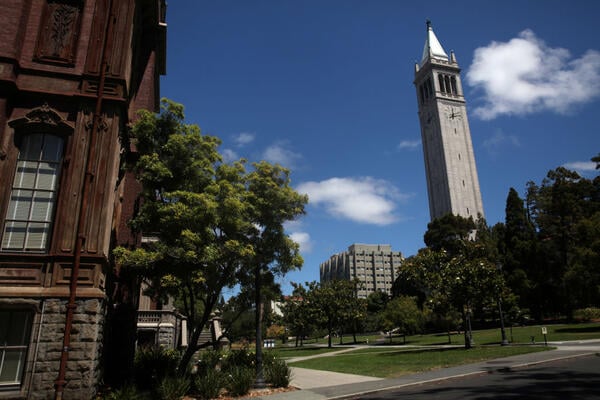
  • UC Berkeley Scientist Wins Nobel Prize for Chemistry

    UC Berkeley Scientist Wins Nobel Prize for Chemistry

    A chemist from the University of California, Berkeley, was among the trio of scientists awarded the Nobel Prize for Chemistry on Wednesday.

    Omar Yaghi, the Berkeley professor; Susumu Kitagawa from Kyoto University in Japan; and Richard Robson from the University of Melbourne in Australia were recognized for their work since the 1990s to develop a new form of molecular architecture that combines metal ions and carbon-based molecules, according to a release from the Royal Swedish Academy of Sciences, which administers the Nobel Prize.

    The metal-organic frameworks can harvest water or store toxic gases. The release noted that the frameworks “may contribute to solving some of humankind’s greatest challenges.”

    The release says the frameworks are essentially “rooms” because of the large spaces that form in the structure. A Nobel committee member compared it to Hermione Granger’s magical bag in the seventh Harry Potter book, the Associated Press reported. Her small bag eventually contained a tent, books and other provisions. Likewise, the frameworks look small but can hold a lot.

    Since the trio’s discoveries, more than 100,000 metal-organic frameworks have been created, according to a news release from Berkeley.

    Source link

  • How Trump’s Compact Threatens Higher Ed Funding, Freedom

    How Trump’s Compact Threatens Higher Ed Funding, Freedom

    The nine universities that were sent the Trump administration’s new deal for higher ed are under increasing pressure to reject the compact.

    Multiple major associations representing institutions and faculty have urged them not to sign it. California governor Gavin Newsom has said the University of Southern California and any other university in his state that signs will “instantly” lose billions of state dollars. Faculty groups at the University of Virginia, another institution presented with the compact, overwhelmingly urged university leaders to reject it. A group of progressive student and higher ed worker organizations is circulating a petition that calls on university presidents and boards to “reject the Trump administration’s attempt to cajole universities into compliance through explicit bribery.” 

    So far, the universities at the center of the fight are remaining mostly mum, saying they’ll review the proposal. Some leaders are hinting they have reservations about signing. But other higher ed leaders and observers say that beyond what those institutions do, the nine-page document represents another escalation in the White House’s precedent-shattering crusade to overhaul postsecondary ed—one that could restrict freedoms at colleges across the nation. They expect the compact will likely serve as a blueprint for the administration’s dealings with other colleges.

    “It’s making it really clear that the dominoes are being set up … they’re going to expand this to the rest of higher ed,” said Amy Reid, interim director of PEN America’s Freedom to Learn program.

    A White House official told Inside Higher Ed in an email that “other schools have affirmatively reached out and may be given the opportunity to be part of the initial tranche.” The New York Times cited May Mailman, a White House adviser, as saying the compact could be extended to all institutions.

    The administration has dangled the compact before universities with promises of extra benefits it hasn’t revealed. It’s an evolution in the White House’s quest to upend higher ed using the blunt instrument of federal funding access. The federal government earlier slashed billions of dollars from Harvard and Columbia Universities and other selective institutions to pressure them to change their internal policies and practices.

    But now, the administration has written a boilerplate contract asking colleges to voluntarily agree to overhaul or abolish departments “that purposefully punish, belittle, and even spark violence against conservative ideas,” without further defining what those terms mean. It also asks universities to, among other things, commit to not considering transgender women to be women and to reject foreign applicants “who demonstrate hostility to the United States, its allies, or its values.”

    In addition to a murky promise of additional money, the compact can be read as threatening colleges’ current federal funding. Higher ed groups say those that sign are taking a big gamble. The compact says failure to adhere to the terms of the agreement, which are vague, can lead to a loss of all federal funding. But it’s also unclear whether the universities have the freedom to refuse. A line at the end of the compact’s introduction says, “Institutions of higher education are free to develop models and values other than those below, if the institution elects to forego [sic] federal benefits.”

    The nine institutions sent the Compact for Academic Excellence in Higher Education aren’t necessarily being asked to sign it. The letter sent to the University of Virginia requested “limited, targeted feedback” on the compact by Oct. 20—before the White House sends invitations to finalize language and sign to universities showing “a strong readiness to champion this effort.”

    Lynn Pasquerella, president of the American Association of Colleges and Universities, said many campus leaders worry that, if any institutions do sign the compact, it will start a ripple effect in which other university leaders feel pressured to sign so they don’t lose out on funding.

    Joy Connolly—president of the American Council of Learned Societies, a federation of 81 groups including the American Academy of Arts and Sciences and the American Historical Association—added that with this compact, the White House “is using nine months of intimidation tests to take its divide-and-conquer strategy to the next level.”

    “If one by one institutions give in and sign, hoping to mitigate the damage later, it will set a truly problematic precedent,” Connolly said. “Some of the most powerful and wealthy institutions on the planet will have agreed to subject their faculty and research and teaching to state approval, and academia will be visibly divided into an insider group and an outsider group.”

    Unclear Carrots, Clearer Sticks

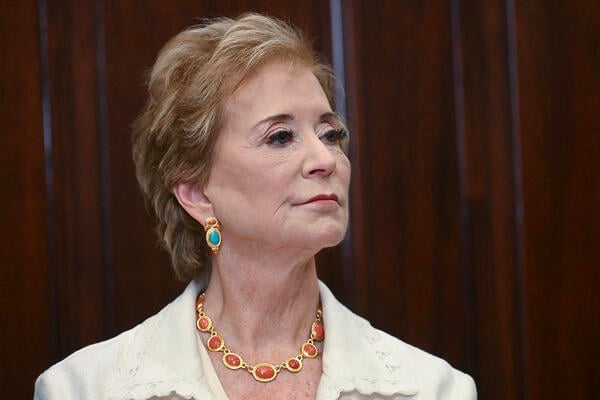
    According to the letter to UVA—signed by Mailman, Education Secretary Linda McMahon and Vincent Haley, director of the White House’s Domestic Policy Council—universities that sign will reap “multiple positive benefits … including allowance for increased overhead payments where feasible, substantial and meaningful federal grants, and other federal partnerships.” The White House didn’t provide Inside Higher Ed further information on how much extra money signatories would be able to receive.

    The compact itself makes no mention about the potential financial benefits of signing.

    For this unclear gain, a signatory university would risk all of their federal funding: The compact says “all monies advanced by the U.S. government during the year of any violation shall be returned to the U.S. government.”

    Asked to clarify whether a university that refuses to sign could lose all federal funding, White House spokeswoman Abigail Jackson replied in an email simply that “the Administration does not plan to limit federal funding to schools that sign the compact.”

    Jackson said universities that do sign “would be given [funding] priority when possible as well as invitations to collaborate with the White House. This is an opportunity for collaboration that all institutions of learning should be excited about.” The White House didn’t grant Inside Higher Ed an interview or answer written requests for more information about the compact’s benefits and how some of its requirements should be interpreted.

    Pasquerella, of AAC&U, said the compact is “meant to be vague as a way of fomenting confusion.”

    “Part of the strategy, I believe, of this administration is to engage in overly broad, overly vague language that is confusing so it’s not clear when institutions are complying,” Pasquerella said—a form of jawboning that pressures universities to overcomply. She said the compact’s promise of federal funds for signatories and apparent threat of cuts for those who refuse is “not a real choice.”

    “It is the continued weaponization of federal funding,” she said. The compact isn’t “reforming higher education but dismantling it and replacing it with institutions that have a conservative ideology.” It disadvantages those institutions that are unwilling to relinquish their academic freedom and other freedoms, such as transgender people’s rights, she said.

    Jon Fansmith, senior vice president for government relations at the American Council on Education, expressed concern that institutions that don’t sign could face the same “harassment” Harvard has suffered for refusing the administration’s earlier demands on that university. The administration cut off Harvard’s access to billions of dollars in research funding, placed it on heightened cash monitoring and tried to prevent it from enrolling international students, among other efforts in a growing pressure campaign against the institution.

    “Now they’re essentially saying we’re going to create two classes of institutions,” Fansmith said: those “swearing fealty to the administration” and getting extra benefits, and those that are punished.

    “That’s a massive step in the wrong direction in the history of American higher education,” he said. He said prioritizing less merit-worthy candidates for federal funding just because they signed the compact is “harmful to the goal of getting the best science performed on behalf of the American people.”

    Standing Up

    Fansmith noted the compact’s ideas aren’t necessarily new for the administration, but they would add up to “very specific intrusions into institutional policies.” For instance, the compact would mandate that all “undergraduate applicants take a widely-used standardized test … or program-specific measures of accomplishment.” Signatories must also agree that no more than 15 percent of their undergraduates be in the “Student Visa Exchange Program [sic], and no more than 5 percent shall be from any one country.” (The Student and Exchange Visitor Program, not the Student Visa Exchange Program, collects information on international students.)

    Reid, of PEN America, said, “The administration has gone from picking off individual schools to selecting a group—a group of well-respected universities, but that for different reasons are seen as perhaps likely to comply—and putting everyone on notice that this is coming for everyone.”

    Some of the nine institutions, however, have hinted at reservations about signing. On Friday, Dartmouth College president Sian Leah Beilock noted in a statement that “you have often heard me say that higher education is not perfect and that we can do better. At the same time, we will never compromise our academic freedom and our ability to govern ourselves.”

    On Sunday, University of Pennsylvania president J. Larry Jameson said Penn’s “long-standing partnership with the federal government in both education and research has yielded tremendous benefits for our nation,” but also that “Penn seeks no special consideration.” On Monday evening, University of Virginia Board of Visitors chair Rachel Sheridan and interim president Paul Mahoney wrote in a message to the campus community that “it would be difficult for the University to agree to certain provisions in the Compact.”

    Reid told Inside Higher Ed that “for those of us who are not at those nine targeted institutions, the question is how do we all respond in a way that bolsters the resolve of any institution to stand up.”

    “It is wrong to call this a compact, because there’s nothing mutual about it,” Reid said. “It is a one-sided coercive proposition that has a bow of commonality stuck onto it that it doesn’t deserve. We need to call this what it is, which is an attempt to extort universities, to shut down free expression on campuses, to impose ideological restrictions under another name.”

    Source link

  • Stop Labeling Students “First-Gen” (opinion)

    Stop Labeling Students “First-Gen” (opinion)

    New policy mandates force us to rethink how best to meet what the Boyer 2030 Commission termed “the equity-excellence imperative.” One way to pursue this goal is to consider the role played by first-generation student success initiatives, which continue to enjoy broad public support. In the current climate, higher ed may be forgiven a rush to establish centers or initiatives for first-generation student success, as many colleges and universities already have. But before we get to raising funds and creating logos, let’s pause and consider new ways to think about and organize such efforts to best meet the moment.

    To put it bluntly, what business is it of ours, or anyone’s, what a student’s parents’ educational attainment happens to be? The usual answer is that we inquire because we aim to foster upward social mobility, and because we know from research that students who are the first in their families to attend college do not succeed at the same cohort rates as so-called continuing-generation students. But I emphasize cohort rates because we are not talking about a group, defined by self-awareness and interaction, but indeed a cohort, defined by impersonal and ill-defined criteria. At the level of individuals and families, first-gen discourse presumes deficits, is intrusive and can be off-putting and condescending.

    Neither of your parents (you have two, right?) earned a bachelor’s degree?

    I’d venture that most who work with first-gen students would agree that there are enduring questions about how best to define who is and is not first-generation using one of several plausible definitions. And even after four decades of promotion, I think it’s fair to say that few students arrive on campus as self-conscious “first-gens,” however defined.

    Some imagine that they qualify if they are the first of their siblings to attend college. Others wonder, understandably, if a parent’s associate degree or years of college attendance not resulting in degree attainment substitutes for an earned bachelor’s degree. A few may even think, erroneously, that they qualify if they are the first in their family to attend a particular institution.

    And then there are the overriding problems of stigma and stereotype threat. Efforts to dispel negative connotations and instill pride notwithstanding—First!—most people can smell a rat when in the presence of Rodentia. While some minoritized students may find it a useful alternative to other, more vexing labels, many students wrestle with it, as they might with any label, especially in the absence of a related scholarship or other inducement. I used to regularly tell first-gens that the land-grant university to which they had matriculated was theirs, that it was made for them and that it was nice of them to let others use it, too. But such tricks of the trade are needed only because the reality, often stark, is so contrary.

    Instead of fighting a Sisyphean battle tainted by class bias, I suggest that we acknowledge that first-gen discourse defines students by a characteristic that is out of their control and that the label is troubling when applied to individual students. Consider that we have more control over almost every other way of identifying ourselves, including our gender and sexuality! Parents, guardians and other parental authorities are as close to a given as it gets, and to define one by a given is reductionist and objectifying.

    To help underscore the stakes involved, consider this thought experiment. What if we labeled students whose parents possess earned doctorates as “dockies” and awarded them membership in the honors program? Most would recoil at even the thought of it. We assume that dockies are privileged or at least not in need of privileged access to scarce resources. We imagine them as possessed of abundant social and cultural capital and a healthy amount of regular old capital, too. Why actively reproduce privilege?

    But let us immediately observe that such assumptions are just as potentially ill-founded for individual dockies as they are for individual first-gens. Ask a Ph.D.-holding parent of a neurodiverse child, of a drug-addicted child, a child with disabilities, a child prone to perfectionism, a child of mild ambition and so forth, and they are apt to share an earful. And let us acknowledge that dockies are often given access to scarce resources such as merit-based scholarships and extra help via supportive honors programs, and for legitimate reasons. For one, these students earn such considerations by virtue of their academic achievement. They also may need them to fulfill their considerable potential.

    The key distinction, then, is between how we relate to students as individuals and what we do to make our institutional practices and campus cultures accessible and just. But before saying more about that, I acknowledge that there is an entrenched cultural assumption in play. We hold that individuals are infinitely complex and of universal value, each unique and sacred. (I mean this exactly and empirically; no rhetorical flourish or exaggeration is involved.) Individual students are not, in this view, bearers of three or four defining categories, nor should we treat them as representatives of groups. That is called stereotypical thinking, and it leads to tokenism, and neither stereotypical thinking nor tokenism have ever been good things. Students have multiple identities, as we all do, and we should not presume which of them are most salient or assume that they are immutable or invariant.

    When, however, we turn attention to institutional and cultural realities—particularly to our college and university’s policies and practices, to campus values, norms and built environment and so forth—then, yes, by all means, dust off social science and humanities textbooks and deploy concepts, data and pertinent humanistic discourses that are needed to make sense of systems, contested histories, shared meanings and the like. Here is where centers for first-generation student success have their rightful place, as hubs for institutional reform, designed to bring into existence a higher education that meets students where they are, as we say.

    First-gen centers might support research into how students experience college life and in other ways help faculty, staff, administrators and graduate students working with undergraduate students to better understand and interact with them. (Three cheers for faculty meals in residence halls!) First-gen centers might facilitate integration of high-impact practices into curricula, rendering these no-longer-nice-to-haves affordable and accessible, and help banish class biases as revealed in diffuse condescension by the college-educated and well-heeled with respect to those thus othered and belittled. Let us put an end to arcane language used for the latent purpose of policing class distinctions and eliminate barriers of entry to STEM majors, which track already underresourced students into lower-paying professions, however otherwise socially vital and personally fulfilling.

    Colleges and universities cannot meet their missions in a democratic society unless they are shorn of institutionalized discrimination rooted in white supremacy, patriarchy, what the poet Adrienne Rich called “compulsory heterosexuality,” ableism, ageism, as well as discrimination against veterans and active-duty armed service members, students whose home countries are not the United States or for whom English is not their first language, students from rural communities, students from urban communities, students from tribal communities, students from foster homes, students who are first-gen as well as students who identify with one or more of the above and then some. Our to-do list is long and varied.

    First-gen discourse is, like most student success discourse, best suited for use by administrators. It is not usually the language of educators, nor should we foist it upon students themselves. To best aid students who are the first in their families to attend college, make higher education affordable, campuses welcoming, curricula efficient and effective. Facilitate transfer student success via inter-institutional peer tutoring, and in myriad similar ways remove the fences surrounding the ol’ ball field in the DEI social imaginary. Higher education may then serve the people, one individual at a time.

    Steven P. Dandaneau is an associate professor of sociology at Colorado State University. He is a former advisory board member for the Center for First-Generation Student Success, an initiative of NASPA: Student Affairs Administrators in Higher Education and the Suder Foundation, and was recognized as a First Scholars First Generation Champion in 2018.

    Source link

  • Economic Uncertainty Spurred Campus Cuts in September

    Economic Uncertainty Spurred Campus Cuts in September

    Judging from the widespread job and program cuts announced last month, higher education continues to face economic uncertainty on multiple fronts, from declining enrollment to federal funding issues.

    September saw layoffs, program cuts and other budget moves at a mix of institutions. While some of the institutions listed below are regional universities battered by declining enrollment, others are among the nation’s wealthiest; they pointed to federal research funding cuts, soaring endowment taxes and other factors as the impetus for recent cutbacks.

    Here’s a look at cost-cutting measures announced across the higher ed sector last month.

    Washington University in St. Louis

    One of the nation’s wealthiest universities is laying off hundreds of employees.

    WashU chancellor Andrew Martin announced last month that the private university had cut 316 staff positions and closed another 198 vacant roles as part of an effort to restructure or reduce budgets. He wrote that the cuts, which extend to WashU’s Medical Campus, total “more than $52 million in annual savings.”

    The chancellor cited both external and internal pressures.

    “These include the changing needs of our students, emerging technologies, and innovations in teaching and learning,” Martin wrote. “Others come from internal decisions and structures that have, over time, created ineffective processes and redundancies in the way we operate. In addition, we’re still facing significant uncertainty about potentially drastic reductions in federal research funding.”

    Uncertainty over federal research funding looms even as the university has lobbied heavily on Capitol Hill. Among individual institutions, WashU has been one of the top spenders on higher education lobbying this year, pumping $540,000 into those efforts across the first two quarters. (Third-quarter lobbying numbers are not yet available.)

    Despite a $12 billion endowment, WashU follows well-resourced peers, including Johns Hopkins, Northwestern and Stanford Universities, in enacting steep layoffs.

    Brown University

    Squeezed by a budget deficit and reeling from a battle with the Trump administration over allegations of antisemitism that included a temporary federal research funding freeze and ended with the university making concessions, Brown is laying off 48 employees and axing 55 vacant jobs.

    The cost-cutting measure comes after the Ivy League institution in Rhode Island already eliminated “approximately 90 mostly vacant positions” earlier this year, according to an announcement from senior administrators. Following the cuts, Brown is walking back freezes on hiring, travel and discretionary spending.

    Officials announced they plan to monetize “non-strategic real estate holdings” and pause “spending on plans to move the University to net-zero emissions,” among other efforts, including “prioritizing fundraising for current-use gifts that have an immediate positive budgetary impact.”

    Brown is among the nation’s wealthiest universities, with an endowment valued at $7.2 billion.

    University of Oregon

    Grappling with a budget deficit of more than $25 million, the public flagship announced plans to lay off 60 employees and close another 59 vacant positions, The Oregonian reported.

    The move comes after the university cut dozens of jobs earlier this year.

    “Through careful consultation with deans, department heads and the University Senate, we were able to substantially close our budget deficit without eliminating any degree programs,” UO senior officials wrote last month. “And while we are cutting 20 filled career faculty positions and 14 unfilled tenure track faculty positions, we are not eliminating any filled tenure track faculty positions.”

    Berklee College of Music

    College leaders cited “rising costs, a dynamic enrollment environment, and shifting national policies” in announcing the layoffs of 70 employees at the storied music school last month.

    The layoffs reportedly amount to 3 percent of the Berklee College of Music workforce and include employees on campuses in Massachusetts, New York and Spain, according to Boston.com. Of the 70 employees laid off, all were staff members and no faculty jobs were cut.

    Southern Oregon University

    After declaring financial exigency in July, officials finalized a plan at the public university in Ashland to cut $10 million in operating costs over four years, Jefferson Public Radio reported.

    The cuts will reportedly affect 70 faculty and staff jobs, though not all are currently filled. In addition to layoffs and the elimination of vacant jobs, the university also plans to scale back programs by cutting 10 majors—including chemistry and mathematics—and dropping a dozen minors.

    University of Arizona

    The public university in Tucson is cutting 43 jobs after Congress eliminated funding for the Supplemental Nutrition Assistance Program, The Arizona Daily Star reported.

    The program, known as SNAP-Ed for short, was removed from the federal budget earlier this year. Termination of the program cut off about $6 million in annual funds to the university to provide education-related services, faculty members told the newspaper.

    Arizona’s job cuts come as the university recently managed to zero out a $177 million deficit that administrators discovered in late 2023, which prompted sweeping cost-cutting measures.

    University of Louisiana at Lafayette

    The public university eliminated six jobs and closed the Office of Sustainability and Community Engagement last month as it navigates a $25 million deficit, The Acadiana Advocate reported.

    Other offices were restructured.

    The newspaper reported that officials have already identified $15 million in cuts to help close the deficit. Most divisions across the university will be required to reduce operational expenses by 10 percent.

    Cuyahoga Community College

    Following other public institutions in Ohio, CCC is axing 30 associate degree programs in low-enrollment areas, as mandated by Senate Bill 1, which the State Legislature passed earlier this year, Signal Cleveland reported.

    The cuts, announced last month, include a mix of programs ranging from advanced manufacturing to creative arts. Multiple apprenticeship programs are also being shut down.

    East Carolina University

    Officials at the public university in Greenville announced plans last month to cut $25 million from the budget amid declining enrollment and other factors, The Triangle Business Journal reported.

    Belt-tightening measures will be implemented over three years and will include “permanent reductions, academic program optimization, and organizational adjustments,” ECU officials announced last month. Administrators did not specify the number of potential layoffs ahead.

    Yale University

    Increased taxes and federal funding uncertainty are driving cost-cutting measures at the Ivy League university in Connecticut, where officials last month announced retirement incentives to eligible faculty as the university braces for an 8 percent tax on endowment income.

    Yale is one of the few universities with a multibillion-dollar endowment that will feel the tax at its highest level. The increase is a significant jump from the prior endowment tax of 1.4 percent.

    The university is also delaying major construction projects, among other money-saving moves.

    Source link

  • Community College Students Want a Social Life

    Community College Students Want a Social Life

    Belonging is a key predictor in student success; students who are engaged in campus activities and feel they belong to a community within their college are more likely to retain and graduate.

    Recently published data from the educational consulting group EAB shows that first-year students at two-year colleges want help connecting with peers on campus; nearly half reported dissatisfaction with their social lives since starting college. The report outlines ways to create engagement and other priorities for community college students.

    Community college in context: First- to second-year retention is the greatest predictor of completion for students enrolled in a two-year degree program, according to data from the National Student Clearinghouse Research Center.

    Approximately two in five undergraduates are enrolled at a community college, according to 2020–21 data from the U.S. Department of Education. But those students are less likely to complete a degree, in part because 32 percent of first-time, full-time students leave their institution before the second year.

    Community colleges are among the most diverse higher ed institutions, with students more likely to be working adults, parents and first-generation learners compared to their four-year peers.

    The EAB data identifies key trends in first-year community college students’ experiences and how institutions can improve their retention.

    Methodology

    EAB’s survey included responses from over 12,600 first-year college students, including 1,531 enrolled in community colleges. The survey was fielded in February and March 2024.

    The data: When asked to name the most disappointing elements of their college experience so far, students indicated they felt disconnected from the campus community. Forty-two percent of respondents said their social life was a top disappointment, followed by not making friends or meeting new people. An additional 35 percent of students said they felt as though they didn’t belong.

    This mirrors results from a 2025 survey conducted by Inside Higher Ed and Generation Lab, which found that only 20 percent of two-year students rated their sense of social belonging at college as above average or excellent, with the greatest share of respondents indicating they have an average sense of belonging (49 percent). By comparison, 29 percent of four-year students said they had an above average or excellent sense of belonging.

    EAB’s report recommends that two-year colleges create small interventions to support students’ desire for community, including arranging drop-in events, hobby groups or peer mentorship programs. Making clubs easier to join through flexible meeting times or virtual meetings can also accommodate learners’ busy schedules, according to the report.

    One-third of respondents to EAB’s survey said they were disappointed by classes and academics, and one in five students said faculty had disappointed them.

    EAB’s community college survey also found that 32 percent of respondents had experienced bias or exclusion in some capacity since starting college, with the greatest share of respondents saying they faced criticism for their physical appearance or for the high school they attended. The results indicate a need for mechanisms for students to report harassment and connect with mental health supports, according to EAB’s report.

    When asked what a “safe campus” means to them, the greatest share of community college respondents selected sufficient support for mental health and wellness (67 percent) and low or no property crime (67 percent). A similar number indicated that low incidence of sexual assault was key to creating a safe campus environment (66 percent).

    Mental health concerns are one of the top reasons students of all backgrounds leave higher education, but community college students are even more vulnerable because they can be less financially secure or have fewer resources to address poor mental health.

    However, community college counseling centers often have smaller staffs and serve only a fraction of their enrolled students; 2025 data from the Association for University and College Counseling Center Directors found that only 5 percent of all community college students receive support from their counseling center.

    When asked what best represents the value of higher education, successful job placement after graduation was the top choice among community college students (44 percent), followed by availability of scholarships (42 percent). Internships, co-ops and active learning experiences (33 percent) were less important than generous financial aid awards (38 percent) and moderate tuition prices.

    Source link