Faculty may include a preferred name policy on their syllabi, but they are advised against mentioning pronouns, the FAQ said.
Photo illustration by Justin Morrison/Inside Higher Ed | menonsstocks/E+/Getty Images | snorkulencija/iStock/Getty Images
After a confusing week, Texas Tech University officials offered the first written clarification on new university policies that prohibit faculty members from speaking or teaching about transgender identity. On Sunday, the provost’s office posted a lengthy frequently asked questions page that, among other things, addressed the definition of “noncompliant language,” explained how the new policies impact research and answered whether faculty can write on their syllabi that they are an ally to transgender people.
But after three days, the FAQ was taken down. Faculty have not been told why the information was removed, and health-care instructors are concerned students will not be trained in care for transgender patients, as required by certification exams.
A university spokesperson did not respond to Inside Higher Ed’s questions on the matter. Some faculty suspect that Brandon Creighton, who was officially named the Texas Tech system’s next chancellor on Tuesday, may have orchestrated the removal of the FAQ. Creighton was the lead author of the Texas Senate’s sweeping ban on diversity, equity and inclusion in 2023, and of the recent bill giving control of faculty senates to university presidents and boards. He will assume the chancellor role on Nov. 19.
While it was the first and most comprehensive written guidance Texas Tech has posted on its anti-trans policies, the FAQ left a lot of questions unanswered. The word “transgender” wasn’t included in any of the written answers. In one answer, officials wrote that noncompliant language “refers specifically to outdated or inaccurate syllabus content (i.e., COVID-era statements or statements referring to offices or units that no longer exist at Texas Tech.),” but said nothing about gender identity.
In response to a question about academic freedom, officials wrote, “Faculty may include course content that is relevant to a student’s program of study and post-graduation opportunities, including workforce and additional education. Faculty are encouraged to be thoughtful about including content that is described in the Chancellor’s memo.”
The new directives do not impact research, the FAQ clarified. Officials advised against including a “personal statement of student support” or a statement professing LGBTQ allyship, writing that “such a statement could attract unwanted attention.” They also wrote that faculty could include a preferred name policy on their syllabi, but that “until further clarification is available, it is advisable to omit personal pronoun language.” When relevant, instructors are permitted to facilitate classroom discussions in which students examine the state’s position on gender alongside other views, but the instructor may not advocate for any particular view.
In a later question about government censorship and faculty retention, officials wrote, “We recognize that faculty recruitment and retention may be affected. At present, the issued guidance applies only to instructional activities, not a faculty member’s independent research.”
The Texas conference of the American Association of University Professors has pushed back on the anti-trans policies at Texas Tech and other public universities in the state.
“Colleges and universities have an obligation to develop campus policies that protect the constitutional rights of their faculty to teach and research the subjects in their areas of expertise without intimidation or censorship,” said Brian Evans, president of the Texas conference of the AAUP. “By ensuring that teachers can speak freely, campus administrators should enable students to explore and learn the widest set of topics for civil engagement and successful careers. Campus policies related to academic freedom and free speech should be devised with the full participation of faculty in the spirit of a shared commitment to excellence.”
The FAQ—as short-lived as it was—only applied to Texas Tech’s flagship campus. The four other campuses in the public system, including Angelo State University, where faculty have received a profusion of conflicting verbal information, were not included.
A faculty member at the Texas Tech University Health Sciences Center who asked to remain anonymous for fear of retribution confirmed to Inside Higher Ed that faculty at their campus have been told not to use certain terms in their course content, including “transgender”; “gender-affirming care”; “diversity, equity and inclusion”; and “affirmative action.” Health Sciences Center faculty have not received any written guidance, and the deans don’t have clarifying information, either, the faculty member said. It is an especially troubling policy to enforce for health-care students, because care for transgender patients is included in some certification exams students must pass to be licensed, they said.
“There are certainly many things that our government has [outlawed] … but I can’t think of another thing that we’ve been told we can’t talk about,” the faculty member said. “Sex trafficking is illegal, but we can talk about how to care for people who have been victims of sex trafficking. Drunk driving—there’s about a million examples.”
It is unclear how much information students have about these new policies, according to the faculty member. Some students are bringing up transgender care in classroom discussions, and instructors are unsure how to respond.
The department is largely closed due to the government shutdown. In the meantime, the Trump administration is using furloughed workers’ emails to make a political statement.
Photo illustration by Justin Morrison/Inside Higher Ed | Tierney L. Cross/Getty Images | nevodka/iStock/Getty Images
Wednesday morning, as the government shutdown began, chief officers at the Department of Education distributed a standard out-of-the-office statement to all furloughed staff members and instructed them to copy and paste it into their email. So that’s what they did.
But just hours later, those same nonpartisan staffers began to hear that the message they’d pasted into their email account was not the message being received by the public.
“On Wednesday evening, my supervisor reached out to me on my personal equipment and said, ‘You’re going to want to log in and change your out-of-office status,’” one department staffer told Inside Higher Ed on the condition of anonymity out of fear of losing her job.
When she followed her supervisor’s direction and logged in, the automatic message she saw was not the one she had saved earlier that morning.
Rather than the original note, which had said, “There is a temporary shutdown … due to a lapse in appropriations,” the new message said, “Unfortunately, Democrat Senators are blocking passage of [a bill] … which has led to a lapse in appropriations.”
This is one of the more than 10 emails Inside Higher Ed received as automatic responses including the same political message. Although Keast was appointed by Trump, most of the staffers we contacted were not.
The outgoing message had been changed internally without her consent. And this staffer was not alone. Inside Higher Ed emailed 10 separate Education Department staffers Thursday, all of whom had been placed on furlough, and each one bounced back with identical responses. One senior leader from the department, who also spoke anonymously, said that to his knowledge the politically charged message was set as the out-of-office notification for all furloughed employees.
(The Department of Education did not immediately provide comment. In fact, the emails sent to both deputy press secretary Ellen Keast and the general press team account were met with the same automatic response.)
The first staffer said that while she was caught off guard by the override at first, it made sense the more she thought about it. Similar messages blaming Democratic senators for the shutdown had already been put at the top of HUD.gov, the landing page for all things Department of Housing and Urban Development, and other federal websites.
As of Thursday evening, the HUD website noted, “The Radical Left in Congress shut down the government. HUD will use available resources to help Americans in need.”
Republicans control the White House, the House and the Senate. In the Senate, they need the votes of at least seven Democratic senators to reach the 60-vote threshold necessary to overcome a filibuster.
“I was really surprised, because we had gotten such explicit instructions on what to use for our out-of-office message,” the staffer said. But “when I saw that message from my supervisor, I assumed it had been changed to something more political than the original neutral one.”
She has already logged back in multiple times to change the automatic response back to the neutral language. But each time, within hours, the department has overridden her changes.
“It’s what [is being sent] to people who contact me, and they could reasonably misunderstand it as coming from me, and I don’t feel comfortable as a federal employee communicating a political message like that,” she said.
A second staffer told Inside Higher Ed that he has worked through multiple shutdowns prior but not experienced anything like this.
“It’s just wild to see your name attached to a message that you had nothing to do with,” he said. “It feels like a violation … You know that you don’t have any expectation of privacy when you’re working for the federal government. But it’s a different thing to say that you don’t have autonomy over your own words.”
The second staffer noted that in his view, not only did this seem to be a violation of his personal rights, but also a violation of federal law.
The Hatch Act, passed in 1939, was intended to ensure that nonpartisan federal workers who worked across administrations remained just that—nonpartisan. And according to documents from the Office of Special Counsel website, the Hatch Act “limits certain political activities of federal employees,” like using official authority for political purposes, soliciting political donations, wearing partisan political gear at work and posting or sharing partisan content on government systems.
“It’s crazy to see the law violated on your behalf,” the second staffer said.
None of the department employees Inside Higher Ed spoke with intended to file an individual lawsuit, nor had they heard anything from their union about a collective legal response. But one shared that Democracy Forward, a nonprofit legal organization that has sued the Trump administration several times this year, will be going to court over the matter as soon as Friday.
The Trump administration has asked nine universities to sign on to a proposed compact, mandating certain changes in exchange for preferential treatment on federal funding.
First reported by The Washington Post and confirmed, with additional details, by The Wall Street Journal, the proposal seeks an agreement with nine institutions that are being asked to commit to a 10-point memo referred to as the “Compact for Academic Excellence in Higher Education.”
Among the various conditions, institutions are reportedly being asked to:
Ban consideration of race or sex in hiring and admissions processes
Freeze tuition for a five-year period
Limit international undergraduate enrollment to 15 percent of the student body
Commit to institutional neutrality
Require applicants to take standardized tests, such as the SAT or ACT
Clamp down on grade inflation
Ensure a “vibrant marketplace of ideas on campus”
Restrict employees from expressing political views on behalf of the institution
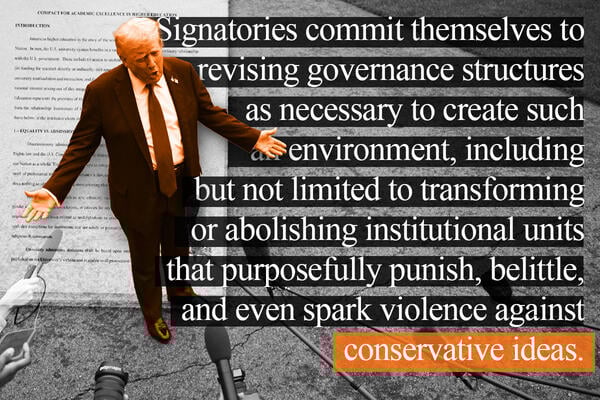
Shut down departments that “punish, belittle” or “spark violence against conservative ideas”
Anonymously poll students and employees on compact compliance and publish the results
Another requirement mandates that signatories “deploy their endowments to the public good,” such as by not charging tuition to students “pursuing hard science programs (with exceptions, as desired, for families of substantial means)” for universities with more than $2 million per undergraduate student in endowment assets. Universities would also be required to post more details about graduates’ earnings and refund tuition to those who drop out in their first semester.
After leveraging funding freezes and other tactics to pressure colleges to make changes, the compact reflects a different approach from the administration while still geared toward the same goal—remaking higher education in Trump’s image. May Mailman, a Trump adviser, hinted at the plan in a New York Times interview a week before the proposal emerged, saying it could be a way for universities to affirm they are “doing the right things.”
“The Trump administration does not want to be all Whac-a-Mole or all negative, but these are the principles that universities and the Trump administration and, frankly, private donors can ascribe to to say, ‘This makes a great university,’” she told the Times.
Institutions reportedly invited to join are: Brown University, Dartmouth College, the Massachusetts Institute of Technology, the University of Arizona, the University of Pennsylvania, the University of Southern California, University of Texas at Austin, the University of Virginia and Vanderbilt University.
Those that agree will receive “multiple positive benefits,” including “substantial and meaningful federal grants,” according to a copy of the memo published by The Washington Examiner.
But failure to comply with the agreement would come with steep consequences. Noncompliant universities would “lose access to the benefits of this agreement” for a year. Subsequent violations would lead to a two-year punishment. And the federal government could claw back “all monies advanced by the U.S. government during the year of any violation.” Private donations would also be required to be returned, upon request.
The Department of Justice would be tasked to enforce the agreements.
Institutional Responses
Most universities did not respond to requests for comment from Inside Higher Ed. But Texas officials seem eager to sign on, sharing a statement indicating their enthusiasm for the compact.
University of Texas system Board of Regents chairman Kevin P. Eltife wrote in the statement that the flagship was “honored” to be among the institutions “selected by the Trump Administration for potential funding advantages” under the proposed compact, which it is currently reviewing.
“Higher education has been at a crossroads in recent years, and we have worked very closely with Governor [Greg] Abbott, Lt. Gov. [Dan] Patrick and Speaker [Dustin] Burrows to implement sweeping changes for the benefit of our students and to strengthen our our [sic] institutions to best serve the people of Texas,” Eltife wrote. “Today we welcome the new opportunity presented to us and we look forward to working with the Trump Administration on it.”
University of Virginia spokesperson Brian Coy told Inside Higher Ed by email that interim president Paul Mahoney “created a working group under the leadership of Executive Vice President and Provost Brie Gertler and Executive Vice President and Chief Operating Officer J.J. Davis to advise him” on UVA’s response to the letter but has not yet made a decision to sign or not.
USC simply said in a statement, “We are reviewing the Administration’s letter.”
Both the White House and the Department of Education initially responded to requests for comment with automatic replies because of the federal government shutdown, which began Wednesday. A press office official later responded only to confirm The Wall Street Journal’s reporting.
Outside Perspectives
News of the proposal prompted a flurry of criticism within academic circles.
American Association of University Professors president Todd Wolfson blasted the idea in a Thursday statement and called on governing boards to reject it.
“The Trump administration’s offer to give preferential treatment to colleges and universities that court government favor stinks of favoritism, patronage, and bribery in exchange for allegiance to a partisan ideological agenda. This compact is akin to a loyalty oath. Adherence by university administrations would usher in a new era of thought policing in American higher education,” Wolfson wrote.
The executive committee of Penn’s AAUP chapter also opposed the proposal.
The Foundation for Individual Rights and Expression also criticized it in a post on X, writing that “the compact includes troubling language” specifically pointing to the call to eliminate academic departments critical of conservative ideas, which it cast as undermining free speech.
“A government that can reward colleges and universities for speech it favors today can punish them for speech it dislikes tomorrow. That’s not reform. That’s government-funded orthodoxy,” FIRE officials wrote.
Trinity Washington University president Pat McGuire called the proposal “political extortion.”
Brendan Cantwell, a higher education professor at Michigan State University, told Inside Higher Ed there are multiple issues with the proposal, including vague language about political speech that could allow universities or the federal government to single out faculty members for publicly discussing topics within their expertise. He added that “enforcement is so vague” that it would be easy for the federal government to declare universities out of compliance with the agreement.
Cantwell suggested, “This is probably a bigger deal than the Columbia [settlement] because it’s creating an incentive structure” that spurs universities to go along or opens them up to retaliation from the federal government, making it risky whether a university signs on or not.
(Columbia agreed to far-reaching changes to admissions, hiring, disciplinary processes and more in July, including a $221 million fine, when it reached a deal with the federal government to settle over findings that it failed to properly police antisemitism on campus. Columbia did not admit to wrongdoing, but administrators have acknowledged the need for reforms.)
Brian L. Heuser, a Vanderbilt professor and long-standing member of the university’s Faculty Senate, urged fellow senators and other faculty colleagues to organize against the idea in an email shared with Inside Higher Ed. Heuser called the compact “a dangerous departure from the core values that should underpin our institutions—namely, free inquiry, open debate, and institutional autonomy” and argued that it endangers academic freedom, among other concerns.
But some conservatives have lauded the idea and want ED to push harder.
“Secretary [Linda] McMahon deserves credit for working to disincentivize the use of race or sex in college admissions,” U.S. Sen. Todd Young, an Indiana Republican, wrote in a social media post. “We must go further—federally accredited institutions should eliminate ALL preferences grounded in ancestry, such as legacy status, or other factors unrelated to merit.”
Why These 9?
While it is unclear how the federal government landed on the nine schools as candidates for the proposal, one official told The Wall Street Journal the Trump administration believed they would be “good actors.” But contextual clues offer insights into why some may have been picked.
Of the nine, only five presidents signed on to a letter published earlier this year by higher education organizations pushing back on government overreach and political interference, which ultimately gathered 662 signatures. Of those five presidents, one has since resigned: Jim Ryan at UVA, who faced pressure from the Trump administration after it claimed the university failed to fully dismantle diversity, equity and inclusion programs.
Two institutions—Brown and Penn—previously struck deals with the federal government.
Others have drawn attention for political reasons. At Vanderbilt, Chancellor Daniel Diermeier has emerged as a leading voice advocating for institutional neutrality and has clashed with other campus leaders, arguing that higher education is in desperate need of reform, agreeing with frequent conservative criticisms of the sector. And Texas—one of three public institutions on the list—has an overwhelmingly conservative board, and both the system and flagship are led by former Republican elected officials.
First-generation students are twice as likely to leave college without completing a bachelor’s degree than their peers, even if they come from higher-income backgrounds and come to college academically prepared, according to a new report from the Common App. The findings suggest these factors do make a difference for student success outcomes but don’t erase other barriers first-generation students might face.
The report, released Thursday and the fourth in a series on first-generation students, used data from the National Student Clearinghouse Research Center to track enrollment, persistence and completion rates for 785,300 Common App applicants in the 2016–17 application cycle. (Students whose parents didn’t complete bachelor’s degrees made up 32 percent of the sample.) The report also took into account how a range of factors could affect student outcomes, including students’ incomes, their levels of academic preparation and how well-resourced their colleges are.
Previous studies have shown that “first-generation students are certainly not a monolith,” said Sarah Nolan, lead author of the report and a research scientist at Common App. “We were hoping to give readers a sense for … which first-generation students might in particular need more support.”
The good news is the report found first-generation applicants enroll in college at rates on par with their peers. Over 90 percent of Common App applicants, first-generation and otherwise, enrolled in college within six years of applying.
But first-generation students were slightly more likely to not enroll immediately (17 percent) or to enroll at a two-year college (12 percent) compared to other applicants (14 percent and 4 percent, respectively). That gap mostly closed when comparing students with strong academic records, defined as having SAT or ACT scores or GPAs in the top quartile. According to the report, that finding may be because a higher share of first-generation students may need extra coursework before enrolling in a four-year institution.
Students might also work to save up for college first or opt for community colleges’ more affordable tuition rates, the report suggested. Lower-income first-generation students, who qualified for application fee waivers, were also less likely to immediately enroll at four-year institutions and more likely to first enroll at a community college compared to similar students not from first-generation backgrounds.
Over all, “we are really heartened to see that there’s really not very strong differences in college enrollment,” Nolan said.
Completion rates, however, are another story. While about 70 percent of first-generation students do complete a bachelor’s degree within six years of enrolling, the report found stark disparities between them and their peers.
About half of first-generation students completed a bachelor’s degree within four years, compared to 68 percent of continuing-generation students, a gap of 18 percentage points. And that disparity persisted when looking at six-year graduation rates. About 69 percent of first-generation students graduated within six years, compared to 86 percent of continuing-generation students, a 17-percentage-point difference.
These gaps shrank but didn’t disappear for first-generation students with strong academic records and higher incomes. Academically prepared first-generation students were twice as likely to disenroll with no degree than their continuing-generation counterparts, 14 percent and 6 percent, respectively. In a similar vein, 24 percent of higher-income first-generation students left college without a degree within six years compared to 12 percent of their continuing-generation counterparts. Even for first-generation students who were both academically prepared and relatively well-off, these gaps remained.
Differences in the institutions first-generation and continuing-generation students attend—and the levels of supports they offer—didn’t account for completion-rate gaps, either.
Even when attending the exact same institutions, first-generation students were 10 percentage points less likely to earn a bachelor’s degree within six years than continuing-generation students.
However, higher per-student expenditures did seem to contribute to better student success outcomes. At institutions that spent at least $20,000 per student, 84 percent of first-generation graduated within six years, compared to 94 percent of continuing-generation students. The gap between first-generation and continuing-generation students’ completion rates widened to 15 percentage points at colleges that spent more moderately, $10,000 to $15,000 per student, and 17 percentage points at colleges with low per-student expenditures, less than $7,500.
These findings suggest that, while first-generation students disproportionately face financial constraints and barriers to college prep, it doesn’t explain away their graduation rate gaps. And students attending less resourced institutions isn’t a full explanation, either. Other obstacles must be at play.
What those barriers are may be “best answered by speaking with first-generation students themselves and unpacking what’s happening at the individual level,” Nolan said. But first-generation students likely struggle with limited access to information about higher ed and its “hidden curriculum” of expectations, regardless of income, high school performance or which college they attend.
“Having the right resources at the right time on the pathway—that’s really critical for student success,” Nolan added.
The stakes of success are high—the report found many first-generation students spent considerable time and money on college with no degree to show for it. Almost a third of first-generation students who didn’t earn a degree were enrolled for at least four years.
But a hopeful finding is that “additional investment can be quite positive for helping these students really actualize their potential,” Nolan said.
Upward transfer is viewed as a mechanism to provide college students with an accessible and affordable on-ramp to higher education through two-year colleges, but breakdowns in the credit-transfer process can hinder a student’s progress toward their degree.
A recent survey by Sova and the Beyond Transfer Policy Advisory Board found the average college student loses credits transferring between institutions and has to repeat courses they’ve already completed. Some students stop out of higher education altogether because transfer is too challenging.
CourseWise is a new tool that seeks to mitigate some of these challenges by deploying AI to identify and predict transfer equivalencies using existing articulation agreements between institutions. So far, the tool, part of the AI Transfer and Articulation Infrastructure Network, has been adopted at over 120 colleges and universities, helping to provide a centralized database for credit-transfer processes and automate course matching.
In the most recent episode of Voices of Student Success, host Ashley Mowreader speaks with Zachary Pardos, an associate professor at the University of California, Berkeley, about how CourseWise works, the human elements of credit transfer and the need for reliable data in transfer.
An edited version of the podcast appears below.
Q: As someone who’s been in the education-technology space for some time, can you talk about this boom of ed-tech applications for AI? It seems like it popped up overnight, but you and your colleagues are a testament to the fact that it’s been around for decades.
Zach Pardos, associate professor at UC Berkeley and the developer of CourseWise
A: As soon as a chat interface to AI became popularized, feasible, plausible and useful, it opened up the space to a lot of people, including those who don’t necessarily have a computer science background. So in a way, it’s great. You get a lot more accessibility to this kind of application and work. But there have also been precepts—things that the field has learned, things that people have learned who’ve been working in this space for a while—and you don’t want to have to repeat all those same errors. And in many ways, even though the current generation of AI is different in character, a lot of those same precepts and missteps still apply here.
Q: What is your tool CourseWise and why is it necessary in the ed-tech space?
A: CourseWise is a spinoff of our higher education and AI work from UC Berkeley. It is meant to be a credit-mobility accelerator for students and institutions. It’s needed because the greatest credit-mobility machine in America, the thing that gets families up in socioeconomic status, is education. And it’s the two-year–to–four-year transition often that does that, where you can start at a more affordable school that gives two-year associate’s degrees and then transition to a four-year school.
But that pathway often breaks down. It’s often too expensive to maintain, and so for there to be as many pathways as possible that are legitimate between institutions, between learning experiences, basically acknowledging what a student has learned and not making them do it again, requires us to embrace technology.
Q: Can you talk more about the challenges with transfer and where course equivalency and transfer pipelines can break down in the transition between the two- and four-year institutions?
A: Oftentimes, when a student applies to transfer, they’ll have their transcript evaluated [by the receiving institution], and it’ll be evaluated against existing rules.
Sometimes, when it’s between institutions that have made an effort to establish robust agreements, the student will get most of their credit accepted. But in instances where there aren’t such strong ties, there’s going to be a lot of credit that gets missed, and if the rules don’t exist, if the institution does go through the extra effort, or the student requests extra effort to consider credit that hasn’t been considered before, this can be a very lengthy process.
Sometimes that decision doesn’t get made until after the student’s first or second semester, semesters in which they maybe had to decide whether or not to take such a course. So it really is a matter of not enough acknowledgment of existing courses and then that process to acknowledge the equivalency of past learning being a bit too slow to best serve a learner.
Q: Yeah. Attending a two-year college with the hopes of earning a bachelor’s degree is designed to help students save time and money. So it’s frustrating to hear that some of these students are not getting their transfer equivalencies semesters into their progress at the four-year, because that’s time and energy lost.
A: Absolutely. It’s unfortunately, in many cases, a false promise that this is the cheaper way to go, and it ends up, in many cases, being more expensive.
Q: We can talk about the transfer pipeline a lot, but I’ll say one more thing: The free marketplace of higher education and the idea that a student can transfer anywhere is also broken down by a lack of transfer-articulation agreements, where the student’s credits aren’t recognized or they’re only recognized in part. That really hinders the student’s ability to say, “This is where I want to go to college,” because they’re subject to the whims of the institutions and their agreements between each other.
A: That’s right, and it’s not really an intentional [outcome]. However, systems that have a power dynamic often have a tendency not to change, and that resistance to change, kind of implicitly, is a commitment not to serve students correctly.
Accreditors Weigh In
The Council of Regional Accrediting Commissions (C-RAC) supports the exploration and application of AI solutions within learning evaluation and credit transfer, according to a forthcoming statement from the group to be released Oct. 6. Three accrediting commissions, MSCHE, SACSCOC and WSCUC, are holding a public webinar conversation to discuss transfer and learning mobility, with a focus on AI and credit transfer on Oct. 6. Learn more here.
So what you do need is a real type of intervention. Because it’s not in any one spot, you could argue, and you could also make the argument that every institution is so idiosyncratic in its processes that you would have to do a separate study at every institution to figure out, “OK, how do we fix things here?” But what our research is showing on the Berkeley end is that there are regularities. There are patterns in which credit is evaluated, and where you could modify that workflow to both better serve the institution, so it’s not spending so many resources on manually considering equivalencies, and serve the student better by elevating opportunities for credit acceptance in a more efficient way.
That’s basically what CourseWise is. It’s meant to be an intervention that serves the institution and serves the student by recognizing these common patterns to credit acceptance and leveraging AI to alleviate the stress and friction that currently exists in affording that credit.
Q: Can you walk us through where CourseWise fits into the workflow? How does it work practically?
A: CourseWise is evolving in its feature set and has a number of exciting features ahead, which maybe we’ll get to later. But right now, the concrete features are that on the administrator side, on the staff or admissions department side, you upload an institution’s existing articulation agreements—so if you’re a four-year school, it’s your agreements to accept credit from two-year schools.
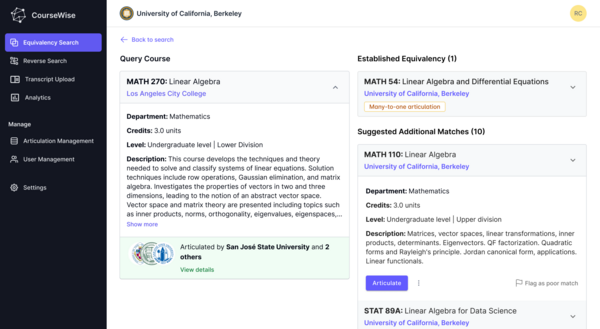
So then, when you receive transcripts from prospective transfer students, the system will evaluate that transcript to tell you which courses match existing rules of yours, where you’ve guaranteed credit, and then it’ll also surface courses that don’t already have an agreement.
If there’s a high-confidence AI match, it’ll bring that to the administrator’s attention and say, “You should consider this, and here’s why.” It’ll also bring to their attention, “Here’s peer institutions of yours that have already accepted that course as course-to-course credit.”
CourseWise compares classes in institutions’ catalogs to identify existing agreements for credit transfer and possible course-to-course transfers to improve student outcomes.
Q: Where are you getting that peer-to-peer information from?
A: We think of CourseWise as a network, and that information on what peer institutions are doing is present. We have a considerable number of institutions from the same system. California is one—we have 13 California institutions, and we’re working on more. The other is State University of New York, SUNY. We have the SUNY system central participating in a pilot. It’ll be up to the individual institutions to adopt the usage. But we have data at the system-center level, and because of that centralized data, we are able to say, for every SUNY institution that’s considering one of the AI credit acceptance requests, give that context of, “Here are other four-year peer institutions within your system that already accept this—not just as generic elective credit, but accept it as perhaps degree satisfying, or at least course-to-course credit.”
Q: That’s awesome; I’m sure it’s a time saver. But where do the faculty or staff members come back into the equation, to review what the AI produced or to make sure that those matches are appropriate?
A: Faculty are a critical part of the governance of credit equivalency in different systems. They have different roles; often it’s assumed that faculty approve individual courses. That’s true in most cases. Sometimes it’s committees; different departments will have a committee of faculty, or they may even have a campus standing committee that considers this curricular committee that makes those decisions.
But what CourseWise is doing right now to incorporate faculty appropriately is we’re allowing for the institution to define what is that approval workflow and the rules around that. If it’s a lower-division statistics class, can your admission staff make that decision on acceptability, even if it’s not existing in a current agreement?
Under what circumstances does it need to be routed to a faculty member to approve? What kind of information should be provided to that faculty member if they don’t have it, making it easy to request information, like requesting a syllabus be uploaded by the sending institution or something to that effect?
Oftentimes, this kind of approval workflow is done through a series of emails, and so we’re trying to internalize that and increase the transparency. You have different cases that get resolved with respect to pairs of courses, and you can see that case. You can justify why a decision was made, and it can be revisited if there’s a rebuttal to that decision.
Now, over time, what we hope the field can see as a potential is perhaps for certain students, let’s say, coming from out of state; it’s more a faculty committee who gives feedback to a kind of acceptance algorithm that is then able to make a call, and they can veto that call. But it creates a default; like with ChatGPT, there’s an alignment committee that helps give feedback to ChatGPT answers so that it is better in line with what most users find to be a high-quality response. Because there’s no way that we can proactively, manually accept or evaluate every pair of institutions to one another in the United States—there’s just no FTE count that would allow for that, which means that prospective students from out of state can’t get any guarantee if we keep it with that approach.
Faculty absolutely have control. We’re setting up the whole workflow so an institution can define that. But one of the options we want to give institutions is the option to say, “Well, if the student is coming from out of state or coming from this or that system, you can default to a kind of faculty-curated AI policy.”
Q: That’s cool. I’ve heard from some colleges that they have full teams of staff who just review transcripts every single day. Having a centralized database where you can see past experiences of which courses have been accepted or rejected—that can save so much time and energy. And that’s not even half of what CourseWise is doing.
A: Absolutely, and we work closely with leadership and these institutions to get feedback. And one of the people involved in that early feedback is Isaiah Vance at the Texas A&M University system, and he’s given us similar feedback where, if you have a new registrar or a new leadership that comes in, and they want to know how good the data is, they want that kind of transparency of how were decisions made, if you have that transparency in that organization to look that over, it can really help an institution get comfortable with those past decisions or decide how they should change in the future.
Q: What are some of the outcomes you’ve seen or the feedback you’ve heard from institutions that are using the tool?
A: Wehave a study that we’re about to embark upon to measure a before-and-after change in how institutions are doing business and how much it’s saving time or not, versus a control of not having the system when making these decisions.
We don’t have the results of that yet. We do have a paper out on where articulation officers, for example, are spending their time. They’re spending a lot of time on looking for the right course that might articulate. So we definitely have identified there is a problem. It’s an open question to what degree CourseWise is remedying that. We certainly are working nonstop to remedy it, but we’re going to measure that rigorously over the next year.
Some early feedback is positive, but also interesting that institutions, many of them, are spending a lot of time getting that initial data uploaded, catalog descriptions, articulations and the rigorousness and validity of that data. Maybe it’s spread across a number of Excel spreadsheets at some institutions—that problem is real—and so I think it’s going to take a field-level or industry-level effort to make sure that everyone can be on board with that data-wrangling stage.
Q: That was my hypothesis, that the tool has a lot of benefits once everything’s all set up and they’ve done the labor of love to hunt down and upload all these documents, find out which offices they’re hiding behind.
A: There are a number of private foundations, funders who are invested in that particular area. So I’m optimistic that there’s a solution out there and that we’ll be a part of that.
Q: I wonder if we can talk about how this tool can improve the student experience with transfer and what it means to have these efficiencies and database to lean back on.
A: Right now, most of the activity is with the four-year schools, because they’re the ones uploading the articulations. They’re the ones evaluating transcripts. But in the next four months, we’re releasing a student-facing planner, which will directly affect students at the sending institutions.
This planner will allow a student who’s at a community college to choose what destination school and major they’re interested in that’s part of the CourseWise network. Then [CourseWise provides] what courses they need to take, or options of courses to take that will transfer into the degree program that they’re seeking, such that when they transfer, they would only have to do the equivalent of two full years of academic work at that receiving school.
It would also let them know what other majors at other institutions they may want to consider because of how much of the credit that they’ve already taken is accepted into the degree programs there. So the student may be 20 percent of the way in completing their initially intended destination program, but maybe they’re 60 percent of the way to another program that they didn’t realize.
Q: What’s next for CourseWise?
A: So the student part is the navigation, the administrator articulation expansion and policy for expansion is creating the pathways; you need a GPS in order to know what the paths are and how to traverse them as a learner. But also states—I mentioned regularities—there are commonalities in how these processes take place, but there’s also very specific state-level concerns and structures, like common course numbering, credit for prior learning, an emphasis on community colleges accepting professional certificate programs and so forth.
I think the future is both increasing that student-facing value, helping with achievement from the student point of view. But then also leveraging the fundamental AI equivalency engine and research to bring in these other ways of acknowledging credit, whether it’s AP credit or job-training credit or certificates or cross-walking between all these different ways in which higher education chooses to speak about learning, right?
If you have a requirement satisfied in general education in California, how do you bring that to New York, given New York’s general education requirements? Are there crosswalks that can be suggested and established with the aid of AI? And I’m excited about connecting these different sorts of dialects of education using technology.
University of Missouri president Mun Choi is pressing local officials about crime rates near the Columbia campus after a student from neighboring Stephens College died Sunday following a downtown shooting, KCUR and the Columbia Missourian reported.
The president’s demand to address the city’s “rampant crime rate” has gathered some support, but critics say that his characterization of the local climate is overexaggerated, pointing to data from the local police department.
The shooting, which also resulted in serious injuries to two others, took place early Saturday morning on the college town’s main street. One individual, not from the city, got into a verbal dispute and then opened fire toward the people he was confronting. The three individuals he hit, however, were bystanders.
In a letter sent the same day as the shooting, Choi called on city and county leaders to bolster the police presence and prosecute crimes to the fullest extent of the law. He also urged them to take down encampments of unhoused individuals, pass a loitering notice and repeal policies that “attract criminals to the region.”
But when asked during a press conference Monday what policies and practices he believes “attract criminals,” the MU president said he had none to cite. Neither the shooter in the Saturday incident nor any of the victims have been identified as unhoused, according to local reporting.
“That is why I am asking [local leaders] to evaluate the processes that we have and the practices,” he explained. “Are we giving the impression to potential criminals that this is a region that doesn’t take crime enforcement as well as the punishment that comes with it seriously?”
Choi later added that students and local business owners have been raising safety concerns about the city’s unhoused population. According to university data, the number of arrests and trespassing violations issued to the unhoused has “gone up dramatically” since 2019, he said.
That is different, however, from what some local police department data shows.
In a Facebook post Monday, the city’s mayor, Barbara Buffaloe, said there have been 58 gunshot incidents since the beginning of the year. That’s down from 105 in the first nine months of 2024.
Columbia Police Department chief Jill Schlude did note in a separate letter, however, that since 2019 more crimes have been concentrated downtown, occurring between midnight and 3 a.m.
“The connection between late-night social activity and violence is clear, and that is where we continue to focus our efforts,” Schlude said.
Regardless of any disputes over the data, multiple government officials—including Gov. Mike Kehoe, several members of the Columbia City Council and Mayor Buffaloe—have voiced support for Choi’s general call to improve safety. Buffaloe has also committed to forming a task force on the matter, and the CPD has outlined plans to increase the police presence downtown.
“Statistics cannot be used solely as a reason for us to move away from what needs to be done in the city of Columbia,” Choi said.
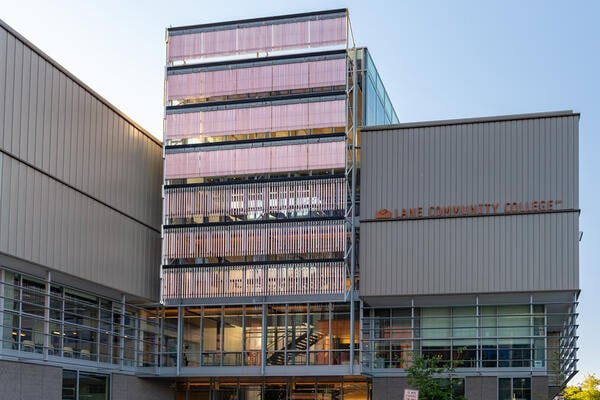
The Lane Community College Board of Education apologized to President Stephanie Bulger at its Tuesday meeting for how members disrespected her on the basis of her race and sex, Lookout Eugene-Springfield reported.
The board’s apology follows the findings of an investigative report released in August that determined board members were frequently dismissive of Bulger—a Black woman—and often deferred questions to male staff members. The report found that former board chair Zach Mulholland was frequently hostile toward Bulger and often cut her off in their interactions. (He was also found to have physically intimidated a student at a board meeting.) Although Mulholland was censured by the board last month, he has resisted calls to step down.
Much of the report focused on Mulholland, but other members were also implicated.
“The board recognizes and is accountable for the harm caused to you, President Bulger,” said Austin Fölnagy, the current board chair, who was also accused of dismissive behavior. “We are deeply sorry for the negative impact our behavior has had on you and the college community at large. President Bulger, please accept the board’s apology for treating you badly.”
He added that the board is “committed to learning from our shortcomings” and will take “remedial actions including training in bias, discrimination and harassment” this fiscal year.
Bulger has been president of the Oregon community college since July 2022.
Dixon has faced blowback for his political activism before and remained in his role at UNC.
Eros Hoagland/Getty Images
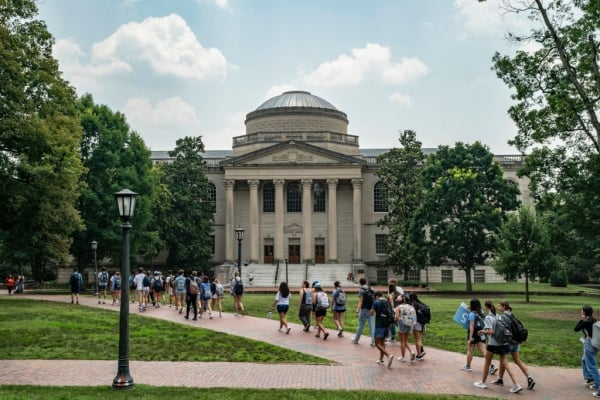
Officials at the University of North Carolina at Chapel Hill placed Professor Dwayne Dixon on leave Monday while the university investigates his “alleged advocacy of politically motivated violence,” said Dean Stoyer, UNC Chapel Hill’s vice chancellor for communications and marketing.
Dixon, an associate professor of Asian and Middle Eastern studies, used to be a member of Silver Valley Redneck Revolt, a chapter of the antifascist, antiracist, anticapitalist political group Redneck Revolt. The group was formed in 2016 and some members, including Dixon, were present at the 2017 Unite the Right rally in Charlottesville, Va., to provide armed security and medical assistance to counterprotesters. Redneck Revolt disbanded in 2019 and has no active chapters, according to its website.
In a 2018 interview with The Chronicle of Higher Education, Dixon described himself as an “anarchist,” and he is no stranger to blowback for his political activism and support for gun rights. He was arrested for bringing a semiautomatic rifle to a Ku Klux Klan counterprotest in Durham, N.C., in 2018—the case was later dismissed as unconstitutional on the grounds that the charges violated Dixon’s First and Second Amendment rights. He was also among 20 people who protected counterprotesters in Durham when white supremacists protested the removal of a Confederate statue in 2017. Through all these events, Dixon remained employed at UNC Chapel Hill.
Why is Dixon in the hot seat now? The answer is convoluted, but it begins with fliers on the Georgetown University campus.
On Sept. 24, Andrew Kolvet, a spokesperson for the late Charlie Kirk’s Turning Point USA, posted on X a photo of a flier on the Georgetown campus in Washington, D.C., that read, “Hey Fascist! Catch!”—a nod to engraving on the casing of bullets left behind by Kirk’s suspected killer—and “The only political group that celebrates when Nazis die.” The flier also included a QR code to a Google form for a potential Georgetown chapter of the John Brown Gun Club, a Redneck Revolt affiliate organization known as a “leftist gun-rights group” with multiple independent chapters, including one in the D.C. area, according to the Counter Extremism Project. It “arms itself to defend against far-right violence and often appears as a security force at protests to protect against expected far-right violence,” the CEP wrote. Google has since removed the form for violating its terms of service.
University officials removed the fliers and reported them to the FBI. Education Secretary Linda McMahon also weighed in: “At a moment like this, Georgetown has to determine what it stands for as an institution … Allowing violent rhetoric to fester on our nation’s campuses without consequences is dangerous. It must be condemned by institutional leaders,” she wrote on X. “I am grateful to those who spoke out against this and made noise about the posters on campus—you made a difference. There is power in speaking up to reveal these hateful ideologies that have incited deadly violence.”
Kolvet posted again, this time linking to a recent Fox News article that cited Dixon’s involvement in Redneck Revolt based on an old blog post that has since been taken down. “I posted this flyer our team spotted at Georgetown University, and now we find out professors at ‘elite’ schools are members of this group and its offshoots,” Kolvet wrote. “This professor must be immediately fired and the group/network investigated.”
Dixon was placed on leave Monday, which will “allow the University to investigate these allegations in a manner that protects the integrity of its assessment,” UNC’s Stoyer said in his statement. “Depending upon the nature and circumstances of this activity, this conduct could be grounds for disciplinary action up to and including potential termination of employment.”
UNC Chapel Hill officials declined to answer any other questions about Dixon and did not say whether Kolvet’s post or the Fox News article led to the investigation. Dixon did not reply to a request for comment but told the student newspaper The Daily Tarheel that he left the Silver Valley Redneck Revolt in 2018.
A Change.org petition to reinstate Dixon is circulating and as of Wednesday evening had more than 900 signatures. In a statement Wednesday, the North Carolina chapter of the American Association of University Professors, as well as UNC Chapel Hill’s AAUP president, condemned the university’s actions and demanded Dixon be reinstated.
“Right-wing activists are attacking Dixon for prior membership in a group that has been inactive since 2019, and are baselessly connecting him to flyers allegedly posted by a different group on a different campus outside of North Carolina. Fox News picked up the story on September 27, 2025, without verifying the existence of the flyers, and apparently this was enough for UNC’s administration to remove a professor from the classroom in the middle of the semester and bar him from campus,” the statement read. “Let’s call this what it is: UNC administrators are capitulating to a call from a right-wing group, infamous for attacking faculty, to fire a professor based on an unsubstantiated rumor.”
Dixon joins the ranks of dozens of college and university faculty members who have been placed on leave, disciplined or fired in the weeks since Kirk was shot and killed. All of these professors have been investigated after right-wing personalities identified them on social media. Two of them—Michael Hook, who was placed on leave for social media comments he made about Kirk’s death, and Thomas Alter, who was terminated after being accused of inciting violence during a speech—have been reinstated by court orders.
In today’s rapidly evolving workforce landscape, higher education institutions face mounting pressure to demonstrate value, relevance and return on investment. Amid this challenge lies an underutilized strategy with remarkable potential: credit for prior learning.
We’ve long recognized CPL’s benefits for students. Learners who receive CPL credits are more likely to complete their degrees (49 percent vs. 27 percent for those without) and, on average, they earn 17.6 additional credits, finish nine to 14 months sooner and save between $1,500 and $10,200 in tuition costs (CAEL). But what’s often overlooked is CPL’s power to transform relationships between educational institutions and employers—creating a win-win-win for students, institutions and industry.
Beyond a Student Benefit
The traditional narrative around CPL emphasizes student advantages: increased enrollment, improved completion rates and reduced time to graduation. These metrics matter tremendously, but they tell only part of the story.
CPL can serve as a bridge between academia and industry, creating powerful new partnerships. When colleges and universities embrace robust CPL programs, they send a clear message to employers: We value the training and development you provide. Recognizing corporate training as creditworthy learning demonstrates respect for workplace knowledge and underscores higher education’s commitment to real-world relevance.
Employer and Workforce Gains
For employers, CPL validates that their internal training programs have academic merit. This recognition strengthens recruitment and retention efforts, as workers see clear pathways to advance their education without duplicating learning they’ve already mastered. Companies that invest in employee development also gain educational partners who understand industry needs and value the attributes that drive employee success.
The benefits extend further: Organizations with tuition remission or reimbursement programs can reduce costs while enhancing employee motivation and persistence.
Deeper Collaboration Between Higher Ed and Industry
As institutions evaluate workplace training for credit equivalency, they gain invaluable insights into industry practices and skill needs. This exchange allows colleges to refine curricula to better meet market demand, ensuring graduates possess the competencies employers seek—not just those defined within academic silos.
The hard but necessary conversations—between faculty and corporate training leaders—help ensure CPL evaluations are rigorous and relevant. Key questions include: Why include certain topics but not others? How do we know participants can demonstrate knowledge? Does the training align with broader disciplinary or leadership needs, or is it niche? These discussions strengthen both educational and workplace outcomes.
Reimagining CPL
The future of higher education lies in breaking down artificial barriers between academic and workplace learning. By embracing CPL as a cornerstone strategy—not only for student success but also for employer partnerships—institutions can position themselves at the nexus of education and employment.
This approach doesn’t diminish academic rigor; it expands our understanding of where and how meaningful learning occurs. Done well, CPL creates pathways that honor all learning, regardless of where it happens. And for learners, the message is clear: Your hard work counts.
Late last spring, something disturbing happened in my classroom. For the first time in 15 years of teaching, I opened by telling my students I wasn’t sure if I was allowed to speak. The class was an introduction to the philosophy of education, and months earlier I’d scheduled this day for our opening discussion on critical pedagogy. But in light of charged campus climates and broader legal threats facing institutions nationwide, I realized that as an academic staff member who engages in teaching and research, I was particularly vulnerable.
What followed was one of the more important classes I’ve taught, though not about the subject I’d planned. We spent the hour investigating our institution’s academic freedom policies, asking questions of whom those policies included and excluded. We discovered the troubling reality: Although I was expected to facilitate complex educational discussions, I lacked clear protections to do so safely.
My situation reflects a growing crisis in higher education that has received little attention. While much has been written about the vulnerabilities of contingent faculty, there has been almost no discussion of the academic freedom needs of one of higher education’s most rapidly growing workforces: third-space professionals.
The Rise of the Third Space
Over the past two decades, universities have dramatically expanded what researcher Celia Whitchurch terms “third-space” professionals: staff who blend academic and administrative functions but operate in the ambiguous territory between traditional faculty and staff roles.
These roles aren’t new or unprecedented. The American Association of University Professors has long recognized that librarians, despite often holding staff status, require academic freedom protections given their integral role in teaching and research. What’s new is the scale and diversity of academic work now performed by nonfaculty academic professionals.
This growth represents the contemporary evolution of a workforce shift that began in the 1970s, when academic support roles developed in response to diverse students entering colleges through open admissions policies. The 1990s brought expansion into new fields like faculty development and community-based learning, as colleges recognized these roles could enhance teaching practices institutionwide. Most recently, colleges have seen explosive growth in data-driven student success and enrollment management roles.
What unites these professionals is their expertise in designing and delivering on the academic mission of the university, with special emphasis on student success. They lead pedagogical and curricular initiatives, make decisions about learning interventions, analyze data that reveals uncomfortable truths about institutional performance, and advocate for evidence-based policy revisions. They also regularly teach college courses, write and receive major grants, and publish in peer-reviewed journals. In essence, they do academic work, but without academic protections.
Why Academic Freedom Matters for Third-Space Work
The problem is easy to name but difficult to address. Institutions have radically restructured how academic work gets done based on the shifting needs of students and priorities of institutions, without a reciprocal restructuring of how academic work gets supported or protected. Third-space professionals need academic freedom protections for four key reasons.
Educational decision-making: These professionals make pedagogical and curricular choices about student learning interventions, program design and educational strategies. Without academic freedom, they face pressure to implement approaches based on administrative convenience, pressure from faculty or donor preferences, rather than evidence-based best practices. What happens, for instance, when a faculty member feels the writing center’s approach to writing pedagogy conflicts with their own vision for writing in their classroom?
Data interpretation and reporting: Student success professionals analyze retention, graduation and achievement data that may reveal uncomfortable truths about institutional performance or equity gaps. They need protection when their findings challenge institutional narratives or suggest costly reforms. What happens when an institutional researcher’s analysis shows that a flagship retention program isn’t working, but the administration has just featured it in a major donor presentation?
Policy advocacy: Their direct work with students gives them insights into institutional policies and processes that harm student success. They should be able to advocate for necessary changes without fear of retaliation, even when those changes conflict with administrative priorities or departmental preferences. What happens when an academic adviser discovers that the prerequisite structure in a major is creating unnecessary barriers for students, but changing it would require difficult conversations with powerful department heads?
Research and assessment: Many third-space professionals conduct and publish research on student success interventions, learning outcomes and institutional effectiveness. This scholarship requires the same protections as traditional academic research. What happens when assessment reveals the ineffectiveness of first-year seminar teaching, but presenting findings could damage relationships with faculty colleagues?
The Problem of Selective Recognition
Universities have already recognized that faculty work has diversified and requires differentiated policy structures. Many institutions now distinguish between research professors (focused on scholarship and grant acquisition), teaching professors (emphasizing teaching practice) and professors of practice (bringing professional expertise into academic settings). Each category receives tailored policies for promotion, performance evaluation and professional development that align with their distinct contributions.
Yet on the staff side, institutions continue to operate as if all nonfaculty work is identical. A writing center director publishing on linguistic justice, an assistant dean of students developing crisis-intervention protocols for student mental health emergencies and a facilities director managing building maintenance are all governed by the same generic “staff” policies. This isn’t just administratively awkward: It’s a fundamental misalignment between how work actually happens and how institutions recognize and protect that work.
Applying Consistent Logic
The way forward isn’t revolutionary, but simply the application of the same logic that most universities already use for faculty. Rather than the outdated single “staff” category, colleges and universities need at least three distinct categories that reflect how staff work actually happens.
Academic staff: Professionals engaged in teaching, research, curriculum design and educational assessment, including learning center directors, faculty developers, institutional researchers, professional academic advisers and academic program directors. These roles require academic freedom protections, scholarly review processes and governance representation.
Student life staff: Professionals focused on co-curricular support, belonging and student life, including residence life coordinators, activities directors and counseling staff. These roles need specialized professional development and advancement pathways that recognize and support their expertise in student development.
Operational staff: Professionals handling business functions, facilities and administrative operations. These roles can continue with traditional staff policies and support structures.
This framework enables differentiated policy environments and support structures across multiple areas. Critically, academic freedom policies can be tailored to protect inquiry for staff who engage in this kind of work, while recognizing that other staff have different professional needs.
The expansion of third-space/academic staff roles represents higher education’s recognition that effective student success requires diverse forms of expertise working collaboratively. But without policy frameworks that acknowledge and protect this academic work, institutions risk undermining the very innovations they’ve created. When the professionals responsible for student success cannot engage in free inquiry, challenge ineffective practices or advocate for evidence-based approaches, everyone loses—especially students.
Aaron Stoller is associate vice president for student success and a lecturer in education at Colorado College.