Tag: Jobs

  • Don’t Wait for Permission to Write for the Public

    Don’t Wait for Permission to Write for the Public

    Welcome to the first installment of my monthly column, “The Public Scholar,” in which I invite academics and other experts to step forward—thoughtfully, clearly and with purpose—to help shape public conversations that matter. In this space, I’ll offer practical, field-tested strategies for turning academic expertise into public impact, including how to know if an idea is op-ed–worthy, how to turn a classroom anecdote into publishable prose, how to know when it’s time to query a literary agent about your book idea and more.

    I’m Susan D’Agostino, a mathematician whose stories have been published in The Atlantic, the BBC, Scientific American, The Washington Post, The Financial Times, Wired, Quanta and other leading publications. (You may recall that I wrote with some frequency about math and technology for Inside Higher Ed a couple of years ago.) My last book, How to Free Your Inner Mathematician (Oxford University Press, 2020), won the Mathematical Association of America’s Euler Book Prize for an exceptionally well-written book with a positive impact on the public’s view of math. My next book, How Math Will Save Your Life, to be published by W. W. Norton, makes the case for harnessing mathematical thinking in the face of personal and global crises.

    But none of that came easily or automatically. A decade ago, I was a tenured mathematics professor who had spent years honing proofs and lectures. Yet amid lagging public math literacy, I felt an unshakable urge to reach beyond the walls of academia and write for the public. Still, I hesitated. Was my voice or expertise welcome outside of peer-reviewed journals? Did I have the authority to write for readers I could not picture in a seminar room? Did I even know how?

    That transition—from academic to public scholar—was bumpy. I made mistakes. I received more rejections than I care to count. (Stay tuned for a future column about all those rejections!) I had to unlearn some academic habits and relearn how to communicate with clarity for broad audiences. But step by step, I found my way.

    You don’t need to leave higher ed to write for the public. And you certainly don’t need permission. Academia often trains scholars to seek approval—through grants, press offices and peer-reviewed publications. But the reality is that institutional support often follows after a scholar gains visibility. You already have the credentials to write for the public in your area of expertise. Now you need the courage and practical tips for doing so.

    Maybe you’re a historian who sees how your field illuminates today’s political divides. Or a scientist concerned about climate change, misinformation or public health. Or an artist reflecting on what the arts can—and do—offer society. Or a literary scholar exploring how stories shape our moral imaginations. Or an educator with hard-won insights into what learning looks like in today’s classrooms. If you feel the tug to engage beyond campus gates, this column is for you.

    Many academics assume that public writing takes time away from scholarship. But making your work accessible to a wide audience forces you to think harder, not less. How can you distill the central argument of your research so that an intelligent friend with no training in your field can understand? Why should they care? Honing translation skills is an art. Your goal is to show up with clarity and generosity.

    As a bonus, crafting the occasional op-ed can energize your research and teaching—not distract from it. You can clarify your ideas and receive real-time feedback on your argument and may even attract collaborators. Public writing can also be personally restorative. It reconnects you with the real-world questions that made you fall for your field. Your op-ed may even catch the eye of a literary agent or editor who’s interested in discussing book ideas. Also, your willingness to be a novice again may offer credibility among students, as that’s what many are wrestling with in your classroom.

    When I began writing in public-facing newspapers and magazines, I felt newly connected to issues that mattered beyond academia. While campus conversations are vital and intellectually rich, I found that engaging the broader public offered a different kind of clarity and urgency—to respond to a moment unfolding in real time and to make research relevant to people’s lives.

    Scholars across disciplines have watched with rising unease as the Trump administration has terminated research grants, dismissed government scientists without cause and wielded funding as a cudgel against universities. In this atmosphere, it can be tempting to self-censor or to wait for more hospitable times.

    But the cost of silence must be weighed against the consequences of inaction. Public conversations—about health care, history, science, democracy, libraries, public art and education—unfold every day, with or without scholars who can offer nuance, evidence and context.

    “Opinions are most malleable before they are fully formed,” wrote Lisa Fazio, a psychology professor at Vanderbilt whose federal grant for misinformation research was terminated. “We must not shy away from the spotlight.”

    Fazio’s warning is especially resonant now, as academics face mounting pressure from funding threats to political scrutiny. These pressures are real, and they are unevenly distributed. As University of Washington computer scientist Kate Starbird, also a target for her work on misinformation, told Science magazine, “I never had the option of keeping my head down.”

    And yet: Sharing knowledge, humanizing data and contextualizing history are profound acts of public service in consequential times. The OpEd Project puts it plainly: “If you say things of consequence, there may be consequences. The alternative is to be inconsequential.”

    Here’s some good news: Editors at newspapers and magazines want academic voices in the mix, and they’re often willing collaborators in helping your ideas rise above the noise. Editors want assurance that you are trained in your area of expertise, but they are less concerned with titles or tenure than your academic colleagues. Whether you’re a graduate student, an adjunct, new on the tenure track or a full professor, what matters is your voice, your argument and your ability to meet the moment.

    Ready to begin? Here are a few prompts to spark your first (or next) op-ed:

    • What’s one thing people misunderstand about your field, and why does it matter?
    • What recent news headline made you think, “If only they understood this about my field …?”
    • What conversation is already happening in the news, online or in your community that your research can help reframe, complicate or clarify?
    • What’s one counterintuitive idea from your work that could shift how people think?
    • Has your research or teaching ever changed how you see the world, and could it do the same for others?
    • Where is your field falling short in meeting a public need, and what would it take to change that?

    You don’t need to have all the answers. Often, a strong op-ed starts with one sharp insight, thoughtfully delivered and timed to the news cycle.

    Try drafting a few notes in your phone during your commute, between classes or even while multitasking in that faculty meeting (I won’t tell). Write as if you’re talking to a smart, curious friend. Make it clear, specific and real. Proofread like your reputation depends on it, because for the editor you’re pitching, it does. Make it short, too! Aim for 800 words max.

    And if you’d like more help along the way, sign up for my monthly newsletter. You’ll get notice of each new article in “The Public Scholar,” practical writing tips, behind-the-scenes insights from my work and inspiration from other academics finding their voice in public spaces. Your expertise is hard-won. What might happen if you shared what you know more broadly?

    Susan D’Agostino is a mathematician whose stories have been published in The Atlantic, the BBC, Scientific American, The Washington Post, Wired, The Financial Times, Quanta and other leading publications. Her last book, How to Free Your Inner Mathematician (Oxford University Press, 2020) won the Mathematical Association of America’s Euler Book Prize for an exceptionally well-written book with a positive impact on the public’s view of math. Her next book, How Math Will Save Your Life, will be published by W. W. Norton. She has been a journalism fellow at Oxford University’s Reuters Institute, Columbia University’s Graduate School of Journalism and the Mila-Quebec AI Institute. For notice of each new article in Susan’s Inside Higher Ed column, “The Public Scholar,” practical writing tips, behind-the-scenes insights from her work and inspiration from other academics finding their voice in public spaces, sign up for her free, monthly newsletter here.

    Source link

  • Research Funding Starts to Flow Back to Columbia, Brown

    Research Funding Starts to Flow Back to Columbia, Brown

    Photo illustration by Justin Morrison/Inside Higher Ed | Wolterk/iStock/Getty Images | Alex Kent/Getty Images

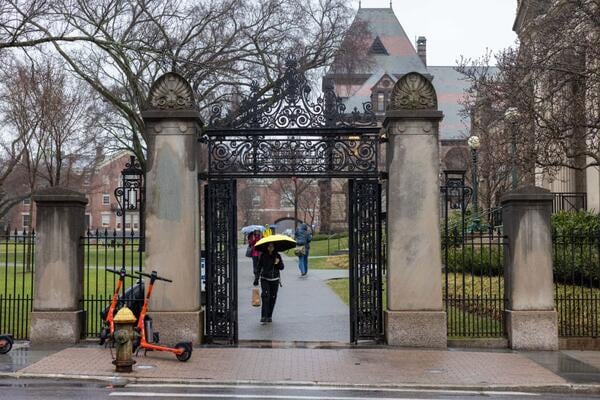
    Days after reaching deals with the Trump administration, Columbia and Brown Universities say the government has already initiated the process of restoring hundreds of millions in federal research dollars it terminated earlier this year in retaliation for their alleged failures to address antisemitism on campus. 

    Many of those grants came from the National Institutes of Health, which is overseen by the Department of Health and Human Services, and funded medical research, including time-sensitive clinical trials.  

    “The agreement finalized this week restored all National Institutes of Health grants to Brown researchers that had been terminated,” Brian Clark, a Brown spokesperson, wrote in an email to Inside Higher Ed Thursday evening. “We started to see that formalized in award letters today and expect in the coming days and weeks to see this across all of these grants.” 

    In April, the administration blocked $510 million in federal grants and contracts for Brown. But under the terms of the agreement the government and university finalized Wednesday, Clark said, “Any payments should resume within 30 days,” which applies to both “the restoration of specific grants that had been terminated, and also to active (non-terminated) grants for which Brown had not been reimbursed.”

    If you had a grant frozen because of the Trump administration’s investigations, we want to hear about your experience and whether you’ve received your funding. Email [email protected] to share more.

    The Brown deal came about a week after Columbia agreed to pay the government $221 million in addition to changing its admissions policies, disciplinary processes and academic programs in order to restore about $400 million in federal funding the administration canceled in March.

    According to Columbia’s website, “Funding and reimbursement payments have already begun to flow.”

    “One week later, more than half of the terminated grants have been restored, and we expect the others to be reinstated promptly,” the website says. “Renewals and continuations that were frozen are also coming in on non-terminated grants.”

    The university wrote that it’s “reviewing all grants that were terminated or suspended over the last months to identify those that were specifically directed at Columbia” and expects “the fair treatment of Columbia grants and ability to compete to be honored by all federal agencies.”

    The university noted that the agreement only applies to HHS and NIH grants that the administration canceled as part of its targeted pressure campaign on Columbia. 

    Faculty who asked to remain anonymous told Inside Higher Ed that either the university or NIH has told them that some grants are being reinstated or renewed. But it was unclear to them whether actual dollars have resumed flowing, and how many.

    Since Trump took office in January, numerous federal agencies, including the NIH, the National Science Foundation and Education Department, have terminated thousands of other research grants at institutions across the country that don’t align with their ideological priorities. In particular, many grants that focused on transgender health, vaccine hesitancy, climate change and racial disparities have been canceled. 

    Columbia researchers whose grants were terminated as part of that sweep should not expect to see their funding restored as part of this deal, the university wrote on its website. 

    “Some of these grants were terminated or suspended across the board for all institutions, and have nothing specific to do with Columbia,” the webpage said. “To the extent that the federal government has made the decision not to fund certain types of projects at any institution, those grants will not be coming back to Columbia.”

    Columbia and Brown are just two of numerous Ivy League Institutions that the Trump administration has targeted by threatening federal funding. 

    The administration was also holding up $175 million at the University of Pennsylvania in retaliation for the university allowing a transgender athlete to compete on its swim team. Last month, the university reached a deal with the government, which has said it will restore the funding

    The administration is also blocking $2.2 billion at Harvard University$202 million at Princeton University and $1 billion at Cornell University. However, those institutions have yet to reach agreements with the government that could result in restoration of their federal funding.

    So far, the administration has frozen nearly $5.9 billion across eight universities, including Brown, Columbia and Penn. Most of the funding freezes started in March, but in the last week, the administration resumed blocking funds at institutions under investigation. First, it put about $108 million on hold at Duke University, and then officials suspended an unspecified number of grants at the University of California, Los Angeles.

    Ryan Quinn contributed to this report.

    Source link

  • GMU President Keeps Job Amid Tensions

    GMU President Keeps Job Amid Tensions

    Embattled George Mason University president Gregory Washington remains on the job despite concerns that GMU’s Board of Visitors would fire him amid multiple federal investigations into alleged racial discrimination, antisemitism and other matters, which he has publicly pushed back on.

    GMU’s Board of Visitors met Friday to review Washington’s performance and to consult with legal counsel on “actual or probable litigation,” according to the board agenda. While specific legal matters were not detailed in the agenda, GMU is facing investigations from both the U.S. Department of Education and the Department of Justice over alleged discrimination in hiring practices and antisemitism. The DOJ also launched a highly unusual investigation into GMU’s Faculty Senate after it approved a resolution in support of Washington’s leadership.

    The Trump administration seized on remarks made by Washington following the 2020 murder of George Floyd. Washington, as noted in a letter from the DOJ to the university, expressed the need to hire diverse faculty members, promised to advance an antiracist agenda and threw his support behind GMU’s diversity, equity and inclusion initiatives.

    Washington denied engaging in what the Trump administration labeled “illegal DEI” efforts.

    On Friday, he defended both GMU and his own performance, noting he arrived on campus in 2020 when tensions were high and racial strife was still simmering over Floyd’s murder. Adding to the pressure, students, faculty members and others demanded he tear down a statue of university founder George Mason, who was a slave owner. 

    “Despite the commentary that you might hear, this institution is doing extraordinarily well,” Washington told board members on Friday in the open session portion of the meeting, during which he touted GMU’s rise in various university rankings as well as an increase in state funding.

    But many community members feared that Washington, GMU’s first Black president, would lose this job as a result of the investigations. They worried that the inquiries give the Board of Visitors—which is stocked with conservative political activists and former GOP officials—the pretext to remove him. Multiple speakers and attendees at a Friday rally held in support of Washington pointed to other campus leaders recently pushed out. That includes Jim Ryan at the University of Virginia, who resigned under pressure from the DOJ over DEI programs, and Cedric Wins, superintendent of Virginia Military Institute, whose contract was not renewed this spring amid alumni complaints about DEI. One rally organizer had referred to the Friday meeting as “high noon at the OK Corral.”

    Instead, after roughly three hours in closed session, the board emerged with one action item: approval of a 1.5 percent raise for Washington, which members unanimously signed off on. Board members did not discuss their review of his performance conducted behind closed doors.

    That means despite faculty concerns Washington will keep his job—at least for now.

    Support for Washington

    As faculty, students and local lawmakers gathered Friday, they had a clear message for the Board of Visitors: Support Washington and push back on federal investigations they deemed both illegitimate and a broadside against academic freedom at GMU. They also called on the board to protect DEI at GMU, which is Virginia’s most diverse university. However, the board defied that demand by passing a resolution Friday to end race-conscious hiring, scholarships, graduation ceremonies and other initiatives.

    While Washington’s fate was unknown during the rally, speakers urged attendees to push on.

    “We’ve got to keep fighting. No matter what happens today, this is still our university,” said Bethany Letiecq, chair of GMU’s chapter of the American Association of University Professors. Letiecq also referenced personal safety concerns, arguing, “Faculty are being harassed and threatened.” (She previously told Inside Higher Ed she has been subject to two death threats.)

    Bethany Letiecq was one of several speakers to voice support for GMU president Gregory Washington at a Friday rally.

    Former Board of Visitors member Bob Witeck, who served on the search committee that hired Washington in 2020, said he “could not believe our luck” in selecting the president from a pool of nearly 200 candidates and praised his “character, intellect and honesty.” Witeck also warned about threats to both academic freedom and the inclusive nature of GMU, stating, “Discrimination cannot find a home here, nor should political interference or baseless investigations.”

    Another speaker was supportive of Washington while also critical.

    Ellie Fox, a GMU student and president of its Jewish Voices for Peace chapter, was critical of Washington for allegedly repressing “pro-Palestinian speech in the name of Jewish safety.” Fox added that he was “reluctant to resist Trump and conservatives and their attack” on GMU but urged Washington to defy calls to resign from his position and work “toward a better future.”

    Other rally speakers included Fairfax mayor Catherine Read and State Senator Saddam Salim, both GMU graduates and Democrats, who threw their support behind the university and Washington and expressed concerns about the investigations and other attacks on higher education.

    Board-Faculty Tensions

    Although the board did not make any public announcement about the items they discussed in closed session, beyond approving a raise for Washington, an exchange between one member and a GMU professor highlighted the tensions at play.

    Robert Pence, a former ambassador to Finland appointed during President Donald Trump’s first term, took issue with a faculty member’s protest sign when he encountered her in a hallway outside the board’s meeting room during a break. Tehama Lopez, a professor in the Jimmy and Rosalynn Carter School for Peace and Conflict Resolution, held a sign calling on the board to support Washington and uphold the First Amendment, academic freedom and due process.

    “You’re suggesting that Bob Pence—Robert Pence—does not support the First Amendment,” he told Lopez before shifting his attention to her call for board members to support Washington.

    Pence then asked Lopez, “If you got a lot of facts and you became convinced that he was engaged in conduct that is deleterious to the university, would you then fire [Washington]? If he meets the standard—whatever the standard is for discharge—would you be willing to fire him?”

    Lopez responded, “Who is being deleterious to the university?” Pence fired back, “You won’t answer the question” and “I’m not playing that game” before walking away from the exchange to return to the meeting.

    A photo of Robert Pence and Tehama Lopez in conversation. She has her back to the camera and an American flag wrapped around her shoulders.

    Board member Robert Pence clashed with a faculty member outside of Friday’s meeting.

    In a brief interview following that conversation, Lopez said that she wanted to see the board uphold its fiduciary duties as GMU faces multiple investigations, which she called “politically motivated.” Given the stakes, she wants to make sure the Board of Visitors protects the university rather than enacting a political agenda pushed by the Trump administration.

    But Lopez appeared uncertain of which path the board will take.

    “Their job on the Board of Visitors is to do the work of protecting the school and the school’s interest, and it’s very unclear whose bidding they’re doing,” Lopez said.

    Source link

  • Faculty Are Latest Targets of Higher Ed’s AI-ification

    Faculty Are Latest Targets of Higher Ed’s AI-ification

    Photo illustration by Justin Morrison/Inside Higher Ed | Dougall_Photography and gazanfer/iStock/Getty Images

    Last week, Instructure, which owns the widely used learning management system Canvas, announced a partnership with OpenAI to integrate into the platform native AI tools and agents, including those that help with grading, scheduling, generating rubrics and summarizing discussion posts.

    The two companies, which have not disclosed the value of the deal, are also working together to embed large language models into Canvas through a feature called IgniteAI. It will work with an institution’s existing enterprise subscription to LLMs such as Anthropic’s Claude or OpenAI’s ChatGPT, allowing instructors to create custom LLM-enabled assignments. They’ll be able to tell the model how to interact with students—and even evaluate those interactions—and what it should look for to assess student learning. According to Instructure, any student information submitted through Canvas will remain private and won’t be shared with OpenAI.

    Steve Daly, CEO of Instructure, touted Canvas’s AI push as “a significant step forward for the education community as we continuously amplify the learning experience and improve student outcomes.” But many faculty aren’t convinced that integrating AI into every facet of teaching and learning is the answer to improving the function and value of higher education.

    “Our first job is to help faculty understand how students are using AI and how it’s changing the nature of thinking and work. The tools will be secondary,” said José Antonio Bowen, senior fellow at the American Association of Colleges and Universities and co-author of the book Teaching With AI: A Practical Guide to a New Era of Human Learning. “The LMS might make it easier, but giving people a couple of extra buttons isn’t going to substitute for training faculty to build AI into their assignments in the right way—where students use AI but are still learning.”

    The AI-ification of Canvas is just one of the latest examples of the technology’s infiltration of higher education amid predictions that the technology will reshape and shrink the job market for new college graduates.

    Earlier this year, the California State University system announced a partnership with a slate of tech companies—including Microsoft, OpenAI and Google—to give all students and faculty access to AI-powered tools, in part to equip students with the AI skills employers say they want. In April, Anthropic unveiled Claude for Education, which it designed specifically for college students. One day later, OpenAI gave college students free access to ChatGPT Plus through finals. Soon after, Ohio State University launched an initiative aimed at making every graduate AI “fluent” by 2029. And this week, OpenAI released Study Mode, a version of ChatGPT designed for college students that acts as a tutor rather than an answer generator.

    Faculty Unsurprised, Skeptical

    Few faculty were surprised by the Canvas-OpenAI partnership announcement, though many are reserving judgment until they see how the first year of using it works in practice.

    “It was only a matter of time before something like this happened with one of the major learning management systems,” said Derek Bruff, associate director of the Center for Teaching Excellence at the University of Virginia. “Some of the use cases they’ve talked about make sense to me and others make less sense.”

    Having Canvas provide a summary of students’ discussion posts could be a helpful time saver, especially for a larger class, though it doesn’t seem like “a game-changer,” he said. But he’s less sure that using the chat bot to evaluate student interactions, as Instructure suggests, could provide faculty with useful learning metrics.

    “If students know that their interactions with the chat bot are going to be evaluated by the chat bot and then perhaps scored and graded by the instructor, now you’re in a testing environment and student behavior is going to change,” Bruff said. “You’re not going to get the same kind of insight into student questions or perspective, because they’re going to self-censor.”

    Faculty, including the thousands who work for the more than 40 percent of higher ed institutions across North America that use Canvas, will have the option to use some or all of these new tools, which Instructure says it won’t charge extra for.

    Those who choose to use it run the risk of “digital reification,” or “locking faculty and students into particular tools and systems that may not be the best fit for their educational goals,” Kathryn Conrad, an English professor at the University of Kansas who researches culture and technology, said in an email. “What works best for student learning is challenge, care and attention from human teachers. Drivers from outside of education are pushing yet another technological solution. We need investment in people.”

    But as higher education budgets keep shrinking, faculty workloads are growing—and so is the temptation to use AI to help alleviate it.

    “I worry about the people who are living out of their car, teaching at three institutions, trying to make ends meet. Why wouldn’t they take advantage of a system like Canvas to help with their grading?” said Lew Ludwig, a math professor and former director of the Center for Learning and Teaching at Denison University. “All of a sudden AI is going to be grading the work if we’re not careful.”

    But that realization could push students to rely more and more on generative AI to complete their coursework without fully grasping the material—and give cash-strapped administrators another justification to increase faculty workloads. Such scenarios run the risk of further devaluing a higher education system that’s already facing scrutiny from lawmakers and consumers.

    “Students are starting to graduate into a new economy, where just having a piece of paper hanging on their wall isn’t going to mean as much anymore, especially if they leaned heavily on AI to achieve that piece of paper,” Ludwig said. “We have to make sure our assignments are impactful and meaningful and that our students understand why in some instances we may not want them to use AI.”

    Despite Instructure’s claims that this new version of Canvas will enhance the learning process in the age of AI, a recent survey by the American Association of University Professors shows that most faculty don’t believe AI tools are making their jobs easier; 69 percent said it hurts student success.

    Britt Paris, co-author of the report and associate professor of library and information science at Rutgers University, said she doesn’t expect that to change with the introduction of an AI-powered LMS.

    “In the history of educational technology there has never been an instance of large-scale … data-intensive corporate learning infrastructure that has met the needs of learners,” she said. “This is because people are nuanced in how they learn. The goal with these technologies is to make money, not [to] support people’s unique learning, teaching and working styles.”

    Source link

  • Video Allegedly Showing U of Iowa Promoting DEI Sparks Probe

    Video Allegedly Showing U of Iowa Promoting DEI Sparks Probe

    Following a complaint by Iowa governor Kim Reynolds, the state attorney general’s office is investigating a video that allegedly shows a University of Iowa administrator saying the institution is still promoting diversity, equity and inclusion, despite the state’s ban.

    Fox News Digital published a story earlier this week based on what it called an “undercover video,” which shows a woman identified as Drea Tinoco, assistant director for leadership and student organization development at the university, saying, “On behalf of my office, we’re still going to talk about DEI, we’re still going to do all the DEI things.”

    The story doesn’t specify who recorded the video or whether they were working for Fox or another entity. The conservative group Accuracy in Media has released similar videos allegedly revealing employees skirting DEI prohibitions in other states, but AIM president Adam Guillette said the video isn’t from his organization.

    In the video, dated July 2, the woman also says, “DEI and student organizations and all of that, it is real, it still exists, we’re still doing DEI work.” Though it’s not in the clip, Fox also reported that Tinoco called Reynolds, a Republican, “cuckoo bananas.”

    Tinoco didn’t respond to Inside Higher Ed’s requests for comment Thursday. In an email, a university spokesperson didn’t confirm or deny whether the video is real or whether Tinoco is the person shown in it, saying, “Personnel matters are considered confidential.”

    Last year, Reynolds signed legislation banning DEI at public universities. In a statement Tuesday, Reynolds said, “I’m appalled by the remarks made in this video by a University of Iowa employee who blatantly admits to defying DEI restrictions I signed into law on May 9, 2024.”

    She filed a complaint with Attorney General Brenna Bird, another Republican, who announced her office is investigating. University president Barbara Wilson additionally told the Iowa Board of Regents Wednesday that her institution has “launched an immediate and comprehensive investigation.”

    Source link

  • HHS Accuses Harvard of Thwarting Investigations

    HHS Accuses Harvard of Thwarting Investigations

    The Trump administration has accused Harvard University officials of failing to comply with an ongoing civil rights investigation into alleged campus antisemitism, The Boston Globe reported.

    The U.S. Department of Health and Human Services said in a letter to Harvard president Alan Garber that it was referring the civil rights investigation to the U.S. Department of Justice, which it is permitted to do in cases where “compliance under Title VI cannot be obtained voluntarily.” 

    The letter, written by Paula Stannard, director of the HHS Office for Civil Rights, also referenced legal actions taken by Harvard, which has fought back against frozen federal research funding and other matters.

    “Rather than voluntarily comply with its obligations under Title VI, Harvard has chosen scorched-earth litigation against the Federal government,” Stannard wrote. “The parties’ several months’ engagement has been fruitless.”

    Harvard did not respond to a request for comment from Inside Higher Ed.

    The letter comes as Harvard is reportedly considering a $500 million settlement with the Trump administration to close current investigations and unfreeze $2 billion in federal research funding. Harvard is reportedly mulling a settlement even though a judge appears to view its case favorably.

    If Harvard settles, it will add to the list of wealthy and highly visible institutions that have yielded to the Trump administration’s demands in recent weeks. Columbia University agreed to far-reaching changes and a $221 million settlement to restore federal funding and close investigations into antisemitism on campus that stemmed from pro-Palestinian protests in 2024. Brown University also struck a deal with the Trump administration to restore $510 million in research funding, agreeing to various concessions but no payout to the federal government.

    As a potential settlement with the Trump administration looms, some Harvard faculty members sent a letter to the president and board, urging Garber to push back on what they called “the Trump administration’s assault on the vibrancy and inclusiveness of U.S. higher education.”

    Signed by multiple well-known scholars, the letter exhorted Garber not to “compromise core university and academic-freedom values that generations before us have worked to define and sustain,” and to resist ceding power to the federal government over hiring and admissions.

    Source link

  • Mass. Governor Proposes $400M in State Funding for Research

    Mass. Governor Proposes $400M in State Funding for Research

    Massachusetts governor Maura Healey introduced legislation Thursday that would provide $400 million in state funding for research and development, including projects conducted by colleges and universities, The Boston Globe reported. The move appears to be an attempt to alleviate some of the pain caused by the Trump administration’s drastic federal funding cuts to higher ed institutions.

    Introducing the legislation at the State House yesterday, Healey cited Massachusetts’ prowess as a research leader, noting that it has the highest percentage of STEM graduates and hosts 10 percent of all research and development jobs in the country. It is also home to Harvard University, which has had roughly $2.6 billion in funding frozen by the Trump administration.

    “In the face of uncertainty from the federal government, this is about protecting one of the things that makes Massachusetts so special—our global leadership in health care and helping families across the world,” Healey said in a statement.

    The plan calls for $200 million to be appropriated for research at hospitals, universities and independent research groups; the other $200 million will support the state’s public colleges and universities in covering the direct and indirect costs of research and partnerships, as well as hiring personnel. The funds must be approved by the Legislature.

    Higher ed leaders applauded the move.

    “University research fosters the creation of new knowledge, drives regional economies, and is vital to prepare the next generation of innovators,” said Northeastern University president Joseph Aoun in a statement. “I commend Governor Healey and her team for their commitment to ensuring Massachusetts remains a global leader in cutting-edge research.”

    “In moments of uncertainty, it is essential that we protect the integrity of Massachusetts’ renowned biomedical research ecosystem, which contributes immensely to our nation’s research enterprise,” said Michael Collins, chancellor of the UMass Chan Medical School. “We are profoundly grateful to Governor Healey and her administration for their leadership in recognizing the urgent need to support research and innovation in the commonwealth, and we look forward to working with the Legislature to assure passage of this timely initiative.”  

    Source link

  • Why Universities Must Not Capitulate to the Trump Regime

    Why Universities Must Not Capitulate to the Trump Regime

    The $221 million settlement with the Trump administration by Columbia University (and a similar $50 million deal by Brown University) represent a terrible capitulation by these campus leaders. AAUP president Todd Wolfson called the settlement “a disaster for Columbia students, faculty, and staff, as well as for academic freedom, freedom of speech, and the independence of colleges and universities nationwide. Never in the history of our nation has an educational institution so thoroughly bent to the will of an autocrat.”

    Columbia and Brown had slam-dunk legal cases against the Trump administration, which clearly violated the processes required under Title VI when they suspended funding. (Brown was never notified of any reasons for the funding to be cut off, and there wasn’t even the pretense of a finding of antisemitic discrimination.) By making a settlement, universities give up their legal rights to challenge this repression, agree to impose massive censorship and pay a huge sum for the privilege of sacrificing their values.

    It’s possible that the leaders of Columbia and Brown made this agreement because they concluded that Trump is a pathological liar, a petty dictator, a petulant lawbreaker intent on taking revenge against any perceived enemy and a president who will simply ignore any adverse judicial rulings. That analysis is accurate. But if you think Trump will ignore the law and violate any rules, then trusting his regime to obey a legal settlement is just as crazy.

    The settlements include a bizarre amount of federal micromanagement of private universities, requiring Brown to provide single-sex floors in student housing, ban admissions decisions using personal statements that mention race and conduct a survey about antisemitism by the end of the year and take “appropriate action” in response. Even the smallest violation of the numerous requirements could be used to justify a future cutoff in federal funds.

    The same officials who made ludicrous accusations of antisemitic discrimination to punish these universities will get to decide if the colleges are violating the agreement and deserve to be punished. While the agreements settle the old baseless charges, nothing prevents new baseless charges from being filed and leading to the same illegal funding cuts. Colleges that settle with the Trump administration have no guarantee of safety from further retaliation, and Trump officials will actually use these settlements to demand a tighter reign of censorship.

    The New York Times reported about those praising the Columbia agreement, “Many have focused on a provision that said no part of the settlement ‘shall be construed as giving the United States authority to dictate faculty hiring, university hiring, admissions decisions or the content of academic speech.’” Far from being a positive protection for intellectual liberty, this language is actually a terrible threat to free expression on campus.

    By only protecting academic speech, this provision leaves the door wide open for government-imposed repression. Most expression on college campuses is not academic speech. The extramural utterances of faculty, along with virtually all student speech, is not academic speech and therefore is open to any suppression by the government under this agreement. But protecting extramural utterances is an essential part of academic freedom and has been a fundamental aspect of its definition since the AAUP’s 1915 Declaration of Principles.

    While the provision says that the government can’t “dictate faculty hiring,” there’s nothing about dictating faculty firings. By solely protecting hiring decisions, Columbia leaves the door wide-open for purging faculty, staff and students who are deemed undesirable by the Trump administration.

    In an email to the campus, Brown president Christina H. Paxson wrote that the first key aspect of the settlement was that “no provision of this Agreement, individually or taken together, shall be construed as giving the United States authority to dictate Brown’s curriculum or the content of academic speech.” (Brown apparently didn’t bother to follow Columbia and get a ban on federal control over its hiring decisions, which is an alarming omission.)

    Some people might think that paying $221 million to get $400 million in research grants is a good bargain. Federal grants aren’t free money for colleges. All of the funding goes to research expenses. Now that the Trump administration has arbitrarily lowered the indirect cost rate to 15 percent, government-sponsored research is much less profitable for colleges—and possibly an expense they must subsidize. Certainly, Columbia will be losing money by paying $221 million to get access to $400 million in grants.

    Paramount bribed Donald Trump a mere $16 million (and purged a few critics) in order to get approved an $8 billion merger that can’t be undone. As terrible as Paramount’s submission to Trump was, Columbia purged far more students and spent 13 times as much to get a deal worth 1/20th the value that increases ongoing federal control over Columbia. Paramount and Columbia executives may share a moral gutter, but at least Paramount’s bribe made financial sense.

    Worse yet, by making a settlement, Columbia loses that $221 million forever, with no opportunity to prevail in court and receive the full funding their researchers are entitled to. By agreeing to obey the government, Columbia hurts its legal options to challenge future funding cutoffs, because the government can claim that Columbia failed to live up to the terms of the settlement. If the courts rule against the Trump administration’s illegal actions, Columbia and Brown will still be forced to pay these millions, impose repressive censorship and face retaliation without legal recourse.

    The Columbia capitulation sets a precedent for Harvard to pay an even bigger settlement, estimated at up to $500 million. Unfortunately, hapless apologists for repression such as former Harvard president Larry Summers are urging Harvard to follow Columbia’s model, and Summers praised the Columbia capitulation as “the best day higher education has had in the last year.” Summers claimed, “The prestige of the university is not to be arrogated by faculty members in support of any set of political convictions, particularly those in leadership positions of academic units.”

    Let me translate this: Professors should not be allowed to express political views. For believers in censorship such as Summers, the desire to suppress academic freedom finds a convenient partner in the Trump administration.

    Universities are making these deals with the Trump regime not in spite of the requirements for censorship, but because of those restrictions. The provisions in these settlements enhance administrative power to suppress dissent, and that’s precisely what makes them so appealing to some campus administrators.

    Columbia and other colleges are trapped in a no-win situation, but even difficult moral dilemmas have wrong answers, and that’s what Columbia’s leadership has chosen. Let’s hope Harvard is not the next lemming to throw itself over the cliff and sacrifice its core values, its donor money and its common sense in the vain hope that fawning obedience and bribery can satisfy the vengeance of a mad leader.

    Source link

  • National Science Foundation Suspends Grants at UCLA

    National Science Foundation Suspends Grants at UCLA

    Frederic J. Brown/AFP via Getty Images

    (This article has been updated with comment from UCLA.)

    The National Science Foundation said Thursday that it’s suspending grant awards at the University of California, Los Angeles. 

    An NSF spokesperson said that the university’s awards “are not in alignment with current NSF priorities and/or programmatic goals,” though they didn’t offer more specifics. NSF changed its priorities in April and, as a result, cut off funding to programs related to diversity, equity and inclusion and those aimed at combating misinformation

    Freelance journalist Dan Garisto wrote on BlueSky that nearly 300 grants at UCLA are now suspended. That includes a $25 million grant that supports the university’s Institute for Pure and Applied Mathematics. (In 2022, UCLA had about 450 grants from the NSF, totaling more than $350 million.)

    UCLA chancellor Julio Frenk wrote in a letter to the campus community that the freeze extended beyond NSF to include grants from the National Institutes of Health and other federal agencies.

    “This is not only a loss to the researchers who rely on critical grants,” Frenk wrote. “It is a loss for Americans across the nation whose work, health, and future depend on the groundbreaking work we do.”

    Frenk noted that UCLA was prepared for a grant freeze and has developed contingency plans. “We will do everything we can to protect the interests of faculty, students and staff—and to defend our values and principles,” he pledged.

    The Associated Press reported that the freeze affected $339 million in federal grants.

    The grant suspension comes as UCLA finds itself the Trump administration’s latest target in its growing war with higher education. Earlier this week, the university settled a lawsuit in which a group of Jewish students alleged that UCLA enabled pro-Palestinian activists to cut off Jewish students’ access to parts of campus. On the same day the settlement was announced, the Justice Department accused UCLA of violating the federal civil rights law that bars antisemitism and race-based discrimination.

    Frenk said the government claimed “antisemitism and bias as the reasons” for the freeze. But he argued that Trump’s “far-reaching penalty of defunding life-saving research does nothing to address any alleged discrimination.” 

    He added that UCLA shares the goal of eradicating antisemitism, detailing the steps the university has taken in the last year to address the issue, including establishing new policies for campus protests.

    UCLA has until Aug. 5 to respond to the DOJ’s notice of violation; DOJ officials threatened that the university would “pay a heavy price for putting Jewish Americans at risk.” The Justice Department is also investigating the admissions practices at UCLA, but that inquiry hasn’t wrapped up yet.

    Source link

  • Senate Appropriators Reject Trump’s Education Dept. Cuts

    Senate Appropriators Reject Trump’s Education Dept. Cuts

    Senate Republicans are planning to protect the Pell Grant program, keeping the maximum grant award at $7,395 for the coming academic year, despite the Trump administration’s proposal to lower it to $5,710.

    The rejection of Pell Grant cuts at a key committee markup Thursday is just the latest rebuke from congressional appropriators as lawmakers in both chambers have appeared wary of President Trump’s plans to shutter offices, gut programs and generally reshape the federal government.

    In addition to protecting $22.5 billion for Pell, the GOP also spared TRIO, campus childcare subsidies and numerous other programs that Trump had proposed zeroing out. It also set new staffing standards for the recently gutted Department of Education, increased funding for medical research by $400 million and rejected the National Institutes of Health’s attempt to cap indirect research cost reimbursements at 15 percent. The legislation also restricts other efforts at NIH to change how grants are awarded, though Democrats say “more needs to be done to protect NIH research programs.”

    Over all, the Department of Education is going to receive $79 billion and the NIH will get $48.7 billion. In comparison, Trump had requested $66.7 billion for ED and $27.5 billion for NIH.

    Committee chair Sen. Susan Collins, a Maine Republican, said she was proud of the legislation that advanced Thursday, calling it a bipartisan effort to fund the health and education of American families. She noted that “the appropriations process is the key way that Congress carries out its constitutional responsibility for the power of the purse.”

    But Democrats, while overall supportive, noted that they’ve had to make a number of compromises already and warned that Trump could still attempt to make unilateral changes moving forward.

    “These are not the bills I would have written on my own, but nonetheless they represent serious bipartisan work to make some truly critical investments in our country and families’ future,” said Sen. Patty Murray, a Washington Democrat and ranking member of the committee. Still, she added, this is only half the battle. “The fact of the matter is we have an administration right now that is intent on ignoring Congress, breaking the law and doing everything it can without transparency to dismantle programs and agencies.”

    The Trump administration has repeatedly frozen or cut grant funding, largely declining to spend money that Congress appropriated—moves that Murray and others have decried as illegal. More recently, the administration waited weeks before sending critical funding to states that supports after-school programs, migrant education and adult education. About $7 billion was affected, and colleges had to scramble to find a way to fill the funding gaps before Trump’s Office of Management and Budget finally released the money last week. Meanwhile, colleges are still waiting for the Education Department to open up grant applications for millions in funds.

    At NIH, grant cancellations and other changes have slowed the flow of research funding to colleges. Earlier this week the administration briefly paused all new grant awards, infuriating congressional Democrats. Over all, since Trump took office, the biomedical research agency has cut more than 4,000 grants at 600 institutions totaling somewhere between $6.9 billion and $8.2 billion.

    Beyond the grant cuts, the Trump administration recently clawed back money that had been allocated to public broadcasting, using a legislative process called rescission. The president is expected to propose a second rescission package in the months to come, this time targeting education dollars. Democrats have warned that using rescissions to change the budget could endanger talks on fiscal year 2026 spending.

    So while higher ed lobbyists typically look to the Senate’s spending plan as the framework for what to expect in the final bill, Trump’s willingness to test the limits of executive power complicates the picture.

    Still, the Senate’s proposals for the NIH as well as the Education Department, which funds a number of programs at the previous year’s level, is a victory for advocates who spent months warning that Trump’s budget cuts would be devastating for students and research.

    “We are not surprised by what we’ve seen. The Senate often works more bipartisanly together, and that was reflected in the markup today,” said Emmanual Guillory, senior director of government relations at the American Council on Education. “In this political environment, flat funding is a win. It’s not ideal, but it is us being mindful of the current realities that we’re in and the financial constraints that we’re in, especially with the upcoming rescissions package that’s supposed to include education.”

    That said, Guillory noted that he’s bracing for deeper cuts from the House, which has yet to release its education and health spending proposals.

    “I could see the House having a bit more influence [than most years past], as they have had more influence so far this Congress,” he said.

    Seeking Guardrails

    Democrats did try to amend the bill in order to establish guardrails that would retroactively address Trump’s funding cuts and protect the fiscal year 2026 appropriations from a similar ambush.

    Sen. Dick Durbin, an Illinois Democrat, proposed reinstating all college grants frozen or retracted since Jan. 28, with the exception of those pulled due to financial malfeasance. He highlighted how, in Chicago, the cuts have halted infant heart defect research and then ran through a lengthy list of other medical projects affected in other senators’ districts.

    “This could happen to any of your states’ research centers. It could hurt any of your families,” he argued.

    Later, Sen. Chris Murphy of Connecticut, one of the few Democrats who did not support the bill, sought an inspector general report into whether the Department of Education’s civil rights office is properly following statutes when investigating discrimination complaints and issuing discipline.

    The Department of Education’s OCR, along with other agencies, has launched dozens of investigations into alleged civil rights violations at colleges and universities. Those inquiries haven’t followed the required statutory procedures, but colleges have lost funding and faced other consequences.

    Murphy proposed withholding OCR funding until the appropriations committee received the IG’s report.

    “My worry is simply that the president is going to ignore the will of Congress that is present in this legislation,” he said. “If this does become normalized—if the president of the United States gets to deny funds to universities because they don’t like political viewpoints of the student body or of the faculty—that is a Pandora’s box that is hard to ever again close.”

    Sen. Shelley Moore Capito, the West Virginia Republican who leads the education and health subcommittee, shot down both proposals, calling Murphy’s amendment “contrary to the point of the [OCR] office” and Durbin’s “too broad.”

    “I think every administration has the prerogative to implement new goals and priorities,” she said.

    Source link