Tag: Jobs

  • It’s More Difficult to File Student Aid Complaints, Dems Say

    It’s More Difficult to File Student Aid Complaints, Dems Say

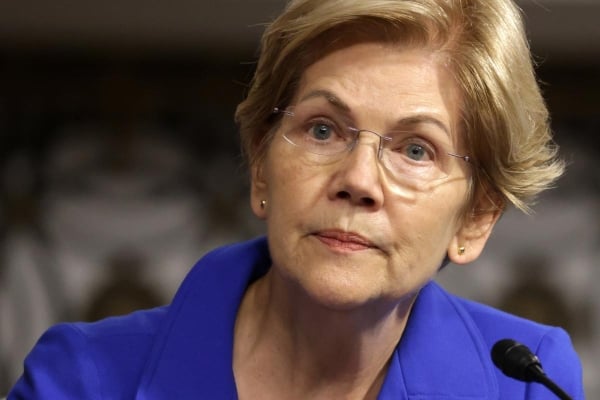
    Alex Wong/Getty Images

    Massachusetts senator Elizabeth Warren and four of her fellow Democrats asked Education Secretary Linda McMahon in a letter Monday why her department has made it more difficult to file complaints about federal student aid and demanded her staff remove any extra steps that have been added to the process.

    “ED is covering up its attempts to make [the Office of Federal Student Aid] less responsive to millions of students, families, and borrowers who rely on the agency to lower the cost of attending college and protect them from loan servicer misconduct,” the senators wrote. “We urge you to immediately act on our findings by streamlining the ‘Submit a Complaint’ process and restoring FSA’s workforce so borrowers can get the help they need.”

    Who Signed the Letter?

    Richard Blumenthal (Conn.), Mazie Hirono (Hawaii), Jeff Merkley (Ore.), Chris Van Hollen (Md.), Elizabeth Warren (Mass.)

    In the letter, Warren states that she told FSA in March that the button for submitting online complaints had been “hidden.” The department responded in April that the button had just been moved from the top of the webpage to the footer and relabeled as “submit feedback.”  The department added that no employees who handle technical functions of the aid applications of loan servicing had been laid off, and while some employees that handle complaints were, the remaining employees will “still be responding” to future complaints. 

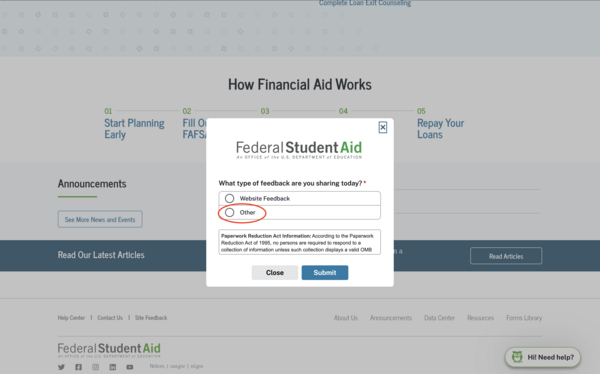
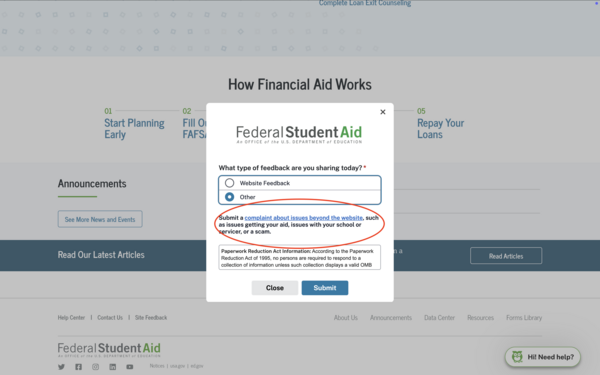
    But the Democrats say they tested those claims and found the department’s reassurances were misleading. Although the department did move and rename the complaint button, it also added a series of four extra navigation clicks that must be made before the user actually reaches the webpage where they can file a complaint. (Inside Higher Ed checked the website and verified these steps. You can see screenshots of the process below.)

    “Via an unintuitive, multi-step process,” the department is “making it more difficult for borrowers to let ED know when they are experiencing issues with their student loan servicer,” the letter reads.

    The senators argue that this change was geared toward increasing the difficulty of filing complaints, citing an email sent by a senior department staff member and obtained by Politico. According to a report published by the department at the end of the Biden presidency, more than 289,000 complaints were filed with FSA in 2024 alone.

    In the email obtained by Politico, the official wrote, “I believe this change would help decrease contact center volume and the number of complaints … so an overall win.”

    Step two FSA complaint process, click other
    Step three of FSA complaint process, click complaint about issues beyond website
    Step four of FSA complaint process, select submit feedback

    Source link

  • University of Florida Hires Interim President

    University of Florida Hires Interim President

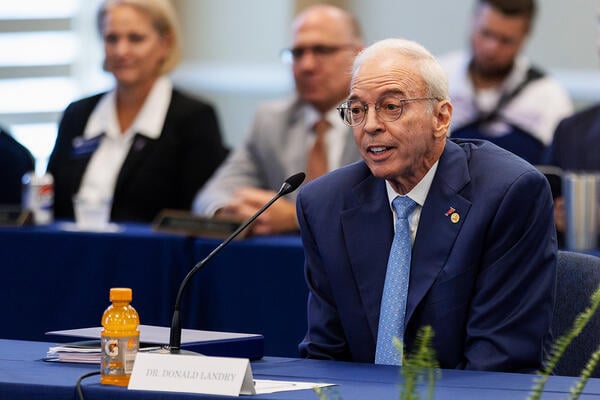
    After months of uncertainty over who will lead the University of Florida, the Board of Trustees tapped Donald Landry as interim president in a unanimous vote at a meeting Monday morning.

    Landry, chair emeritus of the Department of Medicine at Columbia University, will replace outgoing interim president Kent Fuchs, whose contract ends on Sept. 1. The appointment comes after the Florida Board of Governors rejected Santa Ono as UF’s next leader in June over his past support of diversity, equity and inclusion efforts, despite the university’s trustees approving the hire.

    Landry, who is currently president of the American Academy of Sciences and Letters, will officially step into the job on Sept. 1, pending successful contract negotiations. Details of Landry’s contract have not been released, but Ono was set to make about $3 million annually.

    The interim hire will still need to be approved by the state’s Board of Governors.

    UF’s New Leader

    In a public hourlong interview during Monday’s board meeting, Landry promised that UF would be “neutral” under his leadership. However, he added a caveat.

    “A neutral university, paradoxically, in this nation at the moment would be a conservative university. Not espousing conservative values, certainly not indoctrinating in conservatism,” Landry said. “We’d be neutral. We wouldn’t choose sides.”

    Landry also criticized Columbia faculty and administrators for failing to respond to concerns about antisemitism amid pro-Palestinian student protests last year. Last month the university reached a settlement with the federal government that included sweeping reforms to academic programs, speech and disciplinary policies, as well as a $221 million payout.

    “I saw things at Columbia that suggested an alignment between some faculty and students that I think encouraged the students to do things that were more reckless,” Landry told UF’s board.

    At another point, when asked about DEI, he said when it “first emerged it was a bit vague what it actually meant” but “by the time it crystallized it was clear [DEI] had gone too far.” Landry added that he was thankful the “government has intervened and returned us to a rational meritocracy.”

    Landry also cast himself as someone who resisted DEI at Columbia when it was “being implemented widely at every level, from the very top down to the smallest unit,” adding that “the Department of Medicine never wavered in its commitment to excellence” in his time there. Landry vowed to uphold state laws barring spending on DEI at Florida’s public institutions.

    A physician by training, Landry has degrees from Lafayette College, Harvard University and Columbia’s College of Physicians and Surgeons. In 2008, President George W. Bush awarded Landry the Presidential Citizens Medal for his work on stem cell research, which used embryos that did not survive in vitro fertilization. Bush lauded Landry as a man of science and faith, crediting his approach to stem cell research. Landry was also on the President’s Council on Bioethics during the Bush administration.

    Landry has also brought his scientific training to bear on other political debates. In early 2024, he filed a brief in a Supreme Court case in support of former Florida attorney general Ashley Moody and Texas attorney general Ken Paxton, who were sued by a technology trade group over laws passed in both states seeking to limit content moderation on social media platforms. Landry expressed concerns about censoring alternative perspectives, arguing that “the danger of censoring scientific dissent is painfully apparent from the conduct of social media platforms during the COVID-19 crisis,” which “reinforced prevailing opinion and allied government policy by suppressing dissent on a host of scientific questions.”

    SCOTUS ultimately remanded the case to the lower courts.

    Landry has also praised Jay Bhattacharya, director of the National Institutes of Health and an epidemiologist who was skeptical of the dangers of COVID-19 and prevention measures such as stay-at-home orders. Last year Landry said that Bhattacharya refused “to compromise his scientific findings,” thus risking “his own personal and professional self-interest, repeatedly, without hesitation, to take a stand for the public’s right to unrestricted scientific discussion and debate.”

    ‘A Great Selection’

    UF Board of Trustees chair Mori Hosseini emphasized Landry’s scientific background in a news release announcing the hire, stating the new interim president “has shown exceptional leadership in academia and beyond, building programs with innovation, energy and integrity.”

    Chris Rufo, the conservative anti-DEI activist who helped tank Ono’s chances at the UF presidency through an online campaign highlighting his past statements, praised the hire.

    “Dr. Landry is a principled leader who will reverse ideological capture and restore truth-seeking within the institution. Kudos to the UF board of trustees on a great selection,” Rufo wrote on social media.

    Alan Levine, a member of the Florida Board of Governors who voted against hiring Ono, also praised the selection in a post on X, calling Landry “an excellent choice” for the UF interim presidency.

    Landry is expected to serve as interim president while UF begins a national search for its next leader. The university has been without a permanent president since former Republican senator Ben Sasse of Nebraska abruptly resigned from the job shortly before a spending scandal emerged.

    Source link

  • GMU President Refuses to Apologize, Rejects OCR Findings

    GMU President Refuses to Apologize, Rejects OCR Findings

    Bill O’Leary/The Washington Post via Getty Images

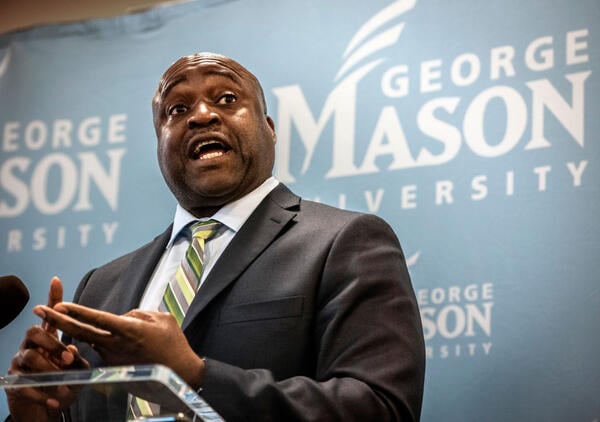
    George Mason University president Gregory Washington has rejected demands by the Department of Education’s Office for Civil Rights that he apologize for alleged discriminatory hiring practices, questioning the findings of an OCR investigation that accused him of implementing “unlawful DEI policies.”

    In a letter to GMU’s board Monday, Washington’s attorney, Douglas F. Gansler, alleged that OCR cut its fact-finding efforts short and only interviewed two university deans before reaching the conclusions the Department of Education published Friday. Gansler wrote that “OCR’s letter contains gross mischaracterizations of statements made by Dr. Washington and outright omissions” related to the university’s DEI practices.

    Gansler also accused OCR of selectively interpreting various remarks by Washington, the first Black president in GMU’s history.

    “To be clear, per OCR’s own findings, no job applicant has been discriminated against by GMU, nor has OCR attempted to name someone who has been discriminated against by GMU in any context. Therefore, it is a legal fiction for OCR to even assert or claim that there has been a Title VI or Title IX violation here,” Gansler wrote in a 10-page letter.

    ED has demanded changes at GMU and a personal apology from Washington.

    “In 2020, University President Gregory Washington called for expunging the so-called ‘racist vestiges’ from GMU’s campus,” Acting Assistant Secretary for Civil Rights Craig Trainor said in a statement released by the Department of Education last week. “Without a hint of self awareness, President Washington then waged a university-wide campaign to implement unlawful DEI policies that intentionally discriminate on the basis of race. You can’t make this up.”

    In his letter to the board, Gansler emphasized that under Washington’s leadership, GMU has complied with executive orders that cracked down on DEI programs and practices, pointing to recent changes such as the dissolution of GMU’s DEI office and restricting the use of diversity statements in hiring.

    “If the Board entertains OCR’s demand that Dr. Washington personally apologize for promoting unlawful discriminatory practices in hiring, promotion, and tenure processes, it will undermine GMU’s record of compliance. An apology will amount to an admission that the university did something unlawful, opening GMU and the Board up to legal liability for conduct that did not occur under the Board’s watch,” Gansler wrote. He added that admitting to such violations could bring about punitive action from other federal agencies, such as the Department of Justice.

    Washington’s rejection of an apology and dispute over the claims made by OCR comes shortly after speculation that GMU’s Board of Visitors—which includes numerous conservative political figures and activists appointed by Republican Virginia governor Glenn Youngkin—would fire him. Instead, the board gave Washington a raise after a lengthy closed-door meeting earlier this month that brought dozens of protesters out to show their support for the besieged president.

    Asked for a statement, GMU officials referred Inside Higher Ed to Gansler.

    ED did not immediately respond to a request for comment from Inside Higher Ed.

    Source link

  • SCOTUS Ruling Has “Bleak Implications” for Researchers

    SCOTUS Ruling Has “Bleak Implications” for Researchers

    Photo illustration by Justin Morrison/Inside Higher Ed | SDI Productions/E+/Getty Images

    Hope is fading that federally funded researchers whose grants were terminated by the National Institutes of Health earlier this year will be able to resume their work as planned.

    On Thursday, the United States Supreme Court ruled 5 to 4 that any legal challenges to the grant terminations should be litigated in the Court of Federal Claims, not the federal district court system they’ve been moving through for months.

    It’s the latest twist in federally funded researchers’ legal fight to claw back nearly $800 million in medical research grants—though accounting for the multiyear grants that the NIH is refusing to fulfill puts that figure closer to $2 billion—the NIH terminated for running afoul of the Trump administration’s ideological priorities. Many of the grants funded programs that advanced diversity, equity and inclusion initiatives and research projects focused on topics such as LGBTQ+ health, vaccine hesitancy and racial disparities.

    Researchers sued the NIH in April and got a win in June when a federal district court judge in Massachusetts ordered the agency to reinstate the grants immediately. Although the NIH has since reinstated many of those grants, Scott Delaney, an epidemiologist at Harvard University and former lawyer who’s been tracking grant cancellations, told Inside Higher Ed that after Thursday’s ruling those reinstated grants will “almost certainly” be re-terminated. If that happens, “I don’t think they’ll get their money back.”

    That’s in part because the Supreme Court said researchers will have to re-file their lawsuits in federal claims court, which generally doesn’t have the power to issue injunctive relief that could keep grant money flowing during the litigation process. And it could take months or even years for the claims court to decide if researchers are owed damages.

    “Nobody has that kind of time. The nature of research is that you can’t just stop and restart it many months later,” said Delaney. “Folks have already had to do that once and many aren’t able to—they’ve had to lay off staff and lost contact with study participants. This additional delay probably renders the research unviable going forward.”

    Trump ‘Always Wins’

    Delaney is among numerous experts and advocates who say the decision is both a blow to the scientific research enterprise and the latest evidence that the Supreme Court is inclined to interpret the law to favor the Trump administration’s whims.

    “Make no mistake: This was a decision critical to the future of the nation, and the Supreme Court made the wrong choice,” the Association of American Medical Colleges said in a statement. “History will look upon these mass NIH research grant terminations with shame. The Court has turned a blind eye to this grievous attack on science and medicine, and we call upon Congress to take action to restore the rule of law at NIH.”

    Jeremy Berg, who served as director of the National Institute of General Medical Sciences from 2003 to 2011, said in an email to Inside Higher Ed that while “many (but not all) grants from the lawsuits that had been terminated have been reinstated at this point,” the big question the Supreme Court’s ruling raises now “is whether NIH will start to re-terminate them.”

    Although a 5-4 majority did agree on Thursday that the district can review NIH’s reasoning for the terminations and kept in place a court order blocking the guidance that prompted the cancellations, Berg said the mixed ruling is “potentially very damaging” because redirecting the case to a different court means “the stay blocking the required reinstatements could go into effect.”

    He added that Justice Ketanji Brown Jackson’s dissent sums up his interpretation of the ruling’s implications. “This is Calvinball jurisprudence with a twist,” Jackson wrote. “Calvinball has only one rule: There are no fixed rules. We seem to have two: That one, and this Administration always wins.”

    That’s how Samuel Bagenstos, a professor of law and public policy at the University of Michigan and former general counsel to the Department of Health and Human Services, interpreted the decision, too.

    “The message the courts sent yesterday is very strong that they are going to let the Trump administration shut down the grants right now and remit grantees to the really uncertain process of going to the Court of Federal Claims and potentially getting damages in the future,” he said in an interview with Inside Higher Ed Friday.

    “But that’s really cold comfort for the grantees,” Bagenstos added. “If they can’t get the grants restarted right now, they probably can’t continue their research projects, and the prospect of maybe getting damages in the future doesn’t keep those research projects alive. It’s a bad sign for the entire research community.”

    The NIH is far from the only federal agency that has canceled federal research grants that don’t align with the Trump administration’s ideologies. The National Science Foundation, the Education Department and the National Endowment for the Humanities are all facing legal challenges in federal district courts after freezing or canceling grants.

    And the Supreme Court’s ruling on the NIH’s terminations has implications for those cases, as well.

    “The message seems to be pretty clear that if you have an ongoing grant that’s been terminated and you want to go to court to keep the money flowing, you’re out of luck,” Bagenstos said. “It’s got very bleak implications for all researchers who are depending on continuing the flow of federal grants.”

    Source link

  • Federal Judge Rules in Favor of Religious Colleges in Minn.

    Federal Judge Rules in Favor of Religious Colleges in Minn.

    Religious colleges that require students to sign a faith statement cannot be shut out of a Minnesota program that funds the dual enrollment of high school students in the state’s public and private postsecondary institutions, a federal judge ruled Friday.

    U.S. District Judge Nancy Brasel’s ruling overturns a Minnesota law prohibiting Christian colleges that participate in the state’s 40-year-old Postsecondary Enrollment Options program from forcing students to pass a religious test. The state Education Department and LGBTQ+ advocates had sought such legislation for years on the grounds that faith statements discriminate against students who are not Christian, straight or cisgender. It finally passed in 2023, under a Democratic State Legislature.

    The families of several high school students seeking to earn credits at two Christian institutions in the state, Crown College and the University of Northwestern, then sued, arguing that the law violated their First Amendment right to religious freedom. The ban on faith statements was suspended while the legal battle played out.

    “This dispute requires the court to venture into the delicate constitutional interplay of religion and publicly-funded education,” Judge Brasel said in her 70-page ruling. “In doing so, the court heeds the Supreme Court’s instruction that the First Amendment gives special solicitude to the rights of religious organizations.”

    Brasel noted in her ruling that the two Christian colleges have received nearly $40 million to cover the costs of the PSEO program since the 2017–18 academic year; she wrote that the University of Northwestern admits about 70 percent of dual-enrollment applicants. Over all, some 60,000 high school students have benefited from PSEO, The Minneapolis Star Tribune noted.

    The Becket Fund for Religious Liberty, which represented the plaintiffs, applauded the decision.

    “Minnesota tried to cut off educational opportunities to thousands of high schoolers simply for their faith. That’s not just unlawful—it’s shameful,” said Becket senior counsel Diana Thomson, according to the Associated Press. “This ruling is a win for families who won’t be strong-armed into abandoning their beliefs, and a sharp warning to politicians who target them.”

    Source link

  • George Mason Must Not Comply With the Government’s Demands (opinion)

    George Mason Must Not Comply With the Government’s Demands (opinion)

    Bill O’Leary/The Washington Post via Getty Images

    On Aug. 22, the U.S. Department of Education’s Office for Civil Rights announced that George Mason University, led by President Gregory Washington, violated Title VI of the Civil Rights Act of 1964. The agency demanded an extraordinary remedy—President Washington must issue a personal apology, to be posted “prominently on the University website,” retract statements supporting diversity and abandon practices that even hint at equity-focused hiring. The message to George Mason, where I was a professor of public policy for nearly two decades, is clear: Equity is now presented as a civil rights violation.

    Title VI was meant to prevent discrimination, not to penalize institutions for recognizing that diversity matters. With courts allowing the consideration of diversity as one factor among many in holistic decisions, OCR’s stance appears to be a politically motivated shift away from long-standing interpretations—not a clear enforcement of the law. Just last week, a federal judge “struck down two Trump administration actions aimed at eliminating diversity, equity and inclusion programs at the nation’s schools and universities,” the Associated Press reported.

    Most alarming in OCR’s proposed resolutions is the demand for a personal apology from the university’s first Black president. Washington, who called for eliminating racist legacies on campus, is now being compelled to apologize for doing just that. This isn’t simply an institutional issue—it’s a deeply symbolic act that resembles public shaming of a leader of color for advocating inclusion. It evokes the disturbing history of targeting minority leaders through law and policy.

    This move against Mason is not an isolated incident; it is part of a broader effort to reshape public institutions. Consider the Trump administration’s recent attacks on the Smithsonian Institution. The president criticized the Smithsonian for highlighting slavery’s brutality and diversity in its exhibits, calling the museums “out of control” and “too woke.” He ordered a comprehensive review of Smithsonian content to align it with his vision of “American exceptionalism,” demanding changes to exhibits begin within 120 days.

    Here again, ideology replaces impartial curation. A common thread emerges: Whether in higher education or national museums, diversity and sincere historical reflection are viewed not as civic strengths but as transgressions. Institutional autonomy and academic governance are being subordinated to partisan narratives.

    Should we dismiss the department’s findings as another part of the culture wars? I worry the consequences are much more serious. If OCR’s interpretation of Title VI holds, even referring to diversity as a priority could trigger federal enforcement. Schools are feel compelled to eliminate inclusive programs, silence voices advocating for equity and adhere to a limited historical perspective—all out of fear of losing funding.

    That chilling effect would cripple higher education when it needs vibrancy most. Universities must remain havens of reasoned inquiry, honest history and inclusive excellence. When federal agencies start dictating not only policy but the exact language leaders must use, we enter coercive territory.

    GMU’s faculty, students, alums and board members must unite in opposition to OCR’s unjustified demands. The proposed resolution is not genuine compliance; it’s forced capitulation driven by intimidation. Institutions should not be compelled to apologize for standing up for the principles of true equal opportunity.

    This moment is a clarion call for universities. Yesterday, it was the University of Pennsylvania and Harvard, dragged through headline-grabbing investigations. It was New College of Florida, where political appointees dismantled DEI programs and faculty governance. It was the University of Virginia, accused by the Department of Justice of defying federal antidiscrimination laws. Today it is Mason. Tomorrow, it could be UCLA, Michigan, Wisconsin or any other institution that values diversity, equity and academic freedom. No campus—public or private, flagship or regional—should assume it is immune.

    George Mason should reject the department’s findings and oppose this injustice. Capitulation is not compliance; it’s surrender. If Mason yields, it will damage its credibility and encourage more attacks on higher education nationwide. When universities submit to politically motivated demands disguised as enforcement, they legitimize them and invite more. Silence will be perceived as complicity. Resistance is crucial to protecting the fundamental principles of higher education: autonomy, fairness and the freedom to teach and learn without political interference.

    This is not the first time universities have faced pressure to abandon their commitments to equity and truth. In the 1960s, Southern universities used “law and order” to oppose desegregation. In the 1980s and 1990s, Black faculty and administrators pushing for fair representation often faced vilification and political retaliation. Today, the same tactics are being used, only now they are masked in the language of “civil rights enforcement.”

    What is happening at Mason is part of that history. Title VI, a law born of the civil rights movement to expand opportunity, is being distorted into a tool to silence leaders of color and dismantle diversity initiatives. President Washington’s commitment to pursuing equity should be celebrated, not criminalized. Twisting Title VI into an instrument of ideological punishment and racial scapegoating should alarm everyone who values a democracy that depends on honest history, inclusive leadership and academic freedom.

    And let’s be honest: Coercing a university president to issue a scripted public apology isn’t enforcement—it’s extortion. It’s the same tactic organized crime always uses: Demand submission, humiliate and make an example of one victim to scare others. That has no place in a democracy, much less in higher education.

    The struggle now is the same as it was then: whether our universities will stay places of truth, inclusion and independent thought, or whether they will become tools of partisan control. Mason must choose the first. And the rest of us—in Virginia and across the country—must support it.

    James Finkelstein is professor emeritus of Public Policy at George Mason University

    Source link

  • Censorship at Northwestern Worse After Dreger’s Resignation

    Censorship at Northwestern Worse After Dreger’s Resignation

    Ten years ago, on Aug. 24, 2015, Alice Dreger submitted her resignation as a tenured professor at Northwestern University’s Feinberg School of Medicine. Dreger was protesting the censorship of an academic journal at Northwestern called Atrium, for which she had served as guest editor of the 2014 issue with the theme “Bad Girls.” That edition included a controversial essay by disability rights advocate William Peace, who wrote about receiving oral sex from a nurse in the 1970s. Northwestern officials removed Atrium’s online issues for 14 months, restoring access to it only after Dreger announced she was going public about the censorship.

    Dreger wasn’t even the first professor to quit in protest over the censorship of Atrium. Kristi Kirschner, a clinical professor of medical humanities and bioethics, resigned in December 2014 because of the repression.

    But Northwestern demanded a new editorial board (including a public relations official) to oversee the journal in the future, which Dreger called a “censorship committee.” The faculty editors of Atrium refused to accept administrative control over its content, and it has never published another issue.

    Dreger recently wrote about her “disappointment (and that tablespoon of regret) at having accidentally caused the end of Atrium. For the magazine was such a gem.” But, of course, she didn’t cause the end of the journal—Northwestern administrators did by making unacceptable demands for control. The blame for censorship always must belong to the censor for suppressing controversy, and not the censored for causing controversy.

    Dreger’s resignation, and the censorship that prompted it, received much less attention than it deserved. This year is also the 10th anniversary of another case at Northwestern that was far more publicized: The Title IX investigation of Laura Kipnis over her essay “Sexual Paranoia Strikes Academe” that examined the case of a Northwestern professor accused of sexually assaulting a graduate student. Two students filed a complaint of retaliation against Kipnis over her writing, and the university cleared her after a lengthy investigation. While Kipnis obviously should never have been investigated for expressing her opinions on a case of campus sexual misconduct, she never suffered any official penalty or censorship.

    By contrast, the censorship of Atrium actually did lead to the demise of a respected academic journal (and the loss of the two professors who protested it). But while the Kipnis case fit a very popular narrative of politically correct leftists demanding suppression, the Atrium case exposed the reality on campus: Conservative censorship was more repressive but much less publicized than the trendy complaints about the PC police.

    Another example of this at Northwestern occurred in 2016, when political science professor Jackie Stevens was suspended and banned from campus after she complained that an administrator had yelled at her and slammed a door. Without any evidence and in violation of its due process policies, Northwestern officials contended that Stevens posed an immediate violent threat to the campus and forced her to undergo a psychological evaluation (which found no danger) before lifting the suspension and banishment. Stevens had been a harsh critic of the administration and was a leader of the successful faculty effort to prevent a retired general without a Ph.D. from being appointed head of an international studies program.

    Looking back at the Dreger resignation a decade ago, it’s hard to feel optimistic, because censorship on campus is even worse today. In the past year, Northwestern University’s actions have been some of the most repressive in the entire history of the institution. In February, Northwestern’s administration adopted the International Holocaust Remembrance Alliance definition of antisemitism, which the Foundation for Individual Rights and Expression has condemned because it “will chill campus speech.”

    One little-known example of Northwestern’s censorship is shockingly reminiscent of what happened to Atrium, except that it’s much worse. In February, Northwestern officials took down the entire website of the Gender and Sexuality Resource Center in response to President Donald Trump’s executive order “Ending Illegal Discrimination and Restoring Merit-Based Opportunity.” GSRC director Matt Abtahi didn’t go public about the censorship, but wrote an April 14 email to his staff to explain the removal of the website: “This last month working with the lawyers and senior leadership at NU has been particularly gutting.”

    He added, “The use of civil rights law and discrimination policy to advance these kinds of changes is alarming.” When Northwestern officials learned about the email, they immediately suspended Abtahi on April 18 and then fired him on April 29 and banned him from campus. Northwestern finally restored the GSRC website in May but censored all of the LGBTQ+ content. The censorship today is far worse than what happened to Atrium, which was finally restored online without censorship and no one was fired for questioning the repression.

    But even more appalling has been Northwestern’s violation of the rights of journalism professor Steven Thrasher. After Thrasher defended a student encampment in spring 2024 to prevent police from arresting protesters, Northwestern’s administration retaliated several months later in the wake of Northwestern president Michael Schill’s testimony before members of Congress who called Thrasher a “goon” and demanded his firing.

    Northwestern used its police powers to order Thrasher’s arrest, although the charges were immediately dismissed. In the fall of 2024, Northwestern suspended Thrasher from teaching for two quarters in violation of campus rules and claimed that he had violated professional norms by questioning the concept of “objectivity” in journalism. After a faculty committee cleared Thrasher of any wrongdoing, Northwestern was forced to reinstate him.

    However, Thrasher was up for tenure in 2025, and Northwestern denied him tenure. When Thrasher publicly criticized that decision and blamed it on retaliation for his criticism of Israel, Northwestern’s administration promptly banned Thrasher from teaching in the spring quarter and the entire 2025–26 academic year, declaring, “Your public lobbying, mischaracterizations and efforts to encourage pressure from groups complicate and compromise the process of tenure review, decision making, and appeal. Therefore, we are concerned about your presence with students in our community.”

    Obviously, criticizing the administration can never be grounds for banning a professor from the classroom for years without due process. Because tenure decisions are secretive, we don’t know if illegitimate, nonacademic judgments affected Thrasher’s case. But we do know that Northwestern’s excuses for twice suspending Thrasher are entirely illegitimate and violate basic norms of academic freedom.

    (Full disclosure: I’m a member of the Illinois AAUP’s Committee A on Academic Freedom and Tenure, and we wrote two letters to Northwestern, condemning its initial suspension of Thrasher and its second suspension of Thrasher that denied him the right to teach during his terminal year after being denied tenure.)

    Despite the extraordinary repression at Northwestern, where merely speaking out against the administration’s censorship can get you immediately banished, faculty and students are resisting efforts to silence dissent. On April 21, 2025, the entire faculty assembly at Northwestern voted 338 to 83 to support a resolution sponsored by the Northwestern AAUP (led by Jackie Stevens) that called upon the university to defend academic freedom, protect free speech and follow due process. But so far Northwestern refuses to back down from its embrace of censorship.

    As Dreger wrote 10 years ago, “An institution in which the faculty are afraid to offend the dean is not an institution where I can in good conscience do my work. Such an institution is not a ‘university,’ in the truest sense of that word.”

    Sadly, Dreger’s warning is going unheeded by Northwestern (and many other “universities”) that are part of a growing wave of repression on campus.

    John K. Wilson was a 2019–20 fellow with the University of California National Center for Free Speech and Civic Engagement and is the author of eight books, including Patriotic Correctness: Academic Freedom and Its Enemies (Routledge, 2008), and his forthcoming book The Attack on Academia. He can be reached at [email protected], or letters to the editor can be sent to [email protected].

    Source link

  • The Gray Zone

    The Gray Zone

    This academic year marks year seven—our last, if all goes well—of paying college tuition for our kids. (TB’s senior year and TG’s first year were the same year.) My brother has just joined the ranks of tuition payers, with his oldest arriving at college a few days ago. We’ve both found ourselves in the increasingly common spot of making too much to get much aid, but too little to reasonably afford tuition without significant aid.

    We’re not alone. That gray zone of “theoretically affordable, but not really” has become normal.

    If anything, it seems to be expanding. We’re lucky enough that for us, it’s annoying rather than prohibitive. That’s not true for everybody.

    People land in the gray zone in any number of ways. Sometimes the FAFSA calculation is simply unrealistic, whether because of fluctuating income, multiple siblings, divorce or the actual cost of living. Need-based aid is usually based on the FAFSA (or the CSS) or income tax return data, each of which is based on formulas that reflect political compromises rather than the cost of living. “Need” is a judgment, and judgments at scale tend to be blunt instruments at best. In practical terms, they pretty much have to be. Sometimes, though, the issue is even worse than the quirks of the FAFSA calculation. To save money, many colleges engage in “gapping,” or offering less aid than even the FAFSA recommends. That makes the gray zone even bigger.

    And that’s under the relatively rosy scenario of having two-parent families in which both are citizens, both are employed and nobody has a disability requiring massive economic support. People with disabilities are often subject to unrealistically low savings thresholds before they lose Medicaid coverage; ABLE accounts help, but they go only so far, and relatively few eligible people know that they exist. Undocumented parents may be increasingly unwilling or unable to submit financial information, even if their children are citizens. And divorced and/or mixed families introduce variables that no algorithm will anticipate. (I had personal experience of that in my student days. It wasn’t pretty.) Include any of those in the picture, and the shortfalls of the current system become more dramatic.

    I had hoped that the free community college movement would make many of these issues moot. But it fizzled at the federal level, as did most student loan forgiveness. Some states adopted versions of free community college, which is great, but states don’t have the fiscal flexibility that the federal government does. Most states aren’t allowed to run deficits, and public college enrollments are usually countercyclical to the economy, which means demand for college goes up at the same time that state tax revenues go down. Without a mechanism to offset the imbalance, public scholarship programs tend to get shorted when they’re most needed. Worse, even when they’re funded, state programs often include means-testing phase-outs that create gray zones of their own.

    With all of those ways into the gray zone, it’s unsurprising that so many people are there. But as an industry, I don’t think we’ve paid enough attention to how people on the ground experience it.

    It comes across as insulting. Being told that aid is for other people, but you have to pay what seems like an unreasonable amount, leaves a bad taste.

    I’ve had conversations with parents who can’t believe that they’re judged too rich to help. They aren’t happy, and there isn’t much to say to make them happy. I can’t help but think that part of the reason the public hasn’t rallied to our side in response to recent political attacks is that after years of being directly and personally insulted, as they see it, they don’t mind seeing some payback. We can offer structural explanations, but structural explanations don’t help when you’re facing a tuition bill higher than you expected and the institution essentially tells you to suck it up. Heck, when UVA had the gall to raise TB’s tuition for a fully remote year, I was personally offended. Years later, I still grumble at the memory. The causes may be long-term and structural, but the offense is direct and personal.

    Answers to the gray zone exist, in big and small ways.

    The best big answer, of course, is recognizing the social benefit of education generally and supporting it with enough public funding that tuition becomes an afterthought. Public libraries don’t have the gray zone because they don’t charge for access to books. That’s an excellent model, and it has ample precedent. The challenge there is political.

    A small but institutionally actionable answer involves strategic philanthropy. We recently had a donor who specifically wanted to aim scholarship money at students in the gray zone, to ensure that they can finish their programs and get started in their careers. It struck me as a fantastic idea. Yes, it’s hard to scale, and yes, it leaves existing systems intact. But until we can get to a saner political moment, it can make a genuinely positive difference for untold numbers of students. It may even serve as a proof of concept for a larger change.

    The main challenge now is to acknowledge the existence of the gray zone and to incorporate that knowledge into policy. The gray zone isn’t just a regrettable imperfection; it’s a direct threat to higher education’s continued existence. It corrodes public support and plays into narratives that make us the bad guys. Every single time a policy includes means-testing, sliding scales, income cutoffs or gapping, we create enemies. We’ve focused so much on immediate economic cost that we’ve lost sight of long-term political cost. I’m much less worried about some scion of the upper middle class getting a free education than I am about folks in the vast middle deciding they’ve had enough and voting for people who will channel their anger at the wrong targets. The cost of that is much higher than simply getting it right in the first place.

    Source link

  • Racial Discrimination on Campus Where 4 of 5 Students Are White?

    Racial Discrimination on Campus Where 4 of 5 Students Are White?

    Administrators at the University of Missouri told a student organization that it could not proceed with a “Black 2 Class Block Party” because the event qualified as “unlawful discrimination.” Is it possible that students who are not Black complained of being denied access to the annual event in prior years? Probably not. This cancellation is one of numerous examples of how institutions are attempting to comply with the Trump administration’s anti-DEI agenda, as Inside Higher Ed reporter Jessica Blake noted in an article last Friday.

    U.S. Department of Education data shows that during the 2023–24 school year, 79 percent of undergraduates on the University of Missouri’s flagship campus were white. Black students were just 5 percent of the undergraduate student body. Put differently, nearly 19,000 students were white and fewer than 1,200 were Black. Numerically, there are not and have never been enough Black students there to create a climate of exclusion for their white counterparts. The same is true among professors—last school year, only 33 of 1,027 tenure-track faculty members at Mizzou were Black, according to statistics published online by the university’s Office of Institutional Research.

    Given these demographics, it seems implausible that collegians in the minority have enough power to routinely and unlawfully discriminate against their peers who comprise the majority. This could be confirmed via systematic analyses of discrimination complaints submitted to the university in recent years. When disaggregated by race, the data is unlikely to show that it is overwhelmingly white students who most often experience racism. Surely few, if any, complaints are about encounters with discrimination at Black student organization events.

    Activities like Mizzou’s annual welcome-week block party are important for Black students, as most will be expected to successfully navigate spaces where they are the only or one of just a few persons from their racial group in every course they take, sometimes in their entire academic majors. Some will be the lone Black students who live on their residence hall floors. In these and other spaces, too many will be met with racial stereotypes, microaggressions and, at times, explicit racial violence. Black student organization events afford them opportunities to meet others who can affirm their sense of belonging at the institution. They may also meet other Black students who can teach them how to navigate campus environments that are anti-Black and otherwise racist.

    The inclusion of “Black” in its title is what made this year’s block party suddenly and presumably discriminatory. Like historically Black colleges and universities, Black culture centers, and African American studies courses, Black student organization events have neither historically nor contemporarily been proven to be spaces that exclude people from other races. Mizzou and universities like it are considerably more likely to find evidence of racial discrimination in predominantly white sorority and fraternity recruitment and member-selection activities, as well as at parties on frat row, than at a student organization event that amplifies black culture.

    As previously noted, 5 percent of Mizzou undergraduates are Black. Noteworthy is that Black men are 2 percent of the student body, yet NCAA data shows that they comprised 62 percent of the football team and 56 percent of the men’s basketball team there last academic school year. Despite generating millions of dollars in revenue for the university, these student athletes and their same-race peers are not allowed to have events that have “Black” in the title.

    “Black college football and basketball players are the most powerful people of color on campus,” I wrote in a Washington Post article 10 years ago. At that time, Black student athletes at Mizzou threatened to skip a football game that would have resulted in a loss of more than $1 million in revenue. This threat was in response to institutional inaction on racism that Black collegians had long experienced there. Within days, the system president and the chancellor of the Columbia campus both resigned.

    Football and basketball players are as powerful there today as they were a decade ago. They can indeed resist anti-DEI efforts that disadvantage them and other students of color. But should they do so in response to a canceled welcome-week block party? Yes, because that one seemingly insignificant event is emblematic of a more expansive demonstration of anti-Blackness on their and other campuses at this time.

    The elimination of culturally resonant programs, centers and institutes, and offices denies Black students access to valuable relationships and resources that bolster their first-year transition experiences, sense of belonging, classroom and out-of-class engagement, academic performance, and retention. Some of the most enduring and transformative advancements for Black collegians in U.S. higher education emerged from student activism. Student athletes, student organization leaders and everyday students who are Black, along with allies and supporters from other racial groups, ought to refuse to allow anyone to mischaracterize activities and spaces as discriminatory just because “Black” is in the title.

    Source link

  • Letter From a Region of My Mind

    Letter From a Region of My Mind

    Working in journalism left Inside Higher Ed’s co-founder Doug Lederman little time to read for anything but information, so last summer, when he stepped away from 90-hour workweeks, he told me he wanted to watch less Netflix. I said, “Friend, you came to the right place.” Recommending reading is pretty much the only area where I can make solid contributions these days.

    I started Doug out with things I knew he’d like. Chad Harbach’s The Art of Fielding was an early favorite. I moved him along to Jess Walter’s Beautiful Ruins, The Friend by Sigrid Nunez, James (Percival Everett, not Henry), Meg Wolitzer’s The Interestings and loaded him onto the Louise Penny train.

    But just before I headed to D.C. last March for his official farewell party, I assigned him a novel I’d been wanting to reread and liked the idea of book-clubbing with him: John Williams’s beautiful and heartbreaking Stoner. I’ve often given Doug a hard time about—well, everything—but especially the fact that he’s never actually been in higher ed. He’s only peered in from outside with a reporter’s magnifying glass, exposing our flaws and fault lines, doing his essential duty as a journalist.

    When Doug asked me to work with him as a thought partner to create a newsletter for upper-level administrators, he wanted to bring tough love to leaders. He confessed to having a case of the fuck-its, disappointed that higher ed has been so slow to change and unwilling to take responsibility for some missteps. As we know, disappointment can only come from love, and is much harder for recipients to bear.

    I responded in my typically tactful fashion, asking him, “Who the fuck are you to have a case of the fuck-its? Do not speak to me of the fuck-its! Have you had to read millions of pages of academic monographs? Have you heard academics complain that their names were too small on book covers? Have you denied thousands of qualified applicants admission to their dream college, or sat through interminable Faculty Senate meetings group-copyediting policies? Have you taught classes that flop or graduate students who just can’t?”

    In other words, I told the co-founder of IHE he had little idea what it was like to be in higher ed, especially from the perspective of a faculty or staff member. Given his role and prominence in the industry, Doug’s attention is always sought after, a high-value treat. In our world, he is beef jerky, not a Milk-Bone.

    I thought it time for him to use his leisure reading to get a deeper understanding of what it’s like to be a regular professor. Not an oversize character like Morris Zapp (my old boss, Stanley) or even Lucky Hank Devereaux (or Lucky Jim).

    Stoner follows the fictional life and career of an English professor at the University of Missouri in the early part of the last century. Early in the novel, and just before the sinking of the Lusitania, the sharpest of a group of three young academics asks his fellows, “Have you gentlemen ever considered the question of the true nature of the University?”

    Mr. Stoner “sees it as a great repository, like a library or a whorehouse, where men come of their free will and select that which will complete them, where all work together like little bees in a common hive.” Mr. Finch, with his “simple mind,” sees it as “a kind of spiritual sulphur-and-molasses that you administer every fall to get the little bastards through another winter.” Finch goes on, naturally, to become a dean.

    But they are both wrong, claims the character named Masters. The university ”is an asylum …. a rest home, for the infirm, the aged, the discontent, the otherwise incompetent.” His self-diagnosis: ”I’m too bright for the world, and I won’t keep my mouth shut about it.” He concludes, ”But bad as we are, we’re better than those on the outside, in the muck, the poor bastards of the world. We do no harm, we say what we want, and we get paid for it.”

    The book, published in 1965, presents characters that feel so current and vibrant you can imagine having a cocktail with them. In the times we now find ourselves, Stoner may become popular again—but not for all the right reasons.

    I have friends who have long said they’re done reading things by dead white men. When Doug and I were in college, that was pretty much the entire curriculum, with the exception of the 19th century gals, an Emily Dickinson here, a Frederick Douglass there. This reluctance is understandable, given how long the canon excluded previously silenced voices. Yet, I don’t discriminate. Stoner offers profound insights into institutional structures that persist today.

    These thoughts were on my mind as I finished my reread just before our flight to D.C. to celebrate Doug’s retirement next chapter, where institutional structures of a different kind awaited us in marble and glass.

    We had half a day before the event and my husband, Toby, and I wanted to be tourists. It had not been my intention to speed-walk through four museums in five hours. (Toby could spend hours in front of one painting, but he loves me and is a good sport.)

    My childhood consisted of trips downstate to see grandparents in New York City, which often involved visits to museums. A favorite was the one that hosted the squid and the whale. Unconsciously, I bought into the primate visions described by Donna Haraway about hierarchies—her critique of how science museums construct narratives of power and evolution that shape our understanding.

    Fifty years later, I was eager to see what had changed. We started at Natural History, moved on to American History, then African American, and ended up at the Holocaust. In March 2025, this journey was not, it won’t surprise you to learn, an uplifting experience. The museums, like higher education itself, told a complex story of American identity that is now under dire threat.

    I sped through to parse the presentation. How did the curators choose to tell the stories, some of which I know well, and which, as an adult, I would always prefer to read? Since I began my career publishing books in American history at Oxford University Press, I’ve imbibed a decent amount of quality scholarship.

    When I became an acquisitions editor at Duke University Press in 1991, I was intrigued by the work of scholars like Kimberlé Crenshaw, Patricia Williams, Mari Matsuda, Derrick Bell and other theorists who used narrative to examine how our legal system perpetuated structural inequalities. Most people weren’t reading law journals back then, and it took a while for those ideas to make it into the mainstream

    Academe cranked open the curriculum to face historical truths not always self-evident: We are a country built on a commitment to diversity, equity and inclusion. At times we fell short of the mark, but the arc of the universe is long, and we were taught the direction in which it bends.

    Except. The rise to power documented in that last somber building we visited reads to me like a blueprint for what’s happening today. Before I could remember not knowing it, my father drilled into me that what it means to be a Jew is there’s always someone who wants to put you in an oven. That was made tangible by the numbers I saw tattooed on the arm of Great-Grandpa Max.

    How much longer will busloads of boisterous students milling around these repositories of culture be able to learn our history? When will the whitewashing take hold so that the ideas contained in the curators’ vision—in the works we’ve published since the latter part of the last century—are mummified?

    One of many chilling moments: coming on a small story I knew from the film Who Will Write Our History? Historian Emanuel Ringelblum organized Jews in the Warsaw Ghetto in 1939 to document unprecedented actions. He collected materials, placed them in milk cans and buried them throughout the city. The archive known as the Oneg Shabbat is housed in Jerusalem at Yad Vashem.

    It was impossible in March not to feel that my colleagues at IHE and other media outlets are busting their butts at a similar task: chronicling the last days of an era of inclusion.

    How long before these exhibits come down, replaced by gold toilets in buildings repurposed for hotels and casinos?

    Just as the bright shining moment of Camelot disappeared for a previous generation, many of us already look back on Hamilton with nostalgia. A too-quick tour of museums in our nation’s capital filled me with love for America and the things that made us great. When I left, all I felt was grief. What happens if we don’t rise to today’s challenge?

    This sobering experience in D.C. brought me back to my conversation with Doug about higher education’s resistance to change. A reading of Stoner should not feel as resonant and familiar as it does. Little about faculty structure and the ethos of academe has evolved in the last century.

    Walking through those endangered halls of American memory, what Doug has long been saying to leaders is urgent: We need more than just better storytelling about higher education—we need to fundamentally reimagine it. And we need to do it now.

    The buried milk cans of our moment will someday be unearthed. The articles, reports and assessments documenting higher education’s struggles will serve as testimony to what we did—or failed to do—in this critical period. My only hope is that they’ll reveal how colleges and universities finally broke free from institutional inertia to continue to do the work of educating our citizenry toward truth and justice for all.

    Note: This reflection was published March 22, 2025, as an issue of The Sandbox. I wanted to share it as part of my new column here for two reasons (and with apologies to subscribers). First, if you’ve been reading the news, you’ll see that I wish I’d been wrong. Just a week after this first came out, the dismantling began. And now we’re seeing a scrubbing of our nation’s history in essential cultural institutions and not just in D.C.

    Also, I got a ton of responses from readers thanking me for putting them onto Stoner. So now, you’re welcome, friends.

    Rachel Toor is a contributing editor at Inside Higher Ed and the co-founder of The Sandbox, a weekly newsletter that allows presidents and chancellors to write anonymously. She is also a professor of creative writing and the author of books on weirdly diverse subjects. Reach her here with questions, comments and complaints compliments.

    Source link