Academic researchers are worried that the government’s plans to stop investing in the development of messenger RNA vaccines, a technology university scientists first used to help develop the COVID-19 vaccines, will undermine the United States’ standing as a global leader in biomedical research and development.
As promising as mRNA technology may be for treating a range of maladies, including numerous types of cancer and autoimmune diseases, its role in developing the COVID vaccine has thrust it into a political crossfire, fueled by the Trump administration’s smoldering criticisms of the Biden administration’s handling of the pandemic.
Last week, Robert F. Kennedy Jr., director of the Department of Health and Human Services, who frequently cites misinformation about vaccines and other public health issues, announced that the department is winding down mRNA vaccine research under the Biomedical Advanced Research and Development Authority and canceling $500 million worth of contracts and grants with numerous biotech companies and Emory University in Atlanta.
“We reviewed the science, listened to the experts, and acted,” Kennedy, a lawyer by training, said in a statement, claiming that “thedata show these vaccines fail to protect effectively against upper respiratory infections like COVID and flu. We’re shifting that funding toward safer, broader vaccine platforms that remain effective even as viruses mutate.”
Jeff Coller, director of the RNA Innovation Center at Johns Hopkins University, whose own graduate student helped develop Moderna’s COVID vaccine, said that “mRNA technology is incredibly misunderstood by the public and many of our politicians.”
Despite that, “the science has always been consistently clear about the powerful medical benefits of the mRNA platform,” he said. “It’s saved millions of lives, is incredibly safe, has huge potential and will revolutionize medicine in the next 100 years. Yet, we’re ceding American leadership in this technology.”
The half-a-billion-dollar cut comes at the same time that the Trump administration has withdrawn support for federally funded scientific research that doesn’t align with its ideological views, including projects focused on vaccine hesitancy, LGBTQ+ health and climate change.
According to a report from STAT News, the 181-page document Kennedy cited as his evidence that mRNA vaccines aren’t safe or effective references disputed studies written by other skeptics of COVID mitigation protocols, including stay-at-home orders and vaccines.
In his op-ed, Bhattacharya acknowledged that mRNA is a “promising technology” that “may yet deliver breakthroughs in treating diseases such as cancer,” but that “as a vaccine intended for broad public use, especially during a public health emergency, the platform has failed a crucial test: earning public trust.”
“Unfortunately, the Biden administration did not manage public trust in the coronavirus vaccines, largely because it chose a strategy of mandates rather than a risk-based approach and did not properly acknowledge Americans’ growing concerns regarding safety and effectiveness,” he wrote.
‘Political Shot Across the Bow’
The vast majority of scientists agree that the mRNA-based COVID vaccine—which was created in record time as a result of President Donald Trump’s Operation Warp Speed, launched in 2020—is generally safe and effective.
“I’m concerned about [the cut] weakening our country and putting us at a disadvantage,” said an mRNA researcher who asked to remain anonymous out of fear of retaliation. “The promise of mRNA is almost limitless, and I’d like to see those advances being made in this country. But currently it seems those advances are more likely to come from Europe and Asia. I’m also worried about the impact this could have on our economy—this is a growing field of industry.”
Coller, of Johns Hopkins, said Kennedy’s decision to withdraw funding for mRNA vaccine research has more than financial implications.
“It was a political shot across the bow of the entire research community, both in industry and academia,” Coller said. “What it says is that the government doesn’t want to support this technology and is going to make sure it doesn’t happen. If you’re an academic thinking about starting a new program in mRNA medicines, don’t waste your time.”
And now it will be even easier for political whims to drive the government’s scientific research priorities. Last week, Trump issued an executive order that will put political appointees—rather than subject-matter experts—in charge of federal grant-making decisions.
Heather Pierce, senior director for science policy and regulatory counsel at the Association of American Medical Colleges, said that while Kennedy’s decision won’t end all of the nation’s mRNA research, “the indication that a certain technology or scientific area won’t be pursued regardless of the progress made so far is worrisome as a concept.”
That’s in part because “when we unilaterally close the door on a specific type of research or technology, we don’t know what would have come from that,” she said. “It’s not to say that every research project using every technology and scientific tool will necessarily lead to a cure or breakthrough, but the initial funding of these projects shows that there was promise that made it worth exploring.”
Both Kennedy and Bhattacharya have said the government will continue to support research on other uses of mRNA technology unrelated to infectious disease vaccines. But experts say separating those research areas isn’t so simple.
“They’re all interconnected,” said Florian Krammer, a professor of vaccinology at the Icahn School of Medicine at Mount Sinai. “If you take away funding in the infectious disease space and innovation doesn’t happen there, it’s also not happening in other spaces where mRNA technology is used.”
That will create a “huge problem for researchers,” he added, “because a lot of fields are using this technology, and if it’s not moving forward, it closes doors.”
The judge denied a motion for a preliminary injunction to block the anti-DEI law.
Just_Super/iStock/Getty Images Plus
Ruling in part that professors lack First Amendment protections in the classroom, a federal judge denied an effort from college faculty and students in Alabama to block a 2024 state law that banned diversity, equity and inclusion programs as well as the teaching of so-called divisive concepts.
The plaintiffs, who include students from the University of Alabama at Birmingham and professors at the University of Alabama in Tuscaloosa, argued in court filings and at hearings that the legislation known as Senate Bill 129 amounted to state-sponsored censorship and infringed on their rights under the First and 14th Amendments. The professors alleged that they had to cancel class projects or events and faced other questions about their classroom conduct from administrators because of the law. They’ve also changed course material as a result.
R. David Proctor, chief judge in the U.S. District Court for the Northern District of Alabama, found that while the professors and the Alabama NAACP had standing to sue, they weren’t likely to succeed at this time. For instance, he ruled that the professors aren’t protected by the First Amendment because their “in-class instruction constitutes government speech.”
Furthermore, Proctor wrote, based on other rulings in the U.S. Court of Appeals for the 11th Circuit, “when there is a dispute about what is taught in the classroom, the university’s interests outweigh those of a professor, and the professor’s interest in academic freedom and free speech do not displace the university’s interest inside the classroom.”
The plaintiffs said Proctor’s ruling was disappointing.
“I feel incredibly dismayed that SB 129 is allowed to continue going into the new school year,” said Sydney Testman, one of the students who sued, in a statement. “As a senior at University of Alabama at Birmingham, I’ve seen firsthand how SB 129 has transformed my college campus for the worst. Voices have been silenced, opportunities have been revoked, and meaningful community engagement has faded. This decision undermines the need for students to properly feel a sense of belonging and inclusion on campus.”
The University of Chicago’s Arts and Humanities Division is reducing how many new Ph.D. students it admits for the 2026–27 academic year across about half of its departments and completely halting Ph.D. admissions elsewhere. Multiple language programs are among those affected.
In a Tuesday email that Inside Higher Ed obtained, Arts and Humanities dean Deborah Nelson told faculty, staff and Ph.D. students, “We will accept a smaller overall Ph.D. cohort across seven departments: Art History, Cinema and Media Studies, East Asian Languages and Civilizations, English Language and Literature, Linguistics, Music (composition), and Philosophy.” The university didn’t tell Inside Higher Ed how many fewer Ph.D. students would be accepted across those departments.
“Other departments will pause admissions,” Nelson wrote.
Andrew Ollett, an associate professor of South Asian languages and civilizations, said that means no new Ph.D. students for these departments: classics, comparative literature, Germanic studies, Middle Eastern studies, Romance languages and literatures, Slavic languages and literatures, and South Asian languages and civilizations, plus the ethnomusicology and history and theory of music programs in the music department.
While the university didn’t provide an interview or respond to multiple written questions, a spokesperson did point out that the UChicago Crown Family School of Social Work, Policy and Practice is also pausing Ph.D. admissions, while the Harris School of Public Policy is pausing admissions for the Harris Ph.D., the political economy Ph.D. and the master of arts in public policy with certificate in research methods.
“A small number of PhD and master’s programs at the University of Chicago will pause admissions for the 2026–2027 academic year while divisions and schools undertake comprehensive reviews of the programs’ missions and structures,” UChicago said in a statement. It said the aim is “ensuring the highest-quality training for the next generation of scholars” and the pauses “will not affect currently enrolled students.”
UChicago, which faces debt issues, has become yet another example of well-known universities freezing or scaling back Ph.D. admissions and programs amid financial pressures and other factors. In November, before Trump retook the presidency, Boston University said it was pausing accepting new Ph.D. students in a dozen humanities and social sciences programs, including philosophy, English and history. In February, the Universities of Pennsylvania and Pittsburgh announced pauses, following other institutions.
But UChicago’s reductions for language programs also reflect a broader trend of universities scaling back foreign language education offerings. In 2023, West Virginia University became infamous in academe for its leaders’ decision to eliminate all foreign language degrees.
“It’s sad and pathetic,” Ollett said of the pause at UChicago, “because it represents the domination of one set of values, which is money, over the values that we say that we are pursuing in our lives as faculty members, as educators and as researchers.”
He argued that the university can’t say it’s committed to the humanities as a field for producing knowledge while turning away from Ph.D. programs.
Nelson’s email said, “This one-time decision applies only to the 2026–2027 academic year.” But Clifford Ando, the Robert O. Anderson Distinguished Service Professor of Classics, History and the College, questioned whether this is just a pause.
“I see no reason to think that we would resume doctoral education if we are simultaneously dismantling the curricula that sustain undergraduate training in these fields,” Ando wrote in an email sent to a classical studies Listserv. “Why would one have a doctoral program in a discipline that undergraduates can’t even study?”
Ollett also said this comes as Nelson has pushed to consolidate smaller departments. He said a big question for the coming academic year was “Do we do Ph.D. admissions if we’re not sure that our department is going to exist?”
Not Rule by Committee
Ando provided Inside Higher Ed the “charge” UChicago gave to the Arts and Humanities Languages Working Group on June 17.
“UChicago is known as a global leader in the instruction of ancient and modern languages,” the charge begins. “Language instruction and expertise is not simply a valuable object in its own right; it is an important foundation for the larger UChicago College education, for graduate education, and for the research and scholarship of our faculty.”
But it then says, “language instruction at this extraordinary scope is also expensive.” It listed several questions for the committee to explore, including:
“Should there be a universal or suggested minimum number of students?
“Do we need to teach every class every year?
“Are there languages we no longer need to teach?
“Are there opportunities for partnerships with peer institutions (with similar standards and schedules) to share language instruction?
“How can we use technology more effectively to support and enhance language instruction?”
Ollett said, “We teach more than 50 languages in the division, which seems to be too much because the committee was asked to find ways of getting that number down.”
Tyler Williams, another associate professor in the South Asian languages and civilizations department and a member of the committee, said the committee members “unanimously declined to endorse any of the suggestions about cutting languages or outsourcing language teaching.” He said Nelson “did not wait for the committee to submit its report,” nor did she “consult with that committee before she made this decision.”
Ando also provided the charge for a separate Ph.D. Working Group, which outlined a number of “existential challenges” for Ph.D. programs. Those include significantly reduced demand for entry-level faculty, increasing costs for the university and long times to degree, which can deter students.
Additionally, the document notes that the programs are facing “heightened public skepticism about the value of what is taught in Arts & Humanities PhD programs, and how it is taught. Yet Ph.D. programs remain a critical part of the research university model, necessary to teaching, research, scholarship, and creativity.”
Among other questions, that committee was asked to explore whether there should be a minimum size for Ph.D. cohorts in order to offer a program.
Williams said that this committee indicated it wasn’t going to endorse an admissions pause, but said it should be divisionwide if it occurred.
Nelson’s email announcing the changes stressed that “this decision is not the recommendation of any committee.”
Williams said the Ph.D. admissions cuts are part of “a crisis manufactured by the university administration itself.” Ollett said he worries for the future of their field.
“We are quite unique in that there’s not a lot of South Asia area studies departments in the United States, and especially ones that train the next generation of scholars,” he said. He said he’s “already turned away prospective Ph.D. students because of this, and that’s just going to keep happening.”
He said he worries that “if we’re not doing it, no one will do it, and the field will wither and die.”
At first glance, Southeastern Michigan University’s website looks like it represents a real institution.
Smiling students in graduation regalia embrace, diplomas in hand, in the video on the front page. A chat bot pops up to ask, “How can I help you?” Southeastern Michigan’s website touts the university’s scholarships, array of accredited academic programs, award-winning faculty, 75 percent graduation rate and “vibrant campus life.”
But littered throughout the website are signs that something is off about Southeastern Michigan.
Blurry backgrounds and distorted limbs hint at the use of generative artificial intelligence. Some images seem likely to fool the untrained eye, while others—like a basketball player with veins bulging from his angular arms—could have been ripped from a poorly illustrated comic book. Meanwhile, paragraphs of text contain repetitive, grandiose and nonspecific language, characteristic of a chat bot’s writing.
In reality, the university is as fake as some of the content on its website. And it’s part of a much larger scam fueled in part by the rise of generative AI.
Some of the images on Southeastern Michigan University website appeared to be AI-generated.
“It took me a while to realize it wasn’t an actual institution,” said Aaron Ament, president of the National Student Legal Defense Network and a lawyer who has investigated for-profit colleges that have defrauded students. “For the average person who’s looking for a program, you could easily see how people would think it’s a real institution.”
Michigan attorney general Dana Nessel warned consumers about Southeastern Michigan University in an alert last week, following a complaint from Eastern Michigan University to her office about the fraudulent website using deceptive practices in an effort to scam students.
Southeastern Michigan is one of nearly 40 fake university sites that Inside Higher Ed recently uncovered, which appear to have been developed with or supplemented by AI. The sites seem to be part of a network, based on the use of identical language, the repetition of images and other design similarities. And many of these fake colleges also have a presence on social media sites, including LinkedIn, Instagram and Facebook.
An Inside Higher Ed analysis also turned up dozens of websites for nonexistent accreditors and a fake U.S. Department of Education website. They all contain at least some AI-generated images and design templates similar to the college websites’, including many that list those fake accreditors—and link to their websites—to give an air of legitimacy. The Education Department is also investigating the scam.
But the network uncovered by Inside Higher Ed reveals how the rise of generative AI is making it faster and easier for scammers to repackage an old ruse and deploy it on a much larger scale.
“This lowers the transaction costs for making a scam site,” said Jose Marichal, a professor of political science at California Lutheran University who studies how algorithms and AI are restructuring social and political institutions. “If I wanted to do this [before generative AI], it would have taken me a week, maybe a month, to put all this together. Now, it would take me a matter of hours.”
AI Increases Scammers’ Reach
The technology is also making it harder for consumers to immediately recognize fraudulent websites like Southeastern Michigan’s and dozens of other similar scam college websites Inside Higher Ed identified.
Large language models—which can immediately generate text and images like those populating the scam college websites—are becoming more sophisticated at mimicking human-created content by the day. For example, last week OpenAI released GPT-5, the latest version of ChatGPT, advertising it as its “smartest, fastest, most useful model yet,” capable of putting “expert-level intelligence in everyone’s hands.”
While suspicious, Marichal couldn’t say for certain if the fraudulent college websites were created using generative AI. But Junfeng Yang, a computer science professor at Columbia University who helped develop a novel tool that can discern whether text was generated by an LLM, had one of his graduate students peruse Southeastern Michigan’s website. “It appears that the [university’s] engineering page is AI generated,” he said in an email.
“A year ago, if you tried to do this, you may have had some bugs to work out,” Marichal said of the scam college websites. “Now, we’re getting to a place where you could keep spitting these out and it doesn’t cost much to host it. If you make 100 of them, you increase your yield. Instead of casting one fishing line, you cast 20, upping your chances of catching fish.”
‘Didn’t Seem Legit’
One prospective student who was looking for a business degree program almost got hooked by Southeastern Michigan’s con, according to Walter Kraft, a spokesperson for Eastern Michigan University, which is a real, accredited institution in Ypsilanti.
The fake Southeastern Michigan University prompted a complaint to the state attorney general from Eastern Michigan University, which has accused it of deceptive practices.
Source: Inside Higher Ed
“He came across an institution named Southeastern Michigan University, and it looked legit to him,” Kraft said. “So he contacted them and received a phone call telling him that his total tuition would be, like, $31,000, but he would receive a 90 percent scholarship and would only have to pay $3,100.”
The fake university asked the would-be student to provide documents for his scholarship application, but he never followed up. Two days later, he got a call from a number spoofing Eastern Michigan’s admissions office number, and the person on the other line told him he got the scholarship, despite never receiving any of his documentation.
After that, he received an admissions offer on letterhead that looked similar to Eastern Michigan’s, which raised his suspicions.
“He could sense that it didn’t seem legit, didn’t seem right, and questioned it,” recalled Kraft, who said two or three other people have reported similar concerns about Southeastern Michigan’s website, though he’s not aware of anyone who has fallen for the scam.
A spokesperson with the Michigan attorney general’s office said the office had “not received complaints from any potential students losing money in connection to these websites” but had contacted officials in two other states about similar schemes and referred concerns to the Federal Trade Commission.
But that doesn’t mean other people haven’t been scammed—or won’t in the future. As of Wednesday, the website was still live.
“That’s problematic, because until somebody finds out who’s responsible and takes that site down, other prospective students could be victimized,” Kraft said. “We certainly don’t want that to happen.”
Universities Push Back
While Eastern Michigan went to the state attorney general, other universities that have encountered similar websites have sought recourse with the World Intellectual Property Organization, a group that mediates domain disputes.
George Washington and New York Universities, as well as the University of Houston system, have all filed successful complaints to challenge websites using their trademarks or a similar name and URL. Those complaints shed more light on the scheme, which appears to date to at least 2021, per archived copies of the websites that were taken down. In its filing, GWU pointed to Kenneth Stone, a person the university believed to be connected to the scheme through a company called Domain Lance, a forwarding service that allows users to redirect URLs.
(NYU did not name a specific individual in its WIPO complaint, which noted that “little is known of the respondent” and indicated the domain owner provided a contact address in Panama. However, another version of that website—New York University of Business and Technology—with a slightly different URL has already emerged.)
The University of Houston system also named Stone in a complaint filed in December, along with William Morocco and Cole Brad as the people believed to be behind the website. The filing suggests that Stone is in Panama, while the other two are in the U.S. In its second complaint, filed in May, Houston pointed to websites in Panama. Despite winning the domain dispute, another version of the contested website has since emerged.
Houston’s complaints indicated that multiple fake college websites were created last year. Three of the websites flagged by Houston were registered between July and October of 2024, and another followed early this year. The fake accreditor websites mentioned in Houston’s complaint were all registered on May 10 of last year, according to the WIPO filing.
Houston University of Texas is one of nearly 40 fake college websites uncovered by Inside Higher Ed.
Source: Inside Higher Ed
Inside Higher Ed contacted two of the individuals it believed to be the persons referenced in the complaint based on a review of public records and LinkedIn profiles, but neither responded. A review of public records, including website registration information, suggests all three individuals are in the U.S., though the fake university websites are hosted on servers located overseas.
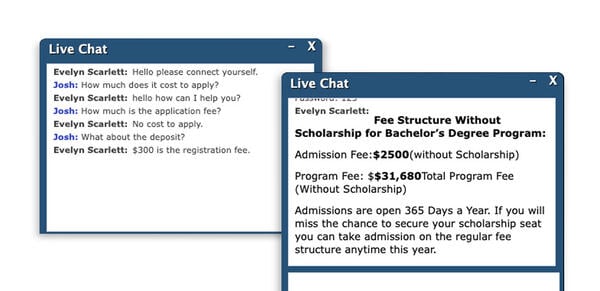
An Inside Higher Ed reporter also had conversations with individuals operating the chat service on three different websites connected to the network. After a reporter requested admissions info through Southeastern Michigan’s chat service, a woman called to talk him through the process.
Over a nearly half-hour conversation, the operator—a woman with a heavy accent—explained the tuition and fees, gave the reporter a password to a demo version of its student portal, and pressed hard for a $300 “registration fee.” When the reporter pushed back on the cost, she offered to lower it to $199 and stressed the importance of signing up while seats were available.
A chat operator at Southeastern Michigan University offered insights into the scheme.
Justin Morrison/Josh Moody
But when the reporter questioned the legitimacy of the operation, telling her it appeared to be a scam, she said, “I will suggest you contact the Department of Education, not me” and hung up.
Contacted by Inside Higher Ed, a Department of Education spokesperson wrote by email that “the department is currently investigating these malign activities and will work with the appropriate authorities to prevent predatory action toward our nation’s students.”
Sector Responses
Universities with similar names to fake college websites encouraged consumers to take steps to protect themselves from scams.
“Students have many affordable, high-quality education options among North Carolina’s public universities. It’s a shame that bad actors are creating fake university websites to prey on students who want to pursue their dreams of a college degree,” Andy Wallace, a spokesperson for the University of North Carolina system, wrote while encouraging people to report the sites.
University of Houston spokesperson Shawn Lindsey wrote by email that UH “continuously monitor[s] for threats, including false or misleading websites and domain names, and use[s] a variety of tools to support this vigilance” and noted UH’s legal team has acted on offending sites.
The Council for Higher Education Accreditation also condemned the rise of fraudulent college and accreditor websites designed to mimic legitimate institutions in an emailed statement.
“Accreditation is meant to assure quality and integrity in higher education—not to be misused as a tool for fraud,” CHEA president Nasser H. Paydar wrote. “These fake accreditors prey on the trust of students and the public, and we are committed to exposing and stopping them.”
But experts warn if these websites aren’t shut down—or similar ones continue to crop up—it could further weaken the public’s trust in higher education in an era marked by politicized attempts to discredit legitimate universities as overpriced and biased.
“People may not know what’s a real university and what isn’t, so they just throw their hands up and say, ‘Universities are too expensive anyway,’” said Marichal, the algorithm expert. “When people don’t know what’s true or false anymore, they’re less inclined to trust any of it.”
Tricia McLaughlin, assistant press secretary at the Department of Homeland Security, recently told the undocumented immigrants brought to the U.S. as children known as Dreamers, who have for years participated in the Deferred Action for Childhood Arrivals program, to self-deport.
She insisted that the Obama-era program, which protects these individuals from deportation and gives them work authorization, “does not confer any form of legal status in this country.”
“We encourage every person here illegally to take advantage of this offer and reserve the chance to come back to the U.S. the right, legal way,” McLaughlin said in a statement to NPR.
Her comments contradict those made by President-elect Donald Trump in a December interview with Meet the Press. He said then that he’d willingly work with Democrats on a plan to keep Dreamers in the country.
“They were brought into this country many years ago,” he told Meet the Press. “Some of them are no longer young people, and in many cases they’ve become successful. They have great jobs … We’re going to have to do something with them.”
This conflicting rhetoric is emblematic of the tenuous position Dreamers, including thousands of college students, have occupied for years, uncertain whether past protections and legal promises will hold. Today, most of the country’s roughly 400,800 undocumented students don’t have DACA status. But the Presidents’ Alliance on Higher Education and Immigration estimates about 119,000 are eligible for the program based on 2022 data.
DACA has suffered—and survived—attacks before, including from Trump during his first term, but immigrant advocates say this administration is launching precision strikes against Dreamers; instead of moving to end the DACA program wholesale, they’re casting doubt on the program’s legal power, and, one by one, targeting other benefits historically extended to Dreamers.
Gaby Pacheco, president and CEO of TheDream.US, a scholarship provider for undocumented students, said the federal government is “chipping away” at protections and public benefits for this population.
The administration is “coming at it from different angles in different ways and creating a lot of chaos,” Pacheco said. “A lot of people are confused and are trying to figure out what’s next and how to protect themselves,” including students and higher ed leaders.
A ‘Methodical, Surgical’ Attack
Legal challenges to DACA go back more than a decade. The U.S. Supreme Court prevented the program from expanding in 2016. Then, during Trump’s first term, he ordered the end of DACA under pressure from Republican lawmakers. When the Supreme Court ruled against his plans to immediately end the program, Trump tried to curb DACA in 2020 by rejecting new applications and limiting the renewal period.
Earlier this year, a three-judge panel for the U.S. Court of Appeals for the Fifth Circuit unanimously affirmed a 2023 district court order that deemed DACA unlawful, but the judges also issued a stay, leaving the status quo unchanged for now. No new DACA applications have been processed since the judge who made that order, U.S. District Judge Andrew S. Hanen, first ruled against the program in 2021. Hanen issued a new order in late July asking for additional written arguments from the parties in the case.
Pacheco said that now the government is doing a “very methodical, surgical” unwinding of Dreamers’ rights.
For example, the administration revoked DACA recipients’ eligibility for Affordable Care Act health insurance. Some Dreamers with DACA status, including students, have been detained by law enforcement.
Meanwhile, the U.S. Department of Justice sued four states for allowing local undocumented students, with and without DACA, to pay in-state tuition, successfully ending these policies in Texas and Oklahoma with support from state lawmakers. The Department of Education is also investigating five universities—the University of Louisville, the University of Nebraska, the University of Miami, the University of Michigan and Western Michigan University—alleging scholarships they provide for undocumented and DACA students violate civil rights law.
“There has been an escalating series of attacks and targeting of undocumented students, including those with DACA, and the institutions seeking to enroll and support them under this administration,” said Miriam Feldblum, president and CEO of the Presidents’ Alliance. “Over all, for students with and without DACA, this has become an increasingly anxious time” as well as for “campuses who are being targeted.”
A DACA recipient, who gained DACA status in 2014 and graduated with a bachelor’s degree in 2022, said the slew of new policies is “really affecting” day-to-day life for undocumented immigrants, including those in the program.
The recipient, who asked to remain anonymous, said the DACA program offered some sense of safety, but that protection now feels “very thin,” like a “Band-Aid on a wound.”
“I can’t imagine what it must feel like to be, especially a younger student or somebody who is currently in college,” they said. “You’re probably in the middle of your academic career and your state has now rescinded in-state tuition … How do you finish your education? What are you supposed to do?”
‘Just the Beginning’
Diego Sánchez, director of policy and strategy at the Presidents’ Alliance, said in a recent webinar that he worries the administration’s coordinated attack on DACA, and Dreamers over all, could signal a larger-scale war on the policy. He believes it’s a “very real concern right now” that the Trump administration could try to end DACA through the formal rule-making process—posting a proposed rule for public feedback, then issuing a regulation to phase out the program.
“We haven’t seen a formal announcement, but the rhetoric coming out of DHS, along with the uptick in enforcement, the detention of Dreamers all over the country, some who’ve had DACA, some who have never benefited from DACA, suggests that this may be under serious consideration,” he said.
Pacheco also fears life for Dreamers in college is going to get worse. She noted that the One Big Beautiful Bill Act poured about $170 billion into immigration enforcement. And while ICE doesn’t have access to the Free Application for Federal Student Aid database, a data-sharing agreement between the Internal Revenue Service and the Department of Homeland Security has students and their advocates worried about immigrant students’ data. Meanwhile, the federal government has plenty of data on DACA recipients, who have been dutifully filing their renewals every two years.
“I always try to be very careful how I say this to our students and to folks when I’m speaking, but this is really just the beginning,” she said.
Higher Ed as ‘Lines of Defense’
Immigrant advocates say colleges and universities have a vital role to play in making DACA and undocumented students safer.
Pacheco believes higher ed institutions over all are “one of the biggest lines of defense for students.” College officials can have plans in place for potential ICE visits and insist that law enforcement show warrants if they come looking for undocumented students, she said, and the fact of being a student, if they’re detained, can elicit public sympathy. And campuses have networks of alumni who can “rally around” them.
“One of the safest places where they can be is in a classroom, in an institution of higher learning,” Pacheco said.
Feldblum said higher ed institutions can also support Dreamers by not complying pre-emptively with the Trump administration’s legal challenges to benefits. For example, scholarships based on immigration status are “permissible,” she said, provided they don’t discriminate based on race, ethnicity, national origin or shared ancestry.
“The key here is to be clear that these programs, this status, is lawful,” Feldblum said. “And while the federal government may be attempting to threaten different regulations or programs … states and colleges and universities need to make sure they are not pre-emptively changing policy or regulation when the law does not require them to do so.”
Pacheco said she empathizes with higher ed leaders who are nervous to put their federal funds at risk by showing public support for their undocumented students. But she believes, at some point, higher ed is going to need to push back.
“When is it going to be enough?” she said. “And when are we going to draw a line and fight back and stand up for academic freedom and stand up for what these institutions have pledged, which is to educate everyone and to ensure that everyone has access to an equitable education?”
Growing public skepticism in higher education has fueled a number of polls and surveys aimed at understanding how families, students and taxpayers perceive the value of a college degree.
For instance, a majority of Americans believe at least one type of postsecondary credential holds value, according to a 2025 study by Gallup, and most parents want their kids to attend college. But few of those studies have looked at how colleges and universities see themselves improving students’ lives.
A new survey by Tyton Partners released Thursday found three in four college stakeholders strongly believe their institution’s education is worth the cost of tuition. However, two-year institutions were more likely to say this is true, compared to private universities.
Only 28 percent of administrators and support staff working at private four-year institutions strongly agree that their institution’s education is worth the cost, compared to 68 percent of community colleges. The survey, fielded in late June and early July, includes responses from more than 1,600 stakeholders at 825 institutions.
The sector breakdown wasn’t a surprise to Catherine Shaw, Tyton’s managing director, in part because of how the vocational missions of two-year colleges to prepare the local workforce compare to four-year private institutions that focus more on holistic student development.
“That part of it was so squarely within the value proposition of the reasons we have two-year degrees,” Shaw said.
For students, there’s a direct relationship between those who say their college is worth the cost and those who think the college prepares students well for jobs and careers. Among the 792 student respondents who do believe their college is worth the cost, 95 percent believe college is preparing them well for jobs and careers. Inversely, fewer than half (48 percent) of students who don’t see the value of their degree believe college is preparing them well for a career.
“In short, perceptions of value hinge on whether institutions effectively prepare students for the workforce,” the report states. This was true regardless of an institution’s sector, size, selectivity or demographic makeup.
This was the first time Tyton’s survey has asked respondents about perceived value, which Shaw said was in part because of larger national studies gauging perceived value among individuals in the U.S.
“It was interesting that there wasn’t the institutional perspective captured at scale [in previous surveys],” Shaw said. “We wanted to contextualize [the conversation] and see if our institutional stakeholders and our students are asking themselves the same questions and how they feel relevant, because they’ve got skin in the game.”
What Creates Value
More than a quarter of all institutions pointed to career readiness as a top college outcome beyond earning a credential, but two-year colleges were most likely to say this was the top outcome (37 percent). In comparison, the most popular outcome among four-year public and private institutions was critical thinking skills (41 percent and 36 percent, respectively).
Faculty members were most likely to say critical thinking skills were a top college outcome, which Shaw said makes sense given their role in higher education. Administrators and advisers were more likely to point to career readiness as a top outcome for students.
Tyton’s survey also asked administrators, support staff and faculty members which support services improve students’ value of education. Academic and career advising rose to the top, with over half of respondents in all roles ranking these services higher than tutoring, financial aid counseling or mental health counseling.
How institutions deliver high-impact career preparation varied based on institution type. Thirty-eight percent of community colleges said apprenticeships were the most meaningful measures to improve student employment metrics, followed by career pathways at 35 percent.
In comparison, embedded career exploration ranked highest among four-year institutions (54 percent of public universities, 50 percent of private) as did guaranteed internships for all students (31 percent of four-year public institutions) and experiential learning coursework (33 percent of four-year privates).
Student awareness of these opportunities is the greatest barrier to career readiness, according to career services professionals (45 percent), followed by limited capacity (17 percent) and a lack of consistent programming throughout the year (13 percent). Fewer than half of surveyed students (42 percent) said they were aware of career services available to them.
“This focus is especially timely as institutions prepare for increased scrutiny under new federal measures, such as the earnings accountability test,” the report states. “Programs that do not result in gainful employment risk losing eligibility for federal aid. Embedding career readiness across offerings isn’t just about boosting ROI: It’s fast becoming essential for institutional viability.”
President Trump first issued the executive action Aug. 7 mandating colleges and universities submit data to verify that they are not unlawfully considering race in admissions.
A draft of the proposal, which will officially be published Friday on the Federal Register, states that certain institutions will be required to collect and report comprehensive data about their admissions decisions going back five years. It must be broken down by race and sex and include students’ high school GPA, test scores, time of application (early decision, early access or regular decision) and financial aid status, among other things.
However, the new survey component, which the Department of Education is calling the Admissions and Consumer Transparency Supplement, will not affect all colleges and universities—just four-year institutions that use “selective college admissions,” as they “have an elevated risk of noncompliance with the civil rights laws,” officials wrote in the notice.
(The document does not say anything about reporting data on legacy admissions, another practice that, like affirmative action, has received public pushback in recent years.)
Members of the public will have 60 days to comment on the notice. Among other things, the department wants feedback on what institutions should be subject to the new reporting requirements as well as the anticipated burden the request will place on university staff.
Some higher education scholars and officials are already chiming in with their concerns informally.
University of Tennessee higher education professor Robert Kelchen wrote in a post on LinkedIn that not only will the request be a “substantial lift” for colleges, but also for staff at the department who run the Integrated Postsecondary Education Data System and will manage the data on the back end.
The Department of Education laid off nearly half its staff—including most of the employees at the National Center for Education Statistics, which would collect and analyze the data—in March.
“I’d love to see the survey form where all of this data would be collected—because after years of sitting in [meetings] where we figured these things out, the sheer number of variables/elements and the lack of any definition around the vagueness of them demonstrates the loss of the knowledgeable NCES staff they lost,” wrote Carolyn Mata, a consultant who works in institutional research, in a response to Kelchen’s post. “This is a case of throwing everything possible at the wall.”
The Office for Civil Rights handles complaints concerning discrimination in federally funded education institutions.
Saul Loeb/AFP via Getty Images
A federal district court judge refused the Trump administration’s request to vacate a previous ruling that prohibited the Department of Education from laying off nearly half its Office for Civil Rights staff.
The decision was made by Massachusetts judge Myong Joun on Wednesday and involved the case Victim Rights Law Center v. Department of Education. It comes just a month after the Supreme Court reversed a preliminary injunction in a similar case, New York v. McMahon, which Joun also oversaw.
In the new order, the district court judge argues that the cases, and therefore their related rulings, are separate.
The New York case, which was filed by multiple state attorneys general, addressed the reduction in force more broadly, Joun said. By comparison, the Victim Rights Law Center case more specifically addresses the RIF at OCR and how it may hold the office back from completing its statutory mandate of protecting students from discrimination.
So, although the Supreme Court allowed the Trump administration to continue with the reduction in force broadly, Joun argues, it does not mean the enjoinment of layoffs within OCR is no longer applicable.
Trump officials “present two arguments for why vacatur or a stay are appropriate: first, that the Supreme Court granted the stay in a related case, and second, that the two related cases are ‘indistinguishable in all pertinent respects.’ I am unconvinced by either argument,” Joun wrote. “Although this case and New York are related, I issued a separate Preliminary Injunction Order to address the unique harms that Plaintiffs alleged arose from their reliance on the OCR.”
He also noted that even though the high court judges reversed one preliminary injunction, that does not mean they have made a final ruling on the merit of the RIF.
Finally, Joun went on to say that the defendants’ motion for stay has little standing, as “they have not substantially complied with the preliminary injunction order” in the first place. Reporting from The 74 backs this up, showing that none of the 276 fired OCR employees have been reinstated.
In rural parts of the U.S., 36 percent of jobs that pay enough for an individual to be self-sufficient require at least a bachelor’s degree, yet only 25 percent of rural workers hold such degrees. Many rural communities do not have a university or four-year college nearby. As a result, students in these communities are likely to start their educational journey to a bachelor’s at a community college. Of the nearly 1,000 community colleges nationwide, more than a quarter are in rural areas and many others are designated as rural-serving.
The paths to a bachelor’s degree for rural students are not as straightforward as they are for students in urban or suburban areas with higher concentrations of four-year institutions. For rural community college students, there are four primary routes to earning a bachelor’s degree. As described below, the first three, more conventional, paths do not always work well. But there is also a fourth path—the community college bachelor’s degree program. While still relatively rare, this path is growing in popularity because, when well designed, it is effective in enabling place-bound students to earn bachelor’s degrees and secure good jobs in their communities.
Path 1: Transfer to a Four-Year University
The first path is to transfer to a four-year college and either become a residential student there or commute a long distance to get back and forth to campus from home. Laramie County Community College, where one of us is president, has worked with the University of Wyoming, the state’s only university, located in Laramie, to develop guaranteed transfer pathways to UW bachelor’s programs in major fields of economic importance to the region and state.
But only a minority of LCCC students—mostly younger students who have financial support from their families—can realistically afford to become full-time residential students at UW. Most community college students have jobs and families they can’t leave for several months a year, even if they could afford room and board in addition to tuition (which few can). Commuting to UW is difficult even for LCCC students who live in relatively nearby Cheyenne, almost an hour’s drive from Laramie on a road that crosses the highest point on the Continental Divide and is often closed in the winter. For LCCC students who live in outlying areas and for students at other Wyoming community colleges, commuting to UW is not realistic.
Path 2: Pursue a Bachelor’s Degree Online
Theoretically, this should be an effective option for rural, place-bound community college students. In reality, this avenue is not feasible for the many rural students who live in “digital deserts” or face “last-mile” barriers to broadband access.
Even when internet access is not a problem, many students struggle to complete online programs. Only a quarter of community college students who transfer to online universities complete a bachelor’s degree within four years of transferring. This compares to 57 percent of community college starters who transfer to a public four-year institution. In general, undergraduates who take all their courses online are less likely to succeed than those who take just some courses online. And online success rates are especially low for low-income students, those from other underserved groups or those who face other challenges typical in rural areas, such as limited access to transportation and childcare.
Path 3: Complete a Bachelor’s Degree Through a Community College–Based University Center
The third path is for students to take upper-division coursework through a university center arrangement, where the four-year university has a physical presence on the community college campus. These arrangements vary in design but typically involve university faculty teaching courses on the community college campus. While reasonable in concept, university centers are often challenging to operate. Beyond common issues of ownership, oversight and authority associated with programs run by two separate institutions, in rural colleges, such programs also often do not enroll enough students to make it worth the investment by the university and thus are difficult to sustain, financially and politically.
A Fourth Path: The Community College Bachelor’s Degree
That leaves community college bachelor’s degree programs, which are often the best option for rural students. Research indicates that these programs not only provide effective access to bachelor’s programs for older working students with families and others who are place-bound but also enable these students to secure good jobs.
Some question whether community colleges should offer bachelor’s degrees, arguing that they duplicate university offerings and represent a form of mission creep. But community college bachelor’s degrees tend to be unlike conventional bachelor’s degrees from universities. First, they are explicitly designed as applied credentials to meet specific regional workforce needs. In the best cases, community college bachelor’s degrees are reverse-engineered collaboratively with employers to meet these needs.
Second, they are also often designed to help the many applied associate degree graduates of community colleges find a more effective path to completing a bachelor’s degree, in which their applied coursework is built upon, not disregarded. Finally, they are delivered at home so that graduates of community colleges who are tied to their local area can advance into family-supporting jobs. They are offered through institutions that most students are already familiar with and by people with whom students already have relationships.
For example, LCCC offers a bachelor’s of applied science in health-care administration, with accelerated eight-week courses, offered at convenient times and through a combination of online and in-person modalities. The program is designed to provide the many working health-care clinicians with applied associate degrees (e.g., nurses, sonographers, radiology techs, etc.) a path to management jobs. This program was developed collaboratively with numerous health-care employers to address the strong demand for talent in health-care administration and provide their employees with a viable path to a bachelor’s degree, without requiring them to start over or relocate to another community.
The number of bachelor’s degrees awarded by community colleges nationally is still small: fewer than 17,000 annually, compared to more than 1.3 million awarded by public universities. Still, policymakers in a growing number of states are recognizing that rural community colleges are well positioned to meet the needs of students and employers for workforce bachelor’s programs not available from other providers. Currently, community colleges in 24 states are authorized to offer bachelor’s degrees in particular fields, yet the majority (nearly 80 percent) of these colleges are located in just seven states. Thus, there is plenty of room to grow. Bachelor’s programs offered by rural community colleges provide a model for what we hope is becoming a national movement to rethink bachelor’s education for the large number of place-bound students who must work and care for their families but need a bachelor’s degree to advance in their careers.
Joe Schaffer is president of Laramie County Community College. Davis Jenkins is a senior research scholar and Hana Lahr is assistant director of research and director of applied learning at the Community College Research Center at Columbia University’s Teachers College.
Ascendium Education Group provided funding for this work.
By now, the memo from the attorney general’s office outlining the administration’s interpretation of civil rights laws as they apply to higher education has made the rounds.
It took me back to my grad school days. I took a seminar in literary theory—the ’90s were a different time—and remember being struck particularly by reader-response theory. As I understood it, it argued that the meaning of a text is determined by the reader rather than the writer. Meanings aren’t as random as that might make it sound; “interpretive communities” take shape around a host of sociological, as well as personal, variables. In other words, we learn how to interpret texts partially by modeling on how people around us do. The same text can be read differently depending on your social location.
I’ve had personal experience of that in rewatching beloved movies or rereading beloved books from my teen years. In high school, Revenge of the Nerds struck me as funny and refreshing. As an adult, I can’t get past its sexism. The movie hasn’t changed, but I have.
The assumptions that different interpretive communities make aren’t always conscious. They don’t work like geometric proofs. In my experience, the most frustrating conflicts happen when different unconscious assumptions (or givens) crash into each other. Having to defend something you take as obviously true feels like either a complete dismissal or a slap in the face; it quickly moves discussion from reasoned disagreement to exasperated incomprehension. (“How can you possibly say that?”)
If you don’t recognize when those assumptions clash, it’s easy to get stuck in cycles of verbal shadowboxing. Is someone arguing against single-payer health insurance because they believe that a regulated market system would be more efficient? If so, a reasoned discussion may be worthwhile. Or are they arguing against it because they believe that poor people deserve to die? In that case, arguments around relative efficiency are pointless. Some folks are skilled at disingenuously using reasonable-sounding arguments to defend horrific assumptions; the tip-off is when they switch from one argument to a contradictory one as soon as they start to lose. The sooner you detect that move, the more time and emotional energy you can save.
The AG’s memo offers a glimpse into the unconscious (or at least unspoken) assumptions animating the administration.
Take, for instance, the assertion that “geographic or institutional targeting” is a proxy for discrimination. The only way that can make sense is if you assume the colleges and universities they had in mind are private ones that draw students from around the country. In the case of community colleges, most have a geographic boundary in their name and/or a defined service district. Monroe Community College, in Rochester, N.Y., is defined by its location in Monroe County. It gives a discount—economists call that price discrimination—to residents of its county. Students from out of county pay more.
And that’s not unique to MCC; it’s the way most community colleges work. Even those that don’t have out-of-county or out-of-district price premiums usually have out-of-state premiums. The same is true of most public universities. I’ve personally had the experience of paying out-of-state tuition for two kids at public universities; it’s not fun. Is that illegal now? If so, I’ll apply for a refund from the Universities of Virginia and Maryland, posthaste.
Of course, the vast majority of colleges and universities draw overwhelmingly from their own state. That’s a direct version of geographic targeting. A national higher ed policy based on the presumption that geographic targeting is the problem simply ignores the vast majority of the sector.
The issues are also more granular than that. The memo ignores scholarships offered by donors for graduates of particular high schools. Are those illegal now? Private donors frequently favor graduates of their own high schools, or people from the towns in which they grew up. Do we have to turn those donors away now? Or only if the towns in which they grew up are too diverse? Are sports scholarships only OK if they don’t draw too diverse a group of students? If so, then sailing is fine and basketball is suspect. Hmm. I think there’s a word for that.
I imagine the answer the attorney general would offer would be something like “as long as geographic preferences aren’t about increasing diversity, they’re OK.” But that presumes a lot. For example, New York City is more diverse than, well, just about anywhere; if a struggling small college on Long Island starts recruiting aggressively in New York City, is that about diversity or about enrollment? And how do you know?
Discerning institutional intent isn’t straightforward. Mixed motives are entirely normal. For example, is the movement to improve graduation rates meant to help students, budgets or institutions’ public images? The answer is all of the above. Is making colleges more inclusive of people of different backgrounds for the benefit of the newly included, the folks already there or institutional budgets? Again, yes.
A serious discussion would look less at intentions and more at incentives. If decades of public disinvestment force public institutions to behave more like private ones, basing more of their budgets on tuition, then we shouldn’t be surprised to see them compete for students. They’ll do what they have to do. If we want colleges to stop competing for students, we should insulate them from the economic need to do so. It has been done before.
The universe assumed in the memo tells us a lot about the people behind it. It presumes a world in which economic issues don’t matter, intentions are obvious, people have only one motive at a time and elite institutions constitute the entire industry. It reflects the kid who thought Revenge of the Nerds was a breath of fresh air. But that kid eventually grew up and learned that there was more to the world than was dreamt of in his philosophy. The word for that process is education.