Tag: Jobs

  • Dept. of Ed Clarifies What Race-Based Data Must Be Reported

    Dept. of Ed Clarifies What Race-Based Data Must Be Reported

    Roman Didkivskyi/Getty Images

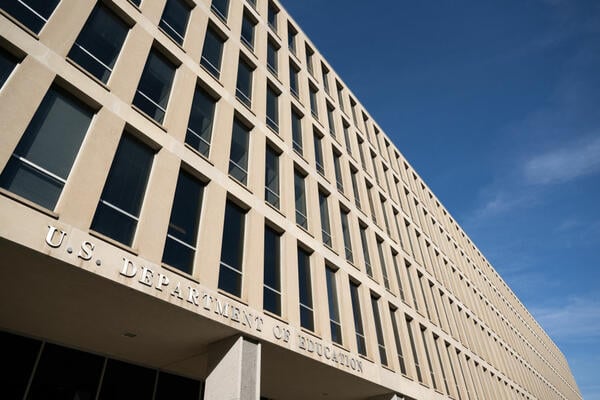
    The Trump administration released further details on its order for colleges to supply more racially disaggregated admissions data and wants to hear from the public about its plan.

    A draft of the proposal, which will officially be published Friday on the Federal Register, states that certain institutions will be required to collect and report comprehensive data about their admissions decisions going back five years. It must be broken down by race and sex and include students’ high school GPA, test scores, time of application (early decision, early access or regular decision) and financial aid status, among other things.

    However, the new survey component, which the Department of Education is calling the Admissions and Consumer Transparency Supplement, will not affect all colleges and universities—just four-year institutions that use “selective college admissions,” as they “have an elevated risk of noncompliance with the civil rights laws,” officials wrote in the notice.

    (The document does not say anything about reporting data on legacy admissions, another practice that, like affirmative action, has received public pushback in recent years.)

    Members of the public will have 60 days to comment on the notice. Among other things, the department wants feedback on what institutions should be subject to the new reporting requirements as well as the anticipated burden the request will place on university staff.

    Some higher education scholars and officials are already chiming in with their concerns informally.

    University of Tennessee higher education professor Robert Kelchen wrote in a post on LinkedIn that not only will the request be a “substantial lift” for colleges, but also for staff at the department who run the Integrated Postsecondary Education Data System and will manage the data on the back end.

    The Department of Education laid off nearly half its staff—including most of the employees at the National Center for Education Statistics, which would collect and analyze the data—in March.

    “I’d love to see the survey form where all of this data would be collected—because after years of sitting in [meetings] where we figured these things out, the sheer number of variables/elements and the lack of any definition around the vagueness of them demonstrates the loss of the knowledgeable NCES staff they lost,” wrote Carolyn Mata, a consultant who works in institutional research, in a response to Kelchen’s post. “This is a case of throwing everything possible at the wall.”

    Source link

  • District Court Judge Continues to Demand OCR Reinstate Staff

    District Court Judge Continues to Demand OCR Reinstate Staff

    Saul Loeb/AFP via Getty Images

    A federal district court judge refused the Trump administration’s request to vacate a previous ruling that prohibited the Department of Education from laying off nearly half its Office for Civil Rights staff.

    The decision was made by Massachusetts judge Myong Joun on Wednesday and involved the case Victim Rights Law Center v. Department of Education. It comes just a month after the Supreme Court reversed a preliminary injunction in a similar case, New York v. McMahon, which Joun also oversaw. 

    In the new order, the district court judge argues that the cases, and therefore their related rulings, are separate. 

    The New York case, which was filed by multiple state attorneys general, addressed the reduction in force more broadly, Joun said. By comparison, the Victim Rights Law Center case more specifically addresses the RIF at OCR and how it may hold the office back from completing its statutory mandate of protecting students from discrimination.

    So, although the Supreme Court allowed the Trump administration to continue with the reduction in force broadly, Joun argues, it does not mean the enjoinment of layoffs within OCR is no longer applicable.

    Trump officials “present two arguments for why vacatur or a stay are appropriate: first, that the Supreme Court granted the stay in a related case, and second, that the two related cases are ‘indistinguishable in all pertinent respects.’ I am unconvinced by either argument,” Joun wrote. “Although this case and New York are related, I issued a separate Preliminary Injunction Order to address the unique harms that Plaintiffs alleged arose from their reliance on the OCR.”

    He also noted that even though the high court judges reversed one preliminary injunction, that does not mean they have made a final ruling on the merit of the RIF.

    Finally, Joun went on to say that the defendants’ motion for stay has little standing, as “they have not substantially complied with the preliminary injunction order” in the first place. Reporting from The 74 backs this up, showing that none of the 276 fired OCR employees have been reinstated.

    Source link

  • George Washington U Violated Federal Civil Rights Law

    George Washington U Violated Federal Civil Rights Law

    The Department of Justice said Tuesday that George Washington University was “deliberately indifferent” toward Jewish students and faculty who said they faced antisemitic harassment and had violated federal civil rights law that bars discrimination based on race and national origin.

    The four-page letter signals that George Washington could be the next university in the Trump administration’s crosshairs. The DOJ sent a similar letter to the University of California, Los Angeles, late last month, and then various federal agencies froze more than $500 million in federal grants at the university. Since then, the Trump administration has demanded $1 billion from the UC system to resolve the dispute—a move the state’s governor called “extortion.”

    GW was one of 10 universities that a federal task force to combat antisemitism had planned to visit and investigate. That list included UCLA and Harvard and Columbia Universities, which also have been targeted by the Trump administration. 

    Harmeet Dhillon, the assistant attorney general for the civil rights division, wrote in the letter that the department plans to enforce its findings unless the university agrees to a voluntary resolution agreement to address the agency’s concerns. She didn’t detail what such an agreement would entail or what enforcement might look like.

    The department’s allegations largely center on how the university responded—or didn’t—to a spring 2024 encampment established to protest the war in Gaza. The university ultimately called in D.C. police to clear the demonstration after it persisted for nearly two weeks.

    “The purpose of the agitators’ efforts was to frighten, intimidate, and deny Jewish, Israeli, and American-Israeli students free and unfettered access to GWU’s educational environment,” Dhillon wrote. “This is the definition of hostility and a ‘hostile environment.’”

    She also wrote that university officials “took no meaningful action” in the face of at least eight complaints alleging that demonstrators at the encampment were discriminating against students because they were Jewish or Israeli. 

    George Washington spokesperson Shannon McClendon said in a statement that university officials were reviewing the letter.

    “GW condemns antisemitism, which has absolutely no place on our campuses or in a civil and humane society,” McClendon said. “Moreover, our actions clearly demonstrate our commitment to addressing antisemitic actions and promoting an inclusive campus environment by upholding a safe, respectful, and accountable environment. We have taken appropriate action under university policy and the law to hold individuals or organizations accountable, including during the encampment, and we do not tolerate behavior that threatens our community or undermines meaningful dialogue.”

    Source link

  • Anti–Affirmative Action Group Settles With Military Academies

    Anti–Affirmative Action Group Settles With Military Academies

    Saul Loeb/AFP/Getty Images

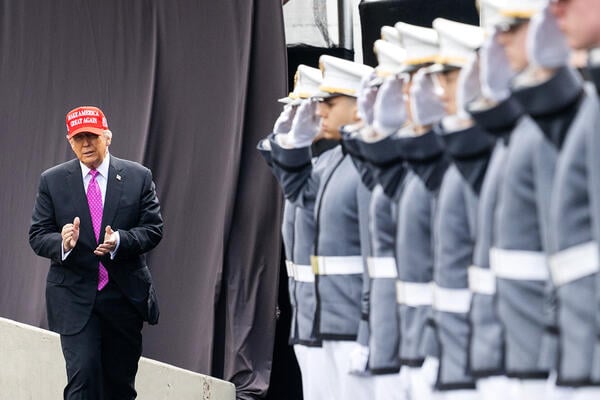
    Students for Fair Admissions, the organization that successfully fought to end race-conscious admissions practices, settled with two military academies that were exempted from the 2023 Supreme Court ruling that ended affirmative action, The New York Times reported.

    The Supreme Court ruled two years ago that military academies could continue to practice race-conscious admissions due to “potentially distinct interests” at such institutions. SFFA then sued, arguing such practices should be struck down. But on Monday, SFFA dropped its lawsuits against the U.S. Military Academy at West Point and the United States Air Force Academy.

    As part of the agreement, the Department of Defense, which oversees military service academies, will no longer consider race and ethnicity in admissions, according to settlement details, which emphasize recruiting and promoting individuals based on merit alone. That settlement also backed away from the notion that it has an interest in a diverse office corps.

    “The Department of Defense has determined, based on the military’s experience and expertise—and after reviewing the relevant evidence—that the consideration of race and ethnicity in admissions at the MSAs does not promote military cohesiveness, lethality, recruitment, retention, or legitimacy; national security; or any other governmental interest,” part of the settlement between SFFA and the Department of Defense reads. “The United States no longer believes that the challenged practices are justified by a ‘compelling national security interest in a diverse officer corps.’”

    Additionally, if an applicant lists race or ethnicity on an application, “no one with responsibility over admissions can see, access or consider” that information prior to a decision being made.

    The move comes amid other changes at service academies enacted by the Trump administration, which announced earlier this year it would end the use of affirmative action in admissions at the military academies, and has been accused of removing numerous books and stifling academic freedom.

    Source link

  • ASU Projects 18% Drop in International Student Enrollment

    ASU Projects 18% Drop in International Student Enrollment

    yongyuan/iStock/Getty Images Plus

    Arizona State University typically welcomes over 17,900 international students to its four campuses each year, but this fall, due to a variety of complications, the university expects only 14,600 international students will attend this fall—an 18 percent drop.

    If the projection holds, international students will account for 7.5 percent of ASU’s 194,000 students this fall, according to an Aug. 11 news release. In comparison, during the 2023–24 academic year, ASU hosted 18,400 international students, with a total enrollment of 183,000, or more than 10 percent.

    The change is in part due a drop in master’s applications from international students, but primarily driven by challenges to visa appointments, according to a university spokesperson.

    ASU’s president, Michael Crow, told Bloomberg that as of early August, 1,000 of the university’s incoming international students (a third of the new cohort of 3,313 students) were still waiting on their visas. The university is providing several pathways for students unable to make it to campus, including online programs, study abroad, starting later in the semester or enrolling in a partner institution overseas, the spokesperson said.

    “We anticipate that our enrollment of international students will continue to grow throughout the year,” said Matt López, deputy vice president of academic enterprise enrollment, said in the university news release. “When students have their visa in hand, we will welcome them with open arms and the classes they need to continue their degree without delay.”

    ASU has the largest share of international students in Arizona, providing $545.1 million in revenue to the state and supporting 5,279 jobs, according to data from NAFSA, the association of international educators.

    ASU also ranks fourth among four-year colleges and universities in terms of total international students enrolled, according to 2023–24 OpenDoors data, behind New York University, Northeastern University and Columbia University.

    Nationally, international student enrollment is projected to decline by about 15 percent this fall due to federal changes to visa issuance and other actions against international students.

    Source link

  • Why Student Motivation Matters (opinion)

    Why Student Motivation Matters (opinion)

    In Jarek Janio’s Inside Higher Ed opinion column, “Beyond ‘Grit’ and ‘Growth Mindsets,’” Janio argues that, to promote better student learning, college instructors should ignore questions about student motivation and focus solely on changing student behavior. He focuses on two ideas from the motivation field—grit and growth mindset—as examples of “traits” that have weak associations with student learning. Instead of focusing on what goes on “inside the student’s head,” he argues we should instead focus on “what’s happening in the environment and change that instead.”

    As educational psychology researchers, we are also interested in how to get students to engage in effective learning behaviors. We fully agree with—and our research supports—the idea that it is important for instructors to structure learning environments to support student learning, such as by offering opportunities for students to revise their work and providing clear, well-defined feedback. However, it is a mistake to ignore what is going on inside students’ heads. In doing so, we miss a very crucial piece of the puzzle.

    Students Are Unique Individuals

    As anyone who has taught a college class knows, students are not robots. There are vast differences between them. Take the example of offering your students an opportunity to revise and resubmit their work, after receiving feedback, for a higher grade. Just because you provide this opportunity does not mean that all your students will take it. Some students will enthusiastically revisit their work, dig into the feedback provided, seek additional feedback and deepen their learning. Others will half-heartedly look over the feedback and make shallow attempts to revise. Still others will not glance at the feedback at all and will not turn in a revision.

    These differences are, in part, due to more stable traits that students may have, such as their conscientiousness, their perfectionism and—yes—their grit. However, these differences may also be a function of other individual differences that are less stable. Take growth mindset, for example. Those of us who study growth mindset tend to think about it as a belief rather than a trait. It is something that can change based on the context.

    Imagine a student who has been told by their statistics instructor that statistics is something that anyone can learn—you just need the right strategies. Their art professor, on the other hand, has told them that you need a special, innate talent to be good at art—you either have it or you don’t. These factors can shape students’ beliefs, and in turn, their behaviors. For example, this student may be much more likely to engage in revising and resubmitting their work in their statistics class (where they have stronger growth-mindset beliefs) than their art class (where they have stronger fixed-mindset beliefs). This pattern is also true for when students feel confident about their abilities or have a desire for learning. Such students seek out help more proactively, and they engage with feedback more constructively.

    Beyond Grit and Growth Mindset

    Although grit and growth mindset are perhaps the most well-known (and have some legitimate weaknesses), researchers in the educational psychology and motivation fields study many other factors that impact student engagement and learning. These include students’ interests, values, goals, needs, emotions, beliefs and perceptions of the instructor and their classroom—all things that are going on inside the student’s head but that are critically important to understanding their behavior.

    Theories of motivation articulate the processes through which students’ beliefs, values, needs and goals shape their engagement, behaviors and choices. Researchers have created and tested effective tools to observe, measure and assess these different factors. Decades of research have given us robust understandings of how these factors are both shaped by and interact with the environment to predict students’ behavior and learning. These aspects of the individual student matter.

    The Student and the Environment Are Both Important

    It is important to focus both on what is going on in students’ heads and what is going on in the environment. Instructors have the power to shape their classroom environment in different ways that can influence student behavior.

    We do not disagree with the strategies Janio proposed instructors should focus on. Instead, we want to emphasize that these strategies are effective because of how they are motivationally supportive. For instance, incorporating a revision process into course assignments is based on mastery goal structures, or the environments instructors can nurture so that students focus on their improvement and growth. Normalizing failure is a growth mindset–teaching practice that helps students see the effort they put into the learning process as being something of value. Providing feedback is an important way to inform a student’s self-confidence and show them how they can be more competent in the future.

    Motivation is the central mechanism through which these strategies can help students persist through learning challenges. By understanding student motivation, these teaching strategies and approaches can be fine-tuned and adapted to differently motivated students to maximize student learning. That is exactly what motivation scientists in education have been investigating for decades. Simply discarding learner motivation is dismantling the science that undergirds motivationally supportive teaching.

    Concluding Thoughts

    A return to behaviorism essentially disregards the last 50 years of psychological research emphasizing the important role students’ cognition, emotion and motivation plays in the classroom. It is critical to understand these psychological processes that have been rigorously tested across many studies. Students are also agentic and complex in their thinking and motivations, so a one-size-fits-all approach rarely works. By harnessing students’ motivation, instructors can better adapt their teaching approaches to match students’ interests and goals in addition to creating motivationally supportive environments that promote persistence and deeper learning. When instructors understand their students’ motivation, it can unlock the type of engagement and behaviors meaningful for learning.

    Katie Muenks is an associate professor of educational psychology at the University of Texas at Austin. Carlton J. Fong is an associate professor of postsecondary student success at Texas State University.

    Source link

  • Visa Appointment Slowdown Hinders ASU International Enrollment

    Visa Appointment Slowdown Hinders ASU International Enrollment

    yongyuan/iStock/Getty Images Plus

    This article has been revised to reflect more enrollment data provided by Arizona State University after publication to correct Inside Higher Ed’s previous analysis.

    Arizona State University welcomed over 15,100 international students to its four campuses in fall 2024, but this fall, due to a variety of complications, the university expects only 14,600 international students will attend.

    If the projection holds, international students will account for 7.5 percent of ASU’s 194,000 students this fall, according to an Aug. 11 news release. In comparison, during the 2023–24 academic year, ASU hosted 18,400 international students, with a total enrollment of 183,000, or more than 10 percent.

    The change is in part due a drop in master’s applications from international students, but primarily driven by challenges to visa appointments, according to a university spokesperson.

    “We anticipate that our enrollment of international students will continue to grow throughout the year,” said Matt López, deputy vice president of academic enterprise enrollment, said in the university news release. “When students have their visa in hand, we will welcome them with open arms and the classes they need to continue their degree without delay.”

    ASU’s president, Michael Crow, told Bloomberg that as of early August, 1,000 of the university’s incoming international students (a third of the new cohort of 3,313 students) were still waiting on their visas. The university is providing several pathways for students unable to make it to campus, including online programs, study abroad, starting later in the semester or enrolling in a partner institution overseas, the spokesperson said.

    ASU has the largest share of international students in Arizona, providing $545.1 million in revenue to the state and supporting 5,279 jobs, according to data from NAFSA, the association of international educators.

    ASU also ranks fourth among four-year colleges and universities in terms of total international students enrolled, according to 2023–24 OpenDoors data, behind New York University, Northeastern University and Columbia University.

    Nationally, international student enrollment is projected to decline by about 15 percent this fall due to federal changes to visa issuance and other actions against international students.

    Source link

  • College Creates 101 Course on Gen AI for Students, Faculty

    College Creates 101 Course on Gen AI for Students, Faculty

    As generative artificial intelligence skills have become more in demand among employers, colleges and universities have expanded opportunities for students to engage with the tools.

    Indiana University is no exception. It’s developed a free, online course for campus community members to gain a basic understanding of generative AI and how the tools could fit into their daily lives and work. GenAI 101 is available to anyone with a campus login and comes with a certificate of in-demand skills for people who complete it.

    Survey says: Artificial intelligence tools have gained a significant foothold on college campuses, especially in teaching and learning.

    A 2023 study by Wiley found over half (58 percent) of instructors say they or their students are using generative AI in their classrooms, and a similar number believe AI-based tools, virtual reality or coursework with flexible assignment types will be important in delivering their courses in three years.

    Even before entering college, learners have said they’re familiar with generative AI and expect their institutions to help them develop their skills in using it. A 2024 survey found 69 percent of high school seniors planning to attend college have used generative AI tools, and 54 percent anticipate their college will engage in AI usage and education in some way. But exposure to AI is not ubiquitous; a different 2024 study of young people (ages 14 to 22) found nearly half of respondents had never used AI tools or didn’t know what the AI tools were.

    AI literacy and safety concerns have presented a growing challenge as well. A February 2025 survey from Microsoft found 73 percent of individuals say spotting AI-generated images is difficult.

    How it works: GenAI 101 at Indiana is free to anyone in the university community, including students, instructors and staff members at all campuses. The course is optional and has no academic credits attached, which allowed faculty designers to be flexible and creative with how content is presented.

    Brian Williams, faculty chair of the Kelley School of Business’s Virtual Advanced Business Technologies Department, serves as the lead course instructor and he, alongside a team of other faculty members, identified key topics to know about generative AI. The goal is to prepare participants to engage in an AI-influenced world with practical takeaways and insights, Williams said.

    The self-paced course has eight modules and 16 lessons that include short, YouTube-style video lectures. Students learn practical examples of how to use generative AI tools, including managing their schedule or planning an event, and content areas range from prompt engineering, data storytelling and fact-checking content to how to use AI ethically. In total, GenAI 101 takes approximately four to five hours to finish.

    The course features an AI character, Crimson, that teaches content, and an embedded AI tutor, Crimson Jr., that can address participants’ questions as they come up.

    After completing the course, participants earn a certificate they can display on their LinkedIn profile or résumé.

    What’s next: The course launches Monday, Aug. 25, and the first person to take it will be IU president Pamela Whitten, according to a university press release. She’ll gain early access to the course on Friday, Aug. 15, Williams said.

    Students will be auto-enrolled in GenAI 101, making it easy to access. Some faculty instructors have also said they’ll embed the content into their syllabus or curriculum, according to Williams, in part to reduce gaps in who’s engaging with generative AI resources and education.

    How is your college teaching students how to use generative AI? Tell us more.

    This article has been updated to correct the date in which the course will launch to the IU community, August 25.

    Source link

  • Community College Research Collateral Damage at Columbia

    Community College Research Collateral Damage at Columbia

    Research on community colleges has taken a hit amid the Trump administration’s ongoing war against the Ivy League.

    The Community College Research Center, an independent organization based at Columbia University’s Teachers College, found out in March that four of its grants totaling at about $12 million were immediately cancelled, despite being multiple years into their grant cycles. The remaining grant money expected from the Institute of Education Sciences amounted to at least $3.5 million. Four half-completed research projects relied on the funding. Now CCRC leaders are scrambling to find ways to continue the work.

    The grants were swept up in the Trump administration’s slashing of $400 million in grants to Columbia University to cow the institution into agreeing to a set of demands. Columbia has since reached an agreement with the administration to restore its federal funding, but the deal only restored grants administered by the U.S. Department of Health and Human Services and the National Institutes of Health. Education Department grants, like the CCRC’s, didn’t return.

    The center, now almost 30 years old, conducts rigorous research into community college programs and practices, like guided pathways and dual enrollment, to help institutions improve the student experience and student outcomes.

    The canceled grants funded two efforts focused on pandemic recovery, including a study into a program at Virginia community colleges to support adults earning short-term credentials in high-demand fields. CCRC researchers were also using IES money to evaluate the Federal Work-Study program and for a fellowship that placed doctoral students in apprenticeships at education agencies and nonprofits. Teachers College has agreed to take over funding for the fellowship program for at least the upcoming academic year.

    Thomas Brock, CCRC’s director, worries the field of community college research—and its benefits for students—are at risk at a time when federal funding has grown more tenuous. He spoke with Inside Higher Ed about how the center is moving forward in the absence of these funds. The conversation has been edited for length and clarity.

    Q: How did you react when you first heard from the Education Department about the nixed IES grants?

    A: It got us completely by surprise. We did not see that coming. The notification came on a Friday morning. We had to be finished with our work by the end of the day that Friday—we could have no further charges beyond that point. So, there was just no time to prepare. And all of our communications with IES until that point had been very positive. We were on track to complete the goals of our grants. We had been in frequent conversation with our program officers. So, there was simply no inkling that this would be coming.

    Q: What was the extent of the funding loss for you?

    A: The overall funding loss amounted to about $3.5 million. Most of the grants that we were working on were pretty far along. The total berth of the grants was well above $3.5 million, but that was about the amount we had remaining. Most of the work that was canceled was in the last year or two. It was all the more disappointing then, because we were so close to having results that we could share with the field. And that is important, of course, not just to CCRC but to the states and colleges that we partner with more broadly to accomplish our mission of informing community colleges, policymakers, practitioners about strategies that work to improve student outcomes.

    Q: Going forward, what’s going to happen to projects funded by the canceled grants?

    A: So, everything had to be put on hold. I will say we’ve been in discussion with some foundations about what they are calling last-mile funding to complete some of the IES-funded work. We don’t have the grants in hand just yet but invited proposals and ones we think have a good chance of funding.

    We should hear news this fall about some of those. With the last-mile funding, we had to narrow the scope. Generally speaking, foundations don’t have the kinds of resources that the federal government does. So, most of these grants are just to really get out the final results and not putting as much emphasis on dissemination as we would have done with the federal funding. But nonetheless, we’re very grateful to have those opportunities.

    We were lucky at CCRC. We’ve been around for a while. So, over many years, we’ve built up a reserve fund for rainy days, and we decided if this wasn’t a rainy day, we didn’t know what was. So, we have dipped into those reserves to keep many of our staff fully employed while they work on these proposals and to continue to have the ability to do the work if we get refunded. Those funds won’t last forever. We will have to make some tough decisions later this year about just what size of organization we can continue to support with foundation funds. And, I should note, we have already made a few layoffs and have had a couple of voluntary departures. So we are already smaller than we were, but we hope to maintain a critical core.

    Q: Columbia recently reached an agreement with the Trump administration to have some of its research funds restored. Were you hopeful that your funds would be restored as well in that agreement?

    A: We were, yes. We were not part of the negotiations. That was handled by Columbia University. And one of the complications here—really, going all the way back to the initial cancellation of our grants—was a misunderstanding, honestly, by the current administration of Teachers College’s relationship to Columbia. We are an affiliated institution, but we are independent—legally, financially, administratively. We have our own president, our own Board of Directors. We are a separate nonprofit organization, a separate 501(c)(3), so the affiliation we have is a loose one. It allows our students to cross-register and take courses at Columbia. But we do not benefit in any way from Columbia’s endowment or its wealth as an institution. Teachers College is a relatively poor stepchild within the Columbia University constellation.

    So, when we first lost our grants, we appealed as we were instructed to do if we had an issue with the cancellation. The beginning of our appeal was just that we are a separate institution. Whatever complaints the administration may have about Columbia University and how it handled the student protests last year, that had no bearing on what happened at Teachers College. And indeed, we had no student protests. We had no actions that were of concern to the administration or to anyone. So, we hope, just on that basis, we might win on appeal.

    Our appeals were acknowledged, but they have not ever been acted upon as the university went forward with its negotiations. We were hopeful that perhaps [the agreement] would benefit us as well. And when the settlement was reached, I had maybe 24 hours when I was I was really holding my breath. But unfortunately, as we looked at the details of the settlement, it only applied to grants made to the U.S. Department of Health and Human Services and the National Institutes of Health. Department of Education grants were not included.

    Q: You touched on this, but what comes next for the CCRC? How are you thinking about moving forward and how you might have to pivot?

    A: In the near term, we will have to depend on foundation funding exclusively or primarily. We are fortunate in that we have a long history of foundation funding, so that’s not new, but our model has always involved a blending of federal and foundation resources. And that’s just very important to an organization like ours, because foundations and the federal government have typically funded different kinds of things. They both are really critical to advancing a research agenda.

    What is the most important about the federal funding is, No. 1, the strong emphasis on scientific rigor. So, things like the randomized controlled trials that we’re doing on Federal Work-Study, it’s possible you could get a foundation to pick up a project like that, but that is much more in the bailiwick, or at least traditionally has been in the bailiwick of the U.S. Department of Education and its Institute of Education Sciences—not just randomized controlled trials but rigor in all ways, the emphasis on nationally representative samples on longitudinal research. IES funding has been really important for that.

    A second way IES has been so critical is this emphasis on dissemination. IES has been criticized, and justifiably so, for the What Works Clearinghouse, for instance, being a bit indecipherable at first and having too much in it that really wasn’t showing effectiveness. But it’s come a long way in improving that resource and also really in encouraging grantees to get their findings out into the field. We depended heavily on federal funding for our website, for our social media efforts, for attending practitioner conferences. It was really vital support for those purposes. So, that is largely what concerns us. Perhaps some new foundation supporters will be interested in that kind of work. [It’s] not likely we will find the level of funding that was available through the federal government, but we hope at least enough to keep our essential communications and outreach efforts intact.

    Our agenda will probably have to shift a little bit. This is also what’s disappointing about the Department of Education and IES stepping back—we could count on them to really help set the national agenda and things that were of importance to all 50 states and students in all parts of the country. It’s not to say foundations don’t have that interest, but it is much more typical with foundations to find that they are investing in particular places. There simply are not that many foundations with the resources to kind of take the national view, and that is a concern moving forward. So, it’s something that we’re addressing or trying to think about strategically, but it will be a challenge.

    Q: How does the uncertainty with federal funding affect the broader field of community college research?

    A: Well, obviously I am biased here. I think research matters, or I would not have entered this profession.

    There have been major advances in how community colleges think about developmental education, for example. The models that were in place 20 years ago just turned out to be fundamentally wrong. Most community college students coming in were assessed and placed into developmental education courses that actually did them more harm than good. It was years of careful research that documented that fact and that then supported partnerships with community colleges interested in trying different strategies.

    And thanks to all of that work, we now have multiple-measures assessment, where students’ high school grades and other indicators are used. It’s resulting in far fewer students being placed in developmental courses. We also have corequisite remediation, where students are placed in college-level work right away with extra support, as opposed to requiring them to do what was known as prerequisite remediation before starting college-level work. So, those are strategies that we would not have known about, but for this kind of investment, and strategies that have been widely picked up now by the field that are demonstrably leading to improve student outcomes.

    So, I guess what I worry about is the cessation, or near cessation, of those kinds of research and development efforts that lead to new insights, that lead to new ways of doing business that really could be transformative for students. And if you think about today’s challenges, they are no different or less concerning.

    Artificial intelligence is transforming education. What will it mean for community college students? How could institutions best harness those tools to really ensure students are learning and moving forward? That’s a big, big area that I think cries out for deeper investigation. Another big area of interest is short-term training. Congress is prepared to make Pell Grants available for short-term training. Past evidence has shown not much effectiveness there. But what are the program areas that do lend themselves to short-term training? How might community colleges focus these efforts so that they really do lead to a payoff for students and for taxpayers?

    These are big questions that, if we don’t have some of the foundational work in place, we’re not going to have answers five or 10 years from now. And the field as a whole, students specifically, will suffer as a result.

    Source link

  • Being Chair at a Time of Existential Challenge (opinion)

    Being Chair at a Time of Existential Challenge (opinion)

    The past few years have brought a seemingly endless series of existential challenges for colleges and their leaders. Although many of the most recent challenges have been initiated by decision-makers in the nation’s capital, a sense of crisis on college campuses is nothing new. For any number of social, political and economic reasons, leadership in the world of higher education has been hard for some time, and it will probably keep getting harder.

    Navigating external crises is especially challenging for midlevel campus leaders, such as department chairs and center directors. Too few of these individuals receive effective leadership training or support. And in moments of crisis, higher education’s collective failure to invest in developing strong leaders is on full display. Beyond the lack of role preparation, the very ambiguity at the heart of midlevel leadership—sandwiched between senior leaders and front-line faculty and students—makes it an inherently tough place to be.

    On so many college campuses, department chair service carries limited power, authority, time and resources. As we prepare to begin a new academic year, chairs and directors may already feel exhausted or overwhelmed. In the paragraphs that follow, we offer a few general principles that may help department chairs figure out how to use their often overlooked and undercelebrated positions to support the collective well-being of their faculty, staff and students in what will most certainly be a challenging year ahead.

    Accept what you cannot do (legally, morally, procedurally). Serving as a director or chair makes you a campus leader, whether or not you tend to describe yourself in those terms. And as a leader, you bear responsibility for acting in accordance with institutional policies and also for exercising good judgment in your actions and speech.

    Chairs should not offer blanket assurances of safety to individuals or guarantees of legal counsel, for example. Instead, the better move might be to connect faculty and staff with identified resources and to let the experts employ their expertise. In moments of budget austerity, midlevel leaders should exercise caution in pledging financial support or informal guarantees of continued employment.

    Chairs are empowered to use their full rights as private citizens—to protest, author op-eds and contact their elected representatives—but they should take care not to blur the lines between their personal activism and their official duties and position. You chair a department that includes diverse individuals who likely think and vote differently from one another. And right now, all of them need your full support for both routine and more substantive university matters. Anticipate that faculty, staff and students may look to you to set the ground rules so that all feel welcome, valued and safe in a polarized and scary world.

    Exercise creative problem-solving within your domain. In a highly charged moment, chairs should use all the tools in their arsenal, strategically employing action and inaction.

    Act by supporting small moments of connection, such as bringing in some baked goods or inviting a colleague who seems particularly overwhelmed to join you on a walk and talk across campus. If a faculty member in your department has lost the support of a federal grant, keep in mind that their entire research program may be in crisis. And if such a colleague is approaching a review for tenure or promotion, you may want to initiate a timely conversation about recalibrating expectations around scholarly productivity.

    As for inaction, a crisis is an opportune moment to do no more than is absolutely necessary. Off-campus turmoil demands energy and attention. Do your best to help the department separate things that must be done now from the things that can wait. This may not be the time to request funds for an external speaker. Delay scheduling a faculty retreat to overhaul the long-overdue revision of the capstone class. Use the opening faculty meeting of the year to set some scaled-back, modest goals and enlist your colleagues in a pledge to keep the shared to-do list lean. (We suspect that’ll be an easy sell.)

    Prioritize stability management. Ashley Goodall has argued that change, even necessary change, tends to disrupt our ability to find belonging, autonomy and meaning in our professional lives. Goodall offers the term “stability management” to describe what leaders can do for their colleagues on a daily basis, especially when everything is in flux.

    Stability management begins by recognizing what works and needs to remain constant, focusing above all on preserving those things. Many faculty members may find comfort in the ordinary work of constructing class schedules, ordering textbooks, applying for travel funds, conducting faculty searches and the like. For some of your colleagues, business as usual may convey the implicit assurance that university life marches ever forward. This doesn’t mean that you should ignore or downplay the severity of a crisis; it just means that you can try to keep it in perspective.

    Rituals and relationships also provide stability. If your department has a tradition of festive gatherings to mark the beginning of the academic year, now is the time to approach such gatherings with all the joy you can muster. And if your department is lacking in joyful traditions, well, that might be an opportunity for meaningful and much-needed change.

    Defer to campus experts. During the pandemic, campuses mobilized their public health resources in highly visible ways, such as appointing campus physicians and researchers to policymaking task forces. Recent executive orders and policy mandates from the federal government have forced colleges to draw on a new set of experts, including international support personnel, grant managers, lawyers and financial aid counselors.

    Rather than chairing high-profile committees, many of these trained professionals may work with impacted individuals in their specific, and often highly technical, unique situations. Many of these sensitive conversations are best conducted away from the limelight.

    In other words, if you don’t see these efforts happening in public, extend the charitable assumption that campus resources are being mobilized to support those in need in the ways that make the most sense.

    Embrace—don’t fight—the messy in-betweenness of being a department chair. The true art of midlevel leadership hinges on accepting its inherent dualities, limitations and freedoms. Department chairs may not be able to issue broad decrees, but they wield considerable influence over climate and tone. Not all problems are theirs to solve, but they can always offer sympathy and empathy. Instead of issuing top-down edicts, they can provide time and space for others to respectfully think together about hard topics.

    In fraught moments, higher ed needs midlevel leaders to lean into their in-betweenness—to serve as translators, mediators and conduits between what on some campuses are warring factions. Send messages up the chain by highlighting the concerns of the most vulnerable members of the department, in case these individuals aren’t already receiving help. Make a point to show up at campus town halls and carefully read emails from central administration so you can keep your faculty informed. When you can, de-escalate hostile exchanges, quash baseless rumors and ensure no one feels overlooked or left out.

    Commit to the beauty of your discipline. One of the hardest parts of leading in a crisis is not just navigating external pressures, but withstanding the slow erosion of your own spirit, which can quietly wear down even the most resilient leader. You can’t show up as the best version of your chair self to serve others if you have fallen into despair.

    The recent attacks on colleges and universities have cut many of us to the core. There is no point in pretending that most of the work that happens in the academy will solve climate change, save American democracy or right centuries of injustice. Whatever benefits accrue to the world out there as a result of your teaching and scholarship will probably be indirect and difficult to measure.

    Nonetheless, an academic leader can gain strength by reflecting on the ways in which their chosen discipline contributes, however indirectly, to the common good. The grunt work you do as department chair also makes it possible for students and faculty to deepen, enrich and expand their understanding of the world. Your work makes it possible for them to come ever closer to fulfilling their dreams.

    Their work has meaning and value because, among other things, it embodies curiosity and an openness to new ideas. Your work may sometimes feel like an exercise in keeping the trains running on time, but you might remind yourself that, as long as the academy stays true to its core principles, the trains are heading in a worthwhile direction.

    As a new academic year approaches, midlevel leaders are uniquely positioned to be a source of information, prudence, levity, focus and reassurance for the faculty, staff and students in their immediate spheres of influence. There’s plenty that we cannot begin to predict about the year to come, but we are confident that this is a year when students, faculty and staff will look to their most proximate leaders for guidance on how to keep moving forward.

    Duane Coltharp is an associate professor of English at Trinity University in San Antonio. He served Trinity for 18 years as an associate vice president for academic affairs.

    Lisa Jasinski is president of the Associated Colleges of the Midwest. She is the author of Stepping Away: Returning to the Faculty After Senior Academic Leadership (Rutgers University Press, 2023).

    Source link