Tag: Jobs

  • A Multiday In-Class Essay for the ChatGPT Era (opinion)

    A Multiday In-Class Essay for the ChatGPT Era (opinion)

    A successful humanities course helps students cultivate critical, personally enriching and widely applicable skills, and it immerses them in the exploration of perspectives, ideas and modes of thought that can illuminate, challenge and inform their own outlooks.

    Historically, the out-of-class essay assignment has been among the best assessments for getting students in humanities courses to most fully exercise and develop the relevant critical thinking skills. Through the writing process, students can come to better understand a problem. Things that seem obvious or obviously false before spending multiple days thinking and writing suddenly become no longer obvious or obviously false. Students make up their minds on complex problems by grappling with those problems in a rigorous way through writing and editing over a sustained period (i.e., not just writing in a blue book in one class session).

    Unfortunately, since ChatGPT became widely available, out-of-class writing assignments keep becoming harder to justify as major assessments in introductory-level humanities courses. The intense personal engagement with perspectives and cultural artifacts central to the value of the humanities is more or less bypassed when a student heavily outsources to AI the generation and expression of ideas and analysis. As ChatGPT’s ability to write convincing papers goes up, so does the student temptation to rely on it (and so too does the difficulty for professors of reliably detecting AI).

    Having experimented very extensively with ChatGPT, I have found that, at least when it comes to introductory-level philosophy courses, the material that ChatGPT can produce with 10 minutes of uninformed prompting rivals much of what we can reasonably expect students to produce on their own, especially given that one can upload readings/course materials and ask ChatGPT to adjust its voice (the reader should try this).

    And students are relying on it a lot. Based on my time-consuming-and-quickly-becoming-obsolete detection techniques, about one in six of my students last fall were relying on ChatGPT in ways that were obvious. Given that it should take a student no more than 10 extra minutes on ChatGPT to make the case no longer obvious, I have to conclude that the real number of essays relying on ChatGPT in ways that conflict with academic integrity must be at least around 30 percent.

    It is unclear whether AI-detection software is sufficiently reliable to justify its use (I haven’t used it), and—at any rate—many universities prohibit reliance on it. Some instructors believe that making students submit their work as a Google Doc with track-changes history is an adequate deterrent and detection tool for AI. It is not. Students are aware of their track-changes history—they know they simply have to type ChatGPT content instead of copying and pasting it. Actually, students don’t even have to type the AI-generated content: There are readily available Google Chrome extensions that take text and “type” it at manipulable speeds (with pauses, etc.). Students can copy/paste a ChatGPT essay and have the extension “type” it into a Google Doc at a humanlike pace.

    Against this backdrop, I spent lots of time over the last winter break familiarizing myself with Lockdown Browser (a tool integrated with learning management software like Canvas that prevents access to and copying/pasting from programs outside of the LMS) and devising a new assignment model that I happily used this past semester.

    It is a multiday in-class writing assignment, where students have access through Lockdown Browser to (and only to): PDFs of the readings, a personal quotation bank they previously uploaded, an outlining document and the essay instructions (which students were given at least a week before so they had time to begin thinking through their topic).

    On Day 1 in class, students enter a Canvas essay-question quiz through Lockdown Browser with links to the resources mentioned above (each of which opens in a new tab that students can access while writing). They spend the class period outlining/writing and hit “submit” at the end of the session.

    Between the Day 1 and Day 2 writing sessions, students can read their writing on Canvas (so they can continue thinking about the topic) but are prevented from being able to edit it. If you’re worried about students relying on ChatGPT for ideas to try to memorize/regurgitate (I don’t know how worried we should be about students inevitably trying this), consider introducing small wrinkles to the essay instructions during the in-class sessions (e.g. “your essay must somewhere critically discuss this example”).

    On Day 2, students come to class and can pick back up right from where they left off.

    A Day 2 session looks like this:

    One can potentially repeat the process for a third session. I had my 75-minute classes take two days and my 50-minute classes take three days for a roughly 700-word essay.

    This format gives students access to everything we want them to have access to while working on their essays and nothing else. While it took lots of troubleshooting to develop the setup (links behave quite differently across operating systems!), this new assignment model offers an important direction worthy of serious exploration.

    I have found that this setup preserves much of what we care about most with out-of-class writing assignments: Students can think hard about the topic over an extended period of time, they can make up their minds on some topic through the process of sustained critical reflection and they experience the benefits and rewards of working on a project, stepping away from it and returning to it (while thinking hard about the topic in the background all the while).

    Indeed, I have talked with several students who noted that they ended up changing their minds on their topic between Day 1 and Day 2—they (for instance) set out to object to some view, and then they realized (after working hard through the objection on Day 1 and reflecting on it) that what they now wanted to do was defend the original view against the objection that they had developed. Perfect: This is exactly the kind of experience I have always wanted students to have when writing essays (and it’s an experience that students don’t get with a one-day blue-book essay exam).

    Because the setup documents each day’s work, it invites wonderful opportunities for students to reflect on their writing process (what are they seeing themselves prioritizing each session, and how/why might they change their approach?). The opportunities for peer review at different stages are also robust.

    For those interested, I have made a long (but time-stamped) video that illustrates and explains step by step how to build the assignment in Canvas (it also discusses troubleshooting steps for when a device isn’t getting into Lockdown Browser). The video assumes very minimal knowledge of Canvas and Lockdown Browser, and it describes the very specific ways to hyperlink everything so that students aren’t bumped out of the assignment or given access to external resources (in Canvas—I cannot currently speak to other LMS platforms). The basic technical setup for the assignment is this:

    • Create a Canvas quiz for Day 1, create an essay question, link to resources in the question (PDFs must be uploaded with the “Preview Inline” display option to work across devices), require a Lockdown Browser with a password to access it, then publish the quiz.
    • Post arbitrary, weightless grades for Day 1 after the first writing session so that students can read (but not edit) what they wrote before Day 2 (students cannot read their submitted work until you post some grade for it).
    • Create a Canvas quiz for Day 2 just like Day 1, but this time, in the essay question, link to the Day 1 Canvas quiz (select “external link” rather than “course link,” and copy/paste the Day 1 Canvas quiz link).

    As I mentioned at the beginning of this piece, a successful humanities course helps students cultivate critical, personally enriching and widely applicable skills, and it immerses them in the exploration of perspectives, ideas and modes of thought that can illuminate, challenge and inform their own outlooks. The research I have done over the past three years tells me I can no longer be confident that an intro-level course that nontrivially relies on out-of-class writing assignments can be a fully successful humanities course so understood. Yet a humanities course that fully abandons sustained essay assignments deprives students of the experience that best positions them to fully exercise and develop the skills most central to our disciplines. Something in the direction of this multiday in-class Lockdown Browser essay assignment is worthy of serious consideration.

    Source link

  • 3 Questions for Karina Kogan of Education Dynamics

    3 Questions for Karina Kogan of Education Dynamics

    In the small world of higher education, Karina Kogan and I know many of the same people. An introduction from one of these colleagues got Karina and me talking, and out of those conversations came this Q&A. I asked if Karina would be willing to share some thoughts about her company, EducationDynamics; her role (VP of partnership development); and her career advice for other aspiring leaders in her industry.

    Q: How does EducationDynamics work with colleges and universities for online and other academic programs? Where does EducationDynamics fit into the ecosystem of companies that partner with universities?

    A: That’s a great question and one I love answering, because this space is full of players, but not all of them are moving higher education forward. At EducationDynamics, we focus on the institutions that are ready to take bold steps forward. Not just in marketing or enrollment, but in how they grow strategically, strengthen their brand and generate revenue in a way that’s built to last.

    We want to help institutions stop doing what they’ve always done. We need to serve modern learners, which takes a fundamentally different approach. These students are focused on cost, convenience and career outcomes. They’re not influenced by tradition alone and they don’t respond to disconnected efforts that don’t reflect who they are or where they’re headed.

    That’s why we start with research. We don’t push a standard playbook or a prebuilt product. We look at the market, the student behavior, the school’s position, and we use those insights to build strategy that aligns with their enrollment priorities while also reinforcing the institution’s brand and reputation. Because those things are not separate anymore. A school’s ability to grow its revenue is directly connected to how it is perceived in the market. If your brand lacks clarity or credibility, students move on.

    Over the past few years, we’ve seen how much student expectations have changed. They’re more in control of their academic path than ever and they defy outdated categories like traditional or nontraditional. At the same time, reputation has become a major factor in their decision-making. That’s why, in 2024, we brought the RW Jones Agency into the EDDY family. They’ve built a national reputation for helping institutions shape perception, elevate their voice and lead through complexity. Bringing that expertise into our ecosystem has allowed us to connect performance with purpose in a way that’s truly differentiated.

    And we don’t just build the plan. We execute. We run the campaigns, manage enrollment outreach and support student engagement. It’s a full life cycle approach from awareness to enrollment to retention with everything working together and accountable to outcomes. That’s what it takes to grow in today’s market. It’s not about lead volume alone. It’s about attracting the right students, setting the right expectations and making sure the institution delivers on its promise.

    As for where we fit in the ecosystem? Well … honestly, we don’t fit the mold and we’re not trying to and that’s intentional. Most institutions are still working with a handful of disconnected partners, each focused on one piece of the puzzle. That model no longer works. We bring brand, communications, marketing and enrollment strategy together, because when those areas are aligned, the institution grows in a way that’s both measurable and meaningful.

    I’ve been in higher ed for more than 20 years, and this moment feels different. There’s real urgency, but also real openness to change. Our new CEO, Brent Ramdin, has brought a clear and future-facing vision that’s aligned our team and elevated our work. He understands where this sector is headed and what it will take to succeed there.

    Q: Tell us about your role at EducationDynamics. What are your primary responsibilities and accountabilities? What career path brought you to your current leadership position within the company?

    A: I serve as vice president of partnerships at EducationDynamics, and in many ways, it’s the role I’ve spent my entire career building toward. My focus is on developing strong, strategic relationships with colleges and universities across the country where I work closely with institutional leaders and our internal teams to craft unique solutions that help schools not only meet but exceed their enrollment goals.

    It’s a highly collaborative role and one that demands both strategic insight and real operational follow-through. Every institution is different, so the work is never one-size-fits-all. I spend my time listening deeply, understanding the nuances of each partner’s challenges and helping shape the path forward, always with the modern learner in mind.

    My career in higher ed started more than 20 years ago at the University of Phoenix, where I held several leadership roles over the course of more than a decade while simultaneously expanding my leadership development through structured curriculum. That experience gave me a strong foundation in enrollment strategy, team leadership and cross-functional execution. From there, I served as chief partnerships officer at a division of Excelsior University, where I helped institutions launch and scale their first online programs.

    That’s what ultimately led me to EducationDynamics, and the transition from the institutional side to the partner side has been both natural and energizing. I understand what it feels like to be inside an institution navigating change, and that perspective helps me show up as a true partner to the schools we work with today.

    Q: What advice do you have for early and midcareer professionals interested in eventually moving into a leadership role in a for-profit company in the higher education and digital marketing spaces?

    A: I always tell people to be deliberately curious. So, one of the biggest pieces of advice I can offer is this: Develop a deep understanding of both the mission of higher ed and the mechanics of the business side of institutions. The sweet spot in this space, especially in leadership, is being able to translate institutional goals into scalable, market-responsive strategies. That takes more than just technical skill. It takes empathy, agility and a strong sense of purpose.

    If you’re coming from the university side, spend time learning how businesses that serve higher ed operate—how they measure success, how they use data, how decisions get made. And if you’re coming from the corporate side, take the time to understand the culture, values and pace of higher education. The people who lead effectively in this space are the ones who can bridge those two worlds with credibility and clarity.

    Also, be proactive about expanding your perspective. Step outside your job function. Learn the language of marketing, enrollment, analytics, finance, because in a leadership role, you’ll need to connect all those dots. What’s key for me is I don’t focus on being the expert in the room; I focus on being useful.

    I’ve also found that relationships are everything. Build your network early, nurture it often and don’t be afraid to show up for others before you need anything in return. Platforms like LinkedIn have made that easier than ever, but the real value is in the follow-up, the conversations and the genuine connections.

    And finally: Get close to the work. The best leaders I know are the ones who stay connected to the impact their work has on students, on institutions and on outcomes that actually matter. That connection is what makes the hard work worth it, and it’s what keeps your leadership grounded in purpose.

    So, if I had to sum it up: Keep learning, look for ways to be of service and stay connected. That mindset opens doors, builds trust and prepares you for leadership in any space, especially in one as dynamic as this one.

    Source link

  • Harvard “Indifference” to Jewish Students Violates Law

    Harvard “Indifference” to Jewish Students Violates Law

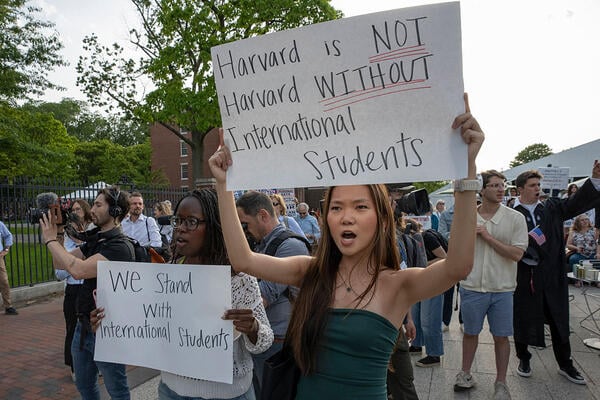
    The Health and Human Services Department announced Monday that Harvard University’s “deliberate indifference” regarding discrimination against Jewish and Israeli students violates federal law.

    The HHS Office for Civil Rights said Harvard is violating Title VI of the Civil Rights Act of 1964, which prohibits discrimination based on shared ancestry, including antisemitism.

    The finding, similar to one HHS announced against Columbia University in May, adds to the Trump administration’s pressure on both Ivy League institutions to comply with its demands. It has already cut off billions in federal funding.

    HHS’s Notice of Violation says that a report from Harvard’s own Presidential Task Force on Combating Antisemitism and Anti-Israeli Bias, combined with other sources, “present a grim reality of on-campus discrimination that is pervasive, persistent, and effectively unpunished.”

    “Reports of Jewish and Israeli students being spit on in the face for wearing a yarmulke, stalked on campus, and jeered by peers with calls of ‘Heil Hitler’ while waiting for campus transportation went unheeded by Harvard administration,” the Notice of Violation says.

    In a statement, Harvard said it is “far from indifferent on this issue and strongly disagrees with the government’s findings.”

    “In responding to the government’s investigation, Harvard not only shared its comprehensive and retrospective Antisemitism and Anti-Israeli Bias Report but also outlined the ways that it has strengthened policies, disciplined those who violate them, encouraged civil discourse, and promoted open, respectful dialogue,” the statement said.

    In April, the federal government ordered Harvard to audit academic “programs and departments that most fuel antisemitic harassment or reflect ideological capture” and report faculty “who discriminated against Jewish or Israeli students or incited students to violate Harvard’s rules” after the Oct. 7, 2023, start of the ongoing Israel-Hamas war. The government also ordered Harvard to, among other things, stop admitting international students “hostile to the American values and institutions inscribed in the U.S. Constitution and Declaration of Independence, including students supportive of terrorism or anti-Semitism.”

    “HHS stands ready to reengage in productive discussions with Harvard to reach resolution on the corrective action that Harvard can take,” HHS Office for Civil Rights director Paula M. Stannard said in a news release.

    Source link

  • A Framework for Moving Up or Moving On (opinion)

    A Framework for Moving Up or Moving On (opinion)

    Over my 16-plus years in higher education, mostly in administration, I’ve had many colleagues reach out and ask a version of the same question:

    “How do I know if I should stay or move on?”

    They are leaders in their field. Most are excelling on paper, teaching, mentoring, leading committees, serving on task forces and writing grants. But they’re tired, stuck or sense that something in the role, or the institution, no longer fits.

    Lately, I’m finding that we don’t talk enough about what to do when we’ve outgrown a role but aren’t sure what comes next. In academic culture, staying where we are is often seen as loyalty, moving up is luck and leaving can feel like defeat. But I’ve learned that career momentum doesn’t always mean climbing a ladder. Sometimes it means building a bridge or choosing a new path entirely.

    So, what do you do when you hit a fork in the road? I recently saw a post on LinkedIn that outlined a relatively simplistic framework, aligned with the business world, which can help if you find yourself questioning your next move: assess, align, act. I’ve taken the liberty to modify it, without losing the concept: reflect, revise, recommit.

    Reflect: Where Are You?

    Before planning your next move, take an honest look at your current professional state. Start by asking yourself the following:

    • Have I grown in the past year, or am I mostly going through the motions?
    • Am I viewed as a contributor or an afterthought?
    • How do I feel at the end of the day, mostly energized or mostly depleted?
    • Are my ideas welcomed or tolerated?
    • Do I see myself staying here for five more years?

    These questions aren’t about job satisfaction alone. They’re about where you are professionally. Assess your responses to the questions above. If you feel stuck where you are and don’t see changes or opportunities for professional growth in the future, it may be time to shift.

    Revise: Is This Still the Right Place for You?

    Consider how your values and contributions align (or don’t) with your work environment.

    In one of the classes I teach, we spend a considerable amount of time discussing values, both personal and professional. Keeping this in mind, ask yourself whether the following statements are true for you:

    • I can ask difficult questions or present unconventional ideas.
    • I feel heard and my input is valued.
    • I can contribute in ways that reflect my strengths.
    • My work is recognized, and not just when it’s convenient.
    • I feel hopeful about my professional future here.

    If you answer “no” more times than “yes,” it’s not a failure on your part. Instead, look at it as an opportunity to implement changes strategically.

    Recommit: Move Up, Move Over or Move On

    Once you’ve assessed your growth and alignment, you’re ready to make a deliberate decision to go deeper, shift roles or step toward something new. Here are three potential paths, each with concrete next steps:

    1. Move Up (Internal Advancement)

    If you still believe in the institution and want more responsibility:

    • Build your case: Document leadership wins, pilot programs or change initiatives—things that show you’re already operating at the next level.
    • Get visible: Let your supervisor or mentor know you’re open to advancement. Ambition isn’t arrogance; it’s clarity.
    • Ask for expanded roles: Volunteer to chair a new initiative or represent your unit on a strategic planning team.
    • Find advocates: You need more than mentors. Advocates promote and back you behind closed doors.
    1. Move Over (Lateral Change)

    If you like the institution but not the role:

    • Explore cross-campus opportunities in centers, institutes or new initiatives.
    • Consider a hybrid position that merges your skills (e.g., combining research and student success).
    • Talk with human resources or a trusted senior leader about other opportunities within your organization—professionally, quietly and strategically.

    Remember: lateral doesn’t mean lesser. Sometimes a lateral move can be the smartest option for long-term impact (and sanity).

    1. Move On (External Transition)

    If the position and the institution don’t fit your needs anymore:

    • Name what you want next: More autonomy? More responsibility? A different kind of leadership role?
    • Update your materials: Be sure to identify transferable skills. If you’ve led change, managed crises or built programs, remember these skills are valued in most industries.
    • Use your network: Former students, collaborators and conference contacts might hold the key to your next chapter.
    • Leave well: Give your employer sufficient notice. Offer to train your successor. Write a transition plan. Protect your reputation and exit with grace and gratitude.

    A Final Note: You’re Not Alone

    I recently spoke with a colleague who worried her career had stalled over the last several years and that she hadn’t grown in her position. When we discussed her accomplishments, we saw that she’d proposed several new initiatives, launched a new program, mentored students and staff, and learned to navigate the complexity of higher education with professionalism and courage. In short, she hadn’t wasted any time; she’d built resilience and capacity. She also realized she was more ready for change and leadership opportunities.

    If you’re at that fork in the road, know this: Moving on isn’t quitting; it’s choosing. Moving up isn’t selling out; it’s stepping in. And staying where you are is perfectly valid if it still serves your purpose, your values and your professional goals.

    Ask yourself this question: “Am I building a future here or am I just getting by?”

    Either way, you get to choose your next steps.

    Laura Kuizin is director of the master of applied professional studies in the Graduate School at the University of North Carolina at Chapel Hill. Laura is a member of the Graduate Career Consortium, an organization providing an international voice for graduate-level career and professional development leaders. Laura dedicates this article to Sadie-dog, who was by her side as she navigated her professional path over the last 16 years.

    Source link

  • College Athletics Enters Uncharted Territory July 1

    College Athletics Enters Uncharted Territory July 1

    After years of court battles, a federal judge ushered in a new era for college athletics earlier this month when she approved a settlement in the House v. NCAA antitrust lawsuit, effectively ending the century-old model of student athletes as amateurs.

    Now students will be able to earn money for their athletic performance at colleges that opt in to the practice known as revenue-sharing, in which institutions share with players the money made off their teams. Former Division I athletes from the recent past will also share a $2.8 billion settlement to compensate for the financial opportunities they were denied due to now-defunct NCAA rules that prevented them from cashing in on name, image, and likeness deals.

    Although the NCAA status quo was undone in an instant, many campus leaders had been planning for months, anticipating the outcome of the ruling.

    The era of paid college athletes officially begins July 1. With it comes questions about how the landscape will evolve and concerns about equity issues, as well as what the fallout of the settlement may mean for nonrevenue sports.

    A State of Transition

    Experts view revenue-sharing as the most consequential part of the settlement.

    Institutions that opt in to revenue sharing will have up to $20.5 million to spread among their athletes. The lion’s share of that is expected to flow to football, the top revenue-earning sport, followed by men’s basketball, with the second-highest distribution amounts. The annual revenue-sharing cap will increase gradually to $32 million over the course of a decade.

    Jason Montgomery, a partner at the law firm Husch Blackwell, said that one commonly discussed formula would see 75 percent of revenue disbursed to an institution’s football team, followed by 15 percent to men’s basketball, 5 percent to women’s basketball, and the remainder spread across all other sports. But he noted institutions can adjust that formula as they see fit.

    At institutions that don’t have a football team, the bulk of the revenue will likely be directed to men’s basketball. And some universities that have top basketball programs are tweaking the formula to direct more money to hoops; the University of Houston, for example, may opt for a formula that directs 23 to 25 percent of revenue to men’s basketball, local media reported.

    The back-pay provision is also heavily tilted toward football, which has already prompted an appeal on Title IX grounds, with plaintiffs alleging women are being shorted on damages. The suit, brought by eight former college athletes who competed in soccer, track and volleyball, argues that female athletes are being deprived of more than $1 billion in past damages.

    Financial Models

    For those opting in to revenue-sharing, a major question looms: Where will the money come from?

    Sean Frazier, athletic director at Northern Illinois University and president of the National Association of Collegiate Directors of Athletics, said financial models will vary by institution.

    “You’re going to see a lot more of that innovative way to revenue-share by getting this money from external sources that are not specific to the universities themselves,” Frazier said.

    Some colleges are leaning on boosters and TV deals to bankroll revenue-sharing, while others are taking different approaches. Earlier this month, the Florida Board of Governors approved the use of auxiliary funds to pay student athletes, which could flow from college bookstores, student housing, dining, parking fees and other income streams. (That measure is intended to be temporary as colleges develop long-term plans.)

    In addition to increasing revenues, colleges are looking for ways to cut costs. Montgomery said one way colleges can do that is by eliminating non-revenue-earning sports—such as swimming and track and field—which some institutions have done, though that move has also been accompanied by other financial challenges for the sector.

    Colleges that opt in to the revenue-sharing model don’t have to pay the maximum amount unless they choose to. That could yield scenarios where less resourced institutions pay much less than the $20.5 million cap.

    While experts say there is no firm data point yet on how many colleges have opted in to revenue sharing, those numbers are likely to be just a fraction of the NCAA’s member institutions. As of last summer, that number stood at 1,085 institutions, with 355 at the Division I level.

    “The vast majority of colleges are not going to be part of this revenue-share,” said Michael McCann, a professor at the University of New Hampshire’s Franklin Pierce School of Law.

    Opportunities for Innovation

    Frazier compared college athletics in the aftermath of the House settlement to flying a plane while building it. He expects colleges will adjust their approaches as they go.

    “It is clunky right now because of the fact that we do not have certain guardrails yet finalized as we go into this. That’s why it’s going to be a little bit of a wait-and-see on some things,” he said.

    He urged patience for those trying to navigate the new landscape.

    “I would caution [college] leaders to not jump to trends, to not jump to any situation as a quick fix,” Frazier said. “There’s no silver bullet to be able to manage this. We’re going to have to go through a cycle to really understand what the impacts of the House settlement mean.”

    McCann expects that colleges will largely pay football players, as they have signaled. Where the money flows, he said, will depend on institutional priorities. If an athletic department is focused on keeping up with rival football teams and landing on television, revenue-sharing money will be invested in football. But he thinks leaders should consider investing in other areas, including women’s sports—which have boomed in recent years, judging from the record viewership for women’s basketball.

    “I see an opportunity for schools that opt in to revenue-share to not follow the script of spending most of the money on football players,” McCann said. “I could see some presidents being innovative and saying, ‘Let’s use that money primarily on women’s basketball; let’s try to create a top women’s basketball team, or softball.’ There are opportunities to distribute money in ways that I think are a lot more innovative than simply trying to catch up with all the other football schools.”

    The Professional Era

    To many experts, this moment amounts to the professionalization of college athletics.

    “If this isn’t pay to play, I don’t know what is,” Montgomery said.

    To Montgomery’s point, some colleges have hired general managers and other personnel with professional sports experience. Last year Stanford University tapped former star quarterback Andrew Luck, who spent seven years in the NFL, to return to his alma mater as general manager of the football program. Similarly, in March the University of California, Berkeley, hired former NFL player and head coach Ron Rivera as general manager of its football program.

    Noting that trend, McCann suggested such programs are “operating as quasi pro teams.”

    Federal Legislation?

    For years, observers have speculated that Congress might get involved in college athletics. President Donald Trump has raised the possibility of his own involvement as well; in May, he proposed establishing a presidential commission on college sports before backing off the idea.

    However, many experts don’t expect federal legislation to emerge.

    “It’s a long shot that Congress intervenes,” Montgomery said, arguing that college athletics is not a priority for lawmakers at the moment. At most, he said Congress might codify the House settlement through federal legislation.

    McCann agrees. While he believes “there will be bills introduced, and there will be press conferences and a lot of media coverage,” he doesn’t think such efforts will be fruitful.

    But Frazier, who describes himself as an optimist by nature, is hopeful that federal legislation could come to pass in the near future, and he stressed the importance of being part of those talks.

    “I think at the end of the day, we need to help [Trump], we need to help the federal government understand what will work,” he said. “Because we have a perception issue that college athletics can’t govern itself. We’ve created that perception as an industry, and what we need to do is take it back. What we need to do is to show the folks that have doubted us, that [think] we’ve lost control, that there is control, and the only way you can do that is with experience, leadership and execution.”

    Source link

  • University of Virginia President Resigns After Trump’s Demands

    University of Virginia President Resigns After Trump’s Demands

    This is a developing story and will be updated.

    The University of Virginia president James Ryan said Friday he was resigning after the Justice Department demanded he step down.

    “To make a long story short, I am inclined to fight for what I believe in, and I believe deeply in this university,” Ryan wrote in a letter to the campus community. “But I cannot make a unilateral decision to fight the federal government in order to save my own job. To do so would not only be quixotic but appear selfish and self-centered to the hundreds of employees who would lose their jobs, the researchers who would lose their funding, and the hundreds of students who could lose financial aid or have their visas withheld.”

    The Justice Department has for months been quietly investigating whether the Virginia flagship complied with President Donald Trump’s order banning diversity, equity and inclusion programs. The university’s Board of Visitors voted to dissolve its DEI office in March, but multiple conservative alumni groups and legal entities complained that Ryan failed to eliminate DEI from all corners of campus. In many cases, critics argue that the university simply changed the names of programs but maintained their core function. 

    The New York Times first reported on the resignation and the Justice Department’s demand Thursday evening.

    Ryan wrote that he had planned to step down next spring for reasons separate from the investigation; he didn’t say when his resignation would take effect.

    “While there are very important principles at play here, I would at a very practical level be fighting to keep my job for one more year while knowingly and willingly sacrificing others in this community,” he wrote.

    Ryan took over at UVA in August 2018, steering the institution through the aftermath of the deadly white supremacist rally in August 2017, the pandemic and the racial reckoning in 2020. He also cracked down on pro-Palestinian protesters last spring—a move that Republicans in the state backed but students and faculty condemned. Ryan also embraced institutional neutrality and sought to make UVA a leader in the study of democracy.

    Assistant Attorney General Harmeet Dhillon said in a statement Friday that the Justice Department welcomes “leadership changes in higher education that signal institutional commitment to our nation’s venerable federal civil rights laws.”

    DOJ hasn’t said publicly what laws UVA allegedly violated, though Dhillon’s statement noted that the agency “has a zero-tolerance policy toward illegal discrimination in publicly-funded universities.”

    From the early days of his second term, Trump has made a point of dragging elite, largely Ivy League institutions like Columbia and Harvard Universities into the national spotlight and berating them for their supposed liberal ideologies and alleged antisemitism. But this investigation of UVA, a public institution in a state led by a Republican, represents a new front in the administration’s  war against higher education—and so far Trump is succeeding.

    Brendan Cantwell, a higher education professor at Michigan State University, said Ryan’s resignation is a “major blow” to the independence of American institutions. 

    “It is a sign that major public research universities are substantially controlled by a political party whose primary goal is to further its partisan agenda and will stop at nothing to bring the independence of higher education to heel,” he told Inside Higher Ed. “It undercuts both the integrity of academic communities as self-governing based on the judgment of expert professionals and the traditional accountability that public universities have to their states via formal and established governance mechanisms.”

    Legal experts who spoke with the Times struggled to recall other instances when the federal government has demanded a university board fire the chief official, saying it has only been done in the past when concerning corporate criminal cases.

    Robert Kelchen, an education policy professor at the University of Tennessee, noted that Ryan’s resignation portends a future in which all public university presidents must conform to the political views of their state’s leadership or be kicked out of office.

    “Trump pushing James Ryan to resign at UVA is important, but it happened in part because VA’s governor is also Republican,” Kelchen wrote on BlueSky. 

    Virginia’s two senators, who are both Democrats, said in a joint statement that the demand for Ryan to resign “is a mistake that hurts Virginia’s future.”

    “It is outrageous that officials in the Trump Department of Justice demanded the Commonwealth’s globally recognized university remove President Ryan—a strong leader who has served UVA honorably and moved the university forward—over ridiculous ‘culture war’ traps,” said Sens. Tim Kaine and Mark Warner. “Decisions about UVA’s leadership belong solely to its Board of Visitors, in keeping with Virginia’s well-established and respected system of higher education governance.”

    Virginia governor Glenn Youngkin thanked Ryan for his service to UVA in a statement Friday afternoon. Youngkin, a Republican, has appointed a majority of the university’s board members.

    “The Board of Visitors has my complete confidence as they swiftly appoint a strong interim steward, and undertake the national search for a transformational leader that can take Mr. Jefferson’s university into the next decade and beyond,” he said in the statement.

    A Quiet Inquiry

    While the administration’s campaign against Harvard and Columbia mostly played out in public, the UVA investigation was more quiet. The DOJ didn’t send press releases about UVA or make public hay about its demands. Instead it sent letters to the university about its inquiry and findings.

    On April 28, DOJ cited complaints about how the university was handling its DEI programs, according to the Times and the Charlottesville Daily Progress. Initially the letter set a compliance deadline of May 2. That was then extended to May 30.

    After that, the DOJ received multiple complaint letters from groups like American First Legal, a legal advocacy group founded by Trump’s deputy chief of staff Stephen Miller, suggesting the university had yet to comply.

    In a final letter, dated June 17, the department laid out its demands yet again, this time noting the complaints it had received from groups like AFL and saying that the university needed to make swift changes or pay the price, the Times reported. The government’s lawyers, which include several UVA alumni, found that UVA considered race in its admissions and in deciding other student benefits, according to the Times.

    “Time is running short, and the department’s patience is wearing thin,” the letter said. 

    Neither the White House nor the DOJ have released a public statement about their demands of UVA or Ryan’s resignation. 

    The university said in a statement Friday morning that it is “committed to complying with all federal laws and has been cooperating with the Department of Justice in the ongoing inquiries.” But it has not said anything further since Ryan announced his departure.

    Source link

  • Three Ways to Give Donation-Minded Visitors a Good Story

    Three Ways to Give Donation-Minded Visitors a Good Story

    In a study of 99,542 donors who supported causes between 2020 and 2024 with gifts totaling less than $5,000 a year (nearly 97 percent of all donors), just 5.7 percent supported education institutions. That’s according to “The Generosity Report: Data-Backed Insights for Resilient Fundraising,” published this April by Neon One, a provider of nonprofit operational technology.

    While major gifts will always be a crucial part of higher ed advancement success, it’s important to remember that smaller gifts add up, and during this uncertain time higher ed leaders must prioritize capturing the interest of every could-be donor.

    Among the donors studied, nearly 30 percent gave to more than one nonprofit, for a combined average of about $545 in 2024, an increase from $368 in 2020. Many—if they have a good relationship with a nonprofit and are asked—will increase their level of support.

    Sharing donation impact stories on a college’s main giving page is an approach not taken enough, in my experience. Typically, the “make a gift” or “give now” link, found prominently on an institution’s homepage, brings a visitor to a form. (“Yes, we’ll take that credit card info now.”) While no one wants to distract anyone from giving online, some colleges are clearly making efforts to inspire and inform giving by sharing how donations are helping students succeed and contributing to research and other efforts benefiting the community or beyond.

    In uncovering examples of colleges using engaging narratives on their donation pages, I now have a clear sense of several practices to consider. For anyone asking how an already resource-strapped marketing and comms team is supposed to make time for additional storytelling, here’s some good news: Most institutions are probably already publishing articles that can be gently repurposed for alumni and other friends thinking about making a gift.

    Following are three actions to take when the goal is telling impact stories on a main giving page.

    1. Find (and tweak) or create the content.

    Do some sleuthing to locate any articles already written about programs and supports made possible at least in part with donor funding. While giving sites can include articles about major gifts that center around the donor, focusing on individuals or communities that are better because of the initiative is more compelling.

    Donation-related video content—although probably needing to be built from scratch—is a great way to highlight real student successes, whether it’s a scholarship that opened up access, emergency funds that allowed a student to stay in school or the excitement of commencement. Minnesota State University, Mankato, recorded accepted students finding out they had received scholarships and students who had benefited from emergency funding sharing how the gift had “saved the day.” Gratitude-focused videos, especially when they use student voices, need not reveal specific personal circumstances.

    To help find individuals to feature, some giving pages invite students, alumni, employees and donors to suggest or contribute their own impact stories.

    1. Provide a mix of content formats and collections.

    Slideshows, blown-up quotes and infographics (individual graphics or numbers-driven stories) are a few visual content tactics spotted on giving pages.

    Lewis & Clark College tells succinct stories on its giving page through a slideshow with three students sharing how their financial aid offers allowed them to enroll. The Oregon college’s giving page also includes a collection of five featured stats, highlighting how gifts from the past year have made an “immediate impact on the areas of greatest need.” Rather than just presenting the most obvious numbers, such as giving totals, these data points note, for example, the number of potential jobs and internships sourced by the career center, or how many new titles were purchased by the library.

    When strategizing about giving page content, consider a series of similar stories that use a standard title or title style. These can even be short first-person pieces, such as “The next decade of [community, achievement, opportunity, gratitude, etc.] begins with you,” a series created for McGill University in Montreal.

    To make an impact story most effective at inspiring a gift, be sure to take the extra step of adding a call-to-action message and link within each article. Even institutions doing this tend to be inconsistent about it. Try adding an italicized note at the end, a sentence within the text or a box that explains the related fund, as University of Colorado at Boulder does.

    1. Be thoughtful about giving page content organization.

    Content-rich giving pages don’t start with a gift form or a bunch of stories. Instead, a single large photo or slideshow featuring students and a short, impactful message seems to be the preferred approach.

    As a visitor scrolls down, additional content tiers can offer more detail and giving encouragement—such as students expressing gratitude for support. More comprehensive feature articles and/or collections of impact story content tend to appear toward the bottom of the page, with a few teaser stories and often a link to see more. Larger collections of stories can be broken into categories and made searchable.

    Some institutions place links to impact story pages in more than one place and include multiple “make a gift” buttons on the main giving page.

    A new focus on giving content should also trigger some tweaks to the gift form itself. Does it include a drop-down menu with specific fund options? Can a donor write in where to direct the gift?

    Or consider McGill’s approach: Each of five big ideas listed on its giving stories page takes visitors to a gift form, followed by a description of the meaning of that idea, followed by specific stories that bring it to life.

    What inspirational success stories could you be sharing with friends who click to donate?

    Source link

  • Wayne State Launches Prison Education Program

    Wayne State Launches Prison Education Program

    Wayne State University

    With the reinstatement of Pell Grant eligibility for incarcerated individuals in 2023, more colleges have launched or restarted prison education programs. Wayne State University in Michigan will join their ranks this fall, offering a bachelor’s degree to incarcerated individuals for the first time.

    Twenty-five students will join the inaugural cohort in August, and the university is forging ahead with program plans despite looming Pell Grant cuts.

    What’s the need: Twenty-five percent of formerly incarcerated people have no high school diploma, and 20 percent have only a high school diploma, compared to the 91 percent of Americans who have attained at least that credential. “We know that today’s workforce, much of it requires a college education, so it’s almost a necessary criterion to earn a living wage in today’s society,” said Michelle Jacobs, a professor of sociology and Wayne State’s Prison Education Program lead.

    While many incarcerated individuals express an interest in postsecondary education, college often gets placed on the back burner after they leave prison as they focus on more pressing challenges, such as meeting basic needs and providing for themselves, Jacobs said. Higher education–in–prison programs help students get a head start on reclaiming their lives after they are released.

    The initiative also ties into Wayne State president Kimberly Andrews Espy’s Prosperity Agenda for the Detroit area, which includes supporting economic mobility for students, improving the health of urban neighborhoods and fostering innovation in the local economy.

    Individuals who participate in postsecondary education programs while in prison are 48 percent less likely to be reincarcerated than those who don’t, and they are more likely to get a job after their release. Research also shows that education-in-prison programs not only benefit the individual but also increase safety in prison settings and can improve families’ socioeconomic mobility.

    “One of our goals for the program is to empower families in low-income communities that have been disproportionately impacted [by mass incarceration],” Jacobs said.

    How it works: Wayne State’s Prison Education Program will enroll 25 incarcerated men at the Macomb Correctional Facility in Lenox, Mich., about 35 miles northeast of the university.

    To be considered, applicants have to be at least five years from their earliest release date, giving them time to finish the program, and they must complete an essay outlining why they want to participate.

    All courses will be delivered in person and the university will provide any school supplies or resources the students need for their coursework, including pens, paper and dictionaries. Students have to complete paper applications and FAFSA forms, so staff will assist with that process.

    Program participants will complete a degree in sociology, as well as a range of general education courses, similar to their on-campus peers. Students can also opt in to an entrepreneurship and innovation minor.

    Both programs are designed to support the unique experiences of incarcerated people, Jacobs said.

    “I’m extremely biased towards sociology, and I think that benefits everyone,” Jacobs said. “I think that incarcerated individuals can benefit so much, not only in terms of understanding the broader structures that have impacted their own realities, but also on that interactional level … I think that’ll be really helpful for them as they’re navigating their lives postrelease.”

    Faculty members from across the university will serve as instructors.

    Facing headwinds: Since beginning the project, Wayne State has encountered various challenges.

    The initial plan was to use donor funding to kick off the program, but officials had to pivot to relying on Pell dollars and money from the Michigan Department of Corrections to cover student tuition. Then, reorganization at the federal Department of Education and a lack of staff stalled approval of the program. Changes to the Pell Grant may further impede the program’s future.

    Despite the obstacles, Jacobs and her team are pushing on.

    “Once we started working on it, I couldn’t let it go,” Jacobs said. “I deeply believe in the transformative power of education, and I also deeply believe that there is an amazing among of talent and wit and love and humor and expertise already in carceral settings … I just made a decision that we will forge ahead regardless of what is happening at the federal level—while, of course, paying attention to it.”

    Wayne State staff received advice and support in establishing the program from the Michigan Consortium for Higher Education in Prison. “It’s very collaborative instead of competitive, which is unique for academic spaces, and I appreciate it so much,” Jacobs said.

    Next steps: Jacobs and her team are currently reviewing student applications to select the inaugural cohort, with plans to enroll another cohort in fall 2026.

    Before classes start this August, participating faculty and students will both complete an orientation. The faculty orientation will provide instructors with professional development that helps prepare them to teach inside a prison, supported by a student organization on campus focused on criminal justice reform.

    Students will be given college-readiness support, as well as access to academic and support resources similar to those offered on campus.

    If your student success program has a unique feature or twist, we’d like to know about it. Click here to submit.

    Source link

  • Universities “At Risk of Overassessing” in Response to AI

    Universities “At Risk of Overassessing” in Response to AI

    The number of assessments set by universities is steadily rising, but there are worries this could result in student burnout and prove counteractive if implemented without centering learning.

    recent report by the U.K.-based Higher Education Policy Institute (Hepi) and Advance HE found that assessments at U.K. institutions have risen to 5.8 summative assignments and 4.1 formative assignments per semester in 2025, compared to five summative assessments and 2.5 formative assessments in 2020.

    Josh Freeman, policy manager at Hepi and co-author of the report, said the advent of AI is “reducing the accuracy of assessments as a measure of students’ performance,” prompting universities to re-evaluate their examination methods.

    “It’s possible that course organizers are assessing students more to improve the confidence they have in their assessments,” he said.

    “It’s also possible that, as they redo assessment models, which may have remained the same for a long time, they are switching to alternative models of assessment—for example, those that assess students on an ongoing basis, rather than simply once at the end of the year.”

    However, rising numbers of exams risks universities “overassessing” students, he added, as “students now face an intense battle over their time,” noting that the number of hours that students spend studying has fallen.

    “[Many are making] sacrifices around social activities, sports and societies. These ‘extra’ activities are the first to go when students are squeezed and would probably be cut further if the academic elements of university become more demanding.”

    Some 68 percent of students in the U.K. are now undertaking part-time work during term time, a record high, largely in response to cost-of-living pressures.

    Michael Draper, a professor in legal education at Swansea University and chair of the university’s academic regulations and student cases board, said that some universities have begun supplementing assessments with “some form of in-person assessment” to counteract AI “credibility concerns.” But “that of course does lead to perhaps overassessment or more assessments than were in place before.”

    “Students have got so many competing claims on their time, not just in relation to work, but care responsibilities and work responsibilities, that you run the risk of student burnout,” he continued.

    “That is not a position you actually want to be in. You want to make sure that students have got a fair opportunity to work consistently and get the best grade possible. You want students to have a chance to reflect upon their feedback and then to demonstrate that in other assessments, but if they’re being continuously assessed, it’s very difficult to have that reflection time.”

    However, Thomas Lancaster, principal teaching fellow in the Department of Computing at Imperial College London, speculated that a rise in the number of exams could be a sign that assessments are being “split into smaller stages,” with more continuous feedback throughout the process, which could also simultaneously have benefits for counteracting AI use.

    “This is something I’ve long recommended in response to contract cheating, where it’s good practice to see the process, not just the final product. So I do hope that the revised assessment schedules are being put in place to benefit the students, rather than purely as a response to AI.”

    While breaking assessments down could prove beneficial to student learning, Drew Whitworth, reader at the Manchester Institute of Education, questioned, “How does one count what constitutes ‘separate’ assessments?”

    “If a grade is given partway through this process … this is actually quite helpful for students, answering the question ‘How am I doing?’ and giving them a pragmatic reason to show [their work and that they are working] in the first place.

    “But does this count as a separate assessment or just part of a dialogue taking place that helps students develop better work in response to a single assessment?”

    Source link

  • DOJ Sues Minnesota Over In-State Tuition for Noncitizens

    DOJ Sues Minnesota Over In-State Tuition for Noncitizens

    The U.S. Department of Justice sued Minnesota lawmakers Wednesday over the state’s policy allowing in-state tuition benefits for undocumented students.

    The lawsuit names Gov. Tim Walz, Attorney General Keith Ellison and the state’s Office of Higher Education as defendants. It claims Minnesota is violating federal law and discriminating against U.S. citizens by permitting noncitizens who grew up in the state to pay in-state tuition rates. Under the Minnesota Dream Act, signed into law in 2013, undocumented students have to meet various criteria to qualify, including spending three years at and graduating from a Minnesota high school.

    The suit also takes issue with the state’s North Star Promise Program, a free college program launched last year for Minnesotans who meet certain requirements, including undocumented students who live in the state.

    The lawsuit comes after the Justice Department successfully sued Texas over the same issue earlier in June. Texas swiftly sided with the federal government, and within hours, its two-decade-old law allowing in-state tuition for undocumented students became moot. The DOJ also sued Kentucky politicians over its in-state tuition policy last week. The lawsuits cite President Donald Trump’s May executive order that called for a crackdown on cities and states with laws that benefit undocumented immigrants, including those that offer in-state tuition benefits.

    “No state can be allowed to treat Americans like second-class citizens in their own country by offering financial benefits to illegal aliens,” Attorney General Pamela Bondi said in a news release. “The Department of Justice just won on this exact issue in Texas, and we look forward to taking this fight to Minnesota in order to protect the rights of American citizens first.”

    Source link