Tag: Journal

  • Why Small Private Colleges Matter More Than Ever – Edu Alliance Journal

    Why Small Private Colleges Matter More Than Ever – Edu Alliance Journal

    Opinion Piece by Dean Hoke — Small College America and Senior Fellow, The Sagamore Institute

    A Personal Concern About the Future of Public Education

    It’s impossible to ignore the rising level of criticism directed at our nation’s public schools. On cable news, social media channels, political stages, and in school board meetings, teachers and administrators have become easy targets. Public schools are accused of being ineffective, mismanaged, outdated, or, in some corners, ideologically dangerous. Some commentators openly champion the idea of a fully privatized K–12 system, sidelining the public institutions that have educated the vast majority of Americans for generations.

    For those of us who have spent our lives in and around education, this rhetoric feels deeply personal. Public schools aren’t an abstraction. They are the places where many of us began our education, where our children discovered their strengths, where immigrants found belonging, where students with disabilities received support, and where caring adults changed the trajectory of young lives.

    Behind every one of those moments stood a teacher.

    Amid this turbulence, there is one group of institutions still quietly doing the hard work of preparing teachers: small private nonprofit colleges.

    Small Private Colleges: An Overlooked Cornerstone of Teacher Preparation

    Despite the noise surrounding public education, small private colleges remain committed to the one resource every school depends on: well-prepared, community-rooted teachers.

    They rarely make national headlines. They don’t enroll tens of thousands of students. But they are woven into the civic and human infrastructure of their regions—especially in the Midwest, South, and rural America.

    This reality became even clearer during a recent episode of Small College America, in which I interviewed Dr. Michael Scarlett, Professor of Education at Augustana College. His insights provide an insider’s view into the challenges—and the opportunities—facing teacher preparation today. Note to hear the entire interview click here https://smallcollegeamerica.transistor.fm/28

    I. The Teacher Shortage: A Structural Crisis

    Much has been written about the teacher shortage, but too often the conversation focuses on symptoms rather than causes. Here are the forces shaping the crisis.

    1. Young people are turning away from teaching

    Data from the ACT show that only 4% of students express interest in becoming teachers—down from 11% in the late 1990s. Bachelor’s degrees in education have fallen nearly 50% since the 1970s. Surveys show that fewer than 1 in 5 adults would recommend teaching as a career.

    The message is clear: Teaching is meaningful, but many no longer see it as sustainable.

    As Dr. Scarlett told us: “The pipeline simply is not as wide as it needs to be.”

    Recent data offers a glimmer of hope: teacher preparation enrollment grew 12% nationally between 2018 and 2022. However, this modest rebound is almost entirely driven by alternative certification programs, which increased enrollment by 20%, while traditional college-based programs grew by only 4%. This disparity underscores a critical concern: the very programs that provide comprehensive, relationship-based preparation—including those at small colleges—are not recovering at the same rate as faster, less intensive alternatives.

    2. Burnout and attrition have overtaken new entrants

    The pandemic accelerated an already-existing national trend: teachers are leaving faster than new ones are entering.

    Reasons include:

    • Student behavior challenges
    • Standardized testing pressure
    • Emotional fatigue
    • Inequities across districts
    • Lack of respect
    • Political and social media hostility

    As Scarlett notes, these realities weigh heavily on early-career teachers: “What new teachers face today goes far beyond content knowledge. They face inequities, discipline issues, emotional exhaustion… and they’re expected to do it all.”

    3. Alternative certification can’t fill the gap

    Alternative routes help—but they cannot replace the traditional college-based pipeline. Many alt-cert teachers receive less pedagogical training and leave sooner.

    Scarlett captures the trend: “Teaching has always attracted people later in life… we’ve definitely seen an uptick.”

    And while alternative routes have seen growth in recent years—increasing 20% between 2018 and 2021—this expansion has not translated into solving the shortage. As of 2025, approximately 1 in 8 teaching positions nationwide remains either unfilled or filled by teachers not fully certified for their assignments. The shortcut approach cannot substitute for comprehensive preparation.

    “The national teacher shortage is real… and retention is just as big a challenge as recruitment.” — Dr. Michael Scarlett

    II. The Quiet Backbone: How Small Private Colleges Sustain the Teacher Workforce

    Small private colleges graduate fewer teachers than large public institutions, but their impact is disproportionately large—especially in rural and suburban America.

    1. They prepare the teachers who stay

    About 786 private nonprofit colleges offer undergraduate education degrees—representing roughly 20% of all teacher preparation institutions in the United States. Together, they produce approximately 25,119 graduates per year, an average of 32 per institution.

    These numbers may seem modest, but these graduates disproportionately:

    • Student-teach locally
    • Earn licensure in their home state
    • Take jobs within 30 miles of campus
    • Stay in the profession longer

    Public schools desperately need these ‘homegrown’ teachers who understand the communities they serve.

    2. Small colleges excel at the one thing teaching requires most: mentoring

    Teacher preparation is not transactional. It is relational. And this is where private colleges excel. Scarlett put it plainly: “Close relationships with our students, small classes, a lot of direct supervision… we nurture them throughout the program.” In a profession that relies heavily on modeling and mentorship, this matters enormously.

    3. Faculty—not adjuncts—supervise student teachers

    One of the most striking differences: “Full professors… working with the students in the classrooms and out in field experiences. Other institutions outsource that.”

    This is not a trivial distinction. Faculty supervision affects:

    • Preparedness
    • Confidence
    • Classroom management
    • Retention

    Where larger institutions rely on external supervisors, small colleges invest the time and human capital to do it right.

    4. They serve the regions hit hardest by shortages

    Rural districts have the highest percentage of unfilled teaching positions. Many rural counties rely almost exclusively on a nearby private college to produce elementary teachers, special education teachers, and early childhood educators.

    When a small college stops offering education degrees, it often leaves entire counties without a sustainable teacher pipeline.

    5. They diversify the educator workforce

    Small colleges—especially faith-based, minority-serving, or mission-driven institutions—often enroll first-generation students, students of color, adult career-changers, and bilingual students. These educators disproportionately fill shortage fields.

    “What we have here is special… students understand the value of a small college experience.” — Dr. Michael Scarlett

    III. Should Small Colleges Keep Offering Education Degrees? The Economic Question

    Let’s be direct: Teacher preparation is not a high-margin program.

    Costs include:

    • Intensive field supervision
    • CAEP or state accreditation
    • High-touch advising
    • Small cohort sizes

    Education majors also often have lower net tuition revenue compared to business or STEM.

    So why should a small college continue offering a program that is expensive and not highly profitable?

    Because the alternative is far worse—for the institution and for the region it serves.

    1. Cutting teacher-prep weakens a college’s identity and mission

    Many private colleges were founded to prepare teachers. Teacher education is often central to institutional mission, community trust, donor expectations, and alumni identity.

    Removing education programs sends the message that the college is stepping away from public service.

    2. Teacher-prep strengthens community partnerships

    Education programs open doors to:

    • District partnerships
    • Dual-credit pipelines
    • Grow Your Own initiatives
    • Nonprofit and state grants
    • Alumni involvement

    These relationships benefit the entire institution, not just the education department.

    3. Education majors support other academic areas

    Teacher-prep indirectly strengthens:

    • Psychology
    • English
    • Sciences
    • Social sciences
    • Music and arts

    When teacher education disappears, these majors often shrink too.

    4. The societal mission outweighs the limited revenue

    There are moments when institutional decisions must be driven by mission, not margins. Producing teachers is one of them.

    5. Addressing concerns about program quality and scale

    Some critics question whether small programs can match the resources and diversity of perspectives available at large universities. This is a fair concern—and the answer is that small colleges offer something different, not lesser.

    Graduation and licensure pass rates at small private colleges consistently match or exceed those of larger institutions. What smaller programs may lack in scale, they compensate for through personalized mentorship, faculty continuity, and deep community integration. These are not peripheral benefits—they are the very qualities that predict long-term teacher retention.

    IV. Why Students Still Choose Teaching—and Why Small Colleges Are Ideal for Them

    Despite all the challenges, students who pursue teaching are deeply motivated by purpose.

    Scarlett described his own journey: “I wanted to do something important… something that gives back to society.”

    Many education majors choose the field because:

    • A teacher changed their life
    • They want meaningful work
    • They value community and service
    • They thrive in supportive, intimate learning environments

    This makes small colleges the natural home for future teachers.

    V. What Small Colleges Can Do to Strengthen Their Programs

    Below are the strategies that are working across the country.

    1. Build Grow Your Own (GYO) teacher pipelines

    Districts increasingly partner to:

    • Co-fund tuition
    • Support paraeducator-to-teacher pathways
    • Provide paid residencies
    • Guarantee interviews for graduates

    2. Develop dual-credit and “teacher cadet” high school programs

    Scarlett sees this as a major reason for hope: “We’re seeing renewed interest in teaching through high school programs… This gives me hope.”

    3. Offer specialized certifications (ESL, special ed, early childhood, STEM)

    These areas attract students and meet district needs.

    4. Create 4+1 BA/M.Ed pathways

    Parents and students love the value.

    5. Provide flexible programs for career-changers

    The rise of adult learners presents a major opportunity for private colleges. “We prepare our students for the world that exists.” — Dr. Michael Scarlett

    VI. Why Small Colleges Must Stay in the Teacher-Prep Business

    If small private colleges withdraw from teacher preparation, the consequences will be immediate and dramatic:

    • Rural and suburban schools will lose their primary source of new teachers.
    • Teacher diversity will shrink.
    • More underprepared teachers will enter classrooms.
    • Districts will become more dependent on high-turnover alternative routes.
    • Student learning will suffer.

    And the profession will lose something even more important: the human-centered preparation that small colleges provide so well.

    • The teacher shortage will not be solved by legislation alone.
    • It will not be solved by fast-track certification mills.
    • It will not be solved by online mega-universities.
    • It will not be solved by market forces.
    • It will be solved in the classrooms, hallways, and mentoring relationships of the small colleges that still believe in the promise of teaching.

    If we want public schools to remain strong, we must support the institutions that prepare the teachers who keep them alive. Small private colleges aren’t just participants in the teacher pipeline—they are its foundation.

    When these colleges thrive, they produce educators who stay, who care, and who transform communities. That’s not just good for education—it’s essential for American democracy.


    Dean Hoke is Managing Partner of Edu Alliance Group, a higher education consultancy firm. He formerly served as President/CEO of the American Association of University Administrators (AAUA). Dean has worked with higher education institutions worldwide. With decades of experience in higher education leadership, consulting, and institutional strategy, he brings a wealth of knowledge on colleges’ challenges and opportunities. Dean is the Executive Producer and co-host for the podcast series Small College America and a Senior Fellow at the Sagamore Institute based in Indianapolis, Indiana.

    Source link

  • Donor Engagement in College Mergers – Edu Alliance Journal

    Donor Engagement in College Mergers – Edu Alliance Journal

    November 2, 2025, By Dean Hoke — When Sweet Briar College’s trustees voted to close in 2015, they framed the decision as a financial necessity. Alumnae mounted an extraordinary campaign—raising $28.5 million in 110 days—and, through a state-brokered settlement, the college reopened under new governance. By 2023, donors had contributed well over $133 million since the crisis. What looked like an inevitable failure became one of higher education’s most remarkable turnarounds.

    Sweet Briar is not only a story of crisis response; it exposes a recurring miscalculation in today’s merger conversations: the assumption that boardroom consensus equals donor legitimacy. Trustees speak for donors in a fiduciary sense—they hold legal responsibility for institutional assets—but not in the communal sense that captures sentiment, legacy, and trust. When colleges announce merger talks, headlines dwell on enrollment curves and debt ratios. Yet behind every deal stands a quieter, decisive constituency: major donors, family foundations, and planned-giving benefactors whose confidence (or loss of it) can determine whether the combined institution thrives—or limps forward under the weight of broken relationships.

    This article reframes mergers as philanthropic integration projects. The legal mechanics matter, but durable success is won in the design phase: early engagement with philanthropic stakeholders, explicit safeguards for identity and donor intent, transparent transition planning, and a mission-first case that invites continued—and new—investment. When leaders bring donors and alumni into the architecture of the merger rather than the press release, they convert anxiety into commitment and preserve the institutional DNA that constituents care about most.

    We’ll see this principle in contrasting cases: mission-advancing acquisitions that attracted significant philanthropic support, integrations that prioritized identity and donor intent from the outset, and lessons from failed or contested processes. The throughline is simple: treat philanthropy as a core workstream—not an afterthought—and the odds of a credible, sustainable merger rise dramatically.

    The stakes have never been higher. Survey data from Ruffalo Noel Levitz’s 2025 National Alumni Survey, which surveyed more than 50,000 alumni, reveals that donor relationships with higher education are already strained. While 81% of alumni report that being philanthropic is important to them personally and 77% make charitable donations, their connection to their alma mater has weakened dramatically. Only 31% of alumni who donate to any charity gave to their alma mater last year, dropping to just 19% among Millennials and 10% among Gen Z graduates.

    Even more troubling: 59% of alumni who never donate to their alma mater actively support other causes, as do 83% of lapsed donors. They have not stopped giving—they have simply redirected their philanthropy elsewhere. This suggests that alumni disengagement reflects institutional failure rather than generational selfishness.

    Satisfaction drives everything. Alumni who report being ‘very satisfied’ with their student experience are 18 times more likely to donate than neutral respondents and 73 times more likely than dissatisfied graduates. Yet only 42% of Gen Z alumni report feeling ‘very satisfied’ with their experience, compared to 72% of Silent Generation graduates.

    Mergers test already-fragile relationships. When institutions announce consolidation, donors who felt lukewarm about their undergraduate experience see confirmation that their alma mater is failing. A merger framed solely as a financial necessity will not inspire them. But a merger presented as advancing mission-driven impact—expanding access, strengthening programs that address social challenges, or preserving an educational model under threat—can mobilize support from the very alumni who have drifted away.

    As Millett (1976) noted, successful integrations often ‘show structure, not just sentiment’—for example, Case Western Reserve kept a distinct Case Institute identity, and Carnegie Mellon created a Carnegie Institute of Engineering and a Mellon Institute of Science to carry legacies forward.

    A half-century ago, John D. Millett’s 1976 analysis of U.S. college mergers examined a range of cases—from research institutes to liberal arts colleges—and distilled lessons that remain strikingly current. Four observations deserve renewed attention today:

    1. Endowments transfer; relationships do not. In many mergers, endowments and restricted funds move to successor institutions through standard legal pathways. The mechanics are manageable. The harder work is relational: ensuring donors can see how their original intent will be honored in the new configuration, and that the program or ethos they loved will not be erased.

    2. Alumni skepticism is predictable—and manageable. Leaders should not assume alumni approval, especially when the smaller institution is absorbed. Visible steps to cultivate and retain legacy alumni—keeping familiar staff contacts for a transitional period, acknowledging a distinct identity, and offering tangible ways to shape the merged future—go a long way.

    3. Governance approval is not donor legitimacy. Even when boards vote, state bodies concur, and presidents sign, philanthropic legitimacy remains a separate test. Communities expect to be consulted; they often oppose mergers if they learn about them too late. Participation must be planned early, not added later.

    4. Language and structure matter more than sentiment. Labels and explanations—federation versus absorption, mission expansion versus rescue—shape how alumni and donors interpret the outcome. Leaders who explain clear educational benefits and who visibly protect identity through formal structures earn trust faster.

    Historical Examples: Structure, Not Just Sentiment

    After the Case Institute of Technology and Western Reserve University merger, the successor Case Western Reserve University continued the designation of Case Institute of Technology as an organizational component. At Carnegie Mellon University, leaders created a Carnegie Institute of Engineering and a Mellon Institute of Science—formal structures that carried legacy identities forward within the new entity.

    The Bellarmine-Ursuline (Louisville) merger (1968-1971) offers another instructive example. The combined institution briefly used the Bellarmine-Ursuline name before reverting to Bellarmine College in 1971, but Bellarmine has continued to honor Ursuline identity through durable structures—explicitly including Ursuline alumnae in alumni awards and honors and recognizing the Ursuline legacy through commemorations and alumni programming. These are structural signals that preserve identity even when the combined name does not persist.

    Millett also notes that successor institutions often made special effort to cultivate and retain alumni of the absorbed college, including keeping an alumni-relations officer from the legacy institution and providing a special alumni designation or status—practical ways to keep traditions and community intact during transition.

    Crisis-Reactive: What Not to Do

    Planning is done privately, the announcement is abrupt, and donors are asked to accept a fait accompli. Mills College’s merger with Northeastern University proceeded despite alumni resistance, prompting legal challenges over donor intent. The Alumnae Association spent hundreds of thousands in legal fees opposing the merger, and a class action lawsuit resulted in a $1.25 million settlement. The litigation divided alumnae and consumed resources that could have been invested in the merged institution’s success.

    Even when the legal mechanics are sound, the community verdict is that identity has been erased. The result: backlash, donor-intent disputes, and years of costly trust repair.

    Compliance-Only: Necessary but Insufficient

    Teams carefully inventory restricted funds, ensure transfers align with donor intent, and communicate the basics. This prevents disasters but rarely generates enthusiasm or new investment. Survey data reveals that 70% of alumni need to believe their gift amount matters, and 66% rate the ability to see how their gift is used as critical. When a college merges, donors worry their legacy has been erased—regardless of legal assurances that funds will be protected.

    The compliance model maintains existing donors but does not mobilize new support for the merged institution’s expanded mission. The message is ‘We will comply,’ not ‘Here is a better future you can help build.’

    Strategic Partnership: The Target State

    Donors and foundations are treated as co-creators from Day 0. Leaders conduct quiet briefings with major benefactors pre-announcement, frame the merger as mission expansion, and embed structural commitments to legacy preservation. This model doesn’t eliminate hard feelings, but it channels energy toward shared outcomes.

    Delaware State University–Wesley College (2020–21). DSU—an HBCU—acquired Wesley and framed the move as mission advancement, launching the Wesley College of Health & Behavioral Sciences to expand pathways in nursing and allied health for underserved students. Financing combined philanthropy and prudence: a $20M unrestricted gift from MacKenzie Scott (with a portion—reported as roughly one-third of the $15M total—applied to transition costs) and a $1M Longwood Foundation grant for the acquisition. The case shows how a mission-first narrative can catalyze major-donor and foundation support.

    By tying dollars to a new health‑workforce pipeline—rather than balance‑sheet triage—leaders converted donor anxiety into visible, restricted impact.

    Ursuline College–Gannon University (ongoing). From the outset, both institutions engaged stakeholders publicly and affirmed philanthropy principles: “Honoring donor intent is important to Gannon University,” and donors will be able to designate gifts to the Pepper Pike campus. Ursuline will retain its identity as the Ursuline College Campus of Gannon University after the transition, and the Ursuline Sisters of Cleveland have voiced support for the merger—signals aimed at preserving community trust and legacy while the integration proceeds through 2026. These commitments, paired with the HLC’s Change-of-Control approval, frame the merger as continuity-minded rather than absorptive.

    University of Tennessee Southern (formerly Martin Methodist College).

    University of Tennessee Southern (formerly Martin Methodist College)
    When Martin Methodist joined the University of Tennessee System in 2021, leaders prioritized transparent, compassionate communication—“a liminal space” requiring a strong plan, as President Mark La Branche put it. They also set aside portions of the legacy endowment (via the Martin Methodist College Foundation) to protect signature programs, showing that integration need not erase institutional identity.

    Public commitments to donor intent and the campus naming convention did early legitimacy work that legal filings can’t.

    When a stronger institution absorbs a struggling one, leaders often assume donor concerns belong primarily to the acquired institution. This is a strategic error. The acquiring institution’s donors also have a stake in the outcome—and their continued support is essential to merger success.

    Major donors to the acquiring institution may question why resources should be directed toward absorbing another college. They may worry that the acquired institution’s struggles will tarnish their alma mater’s reputation, or that merger costs will compete with planned campus improvements. These concerns are legitimate and require proactive engagement.

    Frame the Merger as a Strategic Opportunity

    The narrative for acquiring institution donors must emphasize strategic opportunity rather than charitable rescue. Several frames can be effective:

    Geographic expansion: The merger creates a presence in a new market, expanding the institution’s reach and visibility.

    Program complementarity: The acquired institution brings academic strengths that fill gaps in the acquiring institution’s portfolio.

    Mission advancement: The merger expands capacity to serve students and fulfill the educational mission on a greater scale.

    Competitive positioning: In an era of consolidation, the merger strengthens the institution’s competitive position and long-term sustainability.

    Rather than waiting for resistance to emerge, acquiring institution leaders should brief major donors before public announcement. These confidential conversations acknowledge donors’ legitimate interest in institutional strategy, allow leaders to address concerns directly, and create opportunities for donors to become merger advocates.

    Legal clarity: When restricted funds cannot be used as originally intended post‑merger, pursue a cy‑près modification early—advancement and counsel should partner on donor communication before any filing to preserve trust.

    You can brief a small set of major donors pre‑announcement under strict NDAs without privileging them over faculty governance or regulators. Use a defined rubric for who is briefed (e.g., top 10% of lifetime commitments and active pledgors), disclose no nonpublic counterparties’ terms, and limit to mission rationale, identity safeguards, and timeline. Record each briefing in counsel’s log.

    Before Announcement (Day 0 Work)

    Philanthropic due diligence—parallel to financial. Inventory endowed and restricted funds, bequests in the pipeline, and active foundation grants. Identify potential cy-près risks and draft stewardship language now. Treat this as a distinct workstream with advancement, finance, and counsel at the table from the start.

    Quiet briefings with top donors and foundations on both sides. Under confidentiality, preview the rationale, surface donor-intent questions, and invite advice. Ask for early champions willing to speak publicly when the time comes.

    Identity protections by design, not promise. Prepare a naming plan (e.g., ‘[Legacy] College at [Acquirer]’), preserve scholarship and reporting lines, and keep alumni-relations continuity for 12-24 months. Publish a short ‘Identity & Intent’ brief on day one that shows, in plain language, how donor purposes are carried forward.

    At Announcement

    Mission-driven case for support. Lead with the educational value only possible together: new academic pathways, access expansions, regional partnerships, research synergies. Avoid rescue framing. Make the case specific and concrete, tied to programs and outcomes donors care about.

    Dedicated ‘Legacy to Impact’ funds with challenge matches. Create visible vehicles that convert anxiety into investment—restricted funds for scholarships, program launches, and student success tied to the integrated entity.

    Community-benefit specificity. Spell out local benefits and stakeholder wins (clinics, teacher pipelines, innovation hubs). When people can ‘see’ the upside, they are likelier to invest in it.

    First 12-24 Months

    Quarterly transparency. Report enrollment in merged programs, first scholarship cohorts, renewed or new foundation grants, and capital milestones. Transparency reduces rumors and builds credibility.

    Recognition symmetry. Offer parity for legacy and acquirer donors—naming walls, digital honor rolls, endowed-fund dashboards, and joint stewardship events.

    Two-sided cultivation. Brief the acquirer’s major donors so they see strategic growth rather than a charitable drain. Ask two or three to seed a matching pool restricted to merger priorities; matches signal confidence and reduce perceived risk.

    Because reliable analytics on donor behavior in mergers are sparse, leaders should build their own lightweight evidence base. For each merger, track three years pre- and post-integration for: total private support; alumni participation (where available); number of $1M+ gifts; and the mix of restricted versus unrestricted giving.

    Pair quantitative metrics with a qualitative log: Was identity preserved in naming? Did a Legacy Alumni structure exist? Were there donor-intent disputes? Did the acquirer launch dedicated legacy funds? How soon were KPIs reported?

    Even a simple dashboard, updated quarterly, changes the conversation with trustees and donors. It shows momentum (or lack thereof), prompts targeted stewardship, and gives leaders permission to make mid-course corrections. It also validates the core claim of this article: philanthropy works best when it is built into planning, not bolted on after the fact.

    The most fundamental error in merger planning is treating donors as communications targets rather than strategic partners. Donors are not merely sources of revenue to be managed; they are partners whose investments reflect belief in institutional mission and values.

    Mergers that succeed treat donors, foundations, and alumni as planning inputs, not a downstream audience for PR. Millett’s 1976 study reminds us that while the legal mechanics of endowment transfers are straightforward, the human mechanics are not. Alumni skepticism is predictable; identity needs visible protection through formal structures, not just promises; language and framing carry unusual weight.

    When leaders internalize those lessons—and create structures that honor donor intent, invite co-creation, and make the mission upside measurable—legacy becomes leverage rather than liability. Higher education’s financial pressures are real, but so is the reservoir of goodwill that donors and alumni hold for institutions that respect them.

    The Sweet Briar alumnae who raised $133 million did not do so because they were told the college would comply with donor intent. They did so because they were invited to co-create a future worth investing in. That is the lesson for every merger: bring philanthropic stakeholders into the room early, build identity protections into the design, launch vehicles that convert anxiety into investment, and report steadily and transparently on what their support makes possible.

    That is how two proud legacies become one stronger future—and how the ‘silent stakeholders’ find their voice in shaping it.

    Sources (selected): institutional FAQs and press releases (Ursuline–Gannon; DSU–Wesley; UT Southern), RNL Alumni Giving Data 2025 (for participation/attitudes), and Millett, J.D. (1976) ED134105 on college mergers.

    Dean Hoke is Managing Partner of Edu Alliance Group, a higher education consultancy. He formerly served as President/CEO of the American Association of University Administrators (AAUA). Dean has worked with higher education institutions worldwide. With decades of experience in higher education leadership, consulting, and institutional strategy, he brings a wealth of knowledge on colleges’ challenges and opportunities. Dean is the Executive Producer and co-host for the podcast series Small College America.


    Source link

  • Edu Alliance Group Launches the Center for College Partnerships and Alliances – Edu Alliance Journal

    Edu Alliance Group Launches the Center for College Partnerships and Alliances – Edu Alliance Journal

    October 27, 2025, By Dean HokeAs many of you know, I am deeply committed to helping small and mid-sized colleges find sustainable paths forward. That’s why I’m proud to announce the launch of the Edu Alliance Group Center for College Partnerships and Alliances, dedicated to helping institutions explore partnerships, mergers, and strategic alliances that strengthen their mission and impact.

    The Center will be led by newly appointed partners Dr. Chet Haskell and Dr. Barry Ryan, two distinguished higher education leaders with deep experience in governance, accreditation, and institutional transformation. Together, they bring a wealth of expertise in guiding colleges and universities through complex transitions while preserving mission integrity and academic excellence.

    The Center’s framework draws on insights presented in A Guide to College Partnerships, Mergers, and Strategic Alliances for Boards and Leadership: From Awareness to Implementation,” authored by Dr. Chet Haskell, Dr. Barry Ryan, and Edu Alliance Managing Partner Dean Hoke. The guide outlines a five-stage model: Recognize, Assess, Explore, Negotiate, and Implement. It emphasizes mission integrity, transparency, and trust as the foundation for success.

    “Our goal is to help college leaders and boards move from awareness to action with clarity, confidence, and compassion,” said Dr. Haskell. “Partnerships and alliances can preserve institutional identity while creating new opportunities for students and communities.”

    “Edu Alliance has long supported institutions navigating change,” added Dean Hoke, Co-Founder and Managing Partner. “With the launch of the Center, we’re expanding our ability to help presidents and boards design solutions that are both visionary and pragmatic.”

    About the Leadership

    Dr. Chester (Chet) Haskell recently completed six and a half years as Vice Chancellor for Academic Affairs and University Provost at Antioch University, where he played key roles in integrating the institution academically and structurally, as well as in creating the Coalition for the Common Good with Otterbein University, where he was Vice President for Graduate Programs. He previously held senior positions at Harvard University—including Associate Dean of the Kennedy School of Government—and later served as Dean of the College at Simmons College (Boston). Dr. Haskell went on to serve as President of both the Monterey Institute of International Studies (now part of Middlebury College) and Cogswell Polytechnical College, leading both institutions through successful mergers. He holds DPA and MPA degrees from the University of Southern California, an MA from the University of Virginia, and an AB cum laude from Harvard University.

    Dr. Barry Ryan has served as President of five universities and as Provost and Chief of Staff at three others, spanning state, private nonprofit, and private for-profit institutions. A Supreme Court Fellow in the chambers of Chief Justice William H. Rehnquist, Dr. Ryan is a member of several federal and state bars and has held two terms as Commissioner for WASC (WSCUC). He has led institutions through mergers, acquisitions, and affiliations that preserved academic quality, expanded access, and strengthened long-term viability. His leadership is characterized by transparency, shared governance, and a deep commitment to stakeholder engagement. Dr. Ryan earned his Ph.D. from the University of California, Santa Barbara, his J.D. from the University of California, Berkeley, and a Dipl.GB in international business from the University of Oxford.

    Upcoming Webinar

    As part of the launch, Edu Alliance will host a free national webinar on December 3, 2025, at 1 PM Eastern time titled “Navigating Higher Education’s Existential Challenges: From Partnerships and Mergers to Reinvention.” To register, go to https://admissions.augustana.edu/register/?id=838202a3-c7a7-4ce0-8dc1-11c7979fe27c

    The session will feature a distinguished panel of experts discussing practical strategies for independent colleges and universities.
    Panelists include

    • Dr. Chet Haskell and Dr. Barry Ryan, Partners and Co-Directors of Edu Alliance’s Center for College Partnerships and Alliances;
    • A.J. Prager, Managing Director at Hilltop Securities, specializing in Higher Education Mergers & Acquisitions and Strategic Partnerships;
    • Stephanie Gold, Partner and Head of the Higher Education Practice at Hogan Lovells.

    The program will be moderated by Dean Hoke and Kent Barnds, co-hosts of Small College America.

    Source link

  • A Conversation with Author Jon Nichols – Edu Alliance Journal

    A Conversation with Author Jon Nichols – Edu Alliance Journal

    By Dean Hoke, October 21, 2025

    🎧 Listen to the full podcast episode: https://smallcollegeamerica.transistor.fm/25
    📺 Watch the video on YouTube: https://youtu.be/5e7TmyDxBWo

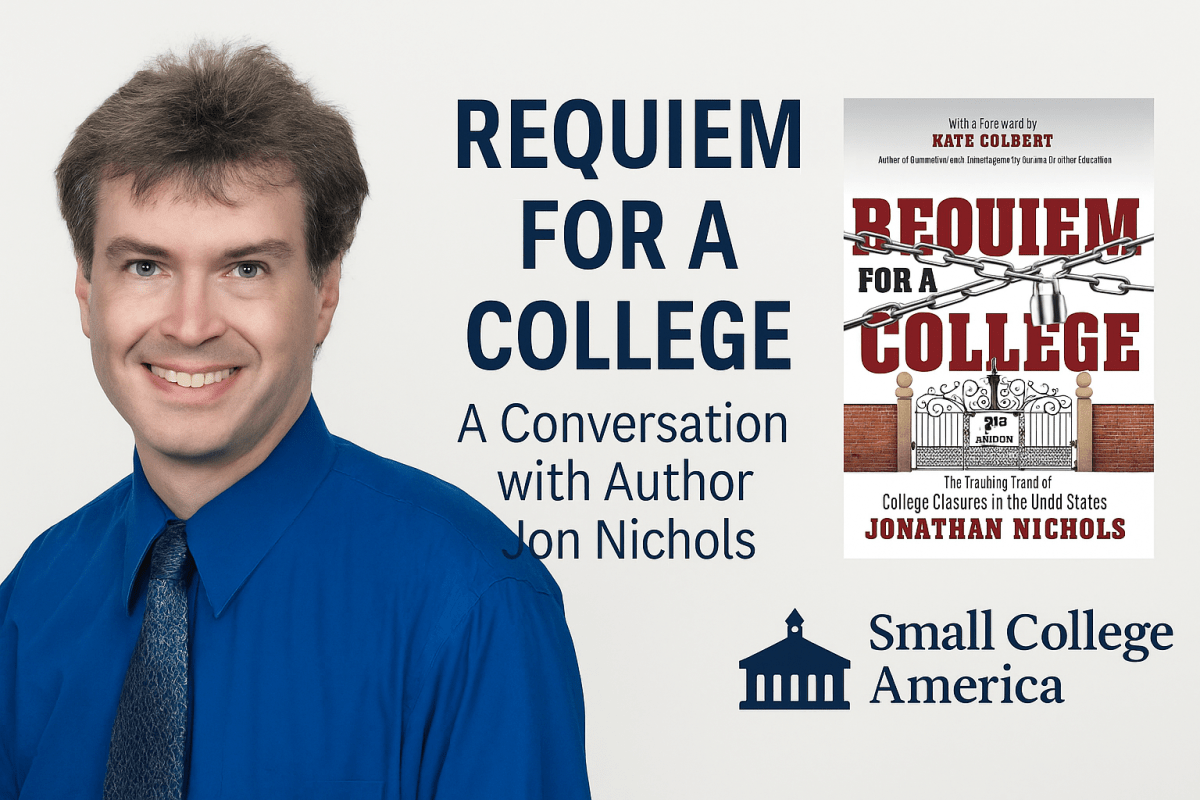
    In the newest episode of Small College America, my co-host Kent Barnds and I speak with Jon Nichols, author of Requiem for a College: The Troubling Trend of College Closures in the United States. Nichols’ book offers a deeply personal and reflective look at the 2017 closure of Saint Joseph’s College, an institution intertwined with his family for three generations—his father, Dr. John Nichols, taught there for five decades, and his brother Michael continues to teach at Purdue University.

    The Story of Saint Joseph’s College

    Founded in 1889 by the Missionaries of the Precious Blood, Saint Joseph’s College in Rensselaer, Indiana, was a small Catholic liberal arts institution known for its close-knit community, rigorous Core Curriculum, and dedication to service. For more than a century, it served as both an educational and cultural anchor for Rensselaer and surrounding Jasper County, educating generations of teachers, business leaders, and clergy. At its peak in the 1970s, the college enrolled more than 1,500 students and earned national recognition for its innovative Core Program, which blended history, philosophy, and theology in an interdisciplinary approach to learning.

    Despite its enduring mission and loyal alumni base, Saint Joseph’s faced mounting financial pressures and declining enrollment, leading to the suspension of operations in 2017. By that year, the college’s enrollment had declined to about 900 students, a sharp drop from its earlier decades of strength. The closure reverberated throughout the region, symbolizing a growing crisis among small, tuition-dependent private colleges across the United States.

    About Jon Nichols

    Jon Nichols is an author, educator, and observer of the changing higher education landscape. A graduate of Saint Joseph’s College and longtime member of its academic community, Nichols witnessed firsthand the personal and institutional struggles that informed Requiem for a College: The Troubling Trend of College Closures in the United States. His work combines narrative storytelling with research and reflection, capturing both the emotional and systemic dimensions of college closures. Today, Nichols teaches English at Waubonsee Community College in Illinois, where he continues to write and speak about the sustainability challenges facing small colleges and the communities they serve.

    Nichols captures the profound emotional and social toll of a college closure—on faculty, students, alumni, and the surrounding town. His narrative reminds readers that when a college closes, it is not just an institution that disappears, but a community, a sense of purpose, and a shared legacy.

    Our conversation explores a range of topics, including the warning signs that should have been taken more seriously—both at Saint Joseph’s and across higher education—and how his book captures not only institutional failure but also human loss: the erasure of identity, community, and legacy. Nichols also reflects on what sustainable models of higher education might look like in the years ahead and what long-term effects the closure has had on former students, faculty, and the Rensselaer community.


    Small College America is a podcast series that shines a spotlight on the powerful impact of small colleges across the nation. Hosted by Dean Hoke and Kent Barnds, the podcast brings listeners inside the world of small colleges through candid conversations with higher education leaders, policy experts, and innovators. Each episode explores how these institutions are adapting, thriving, and continuing to deliver a personal, high-quality education.


    Source link

  • The Economic and Social Impact of Small Colleges in Rural Communities – Edu Alliance Journal

    The Economic and Social Impact of Small Colleges in Rural Communities – Edu Alliance Journal

    By Dean Hoke, October 13, 2025 – In the small towns of America, where factories have closed and downtowns often stand half-empty, a small college can be the heartbeat that keeps a community alive. These institutions—sometimes enrolling only a few hundred students—serve as economic anchors, cultural centers, and symbols of hope for regions that might otherwise face decline.

    From the farmlands of Indiana to the mountain towns of Appalachia, small colleges generate economic energy far beyond their campus gates. They attract students, faculty, and visitors, stimulate local business, and provide the trained workforce that rural economies desperately need. They also embody something deeper: a sense of identity and connection that sustains civic life.

    Economic Impact: Anchors in Fragile Economies

    Small colleges are powerful, if often overlooked, economic engines. Their presence is felt in every paycheck, every restaurant filled with students and parents, and every local business that relies on their purchasing power.

    Across the United States, nearly half of all public four-year colleges, over half of all public two-year colleges, and a third of private four-year colleges make up the 1,100 rural-serving institutions as identified by the Alliance for Research on Regional Colleges (ARRC). These colleges educate 1.6 million students, accounting for more than a quarter of total U.S. enrollments. Yet their role extends far beyond classrooms and degrees.

    Rural-serving institutions are frequently among the largest employers in their counties, especially where other industries have faded. In areas where 35% or more of working-age adults are unemployed, 83% of local colleges are rural-serving, making them pillars of economic stability. Unlike large universities in metropolitan areas, their spending is highly localized—on utilities, food service, maintenance, and partnerships with small vendors.

    Economic models underscore their importance. The Brookings Institution found that high-performing four-year colleges contribute roughly $265,000 more per student to local economies than lower-performing institutions, while two-year colleges add about $184,000. In many rural towns, every institutional dollar recirculates multiple times, magnifying its effect.

    Beyond direct payroll and procurement, small colleges attract outside dollars. Students and visitors rent housing, dine locally, and shop downtown. Athletic events, alumni weekends, and summer programs bring tourists who fill hotels and restaurants. The IMPLAN consulting group estimated that when a college closes, the average regional loss equals 265 jobs, $14 million in labor income, and $32 million in total economic output—a devastating hit in thin rural economies.

    Human Capital and Workforce Development

    If small colleges are the economic engines of rural communities, they are also the primary producers of human capital. They educate the teachers, nurses, business owners, and civic leaders who sustain local life.

    The Federal Reserve Bank of Richmond describes community colleges as “anchor institutions” that shape regional labor markets. Many partner with local employers to design training programs that meet specific workforce needs—often at minimal cost to businesses. In one case study, a rural college collaborated with an advanced manufacturing firm to tailor instruction for machine technicians, ensuring a steady local labor supply and convincing the company to expand rather than relocate.

    Rural-serving colleges are also critical in addressing educational disparities. Only 22% of rural adults hold a bachelor’s degree, compared with 37% of non-rural Americans. This gap translates directly into income inequality: according to the U.S. Department of Agriculture’s Economic Research Service, nonmetro workers with a bachelor’s degree earned a median of $52,837 in 2023, compared with substantially higher earnings for their urban counterparts. In states such as Indiana, Ohio, and Pennsylvania, rural degree attainment lags 10 to 15 percentage points behind state averages.

    Beyond Economics: RSIs as Equity Infrastructure

    Rural-serving institutions are more than economic engines—they are critical equity infrastructure, often providing the only realistic pathway to higher education for students the system has historically marginalized.

    RSIs enroll far higher proportions of high-need students than their urban counterparts. Nearly 50% of undergraduates at RSIs receive Pell Grants, compared to 34% nationally. These institutions also serve disproportionate numbers of first-generation students, working adults, and students from underrepresented communities who lack access to flagship universities.

    For many rural students, the local college isn’t a choice—it’s the only option. Geographic isolation, family obligations, and financial constraints make residential college attendance impossible. Research shows that every ten miles from the nearest college reduces enrollment probability by several percentage points. For students without transportation, without broadband for online learning, or without family support to relocate, the local institution is existential.

    When rural colleges close, equity suffers most. Displaced students, if they re-enroll at all, face higher debt burdens and lower completion rates. Wealthier students can transfer to distant institutions; low-income students stop out. Communities of color, already underserved, lose ground.

    Policymakers often evaluate colleges through narrow metrics: completion rates and graduate earnings. But this ignores mission differentiation. RSIs serve students that flagship universities would never admit, in places that for-profit colleges would never enter, at prices that private colleges could never match. Investing in rural-serving institutions isn’t charity—it’s infrastructure investment in equity, ensuring every region has pathways to economic mobility. If America is serious about educational equity, it must recognize RSIs as essential public infrastructure, not discretionary spending.

    Despite these barriers, rural institutions remain lifelines for upward mobility. They offer affordable tuition, flexible programs for working adults, and pathways for first-generation students who might otherwise forgo higher education.

    However, the pressures are real. Rural students face tighter finances, higher borrowing costs, and fewer grant opportunities. Nearly half of rural undergraduates receive Pell Grants, but average aid remains lower than that at urban institutions. Many graduates leave rural areas to find higher-paying jobs, a “brain drain” that weakens local economies. Yet for those who stay—or return later—their impact is outsized, driving new business formation, civic leadership, and generational stability.

    Example: Goshen College and Elkhart County, Indiana — A Model of Mutual Benefit

    The following example illustrates the positive interdependence of a small college and its surrounding community—how shared growth, service, and opportunity can strengthen both the institution and the region it calls home.

    Few examples better demonstrate this relationship than Goshen College in northern Indiana. Founded in 1894 by the Mennonite Church, Goshen sits in Elkhart County, a region best known for its manufacturing and recreational vehicle industries. While the area has long been an economic hub, its continued success depends heavily on education and workforce development—both areas where Goshen College has quietly excelled for more than a century.

    Goshen employs more than 300 full-time and part-time faculty and staff, making it one of the city’s largest private employers. Its local purchasing—from food services to maintenance and printing—injects millions of dollars annually into the county’s economy. The student body, drawn from across the Midwest and around the world, supports rental housing, restaurants, and small businesses throughout the region.

    According to the 2024 Independent Colleges of Indiana Economic Impact Study, Goshen College contributes roughly $33 million each year to the regional economy through employment, operations, and visitor spending. Beyond the numbers, the college enriches community life. The Goshen College Music Center and Merry Lea Environmental Learning Center are regional treasures, hosting performances, lectures, and research programs that attract thousands of visitors annually. During the COVID-19 pandemic, the college partnered with local health officials to serve as a testing and vaccination site—further demonstrating its civic commitment. Its nursing, environmental studies, and teacher preparation programs continue to meet critical workforce needs across Elkhart County and beyond.

    Goshen College stands as a model of how a small private college and its community can thrive together. Its example underscores a broader truth: when rural colleges remain strong, the benefits extend far beyond campus—bolstering jobs, sustaining income, and enriching the civic and cultural life that define their regions.

    Social and Cultural Role: The Heart of Civic Life

    Beyond numbers, the social and cultural influence of rural colleges may be their most irreplaceable contribution. In many counties, the college auditorium doubles as the performing arts center, the gym as the public gathering space, and the library as a community hub.

    Rural colleges host art shows, festivals, lectures, and athletics that bring people together across generations. They sponsor service projects, tutoring programs, and food drives that connect students with their neighbors. For residents who might otherwise feel isolated or overlooked, the local college provides a sense of belonging and civic pride.

    Research from the National Endowment for the Arts underscores that local arts participation strengthens community bonds and well-being. Rural colleges amplify that effect by providing both venues and expertise. Their faculty often lead community theater, music ensembles, or public workshops—bringing culture to places that might otherwise lack access.

    The COVID-19 pandemic vividly demonstrated this social bond. While large universities shifted to remote learning with relative ease, small rural colleges had to improvise with limited broadband access and fewer resources. Yet many became essential service providers—hosting testing centers, distributing food, and maintaining human contact in otherwise isolated communities.

    In these moments, small colleges revealed what they have always been: not just educators, but neighbors and caretakers.

    Challenges: Fragility and the Risk of Decline

    Despite their immense value, small rural colleges operate under fragile conditions. Their scale limits efficiency, their funding sources are volatile, and demographic shifts threaten their enrollment base.

    Enrollment Declines and Demographic Pressures.

    A steep decline in traditional-age students is projected to start by 2026, with the number of new high school graduates expected to fall by about 13 percent by 2041, according to The Chronicle of Higher Education, March 3, 2025, article “What is the Demographic Cliff”. For rural colleges already competing for a shrinking pool of students, this decline threatens their enrollment base and financial viability. Many have already experienced double-digit enrollment drops since the Great Recession. Rural public bachelor’s/master’s institutions enroll 5% fewer students today than in 2005, while community colleges struggle to recover from pandemic-era losses.

    Financial Constraints.
    Small colleges rely heavily on tuition revenue and relatively modest endowments. According to the Urban Institute, the median private nonprofit four-year college holds about $33,000 in endowment assets per student, compared with hundreds of thousands of dollars per student at elite universities such as Amherst or Princeton. For many rural private colleges, endowment resources are often well below this national median. Their financial models depend heavily on tuition and auxiliary income, leaving them vulnerable when enrollment softens. Fundraising capacity is also limited: alumni bases are smaller and often less affluent than those of major research universities, making sustained growth in endowment and annual giving more difficult to achieve.

    Operational Challenges.
    Compliance, accreditation, and technology costs weigh disproportionately on small staffs. Many rural colleges lack the personnel to pursue major grants or expand programs quickly. Geographic isolation compounds difficulties in recruiting faculty and attracting external partnerships.

    Brain Drain and Opportunity Gaps.
    Even when colleges succeed in educating local students, retaining them can be difficult. Many leave for urban areas with higher wages and broader opportunities. The irony is painful: the better a rural college fulfills its mission of empowerment, the more likely it may lose its graduates.

    Closures and Community Fallout.
    When a small college shuts its doors, the ripple effects are severe. Studies estimate average regional losses of over $20 million in GDP and hundreds of jobs per closure. Local businesses—cafés, landlords, bookstores—suffer immediately. Housing markets soften, municipal tax revenues drop, and cultural life diminishes. It can take a decade or more for a community to recover, if it ever does.

    Reversing the Talent Flow: Retention Strategies That Work

    The brain drain challenge is not insurmountable. Several states and institutions have pioneered retention strategies that show measurable results.

    Loan forgiveness programs specifically targeting rural retention have gained traction. Kansas’s Rural Opportunity Zones offer up to $15,000 in student loan repayment for graduates who relocate to designated counties. Maine provides annual tax credits up to $2,500 for graduates who live and work in-state. Early data suggests these programs can shift settlement patterns, particularly in high-demand fields like nursing and teaching.

    The most effective models involve tri-party partnerships: colleges provide education and career counseling, employers offer competitive wages and loan assistance, and municipalities contribute housing support or tax relief. In one Ohio example, a regional hospital, community college, and county government created a “stay local” nursing pathway that reduced turnover by 40% over five years.

    Place-based scholarships are also emerging as retention tools. “Hometown Scholarships” provide enhanced aid for students from surrounding counties who commit to working regionally after graduation. When paired with community-engaged learning and local internships throughout the curriculum, these programs cultivate regional identity—shifting the narrative from “I have to leave to succeed” to “I can build a meaningful career here.”

    Federal policy could amplify these efforts. A Rural Talent Corps modeled on the National Health Service Corps could leverage student loan forgiveness to address workforce shortages while stabilizing rural economies. The brain drain will never disappear entirely, but intentional investment can shift the calculus from inevitable loss to manageable flow.

    Policy Pathways and Strategies for Resilience

    Sustaining small colleges—and the communities they support—requires creativity, collaboration, and policy attention.

    1. Deepen Local Partnerships.
    Rural colleges thrive when they align closely with regional needs. Employer partnerships, dual-enrollment programs, and apprenticeships can connect education directly to local labor markets. In Indiana and Ohio, several colleges now co-design health care and manufacturing programs with regional employers, ensuring steady pipelines of skilled workers.

    2. Form Regional Alliances.
    Small institutions can collaborate rather than compete. Shared academic programs, cross-registration, and joint purchasing agreements can reduce costs and expand offerings. Examples such as the New England Small College Innovation Consortium show how collective action can extend capacity and visibility.

    3. Diversify Revenue and Mission.
    Rural colleges can strengthen financial resilience by expanding adult education, microcredentials, and workforce training. Many are converting underused buildings into community hubs, co-working spaces, or conference centers. Others are developing online and hybrid programs to reach place-bound learners in neighboring counties.

    4. Increase State and Federal Support.
    Federal recognition of Rural-Serving Institutions within the Higher Education Act could unlock targeted funding similar to programs for Minority-Serving Institutions. States should adapt funding formulas to reflect mission-based outcomes—rewarding colleges that serve low-income, first-generation, and local students rather than penalizing them for small scale.

    5. Encourage Philanthropic Investment.
    Foundations and donors have historically overlooked rural institutions in favor of urban flagships. Increasing awareness of their impact could mobilize new giving streams, particularly from community foundations and regional philanthropists.

    6. Invest in Infrastructure.
    Broadband access, housing, and transportation are essential to sustaining rural higher education. Expanding digital infrastructure allows colleges to deliver online learning, attract remote faculty, and connect to global markets.

    Looking Ahead: The Role of Small Colleges in Rural Renewal

    As rural America seeks to reinvent itself in the 21st century, small colleges are uniquely positioned to lead that renewal. They combine local trust with national expertise, and they possess the physical, intellectual, and moral infrastructure to drive change from within.

    Their future will depend on adaptability. Colleges that align programs with regional industries, embrace digital learning, and form strategic alliances can thrive despite demographic headwinds. Institutions that cling to older models may struggle.

    Yet the measure of success should not be enrollment size alone. A rural college’s value lies in its multiplier effect—on jobs, community life, and civic identity. For many counties, it is the last remaining institution still rooted in the public good.

    Conclusion: Investing in Irreplaceable Infrastructure

    Small colleges in rural America are far more than schools. They are community builders, employers, cultural anchors, and symbols of local resilience. Their closure can hollow out a county; their success can revive one.

    The rural-serving institutions identified by ARRC represent a quarter of U.S. enrollments but touch nearly half the nation’s geography. They serve regions facing population loss, persistent poverty, and limited opportunity—yet they continue to educate, employ, and inspire.

    The choice facing policymakers, philanthropists, and citizens is simple: either we invest in these engines of opportunity, or we risk watching the lights go out in hundreds of rural towns.

    The question is no longer whether we can afford to support small rural colleges but whether America can afford not to.


    Sources and References

    • Alliance for Research on Regional Colleges (ARRC). Identifying Rural-Serving Institutions in the United States (2022).
    • Brookings Institution. The Value of Higher Education to Local Economies (2021).
    • Federal Reserve Bank of Richmond. Community Colleges as Anchor Institutions: A Regional Development Perspective (2020).
    • National Student Clearinghouse Research Center. High School Benchmarks 2022: National College Progression Rates.
    • National Endowment for the Arts. Rural Arts, Design, and Innovation in America (2017).
    • Lumina Foundation. Stronger Nation: Learning Beyond High School Builds American Talent (2024).
    • National Skills Coalition. Building a Skilled Workforce for Rural America (2021).
    • IMPLAN Group, LLC. Measuring the Economic Impact of Higher Education Institutions (2023).
    • U.S. Census Bureau. Educational Attainment in the United States: 2023 (American Community Survey Tables).
    • Bureau of Labor Statistics. Employment and Earnings by Educational Attainment, 2023.
    • Goshen College. Economic Impact Report 2022 and institutional data from the Office of Institutional Research.

    Dean Hoke is Managing Partner of Edu Alliance Group, a higher education consultancy, and a Senior Fellow for the Sagamore Institute located in Indianapolis, Indiana. He formerly served as President/CEO of the American Association of University Administrators (AAUA). Dean is a champion for small colleges in the US. and is committed to celebrating their successes, highlighting their distinctions and reinforcing how important they are to the higher education ecosystem in the US. Dean is the creator and co-host for the podcast series Small College America.

    Source link

  • From Partnerships and Mergers to Reinvention – Edu Alliance Journal

    From Partnerships and Mergers to Reinvention – Edu Alliance Journal

    Webinar December 3, 2025 | 1:00 PM (Eastern) Presented by Small College America with support from Edu Alliance and the American Association of University Administrators

    We Need Your Questions: To make this conversation meaningful, we need your perspective. We’re asking higher education leaders to take five minutes to complete a short, confidential survey before the event. WEBINAR SURVEY LINK

    By Dean Hoke, October 6, 2025: Mergers and closures are not new to higher education. In the 1970s alone, nearly 225 institutions either closed or merged—roughly 7% of all degree-granting institutions at the time. I experienced this personally when my alma mater permanently closed in 2020. Like thousands of alumni, I grieved the loss of a place that had shaped my life. But I also understood something many did not: this wasn’t an isolated tragedy—it was part of a larger historical cycle of growth, contraction, and reinvention.

    In the early 1990s, I was directly involved as President of a public television station that merged with a local public radio station. The process was emotional and complex, requiring open communication, transparency, and leadership from every level. As of today, both of these stations exist within one organization and are doing well. Those lessons stayed with me throughout my career in higher education.

    During my tenure as President/CEO of the American Association of University Administrators (AAUA), it became evident that higher education was entering a new era of financial strain and demographic pressure. Colleges were being forced to explore collaboration and consolidation not as strategic options—but as survival imperatives.

    At the AAUA national conference, we hosted two candid conversations about this reality:

    • A four-hour off-the-record roundtable session titled “Mergers and Acquisitions: Navigating Higher Ed’s Complex Landscape,” which included two leading higher education attorneys, the head of an acquisition firm specializing in higher education, and the Provost of a university that was being merged.
    • A public session featuring Dr. Chet Haskell (Antioch University) and Dr. Wendy Heckler (Otterbein University), who shared their groundbreaking work on the Coalition for the Common Good.

    Why This Webinar Matters

    According to Inside Higher Education’s 2025 Survey of College and University Presidents, one in three presidents at private nonprofit institutions report that their boards and senior leadership teams have had serious discussions about merging or consolidating. Even more telling:

    • 17% believe a merger or acquisition involving their institution is somewhat or very likely in the next five years.
    • 33% expect they may acquire another institution during that same period.

    These numbers underscore a critical truth: every institution should be preparing for the possibility of structural change—even those that appear stable today.

    That’s why this conversation matters now. It’s not about predicting which colleges will survive. It’s about helping leaders understand how to respond when the discussion moves from theoretical to real—when preservation of mission and identity must be balanced with financial reality.

    The Upcoming Webinar

    Against this backdrop, Small College America, with the support of Edu Alliance and AAUA, will host a live 90-minute webinar:

    “Navigating Higher Education’s Existential Challenges: From Partnerships and Mergers to Reinvention” Tuesday, December 3, 2025 | 1:00 PM Eastern

    This will not be another PowerPoint presentation filled with charts and trends. Instead, a panel of leaders who have lived through mergers, partnerships, and reinvention will share what they learned from the inside.

    Panelists include:

    • Dr. Chet Haskell, Former Provost, Antioch University, and key architect of the Coalition for the Common Good
    • Dr. Barry Ryan, Retired President, Woodbury University, who recently led his institution through a merger with University of Redlands
    • AJ Prager, Managing Director at Hilltop Securities, specializing in Higher Education Mergers & Acquisitions and Strategic Partnerships
    • Higher education legal expert to be announced

    Dean Hoke and Kent Barnds, co-hosts of Small College America, will moderate the conversation. Our focus is on the human side of institutional transformation—the conversations that happen behind closed doors, the decisions that test leadership resolve, and the strategies that allow communities to emerge stronger.

    Registration for this free webinar will begin on November 3rd.

    Who Should Attend

    This webinar is designed for:

    • Presidents, provosts, and trustees facing questions of sustainability or succession.
    • CFOs and senior administrators managing budget pressures or enrollment cliffs.
    • Board members and advisors preparing for strategic decision-making.

    If you’ve heard phrases like “structural deficit,” “strategic alternatives,” or “path to viability” in your recent meetings, this discussion is for you.

    Why We Need Your Voice

    To make this conversation meaningful, we need your perspective. We’re asking higher education leaders to take five minutes to complete a short, confidential survey before the event. Your input will directly shape the webinar by:

    • Identifying the most urgent questions institutions are facing.
    • Prioritizing real-world concerns rather than theoretical discussions.
    • Allowing panelists to address the issues keeping leaders awake at night.

    This is your opportunity to ensure that the session reflects the realities of your campus—not assumptions from the outside. Your identity will remain anonymous; our goal is to understand the questions, not who’s asking them.

    Survey closes November 29 to allow time for integration into the program.

    Take the survey today: WEBINAR SURVEY LINK

    Source link

  • Breaking Away from Rankings – Edu Alliance Journal

    Breaking Away from Rankings – Edu Alliance Journal

    The Growing Movement to Reform Research Assessment and Rankings

    By Dean Hoke, September 22, 2025: For the past fifteen years, I have been closely observing what can only be described as a worldwide fascination—if not obsession—with university rankings, whether produced by Times Higher Education, QS, or U.S. News & World Report. In countless conversations with university officials, a recurring theme emerges: while most acknowledge that rankings are often overused by students, parents, and even funders when making critical decisions, few deny their influence. Nearly everyone agrees that rankings are a “necessary evil”—flawed, yet unavoidable—and many institutions still direct significant marketing resources toward leveraging rankings as part of their recruitment strategies.

    It is against this backdrop of reliance and ambivalence that recent developments, such as Sorbonne University’s decision to withdraw from THE rankings, deserve closer attention

    In a move that signals a potential paradigm shift in how universities position themselves globally, Sorbonne University recently announced it will withdraw from the Times Higher Education (THE) World University Rankings starting in 2026. This decision isn’t an isolated act of defiance—Utrecht University had already left THE in 2023, and the Coalition for Advancing Research Assessment (CoARA), founded in 2022, has grown to 767 members by September 2025. Together, these milestones reflect a growing international movement that questions the very foundations of how we evaluate academic excellence.

    The Sorbonne Statement: Quality Over Competition

    Sorbonne’s withdrawal from THE rankings isn’t merely about rejecting a single ranking system. It appears to be a philosophical statement about what universities should stand for in the 21st century. The institution has made it clear that it refuses to be defined by its position in what it sees as commercial ranking matrices that reduce complex academic institutions to simple numerical scores.

    Understanding CoARA: The Quiet Revolution

    The Coalition for Advancing Research Assessment represents one of the most significant challenges to traditional academic evaluation methods in decades. Established in 2022, CoARA has grown rapidly to include 767 member organizations as of September 2025. This isn’t just a European phenomenon—though European institutions have been early and enthusiastic adopters. The geographic distribution of CoARA members tells a compelling story about where resistance to traditional ranking systems is concentrated. As the chart shows, European countries dominate participation, led by Spain and Italy, with strong engagement also from Poland, France, and several Nordic countries. This European dominance isn’t accidental—the region’s research ecosystem has long been concerned about the Anglo-American dominance of global university rankings and the way these systems can distort institutional priorities.

    The Four Pillars of Reform

    CoARA’s approach centers on four key commitments that directly challenge the status quo:

    1. Abandoning Inappropriate Metrics The agreement explicitly calls for abandoning “inappropriate uses of journal- and publication-based metrics, in particular inappropriate uses of Journal Impact Factor (JIF) and h-index.” This represents a direct assault on the quantitative measures that have dominated academic assessment for decades.

    2. Avoiding Institutional Rankings Perhaps most relevant to the Sorbonne’s decision, CoARA commits signatories to “avoid the use of rankings of research organisations in research assessment.” This doesn’t explicitly require withdrawal from ranking systems, but it does commit institutions to not using these rankings in their own evaluation processes.

    3. Emphasizing Qualitative Assessment The coalition promotes qualitative assessment methods, including peer review and expert judgment, over purely quantitative metrics. This represents a return to more traditional forms of academic evaluation, albeit updated for modern needs.

    4. Responsible Use of Indicators Rather than eliminating all quantitative measures, CoARA advocates for the responsible use of indicators that truly reflect research quality and impact, rather than simply output volume or citation counts.

    European Leadership

    Top 10 Countries by CoARA Membership:

    The geographic distribution of CoARA members tells a compelling story about where resistance to traditional ranking systems is concentrated. As the chart shows, European countries dominate participation, led by Spain and Italy, with strong engagement also from Poland, France, and several Nordic countries. This European dominance isn’t accidental—the region’s research ecosystem has long been concerned about the Anglo-American dominance of global university rankings and the way these systems can distort institutional priorities.

    The geographic distribution of CoARA members tells a compelling story about where

    Prestigious European universities like ETH Zurich, the University of Zurich, Politecnico di Milano, and the University of Manchester are among the members, lending credibility to the movement. However, the data reveals that the majority of CoARA members (84.4%) are not ranked in major global systems like QS, which adds weight to critics’ arguments about institutional motivations.

    CoARA Members Ranked vs Not Ranked in QS:

    The Regional Divide: Participation Patterns Across the Globe

    What’s particularly striking about the CoARA movement is the relative absence of U.S. institutions. While European universities have flocked to join the coalition, American participation remains limited. This disparity reflects fundamental differences in how higher education systems operate across regions.

    American Participation: The clearest data we have on institutional cooperation with ranking systems comes from the United States. Despite some opposition to rankings, 78.1% of the nearly 1,500 ranked institutions returned their statistical information to U.S. News in 2024, showing that the vast majority of American institutions remain committed to these systems. However, there have been some notable American defections. Columbia University is among the latest institutions to withdraw from U.S. News & World Report college rankings, joining a small but growing list of American institutions questioning these systems. Yet these remain exceptions rather than the rule.

    European Engagement: While we don’t have equivalent participation rate statistics for European institutions, we can observe their engagement patterns differently. 688 universities appear in the QS Europe ranking for 2024, and 162 institutions from Northern Europe alone appear in the QS World University Rankings: Europe 2025. However, European institutions have simultaneously embraced the CoARA movement in large numbers, suggesting a more complex relationship with ranking systems—continued participation alongside philosophical opposition.

    Global Participation Challenges: For other regions, comprehensive participation data is harder to come by. The Arab region has 115 entries across five broad areas of study in QS rankings, but these numbers reflect institutional inclusion rather than active cooperation rates. It’s important to note that some ranking systems use publicly available data regardless of whether institutions actively participate or cooperate with the ranking organizations.

    This data limitation itself is significant—the fact that we have detailed participation statistics for American institutions but not for other regions may reflect the more formalized and transparent nature of ranking participation in the U.S. system versus other global regions.

    American universities, particularly those in the top tiers, have largely benefited from existing ranking systems. The global prestige and financial advantages that come with high rankings create powerful incentives to maintain the status quo. For many American institutions, rankings aren’t just about prestige—they’re about attracting international students, faculty, and research partnerships that are crucial to their business models.

    Beyond Sorbonne: Other Institutional Departures

    Sorbonne isn’t alone in taking action. Utrecht University withdrew from THE rankings earlier, citing concerns about the emphasis on scoring and competition. These moves suggest that some institutions are willing to sacrifice prestige benefits to align with their values. Interestingly, the Sorbonne has embraced alternative ranking systems such as the Leiden Open Rankings, which highlight its impact.

    The Skeptics’ View: Sour Grapes or Principled Stand?

    Not everyone sees moves like Sorbonne’s withdrawal as a noble principle. Critics argue that institutions often raise philosophical objections only after slipping in the rankings. As one university administrator put it: “If the Sorbonne were doing well in the rankings, they wouldn’t want to leave. We all know why self-assessment is preferred. ‘Stop the world, we want to get off’ is petulance, not policy.”

    This critique resonates because many CoARA members are not major players in global rankings, which fuels suspicion that reform may be as much about strategic positioning as about values. For skeptics, the call for qualitative peer review and expert judgment risks becoming little more than institutions grading themselves or turning to sympathetic peers.

    The Stakes: Prestige vs. Principle

    At the heart of this debate is a fundamental tension: Should universities prioritize visibility and prestige in global markets, or focus on measures of excellence that reflect their mission and impact? For institutions like the Sorbonne, stepping away from THE rankings is a bet that long-term reputation will rest more on substance than on league table positions. But in a globalized higher education market, the risk is real—rankings remain influential signals to students, faculty, and research partners.
    Rankings also exert practical influence in ways that reformers cannot ignore. Governments frequently use global league tables as benchmarks for research funding allocations or as part of national excellence initiatives. International students, particularly those traveling across continents, often rely on rankings to identify credible destinations, and faculty recruitment decisions are shaped by institutional prestige. In short, rankings remain a form of currency in the global higher education market.

    This is why the decision to step away from them carries risk. Institutions like the Sorbonne and Utrecht may gain credibility among reform-minded peers, but they could also face disadvantages in attracting international talent or demonstrating competitiveness to funders. Whether the gamble pays off will depend on whether alternative measures like CoARA or ROI rankings achieve sufficient recognition to guide these critical decisions.

    The Future of Academic Assessment

    The CoARA movement and actions like Sorbonne’s withdrawal represent more than dissatisfaction with current ranking systems—they highlight deeper questions about what higher education values in the 21st century. If the movement gains further momentum, it could push institutions and regulators to diversify evaluation methods, emphasize collaboration over competition, and give greater weight to societal impact.

    Yet rankings are unlikely to disappear. For students, employers, and funders, they remain a convenient—if imperfect—way to compare institutions across borders. The practical reality is that rankings will continue to coexist with newer approaches, even as reform efforts reshape how universities evaluate themselves internally.

    Alternative Rankings: The Rise of Outcome-Based Assessment

    While CoARA challenges traditional rankings, a parallel trend focuses on outcome-based measures such as return on investment (ROI) and career impact. Georgetown University’s Center on Education and the Workforce, for example, ranks more than 4,000 colleges on the long-term earnings of their graduates. Its findings tell a very different story than research-heavy rankings—Harvey Mudd College, which rarely appears at the top of global research lists, leads ROI tables with graduates projected to earn $4.5 million over 40 years.

    Other outcome-oriented systems, such as The Princeton Review’s “Best Value” rankings, emphasize affordability, employment, and post-graduation success. These approaches highlight institutions that may be overlooked by global research rankings but deliver strong results for students. Together, they represent a pragmatic counterbalance to CoARA’s reform agenda, showing that students and employers increasingly want measures of institutional value beyond research metrics alone.

    These alternative models can be seen most vividly in rankings that emphasize affordability and career outcomes. *The Princeton Review’s* “Best Value” rankings, for example, combine measures of financial aid, academic rigor, and post-graduation outcomes to highlight institutions that deliver strong returns for students relative to their costs. Public universities often rise in these rankings, as do specialized colleges that may not feature prominently in global research tables.

    Institutions like the Albany College of Pharmacy and Health Sciences illustrate this point. Although virtually invisible in global rankings, Albany graduates report median salaries of $124,700 just ten years after graduation, placing the college among the best in the nation on ROI measures. For students and families making education decisions, data like this often carries more weight than a university’s position in QS or THE.

    Together with Georgetown’s ROI rankings and the example of Harvey Mudd College, these cases suggest that outcome-based rankings are not marginal alternatives—they are becoming essential tools for understanding institutional value in ways that matter directly to students and employers.

    Rankings as Necessary Evil: The Practical Reality

    The CoARA movement and actions like Sorbonne’s withdrawal represent more than just dissatisfaction with current ranking systems. They reflect deeper questions about the values and purposes of higher education in the 21st century.

    If the movement gains momentum, we could see:

    Diversification of evaluation methods, with different regions and institution types developing assessment approaches that align with their specific values and goals

    Reduced emphasis on competition between institutions in favor of collaboration and shared improvement

    Greater focus on societal impact rather than purely academic metrics

    More transparent and open assessment processes that allow for a better understanding of institutional strengths and contributions

    Conclusion: Evolution, Not Revolution

    The Coalition for Advancing Research Assessment and decisions like Sorbonne’s withdrawal from THE rankings represent important challenges to how we evaluate universities, but they signal evolution rather than revolution. Instead of the end of rankings, we are witnessing their diversification. ROI-based rankings, outcome-focused measures, and reform initiatives like CoARA now coexist alongside traditional global league tables, each serving different audiences.

    Skeptics may dismiss reform as “sour grapes,” yet the concerns CoARA raises about distorted incentives and narrow metrics are legitimate. At the same time, American resistance reflects both philosophical differences and the pragmatic advantages U.S. institutions enjoy under current systems.

    The most likely future is a pluralistic landscape: research universities adopting CoARA principles internally while maintaining a presence in global rankings for visibility; career-focused institutions highlighting ROI and student outcomes; and students, faculty, and employers learning to navigate multiple sources of information rather than relying on a single hierarchy.

    In an era when universities must demonstrate their value to society, conversations about how we measure excellence are timely and necessary. Whether change comes gradually or accelerates, the one-size-fits-all approach is fading. A more complex mix of measures is emerging—and that may ultimately serve students, institutions, and society better than the systems we are leaving behind. In the end, what many once described to me as a “necessary evil” may persist—but in a more balanced landscape where rankings are just one measure among many, rather than the single obsession that has dominated higher education for so long.


    Dean Hoke is Managing Partner of Edu Alliance Group, a higher education consultancy. He formerly served as President/CEO of the American Association of University Administrators (AAUA). Dean has worked with higher education institutions worldwide. With decades of experience in higher education leadership, consulting, and institutional strategy, he brings a wealth of knowledge on colleges’ challenges and opportunities. Dean is the Executive Producer and co-host for the podcast series Small College America.

    Source link

  • Higher Education Leadership in Times of Crisis Part II – Edu Alliance Journal

    Higher Education Leadership in Times of Crisis Part II – Edu Alliance Journal

    By Dr. Barry Ryan, September 15, 2025 – In my August 11th article titled ‘Higher Education Leadership in Times of Crisis,” we established that higher education leadership today cannot be solitary work and that effective crisis response requires both internal and external counsel. Now that you’ve assembled (at least thought through) your cast of trusted advisors and recognized the unique leadership demands of your situation, the next critical step is understanding what you’re actually facing—and how to navigate it successfully. Once you recognize that your organization may be entering such a time, there are three key initial questions to ask:

    1. How long can a crisis be expected to last?
    2. What are the effects of crisis on my institution, on my team, on my loved ones, and on me?
    3. What are some healthy and effective ways I can lead during crisis?

    First, how long should I expect a “typical” crisis to last?

    At first blush, it might seem a little silly to ask how long a crisis lasts. After all, isn’t that inherently unpredictable?

    The answer is “yes” and “no.” It may seem a little flippant to say, but the reality is that the length of a crisis depends to a certain degree on how you and those in leadership alongside you respond to it. Your approach and actions may make it longer or shorter than it would have been. Here’s what I mean.

    Ignoring a crisis and hoping that it blows over is actually a potential strategy—although not one that I would recommend in most circumstances. But there are some built-in roadblocks in a university’s life cycle, which is divided largely into annual, semester, or quarter segments. These can act, on their own, as speed bumps or detours that might diminish or change the course of a crisis.  

    For example, a crisis that is being instigated or aggravated by certain individuals might be relieved to some degree on its own by their departure through retirement, transfer, and so on.  Or a financial crisis might be alleviated by the structural limits on certain types of debt that will be paid off, or the inception of certain grants or gifts that are within sight. But these are, unfortunately, uncommon scenarios, and the timing may be unpredictable.

    On a global scale, one might think of Winston Churchill trying to imagine how long World War II might last. As futile as such a task might have been, he did, indeed, play out various scenarios and their likely duration. Although it makes for a great quote and probably captures an important aspect of Churchill’s thinking, he likely did not say, “When you’re going through hell, keep going.” But that’s a good reminder for anyone in crisis.

    To grossly generalize, I have found that most institutional crises last between six months and two years. Why is that? The more acute ones require quicker action, and the result is either a solution that addresses the issues promptly and efficiently, in, say, six months, and you can move on to other things. Or, failing to find a speedy solution may end with you moving on. (And I don’t mean this lightly, but the reality is that moving on is not the end of the world.)

    Why the two-year time frame, on the other end? Because I’ve found that to be about the maximum time frame that a board, or an accreditor, or a creditor, or even a faculty can endure before a solution is reached. Again, the conclusion of the crisis will either leave you in a happier and stronger position in your institution or leave you seeking happiness and a better position somewhere else. But somewhere between six months and two years is what I have found to be the rough lifespan of an intense crisis. (This is barring, of course, a truly existential crisis as a result of which the institution ceases to exist in its current form. But even that drastic of an outcome can easily take two years or more to unfold.)

    Second, what are some of the common effects, and how do you survive them?

    For the sake of argument, let’s say you become aware that you are entering a crisis period, whether or not it eventually proves to be an existential one. How do you survive in the intervening six months to two years?

    Let’s begin with the effects of a continuing crisis on a leader. The crisis can easily become an enormous distraction for someone who already has too much on their plate. The stress that comes with leadership increases in crisis times, with mental, emotional, and even physical effects. Exhaustion can become a daily (and nightly) companion.  Self-doubt creeps in and steals even more of the leader’s resources.

    It sounds trite, but when this happens, don’t forget to take a few deep breaths – physically and metaphorically. 

    Draw up a “non-crisis” item list, i.e., things that still need to be done, but aren’t necessarily at the crisis point. Now start divvying them up between and among your fellow leaders, and to their direct reports when possible. This could be an opportune time to help them grow and develop, as well as ease your load.

    Along with that, begin to excuse yourself from meetings at which your presence is not absolutely necessary. Only you really know which are and which aren’t. You may still need to attend to some that aren’t technically necessary, but that may prove helpful in crisis-related activities. Again, having trusted substitutes sit in for you for a while can be a growth opportunity for them, and also demonstrate that you trust and empower those with whom you work. When it comes to meetings, which can serve to drain you even more, perhaps adopt a practice of only making limited strategic appearances. Make your participation relevant enough and just long enough to establish your presence and help you – and your colleagues – feel like you’re staying in touch.

    Don’t forget to take some days off, or even vacations. Sad but true, don’t make them too long or too far away or somewhere too difficult for you to be reached. You’re probably not really going to relax completely anyway, but you should at least experience some benefit from a change in perspective and place. Frankly, you would do well to consider the health and happiness of your loved ones who’ve been going through this with you, and that they need a break, perhaps even more than you do. After all, you are able to face the crisis more directly, as well as possible enemies, while your loved ones have to suffer vicariously and without the same ability to engage.

    Third, how to lead during a crisis?

    There is no question that crises have deleterious effects on you, your friends and family, but also your colleagues. You undoubtedly have support and supporters (even though they may seem distant), so don’t neglect them. Their fidelity to the institution and its mission – and you – deserves appreciation and acknowledgement, even if only expressed privately. They’re worried about the institution, but also their livelihood and their colleagues as well. 

    When they see you, try not to be the deer in the headlights (a situation that doesn’t usually end well in the wild). Appearing indecisive is uninspiring. But so is being overbearing or angry.

    Try to be yourself as you were before the crisis. Remember to smile, relax the muscles of your face and neck, and ask them about their loved ones, their teaching, or their research. Be human. The thoughtful ones have an idea about what you’re feeling and going through, so it’s okay for them to see you as a human. You don’t have to adopt a fake effervescence, but you should avoid moping.

    Seek impartial counsel. That may, or may not, include colleagues. A small group of confidants is necessary. External friends who have the courage to be honest with you, and also keep complete confidence, can be your best resource to help you gain and keep perspective. They may have higher ed experience, but not necessarily. I have always found that the best counsel comes from folks who have had real challenges, real losses, survived real attacks, and still kept their heads about them. Ones that are “too perfect” are probably not what you need at this point.


    While there is a need for you to seek and obtain trustworthy counsel, you should at the same time try to avoid seeking too much counsel. Bottom line is that you’re a leader and you’re going to have to make difficult decisions. So you should accept counsel, but too much can be confusing and even overwhelming. 

    Look, you’re in a tough position and no matter what you do, some people (possibly including some people you respect and care about) are not going to be thrilled. Sad but true. And some of those feelings may change over time, as they come to a fuller perspective as well.

    My advice to leaders in crisis situations always includes two elements:

    Can you make a decision that allows you to look at yourself in the mirror? 

    Then do what you believe is right and let the chips fall where they may. Period.

    While you are a leader in a profession you may (or may not any longer) dearly love, there IS an “after.”  That may mean continuing in your post-crisis position in the same post-crisis institution, or it may mean more significant changes for you.  If so, take what you’ve learned along to whatever comes next.  Partings are rarely enjoyable, but I recall a very thoughtful young person we had to let go.  His response was remarkable.  “I want to learn from this experience and become better as a result.” When I saw him at another institution a year later, he came up to me and said that’s exactly what had transpired and that he was grateful.

    Your life, and your legacy, are much more than just this current time of crisis within this current institution. Be grateful to those who have earned that gratitude, and remember who you are.


    Dr. Barry Ryan is a seasoned higher education executive, legal scholar, and former president of five universities. He is a senior consultant for the Edu Alliance Group and a legal scholar. With more than 25 years of leadership experience, Dr. Ryan has served in numerous roles, including faculty member, department chair, dean, vice president, provost, and chief of staff at state, non-profit, and for-profit universities and law schools. His extensive accreditation experience includes two terms on the WASC Senior College and University Commission (WSCUC), serving a maximum of six years. He is widely recognized for his expertise in governance, accreditation, crisis management, and institutional renewal.

    In addition to his academic career, Dr. Ryan ​ served as the Supreme Court Fellow in the chambers of Chief Justice William H. Rehnquist and is a​ member of numerous federal and state bars. He has contributed extensively to charitable organizations and is experienced in board leadership and large-scale fundraising. He remains a trusted advisor to universities and boards seeking strategic alignment and transformation.

    He earned his Ph.D. from the University of California, Santa Barbara, his J.D. from the University of​ California, Berkeley, and his Dipl.GB in international business from the University of Oxford.


    Edu Alliance Group, Inc. (EAG), founded in 2014, is an education consulting firm located in Bloomington, Indiana, and Abu Dhabi, United Arab Emirates. We assist higher education institutions worldwide on a variety of mission-critical projects. Our consultants are accomplished leaders who use their experience to diagnose and solve challenges.

    EAG has provided consulting and executive search services for over 40 higher education institutions in Australia, Egypt, Georgia, India, Kazakhstan, Morocco, Nigeria, Uganda, the United Arab Emirates, and the United States.

    Source link

  • Why Are So Many Smaller Independent Colleges and Universities So Similar and What Does This Mean for Their Futures? – Edu Alliance Journal

    Why Are So Many Smaller Independent Colleges and Universities So Similar and What Does This Mean for Their Futures? – Edu Alliance Journal

    September 8, 2025, by Dr. Chet Haskell: It is well known that many small American private non-profit academic institutions face serious financial pressures. Typically defined as having 3000 or fewer students, more than 170 of these have been forced to close in the past two decades. Numerous others have entered into various mergers or acquisitions, often with well-documented negative impacts on students, faculty, staff, alumni and local communities. Of the more than 1100 such institutions, at least 900 continue to be a risk.

    The basic problems responsible for this trend are also well-known. Most institutions lack significant endowments and are thus almost totally dependent on tuition and fee revenues from enrolled students. Only 60 such small institutions have per student endowments in excess of $200,000. The remainder have far less.

    The only additional potential source of revenue – gifts and donations –is generally neither large nor consistent enough to offset enrollment-related declines. While the occasional donation or bequest in the millions of dollars garners attention, most institutions raise much smaller amounts regularly.

    Enrollment declines are the existential threat to many of these smaller colleges and universities. These declines are also well-documented. There simply will be fewer high school graduates in the US in the coming decade or more. This reality creates a highly competitive environment, especially in regions with many of these institutions.

    Demographic worries are augmented by broad concerns about the cost of higher education and the imputed return on such an investment by students and families. Governmental policies such as limitations on international students or restrictions on immigration further add to the problem. Also, these institutions not only compete with each other for students, but they also compete with colleges and universities of the public sector and a growing number of for-profit entities.

    Most of these 900 or so institutions have high quality programs, often described under the term “liberal arts”. Many are differentiated by a specialization or an emphasis. However, at their core they are very similar. The basic concept of a personal scale four-year undergraduate educational experience provided in a residential campus setting has a long history and is highly valued by many students and faculty alike. These institutions have lengthy, strong histories, loyal alumni and important roles in their local communities.

    The fact is that it is difficult to differentiate among many of these institutions. Not only their scale or their general model of personalized undergraduate education are similar, but many of their basic messages sound the same. A review of the websites of these schools results in striking consistencies of stated “unique” missions, programs, facilities, faculty and even marketing materials.

    Their approaches to financial challenges are also similar. There is considerable competition on price. Most of these institutions discount their formal tuition rates by 50% or more. Initiatives to grow enrollments support an industry of educational consultants whose recommended initiatives are themselves similar and, even if successful, are quickly copied, thus reducing advantages.

    Some have tried to compete by raising money for new, attractive facilities through dipping into limited endowments, borrowing or securing external major gifts. These shiny new buildings – athletic facilities, science centers, student centers – are assumed to provide an edge in student recruitment. In some cases, this works. However, in many others the new facilities do not come with long term maintenance and eventually add to increased on-going institutional expense. The end result is often another demonstration of similarity.

    Some institutions have tried to branch out into selected graduate programs, perhaps based on a strong group of undergraduate faculty. Success is often limited for multiple reasons. Graduate students in commonly introduced professional fields such as business or nursing do not naturally align with an undergraduate in-person academic calendar. Older students, especially those in careers, are reluctant to come to a campus for class twice a week. Even if there is sufficient interest in such a program, it is difficult to increase in scale because of the limits of distance and geography. And most of these institutions lack significant expertise and technology do conduct effective on-line operations.

    Their institutional similarities extend to their governance. Typically, there is a Board of Trustees, all of whom are volunteers, often with heavy alumni representation. These boards generally lack expertise or perspective on the challenges of higher education and thus are dependent on the appointed executive leadership. They often take a short-term perspective and lack strategic foresight that may be most valuable in times of uncertainty and external changes.

    Even when trustees have financial experience from other fields, their common approach to small institutions is to bemoan any lack of enrollments. Most do not make significant personal financial contributions, particularly if they think the institution is struggling to survive. The assumed budget goal is basically a balanced budget and when one does not control revenues, one focuses on the more controllable expense side, trying to balance budgets solely on cuts.  Board members serve because they want to support the institution, but many are risk adverse. For example, a fear of being associated with an institution that might generate possible legal liability for the board member means a first concern usually involves whether there is sufficient insurance.

    While every institution is indeed different in its own way, they also are very similar. What explains this?

    One possible way of explanation is provided by the organizational theorists Walter Powell and Paul DiMaggio who in 1983 (updated in 1991) published a seminal piece on what they called ”institutional isomorphism and collective rationality.” [1]They argued that ”institutions in the same field become more homogenous over time without become more efficient or more successful” and identified three basic reasons for such a tendency.

    Coercive isomorphism – similarities imposed externally on the institutions. In higher education, good examples would be Federal government policies around student financial aid or the requirements of both regional and specialized accreditors. Every institution operates within a web of regulation and financial incentives that impose requirements on all and work to limit innovation.

    Mimetic processes – similarities that arise because of standard responses to uncertainty. Prime examples in higher education are the increasingly common responses to the quest for enrollment growth. As noted, numerous consultants purport to improve enrollments, but the gains typically are limited, as other institutions mimic the same approach. In another example, recent surveys show that almost all institutions expect to be users of artificial intelligence models to promote marketing in the service of admissions, as if this is a “magic wand”. If one institution makes strides in this area, others will follow. The result will be more similarity, not less. It is a bit like the Ukrainian-Russian war, where Ukraine originally had clear advantages using drone technology until that technology was matched by the Russians, leading to a form of stalemate. As DiMaggio and Powell note, ”organizations tend to model themselves after similar organizations in their field that they perceive as more legitimate or successful.”[2]

    Normative pressures – similarities that arise from common “professional” expectations. The authors identify two important aspects of professionalization: the common basis of higher education credentials and the legitimation produced by these credentials and “the growth and elaboration of professional networks.” Examples include common faculty and senior administrator qualification requirements. Another would be so-called “best practices” in support areas like student affairs. “Such mechanisms create a pool of almost interchangeable individuals who occupy similar positions.”[3] Recently, Hollis Robbins pointed out the commonalities in paths to academic leadership positions, likening these to the Soviet nomenklatura process through which a leader progresses in one’s career.[4] Evidence of this is obvious through a cursory review of the qualifications and desired qualities posted in searches for college and university presidents or other senior administrators. Most searches end up looking for and hiring individuals with very similar qualifications and experience.

    The implications of such pressures and processes are several. With common values and similar personnel, “best practices” do not lead to essential changes. Innovation is quickly copied. Indeed, it becomes increasing difficult to differentiate an institution from competitors. Common regulatory structures, declining student pools, increased competition and a lack of resources for investment all combine to enhance similarity over difference. In some sense, it is almost a form of commodification where price does in fact matter, but the “product” basically the same, especially in the minds of the larger population of potential students and families.

    What is to be done?

    Leadership Must Confront Their Institution’s Reality

    Confronting reality has many aspects, but the leaders of every institution must be clear-eyed and unsentimental about where it stands and where it is headed. This is an essential role for boards and executive leadership.

    First and foremost, the mission of the institution must be understood in realistic and practical ways. What is the institution’s purpose and what is required to fulfill that purpose? Institutional mission is central as it should drive an appreciation for the current situation of the institution, provide clarity regarding longer term goals and bringing into focus the necessary means to move forward.

    With clarity of mission must come a full understanding the of institution’s financial situation, its opportunities and the longer term needs required to achieve mission goals.  Building multi-year mission-oriented budgets based on surpluses (positive margins) is key. Sometimes restructuring and cuts are necessary and thus leadership must make sure all faculty and staff have a clear understanding of reality and the strategy for addressing it.

    A clear understanding by all of the marginal results (positive and negative) of major components is also critical. Some elements or units return significant positive margins. Others less so. And some return negative margins, often year after year. Yet, some of these less financially productive elements may be essential to mission and must be balanced or subsidized by other elements. At the end of the day, it is the margin of the entire institution that matters. And, as the saying goes, “no margin, no mission.” However, the opposite is also true. Institutions that are unclear about their mission will be challenged to attract and motivate students, faculty, staff or major donations.

    Every institution must worry about enrollments as the largest source of revenue. Declining enrollments force expense restraints. Every institution must also be concerned about growing enrollments as a key prerequisite of financial stability. Institutions operating on thin or negative margins cannot hope to achieve their mission goals without some form of growth, including having the resources to invest in growth. Without some forms of growth, an institution will either be at risk or will have to make sometimes radical changes in order to continue to pursue mission goals. The only real alternative is to amend the mission and the definition of its success.

    The other important point is that all institutions are subject to unexpected external pressures that they cannot control. Examples would be 9/11, the 2008-09 Great Recession, the COVID pandemic or the advent new government policies, such as those confronting all institutions today. Coping with such events requires having some financial resiliency, strong leadership and creativity.

    Yet, the combination of external pressures and the realities of small-scale institutions operating on thin margins in the face of extensive competition may mean that even the best managed and led organizations will confront existential risk.

    For many institutions, merging or partnering with another institution may be the only realistic path. While there often is reluctance to cede independence to another institution, mergers are hardly new, as consolidation in US higher education is hardly a new phenomenon. There are several hundred examples of mergers, many going back a century or more. Washington and Jefferson College in Pennsylvania in 1865 is the result of such an arrangement, as is Case Western Reserve University in Ohio a century later. In addition to these mergers, hundreds of other institutions have simply closed, including at least 170 in the past twenty years.

    Additionally, may institutions may be placed to take advantage of consortium relationships with other institutions. Again, there are numerous examples of institutions seeking to improve their situations through this form of collaboration. Participating institutions collaborate on such things as sharing costs or providing a wider range of student options, while remaining independent. However, this model, while valuable in many ways, rarely provides major financial advantages except at the margins. And successful consortia require a certain degree of independent sustainability for each member.

    Still others may be able find opportunity in growth through symbiosis. The recent Coalition for the Common Good begun by Antioch and Otterbein universities is an example. Other variants are possible. However, again such middle ground models also assume a basic stability of the members. As stated by Coalition president, John Comerford, “we are looking for a sweet spot of resources. This is not a way to save a school on death’s door. It’s also probably not useful to a school with billions in their endowment. Institutions in the big middle ground both need to look at new business models and likely have some flexibility to invest in them.” This type of model will not work in many cases.

    The point is that many of these small college will continue to be at risk as long as they are tuition dependent within a shrinking pool of potential students and insufficient external support. Fewer and fewer small institutions will be able to survive independently simply because of the financial challenges inherent in their small-scale model.

    Small undergraduate institutions represent the highest ideals of higher education. They are a key source for graduate students and future professors. They are central to their communities. Their strengthening and preservation as a class is an essential element of the American higher education ecosystem with its wide range of institutional models and opportunities. But this does not mean all can survive.

    The leaders of every institution need to have a clear and practical plan for the maintenance of their independence, while also being open to careful consideration of alternatives, exploring potential alternatives well before they face a crisis.

    Notes:

    1. DiMaggio, Paul and Powell, Walter, The Iron Cage Revisited: Institutional Isomorphism and Collective Rationality in Organizational Fields in DiMaggio and Powell, The New Institutionalism in Organizational Analysis, University of Chicago Press, 1991. (pp.63-82)
    2. Ibid. p. 70
    3. Ibid. p. 71
    4. Hollis Robbins, The Higher Ed Nomenklatura? Inside Higher Education, May 12, 2025

    The next essay in this series will examine in some detail the steps in a process that begins with acknowledging the possible need for a partner and hopefully results in an agreement that is implemented.


    As Provost and Chief Academic Officer of Antioch University, he helped lead the creation of the Coalition for the Common Good, a groundbreaking alliance with Otterbein University. Internationally, Dr. Haskell has advised universities in Mexico, Spain, Holland, and Brazil and served as a consultant to the Council for Higher Education Accreditation (CHEA), the Western Association of Schools and Colleges (WASC) and the Council on International Quality Group.

    A respected accreditation expert, he has served as a WSCUC peer reviewer and as an international advisor to ANECA (Spain) and ACAP (Madrid). He is a frequent speaker at global conferences and meetings.


    Source link

  • How Small College Presidents Are Leading Through Uncertainty – Edu Alliance Journal

    How Small College Presidents Are Leading Through Uncertainty – Edu Alliance Journal

    Insights from three post-COVID presidents on enrollment, financial sustainability, and strategic innovation

    September 3, 2025, by Dean Hoke: Small colleges across America face an unprecedented convergence of challenges—demographic shifts, federal policy changes, evolving student expectations, and the lingering effects of COVID-19. In an August 27th Small College America webinar hosted by Dean Hoke and Kent Barnds, three presidents shared how they are navigating these pressures with fresh strategies and resilient leadership: Dr. Anita Gustafson of Presbyterian College, Dr. Andrea Talentino of Augustana College, and Dr. Tarek Sobh of Lawrence Technological University.

    Their conversation revealed that while the obstacles are significant, thoughtful leadership and adaptive strategies can position small colleges to not just survive but thrive.

    The Enrollment and Financial Sustainability Imperative

    Finding Opportunity in Transfers

    For Presbyterian College, located in growing South Carolina, President Gustafson has found opportunity amid challenge. “About 60% of our students come from South Carolina, and the state is growing, which helps us,” she noted. However, rather than relying solely on traditional recruitment, the college has pivoted to focus on transfer students—a population they hadn’t previously targeted.

    This strategic shift required significant cultural change. “We have very robust general education requirements, and we are working with our faculty to be more transfer-friendly,” Gustafson explained. The result has been a notable enrollment bump, demonstrating how institutional flexibility can open new pathways to growth.

    The Four R’s Framework

    At Augustana College in Illinois—a state that isn’t growing—President Talentino has developed what she calls the “four R’s” approach: recruitment, retention, revenue, and results. This framework drives their strategic planning and helps the entire campus community understand how their work connects to institutional sustainability.

    “We budget actually 11 years out,” Talentino shared, acknowledging that “it’s a little bit like the weather—once you get past day three or four, it could rain when it’s supposed to be sunny.” This long-term perspective allows the college to anticipate challenges and make gradual adjustments rather than reactive cuts.

    Both presidents emphasize conservative budgeting practices. As Gustafson put it: “When we build our budget, we build it on conservative numbers so that we’re not trying to overextend our budget. I think that’s really key to sustainability—making sure you’re being realistic.”

    Confronting Federal Policy and International Student Challenges

    The STEM Advantage and Vulnerability

    Lawrence Technological University’s focus on STEM education has provided both advantages and vulnerabilities in the current environment. President Sobh noted that domestic demand for technologically trained professionals has driven significant interest in their programs. “Our programming, given the surge and the need for technological education, has been serving us well from a domestic growth point of view,” he explained.

    However, like many engineering-focused institutions, Lawrence Tech has experienced a decline in international student enrollment. Sobh emphasized that this challenge extends beyond individual institutions: “The same statement would probably be true of every single one of the universities in the country that is home to a college of engineering.”

    International Student Success Stories

    Despite broader challenges, Augustana College achieved remarkable success with international student recruitment. President Talentino reported that they expect to bring in close to 85% of their original international student goal, “probably one of the few places in the country where we’re going to come that close.”

    This success resulted from intensive, hands-on communication and their focus on undergraduate rather than graduate international students, who faced fewer visa complications. About 20% of Augustana’s student body consists of international students, making this achievement particularly significant for their financial sustainability.

    Managing Financial Aid Changes

    The recent changes to federal financial aid programs have created additional complexity. Talentino noted that Augustana has some protection through a generous alumnus who funds a program meeting 100% of the needs of high-achieving, high-need students. However, she acknowledged ongoing challenges: “There’s a lot of folks in the middle where parent loans are being squeezed and caps on borrowing are being squeezed.”

    Strategic Technology Investment and AI Integration

    The Liberal Arts Approach to AI

    President Gustafson acknowledged the challenge of staying current with AI developments at a liberal arts institution. Presbyterian College has taken a pragmatic approach, partnering with external agencies for micro-credentialing programs that will eventually extend to alumni.

    “Our graduates need to understand AI. They need to know how to use it in order to be competitive in the job market,” Gustafson emphasized. The college has also established a technology committee with campus-wide representation to develop long-term budgeting strategies for technology infrastructure.

    AI as an Institutional Efficiency Tool

    At Lawrence Tech, President Sobh described AI integration as both natural and transformative. Beyond curriculum integration, the university has embraced AI for business processes. “Our marketing, branding, and public relations departments are using AI for the development of marketing campaigns, which is 100 times more efficient, faster, cheaper, and more productive than not using AI,” he noted.

    This efficiency extends across departments, from budget management to communications, though Sobh acknowledged that implementation remains “work in progress” for non-academic staff who need training and support.

    Evolving Student Experience and Support

    Becoming “Student Ready”

    President Talentino introduced the concept of institutions becoming “student ready” rather than expecting students to be “college ready.” This perspective shift has driven comprehensive changes at Augustana, from streamlining onboarding processes to reconsidering when and how students want to engage with services.

    “We can’t take things that we used to take for granted,” Talentino observed, noting that students today have different expectations and needs than previous generations. The college has revamped peer mentor programs, developed success teams for every student, and created specialized support centers like their new STEM center.

    Supporting First-Generation Students

    Presbyterian College’s focus on first-generation students—about one-third of its population—has led to innovative programming. Their “PresbyFirst Plus” program brings first-gen students to campus two days early and has earned recognition as a “first-gen forward network champion.”

    This targeted support reflects broader changes in student demographics. As Gustafson noted: “Students of today don’t have the reading skills and the math skills that previous generations have had.” This reality has required faculty to adapt their approaches, sometimes focusing on foundational skills before advancing to advanced content.

    Bold Strategic Moves

    Creating New Academic Pathways

    Lawrence Tech’s establishment of a fifth college—the College of Health Sciences—represents a significant strategic pivot for the 95-year-old institution. “It was quite a bold move to establish a new college 50 years or so after the last one had been established,” President Sobh noted.

    This expansion into health sciences aligns with the growing demand for technologically trained healthcare professionals. The college now offers programs in nursing, physician assistant studies, and cardiovascular perfusion, and more programs are planned.

    Community Development as Institutional Strategy

    Perhaps the most innovative approach comes from Augustana College’s creation of a community development corporation (CDC). President Talentino explained that the condition of the surrounding neighborhood had become a recruiting challenge, with prospective students and families expressing concerns about the area.

    Rather than simply hoping for external improvement, Augustana committed to an active partnership with the city of Rock Island. The CDC purchases and renovates properties to create mixed-use developments with retail on the first floor and housing above. “We really committed to putting our money where our mouth is,” Talentino said.

    This initiative aligns with Lutheran principles of service to neighbor while addressing a practical institutional need. The city has become an enthusiastic partner, and the project has energized both campus and community.

    Leadership Principles for Uncertain Times

    Transparency and Partnership

    President Gustafson’s leadership philosophy centers on transparency and symbiotic relationships. Her first-year theme, “Symbiosis—stronger together,” emphasized that the academic community functions best when operating collaboratively rather than in silos.

    Her second-year pivot to “don’t panic, navigate”—borrowed from the National Association of Independent Colleges and Universities—has helped the leadership team manage multiple simultaneous challenges. This approach emphasizes thoughtful response over reactive decision-making.

    Cultural Understanding and Patience

    President Sobh, who transitioned from provost to president at the same institution, emphasized the importance of cultural understanding. Despite the temptation to implement changes quickly, he spent his first semester meeting with every colleague on campus—”literally hundreds” of people—to understand institutional culture and aspirations.

    “The tendency of leaders to effect changes immediately is, in my opinion, the wrong decision,” Sobh reflected. “Waiting and listening to the culture of the institution, understanding the aspiration and history, and how my own interests can be integrated into that vision is absolutely worthwhile.”

    Institutional vs. Individual Focus

    President Talentino identified a key leadership challenge: helping people understand institutional needs beyond their individual or departmental perspectives. She noted that this represents one of her biggest adjustments from faculty and provost roles to the presidency.

    “Focus on self and focus on own department rather than institutional-wide awareness was a little bit of a surprise to me,” she admitted, “but I guess that’s what makes it challenging and never boring.”

    The Value Proposition Message

    All three presidents emphasized the importance of clearly articulating their institutions’ value propositions to various constituencies. President Sobh stressed the power of concrete outcomes: “Being able to say 97% of my students continue on and are employed at this level and they are guaranteed a job and 85% live locally—that’s an incredibly powerful statement.”

    President Gustafson focused on framing liberal arts education in terms of workforce development and democratic leadership: “All of us are important contributors to workforce development. If we can shape our message around workforce development, economic development, and providing leaders for a democratic society, that’s very helpful.”

    Looking Forward

    These three presidents demonstrate that successful leadership during uncertain times requires a combination of strategic thinking, cultural sensitivity, and adaptive capacity. Their approaches vary based on institutional type and regional context, but common themes emerge: the importance of transparency, the need for long-term planning with short-term flexibility, and the value of viewing challenges as opportunities for innovation.

    As small colleges continue to navigate demographic shifts, policy changes, and evolving student needs, these leadership insights offer practical guidance for presidents, boards, and stakeholders committed to the distinctive mission of small college education.

    The conversation reveals that while the challenges facing small colleges are significant, innovative leadership and strategic adaptation can position these institutions not just to survive, but to thrive in serving their communities and students.

    The complete webinar is available on the Small College America YouTube Channel at https://youtu.be/ya1FBu9eS5Q, and the audio podcast can be accessed at https://smallcollegeamerica.transistor.fm/19


    Small College America is a podcast series that presents critical discussions at the forefront by interviewing small college higher education leaders, policy experts, and innovators. The podcast will delve into the evolving role of small colleges, their economic impact, innovative strategies for sustainability, and how they can continue to provide a highly personalized educational experience. The series is co-hosted by Dean Hoke and Kent Barnds.

    Source link