Tag: Journalism

  • Why Satire, Journalism, and Marches Are Not Enough

    Why Satire, Journalism, and Marches Are Not Enough

    In moments of democratic crisis, societies often turn to familiar tools: satire, journalism, and public demonstrations. Today—amid intensifying authoritarian rhetoric, rising political violence, and fraying institutions—forms of dissent like South Park, The New York Times, and the No Kings marches reflect a country struggling to assert democratic values.

    These efforts matter. But they are not enough.

    If democracy is to endure, millions—not just artists, reporters, or marchers—must engage in coordinated, creative, nonviolent resistance. And they must do so in solidarity.


    Satire as Resistance: When South Park Breaks the Spell

    For decades, South Park has peeled back the layers of American political absurdity. In the Trump era, its depictions of autocratic posturing and the cult of personality have helped audiences see through the spectacle.

    But satire remains commentary, not coordination. It can spark awareness, but it cannot restrain authoritarian power on its own.


    Journalistic Resistance: The New York Times and the Weight of Truth

    The New York Times has played a crucial role in exposing corruption, extremism, disinformation networks, and democratic backsliding. Its reporters have often faced harassment and threats simply for revealing the truth.

    Yet journalism cannot mobilize the public by itself. Facts require action—and action requires organization.


    Street Resistance: The No Kings Marches and Public Defiance

    The No Kings marches—an umbrella for decentralized, anti-authoritarian street demonstrations—represent a powerful expression of nonviolent public resistance. Emerging across cities and campuses, these marches assert a simple moral principle: no leader, party, or faction is entitled to unchecked power.

    Their message is clear:

    • Democracy requires constraints.

    • Political leaders are not royalty.

    • The people, not a single figure, hold ultimate sovereignty.

    The No Kings marches reclaim public space from fear and resignation. They remind communities that resistance does not require weapons—only bodies, voices, and courage.

    But marches alone cannot build the long-term structures needed to protect democracy. They ignite momentum; they do not sustain it without broader collective support.


    Universities Have Failed to Defend Democratic Dissent

    Historically, universities were vital sites of moral courage and mass mobilization. Today, however, university presidents have aggressively squelched campus protests—through police intervention, restrictive rules, suspensions, and pressure from wealthy donors.

    This chilling effect has not recovered. Student activism remains suppressed at the very moment when democratic engagement is most essential.


    The Growing Possibility of a General Strike

    As institutional stability deteriorates, Americans increasingly discuss the possibility of a General Strike—a nationwide, multi-sector refusal to work until political abuses are addressed. General strikes have played decisive roles in democratic movements around the world.

    A U.S. General Strike could:

    • Halt the economic machinery that enables authoritarian governance

    • Force political leaders to negotiate rather than intimidate

    • Demonstrate the nonviolent power of ordinary workers

    The concept is no longer fringe. It is a rational response to a political system in crisis.


    Another Government Shutdown: A Flashpoint for Resistance

    The threat of another federal government shutdown exposes a political class willing to damage the public in pursuit of ideological power. Shutdowns harm millions of workers, families, and communities.

    But they also clarify a crucial truth:

    the government depends entirely on ordinary people showing up.

    If a shutdown occurs, it could accelerate conversations about coordinated nonviolent resistance—boycotts, demonstrations, strikes—and push more Americans to see the system’s fragility and their own collective power.


    Nonviolent Resistance Must Be Mass-Based and Rooted in Solidarity

    Satire, journalism, and street marches each contribute to political consciousness. But democratic survival requires:

    • Coordinated labor action, including sector-wide strikes

    • Mass protests, sit-ins, and civil disobedience

    • Boycotts and divestment aimed at authoritarian enablers

    • Digital resistance against disinformation

    • Local mutual aid networks and coalition-building

    • Cross-racial, cross-class, and interfaith solidarity

    Democracy is not self-sustaining. It requires collective, creative noncooperation with authoritarian drift.


    Solidarity Is the Strategy

    Authoritarianism thrives on isolation and fear.

    Nonviolent movements thrive on courage and connection.

    Satire can puncture illusions.

    Journalism can expose wrongdoing.

    The No Kings marches can reclaim public space.

    Students can still spark moral clarity—if administrators allow it.

    Workers can stop the machine entirely.

    But only mass, sustained, nonviolent solidarity can protect democracy now.

    And the moment to act is now.


    Sources on Nonviolent Movements and Civil Resistance

    Books & Academic Works

    • Gene Sharp, The Politics of Nonviolent Action

    • Erica Chenoweth & Maria J. Stephan, Why Civil Resistance Works

    • Jonathan Pinckney, From Dissent to Democracy

    • Jamila Raqib & Gene Sharp, Self-Liberation

    • Srdja Popović, Blueprint for Revolution

    • Peter Ackerman & Jack DuVall, A Force More Powerful

    Research Centers & Reports

    • International Center on Nonviolent Conflict (ICNC)

    • Albert Einstein Institution

    • U.S. Institute of Peace publications on civil resistance

    • Freedom House reports on democratic erosion

    Historical Case Studies

    • U.S. Civil Rights Movement

    • Solidarity Movement (Poland)

    • People Power Revolution (Philippines)

    • Anti-Apartheid Struggle (South Africa)

    • Selected Arab Spring movements

    Source link

  • An award recognizes the importance of youth journalism

    An award recognizes the importance of youth journalism

    On 18 July, U.S. legislators voted to rescind more than one billion dollars in funding previously allotted to the Public Broadcasting Service (PBS), a nonprofit network of television and radio stations partly funded by the U.S. government.  

    The cuts put at risk educational and training programs geared to young people across the country. 

    That’s why an award from Global Youth & News Media to PBS News Student Reporting Labs is so significant. 

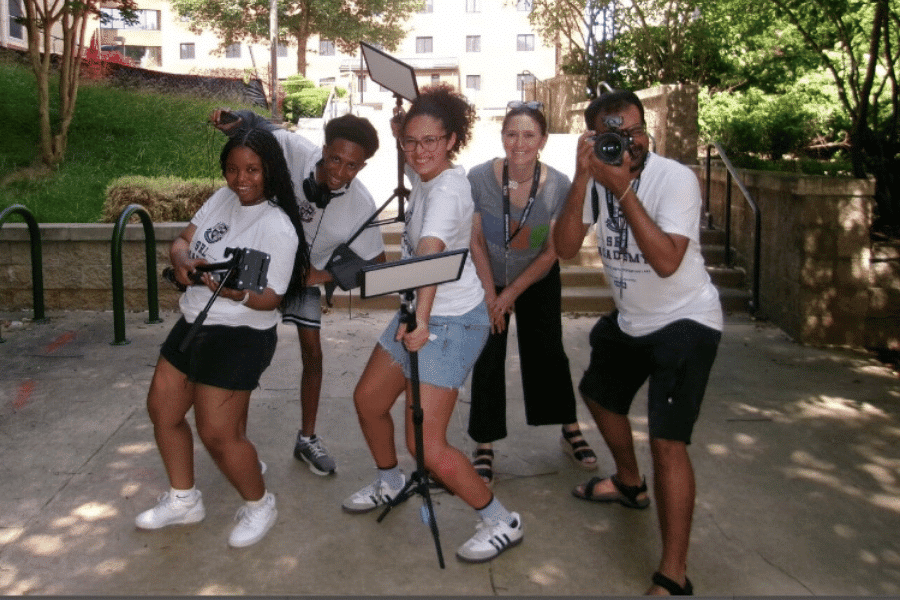
    Student Reporting Labs (SRL) is a U.S.-based journalism training program for young people and their educators. On 23 July, Global Youth & News Media, a France-based nonprofit dedicated to encouraging and honoring news media engagement with the young, awarded SRL its Prize for Outstanding Achievement in Journalism.

    “This award is in recognition of the program’s impactful history and determination to continue its unmatched work to introduce young people throughout the United States to local broadcast journalism,” said Aralynn McMane, executive director of Global Youth & News Media. “In voting to bestow this award, our board was unanimous and adamant about the need to shine a spotlight on Student Reporting Labs to remind the world of what short-sighted politics risks destroying in the wake of defunding public broadcasting.”

    The importance of youth journalism

    This is only the second time the Global Youth & News Media board has bestowed such an honorary award. The first was in 2018 for joint live coverage of the March For Our Lives anti-gun demonstration by The Guardian US with Eagle Eye News student reporters from Marjory Stoneman Douglas High School in Florida, which had seen the killing of 18 people at the school just three weeks prior. 

    Founded in 2009 by Leah Clapman, then the managing editor of education at PBS NewsHour, Student Reporting Labs has helped build broadcast and journalism programs in thousands of secondary schools across all 50 states. 

    The program connects them with over 40 public television stations and local news organizations to bring their story to local audiences. SRL empowers the next generation of storytellers by providing free training fellowships and workshops to students and educators across the country and around the world. In all, more than 125,000 students have participated in the program. 

    SRL also reaches more than 10,000 educators via a free learning platform StoryMaker. StoryMaker provides teachers with instruction materials and lessons to help students think critically, explore their curiosity about the world and engage in their communities. 

    The SRL program was established “on the premise that some stories are best told by young people,” Clapman, now full-time executive director of SRL, wrote in a briefing last week. ”This is especially true in this moment of rapid change and disruption. In this challenging time, we’re leaning in to perseverance and service rather than despair.”

    Mentoring teens to tell important stories

    Clapman wrote that newsrooms can benefit from the important perspectives, experiences and insights that teens have and that these perspectives can help news organizations tell more nuanced and complete stories about issues that affect students.

    One such teenager that the Student Reporting Labs trained was award-winning alumna Mary Williams, who joined the program in 2015 and interned at her local PBS station in Ohio. 

    “Now when I see the news, it’s personal,” she said. “The economy, education system and the Earth’s current state aren’t just my parents’ problems to worry about. They’re mine, too.”

    The Global Youth & News Media Prize for journalism this year focused on youth collaborations that help local news media survive. The rest of the laureates were chosen by an international expert jury and will be announced in the coming weeks. News Decoder, which trains and encourages young people to develop global perspectives in storytelling, is a partner in the award and helped judge the entries. 

    News Decoder Educational News Director Marcy Burstiner said that it is more important than ever to recognize the important work young journalists are doing. 

    “It seems that in the United States and elsewhere there is a war on journalism and truth telling,” Burstiner said. “I used to tell my students that it was a myth that you needed a thick skin to be a journalist. But these days, you do.”

    But every year, News Decoder finds more and more young people stepping up to the challenge, Burstiner said. 

    “They aren’t afraid to tell the important stories that need to be told,” she said. “But people need to support the organizations like PBS News Student Reporting Labs that help and encourage young people to be truth tellers.”

    Source link

  • Investigative Journalism Drives Unprecedented Growth

    Investigative Journalism Drives Unprecedented Growth

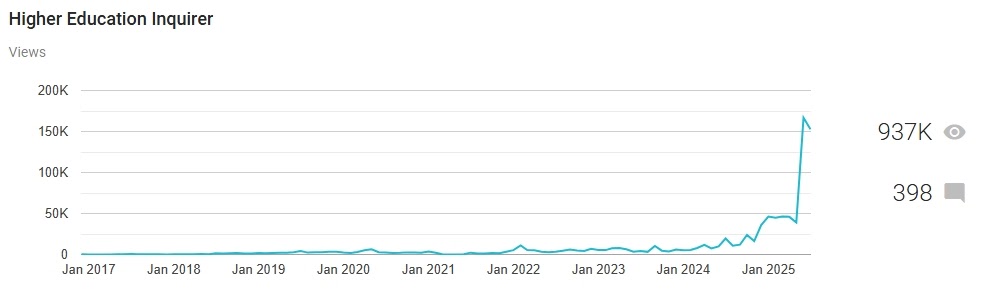
    The Higher Education Inquirer (HEI) is approaching a significant milestone: nearly one million total views expected by September 2025. This achievement underscores the growing demand for investigative journalism that holds higher education institutions accountable.

    HEI’s traffic growth has been steady for more than a year with an explosive rise over the last few months. In the first quarter of 2025, the site recorded about 132,000 views, showing increased interest. By June, monthly views passed 160,000. The highest single-day traffic came yesterday, July 21, 2025, with 10,391 views, breaking previous records. This peak coincided with the release of several articles on economic and social issues facing students, student loan debtors, and young workers.

    Key articles included Bryan Alexander’s examination of whether higher education still makes financial sense for students. Our staff contributed reports on young workers’ declining confidence in the job market and the expanding role of fintech companies like SoFi in student loans.

    HEI also covers broader social and political topics. An article on June 25 about Gaza’s humanitarian crisis and campus dissent drew hundreds of views, showing the publication’s interest in global issues related to academic freedom and student activism.

    One of the most significant examples of HEI’s investigative reporting has been its ongoing coverage of corruption and scandal in the Los Angeles Community College District (LACCD). In May and June 2025, HEI published detailed exposés documenting alleged fraud, retaliation against whistleblowers, grade manipulation, wage theft, and falsification of faculty credentials. These stories brought to light longstanding issues within LACCD, including actions by administrators such as Annie G. Reed, whose conduct has repeatedly raised serious concerns since at least 2016.

    The impact of HEI’s coverage extended beyond readership numbers. After critical articles published by allied independent media outlets were removed from online platforms, HEI stood firm in reporting these issues, highlighting the challenges faced by whistleblowers and the vital role of independent journalism in holding institutions accountable.

    In July 2025, HEI published an in-depth investigation revealing the Pentagon’s longstanding relationship with for-profit colleges, particularly through the Council of College and Military Educators (CCME). The investigation uncovered how these institutions have exploited military-connected students, veterans, and their families, benefiting from federal programs like the Post-9/11 GI Bill and Department of Defense Tuition Assistance. Despite multiple Freedom of Information Act (FOIA) requests, the Department of Defense has withheld critical documents, raising questions about transparency and accountability in military education partnerships.

    Additionally, HEI’s reporting on the exploitation of veterans under the guise of service highlighted how politicians, government agencies, and nonprofits have failed to protect those who have served. The investigation revealed that instead of supporting veterans, these entities have perpetuated systems that prioritize self-interest over the well-being of veterans, leading to wasted benefits and poor educational outcomes.

    Several factors explain HEI’s growth. The publication relies on original documents obtained through Freedom of Information Act requests, legal filings, and insider accounts to reveal facts often missed by mainstream media. This research appeals to readers seeking solid information.

    Contributions from scholars and activists like Bryan Alexander, Henry Giroux, David Halperin, and Michael Hainline add context that helps readers understand education trends and policies.

    HEI focuses on long-term issues such as adjunct faculty exploitation, college closures, student debt, and the privatization of public education, rather than fleeting news. This approach builds a loyal audience interested in ongoing analysis.

    The site offers free access without paywalls or advertising, encouraging sharing and reader interaction through comments, tips, and feedback. Its presence on social media and forums like Reddit helps reach more readers organically.

    Central to HEI’s mission is a commitment to transparency, accountability, and value in higher education. The publication seeks not only to reveal problems but also to hold institutions and policymakers responsible. HEI stresses that higher education must deliver real financial, social, and intellectual value and that openness is key to achieving this.

    The political and economic context has also contributed to HEI’s growth. Lasting effects of Trump-era policies—such as changes in Title IX enforcement, rollbacks of diversity efforts, and disputes over federal funding—have increased public interest. HEI’s clear, evidence-based coverage helps readers understand these complex changes.

    Public concerns about rising student debt, now over $1.7 trillion nationwide, and doubts about the value of college degrees have also driven readers to HEI. At the same time, debates around campus culture and diversity heighten demand for balanced reporting.

    As HEI nears its million-view goal, it plans to expand investigative work, grow its viewership base, and increase community engagement through interactive features and reader participation. The publication intends to continue monitoring higher education’s power structures and highlight factors affecting students, faculty, and institutions.

    In a time of declining trust in mainstream media and widespread misinformation, HEI’s growth shows a strong need for journalism that is thorough, honest, and focused on those involved in higher education.

    For readers seeking clear, direct insight on changes in colleges and universities, HEI offers an essential platform—living up to its motto, “Ahead of the Learned Herd.” Its rise marks a shift toward more accountable journalism in the field.

    Source link

  • Jailed for basic journalism, Texas reporter takes free speech fight to Supreme Court

    Jailed for basic journalism, Texas reporter takes free speech fight to Supreme Court

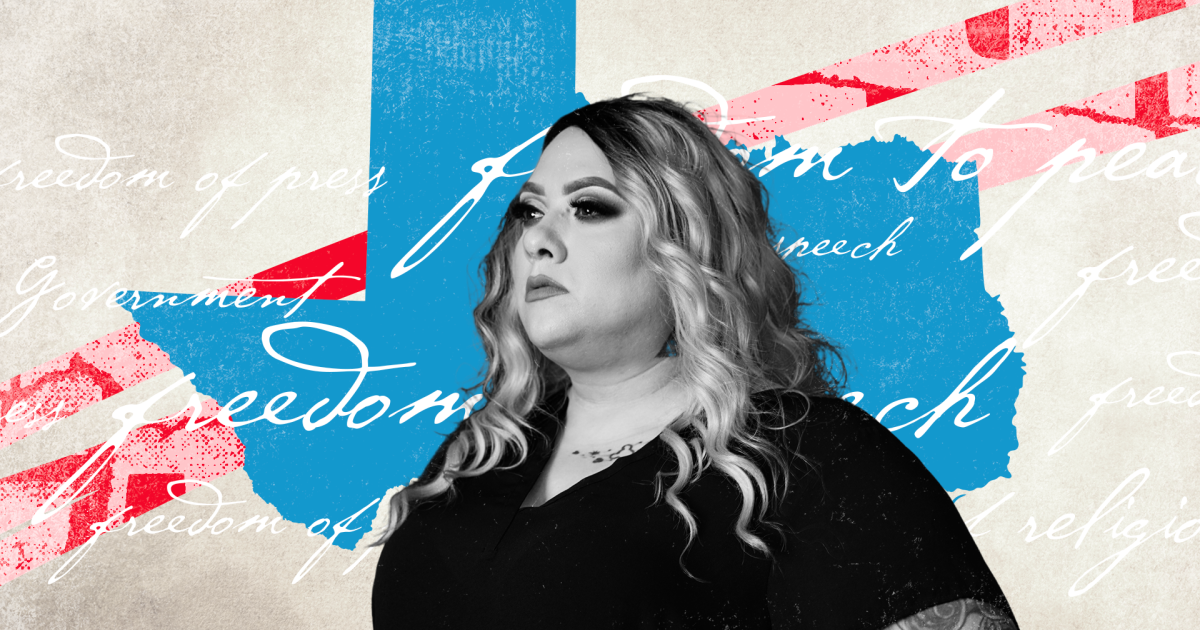
    For years, Priscilla Villarreal has fought to hold officials accountable when they violate Americans’ First Amendment rights, including the Laredo officials who threw her in jail just for asking police to verify facts as part of her everyday news reporting. 

    Priscilla sued, and last fall, the Supreme Court gave her a shot at justice, granting her petition and ordering the U.S. Court of Appeals for the Fifth Circuit to reconsider Priscilla’s case against the officials who tried to turn routine journalism into a felony.

    But in April, a divided Fifth Circuit doubled down, holding the Laredo officials had qualified immunity, a doctrine that often shields government officials from lawsuits even when they violate the Constitution. In his dissent, one judge lamented that the court had simply reinstated what it “mistakenly said before, just in different packaging.”

    So Priscilla and FIRE are doubling down, too. We’re heading back to the Supreme Court, asking it to make crystal clear that Americans have every ability to hold officials accountable for violating core First Amendment rights — like the right to ask government officials questions, and publish what they share.

    That’s exactly what Priscilla has been doing for years, reporting on local crime, traffic, and other news for her 200,000 Facebook followers. She’s made a name for herself too. The New York Times describes her as “arguably the most influential journalist in Laredo.”  But despite her experience, her journey from Laredo, a city on the Mexican border, to the Supreme Court has been a long one.

    In 2017, she reported on a high-profile suicide and a fatal car accident. For both stories, Priscilla received tips from private citizens and verified those facts by asking a Laredo police officer. The First Amendment squarely protects this routine journalistic practice. After all, at the heart of the First Amendment is the freedom to ask government officials and institutions questions, even tough ones.

    Angered by Priscilla’s reporting on these incidents, Laredo officials tried to bully her into silence by arresting her. But with no legitimate basis on which to charge her with a crime, police and prosecutors turned to a decades-old statute that no local official had ever enforced. 

    That law makes it a felony to ask for or receive non-public information from a government official with the intent to benefit from that information. Laredo police and prosecutors pursued two warrants for Priscilla’s arrest under the statute. In short, Priscilla went to jail for basic journalism. 

    So in 2019, she sued the officials for violating her First and Fourth Amendment rights. As Judge James Ho later remarked in his dissent at the Fifth Circuit, it “should’ve been an easy case for denying qualified immunity.”

    But it hasn’t been. A Texas federal district court dismissed her claims on the basis of qualified immunity. A three-judge panel of the Fifth Circuit reversed that decision, denying qualified immunity. But when the whole Fifth Circuit reheard the case at the government’s request, it reversed the panel ruling in a splintered 9-7 decision.

    In 2024, Priscilla and FIRE took her fight to the Supreme Court for the first time. The Court granted Priscilla’s petition to review the Fifth Circuit’s decision and ordered it to reconsider her case in light of the Supreme Court’s 2024 decision, Gonzalez v. Trevino. That decision affirmed the ability to sue government officials when they retaliate against protected speech by selectively enforcing statutes.

    But last April, a splintered Fifth Circuit decided against Priscilla again, granting qualified immunity to the officials who defied longstanding Supreme Court precedent and core principles of American liberty by orchestrating her arrest.

    The Fifth Circuit’s ruling not only denies Priscilla justice, but gives police and prosecutors a free pass to turn core First Amendment rights into a crime. That result cannot stand. And that’s why Priscilla and FIRE are going back to the Supreme Court.

    Priscilla’s fearless reporting has made her a local “folk hero.” Now, she’s channeling the same grit into defending not just her own rights, but the First Amendment rights of all Americans.

    Source link

  • News Decoder helps launch digital student journalism tool

    News Decoder helps launch digital student journalism tool

    Gathering and assessing the quality of information is one of the most effective ways to develop media literacy, critical thinking and effective communication skills. But without guidance, too many young people fail to question the reliability of visual images and overly rely on the first results they find on Google.

    That’s why News Decoder has been working with the Swedish nonprofit, Voice4You, on a project called ProMS to create a self-guided digital tool that guides students in writing news stories.

    The tool, called Mobile Stories, is now available across Europe. It takes students step-by-step through the journalistic process. Along the way, they gain critical thinking skills and a deeper understanding about the information they find, consume and share.

    It empowers students to develop multimedia stories that incorporate original reporting for school, community or global audiences, with minimal input from educators. It comes with open-access learning resources developed by News Decoder.

    After a decade of success in Sweden, Voice4You partnered with News Decoder to help make the tool available across Europe and the globe. Throughout the ProMS project, new English language content suitable for high schoolers was developed and piloted in 21 schools in Romania, Ireland and Finland. The Mobile Stories platform has demonstrated remarkable potential in building student confidence and media and information literacy by providing a platform and an opportunity to produce quality journalism.

    From story pitch to publication

    Using the new international version of Mobile Stories, students have already published 136 articles on mobilestories.com, with another 700 currently in production. Their topics range from book reviews and reporting from local cultural events to in-depth feature articles on the decline in young people’s mental health and child labor in the fast fashion industry.

    “The tool looks like a blogging platform and on every step along the way of creating an article, students can access learning materials including video tutorials by professional journalists from around the world, articles and worksheets,” said News Decoder’s ProMS Project Manager Sabīne Bērziņa.

    Some of these resources, such as videos and worksheets are open access, available to all.

    Source link

  • Pro-Palestinian Journalism Professor Denied Tenure

    Pro-Palestinian Journalism Professor Denied Tenure

    Steven Thrasher, an assistant journalism professor who tried to block police from breaking up a pro-Palestinian encampment at Northwestern University last spring, announced he was denied tenure and will lose his job in August 2026, the end of the next academic year.

    “This has nothing to do with my scholarship or teaching,” Thrasher wrote in a statement he shared on Bluesky. “It is a political hit job over my support for Palestine and for trying to protect our student protesters last year from physical attack, by nonviolently subjecting my own body to assault by the Northwestern Police instead of our students.”

    The incident between Thrasher and campus police came up when Northwestern president Michael Schill went before Congress during a hearing on campus antisemitism. In a June 2024 letter, the House Committee on Education and the Workforce accused Schill of not fully answering members’ questions at the hearing, including about Thrasher.

    Thrasher was suspended from teaching last summer. According to an email from Medill School of Journalism dean Charles F. Whitaker, which Thrasher’s lawyer provided to Inside Higher Ed, the dean initiated disciplinary proceedings in response to complaints about Thrasher’s social media activity and allegedly sexist comments to students, as well as his failure to disclose major course changes and his comments about journalism standards that were “antithetical to our profession.”

    According to Thrasher’s statement, posted Thursday, Whitaker wrote in an explanation of the tenure denial that Thrasher’s teaching was “inadequate with serious concerns reported by some students.” Thrasher said he previously received a “glowing” mid-tenure review in 2023. He also said a university-wide ad hoc faculty committee “exonerated” him after a four-month investigation into issues, including student concerns.

    “I read the situation as a Plan B by Northwestern after Dean Whitaker tried (and failed) to exclude me through the disciplinary process,” Thrasher wrote. “I will appeal this decision at Northwestern and have much more to say.”

    In a statement to Inside Higher Ed, a university spokesperson wrote, “As policy, Northwestern does not comment on personnel matters. The University takes the tenure process very seriously and has adhered to the rules that govern that process. The University has full confidence in the decision-making process of our Medill faculty and dean.”

    Source link

  • Journalism is a calling. Is a story calling you?

    Journalism is a calling. Is a story calling you?

    Marcy Burstiner is the educational news director for News Decoder. She is a graduate of the Columbia Journalism School and professor emeritus of journalism and mass communication at the California Polytechnic University, Humboldt in California. She is the author of the book Investigative Reporting: From premise to publication.

    💡 More Tips Like This

    This story is part of News Decoder’s open access learning resources.

    Whether you’re a secondary student, studying at university or simply interested in learning new things, we can help you build your journalism skills and better understand big global issues.

    If you are a student or a member of a News Decoder Club, check out our other learning resources.

    If you are a teacher, check out our other classroom resources:

    And ask us about joining the News Decoder Club program.


    Source link