Religious colleges that require students to sign a faith statement cannot be shut out of a Minnesota program that funds the dual enrollment of high school students in the state’s public and private postsecondary institutions, a federal judge ruled Friday.
U.S. District Judge Nancy Brasel’s ruling overturns a Minnesota law prohibiting Christian colleges that participate in the state’s 40-year-old Postsecondary Enrollment Options program from forcing students to pass a religious test. The state Education Department and LGBTQ+ advocates had sought such legislation for years on the grounds that faith statements discriminate against students who are not Christian, straight or cisgender. It finally passed in 2023, under a Democratic State Legislature.
The families of several high school students seeking to earn credits at two Christian institutions in the state, Crown College and the University of Northwestern, then sued, arguing that the law violated their First Amendment right to religious freedom. The ban on faith statements was suspended while the legal battle played out.
“This dispute requires the court to venture into the delicate constitutional interplay of religion and publicly-funded education,” Judge Brasel said in her 70-page ruling. “In doing so, the court heeds the Supreme Court’s instruction that the First Amendment gives special solicitude to the rights of religious organizations.”
Brasel noted in her ruling that the two Christian colleges have received nearly $40 million to cover the costs of the PSEO program since the 2017–18 academic year; she wrote that the University of Northwestern admits about 70 percent of dual-enrollment applicants. Over all, some 60,000 high school students have benefited from PSEO, The Minneapolis Star Tribune noted.
The Becket Fund for Religious Liberty, which represented the plaintiffs, applauded the decision.
“Minnesota tried to cut off educational opportunities to thousands of high schoolers simply for their faith. That’s not just unlawful—it’s shameful,” said Becket senior counsel Diana Thomson, according to the Associated Press. “This ruling is a win for families who won’t be strong-armed into abandoning their beliefs, and a sharp warning to politicians who target them.”
Judge Stephanie Gallagher declared in the Thursday ruling that the Department of Education broke the law when it tried to withhold grant funding from institutions that practiced DEI based on one of the president’s executive orders and a related guidance letter.
In her opinion, Gallagher focused less on the legality of the attempt to ban DEI itself, but rather the process through which the president and secretary of education tried to do so.
“This court takes no view as to whether the policies at issue in this case are good or bad, prudent or foolish, fair or unfair. But, at this stage too, it must closely scrutinize whether the government went about creating and implementing them in the manner the law requires. Here, it did not,” the judge wrote. “By leapfrogging important procedural requirements, the government has unwittingly run headfirst into serious constitutional problems.”
That said, she did explain the ways Trump’s policy violated the Constitution, saying, “The government cannot proclaim that it ‘will no longer tolerate’ speech it dislikes because of its ‘motivating ideology’—that is a ‘blatant’ and ‘egregious’ violation of the First Amendment.”
Gallagher’s decision followed a motion for summary judgment that was filed by the plaintiffs, the American Federation of Teachers and the American Sociological Association, after they won a preliminary injunction that blocked parts of Trump’s anti-DEI policy since April. (Gallagher was appointed by Trump during his first presidency in 2018.)
Since the Education Department’s anti-DEI guidance was enjoined, the Trump administration has made other attempts to block the same academic practices. Most recently, the Department of Justice published a nine-page memo that stated that DEI is unlawful and discriminatory.
Still, AFT president Randi Weingarten viewed the ruling as a “huge win” against Trump’s “draconian attacks on the essence of public education.”
“This decision rightly strikes down the government’s attempt to dictate curriculum, and, in so doing, upholds the purpose and promise inherent in our public schools,” Weingarten said in a news release.
This audio is auto-generated. Please let us know if you have feedback.
A federal judge is standing by his June decision requiring the U.S. Department of Education torestore its Office for Civil Rights “to the status-quo” so it can “carry out its statutory functions.” The order, which prevents the department from laying off OCR employees, comes despite a U.S. Supreme Court emergency order in a separate case allowing the agency to move forward with mass layoffs across the department.
The case challenging the gutting of OCR, which included the shuttering of seven out of 12 regional OCR offices, was brought by two students who “faced severe discrimination and harassment in school and were depending on the OCR to resolve their complaints so that they could attend public school,” said Judge Myong Joun in his Aug. 13 decision.
The Education Department appealed Joun’s ruling Thursday to the U.S. First Circuit Court of Appeals, asking the court to allow the department to move forward with its OCR closures.
The court battle prolongs the administrative leave of OCR employees that began in March, after the department laid off more than 1,300 staff across the entire Education Department. President Donald Trump and U.S. Education Secretary Linda McMahon pushed the layoffs as a way to “end bureaucratic bloat” and downsize the federal government, including its expenses.
However, according to American Federation of Government Employees Local 252, the union representing a majority of the laid-off Education Department employees, the federal government has been paying around $7 million a month just for employees to sit idle on administrative leave.
The employees’ administrative leave that began in March originally ended with their termination on June 9. However, court cases blocking the department’s gutting have prolonged their employment.
According to the numbers released by the agency last year, OCR received a record number of complaints against K-12 and higher education institutions in 2023, the most recent year for which numbers are available, surpassing a previous all-time high set in 2022.
This audio is auto-generated. Please let us know if you have feedback.
A federal judge blocked two U.S. Department of Education actions attempting to restrict diversity, equity and inclusion in schools on Thursday.
The decision undoes a February “Dear Colleague” letter that threatened to withhold federal funding to schools that didn’t eliminate race-based programming, as well as a subsequent letter requiring school districts to certify that they do not incorporate DEI in their schools.
In her 76-page opinion, Judge Stephanie Gallagher of U.S. District Court for Maryland ruled that the administration violated decision-making procedures under the Administrative Procedure Act — a move that violated the constitutional rights of plaintiffs, who are led by the American Federation of Teachers.
Gallagher, a Trump-appointed judge, took no stance, however, on the content of the Education Department’s directives themselves.
“Still here, this Court takes no view as to whether the policies at issue in this case are good or bad, prudent or foolish, fair or unfair,” she said. “But, at this stage too, it must closely scrutinize whether the government went about creating and implementing them in the manner the law requires. Here, it did not.”
The administration’s anti-DEI measures were already on pause as a result of this court case and at least two other separate but similar federal court cases pending in Washington, D.C., and New Hampshire. Those cases also challenged the Education Department’s anti-DEI policy.
As a result of previous court action pausing the measures, the department had already withdrawn its certification requirement.
However, in an email to chief state school officers in April retracting the certification requirement, the department said, “Please be advised that the Court Order does not preclude the U.S. Department of Education from initiating any enforcement actions that it may otherwise pursue under Title VI of the Civil Rights Act and its implementing regulations.”
Title VI bars discrimination based on race, color or national origin in federally funded programs — and has in the past been used especially to protect historically marginalized students from such bias. However, since President Donald Trump reentered the White House, the Education Department has invoked the civil rights statute to protect Asian and White students. The Trump administration’s anti-DEI efforts are a core part of that interpretation.
The Education Department echoed its earlier sentiments in a reaction to Thursday’s ruling.
“While the Department is disappointed in the judge’s ruling, judicial action enjoining or setting aside this guidance has not stopped our ability to enforce Title VI protections for students at an unprecedented level,” said the department in an email to K-12 Dive on Friday. “The Department remains committed to its responsibility to uphold students’ anti-discrimination protections under the law.”
However, some public school educators and advocates say the measures would harm decades of equity work meant to level the playing field for Black and brown students. Moreover, the directives would create an environment of fear that impacts other underserved students such as students with disabilities, they say
“Our district works hard to ensure that every student feels included through thoughtful curriculum and programs,” said Eugene School District 4J school board member Jenny Jonak in a statement on Thursday. The Oregon district was a plaintiff in the lawsuit that led to Thursday’s court decision.
“Teachers and schools must be able to provide inclusive, comprehensive education without fear of losing critical federal funding. We should never be forced to choose between supporting our students and securing the resources they need and deserve,” Jonak said.
The Trump administration, in its court response to the lawsuit, argued that the certification requirement “fails to rise to the level of final agency action,” which would have required the formal rulemaking procedures that the department didn’t undergo.
“The Certification requirement merely requests state educational agencies who receive federal funds confirm their compliance with Title VI, which Plaintiffs acknowledge they have been asked to do in the past,” the administration said.
“The government did not merely remind educators that discrimination is illegal: it initiated a sea change in how the Department of Education regulates educational practices and classroom conduct, causing millions of educators to reasonably fear that their lawful, and even beneficial, speech might cause them or their schools to be punished,” she said. “The law does not countenance the government’s hasty and summary treatment of these significant issues.”
The department did not respond to a question as to whether it would appeal Gallagher’s decision in time for publication Friday.
The judge denied a motion for a preliminary injunction to block the anti-DEI law.
Just_Super/iStock/Getty Images Plus
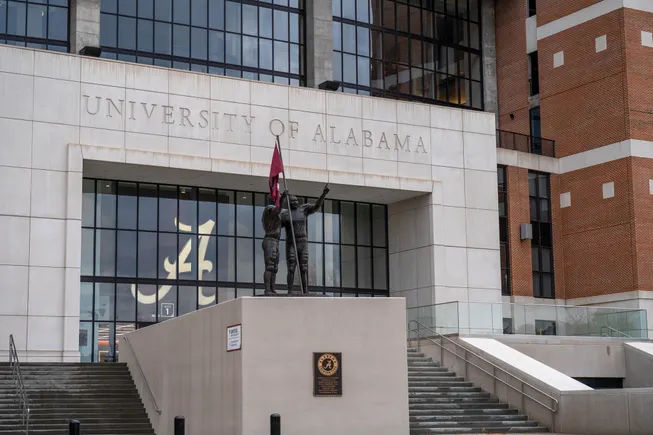
Ruling in part that professors lack First Amendment protections in the classroom, a federal judge denied an effort from college faculty and students in Alabama to block a 2024 state law that banned diversity, equity and inclusion programs as well as the teaching of so-called divisive concepts.
The plaintiffs, who include students from the University of Alabama at Birmingham and professors at the University of Alabama in Tuscaloosa, argued in court filings and at hearings that the legislation known as Senate Bill 129 amounted to state-sponsored censorship and infringed on their rights under the First and 14th Amendments. The professors alleged that they had to cancel class projects or events and faced other questions about their classroom conduct from administrators because of the law. They’ve also changed course material as a result.
R. David Proctor, chief judge in the U.S. District Court for the Northern District of Alabama, found that while the professors and the Alabama NAACP had standing to sue, they weren’t likely to succeed at this time. For instance, he ruled that the professors aren’t protected by the First Amendment because their “in-class instruction constitutes government speech.”
Furthermore, Proctor wrote, based on other rulings in the U.S. Court of Appeals for the 11th Circuit, “when there is a dispute about what is taught in the classroom, the university’s interests outweigh those of a professor, and the professor’s interest in academic freedom and free speech do not displace the university’s interest inside the classroom.”
The plaintiffs said Proctor’s ruling was disappointing.
“I feel incredibly dismayed that SB 129 is allowed to continue going into the new school year,” said Sydney Testman, one of the students who sued, in a statement. “As a senior at University of Alabama at Birmingham, I’ve seen firsthand how SB 129 has transformed my college campus for the worst. Voices have been silenced, opportunities have been revoked, and meaningful community engagement has faded. This decision undermines the need for students to properly feel a sense of belonging and inclusion on campus.”
This audio is auto-generated. Please let us know if you have feedback.
Dive Brief:
A federal judge declined to temporarily block the enforcement of a state law that bans public colleges from funding diversity, equity and inclusion programsand from compelling students to affirm certain “divisive concepts.”
Earlier this year, a group of students and faculty members sued the state’s governor and the University of Alabama’s trustees over the new law,arguing that it violates their free speech rights by placing viewpoint-based restrictions on what can be taught in the classroom. They also contended that the law undermines due process by being so ambiguous that instructors and students don’t know what is prohibited.
U.S. District Judge R. David Proctor— a George W. Bush appointee —pushed back on those arguments in his 146-page ruling Wednesday. Proctor denied their request for a preliminary injunction, writing that public colleges could reasonably control curricular contentand rejecting assertions that the law’s language is impermissibly vague.
Dive Insight:
Last year, Alabama Gov. Kay Ivey signed a law known asSB 129,which bans public colleges and K-12 schools from having DEI initiatives.It defined those efforts as programs, training or other events where attendance is based on “race, sex, gender identity, ethnicity, national origin, or sexual orientation.”
PEN America noted last yearthat while this language doesn’t outright ban all DEI initiatives, the attendance restrictions could bar public colleges from activities like creating programming specifically for international students or recognizing a Black student union.
The law also barred public colleges from requiring students to affirm or adhere to a list of so-called divisive concepts.
Under the law, one of the concepts is that individuals “are inherently responsible for actions committed in the past by other members of the same race, color, religion, sex, ethnicity, or national origin.”Another is that people are “inherently racist, sexist, or oppressive, whether consciously or subconsciously” based on their personal characteristics.
The law also contains carve-outs.It says that the language does not bar public colleges from teaching or discussing divisive concepts “in an objective manner and without endorsement as part of a larger course of academic instruction.”
According to court documents, faculty members who sued over the measure said that while they do not require students to affirm or adhere to these concepts, they worry that their instruction on race and gender could be viewed as running afoul of the law — even with the carve-outs for teaching.
“I do not know what it means to discuss a divisive concept ‘in an objective manner’ and ‘without endorsement,’” plaintiff Cassandra Simon, a social work professor at University of Alabama, said in court documents.“There is robust empirical evidence of implicit bias, white privilege, and the absence of a colorblind meritocracy. I am unable to determine whether continuing to present these scholarly findings, and assigning readings on these subjects, would violate SB 129.”
One of Simon’s class assignments — that students select a social issue of their choice and advocate for it — was abruptly canceled due to the law, according to court documents.
Her students chose to hold a sit-in to protest SB 129 for their project. The day of the sit-in, however, the social work dean told Simon to cancel the assignment in part over concerns that it would compel students to agree with one of the banned divisive concepts.
Another plaintiff raised concerns over teaching about topics such as structural racism, employment discrimination and health disparities by race. And another voiced concerns that the law potentially limits his ability to teach about eugenics.
However, Proctor wrote in his ruling that the law doesn’t prohibit the teaching of divisive concepts and pointed to the carve-outs provided.
The judge also cited an appeals court case that found a public college could “reasonably control the content of its curriculum, particularly that content imparted during class time.”
“There is no legal basis for concluding that the First Amendment protects a university professor’s academic freedom in the way the Professors suggest,” Proctor wrote.
Referring to the canceled sit-in, Proctor wrote that it was “a reasonable exercise of control over course curriculum to ensure that students would not feel coerced into advocating for a belief with which they disagreed.”
Proctor also dismissed Ivey as a defendant in the case, ruling that plaintiffs’ alleged injuries aren’t traceable to her.
The plaintiffs in the case slammed the decision on Thursday.
“SB129 created a culture of fear that has severely hindered the ability of professors to provide comprehensive instruction in our areas of expertise,” Dana Patton, a University of Alabama professor and plaintiff in the case, said in a statement.“The law infringes on our academic freedom and our duty to students to provide a truthful and comprehensive education.”
Alabama state Sen. Will Barfoot, the sponsor of the legislation, didn’t immediately respond to a request for comment.
This audio is auto-generated. Please let us know if you have feedback.
A federal judge is standing by his June decision requiring the U.S. Department of Education torestore the Office for Civil Rights “to the status-quo” so it can “carry out its statutory functions.” The order, which prevents the department from laying off OCR employees, comes despite a U.S. Supreme Court emergency order in a separate case allowing the agency to move forward with mass layoffs across the department.
The case challenging the gutting of OCR, which included the shuttering of seven out of 12 regional OCR offices, was brought by two students who “faced severe discrimination and harassment in school and were depending on the OCR to resolve their complaints so that they could attend public school,” said Judge Myong Joun in his Aug. 13 decision.
The Education Department appealed Joun’s ruling Thursday to the U.S. First Circuit Court of Appeals, asking the court to allow the department to move forward with its OCR closures.
The court battle prolongs the administrative leave of OCR employees that began in March, after the department laid off more than 1,300 staff across the entire Education Department. President Donald Trump and U.S. Education Secretary Linda McMahon pushed the layoffs as a way to “end bureaucratic bloat” and downsize the federal government, including its expenses.
However, according to American Federation of Government Employees Local 252, the union representing a majority of the laid-off Education Department employees, the federal government has been paying around $7 million a month just for employees to sit idle on administrative leave.
The employees’ administrative leave that began in March originally ended with their termination on June 9. However, court cases blocking the department’s gutting have prolonged their employment.
According to the numbers released by the agency last year, OCR received a record number of complaints against K-12 and higher education institutions in 2023, the most recent year for which numbers are available, surpassing a previous all-time high set in 2022.
A class action suit led byresearchers in the University of California system spurred the ruling.
Photo illustration by Justin Morrison/Inside Higher Ed | Genaro Molina/Los Angeles Times/Getty Images | US District Court for the Northern District of California
The National Science Foundation restored grants it recently suspended for researchers at the University of California, Los Angeles, following a court order late Tuesday, a spokesperson for the agency said.
The NSF and UCLA didn’t tell Inside Higher Ed how much funding had been restored, but the Los Angeles Times reported it’s roughly $81 million.
UCLA is the latest target of the Trump administration’s use of mass federal research grant suspensions to pressure prominent universities to change policies and pay restitution, ranging from tens of millions of dollars for Brown University to the billion-dollar demand of UCLA. Federal agencies justify cutting off grants by accusing targeted institutions of failing to address pro-Palestine protesters’ alleged antisemitism, and accusing universities of other transgressions, such as letting transgender women compete in women’s sports or promoting racial preferences.
But this is the first known court order blocking one of those blanket funding freezes. Harvard University also challenged the administration’s decision to suspend more than $2.7 billion in funds, but a judge has a yet to rule in that case.
UCLA didn’t sue, though.
Instead, the ruling came from a lawsuit that UC researchers filed in early June against President Trump, the NSF and other federal agencies and officials that challenged previous NSF grant terminations.
On June 23, U.S. District Court judge Rita F. Lin, of the Northern District of California, issued a preliminary injunction restoring grants that the administration terminated en masse via form letters that didn’t provide grant-specific explanations for the terminations. When the NSF recently cut off grants again, specifically to UCLA, the researchers’ attorneys alleged the agency violated the preliminary injunction.
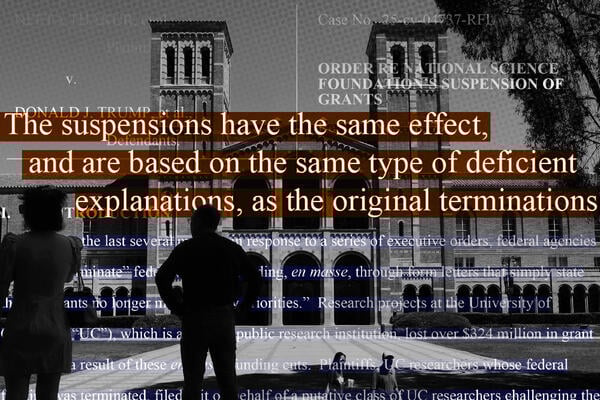
Lin agreed, writing in an opinion Tuesday that the new “suspensions have the same effect, and are based on the same type of deficient explanations, as the original terminations.”
The NSF wrote in a July 30 letter justifying the new suspensions that “NSF understands that [UCLA] continues to engage in race discrimination including in its admissions process, and in other areas of student life, as well as failing to promote a research environment free of antisemitism and bias.” Two days later, the NSF sent a second letter, alleging that UCLA furthermore “engages in racism” and “endangers women by allowing men in women’s sports and private women-only spaces.”
According to Lin, the NSF argued that its recent funding cuts “are not within the scope of the preliminary injunction because it suspended, rather than terminated, the grants.” She said the agency argued that suspensions, unlike terminations, “can be lifted once the grantee takes certain corrective actions.”
However, Lin said the NSF had labeled these “suspensions” as “final agency decision[s] not subject to appeal.”
“There is no listed end date for the suspensions, nor is there any path for researchers to restore funding for their project. If any curative action is actually feasible, it would need to be undertaken by UCLA,” the judge wrote. “In other words, researchers have no guarantee that funding will ever be restored and no way to take action to increase the likelihood of restoration.”
She added that “NSF claims that it could simply turn around the day after the preliminary injunction issued, and halt funding on every grant that had been ordered reinstated, so long as that action was labeled as a ‘suspension’ rather than a ‘termination.’ This is not a reasonable interpretation of the scope of the preliminary injunction.”
Researchers told the court that as a result of the latest suspensions, “projects are already losing talented graduate students, staff will soon be laid off, and years of federally funded work will go to waste,” Lin wrote. Researchers also said the defunded projects include “multi-year research into global heat extremes, a project to address environmental challenges in the Southwestern United States, and another to enhance veteran participation and leadership in STEM fields,” the judge added.
A UC system spokesperson said in an email Wednesday that, “while we have not had an opportunity to review the court’s order and were not party to the suit, restoration of National Science Foundation funds is critical to research the University of California performs on behalf of California and the nation.”
The Office for Civil Rights handles complaints concerning discrimination in federally funded education institutions.
Saul Loeb/AFP via Getty Images
A federal district court judge refused the Trump administration’s request to vacate a previous ruling that prohibited the Department of Education from laying off nearly half its Office for Civil Rights staff.
The decision was made by Massachusetts judge Myong Joun on Wednesday and involved the case Victim Rights Law Center v. Department of Education. It comes just a month after the Supreme Court reversed a preliminary injunction in a similar case, New York v. McMahon, which Joun also oversaw.
In the new order, the district court judge argues that the cases, and therefore their related rulings, are separate.
The New York case, which was filed by multiple state attorneys general, addressed the reduction in force more broadly, Joun said. By comparison, the Victim Rights Law Center case more specifically addresses the RIF at OCR and how it may hold the office back from completing its statutory mandate of protecting students from discrimination.
So, although the Supreme Court allowed the Trump administration to continue with the reduction in force broadly, Joun argues, it does not mean the enjoinment of layoffs within OCR is no longer applicable.
Trump officials “present two arguments for why vacatur or a stay are appropriate: first, that the Supreme Court granted the stay in a related case, and second, that the two related cases are ‘indistinguishable in all pertinent respects.’ I am unconvinced by either argument,” Joun wrote. “Although this case and New York are related, I issued a separate Preliminary Injunction Order to address the unique harms that Plaintiffs alleged arose from their reliance on the OCR.”
He also noted that even though the high court judges reversed one preliminary injunction, that does not mean they have made a final ruling on the merit of the RIF.
Finally, Joun went on to say that the defendants’ motion for stay has little standing, as “they have not substantially complied with the preliminary injunction order” in the first place. Reporting from The 74 backs this up, showing that none of the 276 fired OCR employees have been reinstated.
This audio is auto-generated. Please let us know if you have feedback.
Dive Brief:
A federal judge on Tuesday ordered the National Science Foundation to restore potentially hundreds of millions of dollars in federal research grants to the University of California.
Researchers at the university system in June brought a class-action lawsuit against NSF and other federal agencies over their termination of $324 million in funding, and quickly won a temporary injunction restoring the grants.
This week, U.S. District Judge Rita Lin concluded NSF violated that order by cutting funding to the University of California, Los Angeles in late July over allegations related to antisemitism and other concerns. An NSF spokesperson said in an email Wednesday the agency has reinstated UCLA’s funding in response to the order.
Dive Insight:
On June 4, several University of California researchers sued President Donald Trump and his administration over mass cuts to research funding spearheaded by the newly created Department of Government Efficiency.
Plaintiffs argued that the funding cuts violated key constitutional principles, including separation of powers, freedom of speech and right to due process, in addition to multiple federal statutes.
“Before President Trump took office, federal agency grant making proceeded under the authority of Congress, which created agencies through its constitutionally assigned exclusive legislative power, and appropriated taxpayer funds for specific public purposes that the agencies were tasked to execute,” the researchers said in their complaint.
They added that after taking office, Trump “attempted to seize direct control of federal agencies by bypassing Congress and upending the statutory and regulatory system under which federal agencies have historically and legally operated.”
Later that month, Lin concluded that the researchers would likely win their case on its merits and issued a preliminary injunction directing the Trump administration to restore terminated funding to University of California institutions and barring agencies from cutting their funding without grant-specific explanations.
But in late July, NSF “indefinitely suspended” numerous grants to UCLA, as attorneys for the plaintiffs noted in court filings. In the suspension notices, the agency cited allegations of widespread campus antisemitism and “illegal race-based preferences in admissions” — claims now common in the administration’s attacks on higher education.
The University of California system last week entered negotiations with the Trump administration in an effort to restore more than half a billion dollars in total research funding. When announcing the talks, UC President James Milliken called the UCLA cuts “a death knell for innovative work” that “do nothing to address antisemitism.”
The funding cuts came shortly after the U.S. Department of Justice alleged UCLA had violated civil rights law by failing to adequately address antisemitism.
The Los Angeles Times put the figure of NSF’s cut funding to UCLA specifically at $300 million. As one UCLA professor recounted in court papers filed Monday, the indefinite suspension orders had immediate and permanent effects, including stalled research and the loss of a potential graduate student worker to another project.
NSF argued in court that its indefinite suspensions did not violate Lin’s earlier injunction, which the agency said applied to grant terminations. But in Tuesday’s order, Lin concluded that the two terms were equivalent in practice.
“NSF may have re-labeled its action a ‘suspension,’but it is a distinction without a difference in this case,” Lin wrote. “After all, a terminated grant can be reinstated, just as a suspension can be ‘lifted.’ And a suspension, if it is of indefinite length, is functionally identical to a termination from the researcher’s perspective.”