Tag: Judge

  • Judge halts ban on international enrolments at Harvard

    Judge halts ban on international enrolments at Harvard

    In the latest move in the government’s dramatic feud with the US’s oldest university – and a major victory for international education sector – district judge Allison Burroughs issued a temporary restraining order yesterday, halting the directive stripping Harvard of its eligibility to enrol students from overseas.

    It follows the institution’s swift decision to mount a legal challenge against the administration’s demands that it hand over all disciplinary records for international students from the last five years if it wanted to regain its SEVP status.

    In its lawsuit, Harvard said: “With the stroke of a pen, the government has sought to erase a quarter of Harvard’s student body, international students who contribute significantly to the University and its mission.” The next hearing in the case will be held in Boston on May 29.

    If it comes to pass, the ban on international student enrolments would significantly harm Harvard’s financial situation – with last year’s 6,793 overseas students making up a sizeable 27% of the student body.

    With the stroke of a pen, the government has sought to erase a quarter of Harvard’s student body, international students who contribute significantly to the University and its mission
    Harvard University

    Orders from the Trump administration would not only prevent Harvard from enrolling any F-1 or J-1 students for the 2025/26 academic year, but also force current international students to transfer to another university if they want to stay in the country. 

    The move cause widespread panic among international students – especially given that some are set to graduate in just one week.

    Students told The PIE News that they were worried about what was happening, but trusted Harvard to “have our backs”.

    The institution’s row with Harvard stems from the stand it took – one of the only US institutions to do so – against the administrations raft of demands, including that it reform its admissions and hiring practices to combat antisemitism on campus, end DEI initiatives and hand over reports on international students.

    When the institution refused to do so, the government froze $2.2 billion in the university’s funding, threatened to revoke its tax-exempt status, and demanded international students’ records if it didn’t want to lose its SEVP certification. 

    Although Harvard did send over some student information on April 30, and maintained that it had provided the information it was legally bound to supply, this seems to have been insufficient for the Trump administration.

    In US homeland security secretary Kristi Noem’s letter to Harvard, she said: “This action should not surprise you and is the unfortunate result of Harvard’s failure to comply with simple reporting requirements”.  

    Source link

  • Federal Judge Blocks Trump’s Executive Order to Close Education Department

    Federal Judge Blocks Trump’s Executive Order to Close Education Department

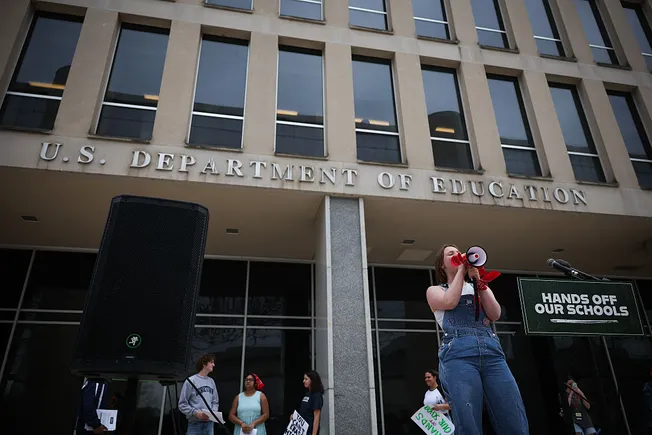
    A federal judge in Massachusetts has issued a preliminary injunction halting President Donald Trump’s executive order to dismantle the U.S. Department of Education, dealing a significant blow to the administration’s efforts to eliminate the federal agency.

    District Court Judge Myong J. Joun on last Thursday blocked Trump and Education Secretary Linda McMahon from carrying out the executive order and ordered the administration to reinstate approximately 1,300 Education Department employees who were terminated in March as part of a sweeping reduction-in-force.

    The ruling comes in response to consolidated lawsuits filed by a coalition of 20 states, the District of Columbia, educator unions, and school districts challenging the administration’s moves to shrink and eventually close the department.

    When Trump took office in January, the Education Department employed 4,133 workers. The reduction-in-force announced March 11 terminated more than 1,300 positions, while nearly 600 additional employees chose to resign or retire, leaving roughly 2,180 remaining staff—approximately half the department’s original size.

    In his ruling, Judge Joun wrote that “a department without enough employees to perform statutorily mandated functions is not a department at all,” adding that the court “cannot be asked to cover its eyes while the Department’s employees are continuously fired and units are transferred out until the Department becomes a shell of itself.”

    The judge also prohibited Trump from transferring management of the federal student loan portfolio and special needs programs to other federal agencies, as the president had pledged to do from the Oval Office.

    Judge Joun determined that the Trump administration likely violated the separation of powers by taking actions that conflicted with congressional mandates. He noted the administration had failed to demonstrate that the staff reductions actually improved efficiency, writing that “the record is replete with evidence of the opposite.”

    The plaintiffs argued that the department could no longer fulfill critical duties, including managing the $1.6 trillion federal student loan portfolio serving roughly 43 million borrowers and ensuring colleges comply with federal funding requirements.

    The American Association of University Professors (AAUP), which joined the legal challenge alongside other educator groups, praised the ruling as a crucial victory for higher education access.

    “The AAUP is thrilled that District Judge Joun has blocked Trump’s illegal attempt to gut the Department of Education and lay off half of its workforce,” said AAUP President Dr. Todd Wolfson. “Eliminating the ED would hurt everyday Americans, severely limit access to education, eviscerate funding for HBCUs and TCUs while benefiting partisan politicians and private corporations looking to extract profit from our nation’s higher education system.”

    American Federation of Teachers President Randi Weingarten called the decision “a first step to reverse this war on knowledge and the undermining of broad-based opportunity.”

    The Education Department’s deputy assistant secretary for communications, Madi Biedermann, criticized the ruling in a statement, calling Judge Joun a “far-left Judge” who “dramatically overstepped his authority” and vowed to “immediately challenge this on an emergency basis.”

    The case, Somerville Public Schools v. Trump, represents the consolidation of two separate lawsuits filed in March. Democracy Forward is representing the coalition of plaintiffs, which includes the AAUP, Somerville Public School Committee, Easthampton School District, Massachusetts AFT, AFSCME Council 93, and the Service Employees International Union.

    The ruling temporarily halts one of the Trump administration’s most ambitious efforts to reshape federal education policy, though the legal battle is expected to continue as the administration pursues its appeal.

    Source link

  • ‘A shell of itself’: Federal judge pauses efforts to wind down Education Department

    ‘A shell of itself’: Federal judge pauses efforts to wind down Education Department

    This audio is auto-generated. Please let us know if you have feedback.

    The U.S. Department of Education is temporarily barred from carrying out an executive order to shut down the agency and must reinstate employees who were fired as part of a mass reduction in force in March, a federal judge ruled Thursday.

    In the preliminary injunction in State of New York v. McMahon, U.S. District Judge Myong Joun ordered that the department be “restored to the status quo” prior to the day President Donald Trump retook office.

    The agency’s actions since show no evidence that its workforce reductions have improved efficiency or that the agency is making progress in working with Congress to close the department, Joun said. 

    “The supporting declarations of former Department employees, educational institutions, unions, and educators paint a stark picture of the irreparable harm that will result from financial uncertainty and delay, impeded access to vital knowledge on which students and educators rely, and loss of essential services for America’s most vulnerable student populations,” his ruling stated.

    Joun also said the Education Department is prohibited from carrying out President Donald Trump’s March 21 directive to transfer management of the federal student loans portfolio and special education management and oversight out of the Education Department.

    “A department without enough employees to perform statutorily mandated functions is not a department at all,” Joun wrote. “This court cannot be asked to cover its eyes while the Department’s employees are continuously fired and units are transferred out until the Department becomes a shell of itself.”

    The preliminary injunction requires the agency to submit a report to the court within 72 hours of the order, outlining all the steps it is taking to comply, and to do so “every week thereafter until the Department is restored to the status quo prior to January 20, 2025.”

    Thursday’s ruling is a setback to the Trump administration’s goals of reducing the size and scope of the federal government. The ambitions are to give more flexibility and decision-making power to the states, supporters of the administration action said.

    Madi Biedermann, deputy assistant secretary for communications at the Education Department, said the agency will challenge the ruling “on an emergency basis.”

    “Once again, a far-left Judge has dramatically overstepped his authority, based on a complaint from biased plaintiffs, and issued an injunction against the obviously lawful efforts to make the Department of Education more efficient and functional for the American people,” Biedermann said in an emailed statement Thursday. 

    Biedermann added, “This ruling is not in the best interest of American students or families.”

    Higher education advocates, on the other hand, celebrated the ruling.

    Today, the court rightly rejected one of the administration’s very first illegal, and consequential, acts: abolishing the federal role in education,” said Randi Weingarten, president of the American Federation of Teachers, in a Thursday statement. Most Americans and states “want to keep the education department because it ensures all kids, not just some, can get a shot at a better life,” she said.

    The legal challenge began March 13, when the attorneys general in 20 states and the District of Columbia sued the Education Department to halt the mass workforce reductions announced March 11. 

    About half of the agency’s 4,133 employees were let go or accepted buy outs. Almost a third of the affected employees had worked in one of three offices within the Education Department: Federal Student Aid, the Office for Civil Rights and the Institute for Education Sciences. 

    Later that month, Trump signed an executive order at a White House ceremony that directed U.S. Education Secretary Linda McMahon to begin closing down the agency to the “maximum extent appropriate.”

    My administration will take all lawful steps to shut down the department,” Trump said at the March 20 signing ceremony. “We’re going to shut it down, and shut it down as quickly as possible.”

    McMahon, during several appearances on Capitol Hill, has acknowledged that only Congress has the authority to close the agency and said she is working with lawmakers to do so.

    Source link

  • ‘A shell of itself’: Federal judge pauses efforts to wind down Education Department

    ‘A shell of itself’: Federal judge pauses efforts to wind down Education Department

    This audio is auto-generated. Please let us know if you have feedback.

    The U.S. Department of Education is temporarily barred from carrying out an executive order to shut down the agency and must reinstate employees who were fired as part of a mass reduction in force in March, a federal judge ruled Thursday.

    In the preliminary injunction in State of New York v. McMahon, U.S. District Judge Myong Joun ordered that the department be “restored to the status quo” prior to the day President Donald Trump retook office.

    The agency’s actions since show no evidence that its workforce reductions have improved efficiency or that the agency is making progress in working with Congress to close the department, Joun said. 

    “The supporting declarations of former Department employees, educational institutions, unions, and educators paint a stark picture of the irreparable harm that will result from financial uncertainty and delay, impeded access to vital knowledge on which students and educators rely, and loss of essential services for America’s most vulnerable student populations,” his ruling stated.

    Joun also said the Education Department is prohibited from carrying out President Donald Trump’s March 21 directive to transfer management of the federal student loans portfolio and special education management and oversight out of the Education Department.

    “A department without enough employees to perform statutorily mandated functions is not a department at all,” Joun wrote. “This court cannot be asked to cover its eyes while the Department’s employees are continuously fired and units are transferred out until the Department becomes a shell of itself.”

    The preliminary injunction requires the agency to submit a report to the court within 72 hours of the order, outlining all the steps it is taking to comply, and to do so “every week thereafter until the Department is restored to the status quo prior to January 20, 2025.”

    Thursday’s ruling is a setback to the Trump administration’s goals of reducing the size and scope of the federal government. The ambitions are to give more flexibility and decision-making power to the states, supporters of the administration action said.

    Madi Biedermann, deputy assistant secretary for communications at the Education Department, said the agency will challenge the ruling “on an emergency basis.”

    “Once again, a far-left Judge has dramatically overstepped his authority, based on a complaint from biased plaintiffs, and issued an injunction against the obviously lawful efforts to make the Department of Education more efficient and functional for the American people,” Biedermann said in an emailed statement Thursday. 

    Biedermann added, “This ruling is not in the best interest of American students or families.”

    Public school supporters, on the other hand, celebrated the ruling.

    Today, the court rightly rejected one of the administration’s very first illegal, and consequential, acts: abolishing the federal role in education,” said Randi Weingarten, president of the American Federation of Teachers, in a Thursday statement. Most Americans and states “want to keep the education department because it ensures all kids, not just some, can get a shot at a better life,” she said.

    The legal challenge began March 13, when the attorneys general in 20 states and the District of Columbia sued the Education Department to halt the mass workforce reductions announced March 11. 

    About half of the agency’s 4,133 employees were let go or accepted buy outs. Almost a third of the affected employees had worked in one of three offices within the Education Department: Federal Student Aid, the Office for Civil Rights and the Institute for Education Sciences. 

    Later that month, Trump signed an executive order at a White House ceremony that directed U.S. Education Secretary Linda McMahon to begin closing down the agency to the “maximum extent appropriate.”

    My administration will take all lawful steps to shut down the department,” Trump said at the March 20 signing ceremony. “We’re going to shut it down, and shut it down as quickly as possible.”

    McMahon, during several appearances on Capitol Hill, has acknowledged that only Congress has the authority to close the agency and said she is working with lawmakers to do so.

    Source link

  • Judge Orders Education Department Employees Reinstated

    Judge Orders Education Department Employees Reinstated

    Photo illustration by Justin Morrison/Inside Higher Ed | Tierney L. Cross/Getty Images | Matveev_Aleksandr and raweenuttapong/iStock/Getty Images

    A federal judge blocked the Trump administration from firing thousands of employees at the Department of Education in a decisive rebuke of this spring’s sweeping reduction in force and the executive branch’s efforts to weaken the Education Department.

    Judge Myong Joun rejected the administration’s argument that the layoffs, which affected half of the department’s workforce, were part of a “reorganization” aimed at improving efficiency and said evidence showed the administration’s “true intention is to effectively dismantle the Department without an authorizing statute.” His order also prevents the department from implementing President Donald Trump’s March directive to dismantle the agency.

    Joun of the District of Massachusetts also said the injunction to rehire the fired staffers was necessary in order to restore the department’s ability to accomplish its core functions and statutorily mandated responsibilities.

    “Not only is there no evidence that Defendants are pursuing a ‘legislative goal’ or otherwise working with Congress to reach a resolution, but there is also no evidence that the RIF has actually made the Department more efficient,” Joun wrote in his 88-page ruling. “Plaintiffs have demonstrated that the Department will not be able to carry out its statutory functions—and in some cases, is already unable to do so.”

    Reports of systemic failings and overloaded staff have streamed out of the beleaguered department ever since the March layoffs, from an untouched backlog of complaints at the Office for Civil Rights to the piling up of applications for student loan repayment and forgiveness plans.

    The injunction, handed down Thursday morning, means the administration must reinstate more than 2,000 Education Department employees and reopen regional offices that were shuttered during the reduction in force.

    The administration has already said it has issued a challenge to the ruling. Madi Biedermann, the department’s deputy assistant secretary for communication, said the administration has already appealed.

    In an email to Inside Higher Ed, Biedermann decried the decision, calling Joun a “far-left judge” who “dramatically overstepped his authority” and maintaining that the layoffs were “lawful efforts to make the Department of Education more efficient and functional.”

    “President Trump and the Senate-confirmed Secretary of Education clearly have the authority to make decisions about agency reorganization efforts, not an unelected Judge with a political axe to grind,” she wrote.

    A spokesperson for the Association of American University Professors, one of the plaintiffs in the case, wrote in a statement that they were “thrilled” with the decision.

    “Eliminating the [Education Department] would hurt everyday Americans, severely limit access to education, eviscerate funding for HBCUs and [tribal colleges and universities] while benefiting partisan politicians and private corporations,” they wrote.

    Education Secretary Linda McMahon defended the layoffs at a budget hearing just a day prior to the ruling. She said the goal was to “wind down the bureaucracy” of the department, and that while she hoped to have congressional support to dismantle it eventually, the administration did not intend to so on its own.

    Joun’s decision undercuts that defense. In the budget hearing, Rep. Rosa DeLauro, a Democrat of Connecticut, told McMahon that the cuts were “unlawful” and a usurpation of congressional authority.

    “As long as you continue to deliberately and flagrantly defy the law, you will continue to lose in court,” DeLauro said.

    The injunction is the latest in a string of court orders challenging the Trump administration’s rapid cuts to federal agencies in its first 100 days, often under the supervision of Elon Musk’s Department of Government Efficiency. DOGE was responsible for the vast majority of the Education Department layoffs, according to McMahon’s House testimony Wednesday.

    Joun’s ruling wasn’t the only one aimed at undoing the administration’s Education Department cuts. Judge Paul Friedman of the U.S. District Court for the District of Columbia also ordered that the department restore grant funding to a Southern nonprofit that has helped further school desegregation efforts since the 1960s. The grant had been defunded as part of the administration’s push to eliminate spending on diversity, equity and inclusion.

    Source link

  • Judge orders release of Tufts student Rümeysa Öztürk

    Judge orders release of Tufts student Rümeysa Öztürk

    A federal judge has ordered the immediate release of Tufts student Rümeysa Öztürk, who faces deportation for writing an op-ed critical of Israel. 

    “Her continued detention cannot stand,” said Judge William Sessions III.

    Judge Sessions explained the government provided no evidence Öztürk engaged in violence or any other crimes. “The reason she’s been detained is simply and purely the expression she made,” he said. The judge also warned her detention chills millions of noncitizens from expressing their views “for fear of being whisked away from their home.”

    Below is a statement from FIRE Supervising Senior Attorney Conor Fitzpatrick, praising the order:

    The court rightly found Öztürk’s detention unlawful and an affront to the First Amendment. No one in America — citizen or not — should fear the government’s wrath for speaking their mind.

    Last week, FIRE was joined by a nonpartisan coalition that included the National Coalition Against Censorship, Cato, PEN America, and the Rutherford Institute calling for the release of Ms. Öztürk and all others detained and targeted for deportation based on protected speech.

    Source link

  • Judge Blocks Energy Dept. Plan to Cap Indirect Cost Rates

    Judge Blocks Energy Dept. Plan to Cap Indirect Cost Rates

    A federal judge temporarily blocked the U.S. Department of Energy’s plan to cap universities’ indirect research cost reimbursement rates, pending a hearing in the ongoing lawsuit filed by several higher education associations and universities.

    Judge Allison D. Burroughs of the U.S. District Court for Massachusetts wrote in the brief Wednesday order that the plaintiffs had shown that, without a temporary restraining order, “they will sustain immediate and irreparable injury before there is an opportunity to hear from all parties.”

    Plaintiffs include the Association of American Universities, the American Council on Education, the Association of Public and Land-grant Universities and nine individual universities, including Brown, Cornell and Princeton Universities and the Universities of Michigan, Illinois and Rochester. They sued the DOE and department secretary Chris Wright on Monday, three days after the DOE announced its plan.

    Department spokespeople didn’t return Inside Higher Ed’s requests for comment Thursday afternoon.

    DOE’s plan is to cap the reimbursement rates at 15 percent. Energy grant recipients at colleges and universities currently have an average 30 percent indirect cost rate. The Trump administration has alleged that indirect costs are wasteful spending, although they are extensively audited.

    The DOE sends more than $2.5 billion a year to over 300 colleges and universities. Part of that money covers costs indirectly related to research that may support multiple grant-funded projects, including specialized nuclear-rated facilities, computer systems and administrative support costs.

    The department’s plan is nearly identical to a plan the National Institutes of Health announced in February, which a judge also blocked.

    Source link

  • Federal judge freezes Energy Department’s 15% cap on indirect costs

    Federal judge freezes Energy Department’s 15% cap on indirect costs

    This audio is auto-generated. Please let us know if you have feedback.

    A federal judge Wednesday temporarily blocked the U.S. Department of Energy from implementing a 15% cap on grant funding for indirect costs. The ruling came just days after a dozen higher education associations and colleges sued the department, calling the new policy an overstep of authority and a threat to U.S. research and advancement.

    In the ruling Wednesday, U.S. District Judge Allison Burroughs said the plaintiffs — including higher ed groups like the American Council on Education and threatened colleges like the University of Michigan and Brown University — had successfully demonstrated that they would “sustain immediate and irreparable injury” if the policy were allowed to proceed in tandem with the lawsuit. 

    Burroughs’ temporary restraining order bars the Energy Department — until further court order — from terminating grants, either under the challenged policy or “based on a grantee’s refusal to accept an indirect cost rate less than their negotiated rate.” The judge is also requiring the department to submit biweekly reports confirming that the federal funds are being distributed during the pause.

    When announcing the funding cap last Friday, the Energy Department said the move would save $405 million annually and reduce what it called inefficient spending. Indirect research costs typically include overhead expenses such as facilities and administrative support staff.

    The department said the change would affect over 300 colleges and that it would terminate grants to any institutions that failed to comply.

    But the plaintiffs said the policy’s rapid implementation would give institutions no choice but to scale back funding and lay off staff.

    Their lawsuit, filed in U.S. District Court in Massachusetts, called the Energy Department’s policy “a virtual carbon copy” of one announced in February by the National Institutes of Health. A federal judge permanently blocked NIH’s plan to cap indirect cost funding at 15% earlier this month, a decision the agency quickly appealed. The NIH plan would cost research universities billions in annual funding.

    “DOE’s action is unlawful for most of the same reasons and, indeed, it is especially egregious because DOE has not even attempted to address many of the flaws the district court found with NIH’s unlawful policy,” the plaintiff’s lawsuit said.

    The next hearing in the case is set for April 28 before the same court. 

    Source link

  • Judge Temporarily Blocks Cuts at Sonoma State

    Judge Temporarily Blocks Cuts at Sonoma State

    Cuts at Sonoma State University are on pause after a judge found leaders had not followed necessary procedures in winding down academic programs amid an ongoing budget crunch.

    Sonoma County Judge Kenneth English ruled that the university sidestepped its own written policies when it announced plans to ax multiple academic programs; he issued a temporary restraining order to halt the process. According to university policies, Sonoma State is required to include the Academic Senate in decisions about program eliminations. But that allegedly didn’t happen, according to a lawsuit to stop the cuts filed on behalf of seven students.

    Sonoma State has denied circumventing its own policies.

    At the heart of the lawsuit is a fight over athletics, which Sonoma State plans to cut entirely. All seven plaintiffs played various sports at the university, which competes at the NCAA Division II level. However, the judge’s ruling did not halt the administration’s plans to eliminate athletics; the restraining order applied only to the academic programs for now.

    It will remain in effect until May 1, the date of the next hearing in the case.

    A Fight Over Cuts

    In January, Sonoma State—part of the California State University system—announced sweeping cuts, citing a nearly $24 million budget deficit.

    “The University has had a budget deficit for several years. It is attributable to a variety of factors—cost of personnel, annual price increases for supplies and utilities, inflation—but the main reason is enrollment,” Interim President Emily Cutrer wrote in an announcement.

    She noted that enrollment at SSU had dropped by 38 percent since it peaked in 2015 at 9,408 students, according to federal data.

    Sonoma State had already taken moves over the last two years to close its persistent budget gap, including offering buyouts and freezing hiring, among other measures. But those actions “are not enough,” Cutrer wrote. After making piecemeal cuts in prior years, she announced a plan to eliminate more than 20 academic programs, let 46 faculty contracts lapse and ax athletics.

    But at least part of that plan is now on hold.

    Legal counsel for the plaintiffs requested a temporary restraining order to stop the shutdown of programs, arguing that their clients “will suffer irreparable harm and the Decision will be unable to be reversed even after it is ultimately found to be unlawful, or if new Sonoma State leadership or the California legislature seek to reverse the decision,” according to an April 10 court filing.

    David Seidel, an attorney representing the plaintiffs, who is also a graduate of Sonoma State, where he played soccer, told Inside Higher Ed that he was concerned about the abrupt nature of the planned program cuts, which he alleged were illegal and “extremely damaging” to students.

    He added that multiple student athletes transferred to Sonoma State over the winter. If officials were aware that SSU planned to cut athletics, as they announced in January, he believes those students were lured by false promises to play for programs that may no longer exist.

    “This is a failure of leadership,” Seidel said.

    While he recognizes that the university may still move forward with the cuts, he wants to see the process restarted under new leadership and using the procedures SSU allegedly bypassed.

    Seidel also plans to address concerns related to athletics at the May 1 hearing.

    “The temporary restraining order does not affect athletics at this time. Of course, that’s still very much a live issue that we will be pursuing on May 1, and we’re seeking a preliminary junction on athletics as well. Sonoma State and [the California State University system] have passed very specific policies and regulations with respect to discontinuing academic programs,” Seidel said. “And it isn’t necessarily true that those also apply to athletics.”

    In an email to Inside Higher Ed, SSU rejected the notion that it violated its own policies.

    “SSU maintains that the university followed its established policies regarding academic discontinuation, including communicating with and considering feedback from all programs impacted by the proposed reductions,” SSU spokesperson Jeff Keating wrote. “Yesterday’s ruling set a later date when the court will more fully review the parties’ positions, including evidence from the university that SSU is complying with its academic discontinuation policy.”

    Other Challenges

    The court decision came amid an already challenging week for Sonoma State.

    At a legislative forum on Monday, state lawmakers criticized Sonoma State’s plans to pull the university out of its fiscal crisis. Beyond the cuts, administrators have developed a blueprint known as Bridge to the Future, which aims to increase enrollment by 20 percent within the next five to seven years, launch new programs and carry out various other actions. But some lawmakers took issue with the plan, arguing it was too light on specifics.

    Sonoma State’s recent financial woes have also been accompanied by leadership turnover.

    Cutrer, the interim president, is Sonoma State’s third leader in as many years after both her predecessors were felled by scandal. In 2022, then-president Judy Sakaki resigned after she was accused of mishandling a sexual harassment scandal tied to her husband, Patrick McCallum, who was accused of acting inappropriately with several university employees. McCallum also defied a ban to stay off the Sonoma State campus while Sakaki was president.

    Sonoma State’s next president, Mike Lee, retired abruptly last year after he was placed on administrative leave when he struck a deal with pro-Palestinian protesters to review contracts to consider divestment opportunities and agreed to an academic boycott of Israel. CSU officials accused Lee of insubordination in making the deal with protesters and ultimately walked back the agreement with students.

    Source link

  • Judge Rules Drake Didn’t Defame Des Moines Community College

    Judge Rules Drake Didn’t Defame Des Moines Community College

    A federal judge recently dismissed claims that Drake University defamed Des Moines Area Community College, the latest development in a fraught trademark battle between the two institutions, the Des Moines Register reported.

    Their ongoing legal dispute, which began last summer, is over the letter “D.”

    Drake University sued the community college after it changed its logo to a simple, block-style “D.” The university has used a “D” as its logo for decades and argued the similar branding creates confusion.

    U.S. Chief District Judge Stephanie Rose concluded in November that Drake was likely to prevail, given the logos’ similar color schemes and other details, and issued a preliminary injunction that the community college stop using the new logo. The order led to two pending appeals, one from the community college to reverse the preliminary injunction and one from Drake asserting the ruling didn’t include some older logos. The community college achieved some wins in February when Rose determined DMACC tried in “good faith” to change the logo and Drake should put more money toward helping the college switch the logo if Drake ultimately wins the case.

    Meanwhile, counterclaims from DMACC accused Drake of defamation. The college dropped those claims after Drake asked the court to dismiss them but then brought defamation claims against the university again on behalf of the Des Moines Area Community College Foundation after Drake sent out an email about the case to its alumni in July.

    Rose wrote on Friday that the foundation took “giant interpretive leaps from the content of the email” such that the defamation claims were “untenable.”

    “While zealous advocacy is expected, counsel must ground their pleadings in reasonable factual and legal interpretations,” she chided.

    Drake President Marty Martin said in an email statement to The Des Moines Register that he was pleased by the outcome. But DMACC shows little sign of giving up.

    “DMACC and the DMACC Foundation continue to believe that Drake does not own the letter ‘D’ and the scope of Drake’s rights are now the subject of appeal,” spokesperson Dan Ryan said in a statement.

    Source link