
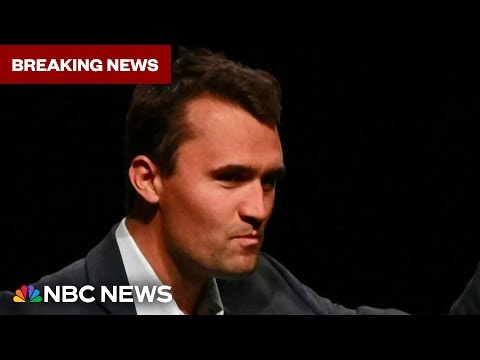
Charlie Kirk was shot and killed at Utah Valley University today. The killer was not immediately caught. The Higher Education Inquirer has been covering Kirk and his organization, Turning Point USA, since 2016. Kirk has been a polarizing force in the United States, particularly on US college campuses. HEI hopes this event will not lead to further violence. Since its inception, we have urged for peace and nonviolence.
Tag: Killed
-
Turning Point USA Founder Kirk Killed at Utah Valley U
Charlie Kirk, the young founder of Turning Point USA, a campus-focused conservative organization that rose to general prominence on the right, died Wednesday after he was shot during one of his group’s events at Utah Valley University in Orem.
Kirk, 31, leaves behind a wife and two children. He first rose to prominence in 2012 after creating Turning Point and speaking out about the need to reform higher education. In recent years, he became a close ally of Donald Trump.
Kirk died doing what he had become known and drawn protests for: visiting college campuses and sharing his right-wing views. He was at Utah Valley kicking off Turning Point’s The American Comeback Tour, which planned at least 10 stops on college campuses across the country. Some had urged the university to cancel his appearance. More than 3,000 people attended the event, Utah officials said.
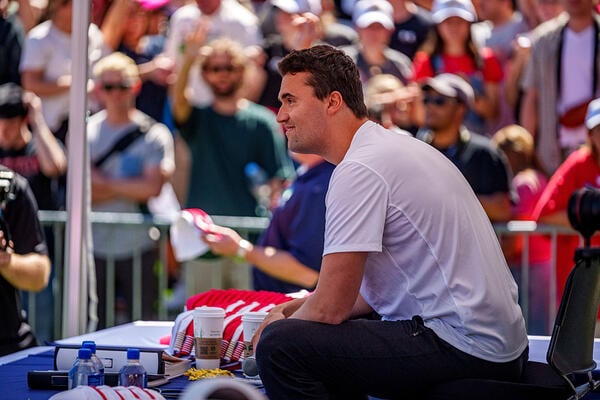
Kirk, wearing a white shirt that said “freedom,” handed out red Make America Great Again hats and then sat under his signature “Prove Me Wrong” tent in the courtyard in the middle of campus to take questions from the audience. According to The Deseret News, Kirk had said there were “too many” mass shooters who were transgender and then fielded another question on the issue when he was shot.
“I want to be very clear this is a political assassination,” said Utah governor Spencer Cox at a press conference Wednesday evening.
Matthew Boedy, author of a forthcoming book on Kirk and head of the Georgia state conference of the American Association of University Professors, said Kirk’s death “could be compared to the second assassination [attempt] on President Trump. Assassination attempts—you would think they would unite us, but as we’ve seen, they have divided us even more so.”
Kirk’s group galvanized conservative activism on campuses nationwide and fueled criticisms of higher ed that are now shared by the White House and the Republicans who control Congress. As higher ed itself became a national political issue, Kirk transcended from a campus presence to a national conservative figure, speaking at the Republican National Conventions in 2020 and 2024, the Conservative Political Action Conference, and on other big stages. He had more than 5.4 million followers on X, where right-leaning profiles are prominent.
Turning Point’s website claims to have “a presence on over 3,500 high school and college campuses nationwide, over 250,000 student members, and over 450 full- and part-time staff all across the country.” And the group’s own events drew national political figures: Donald Trump Jr., Tucker Carlson, Steve Bannon, Tulsi Gabbard, Kristi Noem and others attended the Student Action Summit in July, Times Higher Education reported. Among other things, Kirk said at the event in Tampa, Fla., that no foreigners should be allowed to own homes or get jobs before U.S. citizens.
“This is the greatest generational realignment since Woodstock,” Kirk said. “We have never seen a generation move so quickly and so fast, and you guys are making all the liberals confused.”
Kirk expanded on his views in several books, which include Campus Battlefield: How Conservatives Can WIN the Battle on Campus and Why It Matters and The College Scam: How America’s Universities Are Bankrupting and Brainwashing Away the Future of America’s Youth.
In a statement on X Wednesday, Turning Point confirmed his death and said, “May he be received into the merciful arms of our loving Savior, who suffered and died for Charlie.” Leading Republicans and Democrats issued statements mourning his passing, which President Trump announced himself on Truth Social.
“The Great, and even Legendary, Charlie Kirk, is dead,” Trump wrote. “No one understood or had the Heart of the Youth in the United States of America better than Charlie. He was loved and admired by ALL, especially me, and now, he is no longer with us.”
Trump ordered U.S. flags to be lowered to half-staff.
Former president Obama posted on X that “we don’t yet know what motivated the person who shot and killed Charlie Kirk, but this kind of despicable violence has no place in our democracy. Michelle and I will be praying for Charlie’s family tonight, especially his wife Erika and their two young children.”
Education Secretary Linda McMahon called Kirk “a friend and an invaluable adviser” in a social media post.
“He loved America with every part of his being,” she added. “My heart is broken for his family and friends who loved him, and for the millions of young Americans whom he inspired.”
California governor Gavin Newsom, a potential Democratic presidential candidate who had Kirk on his podcast earlier this year, posted, “The attack on Charlie Kirk is disgusting, vile, and reprehensible. In the United States of America, we must reject political violence in EVERY form.”
Local, state and federal law enforcement are investigating the shooting.
Utah Valley closed campus and canceled classes until Sept. 14. Authorities searched the grounds for the shooter, and officials said in the evening that a person of interest was in custody.
Ellen Treanor, a university spokesperson, said Kirk was shot around 12:15 p.m. local time Wednesday, and that police believe the shot came from the Losee Center, about 200 yards away.
Treanor said Kirk’s private security took him immediately to a hospital, where he underwent surgery.
University police quickly arrested a person, who was later released when the officers determined he wasn’t the shooter, said Scott Trotter, another university spokesperson. The Utah governor’s office, the FBI and other agencies are coordinating with the university police department in investigating, Trotter said. (Utah law allows individuals to carry firearms on campuses.)
UVU officials said in a statement that they were “shocked and saddened” by Kirk’s death.
“We firmly believe that UVU is a place to share ideas and to debate openly and respectfully,” the statement said. “Any attempt to infringe on those rights has no place here.”
At the Wednesday press conference, Jeff Long, the UVU police chief, said that what happened was a “police chief’s nightmare.” Six officers were working the event alongside Kirk’s security team.
“You try to get your bases covered, and unfortunately, today, we didn’t,” he said. “Because of that, we have this tragic incident.”
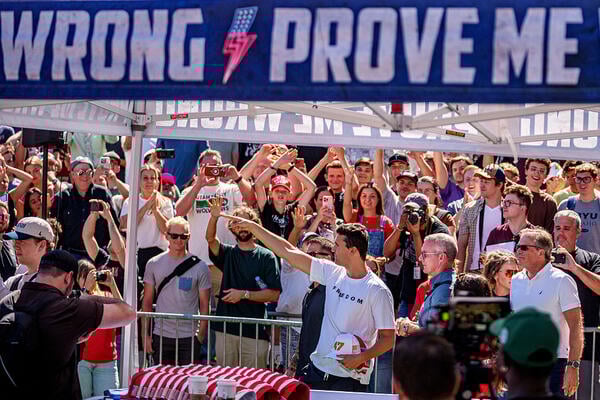
Charlie Kirk was kicking off his “American Comeback Tour” at Utah Valley University.
Photo by Trent Nelson/The Salt Lake Tribune/Getty Images
Turning Point, headquartered in Phoenix, has been at the center of several controversies over the years. About a decade ago, it launched its Professor Watchlist, which has resulted in academics being the targets of vitriol and threats for their alleged views. Last year, two Turning Point workers admitted to charges from an October 2023 incident in which they followed and filmed a queer Arizona State University instructor on campus, with one of them eventually pushing the instructor face-first onto the concrete.
Boedy said Wednesday that Kirk was the most influential person who doesn’t work in the White House.
“He has made Turning Point into an indispensable organization for conservative causes,” he said. “He’s become the new face of Christian nationalism, which is a growing trend in America. And of course, he has, I would say, changed college campuses.”
He added that campus events like Wednesday’s were his “bread and butter.”
“He is very smart,” he said. “He was one of the pioneers of the ‘prove me wrong’ mantra.”
-
What’s happened since Texas killed in-state tuition for undocumented students
SAN ANTONIO — Ximena had a plan.
The 18-year-old from Houston was going to start college in the fall at the University of Texas at Tyler, where she had been awarded $10,000 a year in scholarships. That, she hoped, would set her up for her dream: a Ph.D. in chemistry, followed by a career as a professor or researcher.
“And then the change to in-state tuition happened, and that’s when I knew for sure that I had to pivot,” said Ximena, who was born in Mexico but attended schools stateside since kindergarten. (The Hechinger Report is referring to her by only her first name because she fears retaliation for her immigration status.)
In June, the Texas attorney general’s office and the Trump administration worked together to end the provisions in a state law that had offered thousands of undocumented students like her lower in-state tuition rates at Texas public colleges. State and federal officials successfully argued in court that the long-standing policy discriminated against U.S. citizens from other states who paid a higher rate. That rationale has now been replicated in similar lawsuits against Kentucky, Oklahoma and Minnesota — part of a broader offensive against immigrants’ access to public education.
At UT Tyler, in-state tuition and fees for the upcoming academic year total $9,736, compared to more than $25,000 for out-of-state students. Ximena and her family couldn’t afford the higher tuition bill, so she withdrew. Instead, she enrolled at Houston Community College, where out-of-state costs are $227 per semester hour, nearly three times the in-district rate. The school offers only basic college-level chemistry classes, so to set herself up for a doctorate or original research, Ximena will still need to find a way to pay for a four-year university down the line.
Her predicament is exactly what state lawmakers from both political parties had hoped to avoid when they passed the Texas Dream Act, 2001 legislation that not only opened doors to higher education for undocumented students but was also meant to bolster Texas’s economy and its workforce long-term. With that law, Texas became the first of more than two dozen states to implement in-state tuition for undocumented students, and for nearly 24 years, the landmark policy remained intact. Conservative lawmakers repeatedly proposed to repeal it, but despite years of single-party control in the state legislature, not enough Republicans embraced repeal even as recently as this spring, days before the Texas attorney general’s office and the federal Department of Justice moved to end it.
Now, as the fall semester approaches, immigrant students are weighing whether to disenroll from their courses or await clarity on how the consent agreement entered into by the state and DOJ affects them.
Immigration advocates are worried that Texas colleges and universities are boxing out potential attendees who are lawfully present and still qualify for in-state tuition despite the court ruling — including recipients of the Deferred Action for Childhood Arrivals program, asylum applicants and Temporary Protected Status holders — because university personnel lack immigration expertise and haven’t been given clear guidelines on exactly who needs to pay the higher tuition rate.
At Austin Community College, which serves an area as large as Connecticut, members of the board of trustees are unsure how to accurately implement the ruling. As they await answers, they’ve so far decided against sending letters asking their students for sensitive information in order to determine tuition rates.
“This confusion will inevitably harm students because what we find is that in the absence of information and in the presence of fear and anxiety, students will opt to not continue higher education,” said Manuel Gonzalez, vice chair of the ACC board of trustees.
A billboard promoting Austin Community College in Spanish sits on a highway that leads to Lockhart, Texas. Credit: Sergio Flores for The Hechinger Report Policy experts, meanwhile, warn that Texas’s workforce could suffer as talented young people, many of whom have spent their entire education in the state’s public school system, will no longer be able to afford the associate’s and bachelor’s degrees that would allow them to pursue careers that would help propel their local economies. Under the Texas Dream Act, beneficiaries were required to commit to applying for lawful permanent residence as soon as possible, giving them the opportunity to hold down jobs related to their degrees. Without resident status, it’s likely they’ll still work — just more in lower-paying, under-the-radar jobs.
“It’s so short-sighted in terms of the welfare of the state of Texas,” said Barbara Hines, a former law school professor who helped legislators craft the Texas Dream Act.
Related: Become a lifelong learner. Subscribe to our free weekly newsletter featuring the most important stories in education.
By the turn of the century, almost two decades after undocumented children won the right to attend public school in the U.S., immigrant students and their champions remained frustrated that college remained out of reach.
For retired Army National Guard Maj. Gen. Rick Noriega, a Democrat who served in the Texas Legislature at the time, that reality hit close to home when he learned of a young yard worker in his district who wanted to enroll at the local community college for aviation mechanics but couldn’t afford out-of-state tuition.
Noriega called the school chancellor’s office, which was able to provide funding for the student to attend. But that experience led him to wonder: How many more kids in his district were running up against the same barriers to higher education?
So he worked with a sociologist to poll students at local high schools about the problem, which turned out to be widespread. And Noriega’s district wasn’t an outlier. In a state that has long had one of the nation’s largest unauthorized immigrant populations, politicians across the partisan divide knew affected constituents, friends or family members and wanted to help. Once Noriega decided to propose legislation, a Republican, Fred Hill, asked to serve as a joint author on the bill.
To proponents of the Texas Dream Act, the best argument in support of in-state tuition for undocumented students was an economic one. After the state had already invested in these students during K-12 public schooling, it made sense to continue developing them so they could eventually help meet Texas’ workforce needs.
“We’d spent all this money on these kids, and they’d done everything that we asked them to do — in many instances superstars and valedictorians and the like — and then they hit this wall, which was higher education that was cost prohibitive,” said Noriega.
The legislation easily passed the Texas House of Representatives, which was Democratic-controlled at the time, but the Republican-led Senate was less accommodating.
“I couldn’t even get a hearing,’” said Leticia Van de Putte, the then-state senator who sponsored the legislation in her chamber.
To persuade her Republican colleagues, she added several restrictions, including requiring undocumented students to live in Texas for three years before finishing high school or receiving a GED. (Three years was estimated as the average time it would take a family to pay enough in state taxes to make up the difference between in-state and out-of-state tuition.) She also included the clause mandating that undocumented students who accessed in-state tuition sign an affidavit pledging to pursue green cards as soon as they were able.
Van de Putte also turned to Texas business groups to hammer home the economic case for the bill. And she convinced the business community to pay for buses to bring Latino evangelical conservative pastors from Dallas, San Antonio, Houston and other areas of the state to Austin, so they could knock on doors in support of the legislation and pray with Republican senators and their staff.
After that, the Texas Dream Act overwhelmingly passed the state Senate in May 2001, and then-Gov. Rick Perry, a Republican, signed it into law the following month.
Related: How Trump is changing higher education: The view from four campuses
Yet by 2007, even as immigrant rights advocates, faith-based groups and business associations formed a coalition to defend immigrants against harmful state policies, the Texas legislature was starting to introduce a wave of generally anti-immigrant proposals. In 2010, polling suggested Texans overwhelmingly opposed allowing undocumented students to pay in-state tuition rates.
By 2012, a new slew of right-wing politicians was elected to office, many philosophically opposed to the law — and loud about it. Perry’s defense of the policy had come back to haunt him during the 2012 Republican presidential primary, when his campaign was dogged by criticism after he told opponents of tuition equity during a debate, “I don’t think you have a heart.”
Still, none of the many bills introduced over the years to repeal the Texas Dream Act were successful. And even Texas Gov. Greg Abbott, a Republican border hawk, at times equivocated on the policy, with his spokesperson saying in 2013 that Abbott believed “the objective” of in-state tuition regardless of immigration status was “noble.”
Legislative observers say that some Republicans in the state continue to support the policy. “It’s a bipartisan issue. There are Republicans in support of in-state tuition,” said Luis Figueroa, senior director of legislative affairs at the public policy research and advocacy nonprofit Every Texan. “They cannot publicly state it.”
Meanwhile, as the topic became more politically charged in Texas, the Texas Dream Act ended up amplifying a larger conversation that eventually led to the creation of DACA, the Obama-era program that has given some undocumented immigrants access to deportation protections and work permits.
Even before DACA, many immigrants worked, and those who remain undocumented often still do, either as independent contractors for employers that turn a blind eye to their immigration status or by starting their own businesses. A study from May 2020 found that unauthorized residents make up 8.2 percent of the state’s workforce, and for every dollar spent toward public services for them, the state of Texas recouped $1.21 in revenue.
But without the immediate legal permission to work, undocumented college graduates who had benefited from the Texas Dream Act found themselves limited despite their degrees. As the fight for tuition equity spread to other states, so did the fight for a legal solution to support the students it benefited.
When these young people — affectionately dubbed Dreamers — took center stage to more publicly advocate for themselves, their plight proved sympathetic. By 2017, the same year Trump began his first term, polling had flipped to show a plurality of Texans in support of in-state tuition for undocumented students. More recently, research has indicated time and time again that Americans support a pathway to legal status for undocumented residents brought to the U.S. as children.
But arguments against in-state tuition regardless of immigration status also grew in popularity: Critics contended that the policy is unfair to U.S. citizens from other states who have to pay higher rates, or that undocumented students are taking spots at competitive schools that could be filled by documented Americans.
The DOJ leaned on similar rhetoric in the lawsuit that killed tuition equity in Texas, saying the state law is superseded by 1996 federal legislation banning undocumented immigrants from getting in-state tuition based on residency. That argument has become a template as the Trump administration has sued to dismantle other states’ in-state tuition policies for undocumented residents.
In Kentucky, state Attorney General Russell Coleman, a Republican, has followed in Texas’ footsteps, recommending that the state council overseeing higher education withdraw its regulation allowing for access to in-state tuition instead of fighting to defend it in court.
At the same time, the Trump administration has found other ways to cut back on higher education opportunities for undocumented students, rescinding a policy that had helped them participate in career, technical and adult education programs and investigating universities for offering them scholarships.
Related: Which schools and colleges are being investigated by the Trump administration?
Back in Texas, the sudden policy change regarding in-state tuition is causing chaos. Even the state’s two largest universities, Texas A&M and the University of Texas, are using different guidelines to decide which students must pay out-of-state rates.
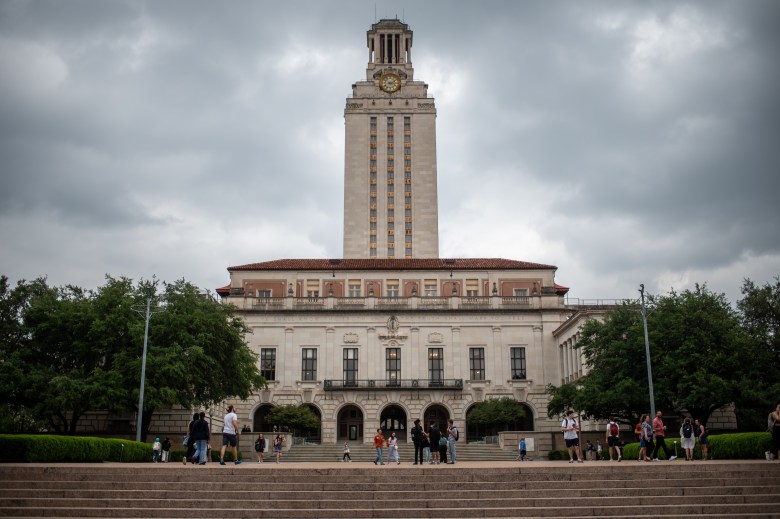
Clouds fill the sky behind the tower at the University of Texas. Credit: Sergio Flores for The Washington Post via Getty Images “Universities, I think, are the ones that are put in this really difficult position,” Figueroa said. “They are not immigration experts. They’ve received very little guidance about how to interpret the consent decree.”
Amid so much confusion, Figueroa predicted, future lawsuits will likely crop up. Already, affected students and organizations have filed motions in court seeking to belatedly defend the Texas Dream Act against the DOJ.
In the meantime, young scholars are facing difficult choices. One student, who asked to remain anonymous because of her undocumented immigration status, was scrolling through the news on her phone before bed when she saw a headline about the outcome of the DOJ court case.
“I burst in tears because, you know, as someone who’s been fighting to get ahead in their education, right now that I’m in higher education, it’s been a complete blessing,” she said. “So the first thing that I just thought of is ‘What am I going to do now? Where is my future heading?’ The plans that I have had going for me, are they going to have to come to a complete halt?’”
The young woman, who has lived in San Antonio since she was 9 months old, had enrolled in six courses for the fall at Texas A&M-San Antonio and wasn’t sure whether to drop them. It would be her final semester before earning her psychology and sociology degrees, but she couldn’t fathom paying for out-of-state tuition.
“I’m in the unknown,” she said, like “many students in this moment.”
Contact editor Caroline Preston at 212-870-8965, via Signal at CarolineP.83 or on email at [email protected].
This story about the Texas Dream Act was produced by The Hechinger Report, a nonprofit, independent news organization focused on inequality and innovation in education. Sign up for the Hechinger newsletter.
-
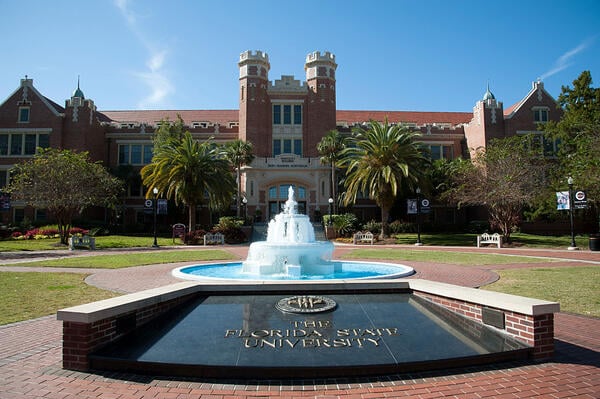
Two Killed and Seven, Including Suspect, Injured in FSU Shooting
One suspect has been taken into custody after a shooting that left two victims dead and six injured at Florida State University’s student union on Thursday, law enforcement officials said in a press briefing.
The suspect, who was identified as Phoenix Ikner, a 20-year-old FSU student and the son of a school resource deputy with the Leon County Sheriff’s Department, has also been hospitalized. He was shot by police after he “did not comply with commands,” according to Tallahassee Police Department chief Lawrence E. Revell.
The two deceased victims were not students, Revell said, but he couldn’t share any other information about the victims’ identities.
FSU president Richard McCullough called this a “tragic day for Florida State University” at the briefing.
“We’re working to support the victims, the families and everyone affected,” he said.
FSU students and employees received an emergency notification at 12:02 p.m. to shelter in place due to an active shooter near the campus’s student union. According to Revell, FSU campus police arrived on the scene “almost immediately” after the shooting began just before noon. Other local law enforcement agencies, including the Federal Bureau of Investigation’s Jacksonville field office and its Tallahassee suboffice, were involved in the response to the shooting. The Tallahassee police will lead the investigation.
Over three hours later, police notified the campus that they had “neutralized the threat” but asked the public to continue avoiding the student union and the surrounding area. Students were advised to remain indoors except to walk to their dorms or the designated reunification point.
Revell said the handgun Ikner used was his mother’s former service weapon. The suspect also had a shotgun with him, Revell said, but it was unclear if he had used it. Revell said the police did not yet know of any motive for the shooting and that Ikner had invoked his right not to speak with police.
At the press briefing, McCullough said he had just returned from visiting the victims in the hospital.
“Right now our top priority is safety and well-being for all the people on our campus,” he said.
One FSU junior, McKenzie Heeter, told NBC that the assailant shot at her with what she thought was a rifle as she was exiting the student union with her lunch just before noon, but he missed. He then returned to his car and retrieved a handgun and shot another individual, at which point Heeter began running away from the student union and back to her apartment.
“It was just me and like three other people that noticed at first, but we were walking in the opposite direction away from the union, so we started running. I just told everybody that I could see, stay away from campus,” she told NBC.
Another group of about 40 individuals avoided the shooter by locking themselves in a bowling alley in the student union’s basement, The Tallahassee Democrat reported.
Classes at FSU are canceled through Friday, and athletic events are canceled through the end of the weekend.