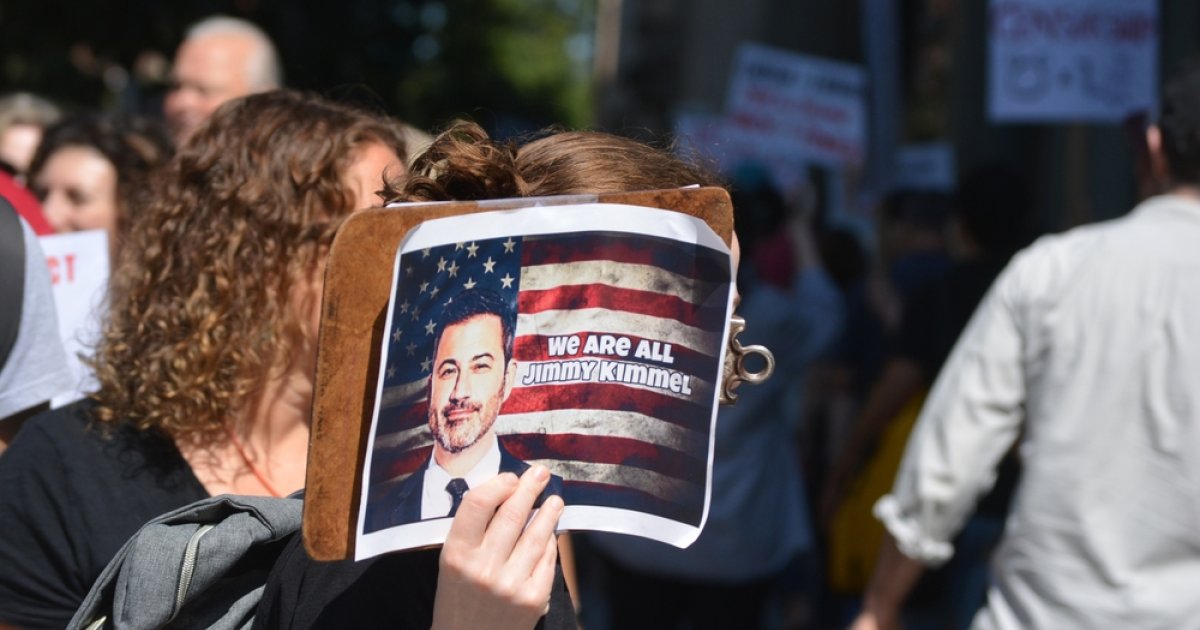
Tag: Kimmel

  • Jimmy Kimmel is back, but don’t get complacent

    Jimmy Kimmel is back, but don’t get complacent

    This essay was originally published by The Dallas Observer on Sept. 26, 2025.


    Last week, ABC suspended Jimmy Kimmel just hours after FCC Chair Brendan Carr directed a thinly veiled threat at the media giant over comments Kimmel made about Charlie Kirk’s assassination.

    “This is a very, very serious issue right now for Disney,” Carr said on Benny Johnson’s The Benny Show. “We can do this the easy way or the hard way. These companies can find ways to take action on Kimmel, or there is going to be additional work for the FCC ahead.”      

    Carr’s message was a clear example of a government pressure tactic known as “jawboning,” and though ABC reversed the suspension days later, returning Kimmel to the air with an emotional yet triumphant monologue on free speech, the damage had been done. Kimmel was off the air for three episodes, and President Donald Trump took the opportunity to encourage even more censorship, saying on Truth Social, “That leaves Jimmy [Fallon] and Seth [Meyers], two total losers, on Fake News [sic] NBC. Their ratings are also horrible. Do it NBC!!!”

    Why our critics’ whataboutery over Jimmy Kimmel is wrong

    Jimmy Kimmel wasn’t canceled by a mob — he was silenced after FCC pressure. Critics say we’re inconsistent, but we’ve opposed jawboning and cancel culture for years. This case is no different.


    Read More

    Consider the events that immediately followed Carr’s comments the same day. Nexstar, an Irving-based company that owns various ABC affiliate stations, suspended Jimmy Kimmel Live! from its programming. Sinclair, another media company that owns ABC affiliate stations, followed suit. Then Disney, which owns ABC, announced Kimmel’s indefinite suspension, thus shutting production down entirely.

    The justified backlash against Disney/ABC was swift, prompting them to switch sides. On Monday, the media giant announced that the show would return to the air. The show’s “welcome back” monologue amassed a record of over 14 million YouTube hits in 16 hours. CNN data analyst Harry Enten reported that a typical monologue on the show rakes in roughly 240,000 YouTube views. That’s over 5,000% growth, courtesy of the Streisand effect.

    Still, we must not let celebration temper our vigilance. As FIRE Chief Counsel Robert Corn-Revere said recently in a Washington Post op-ed, “The law denies the [FCC] ‘the power of censorship’ as well as the ability to impose any ‘regulation or condition’ that interferes with freedom of speech.”

    That Trump’s administration chilled protected speech notwithstanding the law is distressing. Jawboning is unconstitutional, as the Supreme Court unanimously held last year in NRA v. Vullo. In that case, the state of New York pressured financial institutions and insurance companies to sever ties with the gun rights organization in the aftermath of the Parkland shooting. Justice Sonia Sotomayor wrote in the opinion, “Government officials cannot attempt to coerce private parties in order to punish or suppress views that the government disfavors.”

    Yet that is exactly what happened here. We just witnessed the FCC attempt to coerce Disney to suppress Kimmel’s speech, just as New York attempted to coerce financial institutions to suppress the NRA’s advocacy.

    Carr’s influence wasn’t the only factor. Outrage over Kimmel’s remarks was already building. A New York Times analysis of “thousands” of posts and media mentions found that criticism started “as a whisper, then eventually as a shout.” Breitbart covered it, Newsbusters’ Alex Christy wrote an X post that drew 15 million views, Fox’s The Five picked it up, The Blaze host Auron MacIntyre called for Kimmel’s firing, another viral post demanded his “career completely destroyed,” and Elon Musk weighed in: “Jimmy Kimmel is disgusting.” But it was Carr’s podcast threat that pushed the outrage into overdrive. As the Times noted, the anger “became apoplectic” after his remarks. His intervention should have carried no weight, yet instead it was a force multiplier.

    Another cause for concern in this otherwise triumphant moment is that Trump made it abundantly clear his sights are still on Kimmel, according to a Truth Social post on Tuesday night.

    Trump continued, “He is yet another arm of the DNC and, to the best of my knowledge, that would be a major Illegal Campaign. I think we’re going to test ABC out on this. Let’s see how we do. Last time I went after them, they gave me $16 Million Dollars. This one sounds even more lucrative. A true bunch of losers!”

    The First Amendment abuses do not stop there. On Sept. 15, Trump filed a shakedown lawsuit against The New York Times for $15 billion in response to unfavorable coverage. That same day, Attorney General Pam Bondi threatened to target Americans for “hate speech” — she then walked her comments back after conservative outrage.

    Moments like these are why our country needs an unflinching devotion to the First Amendment. They serve as a good reminder that, eventually, the shoe always ends up on the other foot. As Sen. Ted Cruz put it, “It might feel good right now to threaten Jimmy Kimmel, but when it is used to silence every conservative in America, we will regret it.”

    That is no apocalyptic bluster. Under both Republican and Democratic leadership, FIRE has stood firm against First Amendment abuses regardless of which wing or team color it comes from. The tendency for power to target disfavored views or ideas transcends party lines and can only be contained with a consistent, principled application of the First Amendment. As FIRE President Greg Lukianoff wrote recently in a New York Times op-ed, “The weapon that you reach for today will be used against you tomorrow.”

    Kimmel’s return is worth cheering, but unless we resist each attempt at government-driven censorship, the next suspension may not be so brief.
    Source link

  • Why our critics’ whataboutery over Jimmy Kimmel is wrong

    Why our critics’ whataboutery over Jimmy Kimmel is wrong

    Jimmy Kimmel just got suspended for having an opinion. 

    Specifically, ABC pulled Jimmy Kimmel Live! off the air following backlash from the head of the Federal Communications Commission over remarks Kimmel made last week about the murder of Charlie Kirk. We have been vocal in our opposition to this, and as a result, we’ve received some criticism online. So let’s take a minute to consider some of the most common remarks and address those concerns.

    We said an extraordinary amount of things. Let’s start with filing amicus briefs in two Supreme Court cases about government pressure on private companies last term, NRA v. Vullo and Murthy v. Missouri

    Vullo was about the superintendent of New York’s Department of Financial Services pressuring insurance companies and banks to stop providing services to the National Rifle Association. The Department didn’t quite order the companies not to work with the NRA. Instead, it met with the groups, pointed out regulatory violations that didn’t have anything to do with the NRA, and suggested the state might be less interested in pursuing those regulations if the companies “ceased providing insurance to gun groups, especially the NRA.” 

    As our brief explains: 

    The First Amendment does not permit the government to censor speech via informal or indirect means. When government officials “invok[e] legal sanctions and other means of coercion, persuasion, and intimidation” to chill disfavored speech, they impose “a scheme of state censorship” just as unlawful as direct regulation.

    The Supreme Court unanimously agreed. 

    In Murthy, the states of Missouri and Louisiana and a handful of individual social media users sued various federal agencies and officials, arguing that content moderation private companies conducted during COVID-19 and the 2020 election was driven by “jawboning” — that is informal, coercive government pressure — from the Biden administration. Our brief argued that such informal pressure violates the First Amendment.

    We wrote

    Although much attention has focused on the power of “Big Tech,” it is a bad idea for government officials to huddle in back rooms with corporate honchos to decide which social media posts are “truthful” or “good” while insisting, Wizard of Oz-style, “pay no attention to that man behind the curtain.” No matter how concerning it may be when private decisionmakers employ opaque or unwise moderation policies, allowing government actors to surreptitiously exercise control is far worse.

    There’s simply no daylight between our positions in these cases and our position in the current FCC controversy.

    In terms of advocacy, we stood up for a professor accused of bias after writing that if you question the lab origin of COVID-19, you should “at least consider that you are an idiot who is swallowing a whole lot of Chinese cock swaddle.” We argued against a University of Iowa policy limiting what faculty could say about masks and the virus. We criticized NYU for telling medical faculty not to talk to the press. We stood up for RAs whose university told them they couldn’t talk about it in Virginia, and RAs told they couldn’t criticize their university’s response in Maryland

    In research, last year we wrote the Fire Report on Social Media 2024, where we expanded on the problem of jawboning, and specifically how it occurred during the Biden administration. We noted, based on a survey from FIRE and IPSOS, that:

    The American public is concerned about this issue. Our polling found that 77% of Americans believe it is important for social media companies to “[be] fully transparent about any government involvement in content moderation decisions,” including 79% of Democrats, 75% of Republicans, and 81% of independents.

    So, yes. We have been loud, clear, and consistent on this issue for quite some time.

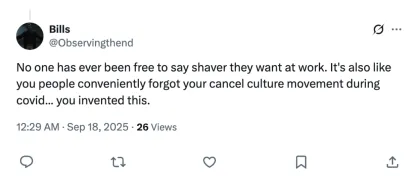
    X post 2

    In fact, we opposed cancel culture then and we oppose cancel culture now. And respectfully, with affection to our fellow co-workers, we’re not what you’d generally consider “key cultural tastemakers.”

    X post 3

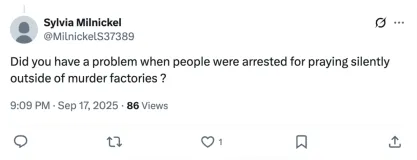
    Actually, we have taken a public stand on people’s right to protest on either side of the abortion debate. Until 2022, we were focused on college campuses, so abortion clinics generally weren’t in the mission, but we did stand up for pro-life students and their right to express themselves. Just as we stood up for pro-choice students. And pro-marijuana students. And pro-Nicki Minaj students. (There are no anti-Nicki Minaj students. That’s a scientific fact. But if there were, we’d stand up for them.)

    But since we have expanded to cover freedom of expression on campus and off, Sarah McLaughlin, senior scholar of global expression at FIRE, has drawn attention to cases exactly like the one you cite.

    X post 4

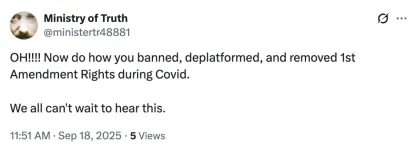
    Not only did we not ban or deplatform any rights during Covid, we vehemently oppose speech bans and deplatforming. In fact, we keep a Campus Deplatforming Database to help monitor and curb such practices. And we have spoken out against government efforts to police disinformation as well as misinformation.

    X post 5

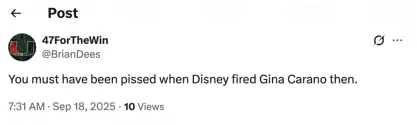
    Yes, but we were a campus-only organization at the time, and by the time we expanded in 2022, she had already sued. (Some of us were pissed personally that they ruined The Mandalorian to do it, if that helps.) Also, there’s a difference between a company caving to a cancel-culture campaign like the one that targeted Carano, and a company making a similar decision under threats from the government. Yes, both are bad for free-speech culture. But one is prohibited by the Constitution.

    Source link

  • FIRE statement on FCC threat to revoke ABC broadcast license over Jimmy Kimmel remarks about Charlie Kirk

    FIRE statement on FCC threat to revoke ABC broadcast license over Jimmy Kimmel remarks about Charlie Kirk

    FCC Chairman Brendan Carr is once again abusing his position to try to assert government control over public discourse, spuriously invoking the “public interest” standard to selectively target speech the government dislikes.

    President Trump has recently called for the FCC to revoke ABC’s broadcast license because he does not like the way the network — and Jimmy Kimmel in particular — speaks about him. Just yesterday, Trump suggested to a reporter that Attorney General Pam Bondi’s statement about prosecuting “hate speech” might mean she will “go after” ABC “because you treat me so unfairly. It’s hate.”

    Now, Carr is threatening ABC for comments about Charlie Kirk’s shooter that Kimmel made during his opening monologue on Monday, insinuating that the shooter was part of “the MAGA gang.”

    The FCC has no authority to control what a late night TV host can say, and the First Amendment protects Americans’ right to speculate on current events even if those speculations later turn out to be incorrect. Subjecting broadcasters to regulatory liability when anyone on their network gets something wrong would turn the FCC into an arbiter of truth and cast an intolerable chill over the airwaves.

    Source link